
AstraZeneca Covid-19 Vaccine Reaction after a Second Dose Administration: A Case Study in Eldoret, Kenya
The Covid-19 pandemic has in recent history been one of the most serious health problems faced by mankind this century. Digital handwashing is one of the latest ways utilized to reduce disease transmission in addition to regular handwashing as prescribed. Attempts to control and manage the pandemic have involved use of various types of vaccines as recommended by WHO [1]. Equitable access to safe and effective vaccines is critical to ending the COVID 19 pandemic. The Oxford University AstraZeneca is one of the many vaccines that have been recommended by WHO for such use. Different reactions to COVID 19 vaccine have been reported in literature and those linked to AstraZeneca vaccine have also been documented. Oxford-AstraZeneca (AZD1222) was developed in the United Kingdom by the British-Swedish multinational pharmaceutical company AstraZeneca Inc in collaboration with the University of Oxford. There are, however, two versions of this vaccine that are being produced by AstraZeneca-SKBio (Republic of South Korea) and the Serum Institute of India. Both versions have been approved by the WHO for emergency use. This vaccine is taken in 2 doses and can be stored at between 2 to 8 degrees Celsius. It has about 63 percent efficacy. According to the World Health Organization, this vaccine may not be suitable for persons who have a history of severe allergic reactions. The WHO recommends a 0.5ml per dose that should be in intervals of between 8 to 12 weeks. Here we give a case report of such a reaction from an individual that had received the recommended two doses of AstraZeneca vaccine.
Background
The Covid-19 pandemic has in recent history been one of the most serious health problems faced by mankind this century. Digital handwashing is one of the latest ways utilized to reduce disease transmission in addition to regular handwashing as prescribed. Attempts to control and manage the pandemic have involved use of various types of vaccines as recommended by WHO [1]. Equitable access to safe and effective vaccines is critical to ending the COVID 19 pandemic. The Oxford University AstraZeneca is one of the many vaccines that have been recommended by WHO for such use. Different reactions to COVID 19 vaccine have been reported in literature and those linked to AstraZeneca vaccine have also been documented. Oxford-AstraZeneca (AZD1222) was developed in the United Kingdom by the British-Swedish multinational pharmaceutical company AstraZeneca Inc in collaboration with the University of Oxford. There are, however, two versions of this vaccine that are being produced by AstraZeneca-SKBio (Republic of South Korea) and the Serum Institute of India. Both versions have been approved by the WHO for emergency use. This vaccine is taken in 2 doses and can be stored at between 2 to 8 degrees Celsius. It has about 63 percent efficacy. According to the World Health Organization, this vaccine may not be suitable for persons who have a history of severe allergic reactions. The WHO recommends a 0.5ml per dose that should be in intervals of between 8 to 12 weeks. Here we give a case report of such a reaction from an individual that had received the recommended two doses of AstraZeneca vaccine.
Materials and Methods
The study site was Eldoret in Rift Valley, Western part of Kenya. The case was a male sixty-four years of age and healthy with no reported case of any comorbid conditions.
The first dose of the AstraZeneca vaccine was given in March, 2021 and the second dose of the same vaccine in October of the same year. The first vaccination was carried out at the Moi Teaching and referral Hospital in Eldoret while the second vaccination was carried out at Eldoret Hospital that is private as directed by the ministry of Health, Kenya [2].
Results
No reaction was observed during the first dose except of slight tenderness at the site of the injection. A rash developed two weeks after administration of the second dose as shown in Figures 1 and 2. No medical attention was sought but the subject bought over the counter Topical cream- Funbact-A. The cream composed of Clotrimazole, Betamethasone and Neomycin sulfate which was applied according to instructions from the pharmacist.
The rash did not resolve immediately but with time it gradually resolved and the skin started appearing normal again.
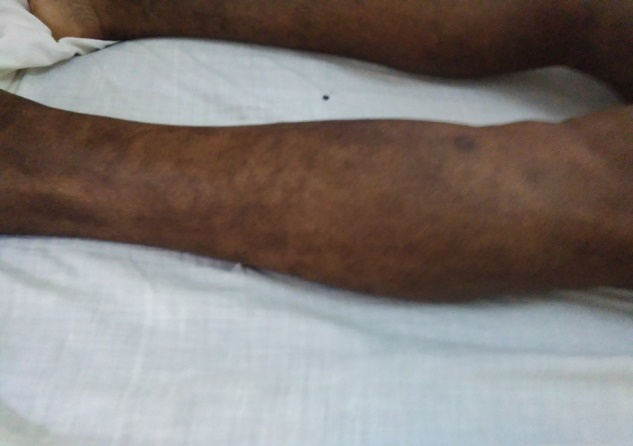
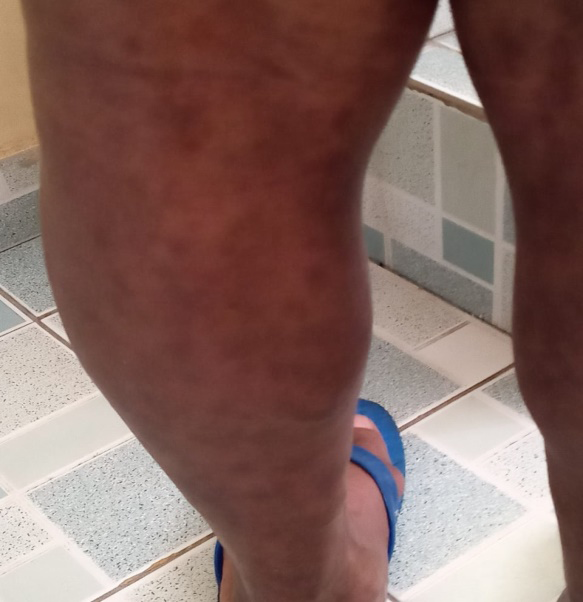
Both Figures 1 & 2 show the dermatological reactions three months after administration of the second dose of the vaccine. Two months prior to taking the pictures the subject showed severe dermatological changes that weaned with time. The rashes were observed on both the legs and hands only at the middle sections. They were not pruritic.
Discussion
Current statistics on uptake of COVID 19 vaccines in Kenya stand at approximately 17 million people. Of these, half were fully vaccinated. All the types of Covid-19 vaccines have been used including Moderna, Pfizer, Johnson & Johnson, AstraZeneca as well as Sputnik. Although no documented information on various types of reactions has been reported, the work here is an example of a reaction experienced by a vaccinated individual [1, 2]. There have also been studies on COVID-19 vaccine knowledge and acceptability among healthcare workers in African countries. According to WHO this vaccine may not be suitable for persons who have a history of severe allergic reactions [3, 4]. So, the allergic reactions observed in this particular case could have been expected [5, 6]. The extent and duration is what could not have been expected. According to WHO it is safe and effective to mix and match different Covid-19 vaccines [7].
Conclusion
Despite reactions to vaccines administered, the overall benefits of vaccinating the population outweigh the minor setbacks experienced by different individuals. As a precautionary measure subsequent booster vaccination could be carried out using a different type of vaccine from the original one to avoid such allergic reactions. Herd immunity in the population can only be achieved by vaccinating a larger percentage of the population. That is the only viable way of controlling or managing the COVID 19 pandemic that shocked the whole world between 2019 to 2022.
References
-
World Health Organization (2019-2022).
-
Ministry of Health (MOH) Kenya (2021).
-
Ekwebere OC, Obidile VC, Azubuike PC, Nnamani CP, Dankano NE, et al. (2021) COVID-19 Vaccine knowledge and acceptability among healthcare providers in Nigeria. International Journal of TROPICAL DISEASE & health 42(5): 51-60.
-
Dayton NG, Dirjayanto VJ, Fakhri A, Prayogo SA (2022) Effectiveness of Digital handwashing intervention as a breakthrough to control COVID-19 and transmissible disease outbreaks: a meta-analysis of clinical trials. JAMSA.
-
World Health Organization (2022) Vaccine advice.
-
Kwena AVM (2020) Corona Virus (COVID-19): Handwashing as a protective Public Health control measure. AJFAND 20(4): 1-4.
-
World Health Organization (2022) Vaccine Safety.
- hMPV: Is It Another Covid-19 Like Situation?
- Streptomyces: Sources of Novel Discoveries in Antibiotic Research to Combat Antimicrobial Resistance
- A Review of Mosquitoes (Diptera: Culicidae) and Their Biodiversity, Medical and Veterinary Importance
- Past and Current Immunotherapy in Cancer
- Hematological Cancer and Viral Infection
- The Growing Threat of Antimicrobial Resistance in India: Challenges and Solutions