
Severity and Situation of Asbestosis in the Era of COVID-19 Pandemic: A Systematic Review and Meta-Analysis
A comprehensive search was carried out in mainstream bibliographic databases or Medical Subject Headings, including ScienDirect, PubMed, Scopus, and ISI Web of Science. The search was applied to the articles that were published between 2003 and early 2024. With strict literature search and screening processes, it yielded 3 articles from 64 articles of initial literature database. Asbestos, a heterogenous group of hydrated magnesium silicate minerals with a tendency of fiber separation. Asbestos-associated pleural fibrosis (pleural plaque or diffuse plural fibrosis), pleural thickening, or asbestosis are the majority of nonmalignant-asbestos-associated-disease conditions. Nevertheless, there is close association between of the nonmalignant-disease presence and the malignancy risk, particularly, lung cancer (complicated with pleural or peritoneal mesothelioma and cigarette smoking). One of search study clearly demonstrated rising trend of mortality in people aged 80 years and older among the three search studies, whereas COVID-19 pneumonia patients requiring respiratory support were higher among patients with history of asbestos exposure or asbestosis, compared to unexposed-asbestos patients (p = 0.015). In conclusion, The detection of an independent relation in small sample of subjects may be precluded by confounding covariables, such as smokers, having more comorbidity, more frequently male, and older age. In occupational asbestos exposure, respiratory support was required higher, compared to unexposed-asbestos patients. Proactive and cooperative participation can protect people with asbestos exposure from COVID-19 comorbidity.
Objectives of the Study
The objectives of this study are to identify the better understanding on the situation and severity of asbestosis and asbestos exposure in the era of COVID-19 pandemic.
Introduction
Asbestos, a heterogenous group of hydrated magnesium silicate minerals with a tendency of fiber separation [1]. Asbestos-associated pleural fibrosis (pleural plaque or diffuse plural fibrosis), pleural thickening, or asbestosis are the majority of nonmalignant-asbestos-associated-disease conditions [1]. Nevertheless, there is close association between of the nonmalignant-disease presence and the malignancy risk, particularly, lung cancer (complicated with pleural or peritoneal mesothelioma and cigarette smoking) [1]. Without obvious clinical signs of nonmalignant asbestos- associated diseases, increased personal cancer risk with prolonged asbestos exposure can be occurred, implying a lifelong increased asbestos-associated-cancer risk [1]. From the general diagnostic-asbestosis criteria established in 1986, they were slightly modified as the following: 1) evidence of structural pathology consistent with asbestos-associated disease as evidenced by histology or imaging; 2 evidence of causation by asbestos as documented by the environmental and occupational history, exposure markers (majority of pleural plaques), and recovery of asbestos bodies, or other means; and 3) exclusion of alternative plausible causes for the findings [1]. It was noticed that during COVID-19 pandemic, chronic-lung-disease patients with comorbidities had tendency to have more severe COVID-19 and more complications [2]. Interstitial lung diseases (ILDs) can result from drug, environmental, or occupational exposures and can be manifested in an underlying systemic diseases, especially, idiopathic pulmonary fibrosis (IPF) is related to viral infections and thoracic surgical procedures with acute exacerbation and high mortality rates of 35 %-70 % [2, 3]. Approximately, 1.4 % of global prevalence of ILDs among global COVID-19 patients was seen [4]. ILD patients with non-survival COVID-19 had high mortality rates (two times), compared with non-ILDs [4]. In idiopathic pulmonary fibrosis (IPF), the fibroblastic foci are characterized, but are infrequent in asbestosis [5]. Whereas mild fibrosis of the visceral pleura is commonly accompanied in asbestosis, this feature is rare in IPF [5]. Very little inflammation is identified in interstitial fibrosis of asbestosis whereas it is better found in IPF [5].
Methods of the Study
Search Strategy and Inclusion Criteria
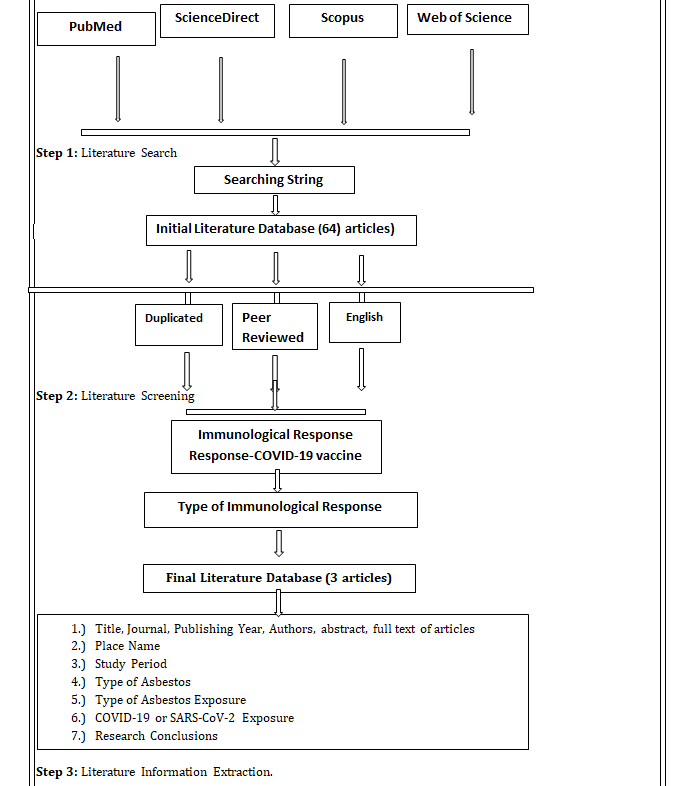
A comprehensive search was carried out in mainstream bibliographic databases or Medical Subject Headings, including ScienDirect, PubMed, Scopus, and ISI Web of Science. The search was applied to the articles that were published between 2003 and early 2024. Our first involved performing searches of article abstract/keywords/title using strings of [(“ Asbestos ” or “ Asbestosis ”, “ SARS-CoV-2 ” or “ COVID-19 ” and “ Severity ” or “ Exposure ”, “ Plaque ” or “ Pleural Thickening ” or “ Pleural Calcification ”, “ Peritoneal Plaque ” or “ Peritoneal Calcification ”, “ Calcified Peritoneum ”)]. After a first approach of search, published articles focusing on asbestos-associated diseases or asbestosis were retained and the information on situation and severity and COVID-19 or SARS-CoV-2 comorbidity and severity was extracted for having a crude knowledge involving their themes. Another round of publication search was conducted for adding the missing published articles that were not identified by the first round.
All keywords combinations from one asbestos-associated disease type and COVID-19 or SARS-CoV-2 variables to bind the population of cases under consideration. Search string for asbestos-associated diseases included [ “ Pleural Plaque” or “ Pleural Thickening ” or “ Pleural Calcification ” or “ Peritoneal Plaque ” or “ Peritoneal Calcification ” or “ Lung Cancer ” or “ Nonmalignant asbestos-associated disease ” or “ Interstitial-Lung-Disease-Associated Asbestos Exposure ” or “ Occupational Asbestos Exposure ” or “ Environmental Asbestos Exposure ” ]. The initial literature databases were further manually screened with the following rules : 1) non- asbestos-exposure-associated-disease-related articles were excluded; 2) articles that did not report a result of asbestos- associated diseases or conditions related to COVID-19 exposure or comorbidity were not considered, such as commentary articles, or editorial; 3) non-peer reviewed articles were not considered to be of a scholarly trustworthy validity; and 4) duplicated and non-English articles were removed. The articles were carefully selected to guarantee the literature quality, which is a trade-off for quantity.
With strict literature search and screening processes, it yielded 3 articles from 64 articles of initial literature database. Needed article information was extracted from each article by : 1) direct information including journal, title, authors, abstract, full text documents of candidate studies, publishing year; 2) place name of the study area; 3) study period; 4) research method used; 5) types of asbestos variables studied; 6) types of asbestos exposure studied; 7) COVID-19 or SARS- CoV-2 comorbidity and situation; and 7) the conclusions made about the impacts of asbestos-associated diseases or conditions related to COVID-19 or SARS-CoV-2 comorbidity and situation. An overview of the information required for the present analysis that was captured by those themes was demonstrated in the Figure 1.
Results
| for header rows | for data cells | for results | for references | |
|---|---|---|---|---|
| 2024 | Fazzo, et al. | Retrospective Cohort of all death certificates in Italy involving malignant pleural mesotheliomas (MPMs) or asbestosis in 2010-2020 and those involving COVID-19 in 2020. | In 2020, 1,348 involved MPM and 286 involved asbestosis among 746,343 people deaths. Mortality involving the two diseases reduced in people with age below 80 years, whereas, a rising trend was noted in persons aged 80 years and older, with a relative mortality risks of 1.1.7 for asbestosis and 1.1.0 for MPM. | [6] |
| 2022 | Granados, et al. | Clinical Prospective Cohort | Total patients of 293 (mean age 54 + 13 years) with COVID-19 pneumonia and occupational asbestos exposure were included. During hospitalization, the 6-minute walk test, CO diffusion test, spirometry, and high resolution chest computed tomography (CT) were performed and occupational asbestos-exposure questionnaire was also done after hospital discharge. Higher frequency of COVID-19 pneumonia requiring respiratory support (n = 52, 77.6 %) was identified patients with occupational-asbestos exposure than unexposed asbestos persons (n = 139, 61.5 %) (p = 0.015). The 6-minute walk test, CO diffusion test, spirometry, and high resolution chest computed tomography (CT) were not different including the follow-up variables. Independent relation could not be confirmed between asbestos exposure and COVID-19 severity. | [7] |
| 2021 | McNew, et al. | Prospective Original Cohort Investigation | Center for Asbestos-Related Disease (CARD) has COVID-19 testing more than 2,300 people with 44 positive test results. 8 % (1,616 residents) of Lincoln county, USA were diagnosed of COVID-19 that was below the 10 % of confirmed cases in the U.S. population. With proactive and cooperative participation, 92 % of Lincoln county population of residents with asbestos exposure and chronic pulmonary diseases had been managed to avoid COVID-19 infection or comorbidity. | [8] |
Table 1: Demonstrating the asbestos-associated diseases or conditions impacted by COVID-19 or SARS-CoV-2 comorbidity (2021-to ear
Discussion
One of the three search studies clearly demonstrated rising trend of mortality in people aged 80 years and older, whereas COVID-19 pneumonia patients requiring respiratory support were higher among patients with history of asbestos exposure or asbestosis, compared to unexposed-asbestos presented more intense dyspnea, compared to unexposed patients [7]. In the univariate analysis, asbestos exposure was related to severe COVID-19 [7]. Nevertheless, in the logistic multivariate regression analysis, this hypothesis could not be confirmed [7]. In asbestos-exposed patients, other more frequent variables were cigarette smoking, male predominance, older age, respiratory and cardiological pathologies, and history of diabetes [7]. Currently, the study of association between exogenous-agent-inhalation exposure and the COVID-19 severity has been concentrated on environmental contamination [9]. An original- investigational-research project recently conducted by the US Center for Asbestos-Related Disease (CARD), demonstrated that approximately, 92% of the US Lincoln county population with asbestos exposure and chronic pulmonary diseases had been protected from COVID-19 infection or comorbidity by proactive and cooperative participation of their residents with unknown asbestosis situation and severity in the period of COVID-19 pandemic [8].
Conclusion
The detection of an independent relation in small sample of subjects may be precluded by confounding covariables, such as smokers, having more comorbidity, more frequently male, and older age. In occupational asbestos exposure, respiratory support was required higher, compared to unexposed-asbestos patients. Proactive and cooperative participation can protect people with asbestos exposure from COVID-19 comorbidity.
Authors ‘ Contributions
Dr. Attapon Cheepsattayakorn conducted the study framework and wrote the manuscript. Associate Professor Dr. Ruangrong Cheepsattayakorn and Professor Dr. Porntep Siriwanarangsun contributed to scientific content and assistance in manuscript writing. All authors read and approved the final version of the manuscript.
References
-
American Thoracic Society (2004) Diagnosis and initial management of nonmalignant diseases related to asbestos. Am J Respir Crit Care Med 170(6): 691-715.
-
Azadeh N, Limper AH, Carmona EM, Ryu JH (2017) The role of infection in interstitial lung diseases: a review. Chest 152(4): 842-852.
-
Drake TM, Docherty AB, Harrison EM, Quint JK, Adamali H, et al. (2020) Outcome of hospitalization for COVID-19 in patients with interstitial lung disease: an international multicenter study. Am J Respir Crit Care Med 202(12): 1656-1665.
-
Ouyang L, Gong J, Yu M (2021) Pre-existing interstitial lung disease in patients with coronavirus disease 219: a meta-analysis. Int Immunopharmacol 100: 108145.
-
Roggli VL, Gibbs AR, Attanoos R, Churg A, Popper H, et al. (2010) Pathology of asbestosis-an update of the diagnostic criteria : Report of the asbestosis committee of the college of american pathologists and pulmonary pathology society. Arch Pathol Lab Med 134(3): 462-480.
-
Fazzo L, Grande E, Zona A, Minelli G, Crialesi R, et al. (2024) Mortality rates from asbestos-related diseases in Italy during the first year of the COVID-19 pandemic. Frontiers Public Health 11: 1243261.
-
Granados G, Saez-Lopez M, Aljama C, Sampol J, Cruz M-J, et al. (2022) Asbestos exposure and severity of COVID-19. International Journal of Environmental Research Public Health 19(23): 16305.
-
McNew T, Morrissette KL, Black B (2021) Controlling COVID-19 in an asbestos-exposed population. Chest 160(4): A1927.
-
Wu X, Nethery RC, Sabath MB, Braun D, Dominici F (2020) Air pollution and COVID-19 mortality in the United States: strengths and limitations of an ecological regression analysis. Sci Adv 6(45): eabd4049.
- hMPV: Is It Another Covid-19 Like Situation?
- Streptomyces: Sources of Novel Discoveries in Antibiotic Research to Combat Antimicrobial Resistance
- A Review of Mosquitoes (Diptera: Culicidae) and Their Biodiversity, Medical and Veterinary Importance
- Past and Current Immunotherapy in Cancer
- Hematological Cancer and Viral Infection
- The Growing Threat of Antimicrobial Resistance in India: Challenges and Solutions