
Knowledge, Practice and Acceptability of Cervical Cancer Screening among Midwives in the Gambia
Cervical cancer is one of the commonest malignancy among women in the world with an estimated 527,624 new cases and 265,653 deaths in 2012.The burden of cervical cancer in developing countries is huge with an incidence rate that exceeds the average worldwide rates of 15.3 per 100,000 women per year. Furthermore, countries like Gambia, Mali, Uganda and Zimbabwe have age incidence rate of 32.5, 37.7, 47.5 and 47.4 per 100,000 women per year respectively. The aim of the study was to assess the Knowledge, Practise and Acceptability of Cervical Cancer Screening among Midwives in public health facilities in the Gambia. A cross-sectional study design was used and a sample size of 91 female midwives was selected from 14 public health facilities using multistage sampling method. A questionnaire consisting of structured and semi-structured questions was used. The questionnaire was pilot tested among 24 midwifery students for validity and had a Cronbach score of 0.76 after deleting six questions. Data was analyzed using SPSS version 20, descriptive and inferential statistics like hypothesis tested was performed. The results shows that 35.2% (n=32) had poor knowledge on cervical cancer, while 27.5% (n=25) had fair knowledge and 37.4% (n=34) had good knowledge on cervical cancer. There is no statistically significant association between length of service and knowledge on cervical cancer (P= 0.397). However, there is a statistically significant association between cadre and knowledge on cervical cancer screening as chi square test shows P= 0.006. There is knowledge deficit on cervical cancer among female midwives working in public health facilities in the Gambia. Very few midwives have been trained on visual inspection using acetic acid.
Introduction
Cervical cancer can be defined as a distinct change in the epithelial cells of the transformation zone of the cervix; the cells begin developing in an abnormal fashion in the presence of persistent or long term HPV infection [1]. Cervical cancer is one of the leading malignancy among women in the world with an estimated 527,624 new cases and 265,653 deaths in 2012 [2]. Cervical cancer a largely preventable disease, is one of the most common cancers found in women living in low- and middle-income countries (LMICs) [2]. With the use of cytology–based Papanicolaou smears screening; there has been significant reduction in countries that are able to maintain it. However, cytology-based screening for cervical cancer is not yet successful in reducing cervical cancer burden in developing countries because it is expensive and require a robust and well-funded health care system [2]. This is lacking in many developing countries like Nigeria and The Gambia going by the 2001 Abuja Declaration recommendation, less than 15% of the national budget is spent on health [2].
The burden of cervical cancer in developing countries is huge with an incidence rate that exceeds the average worldwide rates of 15.3 per 100,000 women per year3. Furthermore, countries like Gambia, Mali, Uganda and Zimbabwe have age incidence rate of 32.5, 37.7, 47.5 and 47.4 per 100,000 women per year respectively [3]. Persistent infection with oncogenic subtypes of the human papillomavirus (HPV) results in carcinogenesis, mostly occurring at the cervical transformation zone where the endocervical columnar cells undergo metaplasia to a stratified squamous epithelium. The precursor state of cervical neoplasia may last for years allowing for ready detection through successful screening programs in developed countries using cervical cytology and/or high-risk HPV DNA testing [4]. Well organized and quality assured cytology-based screening programmes have substantially reduced cervical cancer burden in many developed countries. However, there are considerable obstacles to setting up cervical cancer screening programs in developing countries [5]. Countries like Gambia facing enormous health challenges should use alternative way for cervical cancer screening that is cost effective and sustainable so as to increase access to valuable women. Simple screening methods such as visual inspection with Acetic Acid and Pap smear can be integrated into existing reproductive health services thereby increasing access to these important live saving services. Empowerment of women, (education), early screening and treatment of precancers are the most important public health strategy in the prevention and control of cervical cancer in the developing world [6].
Justification
It is estimated that The Gambia has a population of 549,836 women within the ages of 15 years and older who are at risk of developing cervical cancer. Furthermore, estimates indicates that every year about 98 women are diagnosed with cervical cancer and 57 die from the disease [7]. Though data on HPV prevalence in the general population of the Gambia is not available, data in West Africa indicates that about 4.3% of the general population harbour HPV type 16 and18 which are largely attributed to cervical cancer [7].
In a study conducted by Bah, et al. [8] which reviewed the Gambia Cancer Registry from 1999-2009 revealed that cervical cancer was the highest cancer incidence among females forming about 33% of all female cancers. In a similar study conducted by Sighoko [9], finding showed that cervical cancer was the most frequent cancer among women, representing 29% of the all registered female cancers in 1998 -2006 with an Age Specific Rate (ASR) of 15.42 (95% CI) per 100,000 person-years.
Aim and Objectives
Aim: To assess the Knowledge, Practice and Acceptability of Cervical Cancer Screening among Midwives in public health facilities in the Gambia
Objectives
- To assess level of knowledge of midwives on cervical cancer
- To assess the practice of midwives on cervical cancer screening in four major health centers in the Gambia.
- To use findings to develop training guide for training nurses and midwives on cervical cancer screening using visual inspection with acetic acid. Null hypothesis: There is no statistically significant association between length of service and knowledge on cervical cancer screening except by chance alone Alternate hypothesis: There is a statistically significant association between length of service and knowledge on cervical cancer screening except by chance alone Null hypothesis: There is no statistically significant association between cadre and knowledge on cervical cancer screening except by chance alone Alternate hypothesis: There is a statistically significant association between cadre and knowledge on cervical cancer screening except by chance alone
Literature Review
A study conducted by Olumideet, et al. [3] found that awareness, knowledge and uptake on cervical cancer screening among rural women in Nigeria were very low. Lack of access to screening for cervical cancer is the most important risk factor among women of reproductive age [3]. Early detection of the disease can lead to better prognosis resulting to a decreased in mortality and health care cost [3]. In a study conducted in Gabon by Assoumou, et al. [10] on awareness and knowledge of women on cervical cancer, found that out of 452 women 91.6%
(n=414) heard of cervical cancer. The study further revealed that only 27.9% (n=126) had heard of Pap smear test and 65.1% (n=82) of those who heard of Pap smear test had one done for them and greater number of these tests were initiated by doctors [10].
In another study conducted by Tchounga, et al. [11] on knowledge, attitude and Practises of midwives in Cote d’Ivoire, revealed that out of 592 midwives, 55.7% had appropriate knowledge on cervical cancer. Only 18.4% had a cervical cancer screening test and only 8.4% were able to perform visual inspection screening for cervical cancer. Belete, et al. [12], revealed that out of 110 respondents (34.2%) knew about cervical cancer in which majority of respondents got their source from health professionals. Furthermore, the study stated that majority of respondents 88.2% (n=97) believed that the disease is preventable while about one third (34.4%) knew about the availability of the screening test and 62.7% were willing to screen for cervical cancer [12]. The same study identified the following factors as reasons for not taking up a cervical cancer test; high cost of the test, religious denial, partner acceptance, time consuming, fear of test result and lack of female screeners [12].
A study conducted at Nnamdi Azikiwe University Teaching Hospital Nnewi center by Udigwe [13], found out that out of 144 nurses, 87% (n=122) were aware of the existence of Pap smear screening services. The study further revealed that 9.3% of nurses had lost a relative from cervical cancer, yet still only 5.7% of nurses had ever done a Pap smear. It was also stated that 37.1% (n=52) had no reason for not doing a screening test while 15% (n=21) were afraid of the possible outcome and 25% (n=35) felt they were not at risk of the disease [13].
Maseko, et al. [14] stated that 43% of participants in a study on client satisfaction on cervical screening in Malawi knew that cervical cancer is preventable while 71.8% of participants had no knowledge on visual inspection (VIA) screening test and 23.3% of the respondents knew the clinic time. It was further revealed that about 46.2% of study participants covered a distant of between one and five kilometers to a screening center [14].
A study conducted by Keita [15] on the factors influencing the uptake of cervical cancer prevention services among women of reproductive age (15-49) residing in the Greater Banjul area, The Gambia found out that 94% of the respondents have never been screened for the disease. The study further revealed that the main reasons for not been screened were lack of awareness about the screening services (65%) and unawareness of the disease (13%) [15]. Furthermore, it was found that age (p= 0.010), use of intrauterine contraceptive device (p=0.018), use of condom (p=0.050) and first place to seek care when sick (p=0.019) were statistically significant predictors associated with decreased uptake of cervical cancer screening services whereas knowledge on signs and symptoms of cervical cancer (p=0.001) was significantly associated with increase uptake of cervical cancer screening services in the country [15].
In a study conducted by Mensah [16] found out that the awareness of cervical cancer screening was very high among female nurses at the Korle-Bu Teaching Hospital. It also revealed that most of the respondents expressed high knowledge of the signs and symptoms of screening services. Nurse are expected to have high knowledge on cervical cancer because among their roles is to educate women on the disease. In another study conducted by Abd Allah, et al. [17]. Found out that most of the students (84.0%) were not aware of a screening method other than Pap smear test and approximately half of the respondents (49.9%) have no complete information about the HPV vaccine.
In a study conducted by Anantharaman, et al. [18] found out that all the Health Care Providers were aware of Cervical Cancer and 95.3% of HCPs were aware of the cervical cancer screening either Pap smear or visual inspection using acetic acid or Lugol’s iodine. However, 57.9% felt that they were at risk of cervical cancer and only 18.4% of the female them have ever undergone cervical cancer screening [18].
Finally, cervical cancer which is largely a preventable disease with slow progression but still remains a public health challenge in Sub-Saharan Africa. For a meaningful progress to be made women’s awareness on the disease as well as cultural and socioeconomic barriers to accessing screening services should be tackled. Both primary prevention with the use of vaccination and secondary prevention such as regular screening should be made available, accessible and affordable for women and at a cost the country can afford to maintain at every level of the primary health care delivery system.
Methodology
Research Design
A cross-sectional study design was used hence the study was of a short duration and is aimed at describing knowledge, Practise and acceptability of midwives on cervical cancer.
Study Population
The study population consisted of all the female midwives working in the 12 health public health facilities in four health regions in the country.
Sample Size
The sample size comprised of female midwives working in the 14 public health facilities in the four health regions randomly selected out of the seven health regions in the country. The estimated number of female midwives working in these facilities was about 150. The researcher was interested in female midwives only hence they are the ones doing the cervical cancer screenings. The sample size was calculated using the formula n=Z2pq. With d2 This gave a sample size of 94 respondent. However, 91 respondents filled and returned the questionnaires distributed having a 96.8% response rate.
Sampling Technique
A multistage sampling method was used to select the sample for this research. First a simple random sampling method was used to select four regions out of seven health regions in the country. The regions selected were Western health region one whose headquarter is in Kanifing, Western health region two whose headquarter is in Brikama, North Bank West health region whose headquarter is in Essau and Lower River Health Region whose headquarter is in Mansakonko. The second step was to randomly select health facilities in these regions. In Western Health Region one which is the biggest, six health facilities were selected. For Western Health Region two, three health facilities were selected while another three were selected from North Bank West health Region and two from Lower River Health Region. A total of fourteen health facilities were selected in the four health regions.
Inclusion Criteria
Any midwife working in any of the selected public health facilities.
Exclusion Criteria
Midwives working in any of the selected public health facilities but on annual, study leave and/or maternity leave were excluded from the study.
Data Collection Tools
A questionnaire consisting of structured and semi- structured questions was used. The questionnaire were given to study participants to fill and were later collected hence it was very difficult to meet everyone at the same because they work on different shift duties.
Validity and Reliability
A pilot testing of the questionnaires was conducted among 24 midwifery students to validate the questionnaires which had a Cronbach score of 0.76 after deleting six questions that were found negatively affecting the score.
Data Analysis
Data was analyzed using software package like SPSS version 20, descriptive and inferential statistics like hypothesis tested was performed.
Ethical Issues
All the ethical issues that may arise from this research such as anonymity, voluntary participation, informed consent, and confidentiality were adequately addressed. A consent form and information sheet was provided. Ethical approval was obtained from the Director of Medical and Health services of the Ministry of Health and Social Welfare of the Gambia. No medical procedure was performed and the data collection method consisted of administration of questionnaires only.
Results
The results show that the mean age of respondents was 38 years with a standard deviation of 8.6 and a range of 36 (Table 1), while the mean length of service was 14.8 years with a standard deviation of 9.2 and a range of 37years. The average number of children (parity) was 2 with a standard deviation of 1.8 and a range of 7.
| D | Std. | n | |||||||||||||||||
|---|---|---|---|---|---|---|---|---|---|---|---|---|---|---|---|---|---|---|---|
| Variables | N | R | ang | e | M | inimu | m | M | aximu | m | M | ea | n | ||||||
| eviatio | |||||||||||||||||||
| R | Age of | s | |||||||||||||||||
| 9 | 1 | 36 | 23 | 59 | 38.1 | 8.633 | |||||||||||||
| espondent | |||||||||||||||||||
| Length of | |||||||||||||||||||
| 8 | 4 | 37 | 1 | 38 | 1 | 4.8 | 6 | 9.293 | |||||||||||
| Service | |||||||||||||||||||
| R | Parity of | s | |||||||||||||||||
| 8 | 4 | 7 | 0 | 7 | 2.56 | 1.806 | |||||||||||||
| espondent | |||||||||||||||||||
Table 1: Demographic data of respondents (Age, length of service and parity).
Majority of the respondents were Community Health Nurse Midwives 46.2% (n=42), followed by Enrolled
Midwives 30.8% (n=28) (Table 2), while Registered Midwives account for 18.7% (n-17) and the rest fall into other cadres.
| Cadre | Frequency | Percen | t | Cumulative Percent | |||||||
| RM | 17 | 18.7 | 18.7 | ||||||||
| EM | 28 | 30.8 | 49.5 | ||||||||
| CHNM | 42 | 46.2 | 95.6 | ||||||||
| O | ther | s | 4 | 4.4 | 100 | ||||||
| Total | 91 | 100 |
Table 2: Cadre of respondents.
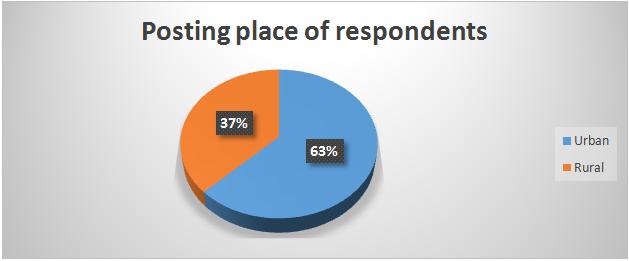
Majority of the respondents 62.6% (n-57) were working in the urban area of the country while the rest works at the rural are of the country. This shows that more midwives are concentrated in the urban area (Figure 1).
Awareness on Cervical Cancer
All the respondents were aware of cervical cancer and 97.8% of them are aware of cervical cancer screening however, only 25.3% of them had training on cervical cancer (Table 3). About 10% of them had a relative who have had a cervical cancer and 29.7% of the respondents had nursed a patient with cervical cancer.
| Variable | Response | Frequency | Percen | t | Cumulative Percent | |||||||||
| Awareness on cervical cancer | Yes | 91 | 100 | 100% | ||||||||||
| No | 0 | 0% | 0% | |||||||||||
| Total | 91 | 100% | ||||||||||||
| Awareness on cervical cancer screening | Yes | 89 | 97.80% | 97.80% | ||||||||||
| No | 2 | 2.20% | 100% | |||||||||||
| Total | 91 | 100% | ||||||||||||
| Training on cervical cancer | Yes | 23 | 25.30% | 25.30% | ||||||||||
| No | 68 | 74.70% | 100% | |||||||||||
| Total | 91 | 100% | ||||||||||||
| Had a relative with cervical cancer | Yes | 9 | 9.90% | 9.90% | ||||||||||
| No | 80 | 87.90% | 97.80% | |||||||||||
| Missing | 2 | 2.20% | 100% | |||||||||||
| Total | 91 | 100 | ||||||||||||
| Ever nursed a patient with Cervical Cancer | Yes | 27 | 29.70% | 29.70% | ||||||||||
| No | 62 | 68.10% | 97.80% | |||||||||||
| Missing | 2 | 2.20% | 100 | |||||||||||
| Total | 91 | 100% |
Table 3: Respondents’ information of cervical cancer.
Knowledge on Cervical Cancer and HPV
Scoring and classification system: Knowledge on cervical cancer: Ten (10) questions which were used to assess participant’s knowledge on cervical cancer were scored for correctness. A correct response was given a score of one while an incorrect response a score of zero. The total score for each participant was converted to percentage and classified as poor knowledge less than 50%, fair knowledge 50% to 59% and good knowledge 60% and above.
The Table 4 shows that 35.2% (n=32) had poor knowledge on cervical cancer, while 27.5% (n=25) had fair knowledge and 37.4% (n=34) had good knowledge on cervical cancer.
| Knowledge Grade | ||||||||||||||
|---|---|---|---|---|---|---|---|---|---|---|---|---|---|---|
| Valid | t | C | umulativ | e | ||||||||||
| F | requenc | y | P | ercen | t | |||||||||
| Percen | Percent | |||||||||||||
| Poor | ||||||||||||||
| 32 | 35.2 | 35.2 | 35.2 | |||||||||||
| knowledge | ||||||||||||||
| Fair | ||||||||||||||
| 25 | 27.5 | 27.5 | 62.6 | |||||||||||
| knowledge | ||||||||||||||
| Good | ||||||||||||||
| 34 | 37.4 | 37.4 | 100 | |||||||||||
| knowledge | ||||||||||||||
| Total | 91 | 100 | 100 |
Table 4: knowledge on cervical cancer and HPV.
Practice and Acceptability of Cervical Cancer Screening
The Table 5 shows that 86.7% (n=80) of the respondents either strongly agree or agree that they are ready to do a cervical cancer screening test while the rest are either undecided or disagree that they are ready to do a test.82 (92.2%) of the respondents either strongly agree or agree that the reason of doing a cervical cancer testis to protect myself from the disease. Majority of respondents 85 (n=93%) are willing to tell my family members to do a cervical cancer test.
Only 57 (n=63.7%) considered them self to be at-risk of contracting Human Papilloma virus while the rest do not.
| Strongly | Strongly | ||||||||||||||||||||||
|---|---|---|---|---|---|---|---|---|---|---|---|---|---|---|---|---|---|---|---|---|---|---|---|
| Disagre | e | Undecided | Agree | ||||||||||||||||||||
| Practice and Acceptability items | N | Mean | disagree | agree | |||||||||||||||||||
| n (%) | n (%) | n (%) | n (%) | n (%) | |||||||||||||||||||
| I am ready to do a cervical cancer test | 90 | 4.24 | 4 (4.4) | 2 (2.2) | 4 (4.4) | 38 (42.2) | 42 (46.7) | ||||||||||||||||
| My reason of doing a cervical cancer testis to protect myself from the disease | 89 | 4.44 | 5 (5.6) | 2 (2.2) | 0 (0.0) | 24 (27.0) | 58 (65.2) | ||||||||||||||||
| I will be willing to tell my family members to do a cervical cancer test | 91 | 4.47 | 4 (4.4) | 0 (0.0) | 2 (2.2) | 28 (30.8) | 57 (62.6) | ||||||||||||||||
| I consider myself at-risk of contracting cervical cancer | 89 | 3.62 | 8 (8.8) | 11 (12.1) | 11 (12.1) | 36 (39.6) | 23 (25.3) | ||||||||||||||||
| I am ready to accept a positive cervical cancer test | 89 | 3.9 | 6 (6.6) | 6 (6.6) | 8 (8.8) | 40 (44.0) | 29 (31.9) | ||||||||||||||||
| I consider myself to be at-risk of Human Papilloma virus(HPV) infection | 90 | 3.47 | 13 (14.3) | 10 (11.0) | 10 (11.0) | 36 (39.6) | 21 (23.1) | ||||||||||||||||
| I am ready to do a HPV test if available | 89 | 4.65 | 4 (4.5) | 2 (2.2) | 0 (0.0) | 48 (53.9) | 35 (39.3) | ||||||||||||||||
| I am willing accept a HPV positive test | 90 | 3.89 | 4 (4.4) | 8 (8.9) | 9 (10.0) | 42 (46.7) | 27 (30.0) | ||||||||||||||||
| I will accept my daughter to receive HPV vaccine | 90 | 4.33 | 3 (3.3) | 4 (4.4) | 1 (1.1) | 34 (37.8) | 48 (53.3) | ||||||||||||||||
| Nurses and midwives should be trained to offer cervical cancer screening at health facility level | 90 | 4.62 | 5 (5.6) | 0 (0.0) | 0 (0.0) | 14 (15.6) | 71 (78.9) | ||||||||||||||||
| Cervical cancer screening should be integrated into Nurses and Midwives training curricula | 91 | 4.59 | 5 (5.5) | 0 (0.0) | 0 (0.0) | 18 (19.8) | 68 (74.7) | ||||||||||||||||
| Cervical cancer screening should be integrated into Reproductive Health Services | 88 | 4.55 | 6 (6.8) | 0 (0.0) | 0 (0.0) | 16 (18.2) | 66 (75.0) |
Table 5: Practice and Acceptability of Cervical Cancer screening among the respondents.
Cervical cancer is one of the most common female malignancy with a slow progression. It has a well understood natural history and well researched on but still remains a major public health problem in Low and
32.5, 37.7, 47.5 and 47.4 per 100,000 women per year respectively [3].
The aim of the study was to assess knowledge Practise and acceptability of cervical cancer screening among midwives in ten public health facilities in the Gambia. A multistage sampling was used to select four out of seven health regions and 14 health facilities were selected from these regions in which 91 female midwives filled and returned the questionnaires. Almost all the respondents were aware of the existence cervical cancer screening as a preventive method, while only a quarter of them were trained on visual inspection with acetic acid as a screening method. The results identified that there is a training gap on cervical cancer screening among female midwives in the Gambia. Hence the Gambia is using visual inspection as a screening method for cervical cancer and it is implemented by female midwives, it is important that training on cervical cancer screening be incorporated into midwifery training curricula so that every midwife who graduate from the nursing training institutions will be trained. This will make the service more available to every woman in the country.
The study further revealed that 35.2% (n=32) had poor knowledge on cervical cancer, while 27.5% (n=25) had fair knowledge and 37.4% (n=34) had good knowledge on cervical cancer. This is in contrast with a finding from a study conducted by Tchounga, et al. [10] on knowledge, attitude and Practises of midwives in Cote d’Ivoire which revealed that out of 592 midwives, 55.7% had appropriate knowledge on cervical cancer while 42.4% had appropriate knowledge on cervical cancer prevention strategies. This shows that there is need for more training of midwives who are the main service providers of visual inspection with acetic acid.
The study shows that 86.7% (n=80) of the respondents either strongly agree or agree that they are ready to do a cervical cancer screening test while the rest are either undecided or disagree that they are ready to do a test. All the respondents were aware of cervical cancer and 97.8% of them are aware of cervical cancer screening however, only 25.3% of them had training on cervical cancer. In contrast only 8.4% were able to perform visual inspection screening for cervical cancer [10]. In another study conducted by Belete, et al. [11] in Addis Ababa, Ethiopia, revealed that out of 110 respondents (34.2%) knew about cervical cancer in which majority of respondents got their source from health professionals. Furthermore, the study stated that about one third (34.4%) of the respondents knew about the availability of the screening test and 62.7% were willing to screen for cervical cancer [11].
In another study conducted at Nnamdi Azikiwe University Teaching Hospital Nnewi center by Udigwe [12], found out that out of 144 nurses, 87% (n=122) were aware of the existence of Pap smear screening services. The study further revealed that 9.3% of nurses had lost a relative from cervical cancer, yet still only 5.7% of nurses had ever done a Pap smear. This shows that even among health workers cervical cancer screening is low therefore more effort should be directed towards increasing awareness and uptake of cervical cancer screening. This is in line with my study findings which revealed that 9.9% of the respondent had a relative with cervical cancer.
The null hypothesis 1 (H0) (There is no statistically significant association between length of service and knowledge on cervical cancer screening except by chance alone) was accepted after performing a chi square test (P= 0.397) therefore, the alternate hypothesis was rejected (There is a statistically significant association between length of service and knowledge on cervical cancer screening except by chance alone).
The null hypothesis 2 (H0) (There is no statistically significant association between cadre and knowledge on cervical cancer screening except by chance alone) was rejected as chi square test shows P=0.006 therefore, the alternate hypothesis (H1) is accepted (There is a statistically significant association between cadre and knowledge on cervical cancer screening except by chance alone). The P value for testing the hypothesis was set at P=0.05.
Conclusion
There is knowledge deficit on cervical cancer among female midwives in working in public health facilities in the Gambia. Very few midwives have been trained on visual inspection using acetic acid. This will make cervical cancer screening services inaccessible to many women in the Gambia hence midwives are the one rendering this service. The study also shows that midwives are ready to do cervical cancer screening test and would allow their daughters to do it and take HPV vaccine.
Recommendation
- Training on visual inspection with acetic acid should be incorporated into midwifery training curricula so that any midwife who graduate from the training institutions will be equipped with adequate knowledge and skills to offer cervical cancer screening services.
- Cervical cancer screening should be decentralize into the rural areas of the country so that vulnerable women can get access to screening services.
- More sensitization using different approaches should be conducted to raise more awareness on the disease among women
- Visual inspections conducted by midwives should be evaluated to assert its accuracy in detecting pre-cancer of the cervix
References
-
WHO (2014) Comprehensive cervical cancer control: A guide to essential Practise, 2nd(edn), Library Cataloguing-in- World Health Organization, pp: 408.
-
Denny L, Herrero R, Levin C, Kim JJ (2015) Cervical cancer. In: Gelband H, et al. (Eds.) Disease control priorities, 3rd (Edn.), World Bank Group, 3, pp: 69-84.
-
Olumide AA, Olatunbosun FK, Oluwatosin OOA (2014) Knowledge, perception and predictors of uptake of cervical screening among rural Nigerian women. Journal of Public Health and Epidemiology 6(3): 119- 124.
-
Tewari KS, Monk BJ (2014) New strategies in Advanced Cervical Cancer: From Angiogenesis Blockade to Immunotherapy. Clin Cancer Res 20(21): 5349-5358.
-
Denny L, Quinn M, Sankaranarayanan R (2006) Screening for cervical cancer in developing countries. Vaccine 24: S71-S77.
-
Ntekim A (2012) Cervical Cancer in Sub Sahara Africa, Topics on Cervical Cancer with an Advocacy for Prevention. In: Rajamanickam R (Ed.).
-
ICO HPV Information Centre (2016) Gambia Human Papillomavirus and Related Cancers, Institut Català d’Oncologia Avda. Gran Via de l’Hospitalet, 199-203 08908 L’Hospitalet de Llobregat (Barcelona, Spain).
-
Bah E, Carrieri MP, Hainaut P, Bah Y, Nyan O, et al. (2013) 20-Years of Population-Based Cancer Registration in Hepatitis B and Liver Cancer Prevention in the Gambia, West Africa. PLoS ONE 8(9): e75775.
-
Sighoko D, Bah E, Haukka J, McCormack VA, Aka EP, et al. (2010) Population-based breast (female) and cervix cancer rates in the Gambia: evidence of ethnicity-related variations**.** Int J Cancer 127(10): 2248-2256.
-
Assoumou SZ, Mabika BM, Mbiguino AN, Mouallif M, Khattabi A, et al. (2015) Awareness of cervical cancer, Pap smear screening and Human Papillomavirus infection in Gabonese women. BMC Women’s Health 15: 37.
-
Tchounga BK, Jaquet A, Coffie PA, Horo A, Sauvaget C, et al. (2014) Cervical cancer prevention in Reproductive Health Services: Knowledge, Attitudes and Practices of midwives in Cote d’Ivoire West Africa. BMC Health service Research 14: 165.
-
Belete N, Tsige Y, Mellie H (2015) Willingness and acceptability of cervical cancer screening among women living with HIV/AIDS in Addis Ababa, Ethiopia: a cross sectional study, gynaecologic oncology Research Practise. Gynecol Oncol Res Pract 2: 6.
-
Udigwe GO (2006) Knowledge, attitude and practice of cervical cancer screening (pap smear) among female nurses in Nnewi, South Eastern Nigeria. Niger J Clin Pract 9(1): 40-43.
-
Maseko FC, Chirwa ML, Muula AS (2014) Client satisfaction with cervical cancer screening in Malawi, BMC Health Services Research 14: 420.
-
Keita M (2015) Factors Influencing the Uptake of Cervical Cancer Prevention Services among Women of Reproductive Age (15-49) Residing in the Greater Banjul area, The Gambia, Research Dissertation for the Degree of Master of Public Health, Curtin University, Australia.
-
Mensah AD (2016) Awareness of cervical cancer screening among nurses in the korle bu teaching hospital, Dissertation for Master of Public Health Degree, University of Ghana.
-
AbdAllah AAA, Hummeida ME, Elmula IMF (2016) Awareness and Attitudes of Nursing Students towards Prevention of Cervical Cancer. Cervical Cancer 1(2): 1000107.
-
Anantharaman VV, Sudharshini S, Chitra A (2012) A cross-sectional study on knowledge, attitude, and practice on cervical cancer and screening among female health care providers of Chennai Corporation. J Acad Med Sci 2(4): 124-128.
- The Need for Partner Education and Mental Health Support During Pregnancy and the Postpartum Period
- Application of Combined PGT-A and PGT-M for Reproductive Management in a Couple Carrying GCDH Mutations with Prior Affected Offspring: A Rare Case Report
- The Effect of Using a New Technique Karman Injector (Elif Technique) on the Healing Process of Wound Infection-Case Series
- GSM: Counseling Points to Discuss with Women Fearful of Vaginal Estrogen
- Antenatal Diagnosis of Meckel Syndrome: A Case Report
- Discrimination and Workplace Harassment (Mobbing) against Women in the Post-Pandemic Era