
The Availability and Effectiveness of Lactation Rooms Usage in Shopping Centers (Case Study in Metropolitan Jakarta)
Backgrounds: World Health Assembly stated that 41% of infants less than 6 months are exclusively breastfed, whereas the global rate target is at least 50% by 2025. Indonesia’s rate of exclusive breastfeeding was 68.7% in 2018. Rate of exclusive breastfeeding can be affected by many factors for instance level of knowledge and socioeconomic status. One of the government’s attempts to increase the rate of exclusive breastfeeding is setting a regulation regarding the provision of lactation room for instance in Minister of Health Regulations Act 15 of 2013 Regarding Procedures for Provision of Breastfeeding and/or Pumping Breast’s Milk Facilities . Objectives: To analyze the usage of lactation room effectiveness in malls as a supporting factors of exclusive breastfeeding. Methods: An evaluative research in four malls in Central Jakarta with 57 subjects. Data were collected through interview and observation. Fisher-exact test were used to analyze bivariate analysis. Results: All shopping centers provide lactation rooms, but only 50% meet the requirements and standards. The number of visitors to the mall in the past week was 5000 people and only 263 (5.3%) used the lactation room with an average duration of 20 minutes. Most of the users (78.3%) were babysitters and the rest were mothers with the characteristics are 70.2% vocational and tertiary education, 75.4 is working, 45.6% middle socioeconomic class. The use of the lactation room is 40% and bellow and less effective. Almost mothers of babies have a good level of knowledge about exclusive breastfeeding. There is a relationship between the level of knowledge with the level of education (p= 0.006), employment status (p= 0.020), and socioeconomic status (p= 0.040). Conclusion: Not all shopping centers with lactation rooms meet the standards and use less effectively. Only a small number of visitors, especially mothers of babies, use it
Introduction
Exclusive breastfeeding is very important and according to the World Health Organization (WHO), Exclusive Breastfeeding is the provision of only breast milk to infants for the first six months and no other food or liquid, except drops or syrup containing vitamins, minerals, supplements, or drugs [1]. The World Health Assembly (WHA) in 2012 determined that the exclusive breastfeeding coverage target was at least 50% in 2025 and 70% in 2030. The current situation globally, exclusive breastfeeding coverage is still below the target of 41% [2]. Exclusive breastfeeding coverage in 2015 was 52.2% in Myanmar and 23% in Thailand, while in 2016 it was 40.3% in Malaysia and 50.2% in Timor Leste [3]. United Nations International Children’s Emergency Fund (UNICEF) data in 2017 showed that infants 0-5 months who received exclusive breastfeeding in Indonesia were 50.7% [3] and increased to 68.74% in 2018 [4]. Exclusive breastfeeding coverage in DKI Jakarta is still low at 45.39%, still far from the national target and the WHA target [4].
WHO states that breast milk is the ideal food for infants that meets the nutritional needs of infants in the first six months of life [5]. Breast milk contains antibodies that can protect babies from disease. Exclusive breastfeeding has a good impact on the health and development of children [5] and is a protective factor against stunting [6]. Babies who are not breastfed and replaced with formula milk can increase the risk of diarrhea and pneumonia/respiratory disease [7] and more babies are found to be malnourished [8]. The socio-economic impact on infants who are not exclusively breastfed is an increase in family spending to buy breast milk substitutes such as formula milk and an increase in the cost of treatment for diseases [7].
The achievement of exclusive breastfeeding coverage can be attributed to various factors, both internal and external. Knowledge of breastfeeding is one of the internal factors related to breastfeeding [9, 10]. Research on working mothers in Jakarta shows that 78.4% of mothers who do not give exclusive breastfeeding have a sufficient level of knowledge [11]. Maternal and child health is also one of the factors related to exclusive breastfeeding, where mothers who experience postpartum complications, mothers who give birth by caesarean section, and babies who have infectious diseases can increase the chances of babies not getting exclusive breastfeeding [9, 12]. External factors also play a role in exclusive breastfeeding such as socio-economic and the existence of public spaces as a means of breastfeeding. Studies show that socioeconomic status such as education level and income can affect exclusive breastfeeding for infants [1]. Mothers who have a formal educational background tend to be more likely to give exclusive breastfeeding than mothers who do not have an educational background [1, 13]. Families with above-average income are more likely to give exclusive breastfeeding to their babies [1, 14] .
Public space as a means of breastfeeding is very important because in some countries there are obstacles that occur when breastfeeding in public area. A mother in Australia who breastfeeds has to cover with a large napkin [15], women in China who breastfeed in public are still seen as disrespectful [9], 60% of women in the United Kingdom (UK) who breastfeed in public areas fear harassment, disapproving glances , and asked to stop breastfeeding or change places [16]. Breastfeeding in public spaces will be more acceptable if it is carried out secretly or discreetly by using a cloth cover or in a hidden place and not visible to the public [16, 17]. This can be an obstacle for women in giving breast milk to their babies. Therefore, in some countries like Australia [18], England [19], and part of Indonesia [10] provided lactation rooms in public area.
Given the importance of exclusive breastfeeding, it is necessary to make efforts to increase the coverage of exclusive breastfeeding, one of which is by establishing regulations. In Indonesia, regulations are stipulated in the Regulation of the Minister of Health No. 15 of 2013 on Procedures for Providing Special Facilities for Breastfeeding and/or Pumping Breastmilk [20] and Government Regulation of the Republic of Indonesia No. 33 of 2012 on Exclusive Breastfeeding [21] where one of the point is the obligation for the workplace and public space to provide private area for breastfeeding and/or pumping breast milk, namely lactation rooms that are in accordance with standards.
Previous studies have shown that some public area in Indonesia such as workplaces and shopping centers have provided lactation rooms, but there are still not in accordance with established standards [10, 22, 23]. Therefore, it is necessary to further evaluate whether the lactation room provided in public area is adequate in accordance with the regulations that have been set and according to its function. This study aims to evaluate the completeness of the lactation rooms and the effectiveness of the usage in shopping centers.
Methods
The research design is evaluative research. Researchers approached the management and mothers who used lactation room in four shopping centers in the central Jakarta area. The populations in this study were all breastfeeding mothers in 4 selected shopping centers in the central Jakarta area, namely PI, FxS, PS, and TCP. The number of subjects was 57 people who were taken by purposive sampling with inclusion criteria: Breastfeeding mothers who have babies 0-24 months, Mothers who use lactation room according to purposes such as storing, pumping, expressing, and direct breastfeeding their babies, do not have communication barriers, and willing to be the subject of research. Meanwhile, the exclusion criteria were users of lactation rooms other than breastfeeding mothers. The primary data in the study included the characteristics of the mother, the area of the lactation room, the room facilities and infrastructure, the pattern of using the lactation room, and the mother’s knowledge of breastfeeding obtained through interviews and observations. Fisher- exact test was used to test the relationship between the level of knowledge and the characteristics of the mother using a 95% confidence level. This study protocol was approved by the Ethical Committee of Poltekkes Kemenkes
Jakarta II, number LB.02.01/KE/31/007/2017.
Result and Discussion
Lactation Room Management
The location of the research was carried out in 4 shopping centers in the area Central Jakarta, namely PI, FxS, PS, TCP. The location of the lactation room which is part of the nursery room is usually near the children’s play area or near a baby supply store. Every mall has more than one lactation rooms, except in TCP there is only 1 feeding space.
In terms of planning, all shopping centers (PI, FxS, PS anda TCP) have taken into account the working area and considered the potential hazard in the lactation room. From the four shopping centers, PI and FxS cooperate with baby product companies in operating a lactation room where the company provides products such as baby powder, wet wipes, and baby oil in the room. The situation is almost the same as in Malaysia namely Baby Care Room (BCR) provided by anchor tenant [24]. On the other hand, all shopping centers do not yet have a special team to build and organizational structure for lactation rooms, set a target number of users, and set limits on the duration for the use of the rooms.
For activities related to the coaching and supervision, all shopping centers have evaluated the nursery room included lactation room, made notes and reports, and are responsible for carrying out other tasks from head of division. On the other hand, Managers in all shopping centers have not given written responsibilities and have not been involved in planning lactation rooms. The detailed data is in Table 1.
| No. | Parameter | Yes | No | Total | |||
|---|---|---|---|---|---|---|---|
| n | % | n | % | n | % | ||
| Planning | |||||||
| 1 | Have a special team to build lactation room. | 0 | 0 | 4 | 100 | 4 | 100 |
| 2 | Have an organizational structure for the lactation room. | 0 | 0 | 4 | 100 | 4 | 100 |
| 3 | Set the target number of users | 0 | 0 | 4 | 100 | 4 | 100 |
| 4 | Collaboration between the organizers and other parties. | 2 | 50 | 2 | 50 | 4 | 100 |
| 5 | Calculate of the working area of lactation room | 4 | 100 | 0 | 0 | 4 | 100 |
| 6 | Rule for the time limit for the use of lactation room | 0 | 0 | 4 | 100 | 4 | 100 |
| 7 | Considering the potential hazard | 4 | 100 | 0 | 0 | 4 | 100 |
| Guidance and Supervision | |||||||
| 1 | Assignment of responsibilities in writing | 0 | 0 | 4 | 100 | 4 | 100 |
| 2 | Responsible for planning the lactation room. | 0 | 0 | 4 | 100 | 4 | 100 |
| 3 | Responsible for evaluating the lactation room. | 4 | 100 | 0 | 0 | 4 | 100 |
| 4 | Recording and reporting | 4 | 100 | 0 | 0 | 4 | 100 |
| 5 | Responsible for carrying out other duties of the leader. | 4 | 100 | 0 | 0 | 4 | 100 |
Table 1: Lactation Room Management at 4 Shopping Centers in Central Jakarta (PI, FxS, PS, and TCP).
The requirements for a lactation room according to the Law of the Ministry of Health No. 15 of 2013 which is intended for female workers as well as for mall visitors includes the availability of lactation special with a minimum size of 3x4m2 and/or according to the number of users. There is a lockable door, easy to open/close, Floor ceramic/ cement/carpet, has good ventilation and air circulation sufficient, free from potential hazards in the workplace including pollution-free, fairly quiet environment away from noise, the lighting in the room is sufficient and not dazzling. The humidity ranges from 30-50%, maximum 60%, available sink with running water for hand washing and washing equipment. Minimum standard for lactation room facilities, namely chairs and table, sink, hand soap.
The results showed that two of the four shopping centers had met the health requirements for lactation rooms and the standard for lactation room facilities, which refers to the Law of the Ministry of Health Number 15 of 2013 [20]. PS and TCP shopping centers do not provide washbasins in nursing and/ or lactation rooms; in addition there are potential hazards in nursing rooms at TCP (Table 2). The area of lactation rooms in Central Jakarta is wider than that in Malaysia, but the number of rooms is more in Malaysia, which is an average of 2-5 rooms for BCR in each building [24].
| No | Location | Requirements | Standard | ||
|---|---|---|---|---|---|
| Fulfilled | Unfulfilled | Fulfilled | Unfulfilled | ||
| 1 | PI | √ | - | √ | - |
| 2 | FxS | √ | - | √ | - |
| 3 | PS | - | √ | - | √ |
| 4 | TCP | - | √ | - | √ |
| Total | 2 | 2 | 2 | 2 |
Table 2: Standard and Requirement of Lactation Room.
Characteristics of Mall Visitors in a week
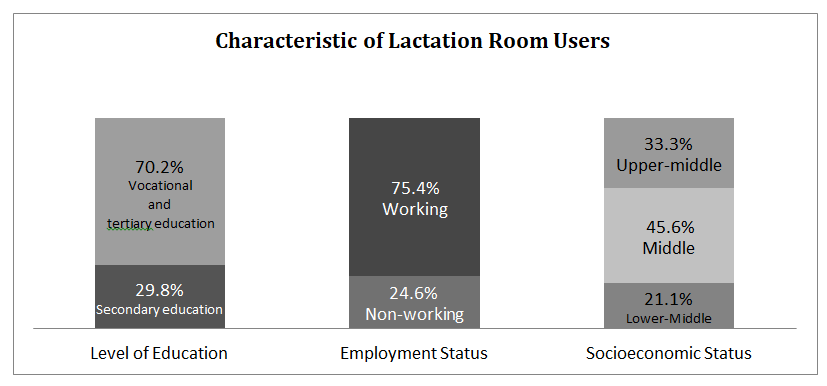
Table 3 shows that of the four shopping centers in Central Jakarta, there are a total of 5000 visitors for one week, of which only 5.3% of visitors use the lactation room. The highest lactation room users were PI (7.8%) and the lowest was TCP (2.8%). The use of the space is dominated by babysitters (78.3%). There are 22.7% of visitors are mothers with babies who use lactation rooms, with the characteristics of graduating from college (70.2%), working status (75.4%), middle socioeconomic status (45.6%) (Figure 1).
| Visitors | PI | FxS | PS | TCP | Total | |
|---|---|---|---|---|---|---|
| 1 | Total visitors (in a week) | 950 | 1100 | 1300 | 1650 | 5000 |
| 2 | Lactation room users | 74 | 75 | 68 | 46 | 263 |
| Mother | 10 | 16 | 13 | 18 | 57 | |
| Babysitter | 64 | 59 | 55 | 28 | 206 |
Table 3: Characteristic of the Mall Visitor.
Level of Exclusive Breastfeeding’ knowledge
The average score of the mother’s knowledge about exclusive breastfeeding is 50±SD 15 (the highest score is 100 and the lowest score is 50). There are 93.0% of mothers with a score above 60 or in good category, and still 7.0% of mothers with less knowledge who have difficulty in answering questions about exclusive breastfeeding and the content of breast milk. They have opinion that babies can still be given formula milk within 6 months of exclusive breastfeeding. Monika, et al. stated that breastfeeding education for mothers may improve breastfeeding rates [25]. The provision of lactation rooms in public places especially in mall or shopping centers can encourage mothers with good category knowledge to continue to be able to breastfeed their babies anytime and anywhere.
Lactation Room Usage Pattern
Table 4 shows that the average usage duration of the lactation room in one week by the mother and babysitter was 22.5±5.5 SD (min=5 minutes; max=30 minutes). Average usage by babysitters was longer (25±5 minutes; min=5 minutes; max=30 minutes) than by mothers (mean 20±6 minutes; min=10 minutes; max=30 minutes). Most of the mother’s activities are for breastfeeding, while the babysitter’s activities are for preparing formula milk.
Mother’s use of time is appropriate, that is 10 to 30 minute while 12.6% of babysitter it’s not appropriate (5 to 30 minute). The activities of breastfeeding mothers at mall visitors who carry out activities in the lactation room are different from those of nursing mothers who are working. The activities of breastfeeding mothers at malls are breastfeeding their babies, while breastfeeding mothers at work are only limited to pumping breast milk [23, 26, 27].
| Type of Visitors’ Activity | Usage duration of Lactation room | ||||||
|---|---|---|---|---|---|---|---|
| n | % | Appropriate | Inappropriate | ||||
| Mother (n = 57) | n | % | n | % | |||
| Breastfeeding | 35 | 61.4 | X̅: 20 | ||||
| Changing diaper | 9 | 15.8 | 57 | 100 | 0 | 0 | Max: 30 |
| Breastfeeding and changing diaper | 0 | 0 | Min: 10 | ||||
| Pumping and storing breast milk | 13 | 22.9 | SD: ±6 | ||||
| Babysitter (n = 206) | X̅: 25 | ||||||
| Changing diaper | 51 | 24.8 | Max: 30 | ||||
| Preparing formula milk | 80 | 38.8 | 180 | 87.4 | 26 | 12.6 | Min: 5 |
| Changing diaper and making formula milk | 75 | 36.4 | SD: ±5 |
Table 4: Type of Visitor Activity and usage duration of lactation room.
Mother’s Level of Knowledge Based on Characteristics
Based on the fisher-exact test (Table 5), there is a significant relationship between the level of knowledge of exclusive breastfeeding with the mother’s education level (p_educ= 0.006), employment status (_p_ES= 0.020), and family Level of Knowledge Total _p-value Poor Good Level of Education Secondary education 4 (23.5%) 13 (76.5%) 17 (100%) 0.006* High education 0 (0.0%) 40 (100.0%) 40 (100%) Socioeconomic Status Low income 3 (25.0%) 9 (75.0%) 12 (100%) 0.020* Middle income 1 (4.0%) 25 (96.0%) 26 (100%) High income 0 (0.0%) 19 (100.0%) 19 (100%) Employment Status Working 3 (22.0%) 11 (78.0%) 14 (100%) 0.040* Non-working 1 (3.0%) 42 (97.0%) 43 (100%) Total 4 (7.0%) 53 (93.0) 57 (100%)
| Total | 4 (7.6%) | 33 (93.6) | 37 (100%) |
Table 5: Level of Mother’s knowledge based on Characteristics.
socioeconomic status (_p_SES = 0.040). Means that the level of knowledge depends on the level of education, employment status and socioeconomic class. This is in line with the study Boff, et al. that the higher family income, the better the knowledge about breastfeeding [28] and study, Heck, et al. that maternal and paternal education remains positively association with breastfeeding [29].
Conclusion
Lactation room facilities at 4 shopping center locations in central Jakarta do not have detailed written responsibilities that can be implemented by supervisors, and there is no involvement in lactation room planning. Most of mothers who use lactation rooms are those with higher education, employment status and coming from middle and high income, and good knowledge in breastfeeding. The average room usage time is between 5 to 10 minutes with the main activity of the mother is breastfeeding while the babysitter prepares formula milk. Fisher-exact test shows that there is a relationship between knowledge of exclusive breastfeeding with mother’s characteristics (peduc=0.006; pSES=0.020; pES=0.040). Only a small number of visitors, especially mothers of babies, use it. In order to increase the use of lactation rooms as well as promoting breastfeeding practices among Indonesian mothers, apart from having directions, it is also necessary to provide signs at every corner that lactation rooms are available in the mall or shopping centers.
References
-
Jama A, Gebreyesus H, Wubayehu T, Gebregyorgis T, Teweldemedhin M, et al. (2020) Exclusive breastfeeding for the first six months of life and its associated factors among children age 6-24 months in Burao district, Somaliland. Int Breastfeed J 15(1): 1-8.
-
WHO & UNICEF (2019) Global Breastfeeding Scorecard, 2018. Enabling Women to Breastfeed through Better Policies and Programmes. WHO/Unicef (3): 3.
-
UNICEF (2021) Infant and Young Child Feeding-UNICEF DATA. Unicef.
-
Kementerian Kesehatan RI (2018) Laporan Hasil Riset Kesehatan Dasar (Riskesdas) Indonesia tahun.
-
WHO (2018) Breastfeeding, World Health Organization.
-
Lestari ED, Hasanah F, Nugroho NA (2018) Correlation between non-exclusive breastfeeding and low birth weight to stunting in children. Pediatric Nutrition & Metabolic Disease 58(3): 123-127.
-
Siregar AYM, Pitriyan P, Walters D (2018) The annual cost of not breastfeeding in Indonesia: The economic burden of treating diarrhea and respiratory disease among children (<24mo) due to not breastfeeding according to recommendation. Int Breastfeed J 13(1): 1-10.
-
Ananta Y, Gandaputra E, Waiman E, et al. (2016) Exclusive breastfeeding rate and factors associated with infant feeding practices in Indonesia. Paediatr Indones 56(1): 24-31.
-
Shi H, Yang Y, Yin X, Li J, Fang J, et al. (2021) Determinants of exclusive breastfeeding for the first six months in China: a cross-sectional study. Int Breastfeed J 16(1): 1-12.
-
Basrowi RW, Sulistomo AB, Adi NP, Vandenplas Y (2015) Benefits of a dedicated breastfeeding facility and support program for exclusive breastfeeding among workers in Indonesia. Pediatr Gastroenterol Hepatol Nutr 18(2): 94-99.
-
Rapingah S, Muhani N, Besral, Yuniar P (2021) Determinants of exclusive breastfeeding practices of female healthcare workers in Jakarta, Indonesia. Kesmas 16(1): 59-65.
-
Le QNT, Phung KL, Nguyen VTT, Anders KL, Nguyen MN, et al. (2018) Factors associated with a low prevalence of exclusive breastfeeding during hospital stay in urban and semi-rural areas of southern Vietnam. Int Breastfeed J 13(1): 1-10.
-
Laksono AD, Wuland ari RD, Ibad M, Kusrini I (2021) The effects of mother’s education on achieving exclusive breastfeeding in Indonesia. BMC Public Health 21(1): 1-6.
-
Sinta P, Salimo H, Pamungkasari EP (2017) Multilevel Analysis on the Biosocial and Economic Determinants of Exclusive Breastfeeding. J Matern Child Heal 2(4): 356- 370.
-
Amir LH (2014) Breastfeeding in public: You can do it? Int Breastfeed J 9(1): 7-9.
-
Giles F (2018) Images of women breastfeeding in public: Solitude and sociality in recent photographic portraiture. International Breastfeeding Journal 13(1): 1-12.
-
Sheehan A, Gribble K, Schmied V (2019) It’s okay to breastfeed in public but... Int Breastfeed J 14(1): 1-11.
-
Schmied V, Burns E, Sheehan A (2019) Place of sanctuary: An appreciative inquiry approach to discovering how communities support breastfeeding and parenting. Int Breastfeed J 14(1): 1-14.
-
Simpson E, Garbett A, Comber R, Balaam M (2016) Factors important for women who breastfeed in public: A content analysis of review data from FeedFinder. BMJ Open 6(10): 1-8.
-
Kementerian Kesehatan Republik Indonesia (2013) Peraturan Menteri Kesehatan Republik Indonesia Nomor 15 Tahun 2013 Tentang Tata Cara Penyediaan Fasilitas Khusus Menyusui Dan/Atau Memerah Air Susu Ibu. Menteri Kesehat Republik Indones Peratur Menteri Kesehat Republik Indones, pp: 1-9.
-
(2012) Peraturan Pemerintah Republik Indonesia Nomor 33 Tahun 2012 Tentang Pemberian ASI Eksklusif Peratur Pemerintah Republik Indones, pp: 1-34.
-
Rahmayanthi G, Sukihana IA (2020) Perlindungan hukum bagi ibu menyusui dalam penyediaan ruang menyusui yang layak pada pusat perbelanjaan modern (Plaza Renon Denpasar). J Kertha Semaya 8(3): 334-349.
-
Rahadian AS (2014) Fulfilling the Right for Exclusive Breastfeeding among Working Women: Opportunities and Challenges. J Kependud Indones 9(2): 109-118.
-
Azhari NFN, Salam H, Hasbullah MN (2012) Baby Care Room in Shopping Malls: Accessibility to Malaysian Public. Procedia - Soc Behav Sci 35: 531-538.
-
Zielińska MA, Sobczak A, Hamułka J (2017) Breastfeeding knowledge and exclusive breastfeeding of infants in first six months of life. Rocz Panstw Zakl Hig 68(1): 51-59.
-
McCardel RE, Padilla HM (2020) Assessing Workplace Breastfeeding Support Among Working Mothers in the United States. Work Heal Saf 68(4): 182-189.
-
Al-Attas SFAZSH, Shaw RM (2020) Expressing breastmilk while on break and in private: a qualitative study of Malaysian first-time mothers. Community, Work Family 1-16.
-
Boff ADG, Paniagua LM, Scherer S, Goulart BNG de (2015) Mother’s social/economic aspects and level of knowledge about breastfeeding. Audiol - Commun Res 20(2): 141-145.
-
Heck KE, Braveman P, Cubbin C, Chávez GF, Kiely JL (2006) Socioeconomic status and breastfeeding initiation among california mothers. Public Health Rep 121(1): 51-59.
- The Need for Partner Education and Mental Health Support During Pregnancy and the Postpartum Period
- Application of Combined PGT-A and PGT-M for Reproductive Management in a Couple Carrying GCDH Mutations with Prior Affected Offspring: A Rare Case Report
- The Effect of Using a New Technique Karman Injector (Elif Technique) on the Healing Process of Wound Infection-Case Series
- GSM: Counseling Points to Discuss with Women Fearful of Vaginal Estrogen
- Antenatal Diagnosis of Meckel Syndrome: A Case Report
- Discrimination and Workplace Harassment (Mobbing) against Women in the Post-Pandemic Era