
Awareness of Women about Tetanus in Baghdad
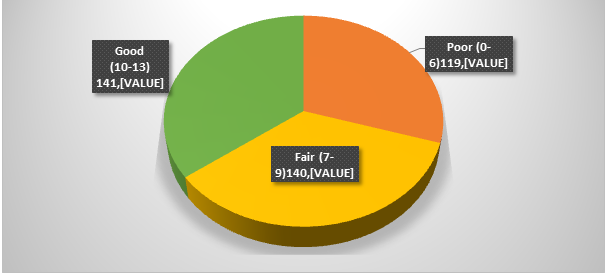
Background: Tetanus toxoid (TT) vaccine is still recommended for pregnant women even in countries that declared elimination of neonatal tetanus (NT) and consequently the maternal tetanus (MT). Many factors may affect TT vaccination during pregnancy. Awareness is a key factor that greatly affect the pregnant women to receive tetanus toxoid vaccination during pregnancy. Aims of study: To assess the awareness of women regarding different aspects of tetanus and tetanus toxoid vaccination as well as to identify the factors influencing their awareness. Subjects and Method: A cross sectional study conducted in Baghdad from first of April to the end of September 2021. Convenient sample of women in reproductive age, attended the designated primary health care centers for the study were enrolled. An interview questionnaire was used to collect quantitative data pertaining to awareness of women about tetanus toxoid immunization and tetanus infection. The total number of women enrolled in the study was 400, the study found that that 35.2% and 35% of women had good and fair level of awareness respectively. Good awareness level was significantly higher among older aged women and those with higher level of education as well as working women. Good awareness was more prominent among women’s having1-2 children (39%), as compared to those having five and more children (21.3%). Antenatal care attendance and place of delivery shown statistical significant link with level of awareness. Women identify family members and friends as their primary sources of information about tetanus infection and immunization. Conclusion: Women’s awareness was acceptable regarding Tetanus and TT immunization. Yet still there is a place for proper health education targeting young women to bridge gap in the connection between the etanus immunization status of women and the occurrence of Maternal neonatal tetanus (MNT), as well as need for the appraisal of the components of health information delivered by health care providers to women attending antenatal care clinics.
Introduction
Tetanus is caused by a potent exotoxin, which is formed by the anaerobic bacterium Clostridium tetani. It is a life- threatening disease, which causes severe mortality among maternal, neonatal, and young infant. Maternal neonatal tetanus (MNT) is important public health problem in many developing countries [1, 2].
Maternal Neonatal tetanus (MNT) can be prevented by immunizing the women with Tetanus Toxoid vaccine, immunization is one of the best effective public health initiatives towards Maternal and neonatal tetanus (MNT) elimination [3].
Tetanus toxoid (TT) vaccine is still recommended for pregnant women even in countries that declared elimination of neonatal tetanus (NT) and subsequently the maternal tetanus (MT). Several issues may affect the utilization TT vaccine during pregnancy [4].
Awareness is a factor that considerably motivated pregnant women to receive tetanus toxoid vaccination during pregnancy. On the other hand, inadequate or poor awareness is risky and may effect the tetanus oxoid uptake and underutilization of other vaccination programs [5].
Awareness about tetanus and tetanus toxoid vaccination is a fundamental factor of tetanus toxoid vaccination use among pregnant women. Misinformation about vaccination can interrupt, particularly if the health care providers be unsuccessful in deliver sufficient information and education on the topic of its benefits, importance, and effectiveness [6].
The results of prior studies from Iraq and other countries revealed that most of women lacked appropriate awareness of MNT and TTV and this reflected in inadequate uptake of TT by women [7, 8, 9].
The current study was conducted aiming to assess the awareness of women regarding tetanus and tetanus toxoid vaccination, and to find out the factors influencing women’s awareness.
Subjects and Method
Across sectional study with analytic elements carried out in ten primary health care centers in Baghdad/ Iraq over a period from first of April to end of September 2021. The study group comprised convenient sample of women in reproductive age, be present at the selected PHCCs for any cause interrelated to their health or for vaccination for their children, and agree to join in the study.
The data collected by direct interview; using a structured questionnaire, which was geared up for the purpose of the study after reviewing, related available studies [10, 11].
The questionnaire comprised two sections, first one including sociodemographic features of the woman: Age, number of children, the education and working status. This section of questionnaire also queries about the antenatal care attendance and place of delivery in the course of the last pregnancy.
While the second section consist of 13statements
assessing woman’s awareness about Tetanus disease, causes, transmission, and TT vaccine required doses, time of vaccination during pregnancy and benefits of TTV.
The women demanded to answer by “Yes”, “No” or” do not know “for each statement. They were scored one point for each statement answered correctly and zero for incorrect and “do not know” answers. Following completing the questionnaires, scoring of the responses performed. The total awareness score of each participant could range from zero to13. Scores between ( 0-6 )were considered poor level of awareness, between( 7-9) were considered Fair, and scores of( 10-13) were considered good level of awareness. In addition, women were enquired to pinpoint the sources of their information about tetanus and TT immunization.
Ethical Consideration
A verbal consent was attained from all participants, the ethical approval was obtained from College of Medicine / Al-Mustansiriyah University as well as, official permissions were also acquired from Ministry of Health and health directorates in Baghdad.
Statistical Analysis
Analysis of data carried out using the available statistical package of SPSS-27 (Statistical Packages for Social Sciences- version 27). Pearson’s χ 2 -test applied to evaluate the association between the study variables and level of awareness. A p-value of less than or equal to 0.05 was considered statistically significant.
Results
The study group comprised 400 women in their reproductive age.
The awareness of the study group regarding tetanus disease and TT presented in table 1. The rate of correct answers among women ranged from (54.2%to 91.2%). The majority of women (87%) knew that there is disease named tetanus. The tetanus disease caused by bacteria recognized by 44.2% of the women.
It is worth mentioning that 62.8% of study participants did not know that the microbes caused tetanus found usually in soil and animal waste. The result points out that 54.2 % of the study group were aware that tetanus disease occur when unsterile instruments and unhealthy practice used in the course of delivery and care of umbilical cord. One hundred forty seven (36.8%) of the respondents falsely believed that tetanus can transmitted between people.
Out of 400 women, 84.5% of them aware that tetanus is prevent by vaccine. Additionally, 80% of study participants acknowledged that people when have wounds should receive tetanus vaccine. It is remarkable that only 49(12.2%) of study participants had correct knowledge regarding doses of TT woman need during her reproductive life. Moreover, 79.4% of women were aware that TT during pregnancy protects mother and her baby.
Lastly, fever and swelling at site of injection correctly considered as possible problems of TT vaccination by 91.2% of study group.
| Statement | Yes | No | Do not know | |||
|---|---|---|---|---|---|---|
| No | % | No | % | No | % | |
| 1-There is a disease named “Tetanus” | 348 | 87 | 52 | 13 | - | - |
| 2-The tetanus disease caused by bacteria | 177 | 44.2 | 43 | 10.8 | 180 | 45 |
| 3-The microbes caused tetanus found usually in soil and animal waste | 149 | 37.2 | - | - | 251 | 62.8 |
| 4-Tetanus disease happen when using unsterile instruments during delivery | 217 | 54.2 | 59 | 14.8 | 124 | 31 |
| 5-Unhealthy practice during umbilical cord management can cause tetanus disease | 217 | 54.2 | 59 | 14.8 | 124 | 31 |
| 6-Tetanus disease can transmitted from person to another person * | 147 | 36.8 | 129 | 32.2 | 124 | 31 |
| 7-Tetanus disease is prevented by vaccine | 338 | 84.5 | 12 | 3 | 50 | 12.5 |
| 8-People who are not completely immunized and have wounds should receive a tetanus vaccine | 320 | 80 | 14 | 3.5 | 66 | 16.5 |
| 9-TT can be given to every person (man, woman & children) | 268 | 67 | 132 | 33 | - | - |
| 10-The woman need five doses of TT during her reproductive life | 49 | 12.2 | 223 | 55.8 | 128 | 32 |
| 11-The pregnant woman can receive TT at the fourth month of pregnancy | 261 | 65.3 | 62 | 15.4 | 77 | 19.3 |
| 12-The TT vaccine is given during pregnancy to protect the mother and her baby | 318 | 79.4 | 59 | 14.8 | 23 | 5.8 |
| 13-The possible problems of TT vaccination is fever and swelling at site of injection | 365 | 91.2 | 35 | 8.8 | - | - |
Table 1: Distribution of awareness responses among the study group.
The mean Score was 7.9±2.8 (1-13) Table 1: Distribution of awareness responses among the study group.
It showed that the level of awareness generally increased with increasing the age of the woman, no woman aged less than 20 years had good level of awareness, while the same level of awareness found in 41.9% of those aged 40 years and more. The relation between age and the awareness level showed statistical significant association (P = 0.0001). Education of the woman revealed a statistical significant relation with the awareness level (P = 0.0001). Among women with primary education, 76.5% had poor awareness in comparison with only 18.4% of women with higher educational status. Concerning women ‘working status, it showed a statistical significant association with the awareness level (P = 0.0001). 52.2% of the working people had good level of awareness. On the other hand, good awareness was allocated to 16.8% of not working women. Regarding the number of children, table-6 indicated that the level of awareness was statistically associated with the number of children the woman had (P =0.041).
Good level of awareness observed in 39 % of women having1-2 children, while 21.3% of those having five and more children had this level of awareness.
| Woman characteristics | Level of awareness | P value | ||||||
|---|---|---|---|---|---|---|---|---|
| Poor(0-6) | Fair (7-9) | Good(10-13) | ||||||
| No. | % | No. | % | No. | % | |||
| Age (years) | <20years | 8 | 66.7 | 4 | 33.3 | - | - | 0.0001* |
| 20-29 | 55 | 39.9 | 41 | 29.7 | 42 | 30.4 | ||
| 30-39 | 46 | 24.5 | 69 | 36.7 | 73 | 38.8 | ||
| =>40years | 10 | 16.1 | 26 | 41.9 | 26 | 41.9 | ||
| Education level | Primary | 39 | 76.5 | 12 | 23.5 | - | - | 0.0001* |
| Intermediate & secondary | 28 | 41.8 | 26 | 38.8 | 13 | 19.4 | ||
| College & higher | 52 | 18.4 | 102 | 36.2 | 128 | 45.4 | ||
| Working status | Working | 29 | 13.9 | 71 | 34 | 109 | 52.2 | 0.0001* |
| Not working | 90 | 47.1 | 69 | 36.1 | 32 | 16.8 | ||
| Number of children | 02-Jan | 33 | 26.8 | 42 | 34.1 | 48 | 39 | 0.041* |
| 04-Mar | 13 | 22.8 | 24 | 42.1 | 20 | 35.1 | ||
| 5 & more | 23 | 48.9 | 14 | 29.8 | 10 | 21.3 |
Table 2: presents the distribution of study group according to the levels of awareness and some women’s ‘ characteristics.
*Significant difference between percentages using Pearson Chi-square test (c2-test) at 0.05 level. Table 2: presents the distribution of study group according to the levels of awareness and some women’s ‘ characteristics.
The participants ANC attendance showed a statistically significant influence on awareness level (P=0.002), as 36.6% of women attended ANC had a good awareness compared to only 7.1% of those who did not attend ANC.
Place of birth in last pregnancy also publicized statistically significant impact on the level of awareness (P=0.010).27.6% of those delivered in hospital had poor awareness, while 50% of women delivered at home had the same level of awareness.
| ANC attendance and place of delivery | Level of awareness | P value | ||||||
|---|---|---|---|---|---|---|---|---|
| Poor (0-6) | Fair (7-9) | Good(10-13) | ||||||
| No | % | No | % | No | % | |||
| Attended ANC during the last pregnancy | Yes | 109 | 28.2 | 137 | 35.5 | 140 | 36.3 | 0.002* |
| No | 10 | 71.4 | 3 | 21.4 | 1 | 7.1 | ||
| Place of birth of the last delivery | Hospital | 100 | 27.6 | 128 | 35.4 | 134 | 37 | 0.010* |
| Home | 19 | 50 | 12 | 31.6 | 7 | 18.4 |
Table 3: The distribution of study group according to level of awareness in relation to ANC attendance and place of delivery in t
*Significant difference between percentages using Pearson Chi-square test (c2-test) at 0.05 level. Table 3: The distribution of study group according to level of awareness in relation to ANC attendance and place of delivery in the last pregnancy.
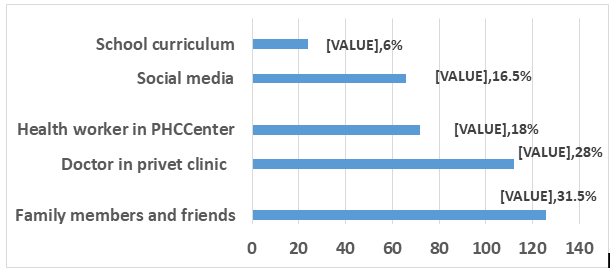
Concerning the sources of women information, the main source was family members and friends as stated by 126(31.5%) women. Other sources of women ‘ information demonstrated in Figure 2.
Discussion
Awareness is an influence that significantly affects pregnant mothers to obtain TT vaccination during pregnancy. The results from the current study demonstrated that woman’s awareness were satisfactory in some items, and inadequate in other items. These results were also reached by study from Gambia and Senegal [12].
The overall awareness was adequate since (35.2% and 35%) of the women had a good and fair level of awareness respectively.
These findings supported by other studies done in Iraq [10, 13] and Nigeria [14, 15], which displayed adequate awareness of mothers about tetanus infection and immunization. The finding of the study however contradicts with the findings of studies conducted in Saudi Arabia [16] and Egypt [17, 18], which stated that the majority of women had poor knowledge on MNT and TTV. The dissimilarities in results may be a role of the variation in the studied population characteristics and variances in study designs and difference in tools used to measure the outcome variable.
Factors influencing woman’s awareness
Present study results showed the rate of good awareness become higher with increasing age. This result coincides with previous studies from Saudi Arabia [16] and Nigeria [19].
A possible reason for this finding could be that women with increasing age are more mature and gathering more knowledge and information. Moreover might have had previous exposure to information about immunization and its benefits for themselves and their offspring. When point out the level of education of the study members, the results establish that when the level of education increases the awareness increases as well. This result was in keeping with finding by earlier studies conducted in Iraq [10, 13] and elsewhere [20] which stated that education has great influence on the level of awareness that the respondents would have on Tetanus infection and TT immunization.
This finding may indicate that women with higher educational level were more considerate in terms of understanding and interpreting the health information. Results of present study indicated a significant relationship between number of children and level of awareness. This evidence was observed by former studies carried out in Nigeria [15, 19], which confirmed that the level of awareness was significantly associated with parity. The current study demonstrates that the mother working status was one of the factors determining her level of awareness. Better awareness was reported among the working women. This was corroborated by findings of studies conducted in Iraq [13] and Nigeria [21], which showed that maternal working status had an influence on the awareness level.
The likely explanation of this can be attributed to that, employment empower woman and give her more mobility to gain health information and control resources as well as access to good health care practice. As well, women may acquire more knowledge from part taking in work with succeeding interactions with surrounding community.
The result obtained from current study found a significant influence of ANC attendance on level of awareness. As better awareness observed among women who had attended ANC. A finding replicated in other studies from Iraq [10] and Uganda [22], which have verified significant improvement of maternal awareness concerning tetanus and TT immunization following antenatal visits. The plausible explanation might be that women who have attended ANC are more likely to have frequent contact with healthcare providers which itself supports and enhance awareness of mothers about of TT vaccination utilizing and benefits. Therefore, regular antenatal care is an essential way to expand TT vaccination.
Conclusion
The present study found that about one third of the respondents gain information about tetanus from family members and friends. This was similar to study conducted in Egypt [17]. This can be elucidated the important role-play by family members and the women feel close and contented with relatives. In addition, such findings can disclose the shortage in information provided by medical personnel to these women whose source of information was mainly family members and friends, while the role of obstetricians, nurses, and media was not relevant. On contrary, health personnel from an antenatal clinic and primary health care centers were the main source for information in previous studies done in Iraq [7, 23].
References
-
Rupani S, Kazmi U, Ahmed U, Ali A, Rehman H (2015) Knowledge of tetanus vaccination among undergraduate medical students in Karachi, Pakistan 2(5): 154-159.
-
Burgess C, Gasse F, Steinglass R, Yakubu A, Raza AA, et al. (2017) Eliminating maternal and neonatal tetanus and closing the immunity gap 389(10077): 1380-1381.
-
Mamoro MD, Hanfore LK (2018) Tetanus Toxoid Immunization Status and Associated Factors among Mothers in Damboya Woreda, Kembata Tembaro Zone, SNNP, Ethiopia. Journal of Nutrition and Metabolism
-
Ahmed A, El-Berrawy M (2019) Factors affecting maternal tetanus vaccination in Dakahlia Governorate, Egypt. Journal of High Institute of Public Health 49(1): 30-35.
-
Orimadegun AE, Adepoju AA, Olusina O (2014) Adolescent girls’ understanding of tetanus infection and prevention: implications for the disease control in western Nigeria. Frontiers in public health 2(24).
-
Mohamed A, Nasor F (2020) Effect of tetanus toxoid immunization training program on knowledge and attitude on female nursing students in government universities In Khartoum State. International Journal of Nursing and Midwifery 12(2): 51-63.
-
Tamadur D, Alwan BH (2017) Knowledge and Practice of Mothers about Antenatal Tetanus Toxoid Vaccination in ALHilla City 2015. Journal of Babylon University/Pure and Applied Sciences 25(3): 1098-1104.
-
Bello AD, Aduroja PE (2017) Assessment of Tetanus Toxoid Vaccination Awareness and Uptake among Women of Reproductive Age in Kwara State, Nigeria. Journal of Complementary and Alternative Medical Research 4(2): 1-10.
-
Ajmal KBE, Azam N, Perviaz F, Akhtar SS, Yousaf S (2019) Knowledge Attitude and Practice regarding Tetanus Toxoid Vaccination in reproductive age women(15-49). A descriptive cross-sectional study in PAK EMIRATES MILITARY HOSPITAL, RAWALPINDI. Pak Armed Forces Med J 69(2): 334-339.
-
Seger HR, Abbas IM (2014) Assessment of Pregnant Women’s Knowledge about Tetanus Toxoid Vaccination in Karbala City. Iraqi National Journal of Nursing Specialties 27(1): 23-31.
-
Awosan KJ, Hassan M (2018) Perception and utilization of tetanus toxoid immunization among pregnant women attending a tertiary centre in North-West Nigeria. Journal of Drug Delivery Therapeutics 8(6): 119-124.
-
Johm P, Nkoum N, Ceesay A, Mbaye EH, Larson H, et al. (2021) Factors influencing acceptance of vaccination during pregnancy in The Gambia and Senegal. Vaccine 39(29): 3926-3934.
-
Ghaza RS, Jaber EA (2019) Pregnant Women’s Knowledge Concerning Tetanus Vaccination in Al-Rusafa Health Sector. Indian Journal of Public Health Research & Development 10(04): 643-648.
-
Ogbeyi OG, Gbahabo DD, Afolarani T (2017) Knowledge, Beliefs and Practices Regarding Tetanus Toxoid Immunization Among Nursing Mothers in Benue State, North Central, Nigeria. International Annals of Medicine 1(9).
-
Abah MG, Otobong A, Asuquo, Emmanuel C, Inyangetoh (2019) Knowledge and Behaviour Towards Tetanus Toxoid Immunisation in South-South, Nigeria: Findings from Antenatal Clinic Attendees. Asian Journal of Applied Sciences 7(5): 608-617.
-
Azzahrani MK, Alsaedy AM, Alsalmi AA, Alshehri MA, Alrashoud MR, et al. (2017) Public Attitude and Awareness towards Tetanus and Its Vaccine in Riyadh. International Journal of Science and Research (IJSR) 6(1): 839-843.
-
Mehanna A, Ali MH, Kharboush I (2020) Knowledge and health beliefs of reproductive-age women in Alexandria about tetanus toxoid immunization. Journal of the Egyptian Public Health Association 95: 22.
-
El-Adham AF, Nagar AEEL, Hashem SM (2022) Determinants of Tetanus Toxoid Vaccination Use among Pregnant Women. Tanta Scientific Nursing Journal 27(4): 30-52.
-
Bello AD, Aduroja PE (2017) Assessment of Tetanus Toxoid Vaccination Awareness and Uptake among Women of Reproductive Age in Kwara State, Nigeria. Journal of Complementary and Alternative Medical Research 4(2): 1-10.
-
Madubuike G, Asuquo EO, Oriji VK (2018) Tetanus toxoid immunization, Drop - out Rates and determining factors among women in Niger- Delta community, Nigeria. International Journal of public Health Research 6(2): 20- 25.
-
Sule SS, Nkem-Uchendu C, Onajole AT, Ogunowo BE (2014) Awareness, perception and coverage of tetanus immunisation in women of child bearing age in an urban district of Lagos, Nigeria. The Nigerian Postgraduate Medical Journal 21(2): 107-114
-
Kajungu D, Muhoozi M, Stark J, Weibel D, Sturkenboom MCJM (2020) Vaccines safety and maternal knowledge for enhanced maternal immunization acceptability in rural Uganda: A qualitative study approach. PLoS ONE 15(12): 1-17.
-
Jasim RM, Thanoon SR , Alzaidy ZF, Sulaiman NK (2021) Assessment Knowledge of Pregnant Women about Tetanus Toxoid Vaccination in Mosul City. Sys Rev Pharm 12(1): 1501-1505.
- The Need for Partner Education and Mental Health Support During Pregnancy and the Postpartum Period
- Application of Combined PGT-A and PGT-M for Reproductive Management in a Couple Carrying GCDH Mutations with Prior Affected Offspring: A Rare Case Report
- The Effect of Using a New Technique Karman Injector (Elif Technique) on the Healing Process of Wound Infection-Case Series
- GSM: Counseling Points to Discuss with Women Fearful of Vaginal Estrogen
- Antenatal Diagnosis of Meckel Syndrome: A Case Report
- Discrimination and Workplace Harassment (Mobbing) against Women in the Post-Pandemic Era