
Gender Role in Handicraft Promotion: A Case Study among Dongria Kandha Women in Rayagada District, Odisha
The indigenous knowledge belongs to a particular ethnic group. Indigenous knowledge develops in a specific socio-cultural environment with an unique innovative practice of local community. Kapdaganda an embroidery shawl represents the rich cultural heritage of Dongria Kandha community is an excellent indigenous handicraft. The knowledge regarding the traditional handicraft is only confined to women among Dongria Kandha. The objective of this paper is to study the gender role in production, promotion and preservation of the skill of traditional handicraft. It also focuses the cognitive aspects behind the style, design and colors used in Kapdaganda and highlight the socio-cultural significance of shawl in their life. This study has undertaken by using anthropological tools and techniques like observation, In-depth interview, focus Group Discussion (FGD) and scheduled.
Introduction
The craft made by the rural folk are typical in nature with a cultural and aesthetic life. Craft is the sign of creativity, innovativeness limited to certain groups who are blessed with magical hand. Odisha is famous for its natural scenery, cuisine, art, craft, traditional dance form, folk song and culture. More or less every part of Odisha retains some handicraft artefacts. Handicraft is most probably considered as craft made out of hand. The handicraft industry of India as well as Odisha is famous for its perfection, incredible craftsmanship. The mythological, religions, social world view artistic value, cultural value, historical elements attached to craft reflect the prestigious cultural heritage of Indian country [1]. Raghurajpur is famous for Pattachitra and palm leaf work, Pipili famous for Appliqué, Cuttack is famous for Silver filigree, Kalahandi, Nabarangpur, Jagatsinghpur, Bhadrak for Wood carving, Kendrapara for Golden grass, Rayagada, Mayurbhanj, Cuttack, Nabarangpur, Dhenkanal for Dhokra, Puri and Bhubaneswar for Stone carving.
Investigation Paper
Ganjam for Brass fish, Dhenkanal and Rayagada for Tribal jewellery. Odisha is a homeland for 62 tribal groups who are distributed in different geographical regions. The tribal community have different from each group with unparallel cultural social identity. They have their own cultural beliefs, traditions, attires, ornaments, song, dance, folklore, rituals, indigenous skill, craft etc. They have a rich material culture with them which is transmitted generation after generation. The skill, the knowledge, the art which a tribe have is innate. The handicraft is not only an industry but also an identity and fulfilled the necessities of the people. The Odisha tribes are famous for their traditional skill like Juang are expert in wood carving, Bonda are expert in weaving of clothes and carpet, Lanjia Saora popular for painting, Lodha for sabai rope making, Chuktia Bhunjia and Didayi for bamboo basketry. The craft of tribal communities are the output of indigenous skill intertwined with the artistic imagination of the people. The craft created by them have distictive design, primitive technique of production, distinguish shape and colour. The handicraft produce by the tribal communities are basically utilitarian, decorative and religious valued objects. Some objects are used in day to day activities like textiles, baskets, hunting and musical instruments etc, decorative objects are jewellery and religious objects are like figurine of deity, items used during rituals. The art and craft made by the Soura tribe are related to various social-cultural life such as healing process, Child birth, deities, life situations etc [2]. Some of the craft has religious value such as either it has significance during festival or rituals. Appliqué craft is attached with religious ceremony. During Dola and rituals associated with lord Jagannath ,canopy chariots, flag are used which are made of appliqué [3]. The artefacts made out of Bena grass by its design, durability, beautifulness character has been popular by the user. It has also socio-religious significance like Brata Pedi, Puja Gua Pedi, Bhoga Pasara [4]. The Dhokra craft made by the craft man of Jhigidi village is very fond among Dongria Kandha. They purchase jewellery like ear ring, ring, necklace etc from the local market and also numbers of foreigner attracted to the Chatikana weekly market to purchase Dhokra items [5]. The flexible brass fish is a 300 years old craft originated in the Ganjam district once had popular in the international world is now in the stage of extinction. The skill is only limited to three descendant [6]. The art & craft of Odisha is a source of livelihood reflected the way of life. Sabai grass is a minor forest produce used for making rope. The rope is used for making sofa, chairs, baskets, tea poi. The rural family engaged in rope making for their livelihood. The female and children are basically involved in the rope making [7]. The handicraft and cottage industry of Odisha is the representative of the state’s heritage and culture. The preservation of this skill essential for both the artisan and for the state to maintain its value [8]. North eastern zone of India is popular for handloom. Women are the real weavers and predominant the handloom world but they are facing problem due to changing market system and strong competitor [9]. Handicraft sector of India suffered for several factors like illiteracy, unorganised, financial constraints, middleman, less knowledge regarding new technology, inefficient market system etc. [10].
Area & People
Scheduled Tribe constitutes 8.6 percent of total population of India. As per 2011 census 705 scheduled tribes are there in India; Odisha has contained 62 tribal communities and 13 are among them coming under particularly vulnerable tribal groups (PVTGs). The State of Odisha occupies third position in the country having a high concentration of Scheduled Tribe. As per the 2011 census Scheduled Tribes and Scheduled Castes together constitute nearly 40% of the State’s total population (S.Ts 22.85% and S.Cs 17.13%). Kandha is numerically the most populous tribe in Odisha. Their main concentration is in South Odisha. The population of Kandha in Odisha is 16.27 lakh. The Niyamgiri hill range of Eastern Ghats is home for Dongria Kandha. They mainly confined to Bissam cuttack, Muniguda and Kalyanisinghpur block. They inhabit in 103 revenue village and hamlets since long period. The total population is 8924 out of which male is 3739 and female is 5189. Dongria mostly prefer nuclear family and patrilineal and patriarchal society. They are called as Dongria by the Hindu counterpart though they lived in the dongar. They love to settle in the high altitude to meet the necessities and economic demand.
Materials & Methods
Anthropological studies are characterized by holistic approach, first-hand information collected through fieldwork and cross cultural comparison. The Information collected through an intensive field survey conducted in the Kurli Gram Panchayat of Bissamcuttuck Block. The techniques used for this study were Scheduled, Focus Group Discussion (FGD), Observation, and in-depth Interview with Informants. Simple random sampling had taken to select the 40 informants including Dongria Kandha women and young girls.
Analysis & Discussion
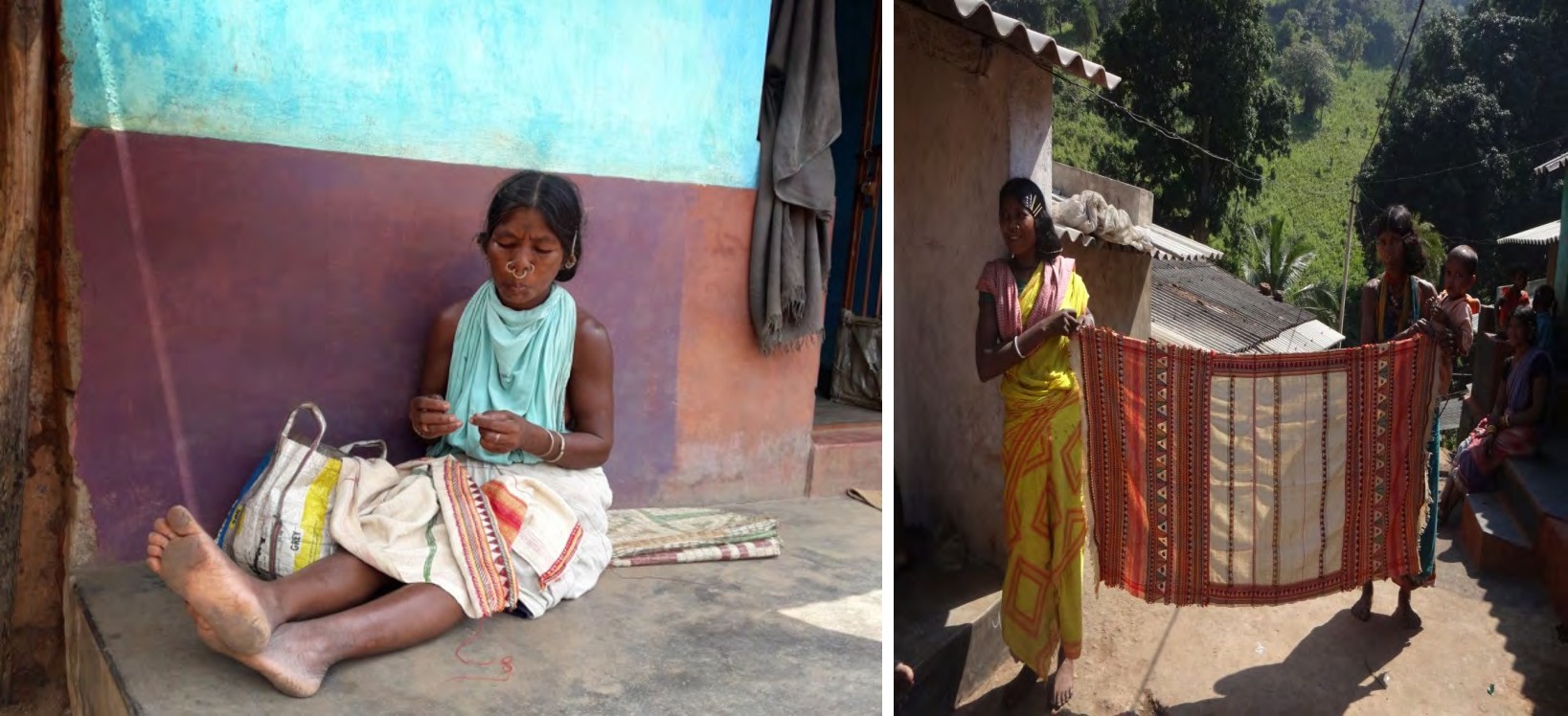
The embroidered shawl (Kapdaganda) is one of the widely popular, colourful, attractive indigenous knowledge of Dongria Kandha. It is most admirable customary practices within their own community as well as in foreign country. The Dongria Kandha a section of numerically preponderant Kandha tribe is wearing off white coarse cotton cloth. The clothes they wear give them comfort while doing the daily activities. During festivals, ceremonies, fairs season they used to wear a shawl (locally known as Kapdaganda). The shawl is very fond at the time of special occasion by both male and female. This shawl is hand woven and basically made by young girls and women. The shawl which is made by Dongria is two types one is called Kapdaganda and the other one is Watangaganda. The white cloth is known as Ganda or Kapda. Earlier the only source of getting cloth was Domb but now Dongria Kandha Development Agency (DKDA) is providing the cloth. Sometimes the cloth is provided by the Domb people inhabited in the Jhigidi village and sometimes it is available in the local market.
The cloth for Kapdaganda is off white colour and made up by loom. The colour of thread used in the Kapadganda is generally four viz. brown, yellow, green and red. These colours have its own significance. They represent the worldview of Dongria Kandha peoples. The Dongria Kandha is very simple and their life confined to the nature. The red colour represents the blood, sacrifice, conflicts, feuds, war, jealously etc. The green represents the forest, vegetation, cultivation that grown by the Dongria Kandha community, happiness etc. The yellow colour represents the turmeric field, harmony, peace etc. The brown represents the hill and mountains, strongness, masculine power etc.
Cultural Importance of Colour
Red (Kambiti): Dongria Kandha is inhabited in the dense forest. They worship different god and goddesses and they are very fond of blood. Dongria used to offer animals and blood to their deities. They also offered red flower to their deities. So red is the favourite colour of Dongria cultural as well as religious life. Green (Aka): Dongria Kandha is live in the lap of nature. Throughout the year they attract find something which grew in the forest. They collect green leaves, flowers, fruits, herbs from the forest. They are also doing shifting cultivation and horticulture. So green also favourite colour of Dongria Kandha. Yellow (Hinga): The cash crop which cultivated by Dongria is turmeric. The major share of their income comes from the turmeric. Turmeric also used in various occasion like marriage, birth and also in festivals. So yellow is very fond colour for them. Brown (Mirga): They worship Dongar Raja Niyamgiri. They considered themselves as the descendent of Niyamraja. Their village is surrounded by number of hills. They are doing shifting cultivation in the hills. So hill /Dongar is very important for their in both religious perspective and economic perspective. So brown colour also preferable one.
Cultural Importance of Kapdaganda
The tribal society in India has adopted various ways of acquiring mates. Among these arrange, capture and love marriage is common one. During marriage both bride and groom wear Kapdaganda. The possession of it is a matter of pride. The Kapdaganda have a high cultural value. When a girl is love with a boy she eagerly gives different gift to her loved one. The young boy gives his cotton cloth on which the girls do embroidery work. And sometimes the girl weaving Kapdaganda and offer to the boy with whom she wishes to live together till last breath. If the boy interested he accept the shawl and their relation further progress. Both boys and girl, male and female love to wear in festivals, marriage ceremonies and fair. In marriage ceremony the boys and girls during dance exchange their shawl with whom he/ she interested to make him/her as life partner. Both male and female put on lots of jewellery and love to beautifying themselves starting from hair to foot and with number of ornaments when they put on shawl it seem more attractive and colourful. The Dongria Kandha when saw the yellow colour in the shawl they feel happy think about turmeric field. The Dongria Kandha village headman like Jani, Disari, Bismajhi and Mandal during the meeting hand shawl on the shoulder.
Shape and Design of the Shawl
The embroidery works starts with four straight lines of four colour starting from brown, red, yellow and green is known as “Wata”. Another design is small triangle made out of red thread symbolize the axe which is highly cultural value possess by Dogria Kandha. They sacrifice the animals by using it and cut the trees for shifting cultivation, construction work and household assets. The male member of Dongria always hang axe in the shoulder. The design is known as “Kralikana”. Another design is known as “Hipa”. Then they stitch the design of “Keri”. The Keri represents the green, red and yellow colour. The next design is Khandba. The Khandba is triangular in shape and red colour thread is used.
The another design is “Kahani” and “Karpi” a medium size triangle divided by straight line and 30 degree angle straight line touch the two lateral line of triangle is known as Karpi. Then the next design Kanka, which is semi rectangular or circular shape. Here they use colour like brown, yellow, red, green etc.
Role of Women in Handicraft Making
Dongria after puberty and in case of boys after initiation ceremony enter into the customary youth dormitory known as Da-Sha-Hada/Dhangdi Sala/ Adasbetta. Da-Sha- means unmarried girls and Hada means house. Here the unmarried girls spend nights with other boys of neighbour village. The dormitory act as a training centre here the girl learns about the tradition, custom, rules and regulation of their own society. They also learn the folk song, dance, myth, folklore of the community of which they are member. Here in dormitory the girl learn about the indigenous knowledge, skill, and craft of their society. In dormitory the elder unmarried girl teach the young girls the stitching techniques. The Kapdaganda is truly the work of women and girl. There is no barrier in case of age, status, clan, position etc. All the age group can weave the shawl and also sell it in near market. Earlier Kapdaganda is not made to earn money. The stitching work takes several days to complete as Dongria Kandha women are engaged the whole days in the Dongar. When they come back from the work or when they get leisure time prefer to weave this Kapdaganda. It takes two to three month to complete the shawl. But though shawl has a social and cultural significance the women transmit the tradition from generation after generation through using of this in various occasions and also give training to younger girl.
There are two micro projects working for the development of Dongria Kandha. Dongria Kandha Development Agency (DKDA), Chatikana and Dongria Kandha Development Agency (DKDA), Parsali which was established in 1978-79 and 1987- 88. DKDA provides number of facilities to upgrade the status of Dongria Kandha in various sectors like education, health and livelihood. DKDA provides cloth and thread, needle and also give financial assistance for the labour and time they invest for making this beautiful and trendy shawl. After completion of Kapdaganda women are getting 500 per shawl by DKDA.
| S.No | List of Material | Amount |
|---|---|---|
| 1 | Cloth | 250 |
| 2 | Red Thread-1 bundle | 800 |
| 3 | Yellow Thread-1 bundle | 800 |
| 4 | Green Thread-1 bundle | 750 |
| 5 | Brown Thread-1 bundle | 750 |
Table 1: Investment of Money for a Shawl. Source: Fieldwork
Conclusion
Dongria Kandha women and men are very fashionable and showiness for ornaments that gives attractive and unique appearance. Like other tribal groups of Odisha Dongria Kandha also have traditional skill and they also create a unique place and identity for their heroic activities. women are the integral part of the Dongria society. They are not only contributed to large share in economy but also to preserve and continue the tradition, skill, craft and knowledge bestowed upon the shoulder of women. Beside embroidery shawl Dongria have also knowledge in wood carving, wall painting, comb making etc. The shawl represents their heritage and rich culture. This is the craft which is not limited to state, nation only it is widely popular in the foreign also. For this there is the chance to imitate the skill and misuse the knowledge and make profit by selling the duplicate textile of it by any agency. So there should be geographical indication (GI) tag for Dongria Kandha Kapdaganda.
Acknowledgment
Authors acknowledge the each and every member of the Dongria Kandha community for their cooperation and special thanks to Dongria Kandha women for giving complete information about Kapdaganda.
References
-
Dash M (2011) Marketing of Orissa Handicrafts: A Study on Challenges & Opportunities. International Journal of Multidisciplinary Management Studies 1(2): 47-63.
-
Sharma E (2015) Tribal Folk Arts of India. Journal of International Academic Research for Multidisciplinary 3(5): 300-308.
-
Samall B (1998) Applique Craft in Orissa, India: Continuity, Change and Commercialization. JASO 29(1): 53-70.
-
Tripathy BK, Panda T, Mohanty RB (2014) Traditional Artifacts from Bena grass [Chrysopogon zizanioides (L.) Roberty] (Poaceae) in Jajpur district of Odisha, India. Indian Journal of Traditional Knowledge 13(4): 771-777.
-
Sethi S, Naik P (2016) Dhokra Craft: A Case Study of Jhigidi Village in Rayagada District, Odisha. Bhubaneswar: ADIVASI, SCSTRTI 56(2).
-
Behera B (2018) Curator’s Eye: An Anthropological Analysis of Old Vanishing Art and Craft of Ganjam District of Odisha. Anthropology and Ethnology Open Access Journal 1(1): 000106.
-
Satapathy AR, Sahu UN (2010) The Role of Sabai Grass Industry in the Economic Development of Mayurbhanj District of Orissa (India). International Journal of Applied Agricultural Research 5(2): 221-242.
-
Agasty MP, Senapati J (2015) Handicraft Industries in Odisha: Problems and Prospects. International Journal of Multidisciplinary Research and Development 2(5): 517-521.
-
Devi Ch V (2013) Handlooms for Livelihood in North- Eastern Region: Problems and Prospects. Hyderabad: Journal of Rural Development 32(4): 427-438.
-
Datta DB, Bhattacharyya S (2016) An Analysis on Problem and Prospects of Indian Handicraft Sector. Asian Journal of Management 7(1): 05-16.
- The Indispensable Role of Informal Caregivers in Supporting the Aging Population
- Socio-Religious Significance of Kamakhya Temple in Guwahati, Assam
- Is Anthropology Possible?
- A Contribution to the History and Paleobiology of Harput/Elazığ Türkiye and Its Surroundings
- A Study on the Cowrie Shells of the Dimasas in Assam
- The Significance of International Organizations Cooperation in the Efficient Resolution of Global Conflict