
Prevalence of Musculoskeletal Injuries in Kho-Kho Players
Background: Kho-Kho, a popular sport in India, is a game of fitness, timing, reflex and stamina. This game involves rapid and forceful movements of the body as a whole with quick reflexes resulting in frequent injuries. These injuries result from accidents, poor training practices, inadequate facilities, lack of conditioning, or insufficient warm-up and stretching. It is necessary to understand the injury prevalence, so as to identify risk factors and to set up preventive measures. Objective: To determine the prevalence and nature of injuries in school and college going Kho-Kho players. Methods: Injuries in school and college going Kho-Kho players for past one year were assessed with the help of the questionnaire. Results: There was a higher prevalence of injuries (83.4%) in these young athletes. The time loss due to muscle and ligament injury was 1-3 weeks. Conclusion: A high prevalence of injuries was noted in school and college going kho-kho players in the past one year. Lower limb injuries were more common. The knee, ankle & foot and wrist & hand were the most commonly injured sites.
Introduction
Kho-Kho, a popular traditional sport in India, is a game of fitness, timing, reflex and stamina. It is a vigorous game which is not merely running with speed but it is a modified form of chase and run, mainly by chasing and touching the opponent [1]. Controlled Sprinting, Dodging, Diving, Post Dive, Tapping, Covering, Pole turning are few skills exhibited during the game. The game is a great test of the participants’ physical fitness, strength, speed and stamina and it also requires a certain amount of ability on behalf of the participants. Young athletes are more vulnerable to sports related injuries [2]. Adolescence is the common age for sport involvement and these athletes are more vulnerable to injury compared to adults. This game involves rapid and forceful movements of the body as a whole with quick reflexes resulting in frequent injuries [3]. These injuries result from accidents, poor training practices, inadequate facilities, lack of conditioning, or insufficient warm-up and stretching. The number and type of injuries are as varied as the individual who plays. A sports injury is defined as any complaint or injury to the player that results in tissue damage, causes time loss and needs medical attention [4]. A few studies have been carried out to assess the types of injuries in Kho-Kho players. Lower limb injuries appear to be more common [5]. Knee appears to be the most commonly injured body part followed by the ankle and the back [1]. Kho-Kho players are more likely to experience superficial injury, muscle injury, ligament injury and muscle spasm.
As Kho-Kho is very popular among school and college students and is widely played all over India, it is necessary to understand the injury prevalence, so as to identify risk factors and to set up preventive measures [6]. Hence, this study was carried out to determine the prevalence and nature of injuries in school and college going Kho-Kho players during training and competition time.
Materials and Methods
A prospective and cross sectional study was carried out over 6 months to determine the nature and prevalence of injuries in school and college going Kho- Kho players. Ethical approval to conduct the study was obtained from DY Patil University, Navi Mumbai.
A total of 136 players were included in the study. The data was collected at interschool and intercollege Kho - Kho tournaments held in Mumbai. Consent was taken from the parents below 18 years and assent was taken from the participants to conduct the study. The objectives and procedure of the study were explained to the PLAYERS. The inclusion criteria of the study were school and college going Kho-Kho players who were playing Kho- Kho for at least one year at competitive level. Players with any recent injury were excluded from the study The data was collected using a self-administered validated questionnaire. The questionnaire were validated by two experienced researchers who had conducted similar studies previously to evaluate the content. The final questionnaire was used to collect the data amongst the players. The author was present during the completion of questionnaire to attend for any queries. The athletes were asked to record the injuries over the past 1 year.
The questionnaire consisted of demographic information, questions regarding the nature and anatomical location of injuries, injury and or treatment received. The questionnaire also included details on warm up and cool down period, the type of surface used for training and duration of training. Information on any specific nutrition programme and use of protective devices was also recorded. The data was further analyzed descriptively using frequency distribution and percentage.
Observations and Results
The study population of Kho-Kho players consisted of 80.14% (n=109) males and 19.85% (n=27) females aged between 12 and 18 years. Total of 136 Kho-Kho players who had represented the game at schools, district, zonal, state, national level etc. had participated in the survey.
Type of Injury
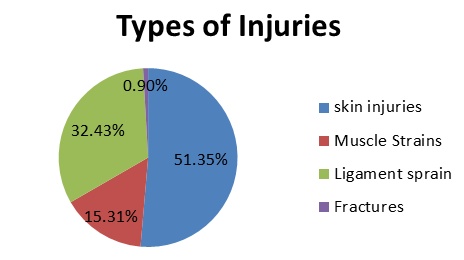
The most common nature injury seen was soft tissue injuries. It was observed that 83.4% players had suffered from some or the other injury over past one year. Most of the players had superficial skin injuries (51.35%), 32.43% suffered from ligament sprains while 15.31% had of muscle strain (Figure 1).
Location of Injury
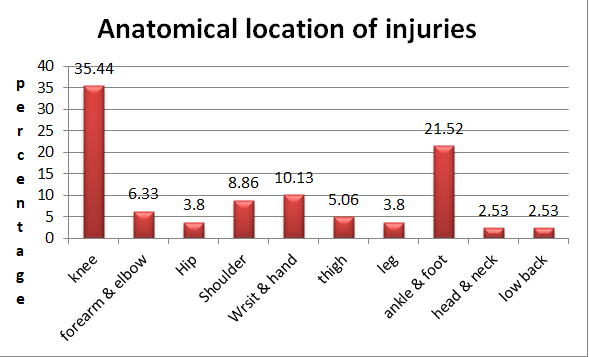
Injuries on the dominant side were more common. The knee was the most frequently injured site with 35.44% of injuries followed by the ankle & foot, wrist & hand with 21.52% and 10.13% respectively (Figure 2).
Cause of Injury
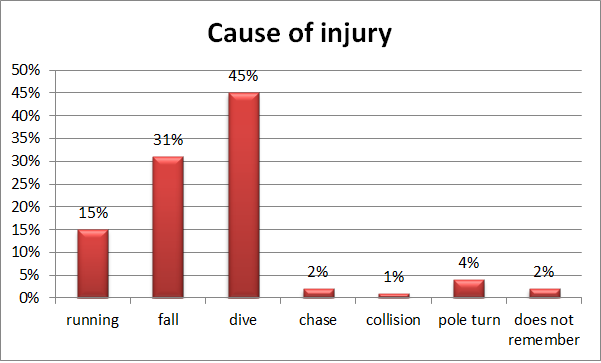
45% players were injured during dive, 31% due to fall, 15% during running, while 2% of them did not recollect the cause of injury (Figure 3).
Practice Surface and Duration of Play
83.4% of the players practiced regularly on muddy surface, 9.8% were practicing on concrete surface, 6% on grass surface while less than 1% practiced on turf. 61.6% players were playing the game since 1-3 years, 25.5% were playing since of 4-6 years, while 2.8% had been playing for more than 6 years.
BMI Range and Nutrition
A majority of the athletes were underweight with 54.9% athletes in BMI range 16-20.9, 2.3% in the range of 11- 15.9 and only 12.8% were in the BMI range of 21-25. 79% of the players did not follow any specific sports nutritional program. Only 21% followed high protein diet.
Treatment of Injured Players
Most of the injured players received first aid including bandage in 47% and spray in 18%. 10% players were given RICE protocol. Only 7% of the injured players required hospital admission. Only 2% of injured players had received physiotherapy treatment.
Time Loss
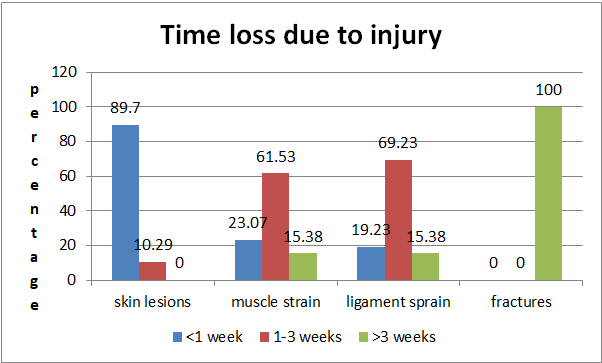
Time loss due to injury for superficial skin conditions had missed their practice session for a week (89.7%), whereas participants who had muscle strain (61.53%) and ligament sprain (69.23%) had to miss their practice/competition for a period of 1-3 weeks. Only 1 participant had reported history of fracture in past 1 year and time loss was for more than 3 weeks (Figure 4).
Discussion
The overall goal of the present study was to identify the prevalence of musculoskeletal problems, injuries as well as common site of injury in Kho-Kho players. The participants of the current study were 133 school and college going kho-kho players, including 81% males and 19% females, from sports clubs and tournaments in Mumbai region. Participation rate was higher in males than in females. There was a higher prevalence of injuries (83.4%) in these young athletes. Kho-kho, a game of strength, speed, agility, stamina is played all over India especially by adolescents and young adults. This game includes the threat of injuries. Collision with the opponent as well as with the team members is usual. Contact with poles also leads to injuries [1].
Controlled Sprinting, Dodging, Diving, Post Diving, Covering, Pole Turning are a few skills exhibited during the game. It is generally seen that due to excitement of the game the active chaser instead of just ‘touching’ rather ‘pushes’ vigorously the seated chaser which may lead them towards the injury [6]. Injuries occur while diving, pole turning, running and chasing. Slipping and falling while running is also frequent [7]. The most common causes of injury noted in this study while playing the game were diving (45%) to touch the opponent, fall (31%) while diving, running (15%) and pole turning (3%).
Running, quick movements, critical jump, and stretching styles while playing kho-kho can result in knee joint injury, ankle injury, skull injury, abdominal injury, etc. The injury trends in the present study were similar to researches carried out in the past. In this study, it was noted that injuries on the dominant side were more common [8]. The knee was the most commonly injured site followed by the ankle & foot. Other investigators have also observed that the knee and ankle were the most common sites of injury. In this game, the knee almost always comes in direct contact with the playing surface [1]. The most used body part in this game is the knee and hence it is frequently injured. In the upper extremity, it was observed in the current study that injuries mainly occurred in the shoulder, wrist & hand. The palm often comes in contact with the rough surface, which also sometimes causes injury to the hand and fingers. Injuries to the hand also occur from falling on to the hand as well as contact with another player.
The most common superficial skin injuries observed in the players were skin abrasions and deep skin cuts as a result of tendency to fall [1]. 31% of the participants were injured due to falling. 32.43% of the players complained of sprain. Knee and ankle sprains were more common. Muscle strain was noted in 15.31% – mainly in the thigh and calf muscle. This again confirmed that lower limb injuries are more common while playing this game.
Majority of sport injuries in this study were relatively mild and required simple forms of treatment. The first aid offered for most injuries was bandage, spray and RICE – rest, ice, compression and elevation. Only a few cases needed more extensive treatment in a medical set up and very few (7%) required hospital admission. Although a considerable number of players suffered from knee and ankle sprain as well as muscle strain, very few (2%) were given physiotherapy treatment.
A combination of a hard, uneven playing surface and contact of the knee creates a situation of possible injury. During a fall, the palm and hand are often injured due to contact with rough or hard surface [1]. In the present study, most of the players (83.4%) practiced and played on muddy surface which is ideal. As on today, kho-kho is played on grounds prepared from mud or turf.
Less than 50% of the participants used protective devices while playing. The players mainly used knee and ankle supports [9]. Since knee, ankle and hand are more commonly injured sites, good use of protective equipment is essential. All participants will benefit from use of protective devices as they aid performance and reduce the risk of injury. Good and properly fitted protective gear will help in preventing injury and re-injury [3].
It has been noted that most of these injuries result from intrinsic risk factors; others are due to poor training practices, inadequate facilities, lack of conditioning, or insufficient warm-up and stretching. In any game, an appropriate warm up and cool down period is necessary. Most of the players in the current study followed a warm up period of 20-30 minutes and did cool down exercises after the game. Improper warm up and cool down has shown to increase the risk of injury.
Most participants (54.9%), in the present study were in the BMI range of 16 - 20.9, which is on the lower side. Only 21% athletes followed a specific nutrition program, consisting mainly eggs and high protein diet. A well balanced diet with adequate carbohydrates, lean protein, energy intake, vitamins and minerals is recommended for kho-kho players.
The time loss varied depending on the nature of injury. For superficial skin injuries 89.7% had to skip practice/competition for at least 1 week. For Muscle (61.53%) and Ligament injuries (69.23%), the participants took rest from training or competition for a period ranging from 1 week to 3weeks depending upon the severity of injuries. Injuries and returning to the sport after that are major concerns among athletes. Majority of the injured players returned to play after one to three weeks as the nature of injury was mild [10].
Prevention and intervention have become focal points for researchers and clinicians. In order to decrease recovery time and promote healing, swelling and tissue congestion in the injured area must be controlled and reduced. Continuation of training and/or playing following an injury significantly increases the severity of most injuries [11]. Hence, the injured player must take rest till the injury is healed completely. Adequate nutrition also helps in recovery.
The results of this study indicate that injury rate in kho-kho players is highly notable. This research provides a platform for further research on various injuries occurring in kho-kho players, especially regarding the severity of injury and methods to prevent and reduce such injuries. A detailed study of the facilities provided to these players will help to reduce their prevalence and further improve performance.
Conclusion
In the current study, a high prevalence (83.4%) of injuries was noted in young kho-kho players in the past one year. Lower limb injuries were more common. The knee and the ankle & foot were the most commonly injured sites in the lower extremity. In the upper limb, maximum injuries occurred on the shoulder, wrist & hand. Soft tissue injuries like superficial skin injuries were more common followed by Ligament sprains and muscle strains.
Acknowledgement
The authors would like to acknowledge the athletes who participated in the study. We would also to thanks Mr. Umesh Bhaide, senior Kho-Kho coach for his support.
References
-
Sen J (2007) A Study of Injury Profiles of Kho-Kho Players. International Journal of Applied Sport Sciences 19(1): 1-11.
-
Senthilkumar P (2015) Comparative Study of Speed Agility and Strength Endurance among Kho-Kho and Kabaddi Players. International Journal of Recent Research and Applied Studies 1(8): 37-39.
-
Sreekaarini L**,** Eapen C, Zulfeequer CP (2014) Prevalence of Sports Injuries in Adolescent Athletes. Journal of Athletic Enhancement 3(5).
-
Prabhu A, Kumar CK (2014) Common injuries among Kabbaddi and Kho -Kho players - An empirical study. International Journal of Engineering Research and Sport Science 1(7): 1-4.
-
Philips LH (2000) Sports Injury Incidence. British Journal Sports Medicine 34(2): 133-136.
-
Mali A (2014) Prevalence of injury in Kho -Kho and players of Vidarbha region. International Human Research Journal 2(2).
-
Vivek R (2016) Comparative study on agility and explosive power between high school Kho- Kho and basketball players of Puducherry. International Journal of Physical Education and Sports 1(5): 8-14.
-
Gundre SD, Suryavanshi SV, Sangle D, Sonawane DB, Dafne LP, et al. (2015) Injury Profile in state level Inter University sports competition. IOSR Journal of Sports and Physical Education 2(3): 44-47.
-
Shantharaju, Madialagan S (2017) Performance of University Level Kho-Kho Players in relation to Selected Cognitive Variables 3(2).
-
Dhillon H, Dhillon S, Dhillon MS (2017) Current Concepts in Sports Injury Rehabilitation. Indian Orthopedics 51(5): 529-536.
-
Dhabolkar A, Singh K, Patil D (2017) Evaluation of foot posture and Correlation with the injury in female Kho-Kho players. International Journal of Physical Education, Sports and Health 4(4): 381-384.
- Electrolyte Considerations for Athletes
- Comprehensive Rehabilitation in Adults with Diabetic Peripheral Neuropathy: A Literature Review on Frequency, Intensity, and Duration Parameters
- Exercise Duration and Its Association with ADHD Symptom Severity in Children and Adolescents: A Parent-Reported Survey Study
- Adaptation of the Adult Neurophysiology of Pain Questionnaire for Use in Pediatrics
- A Non-Pharmacological Multidisciplinary Pain Program within a Hospital Wellness Program: A Mixed Methods Study
- The Effect of Frenkel's Exercise with PNF on Functional Reach in Stroke Survivors: A Randomized Control Trial