
School and Sleep Participation of University Students
Occupational therapists deemed that restful and adequate sleep is an essential factor that affects occupational performance, participation and engagement in daily life because sleep influences many body functions such as cognition that aids an individual to function optimally. In order to achieve the beneficial effects of sleep, literatures suggest the right number of hours of sleep that individuals should obtain which is seven hours of night sleep and eight to nine hours of daily sleep. This study aimed to determine whether there’s a correlation between sleep participation which includes the number of hours of sleep and school participation of allied medical students in terms of their grade point average. Descriptive correlational research design was used to achieve the aim of the study. The subjects were chosen via convenient sampling wherein questionnaires were distributed upon the approval of the department chair of Occupational Therapy of University Batangas. The study found out that the average number of hours of sleep of the students was not tied with their grade point average. This study also revealed that majority of the respondents, which constituted 57.5% sleep for only 6 hours. Although the relationship between number of hours of sleep and grade point average were inconclusive, it is still alarming that most of the students were not able to get the recommended amount of sleep. There is a possibility that number of hours of sleep can affect other areas of occupation, not necessarily the student’s school participation.
Homoroc ZCV and Luna SMA
student’s school participation.
Keywords: Sleep Participation; School Participation; Occupational Therapy
Introduction
The definition of sleep and a description of its functions have always baffled the scientists. By 1830, Macnish defined sleep as “suspension of sensorial power in which the voluntary functions are in abeyance but the involuntary powers such as circulation or respiration, remain intact [1].” In simple terms, sleep is defined as an altered state of consciousness during which the body rests and restores itself [2]. Many health professionals see the importance of sleep. One of which are occupational therapist. In fact, sleep belongs in one of the domains of occupational therapy practice. As cited by Ho & Siu [3] in occupational therapy theories, sleep is viewed as a restorative occupation which aims the goal of rest and recuperation. Also, having a good sleep could support formation of the occupation mix of self-care, work and leisure.
Sleep have many important functions in the human body, one of which is its function in memory. Sleep plays a role in stabilizing the perceived information and facilitating general knowledge [4]. It also helps with memory consolidation, learning, decision-making, and critical thinking [5], as cited by King [6] concluded that sleep is vital to the consolidation of memory, whether memory for specific information, for skills or for emotional experience. Sleep plays a role in learning; therefore, it is very vital for those individuals who go to school.
Sleep and academic performance may be related through several pathways and mechanisms. A study made revealed that sleep restriction has resulted in impaired learning and memory performance in early adolescence. In addition to this, sleep may also impact upon academic performance indirectly through tardiness or school absence, which often accompanies sleep problems in the age group of adolescence [7]. Another study made by Baert, et al. [8] revealed that deterioration of overall sleep quality, leads to a decrease of the exam mark with 0.97 out of 20 points (or with 4.85 percentage points). The study also revealed that night’s rest is essential to helping maintain mood, motivation, memory and cognitive performance. This was supported by a study among undergraduate medical students which showed that optimized sleep leads to improved learning ability that further enhanced their academic performance. Those students having high grades have better sleep quality than those with low grade [9]. In all those studies, number of hours of sleep became a very vital part that contributes to the cognitive capacity of the participants.
However, there are studies that suggest that there is an inconclusive relationship between sleep and academic achievement. One study showed no significant difference on cognitive tests that they conducted and sleep deprivation. This suggests that one night sleep deprivation only have minimal effects on the cognitive capacity of the participants. The study also showed that physical performance is more affected than the cognitive performance. Changes in physical performance include increased post exercise blood pressure, increase reaction time and decrease heart rate post exercise in students [10]. Another study among health sciences students showed that a significant proportion of the respondents experienced sleep deprivation and they are not able to complete nocturnal hours of sleep at night but, that doesn’t affect the student’s academic performance in terms of their general point average [4].
One negative factor that contributes in academic performance is sleep deprivation. Sleep deprivation is common amongst university students who live in a culture that promotes reduced sleep, due to the burden of academic work and social pursuits. The reasons for poor sleep hygiene include alcohol and caffeine intake, stimulants, and technology, which prevent students from achieving enough sleep time and quality [10]. Sleep deprivation also works against the student’s efforts to study and learn.
Because sleep is an essential component of life and it falls under one of the occupational domains, it should be one of the things that an occupational therapist should consider. According to American Occupational Therapy Association [11] Fact Sheet, restful and adequate sleep provides the foundation for optimal occupational performance, participation, and engagement in daily life, a concept that is historically consistent with the development of occupational therapy. Since sleep lies within the scope of practice of occupational therapy, some prevention and intervention strategies to address individual, family and population-based sleep needs are included.
There are four types of effective sleep management that occupational therapist usually use. These are use of assistive devices, cognitive behavioral therapy for insomnia, activities and lifestyle interventions [4]. Lifestyle interventions can be a focus of occupational therapist once it is identified that number of hours of sleep and school participation (in terms of general point average) is correlated. As cited by Ho & Siu [4], a lifestyle intervention emphasizes promotion of sleep habits and activity rescheduling. Too much or too little daytime activities are highly related to sleep pattern at night, thus, rescheduling a daytime activity helps a person in achieving a balance lifestyle to facilitate sleep during night time.
The aim of this study is to determine whether there is a correlation between sleep participation which include number of hours of sleep and school participation of allied health students in terms of their grade point average. The significance of this study is that people will be more aware of how important sleep is when it comes to learning. It will also pave way for occupational therapists to recommend sleep protocols and some lifestyle interventions that will help improve occupational performance.
Literature Review
Sleep changes through the life cycle, becoming shorter and lighter with aging. As adults, people tend to spend approximately one third of their lives asleep and a they progress through life, there are certain changes in sleep architecture. Most notable change is the change in sleep quantity. Sleep quantity is concerned with the amount of time spent for sleeping. There are numerous studies that showed short sleep, long sleep and sleep problems are related to poorer cognitive function [12]. In the study made by Dean, Lowry & Manders [13], they found out that average amount of sleep per night was correlated with the general point average of the students while sleep quality of the students was found not to be correlated with the student’s GPA.
Because sleep is treated as a necessity in life, there are various theories in the literature that proposed the need for sleep. Chokroverty [1] mentioned the first two theories which are restorative theory and theory of adaptation and energy conservation. Rathus [14] mentioned another theory for the need for sleep. This theory is the evolutionary perspective theory. First, from an evolutionary perspective, sleep may have developed because animals needed to protect themselves at night. The idea is that it makes sense for animals to be inactive when it is dark, because nocturnal inactivity helps them to avoid both becoming other animals’ prey and injuring themselves due to poor visibility. as cited by Rathus [14] suggested another second possibility is that sleep is a way to conserve energy. Spending a large chunk of any day sleeping allows animals to conserve their calories, especially when food is scarce For some animals, moreover, the search for food and water is easier and safer when the sun is up. When it is dark, it is adaptive for these animals to save their energy. Animals that are likely to serve someone else’s food sleep the least of all. A third explanation for the need for sleep is that sleep is restorative. Scientists have proposed that sleep restores, replenishes, and rebuilds the brain and body, which the day’s waking activities can wear out. This idea fits with the feeling of being tired before we go to sleep and restored when we wake up. In support of the theory of a restorative function of sleep, many of the body’s cells show increased production and reduced breakdown of proteins during deep sleep.
Aside from the theories discussed above, it is also important to note that one of the reasons why sleep is very vital in life is because sleep serve many functions. During sleep, our body rests our muscles, decreases metabolism, cellular maintenance in neurons, reorganizes synapses and strengthen memories [15]. In order to achieve the beneficial effects of sleep, literatures suggest the right number of hours of sleep. Rathus [14] cited the amount of sleep we need seems to be in part genetically determined. Human body normally requires seven hours of night sleep and eight to nine hours of daily sleep [9]. Although 7.5 hours is frequently cited as adequate for healthy adults, recent sleep extension studies with college athletes showed performance enhancement at 10 hours of time in bed [16].
One important function of sleep is its function in cognition thus, once there is a presence of sleep deprivation, cognition can be affected. Cognitive functions particularly affected by sleep loss include psychomotor and cognitive speed, vigilant and executive attention, working memory, and higher cognitive abilities [17]. A study made as cited by Jungnickel, et al. [18] suggested that inadequate sleep decreases general alertness of an individual and also impairs the attention which results in slower cognitive processing. As cited by King [6] lack of sleep is stressful and has an impact on the body and the brain. The impact of sleep loss may be severe in cognitive and behavioural domains [16]. According to Mullington, et al. [19] when deprived of sleep, people have trouble paying attention to tasks and solving problems. Studies have shown that sleep deprivation decreases brain activity in the thalamus and the prefrontal cortex and reduces the complexity of brain activity [6]. Under deprivation of REM sleep, animals and people learn more slowly and forget what they have learned more quickly. REM-sleep-deprived people and animals tend to show REM rebound, meaning that they spend more time in REM sleep during subsequent sleep periods [14].
Sleep deprivation is also a factor in mental health disorders. Cited in the study made by Ashouri FP [9], is a study among medical students which revealed that there is a relationship between psychiatric disorders, specifically depression and anxiety and sleep disturbance. People who don’t get enough sleep react more severely when placed in stressful situations. It is either they can develop psychiatric symptoms or it can aggravate the symptoms that they already had [15].
Role of Occupational Therapy in Sleep
The OTPF-2 defines sleep as “[a] natural periodic state of rest for the mind and body, in which the eyes usually close and consciousness is completely or partially lost, so that there is a decrease in bodily movement and responsiveness to external stimuli [20]. In OTPF-3 the sub-areas of rest and sleep are rest, sleep preparation, and sleep participation. Sleep preparation is engaging in routines that prepare the self for a comfortable rest, such as grooming and undressing, reading or listening to music to fall asleep, saying goodnight to others, and engaging in meditation or prayers; determining the time of day and length of time desired for sleeping and the time needed to wake; and establishing sleep patterns that support growth and health (patterns are often personally and culturally determined). Preparing the physical environment for periods of unconsciousness, such as making the bed or space on which to sleep; ensuring warmth or coolness and protection; setting an alarm clock; securing the home, such as locking doors or closing windows or curtains; and turning off electronics or lights. In sleep participation an individual is taking care of personal needs for sleep, such as ceasing activities to ensure onset of sleep, napping, and dreaming; sustaining a sleep state without disruption; and performing nighttime care of toileting needs and hydration; also includes negotiating the needs and requirements of and interacting with others within the social environment such as children or partners, including providing nighttime caregiving such as breastfeeding and monitoring the comfort and safety of others who are sleeping [21].
There are four types of effective sleep management that occupational therapist usually use. These are use of assistive devices, cognitive behavioral therapy for insomnia, activities and lifestyle interventions [3]. Occupational therapy interventions to improve sleep includes client education, self-care and health habits, occupational balance and optimal environments [16]. The occupational therapist addresses the issue of inconsistent sleep time as a result of a poor lifestyle of an individual, difficulty in management of multiple roles and responsibilities [22].
Methods
Research Design
The study used the descriptive correlational method in order to identify the interrelationship between the number of hours of sleep and grade point average of the students of University of Batangas College of Allied Medical Sciences.
In terms of the data gathering instruments, the researchers used questionnaires to determine the profile, the number of hours of sleep, and grade point average of the respondents.
Ethical Considerations
The study adhered to the Helsinki principles wherein each participant was initially asked to provide an informed consent. Also, the study proposal underwent review and approval from the Department Chair of Occupational Therapy under the College of Allied Medical Sciences.
Participant Recruitment
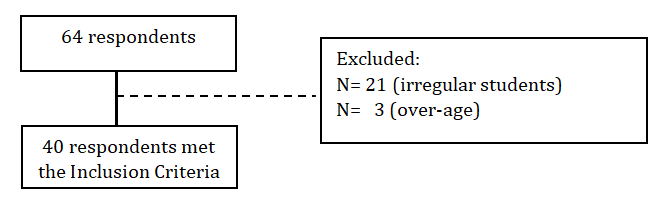
The subjects were chosen by means of convenient sampling which involved all of University of Batangas College of Allied Medical Sciences students. Out of 64 respondents, only 40 respondents met the inclusion criteria of this study. The other 24 respondents didn’t meet the inclusion criteria because 21 of them were irregular students and 3 of the respondents were beyond the age required for the study. The criteria for inclusion of the subjects consisted of respondents who was enrolled students in University of Batangas College of Allied Medical Sciences under any of its offered programs such as BS Physical Therapy, BS Occupational Therapy, and BS Respiratory Therapy. They were regular students of the last semester and in terms of age, they must range from 18 to 23 years of old [23].
Meanwhile, criteria for exclusion of the subjects are working and irregular students, interns and employees of the university.
Data Gathering Procedure
To attain the data for the completion of the study, the researchers gathered data from books, journals, and online references that are connected to the study. The researchers also created a questionnaire through a review of literature initially underwent approval from at least 2 professionals. The researchers also sought approval from the CAMS department to distribute the questionnaires to the subjects who belong to the said department. After the sought approvals, the researchers went room to room to distribute the questionnaires to the respondents. They
asked the subjects’ consent to answer the questionnaires and once approved, the researchers explained to the subjects the instructions in answering of the questionnaires. The researchers stood by while the subjects were answering to provide assistance when needed. When the respondents failed to recall their GPA last semester and they were unable to provide the answers in the questionnaire, a follow up in the following day was done by the researchers. After obtaining all the data needed, the researchers went through a series of steps in data gathering and tallied and subjected the results to statistical treatment.
Statistical Treatment
The frequency and percentages were used to describe the profile of the respondents, sleep quantity and grade point average whereas the researchers used the Pearson r correlation, which measures the linear association between two variables which were the grade point average and the number of hours of sleep [24]. The following formula was used to calculate the Pearson r correlation:
r = Pearson r correlation coefficient N = number of observations ∑xy = sum of the products of paired scores ∑x = sum of x scores ∑y = sum of y scores ∑x2= sum of squared x scores ∑y2= sum of squared y score T-test √ √ n= total number of respondents r= value of Pearson’s correlation Upon arriving with the value of the r in Pearson’s correlation, T-test was used. Significance level of 0.05 was used with 38 degrees of freedom, thus arriving to the critical value of t-distribution which is 1.686.
Results
| Frequency | Percentage | ||||||
|---|---|---|---|---|---|---|---|
| Gender | Male | 8 | 20 | ||||
| Female | 32 | 80 | |||||
| Age | 18 | 9 | 22.5 | ||||
| 19 | 23 | 57.5 | |||||
| 20 | 3 | 7.5 | |||||
| 21 | 3 | 7.5 | |||||
| 22 | 1 | 2.5 | |||||
| 23 | 1 | 2.5 | |||||
| BSPT | 13 | 32.5 | |||||
| Course | BSOT | 15 | 37.5 | ||||
| BSRT | 12 | 30 | |||||
| 1 | 29 | 72.5 | |||||
| Year Level | 2 | 0 | 0 | ||||
| 3 | 1 | 2.5 | |||||
| 4 | 10 | 25 |
The study engaged students from College of Allied Medical Sciences. The total number of respondents were 64 but only 40 respondents meet the inclusion criteria. An analysis of the respondent’s characteristics revealed that 80% of the respondents were female and the remaining 20% were male. The age range of the respondents was 18-23 years old but most of the respondents were 19 years old which garnered 57.5% of the total number of respondents. Meanwhile, majority of the respondents were first year students and taking up Bachelor of Science in Occupational Therapy.
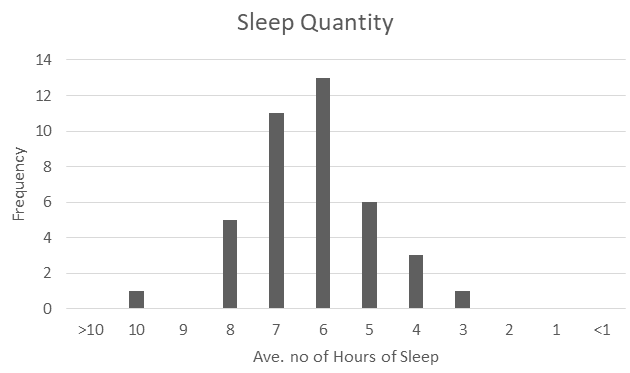
Majority of the respondents, which constituted 57.5% were not able to get the recommended amount of night sleep. Literature suggests that young adults must aim to have 7-9 hours of sleep at night [25]. Most of the respondents who did not get the recommended amount of sleep had an average of 6 hours of sleep per week during school days and constituted the largest percentage which was 32.5.
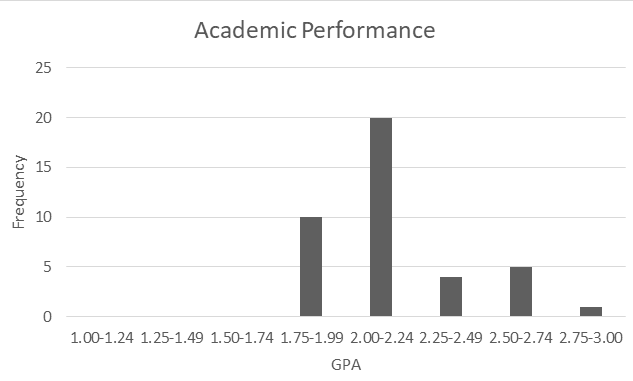
In terms of academic performance of the respondents, majority of the respondents had a GPA between 2.00 and 2.24. This constituted 50% of the total number of the respondents.
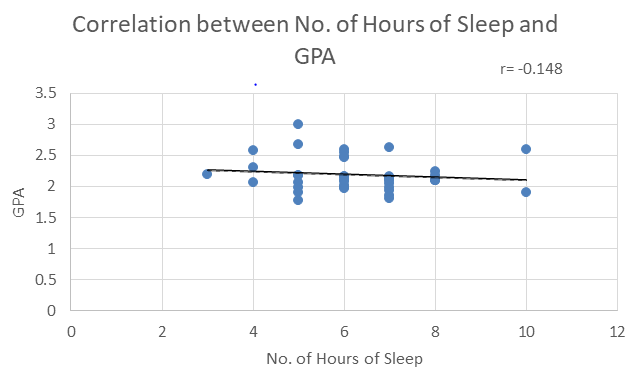
Figure 4: Hypothesis Testing. There is no significant correlation between academic performance in terms of grade point average and quantity of sleep in students of College of Allied Medical Sciences. A Pearson’s Correlation was used to test the hypothesis. Using the 0.05 significance level, the researchers arrived at a critical value of 1.686 which is higher than the computed t-value -0.922. The findings agreed with those of previous studies. A study showed that both sleep quantity and sleep quality were insignificantly related to the academic performance of some medical students.
They indicated that academic performance may be due to other factors like personality and time management [26]. Another study done in College of Allied Health Science of Kebangsaan University in Malaysia reported that the academic achievements were not impacted by sleep duration hours.
Discussion
This study showed that a significant proportion of the students in College of Allied Medical Sciences were not getting the recommended amount of sleep. Literature suggest that obtaining 7 hours of sleep per day is essential for a growing adult to achieve optimum health and well- being [18]. This finding among the students of College of Allied Medical Sciences can warrant attention from faculty members and school administration. Previous researches showed that sleep deficits was not only tied with the cognitive function of an individual but it also lead to other sleep related complications such as diabetes and cardiovascular disease [18].
This study also showed that there was no significant correlation between the number of hours of sleep and grade point average. This can indicate that academic performance of the students may be due to other factors, which was mentioned by the respondents who did not supported the hypothesis that sleep quantity and grade point average were correlated. Type of learner the student was, being engage in social media sites and being pressured to study for almost whole night were some of the factors that the students recognized that took part in their academic performance. There were researches that also found the same result. A study made among medical students at Riyadh showed that both sleep quantity and sleep quality were insignificantly correlated with the student’s academic performance [26]. Another study among college students showed that the average amount of sleep of a student receive per night does seem to be tied with the student’s grade point average [13].
On the other hand, some respondents supported the hypothesis that there was a correlation between number of hours of sleep and academic performance. Those who supported the hypothesis said that sleeping serve as a resting time for them, thus can further improve their academic performance. The respondents also recognized that when sleep deprived, the ability to focus on school activities lessen. Also, daytime sleepiness occurs when they did not get enough time in sleeping thus impedes their participation in school. Various researches supported that sleep was an important factor when it comes to academic performance. A study made on the student pharmacists at Kenya revealed that the sleep the night prior to an examination is correlated with the student’s course grade and the student’s semester.
Conclusions
It was found on the study that there is an insignificant relationship between the number of hours of sleep and GPA. According to the comments from the questionnaire, majority of the respondents agreed that the number of hours of sleep affects the academic performance of an individual while the rest stated that the number of hours of sleep alone does not affect their academic performance since there are other factors that need to be considered such as the class schedule, subjects, professors, extracurricular activities, health status, activities of daily living, and leisure activities. Although there is no significant relationship between sleep and GPA, there are literature studies that say a person should sleep at least 7 hours to function optimally.
Limitations of the Study
Several limitations were needed to be considered when interpreting the findings of this study. First, the study conducted on only small sample size of participants. Second, academic performance in this study only refers to the student’s GPA. Third, there were other factors that can take a role in the student’s academic performance such as their type of learning, intelligence quotient, time management and presence of stress and how they handle it.
Recommendations
For future researchers, there should be larger sample size or test selection that would give further holistic perspective on the impact of the number of hours of sleep on GPA. They should make a wider range of scope relation that assesses their IQ, student’s sleeping environment and some destressing techniques that they use when they have trouble on falling asleep. Researches about sleep would help the students to become aware of specifics ways that can utilize their sleep habits in the hope of improving grades.
In occupational therapy, the researchers suggest certain interventions for students to acquire balance in their sleep and education, such as educating the students on sleep's benefits, misconceptions, and expectations; addressing other conditions that may promote diminished sleep quality and quantity (e.g., depression, anxiety); establishing sleep scheduling; creating individualized sleep hygiene routines; teaching cognitive- behavioral techniques; improving one's coping skills, stress management, and time management; modifying the environment, such as noise, light, temperature, and technology use and; encouraging health management behaviors, such as decreased caffeine intake, a balanced diet, and adequate exercise.
References
-
Chokroverty S (2009) Sleep disorders medicine: Basic science, technical considerations and clinical aspect. Saunders Elsevier, Philadelphia.
-
Foss JJ, Tester NJ, (2018) Sleep as an occupational need. The American Journal of Occupational Therapy 72: 1-4.
-
Ho ECM, Siu AMH (2018). Occupational therapy practice in sleep management: A review of conceptual models and research evidence. Occupational Therapy International, pp: 1-12.
-
Al Aamer MA, Al Adel AM, Al Olayan LI, Modayder OI (2016) Impact of sleep quality and general health on academic performance. International Journal of Medical Science and Public Health 6(4): 779-782.
-
Gilbert S, Weaver C (2010) Sleep quality and academic performance in university students: A wake-up call for college psychologists. Journal of College Student Psychotherapy 24(4).
-
King LA (2011) The science of psychology: An appreciative view. McGraw-Hill, New York.
-
Askeland KG, Harvey AG, Hysing M, Linton SJ, Sivertsen B, et al. (2016) Sleep and academic performance in later adolescence: results from a large population-based study. J Sleep Res 25(3): 318-324.
-
Baert S, Omey E, Verhaest D, Vermeir A (2014) Mister Sandman, bring me good marks! On the relationship between sleep quality and academic achievement, pp: 1-40.
-
Ashouri FP, Pirouzan A, Rasekhi S (2016) Effects of sleep quality on the academic performance of undergraduate medical students. Health Scope 5(3): 1-7.
-
Gerard L, Gupta S, Lee A, Moghal MU, Morrell M, et al. (2017) Effects of sleep deprivation on cognitive and physical performance in university students. Sleep Biol Rhythms 15(3): 217-225.
-
Occupational Therapy’s Role in Sleep. American Occupational Therapy Association Inc.
-
Cappuccio FP, Hough J, Miller MA, Wright H (2014) Sleep and cognition. Intech, pp: 1-28.
-
Dean K, Lowry M, Manders K (2010) The link between sleep quality and academic performance for the college students. Sentience: The University of Minnesota Undergraduate Journal of Psychology 5(11): 16-19.
-
Rathus SA (2017) Psychology. 839 EDSA, South Triangle, CE Publishing, Inc., Quezon City.
-
Kalat JW (2016) Biological psychology. 12th (Edn.), Cengage Learning Asia Pte Ltd., Philippines.
-
Boyt Schell BA, Gillen G, Scaffa ME (2014) Willard & Spackman’s occupational therapy. Lippincott Williams & Wilkins, Philadelphia.
-
Dinges DF, Durmer JS, Goel N, Rao H (2009) Neurocognitive consequences of sleep deprivation. Semin Neurol 29(4): 320-339.
-
Jungnickel PW, Kennemur LM, Qian J, Savoie MJ, Song M, et al. (2015) Sleep duration and academic performance among student pharmacists. American Journal of Pharmaceutical Education 79(5): 63. Maudi E, et al. (2018) The relationship between sleep patterns and academic performance among medical students at King Saud Bin Abdulaziz University for Health Sciences. The Egyptian Journal of Hospital Medicine 70(7): 1131-1134.
-
Mullington JM, Meier-Ewert H, Haack M, Serrador J, Toth M, et al. (2009) Cardiovascular, inflammatory and metabolic consequences of sleep deprivation. Prog Cardiovasc Dis 51(4): 294-302.
-
Pendleton HM, Schultz-Krohn W (2014) Pedretti’s occupational therapy practice skills for physical dysfunction, 7th (Edn.), Elsevier Mosby, St. Loius, Missouri.
-
American Occupational Therapy Association (2014) Occupational therapy practice framework: Domain and process, 3rd (Edn.), American Journal of Occupational Therapy 68: 1-48.
-
Radomski MV, Trombly Latham CA (2014) Occupational therapy for physical dysfunction, 7th (Edn.) Elsevier Mosby, Baltimore, pp: 945.
-
Becky Brensinger B, Cheek S, Flood J (2008) The impact of sleepiness levels on academic achievement for college students. Undergraduate Research Journal for the Human Sciences 7.
-
Tolentino ARP, Tenorio MAI (2009) College statistics. Hilltop Batangas City, WBDC Bookstore, Philippines.
-
Abura GO, Gikunda RM, Kiriungi L, Muchiri JM (2014) The effects of sleep quantity on performance of students in public universities, Kenya. Merit Research Journals 2(6): 113-118.
-
Alakbi SM, Alghamdi RN, Algarni A, Alhazanni N,
- Electrolyte Considerations for Athletes
- Comprehensive Rehabilitation in Adults with Diabetic Peripheral Neuropathy: A Literature Review on Frequency, Intensity, and Duration Parameters
- Exercise Duration and Its Association with ADHD Symptom Severity in Children and Adolescents: A Parent-Reported Survey Study
- Adaptation of the Adult Neurophysiology of Pain Questionnaire for Use in Pediatrics
- A Non-Pharmacological Multidisciplinary Pain Program within a Hospital Wellness Program: A Mixed Methods Study
- The Effect of Frenkel's Exercise with PNF on Functional Reach in Stroke Survivors: A Randomized Control Trial