
Attitudes towards Assessment and Management of Chronic Pain amongst Clinicians at a Tertiary Care Facility, Kenya
Background: Chronic pain being a common medical condition seen by clinicians has a significant socio economic and health burden to clients, clinicians and the health institution. Patients with chronic pain presents with limited activities and participation restrictions affecting their quality of life. Previous studies have shown clinician’s negative attitudes towards management of chronic pain. Objective: To determine, attitudes of clinicians towards assessment and management of patients with chronic pain in a tertiary hospital in Kenya. Methods: This was a descriptive cross-sectional study designed to utilize a quantitative approach, a questionnaire containing 77 items was used to collect data, this study adopted census method of sampling because of the small number of the study population (n=240). A total of 153 clinicians volunteered to participate in the study. Data was analyzed using Statistical package for social sciences (SPSS) Version 24. Descriptive statistics was calculated and presented in summary tables and bar graphs. Chi-Square test was calculated to determine the association between sociodemographic characteristics and level of knowledge, attitudes and practice. The statistical significant was accepted at P – value less than 0.05. Results: The response rate was 83.3% (n=153). Only 9% (n= 14) of the respondents believed to have positive attitudes. While 62% (n=95) had negative attitudes on cognitive/behavioral management of chronic pain. Few participants (9% n=14) had positive attitudes in assessment and measurement of chronic pain. Conclusion: The current study supports the concern about negative attitudes and poor practices among clinicians in tertiary healthcare institution. We believe that continuous medical educational on chronic pain, adopting chronic pain guidelines, and research on pain curriculum in medical training institutions are needed to improve clinician’s knowledge, attitudes and practices which may result to better chronic pain outcome.
Abbreviations
NACOSTI: National Commission for Science, Technology and Innovation; KASRP: Knowledge and Attitudes Survey Regarding Pain; RPKAQ: Revised Pain Knowledge And Attitude Questionnaire.
Introduction
Despite the recent advances in understanding the algorithm of diagnosing and treating clinical pain, many clinicians globally continue to exhibit negative attitudes and misconceptions about chronic pain raising public health concern [1, 2, 3, 4, 5]. In addition, Chronic Pain being is one of the most common clinical symptoms reported by patients in referral facilities it has continue to impose a significantly socio-economic and health burden on patients, clinicians and the health care sector [6]. Conceptualizing chronic pain as; “an unpleasant sensory and emotional experience associated with actual or potential damage of tissue” [7] makes it complex to comprehend. Furthermore, in regard to relationship between chronic pain and tissue damage, the pain does not provide a measure of state of the tissue as it’s modulated by many factors which includes; somatic, psychological and social factors, therefore, the relationship between pain and tissue becomes less predictable as pain persist makes it complex to understand [8]. Chronic pain is both sensory and emotional components and thought to be without real biological cause and persist beyond the normal time for tissue healing [7, 9, 10]. Patients with chronic pain often report high levels of pain intensity, activity limitation, participation restrictions and poor quality of life which come with high medical costs as a result of prolong utilization of health care services [11]. In practice, the outcomes of patients with chronic pain are often poor because of inaccuracy among clinicians in choosing and administering appropriate treatment [12]. Inaccurate prescription for patients with chronic pain may be a function of misclassification or misdiagnosis which lead to inappropriate treatment and undesirable outcomes as well as increased health and social costs [1, 13].
Whereas the goal when managing people with chronic pain is to relieve pain and improve function; a bio-psychosocial approach is currently preferred for improved outcome especially when provided by a multidisciplinary team [8, 14, 15, 16]. However, research evidence has shown that most clinicians utilize a biomedical approach which is regarded as a retrogressive practice that is often associated with poor outcomes, reduced quality of life, increasing disability and high cost of health care [15, 16]. According to Gustafsson and Borglin [17] improving clinician’s level of knowledge positively influences their attitudes and practice for effective management of patients with chronic pain. However most of the studies have been conducted in developed countries such as UK settings, USA and in Asian countries [3, 18, 19]. In the African region, information regarding, attitudes of healthcare professionals about assessment and management of patients with chronic pain is relatively scanty. To address this gap, the current study was to determine the l attitudes on assessment and management of chronic pain amongst clinicians in a tertiary care facility in Kenya. This would establish a baseline for further research and inform future review of healthcare policy, capacity development programs and practice.
Materials and Methods
This cross- sectional survey was conducted Tenwek Hospital in Kenya from January 2020 to May 2020 after obtaining approvals from the JKUAT and Tenwek Hospital ethical and review committees and authority from National Commission for Science, Technology and Innovation (NACOSTI). The census method was adopted due to the small study population (n=240) all being clinicians who volunteered and were directly managing patients with chronic pain. The revised pain knowledge and attitude questionnaire (RPKAQ) and a section adopted from the knowledge and attitudes survey Regarding Pain (KASRP) questionnaire which mainly focuses on pharmacological management of pain was used to collect data. Both the RPKAQ and KASRP questionnaires have undergone cognitive testing and validation in different settings and cultures and have been found reliable (Cronbach’s alpha of 0.65 and 0.80 respectively); which is acceptable [4]. Collected data was entered twice into Microsoft Excel sheets and entry errors corrected. The clean data MS Excel sheet was imported into the Statistical Package for Social Sciences, version 24.0. Descriptive statistics were then calculated. Chi-square test of association between sociodemographic characteristics and the level of knowledge attitudes and practices was also calculated (level of statistical significance at P- value less than 0.05).
Results
A total of 153 clinicians volunteered to participate in this study. Male participants (52%; n= 79) were more than females (48%; n=74). Regarding age, majority of the participants (55 %; n=84.) were aged less than 30 years followed by those aged 31-40 (30%; n=47). Almost three quarters (71%; n= 108) of the participants had less than 5 years of experience. Only a handful (17%; n=27) had 6 plus years of experience. According to the participants level of education, majority had college education (70 %; n=106). Half of them were nurses (50%), followed by Clinical Officers (15%) with Physiotherapists (2%) and Dentists (2%) having the least representation as illustrated in Table 1.
| Characteristic | Frequency (n) | Percentage (%) |
|---|---|---|
| Gender | ||
| Males | 79 | 52% |
| Females | 74 | 48% |
| Age Group | ||
| < 30 Years | 84 | 55% |
| 31-40 Years | 47 | 30% |
| 41- 50 Years | 19 | 13% |
| > 50 Years | 3 | 2% |
| Years of Clinical Practice | ||
| 1-5 Years | 108 | 71% |
| 6- 10 Years | 27 | 17% |
| >11 Years | 18 | 12% |
| Level of Education | ||
| College Diploma | 106 | 70% |
| Bachelor’s Degree | 31 | 20% |
| Master’s Degree | 8 | 5% |
| Post graduates degree | 8 | 5% |
| Clinician Cadre | ||
| Nurses | 77 | 50% |
| Clinical Officers | 23 | 15% |
| Medical Officers | 14 | 9% |
| Physiotherapist | 3 | 2% |
| Consultant | 7 | 4% |
| Residents | 13 | 8% |
| Anesthetists | 8 | 5% |
| Dentist | 3 | 2% |
| Oncology Team | 5 | 3% |
Table 1: Socio-demographic characteristics of participants (N=153).
Level of Knowledge and Attitudes on Assessment and Management of Chronic Pain
Majority of the participants (91%; n=139) had inadequate knowledge and attitudes (scored below 75%) on assessment and management of chronic pain. With regard to their level of knowledge of chronic pain, developmental changes in pain perception (31% n= 48) had the majority and physiological basis of pain had the least number of participants with adequate knowledge and positive attitudes (10% n=16) as illustrated in Table 2 & Figure 1.
| Level of knowledge and attitudes on Chronic Pain | Adequate knowledge | Inadequate knowledge | Average score |
|---|---|---|---|
| n (%) | n (%) | ||
| Physiological Basis of Pain | 16 (10%) | 137 (90%) | 61.7% (12.6) |
| Psychological Factors of Pain Perception | 21 (14%) | 132 (86%) | 60.7% (13.9) |
| Developmental Changes in Pain Perception | 48 (31%) | 105 (69%) | 64.2% (18.9) |
- Knowledge and attitudes on Assessment & management
- Assessment and Measurement of Pain
- 14 (9%)
- 139 (91%)
- 51.7% (15.9)
- Cognitive/ Behavioral Methods of Pain Relief
- 95 (62%)
- 58 (38%)
- 78.5% (14.9)
- Pharmacological management of chronic pain
- 11 (7%)
- 142 (93%)
- 54.5% (11.8)
- Overall scores
- 14 (9%)
- 139 (91%)
- 61.9% (7.5)
Table 3: Level of knowledge and attitudes on Chronic Pain.
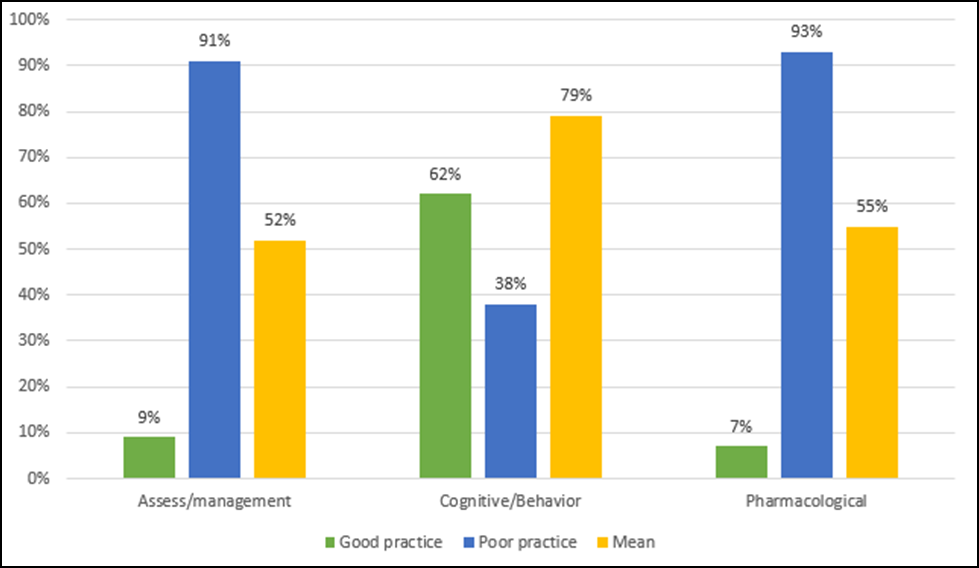
Discussion
The study is one of the few that have attempted to examine the attitudes of clinicians managing chronic pain in a tertiary hospital in Kenya. The results are a source of concern as majority of the participants (91%; n=139) had inappropriate attitudes towards management chronic pain. These results are similar to previous studies that have found clinicians have negative attitudes regarding management of chronic pain [4, 3, 12]. The finding of the current study may have been influenced by the fact that the majority of participants were diploma nurses (70% n-106) some with less than 5 years of clinical. The results resonate with previous studies that showed that nurses lacked requisite attitude and expertise to evaluate and manage chronic pain [1, 20, 21]. Further, experience is paramount to successfully manage chronic pain which majority of the nurses in the current study lacked. This view is supported by Miró, et al.
[22]; Shipton, et al. [23]; Enskär, et al. [24], Bouri, et al. [25] and Nuseir, et al. [1] studies that have showed that clinical experience and level of education influence clinician practice.
Though, the study examined wide range of clinical cadres, there was uneven distribution of among them; therefore, generalizing the results of this study to a larger population must be done cautiously due to its small study population. Despite this weakness, the results of this study may provide useful information on the level of knowledge, attitudes and practice of clinicians regarding chronic pain to the region and the study site.
Few studies in the region are similar to our findings; A Kenyan study by Jin [26] (n=96) which evaluated the knowledge and attitudes of various health care workers regarding pain assessment and management in children, in the country’s national referral hospital, found a significant knowledge gap among participants with over half (58.3%) performing poorly, while an Ugandan study by Kizza, et al. [27] found that 73.5% of nurses perceived to have inadequate knowledge in key concepts of pain management. Furthermore, a South Africa study by Clenzo, et al. [4] found 14.5% of participants with adequate knowledge. The results of the current study are in contrast to the UK, south Africa and Sweden (n=106) comparative study amongst nurses working with children with cancer by Enskar, et al. [24] who found that participants had high level of knowledge and appropriate attitudes towards pain management.
Regarding the current practices our study found only 9% (n= 14) of participants use best practice, which is similar to previous studies by Al-Quliti and Alamri [3] and Clenzo, et al. [4], who found 4%; (n=8) and 5.7% (n=6) of participants respectively had adequate knowledge in this domain. Similarly, on pharmacological domain, participants performed poorly which corroborates the findings of the study conducted by Kheshti, et al. [12]. The result is disturbing because it highlights a poor efficacy of most pain interventions people get and risk of chronification [28, 29]. Interestingly, by the current study recorded good performances in the cognitive/ behavioral aspect of chronic pain intervention compared to all other domains. This is a non-pharmacological aspect of pain intervention which focuses mainly on psychological, social and educational aspect of pain intervention which has been reflected by previous studies to be effective when combined with other modalities [30, 31]. Undoubtedly, the current study indicates the need to improve clinician’s level of knowledge, attitudes and practices in order to reduce the burden associated with chronic pain. A similar view was expressed in previous studies on healthcare providers knowledge, attitudes and practice with regard to pain management [6, 11, 32, 33]. Furthermore, educational intervention particularly continuous medical education and adopting chronic pain guidelines have been recommended by earlier studies to improve clinician’s knowledge, attitudes and practices [17, 33]. The current study results form a baseline for further research in a wider population and may inform future review of healthcare policy, training curricula and practices in healthcare [34, 35].
Conclusion
Patient with chronic pain continue to suffer due to clinicians’ unhelpful attitudes and generally poor practice. Educating clinicians on best practice about assessment and measurement of chronic pain, and encouraging self-initiated continuing medical education is critical. The results have an implication on training curricula and quality of healthcare in the region.
Acknowledgement
We would like to thank all clinicians at Tenwek Hospital who volunteered to participate in the study, the members of ethics and review committee of Jomo Kenyatta University of Agriculture and Technology Ethics, Tenwek Hospital and NACOSTI for their support during this study.
References
-
Nuseir K, Kassab M, Almomani B (2016) Healthcare Providers’ Knowledge and Current Practice of Pain Assessment and Management: How Much Progress Have We Made. Pain Res Manag pp: 1-7.
-
Magalhaes MO, Costa LOP, Cabral CMN, Machado LAC (2012) Attitudes and beliefs of Brazilian physical therapists about chronic low back pain: a cross-sectional study. Rev Bras Fisioter 16(3): 248-253.
-
Quliti KW, Alamri MS (2015) Knowledge, attitudes, and practices of health care providers in Almadinah Almunawwarah, Saudi Arabia. Neurosciences 20(2): 131-136.
-
Clenzos N, Naidoo N, Parker R (2016) Physiotherapists’ knowledge of pain: A cross-sectional correlational study of members of the South African Sports and Orthopaedic Manipulative Special Interest Groups. South African Journal of Sports Medicine 25(4): 95.
-
Ung A, Salamonson Y, Hu W, Gallego G (2016) Assessing knowledge, perceptions and attitudes to pain management among medical and nursing students: A review of the literature. Br J Pain 10(1): 8-21.
-
Goldberg DS, McGee SJ (2011) Pain as a global public health priority. BMC Public Health 11: 770.
-
(2015) What is neuropathic pain. International Association for the study of Pain pp: 1-3.
-
Moseley GL (2008) Reconceptualising pain according to modern pain science. Physical Therapy Reviews 12(3): 169-178.
-
Treede R, Cohen M, Quintner J, Rysewyk S (2018) The International Association for the Study of Pain definition of pain : as valid in 2018 as in 1979, but in need of regularly updated footnotes. Pain Rep 3: 3-5.
-
Raja SN, Carr DB, Cohen M, Finnerup NB, Flor H, et al. (2020) The revised IASP definition of pain:concepts, challenges and compromises. Pain 161(9): 1976-1982.
-
Salazar A, Mico JA, Failde I (2016) A review of chronic pain impact on patients, their social environment and the health care system. J Pain Res 9: 457-467.
-
Kheshti R, Namazi S, Mehrabi M, Firouzabadi D (2016) Health Care Workers’ Knowledge, Attitude, and Practice About Chronic Pain Management, Shiraz, Iran. Anesth Pain Med 6(4): e37270.
-
Breivik H, Collett B, Ventafridda V, Cohen R, Gallacher D (2006) Survey of chronic pain in Europe: Prevalence, impact on daily life and treatment. Eur J Pain 10(4): 287- 333.
-
Ernstzen DV, Louw QA, Hillier SL (2017) Clinical practice guidelines for the management of chronic musculoskeletal pain in primary healthcare: A systematic review. Implement Sci 12(1): 1-13.
-
Bevers K, Watts LF, Gatchel R (2016) The Biopsychosocial Model of the Assessment, Prevention and Treatment of Chronic Pain. Neuropathic Pain 12(2): 98-104.
-
Espejo TB, Segura OE, Domenech J, Lison JF, Sanchez ZD (2011) Impact of biomedical and biopsychosocial training sessions on the attitudes, beliefs, and recommendations of health care providers about low back pain: A randomised clinical trial. Pain 152(11): 2557-2563.
-
Gustafsson M, Borglin G (2013) Can a theory-based educational intervention change nurses knowledge and attitudes concerning cancer pain management ? A quasi- experimental design. BMC Health Services Researcher 13(328): 1472-6963.
-
Ryan C, Murphy D, Clark M, Lee A (2010) The effect of a physiotherapy education compared with a non- healthcare education on the attitudes and beliefs of students towards functioning in individuals with back pain: An observational, cross-sectional study. Physiotherapy 96(2): 144-150.
-
Duke G, Haas BK, Yarbrough S, Northam S (2013) Pain Management Knowledge and Attitudes of Baccalaureate Nursing Students and Faculty. Pain Manag Nurs 14(1): 11-19.
-
Yaqoob SH, Nasaif HA (2015) Nurses’ knowledge and attitudes toward pain assessment and management for adult sickle cell disease patients during sickling crisis. Clinical Nursing Studies 3(4).
-
Kiwanuka F, Masaba R (2018) Nurses ’ knowledge , attitude and practices regarding pain assessment among patients with cancer at Uganda Cancer Institute. J Anal Res Clin Med 6(2): 72-79.
-
Miro J, Castarlenas E, Sole E, Marti L, Salvat I, et al. (2019) Pain curricula across healthcare professions undergraduate degrees: A cross-sectional study in Catalonia, Spain. BMC Medical Education 19(1): 1-8.
-
Shipton EE, Bate F, Garrick R, Steketee C, Shipton EA, et al. (2018) Systematic Review of Pain Medicine Content, Teaching, and Assessment in Medical School Curricula Internationally. Pain Ther 7(2): 139-161.
-
Enskar K, Ljusegren G, Berglund G, Eaton N, Harding R, et al. (2007) Attitudes to and knowledge management about pain and pain management, of nurses working with children with cancer : A comparative study between UK, South Africa and Sweden. Journal of Research in Nursing 12(5).
-
Bouri F, Ansari A, Elhessy A, Dosari M, Mahmoud S, et al. (2018) Orthopedic Professionals’ Recognition and Knowledge of Pain and Perceived Barriers to Optimal Pain Management at Five Hospitals. Healthcare 6(3): 98.
-
Jin Z (2015) Knowledge and attitude of health care workers at Kenyatta National Hospital on pain assessment and management in children. Research Achieve.
-
Kizza IB, Muliira JK, Kohi TW, Nabirye RC (2016) Nurses’ knowledge of the principles of acute pain assessment in critically ill adult patients who are able to self-report. International Journal of Africa Nursing Sciences 4: 20- 27.
-
Ranger M, Johnston CC, Anand KJS (2007) Current Controversies Regarding Pain Assessment in Neonates. Semin Perinatol 31(5): 283-288.
-
Subhashini L, Vatsa M, Lodha R (2009) Knowledge, attitude and practices among health care professionals regarding pain. Indian J Pediatr 76(9): 913-916.
-
Louw A, Zimney K, Hotto C, Hilton S (2016) The clinical application of teaching people about pain. Physiotherapy Theory and Practice 32(5): 385-395.
-
Turk DC, Swanson KS, Tunks ER (2008) Psychological Approaches in the Treatment of Chronic Pain Patients- When Pills, Scalpels, and Needles Are Not Enough. Can J Psychiatry 53(4): 213-223.
-
Stewart WF, Ricci JA, Chee E, Morganstein D, Lipton R (2003) Lost Productive Time and Cost Due to Common Pain Conditions in the US Workforce. JAMA 290(18): 2443-2454.
-
Sessle BJ (2012) The Pain Crisis: What It Is and What Can Be Done. Pain Res Treat 2012: 703947.
-
Mcnamara MC, Harmon D, Saunders J (2012) Effect of education on knowledge, skills and attitudes around pain. Br J Nur 21(16): 958.
-
Khawla N, Kassab M, Almomani B (2016) Healthcare Providers’ Knowledge and Current Practice of Pain Assessment and Management: How Much Progress Have We Made?. Pain Res Manag 2016: 8432973.
- Electrolyte Considerations for Athletes
- Comprehensive Rehabilitation in Adults with Diabetic Peripheral Neuropathy: A Literature Review on Frequency, Intensity, and Duration Parameters
- Exercise Duration and Its Association with ADHD Symptom Severity in Children and Adolescents: A Parent-Reported Survey Study
- Adaptation of the Adult Neurophysiology of Pain Questionnaire for Use in Pediatrics
- A Non-Pharmacological Multidisciplinary Pain Program within a Hospital Wellness Program: A Mixed Methods Study
- The Effect of Frenkel's Exercise with PNF on Functional Reach in Stroke Survivors: A Randomized Control Trial