
Revisiting the Concept of “Angry Skin” and New “Calming” Strategies
A 6-year-old patient, come to our clinic reporting itching, especially at night on the entire body since 12 months. Asked about the symptoms the patient’s also stated the following: “My skin is always «angry», it itches and sometimes it burns. Maybe it he's made at me?”. She also added: “... and then it gets angry all over my body.
Dear Editor,
Let me send you a letter aiming at revisiting the concept of “angry skin” in children.
A 6-year-old patient, come to our clinic reporting itching, especially at night on the entire body since 12 months.
Asked about the symptoms the patient’s also stated the following: “My skin is always «angry», it itches and sometimes it burns. Maybe it he's made at me?”. She also added: “... and then it gets angry all over my body ...”.
Letter to Editor
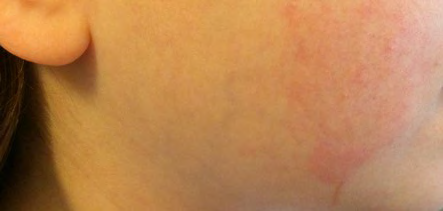
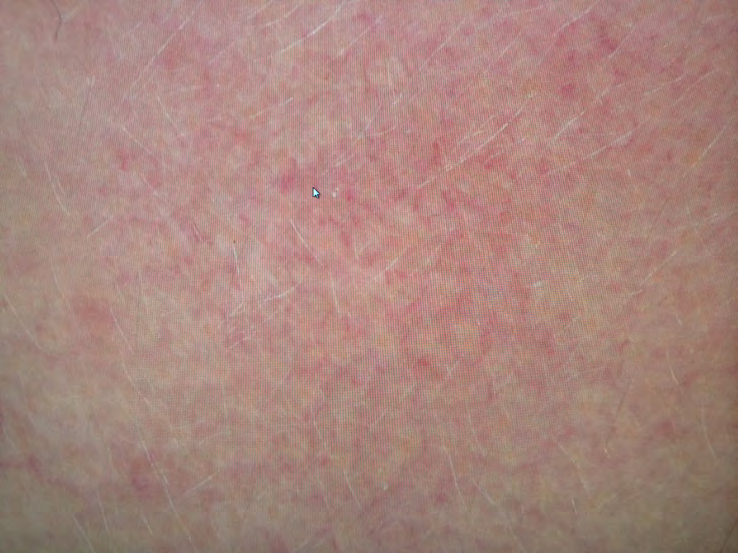
The dermatological examination reported dry skin, scratch marks, red to brownish-gray patches, especially on the cheeks, hands, and feet (Figure 1). The patient was analyzed also using dermatoscopy (MoleMax™) (Figure 2) and a diagnosis of eczema was made.
The concept of “angry skin” was first introduced by Mitchell [1] in 1975. He coined the term “Angry back syndrome” (ABS) to signal a strong positive reaction to patch testing of many substances on the back of subjects when one of these gave a strongly positive response. His thesis pointed out that the strong positive reaction affected the skin (which was “angry”) response giving results deemed false-positive.
Later Bruynzeel e Maibach [2] expanded the definition in “Excited Skin Syndrome” (ESS) suggesting that the whole skin of the body can become hyper-reactive as a response to allergic and irritating stimuli.
Another description of “angry skin” was reported by Kligman [3] who pointed out that as a consequence of repeated inflammatory cutaneous reactions or recurrent dermatitis skin could become hyper-reactive/angry.
Later, Memon [4] challenged Mitchell theory stated that ABS might be considered a rare, and individual-specific phenomenon and that also in the subjects who had previously been diagnosed as having ABS they failed to reproduce the angry back.
Here we want to share a reinterpretation of the «angry» skin concept extending the definite to all those phenomena resulting from various irritating stimuli on the skin, both from contact reaction and from atmospheric agents (e.g. sun, heat, cold, humidity, pollution, dust, etc). It can be stated that “Eczema calls Eczema”.
A child reporting irritating phenomena, so with “angry skin” according to the new concept, will manifest continuous inflammatory and irritating reactions all around his body.
In children with persistent sensitivity to one or more sensitizing substances, it would be advisable to consider treatments to keep the skin as less reactive as possible to improve the skin beneficial response. These treatments might be cosmetic either a medical device with a strong lenitive action containing also hydrating substances and probiotics or postbiotics [5] to keep also the microbiome well balanced and preserving its beneficial action on the skin. Product whit a limited number of ingredients (as less as possible), without perfumes or sensitizing substances have to be preferred.
The use of this kind of approach would also improve the quality of life of these patients which could resulted altered by the persistent use of topical or systemic antihistamines, corticosteroids, or, in the worst cases calcineurin inhibitors.
Also, the use of specific detergents and the removal of all the risk factors (cold, sun, dust…) have to be taken into account. Pay attention to the diet, in particular, could reveal its usefulness since the strict correlation between diet, gut microbiota, and immunity [6].
References
-
Mitchell JC (1975) The angry back syndrome: eczema creates eczema. Contact Dermatitis 1(4): 193-194.
-
Bruynzeel DP, Maibach HI (1986) Excited skin syndrome (angry back). Arch Dermatol 122(3): 323-328.
-
Kligman AM, Epstein W (1975) Updating the maximization test for identifying contact allergens. Contact Dermatitis 1(4): 231-239.
-
Memon AA, Friedmann PS (1996) ‘Angry back syndrome’: a non-reproducible phenomenon. Br J Dermatol 135(6): 924-930.
-
Rinaldi F, Daniela P, Giuliani G (2020) “Postbiotic Evolution in Dermatology”. EC Microbiology 16.3: 01-04.
-
Maslowski KM, Mackay CR (2011) Diet, gut microbiota and immune responses. Nat Immunol 12(1): 5-9.
- Epithelioid Granuloma; 3cases with Different Clinical Features
- Advancing Representation in Dermatology Clinical Trials: Ethical, Scientific, and Regulatory Imperatives for Inclusion Across all Fitzpatrick Skin Types
- A Case of Atopic Dermatitis with Concurrent Psoriasis Vulgaris: Successful Treatment with Upadacitinib
- Innovation Lifting Eyeshadow: A Synthesis of Makeup and Optical Illusion
- Distinguishing Superficial Actinic Porokeratosis from Actinic Keratosis with UVF Dermoscopy: A Case Report
- High Mobility Group Box 1 (HMGB1) in Cutaneous Inflammation: An Immune Modulator Bridging Cellular Stress, Ferroptosis and Danger Signaling