
Aplasia Cutis Congenita in the Napkin Area: A Rare Case Report
Aplasia cutis congenita (ACC) is a condition of localised or widespread areas of skin that are absent or scarred at birth. Most commonly it presents on the scalp however we present a rare case of ACC in the napkin area which, to our knowledge, has not been reported in the literature.
Introduction
Aplasia cutis congenita (ACC) is a condition of localised or widespread areas of skin that are absent or scarred at birth. Most commonly it presents on the scalp but it has been described on non-scalp locations such as the trunk and limbs. We present a case of ACC in the napkin area which, to our knowledge, has not been reported in the literature.
Case Report
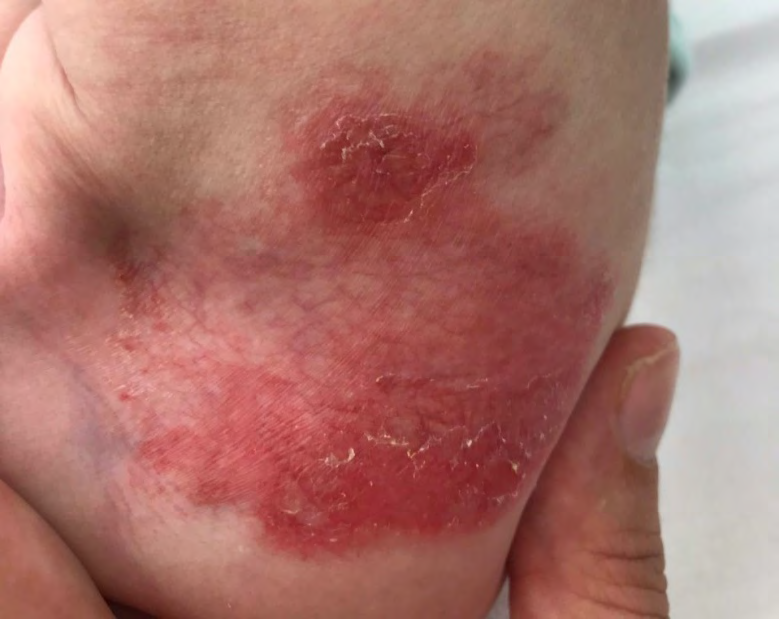
A ten week old baby girl of non-consanguineous parents presented with a 4.5 x 5.5cm erythematous, telangiectatic atrophic patch of skin in the left inguinal region underlying the nappy (Figure 1). The atrophic area had been present since birth but the erythema and mild scale started after a couple of weeks. Some areas were starting to erode. She had a capillary stain at the nape of her neck and a small congenital melanocytic naevus on her left palm but the rest of her skin was clear. She was an otherwise well baby, born at term and developing normally. There was no family history of ACC, history of foetus papyraceus or any perinatal infections or medications.
A diagnosis of ACC with secondary irritant napkin dermatitis was made clinically.
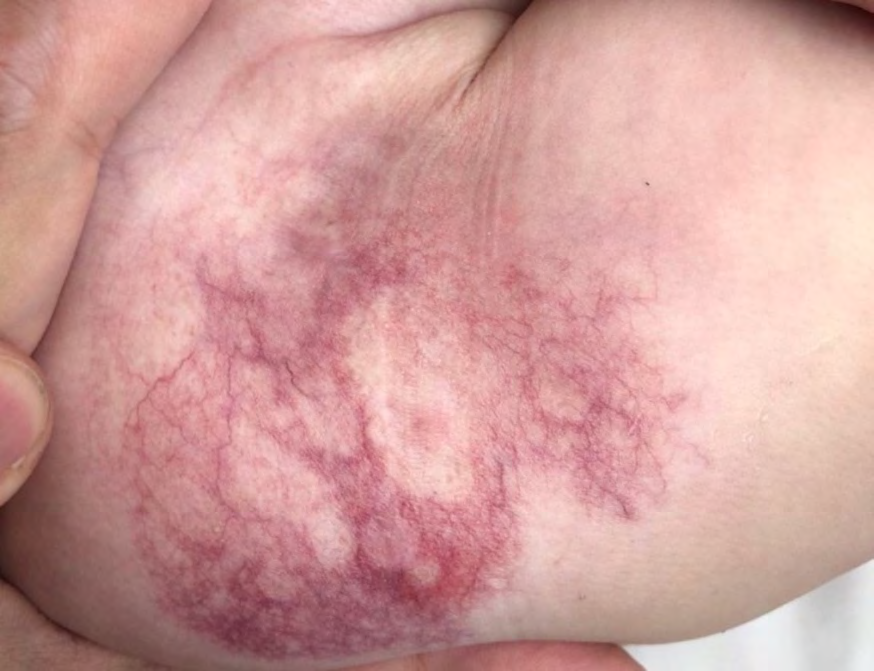
A biopsy was not taken as thought to be unnecessary as a number of opinions from expert dermatologists were sought and agreed with the diagnosis. Management included Methylprednisolone aceponate ointment to the areas of dermatitis and solugel to the eroded areas daily which worked very effectively. Non adhesive dressings were also used when the areas were eroded. Disposable nappies were used and cotton wool with water used to wash the area at nappy changes. Over a period of months the eroded areas and dermatitis resolved with intermittent Methylprednisolone aceponate ointment use (Figure 2).
Discussion
ACC affects approximately 1 in 10,000 newborns. The pathogenesis is unknown, but it can run in families. It has been linked to in-utero medications such as methimazole and carbimazole, fetal trauma/vascular compromise and intrauterine infections such as varicella, herpes simplex or rubella.
ACC can rarely be associated with syndromes such as Adams-Oliver, Johanson-Blizzard, Bart’s or SCALP. Freiden, in 1986, created a classification of 9 different groups of ACC based on the location and presence of other abnormalities (Table 1) [1]. It can present as a superficial erosion to a deep ulcer with the affected area often covered with a thin transparent membrane. If it occurs early in pregnancy it can heal before birth leaving a congenital atrophic scar. Otherwise it usually heals over several months leaving a scar and can have associated alopecia if on the scalp. The scalp is the most common site, accounting for at least 85% of cases. Non scalp ACC are usually on the trunk and limbs, of large size and may be associated with epidermolysis bullosa, fetus papyraceus, placental infarction or duodenal, ileal and/or biliary atresias with intestinal infarction [2]. In our case we are not sure of the underlying cause as none of the known causes or associations were present. A literature review has found no other case reports of ACC reported in the napkin area. ACC in the napkin area poses a secondary risk of an irritant contact dermatitis due to the nature of the area and thus needs to be treated accordingly.
| Subtypes of ACC /Frieden classification | |
|---|---|
| Group 1 | Scalp ACC with other anomalies |
| Group 2 | Scalp ACC with associated limb abnormalities |
| Group 3 | ACC with associated epidermal or organoid naevi |
| Group 4 | ACC overlying an embryologic malformation |
| Group 5 | ACC with associated foetus papyraceus or placental infarct |
| Group 6 | ACC associated with epidermolysis bullosa |
| Group 7 | ACC localised to extremities without blistering |
| Group 8 | ACC caused by specific teratogens such as infection or medications |
| Group 9 | ACC with associated syndromes of malformation |
Table 1: Subtypes of Aplasia Cutis Congenita/Frieden classification.
Conflicts of Interest
No conflicts of interest to declare.
No identifiable patient information has been used however consent has been obtained from the patient’s parent for use in publication.
References
-
Frieden IJ (1986) Aplasia cutis congenital: a clinical review and proposal of classification. Jam Acad Dermatol 14(4): 646-660.
-
Bolognia JL, Jorizzo JJ, Schaffer JV, Callen JP, Cerroni L, et al. (2012) Dermatology. 3rd (Edn.), Elsevier, London, 1: 1001-1003.
- Epithelioid Granuloma; 3cases with Different Clinical Features
- Advancing Representation in Dermatology Clinical Trials: Ethical, Scientific, and Regulatory Imperatives for Inclusion Across all Fitzpatrick Skin Types
- A Case of Atopic Dermatitis with Concurrent Psoriasis Vulgaris: Successful Treatment with Upadacitinib
- Innovation Lifting Eyeshadow: A Synthesis of Makeup and Optical Illusion
- Distinguishing Superficial Actinic Porokeratosis from Actinic Keratosis with UVF Dermoscopy: A Case Report
- High Mobility Group Box 1 (HMGB1) in Cutaneous Inflammation: An Immune Modulator Bridging Cellular Stress, Ferroptosis and Danger Signaling