
Detection of Risk Factors for Eating Disorders in University Students
Eating disorders are a psychiatric pathology, considered as a health and nutrition problem, where the patient tends to present malnutrition or obesity, in the same way it is related to high rates of comorbidity and mortality. Worldwide, they have a prevalence of 5%, with the female sex being the most affected. The objective was to detect risk factors for eating disorders in university students. We worked under a quantitative research approach, non-experimental design and descriptive scope, where the EAT-26 interview was applied to 146 students from the Technical University of Ambato, while the data was tabulated and whose results were expressed in the form of graphs and tables. The results of the questionnaire identified that the students analyzed did not present any risk factor for eating disorders. In addition, it was identified that 32.9% of students do not diet, 52.6% have never presented physiological or psychological problems and 29% do not present problems in terms of their eating habits. However, it was identified that the students have a slight fear of being overweight but do not control their diet by reducing the percentages of carbohydrates and sugars
Introduction
Eating disorders (ED) are considered as a psychiatric type of pathology that seriously affect human health, mainly behavior, attitude and food intake, because patients are extremely concerned about both their weight and body shape [1, 2].
Anorexia nervosa, bulimia nervosa and eating disorder not otherwise specified are the main EDs, described in the literature [3].
Globally, ED is one of the chronic diseases in the adolescent population with an incidence of 5%, mainly affecting the female sex [4]. Anorexia nervosa has a prevalence of 0.5-1%, while bulimia nervosa has a prevalence of 1-3% [5].
In Latin America, it has been estimated that 5 out of every 100 women suffer from anorexia, while bulimia affects 3 out of every 100 women [6]. However, in Ecuador there are not enough research studies on the risk or prevalence of young people and adolescents with respect to suffering from ED. However, there are some studies at university level, which have determined an incidence of 2.7% of anorexia nervosa, affecting 53.1% of men and 46.9% of women [7].
Thus, from the described problem, the importance of determining the prevalence of eating disorders at the university level in Ecuador arose, because it affects the adolescent population causing mainly psychological damage. This study will benefit adolescents and young university students who will identify the main factors that lead to the development of either anorexia or bulimia. For this purpose, the following research objective was proposed: to detect the risk factors for eating disorders in university students.
Methods
Type of Research
Approach: Quantitative, we worked with phenomena that can be assigned number, i.e., quantified or measured through statistical analysis of the da collected [8]. Study design: Non- experimental, allowing observation and recording of events without intervening in their natural course, which can be over time o only once [9]. Scope: Descriptive, it made it possible to identify the conditions, attitudes or characteristics of the population or populations under study [10]. Place and period of investigation: Classrooms of the Technical University of Ambato. Population and sample: Students of the Technical University of Ambato with a census sample of 146 randomly selected students.
Collection Method and Techniques
Data collection technique: First, authorization was obtained to carry out the research within the institution, then the interview was applied to the established population, and finally the data was tabulated and interpreted. Data collection instrument. The instrument used was the (EAT- 26) which has 88.9% sensitivity and 97.7% specificity.
Diet
Each question presented 6 response options (never, rarely, sometimes, often, usually, always), the first 3 were scored with 0. the fourth with 1, the fifth with 2 and the sixth with 3. The total score is the sum of the values of the items, taking as a precaution that question 25 is scored inversely: the higher the score, the higher the risk of AN or BN. This version had 3 subscales: a) diet: 13 items on avoidance behaviors of fattening foods and concerns about thinness; b) bulimia and preoccupation with food: 6 items on bulimic behaviors and thoughts about food, and c) oral control: 7 items on self-control of intake and pressure from others to gain weight [11]. Processing and analysis: Through a statistical platform, data obtained were tabulated. The results were expressed in tables and/or graphs. Results and Discussion: Eating disorders in general are under-identified and have a long duration, which includes a series of negative health effects including risk of death, psychological damage and poor quality of life [12]. Its rapid identification is of vital importance in order to generate serious consequences in the health and life of the person.
It is estimated that this type of disorder has a high incidence in the young population, being more common in females [13]. This rationale was contrasted by means of the following research, in which a study was made of young university students under 25 years of age, with a higher prevalence in the female gender.
Three factors were analyzed, which are diet, physiological and psychological aspects and habits, which are detailed below:
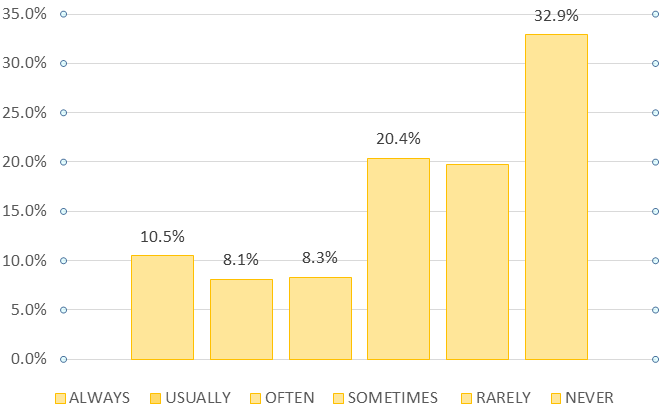
Source: Velasquez A (2023) Figure 1: Diet development in university students.
The figure shows whether the university students develop a diet, where it was observed that 32.9% never do it and 20.4% do it only sometimes. Therefore, most of the population does not eat a diet, which may be caused by having a heavy load of academic activities and losing interest in maintaining a balanced and therefore healthy diet, in agreement with the World Health Organization [14] which mentions that the consumption of a healthy diet prevents the development of any form of malnutrition which mentions that the consumption of a healthy diet can prevent the development of any form of malnutrition, as well as certain diseases or non-communicable conditions that are directly related to food. This type of diet generally includes high vegetable, protein, and low carbohydrate intake [15]. Likewise, Wadden, et al. [16], mentioned that one of the treatments that allow a rapid and long-term weight loss is the low-calorie diet, always avoiding high amounts of carbohydrates. While, in relation to the development of eating disorders, Counselor, et al. [17], stated that most of the people treated with diet, after some time developed eating disorders, so it is considered as a risk factor.
Similarly, through the determination of this risk factor, it was identified that people are sometimes afraid of being overweight, they are aware of the calorie content they consume, they never avoid consuming foods that contain high concentrations of carbohydrates, they never feel guilty
Physiological and Psychological
after eating, they do not worry about being thinner or about the fat content in their body, nor about the amount of sugar. In addition, they do not consume foods that are dietary and enjoy eating new foods that taste good.
With respect to overweight and the idealization of a perfect body, it has been determined that the female gender is more prone to present these problems, always considering the consumption of dietary foods or foods with a low concentration of carbohydrates and fats [18]. Likewise, Zuñiga and Mora [19] evidenced that when a person presents eating disorders, they tend to present anxiety when having to eat, including feelings of guilt due to their obsession with gaining weight.
Among these results, we also find those obtained by Nieto and Nieto [20] who determined that in women there are high rates of job dissatisfaction and concern about their weight, which is considered a risk factor for eating disorders.
Another point to consider in this risk factor is the control of calorie content and therefore the prohibition of certain foods rich in carbohydrates and fat. Thus, Avellaneda, et al. [21], determined that diets low in sugars and fats are very useful for treating diseases such as diabetes, however, they are very prone to develop eating disorders.
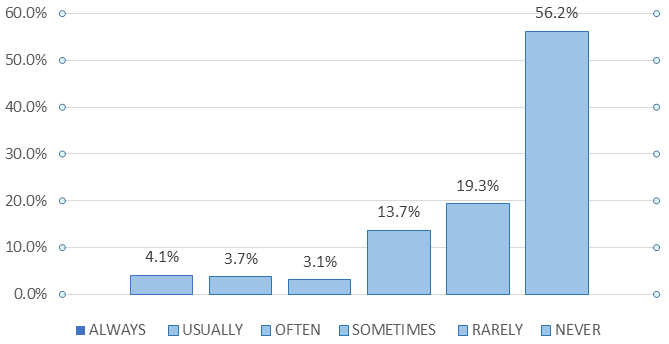
Source: Velasquez A (2023) Figure 2: Development of physiological and psychological problems in university students.
The figure shows whether the university students developed problems at the physiological and psychological level. It is observed that 52.6% have never suffered from this type of problems, while 19.3% have suffered very rarely.
Therefore, most of the population has never developed this type of problem, so it is not considered a risk factor for the development of eating disorders.
At the physiological level, Benitez [22] determined that eating disorders cause dangerous and even reversible damage to the cardiovascular, skeletal, renal, neurological and pulmonary systems. This is due to the fact that both appetite and satiety imply a series of highly complex interactions between hormones at the digestive and neuronal levels, among others, where an alteration generates damage to the cardiovascular, skeletal, renal, neurological and pulmonary systems [23]. On a psychological level, it has been evidenced that these people suffer from low self-esteem, perfectionism, impulsivity and attitude to develop problems [24]. Similarly, Mendez, et al. [25], defined that when a person suffers from eating disorders it is very important that they receive psychological support in order to increase the levels of self- esteem and therefore they can manage their emotions in a timely manner. Thanks to these authors, it was identified that the study population does not present the physiological and psychological factor because they do not present any danger symptoms.
Through the analysis of this factor it was also obtained that at the university level they rarely present worries about food, they have never continued eating a lot and thinking that they will never stop, they never vomit after eating, they
Habits
do not feel that they depend on the food they consume, they never spend a lot of time thinking about what to eat and they do not present the urge to vomit after eating.
This is evidence that most students do not have bulimia or anorexia, because they are not worried about consuming large amounts of calories and do not vomit or feel this type of desire after eating.
Rodriguez [26] in his research on the main symptoms of eating disorders found that in bulimia the main symptom is binge eating followed by vomiting. Vomiting has a very negative effect on general health, for example [27], Range et al, determined that through this symptom an erosive dental wear is promoted where gingivitis problems are mainly evidenced. Likewise, Quilla, et al. [28], identified that a gastric emptying known at the medical level reflects a series of alterations in the intestinal peptide responses, thus affecting the entire digestive system.
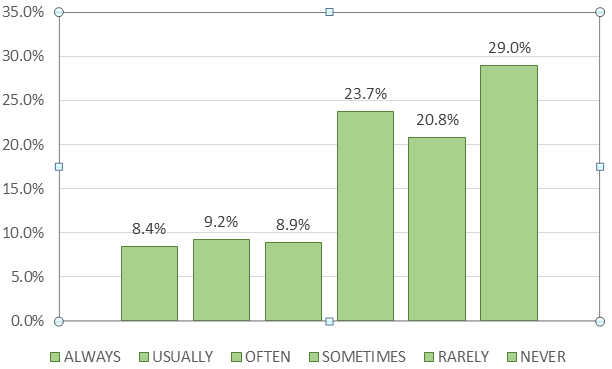
Source: Velasquez A (2023). Figure 3: Habits in college students.
The figure shows the food control habits of university students. It is observed that 29.0% never check or think about what they eat, while 23.7% do so but on certain occasions. Therefore, most of the population has never developed habits that lead to the control of food consumption.
Nowadays, it has been evidenced that there is a great amount of food products where a variety of fast food is observed, which generates certain disorders at a nutritional level due to the high concentrations of unsaturated fats and sugars [29]. Therefore, it is suggested a balanced diet based on what the body needs and always promoting the consumption of adequate food [30].
Similarly, it was determined that most students never avoid eating when they are hungry, sometimes make very small cuts in their food, do not feel that other people ask them to eat more, never consider that people think they are too thin, sometimes feel that they take too long to eat, sometimes show self-control over food, and finally never feel pressured by others when eating.
The loss of self-control over food involves the consumption of high-calorie foods when there is no hunger and outside of the various eating schedules, which are characteristic of bulimia [31]. Similarly, this variable is directly related to the hunger and satiety signals, where food intake is produced by the central nervous system, which is strongly affected in the TCA [32, 33].
Conclusion
Eating disorders, being a psychiatric pathology, affect both the behavior and the way of food intake because patients tend to obsess about their weight and the shape of their body. There are multiple risk factors that lead to present this pathology, however, within the present investigation it was identified that 32.9% of students do not diet, 52.6% have never presented problems at physiological or psychological level and 29% do not present problems in terms of their eating habits. However, it was identified that students have a slight fear of being overweight but do not control their diet by reducing the percentages of carbohydrates and sugars.
Bibliographic References
1. Pardo MDMA, Martín MF, Hernández MAC, Marquez FM (2017) Adherence of psychopharmacological prescriptions to clinical practice guidelines in patients with eating behavior disorders. Eur J Clin Pharmacol 73(10): 1305-1313.
2. Fernandez MLP, Cano TR, Zafra MDO, Haro MJP, Alonso VC, et al. (2018) Prevalence of orthorexia nervosa in university students and its relationship with psychopathological aspects of eating behaviour disorders. BMC Psychiatry 18(1): 364.
3. Castaneda T (2020) Clinical profile of patients with eating disorders. ResearchGate 1(1).
4. Galmiche M, Dechelotte P, Lambert G, Tavalacci MP (2019) Prevalence of eating disorders over the 2000- 2018 period: a systematic literature review. Am J Clin Nutr 109(5): 1402-1413.
5. DeSocio JE, Riley JB (2021) Feeding and Eating Disorders in Childre and Adolescents. Wiley Online Library Chapter 15.
6. Kolar DR, Mebarak M (2022) An update on the epidemiology of eating disorders in Latin America: current findings and future challenges. Curr Opin Psychiatry 35(6): 385-389.
7. Suarez P (2011) Is Stereotyped Beauty a Social Influence that Affects Adolescent Teenagers Who Present Eating Disorders in the Inmaculada College in the City of Ambato in the Province of Tungurahua Period 2010- 2011. Repositpry of the Technical University of Ambato pp: 29-30.
8. Sanchez F (2019) Epistemic foundations of qualitative and quantitative research: Consensus and dissent.
Digital Journal of Research in University Teaching 13(1): 102-122.
9. Manterola C, Quiroz G, Salazar P, Garcia N (2019) Methodology of the most frequently used study types and designs in clinical research. Las Condes Clinic Medical Journal 30(1): 36-49.
10. Vallejo M (2002) Research desing: a brief methodological review. Arch Cardiol Mex 72(1): 8-12.
11. Constain G, Ricardo C, Rodriguez M, Gomez M, Marin C, et al. (2013) Validity and diagnostic utility of the EAT-26 scale for risk assessment of eating disorders in a female population in Medellin, Colombia. Atencion Primaria 46(6): 283-289.
12. NICE (2017) Eating disorders: recognition and treatment.
13. Sodersten P, Leon M, Broding U, Zadian M, Bergh C (2017) Cognitive behavioral therapy for eatings disorders versus normalization of aeating behavior. Physiol Behav 174(1): 178-190.
14. WHO (2019) Healthy diet. pp: 1-20.
15. Melini F, Melini V (2019) Gluten-Free Diet: Gaps and Needs for a Healthier Diet. Nutrients 11(1): 179-189.
16. Wadden T, Tronieri JS, Butryn ML (2020) Lifestyle Modification Approaches to the Treatment of Obesity in Adults. Am Psychol 75(2): 235-251.
17. Conviser JH, Fisher SD, McColley SA (2018) Are children with chronic illnesses requiring dietary therapy at risk for disordered eating or eating disorders? A systematic review. Int J Eat Disord 51(3): 187-213.
18. Guerrero B, Valero L, Solano D, Priore C, Pereaa A, et al. (2022) Detection of eating problems and their relationship with eating habits in adolescents. Mexican journal of aeting disorders 10(3).
19. Paula BZ, Jessica IM (2022) Eating disorders in students of Pedagogy in Physical Education, Sports and Recreation of the Metropolitan University of Educational Sciences. Physical Education Magazine Chile 1(275).
20. Nieto D, Nieto I (2020) Body image perception in female university students in the city of Barranquilla, Colombia: a descriptive-cross-sectional study. Gender vulnerability: Contributions to the debate 5(2).
21. Avellaneda P, Codina M, Cespedes J (2020) Nutrition in diabetes from hospital catering. Intervention in Clinical and Health Contexts 2(1).
22. Benitez L (2021) Physiological alteration in eating disorders.
23. Yeung AY, Tadi P (2020) Physiology, Neurohormonal Obesity, Appetite Control and Satiety. In: StatPearls. Treasure Island (FL): Stat Pearls Publishing.
24. Hernandez RJ, Ledon LL (2020) Clinical behavior and therapeutic approach to eating disorders in people with type 1 diabetes mellitus. Rev Cubana Med Gen Integr 36(2): 1-15.
25. Mendez Y, Cerquera A (2018) Social support in population with eating disorders. Virtual Journal University Católica del Norte 36(2).
26. Rodriguez GM, Gempeler RJ, Major AN, Patio SC, Lozano CL, et al. (2017) Emotional dyregulation and eating symptoms: Analysis of group therapy sessions in patients with eating disorder. Mexican Journal of eating disorders 8(1): 72-81.
27. Range H, Colon P, Godart N, Kapila Y, Bouchard P (2021) Eating disorders through the periodontal lens. Wiley Online Library 87(1): 17-31.
28. Quilla P, Eckel L, Hilbebrandt B, Haedt A, Murry D, et al. (2021) Unraveling links between gastric emptying and binge. purging in eating disorders using a case control desingn. Psychological Medicine 2(1).
29. Cerda PD, Mayorga D, Viciana J (2018) Brief mental training in adolescents with unspecified eating disorder presenting demanding physical activity habits. Physical Education and Science. 24(4).
30. Priego H, Suarez N, Cordova J (2019) Promotion of healthy habits and lifestyles in children aged 2-6 years to prevent eating disorders in a kindergarten. ResearchGate 5(3).
31. Rodriguez B (2017) Physical activity in the self-control of food craving. Science and Physical Activity 1(1): 38- 51.
32. Aantacoloma A (2018) Self-monitoring: Variations on eating.
33. Sharma K, Mongensen K, Robinson MK (2019) Pathophysiology of Critical Illness and Role of Nutrition. Nutr Clin Pract 34(1): 12-22.
References
-
Pardo MDMA, Martín MF, Hernández MAC, Marquez FM (2017) Adherence of psychopharmacological prescriptions to clinical practice guidelines in patients with eating behavior disorders. Eur J Clin Pharmacol 73(10): 1305-1313.
-
Fernandez MLP, Cano TR, Zafra MDO, Haro MJP, Alonso VC, et al. (2018) Prevalence of orthorexia nervosa in university students and its relationship with psychopathological aspects of eating behaviour disorders. BMC Psychiatry 18(1): 364.
-
Castaneda T (2020) Clinical profile of patients with eating disorders. ResearchGate 1(1).
-
Galmiche M, Dechelotte P, Lambert G, Tavalacci MP (2019) Prevalence of eating disorders over the 2000- 2018 period: a systematic literature review. Am J Clin Nutr 109(5): 1402-1413.
-
DeSocio JE, Riley JB (2021) Feeding and Eating Disorders in Childre and Adolescents. Wiley Online Library Chapter 15.
-
Kolar DR, Mebarak M (2022) An update on the epidemiology of eating disorders in Latin America: current findings and future challenges. Curr Opin Psychiatry 35(6): 385-389.
-
Suarez P (2011) Is Stereotyped Beauty a Social Influence that Affects Adolescent Teenagers Who Present Eating Disorders in the Inmaculada College in the City of Ambato in the Province of Tungurahua Period 2010- 2011. Repositpry of the Technical University of Ambato pp: 29-30.
-
Sanchez F (2019) Epistemic foundations of qualitative and quantitative research: Consensus and dissent. Digital Journal of Research in University Teaching 13(1): 102-122.
-
Manterola C, Quiroz G, Salazar P, Garcia N (2019) Methodology of the most frequently used study types and designs in clinical research. Las Condes Clinic Medical Journal 30(1): 36-49.
-
Vallejo M (2002) Research desing: a brief methodological review. Arch Cardiol Mex 72(1): 8-12.
-
Constain G, Ricardo C, Rodriguez M, Gomez M, Marin C, et al. (2013) Validity and diagnostic utility of the EAT-26 scale for risk assessment of eating disorders in a female population in Medellin, Colombia. Atencion Primaria 46(6): 283-289.
-
NICE (2017) Eating disorders: recognition and treatment.
-
Sodersten P, Leon M, Broding U, Zadian M, Bergh C (2017) Cognitive behavioral therapy for eatings disorders versus normalization of aeating behavior. Physiol Behav 174(1): 178-190.
-
WHO (2019) Healthy diet. pp: 1-20.
-
Melini F, Melini V (2019) Gluten-Free Diet: Gaps and Needs for a Healthier Diet. Nutrients 11(1): 179-189.
-
Wadden T, Tronieri JS, Butryn ML (2020) Lifestyle Modification Approaches to the Treatment of Obesity in Adults. Am Psychol 75(2): 235-251.
-
Conviser JH, Fisher SD, McColley SA (2018) Are children with chronic illnesses requiring dietary therapy at risk for disordered eating or eating disorders? A systematic review. Int J Eat Disord 51(3): 187-213.
-
Guerrero B, Valero L, Solano D, Priore C, Pereaa A, et al. (2022) Detection of eating problems and their relationship with eating habits in adolescents. Mexican journal of aeting disorders 10(3).
-
Paula BZ, Jessica IM (2022) Eating disorders in students of Pedagogy in Physical Education, Sports and Recreation of the Metropolitan University of Educational Sciences. Physical Education Magazine Chile 1(275).
-
Nieto D, Nieto I (2020) Body image perception in female university students in the city of Barranquilla, Colombia: a descriptive-cross-sectional study. Gender vulnerability: Contributions to the debate 5(2).
-
Avellaneda P, Codina M, Cespedes J (2020) Nutrition in diabetes from hospital catering. Intervention in Clinical and Health Contexts 2(1).
-
Benitez L (2021) Physiological alteration in eating disorders.
-
Yeung AY, Tadi P (2020) Physiology, Neurohormonal Obesity, Appetite Control and Satiety. In: StatPearls. Treasure Island (FL): Stat Pearls Publishing.
-
Hernandez RJ, Ledon LL (2020) Clinical behavior and therapeutic approach to eating disorders in people with type 1 diabetes mellitus. Rev Cubana Med Gen Integr 36(2): 1-15.
-
Mendez Y, Cerquera A (2018) Social support in population with eating disorders. Virtual Journal University Católica del Norte 36(2).
-
Rodriguez GM, Gempeler RJ, Major AN, Patio SC, Lozano CL, et al. (2017) Emotional dyregulation and eating symptoms: Analysis of group therapy sessions in patients with eating disorder. Mexican Journal of eating disorders 8(1): 72-81.
-
Range H, Colon P, Godart N, Kapila Y, Bouchard P (2021) Eating disorders through the periodontal lens. Wiley Online Library 87(1): 17-31.
-
Quilla P, Eckel L, Hilbebrandt B, Haedt A, Murry D, et al. (2021) Unraveling links between gastric emptying and binge. purging in eating disorders using a case control desingn. Psychological Medicine 2(1).
-
Cerda PD, Mayorga D, Viciana J (2018) Brief mental training in adolescents with unspecified eating disorder presenting demanding physical activity habits. Physical Education and Science. 24(4).
-
Priego H, Suarez N, Cordova J (2019) Promotion of healthy habits and lifestyles in children aged 2-6 years to prevent eating disorders in a kindergarten. ResearchGate 5(3).
-
Rodriguez B (2017) Physical activity in the self-control of food craving. Science and Physical Activity 1(1): 38- 51.
-
Aantacoloma A (2018) Self-monitoring: Variations on eating.
-
Sharma K, Mongensen K, Robinson MK (2019) Pathophysiology of Critical Illness and Role of Nutrition. Nutr Clin Pract 34(1): 12-22.
- Epithelioid Granuloma; 3cases with Different Clinical Features
- Advancing Representation in Dermatology Clinical Trials: Ethical, Scientific, and Regulatory Imperatives for Inclusion Across all Fitzpatrick Skin Types
- A Case of Atopic Dermatitis with Concurrent Psoriasis Vulgaris: Successful Treatment with Upadacitinib
- Innovation Lifting Eyeshadow: A Synthesis of Makeup and Optical Illusion
- Distinguishing Superficial Actinic Porokeratosis from Actinic Keratosis with UVF Dermoscopy: A Case Report
- High Mobility Group Box 1 (HMGB1) in Cutaneous Inflammation: An Immune Modulator Bridging Cellular Stress, Ferroptosis and Danger Signaling