
Isolated Faun Tail at Thoracic Level
Faun tail or Silky down is an abnormal posterior midline hypertichosis, usually lumbo-sacral, which maybe associated with spinal dysraphism. The appearance also causes psychological distress to the patient. This is a case report of a 14-year old female presenting with a faun tail over mid thoracic region, without any associated spinal anomaly. Permanent laser hair reduction was performed for cosmetic improvement, using triple wavelength laser
Introduction
Faun tail is a congenital localized hypertrichosis occurring over posterior midline, which can be a marker for underlying spinal defects. It presents as a circumscribed, triangular or lozenge shaped patch of terminal hair. The commonest site of involvement is the lumbosacral area [1]. While Faun tail itself is a rare entity, its presentation at thoracic level is even rarer [2].
Case Report
A 14-year old female presented with a patch of excessive and coarse hair growth over mid-thoracic region since birth. She was born of a non-consanguineous marriage, with no family history of similar lesions. She had normal developmental milestones. Her only concern was cosmetic appearance, with no associated history of back pain, bladder or bowel incontinence or muscle weakness.
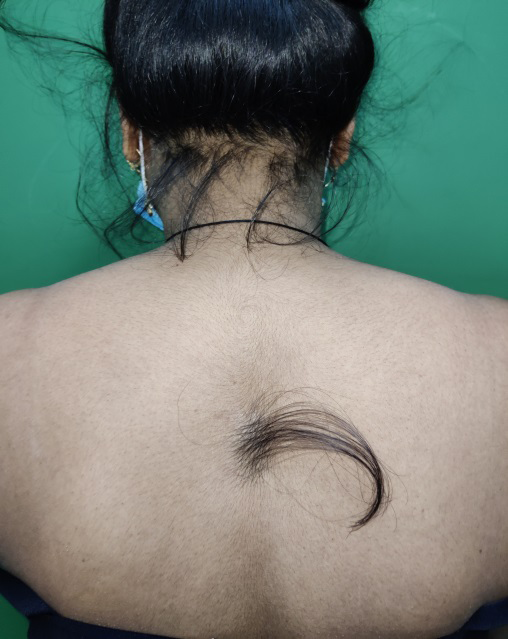
Dermatological examination revealed a lozenge shaped area of 6x3cms with tuft of long terminal hair (Figure 1). No associated pigmentary changes, subcutaneous lipoma or dermal sinuses were noted. Her neurological examination was found to be normal. As this entity is a known cutaneous marker of spinal dysraphism, further radiological studies were warranted. However, Radiography and Magnetic Resonance Imaging were both found to be normal. Hence, this was a case of isolated faun tail nevus.
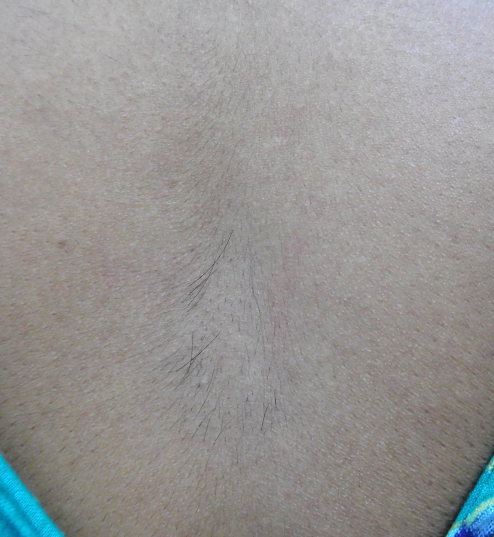
The treatment undertaken was Laser hair removal for cosmetic improvement, using a triple wavelength laser (755+810+1064nm; Dermaindia, Tamil Nadu, India). Parameters used were- 14x14mm spot size, frequency 4-6 Hz, Pulse Width 100ms and a gradually increasing Fluence (ranging 18-26 J/cm2). Laser sittings were performed at 6-8 weekly intervals. Ice-packs were used prior to treatment to reduce any discomfort and avoid paradoxical hypertrichosis in surrounding areas. We noted good cosmetic improvement in density and character of hair after 6 sittings (Figure 2).
Discussion
Faun tail is a form of localized hypertrichosis occurring over posterior midline most commonly reported over lumbar region. Our patient presented with involvement at the mid thoracic level. A literature search revealed a single such case reported in the past [2].
Faun tail nevus is known to be associated with underlying spinal dysraphism due to failure of fusion of the caudal neuropore [1, 3]. Upto 75% patients with occult spinal dysraphism present with singular or combinations of median or paramedian spinal cutaneous lesions. The lesions can include faun tail, human tail, subcutaebous lipomas, port win stains, dermal sinuses, hemangiomas, pigmentary nevi, deviation of gluteal furrow and dimpling.
Hence, it is mandatory for patients presenting with these to undergo neurological and radiological examination [4]. The case reported is that of an isolated Faun tail, without any associated spinal or neurological defect.
The management of these patients depends on the extent of involvement and in case of presence of spinal dysraphism a multidisciplinary approach is mandated. Surgical management can also be required to reduce neurological disability, if present [3]. To overcome the psychological distress associated with the hypertrichosis, permanent hair reduction with various modalities can be done. These include electrolysis, intense pulsed light and laser hair removal. Lasers most frequently used include diode, Nd:Yag, ruby and alexandrite. The choice of laser depends on the darkness of hair and the skin type. The principle of laser hair reduction is thermal destruction due to selective absorption of energy by the melanin in hair follicle [5, 6].
We are reporting this case for the rarity of presentation of faun tail at thoracic level, as opposed to the commoner lumbosacral involvement.
References
-
Griffiths CEM, Barker J, Bleiker TO, Chalmers R, Creamer D (2016) Rook’s textbook of dermatology. John Wiley & Sons pp: 4696.
-
Chembolli L (2015) Faun tail overlying spinal dysraphism (diastematomyelia) at the mid thoracic level: Cosmetic improvement achieved with diode laser epilation. Indian J Dermatol 60(6): 638.
-
Venkataramana NK (2011) Spinal dysraphism. J Pediatr Neurosci 6(Suppl1): S31-40.
-
Guggisberg D, Hadj-Rabia S, Viney C, Bodemer C, Brunelle F, et al. (2004) Skin markers of occult spinal dysraphism in children: a review of 54 cases. Arch Dermatol 140(9): 1109-1115.
-
Olsen EA (1999) Methods of hair removal. J Am Acad Dermatol 40(2): 143-155.
-
Gan SD, Graber EM (2013) Laser hair removal: a review. Dermatol Surg 39(6): 823-838.
- Epithelioid Granuloma; 3cases with Different Clinical Features
- Advancing Representation in Dermatology Clinical Trials: Ethical, Scientific, and Regulatory Imperatives for Inclusion Across all Fitzpatrick Skin Types
- A Case of Atopic Dermatitis with Concurrent Psoriasis Vulgaris: Successful Treatment with Upadacitinib
- Innovation Lifting Eyeshadow: A Synthesis of Makeup and Optical Illusion
- Distinguishing Superficial Actinic Porokeratosis from Actinic Keratosis with UVF Dermoscopy: A Case Report
- High Mobility Group Box 1 (HMGB1) in Cutaneous Inflammation: An Immune Modulator Bridging Cellular Stress, Ferroptosis and Danger Signaling