
Epidemiological, Clinical and Treatment Profile of Leishmaniasis in Birao, Central African Republic
Objective: To contribute to improving the management of leishmaniasis in the population of the town of Birao. Patients and Methods: This was a prospective, descriptive study from August to September 2024, recording demographic, clinical and therapeutic data on leishmaniasis on questionnaires, in a population of 14,572 inhabitants. Results: We included 155 people with skin lesions in the population (1.06%). Lesions clinically suspicious of leishmaniasis were found in 25 people surveyed, giving a prevalence of 0.17%. The frequency of leishmaniasis among skin lesions was 16.12% (25/155). Patients ranged in age from 2 to 55, with an average age of 22 and a sex ratio of 1.5 in favor of men. The 2 to 10 age group was the most represented (40%). Among the 25 cases detected, a 2-year-old infant treated unsuccessfully for eczema was cured on metronidazole. Schoolchildren were more represented (28%), followed by farmers (24%). Most patients presented with crusted lesions (56%); some (56%) had lesions that had been evolving for more than 2 years. Biological examination of the 13 samples showed amastigote forms of leishmaniasis on all slides. No genotyping was performed. In all cases, lesions progressed favorably on metronidazole 40mg/kg twice daily for 21 days, with unsightly scarring. Conclusion: Leishmaniasis exists in Birao (98%), and is a public health problem requiring improved diagnosis and treatment.
Abbreviations
CL: Cutaneous Leishmaniasis; WHO: World Health Organisation.
Introduction
Cutaneous leishmaniasis is a parasitic infection transmitted to humans by the bite of the sandfly, the vector of the disease. Depending on the parasite species responsible and the immune defense system set up by the host, the disease can take the form of a skin or visceral. Cutaneous leishmaniasis (CL) is a global public health problem; it is endemic in more than 70 countries with an estimated annual incidence of 1,500,000 cases [1]. According to WHO, it ranks ninth among the 13 most important tropical diseases [2]. In Africa, cutaneous leishmaniasis is endemic, particularly in the north, east and south. In addition, the number of cases of cutaneous leishmaniasis that are neither reported nor diagnosed is probably higher, so much so that official data hardly allow us to know the real number of patients. It is noted that affected populations do not always consult a doctor for this condition [3].
In the Central African Republic, little work has been done on this subject, hence the interest of this present study on the epidemiological, clinical and therapeutic profile of leishmaniasis in the provincial town of Birao. This study contributes to the epidemiological surveillance of neglected tropical diseases [4, 5, 6].
Patients and Methods
This was a prospective descriptive study, from August to September 2024, which made it possible to record demographic, clinical and therapeutic data on leishmaniasis among the population of the city of Birao, as well as surrounding villages (Table 1).
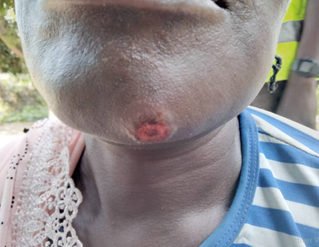
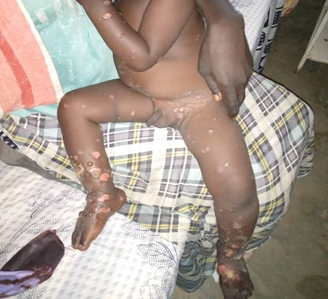
A survey was therefore carried out in the neighborhoods, looking for suspected cases of cutaneous leishmaniasis. After raising awareness among health and administrative authorities, the survey team was placed at fixed points in the neighborhoods and villages to receive all those who presented with skin lesions similar to leishmaniasis. These were vegetative papular lesions or vegetative or crusted or ulcerated papulonodules (Table 2).
Sociodemographic and clinical data were collected after questioning and examination. The cases were put on treatment with metronidazole. Skin scrapings from the edges of the lesions were taken in some cases and were stained with Giemsa and interpreted at the National Laboratory (Table 3). Questionnaires consisting of different variables were used to obtain data entered and analyzed on Epi info version 7 (Figures 1 & 2).
| Frequency | Pourcentage | |
|---|---|---|
| Students | 7 | 28,00% |
| Farmers | 6 | 24,00% |
| Un-employed | 5 | 20,00% |
| House-wife | 2 | 8,00% |
| Shop keepers | 2 | 8,00% |
| Water and forestry agents | 1 | 4,00% |
| Hair-dresser | 1 | 4,00% |
| Security agent | 1 | 4,00% |
Table 3: Distribution of patients by occupation Frequency Percentage.
| Frequency | Pourcentage | |
|---|---|---|
| Crusteous | 14 | 56,00% |
| Nodular | 9 | 36,00% |
| Ulcerative | 2 | 8,00% |
Table 1: Distribution of patients by type of lesion Type of lesion Frequency Percentage.
| Duration | Frequency | Pourcentage |
|---|---|---|
| 1 year | 6 | 24,00% |
| 2 years | 14 | 56,00% |
| 3 to 5 years | 3 | 12,00% |
| >5 years | 2 | 8,00% |
Table 2: Distribution of patients according to the duration of the lesions.
Discussion
More than half of the patients (56%) had lesions that had been developing for more than 2 years. As for Koureissi T [7] in Mali, he reported in his study an average duration of development of 5 months. This difference could be explained by the higher level of knowledge among the Malian population than that of the Central African Republic [8]. This level of knowledge of leishmaniasis allows the patient to go to the hospital more quickly in the event of the appearance of skin lesions and reduces traditional treatments. All the slides sent showed amastigote forms without genotyping and all the cases had evolved favorably under metronidazole. Kelembho E, et al. [9] in 2003 described a proven case of leishmaniasis imported from Chad, bordering Birao, due to leishmania major which had been cured under the same molecule [10, 11].
Conclusion
This study has shown that this pathology does exist in the population of Birao with a prevalence of 0.17%. Children are the most affected with a male predominance; the crusty and nodulo-ulcerative forms evolve favorably under methronidazole. Despite this low prevalence, it constitutes a public health problem, being a disabling neglected tropical disease, hence the need for staff training and the availability of drugs, including metronidazole and antimony derivatives.
Acknowledgment
We thank the health professionals of Birao Hospital for their help throughout the work. Ethical considerations Authorization was obtained from the Director of Birao Hospital, the ethical authority of the health facility. The data were used in the strictest confidentiality and stored according to the standards.
References
-
Molyneux DH, Hotez PJ, Fenwick A (2005) Rapid-impact interventions: how a policy of integrated control for Africa’s neglected tropical diseases could benefit the poor. PLoS Med 2(11): e336.
-
(1990) Lutte contre les leishmanioses. OMS, pp: 176.
-
Harrat Z, Pratlong F, Belazzoug S, Dereure J, Deniau M, et al. (1996) Leishmania infantum and Leishmania major in Algeria. Trans R Soc Trop Med Hyg 90: 625-629.
-
Larivirere M, Beuvais B, Derouine F, Traore F (1987) Paris. Ellipses 26: 238.
-
Doumbia Y (2023) Serie des cas de leishmaniose cutanee chez les militaires au retour de la mission au Nord du Mali. These Med.
-
Diallo K (2014) Profil epidemiologique, clinique, therapeutique et evolutif a propos des 87 cas recenses dans le service de dermatologie de l’institut d’hygiene sociale de DAKAR. These Med.
-
Tall K (2008) Etude epidemiologique clinique et prise en charge de la leishmaniose cutanee a Bamako et dans deux villages endemiques du Mali. These Med.
-
Traore KS (2000) Etude de la leishmaniose cutanee dans des formations sanitaires de la ville de Ouagadougou de 1996 a 1998. These Med.
-
Kelembo E, Kobangue L, Huerre M, Morvan JM (2003) Premier cas de leishmaniose cutanee d’importation a Bangui en Republique centrafricaine, efficacite du Metronidazole. Med Trop 63: 597-600.
-
Kobangue L, Denissio M, Bangue C (2021) Skin leishmaniasis in an infant in Bangui. First Documented local case in the Capital City of the Central African Republic and History of the Disease in the country. Clin Dermatol J 6(4): 1-4.
-
Konate I, Sangare I, Zoungrana J, Meda ZC, Kafando C, et al. (2020) Description d’un nouveau foyer epidemique de la leishmaniose cutanee a leishmania major a l’ouest du Burkina Faso Pub Med.
- Epithelioid Granuloma; 3cases with Different Clinical Features
- Advancing Representation in Dermatology Clinical Trials: Ethical, Scientific, and Regulatory Imperatives for Inclusion Across all Fitzpatrick Skin Types
- A Case of Atopic Dermatitis with Concurrent Psoriasis Vulgaris: Successful Treatment with Upadacitinib
- Innovation Lifting Eyeshadow: A Synthesis of Makeup and Optical Illusion
- Distinguishing Superficial Actinic Porokeratosis from Actinic Keratosis with UVF Dermoscopy: A Case Report
- High Mobility Group Box 1 (HMGB1) in Cutaneous Inflammation: An Immune Modulator Bridging Cellular Stress, Ferroptosis and Danger Signaling