
Knowledge of Leishmaniasis and Attitudes of the Population of Birao, Central African Republic
Introduction: Leishmaniasis is an insect-borne disease caused by Leishmania. In East Africa, Sudan has the highest prevalence rate (50-60%) of post-Kala-azar cutaneous leishmaniasis. The Central African Republic, which borders the two Sudanese countries, is subject to population movements linked to military and political crises on both sides, which are conducive to the spread of the disease. The aim of this study was to assess the knowledge and attitudes of the population of the city of Birao. Patients and Methods: This was a prospective, descriptive, cross-sectional study carried out in Birao from August to September 2024. Results: Age ranged from 20 to 57 years, with an average of 36 years. The 31 to 40 age group was the most represented (40.64%). The sex ratio was 1.5. Leishmaniasis is known to the population of Birao, with the vernacular name Am-Chabach (98%); the people surveyed (86.45%) declared the disease transmissible by mosquito bites. Some respondents (65.80%) did not know the degree of impact of leishmaniasis on their general condition; others (98%) said they had never had leishmaniasis. Treatment by the population consisted in applying oil to the pimple or wound before applying a braised knife. Conclusion: leishmaniasis is known in the population of Birao, along with its mode of transmission. Treatment remains traditional, but means of prevention do not exist, hence the need to raise awareness and provide health facilities with antileishmanial drugs.
Abbreviations
CL: Cutaneous Leishmaniasis; PCLA: Post-Kala-Azar Cutaneous Leishmaniasis; VL: Visceral Leishmaniasis.
Introduction
Leishmaniasis is a disease common to humans and some mammals, caused by protozoa of the genus Leishmania
transmitted by an insect, the female sandfly [1]. Certain intrinsic and extrinsic factors, often acting in synergy, have made it a little-known or at least despised disease in its importance and geographical spread. Cutaneous leishmaniasis (CL) represents a public health problem on a global scale; it is endemic in more than 70 countries with an estimated annual incidence of 1,500,000 cases [2]. According to the WHO, it ranks ninth among the 13 most important tropical diseases [3]. Approximately, 3431, 2000, 2750 and 1700 new cases are reported each year in Morocco, Algeria, Tunisia and Libya respectively [4]. In East Africa, Sudan has the highest prevalence rate (50 to 60%) of post-Kala-azar cutaneous leishmaniasis (PCLA) in the world; a cutaneous complication of visceral leishmaniasis (VL) [5]. The Central African Republic is a country bordering the two Sudans with significant population movements linked to military-political crises on both sides. The aim of this study was to assess the knowledge and attitudes of the population of the city of Birao, on the border with Sudan.
Patients and Methods
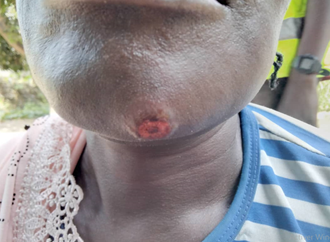
This was a cross-sectional study with prospective collections from August to September 2024. The study population consisted of people with skin lesions suspected of leishmaniasis. The sample was probabilistic depending on the cases. All consenting people were included. After approval of the research protocol by the Scientific Committee, the hospital team was asked to collect sociodemographic data and knowledge of leishmaniasis. These data were collected on coded individual questionnaires. They were entered and processed on the Epi Info software (Figure 1).
Results
As for the study of knowledge of leishmaniasis, we were able to survey 155 people who had given their informed consent. The age of the respondents is presented in the Table 1 the age of the respondents varied from 20 to 57 years with an average age of 36 years. The most represented age group was that of 31 to 40 years with a percentage of 40.64%. There were 93 men for 62 women, i.e. a sex ratio of 1.5. Direct exchanges with the respondents showed that leishmaniasis is well known by the population of Birao, with the vernacular name Am- Chabach at (98%). Some ethnic groups called it douten-zidi, others Ngoho. Table 2 shows the distribution of vernacular names of leishmaniasis according to ethnic groups. Some groups have the same name for the disease and the vector agent (the sandfly). Others did not know the vector (Table 3).
| Age groups | Frequency | Pourcentage |
|---|---|---|
| 20 to 30 years | 46 | 29,67% |
| 31 to 40 years | 63 | 40,64% |
| 41 to 50 years | 32 | 20,64% |
| 51 to 60 years | 14 | 9,03% |
Table 1: Distribution of respondents by age.
The age of the respondents ranged from 20 to 57 years with an average age of 36 years. The most represented age group was 31 to 40 years with a percentage of 40.64%. There were 93 men for 62 women, i.e. a sex ratio of 1.5. Direct exchanges with the respondents revealed that leishmaniasis is well known by the population of Birao, with the vernacular name Am-Chabach at (98%). Some ethnic groups called it douten-zidi, others Ngoho. Table 2 shows the distribution of vernacular names for leishmaniasis according to ethnic groups. Some groups have the same name for the disease and the vector agent (the sandfly). Others did not know the vector (Table 3).
| Vernacular names of leishmaniasis | Names of the Phlebotomine | |
|---|---|---|
| Goula | douten-zidi | douten-zidi |
| Sara | Ngoho | |
| Rounga | Andjir-ndjododo | |
| Kara and arabes | Am-chabach | Am-choukoh |
Table 2: Distribution of vernacular names of leishmaniasis according to ethnic groups in Birao.
| How do you think you can catch this disease? | Frequency | Pourcentage |
|---|---|---|
| Mosquito bites | 134 | 86,45% |
| Respiratory tract | 3 | 1,93% |
| Sexual tract | 4 | 2,58% |
| Others (don't know) | 14 | 9,03% |
Table 3: Distribution of respondents according to knowledge of the mode of transmission of leishmaniasis.
Among the respondents, 86.45% said that the disease was transmitted by mosquito bites. The distribution of respondents according to the knowledge of the impact of the disease on the general condition is shown in Table 4. Most patients (65.80%) did not know the degree of impact of leishmaniasis on the general condition.
| According to you, if you contact these diseases you risk being: | Frequency | Percentage |
|---|---|---|
| Quite sick | 21 | 13,54% |
| Sick | 18 | 11,61% |
| Don’t know | 102 | 65,80% |
| Very sick | 14 | 9,03% |
Table 4: Most patients (65.80%) did not know the degree of impact of leishmaniasis on the general condition.
Most of the respondents (98%) said they had never had leishmaniasis. In terms of traditional care, the treatment by the population consisted of putting oil on the button or wound and applying a braised knife to it. The second technique consisted of putting hot oil on it. About 97.56% of the respondents reported that traditional treatment was not only less expensive, but had a cure at a safe cost. Table V shows the distribution of respondents according to knowledge of the risk. Forty percent did not know the level of risk for transmission of the disease and 39.35% thought that the risk was low and 20.64% of high risk. During the study, 98% of the respondents preferred personal protective equipment (gloves, mosquito nets and wearing long clothes in the evening) to insecticides.
Discussion
Very few studies have been conducted in the world to assess the knowledge and attitude of the population on leishmaniasis. The cutaneous signs recognized by the respondents were round disc-shaped buttons commonly called “Am-chabach” witch mean <<Calabash Wound>>. The disease was actually transmitted by the bite of a mosquito according to the respondents (86.45%). In the case of leishmaniasis, 97% of the respondents reported seeking treatment from traditional practitioners, who applied braised knives or hot oil to the skin lesions. According to the work carried out in 2003 by Kelembo E, et al. [6] in the Central African Republic and Kobangue L, et al. [7] in 2021, leishmaniasis exists in the Central African Republic, more precisely in the northern regions, in particular the border regions with Sudan and Chad but also in Bangui, the capital of the country, located in the south. In the study by Issouf K, et al. [8] in Burkina Faso: the disease was not known by the inhabitants of the village surveyed. The discrepancies in the results obtained can be explained by the random selection of the villages surveyed in the two countries. Although there is a difference between these studies, leishmaniasis is one of the neglected tropical diseases in the Central African Republic.
Conclusion
Cutaneous leishmaniasis is a parasitic disease transmitted to humans by the bite of the sandfly vector of the disease. This pathology seems to be little known in some countries including the Central African Republic, probably due to a lack of awareness among the population. This was the hypothesis at the origin of our study. It allowed us to note not only that this pathology is well known to the population of Birao under the name of “Am-chabach”, but that it constitutes a public health problem, being moreover a neglected tropical disease. Unfortunately, infected people consult the traditional practitioner more promptly or self- medicate and only go to the hospital as a last resort, thus remaining with the lesions for several years, increasing the risks of complications and transmission of leishmaniasis. Leishmaniasis is known by the population of Birao who call it by different vernacular names. But the most frequently used is <<Am-chabach>>.
References
-
(2010) CMIT: Leishmanioses in E. PILLY: Vivactis Plus, pp: 424-425.
-
Molyneux DH, Hotez PJ, Fenwick A (2005) Rapid-impact interventions: how a policy of integrated control for Africa’s neglected tropical diseases could benefit the poor. PLoS Med 2(11): e336.
-
Harrat Z, Pratlong F, Belazzoug S, Dereure J, Deniau M, et al. (1996) Leishmania infantum and Leishmania major in Algeria. Trans R Soc Trop Med Hyg 90: 625-629.
-
Desjeux P (2004) Leishmaniasis:current situation and new perspectives.Comp Imunnol Microbiol Infect Dis 27: 305.
-
Dembele S (1992) La Leishmaniose cutanee : Interet d’un traitement par le 4-4 Diamino Diphenyl Sulfone (a propos de 20 cas a l’Institut Marchaux). These Med. Bamako, pp: 44-46.
-
Kelembo E, Kobangue L, Huerre M, Morvan JM (2003) Premier cas de leishmaniose cutanee d’importation a Bangui en Republique Cenytrafricaine, efficacite du Metronidazole. Med Trop 63: 597-600.
-
Kobangue L, Denissio M, Bangue C, Gbangbangai E , Lenguebanga F, et al. (2021) Skin leishmaniasis in an infant in Bangui. First Documented local case in the Capital City of the Central African Republic and History of the Disease in the country. Clin Dermatol J 6(4): 1-4.
-
Issouf K, Sangare I, Zoungrana J, Meda ZC, Kafando C, et al. (2020) Description d’un nouveau foyer epidemique de la leishmaniose cutanee a leishmania major a l’ouest du Burkina Faso Pub Med.
- Epithelioid Granuloma; 3cases with Different Clinical Features
- Advancing Representation in Dermatology Clinical Trials: Ethical, Scientific, and Regulatory Imperatives for Inclusion Across all Fitzpatrick Skin Types
- A Case of Atopic Dermatitis with Concurrent Psoriasis Vulgaris: Successful Treatment with Upadacitinib
- Innovation Lifting Eyeshadow: A Synthesis of Makeup and Optical Illusion
- Distinguishing Superficial Actinic Porokeratosis from Actinic Keratosis with UVF Dermoscopy: A Case Report
- High Mobility Group Box 1 (HMGB1) in Cutaneous Inflammation: An Immune Modulator Bridging Cellular Stress, Ferroptosis and Danger Signaling