
A Fundamental Error in the Treatment of all Diabetes
Since Banting discovered insulin in the 1920’s, he mentioned that “insulin was not the cure for diabetesâ€. More recent research has indicated that oxidative/nitrosative stresses in the pancreatic Beta cells are almost certainly the cause of death of these insulin-producing cells. How does this occur? Macrophages which are close to the Beta cells in the islets of Langerhans are activated by T lymphocytes. The macrophage generates a peroxide known as peroxynitrite (OON=O-) which reacts with carbon dioxide to produce an excellent oxidizer and nitrator which kills the Beta cells and insulin production ceases. Peroxynitrite and/or its carbon dioxide derivative damages DNA, RNA, protein and lipids which kills the cellular source of energy- the mitochondria. At first the peroxynitrite produces acute inflammation but after months of this inflammation the damage process becomes chronic and much more difficult to treat. In fact, the treatments are usually one or multiple types of fast and slow acting insulin, drugs which help control fasting glucose or drugs which control glucagon. These drugs help controlling excessive blood glucose or hemoglobin A1C or replace the missing insulin needed for life itself. But, they do not treat the main toxin causing the disease. This is done by controlling the ravaging effects of peroxynitrite and/or derivatives. The most effective method would be to use non-toxic substances which act as chemical targets of oxidation and/or nitration and which can control excessive peroxynitrite continuously. This would be substances like L-tyrosine, substantial amounts of sustained release vitamin C, monophenols, astaxanthin and phospholipids from Krill, fish oil fatty acids, eg EPA, DHA, short chain unsaturated fatty acids or their salts or flaxseed oil, tocotrienols (alpha, beta, gamma and delta. In addition- a variety sustained release mono and di phenolic substances could effectively control excessive levels of peroxynitrite.
Introduction
Since Banting discovered insulin in the 1920’s, there has not been any effective pharmacological treatment that actually treats the basis of diabetes [1]. Available treatments are mostly symptomatic. In general, most treatments use either different types of insulin or glucose lowering substances and/or insulin releasing substances. Recent drugs can inhibit the production of glucagon which in type 2 diabetes causes depletion of glucose. There are also drugs which cause more glucose to be excreted in the urine. Banting in his Nobel Prize speech in the 1920’s said “insulin is not the cure for diabetes”. Since a major function of insulin is to drive glucose into the liver and muscles and adipose etc., therefore it is utilized to produce an increased stored energy in the form of adenosine triphosphate (ATP). Diabetes is not mainly caused by excessive glucose or by insufficient insulin or the lack of exercise. However, the physical damage caused by the disease itself is consistently worse even though glucose is tightly controlled. If sugar and insulin were well controlled and a person has diabetes-diabetic damage still occurs. The actual cause of diabetes is almost certainly excessive and continuous production of a toxic peroxide known as peroxynitrite (OON=O-). Our group demonstrated this in early type 1 diabetes in children [2]. We demonstrated that in animals that by preventing the action of peroxynitrite, diabetes can be completely prevented using carboxy-PTIO a compound which oxidizes nitric oxide-a major component of peroxynitrite (OON=O-) [2]. This compound causes chemical damage to key enzymatic proteins, enzymes and receptors occur which contain tyrosine, tryptophan and/or sulfur amino acids containing a free –SH group occurs via nitration or nitrosylation depending on the chemical group attacked. All the 6 major pathological consequences of diabetes occur because of chemical attack from OON=O- or its carbon dioxide derivative.
What Causes the Different Types of Diabetes and how is it Treated?
• In Type 1 or juvenile diabetes- the beta cells of the pancreas which make, store and release insulin mostly die from infection and/or immune attack and these beta cells are replaced by alpha cells which make, store and release the peptide glucagon. Glucagon stimulates gluconeogenesis (which makes glucose from non- carbohydrate sources like amino acids) or causes the degradation of glycogen. Therefore, when a person has type 1 diabetes, their blood glucose is increased, from higher than 125mg/dl (normal) to even more than 500mg/dl if they are not treated with insulin-usually of multiple types (short or long acting or both). Type 1 diabetics must be injected with one or more types of insulin.
• Type 2 diabetes is a slower developing type of diabetes which is usually associated with insulin resistance where insulin is produced but it is not as effective at lowering blood glucose as normally. It is known that the tyrosines from insulin and/or its receptor has been damaged by the peroxynitrite chemistry of nitration etc. and/or oxidation so the damaged substances (insulin and/or insulin receptors are less effective at lowering blood glucose. It often begins with early metabolic disease and if not properly treated develops into type 2 diabetes. Exercise and a controlled carbohydrate diet are partially effective if applied rigorously early and continuously in disease development. Some of the most effective drugs for type 2 diabetes are: 1. metformin-sustained release or 2. The herbal product known as berberine hydrochloride taken every 8 hours. Three 400 mg capsules taken in a timely fashion will do an excellent job to maintain normal levels of blood glucose without major side effects and it is inexpensive. Metformin is also an excellent drug for type 2-diabetes for most people, particularly in the sustained release form, but it can produce significant side effects in some older people. There are many drugs that help to control excessive blood glucose in type 2 diabetes and they are generally expensive and have many unwanted side effects. If the Beta cells die insulin is used.
• Gestational diabetes is also a type of diabetes that usually occurs in later stages of pregnancy and drugs which are effective for type2 diabetes are usually effective but each drug should be evaluated for toxicity in pregnancy and as a possible teratogen.
Causes of Diabetes and New Treatments
Type 1 diabetes is thought to begin with activated T lymphocytes. T lymphocytes are activated by inflammation, infection and/or virus. Chronic inflammation generates cytokines, chemokines, growth factors and inflammatory products to maintain a chronic inflammatory state which stimulates monocytes/macrophages to become activated and at first generate smaller amounts of peroxynitrite in an acute inflammatory state. Excessive amounts of peroxynitrite are later generated in a chronic inflammatory state which is insensitive to inflammatory steroids. All types of diabetes start as an acute inflammatory disease and over time become a chronic –almost untreatable disease that often causes death directly or indirectly. Diabetes is really the mother of many other diseases and a solid link between Alzheimer’s (A) and Parkinson’s (P) diseases and cancer has been demonstrated in several studies indicating a linkage as much as 80% association in both A and P cases. Is it possible to have such a high association to other diseases? When it is realized that diabetes is a fundamental metabolic disease, it should not be too surprising that a disease which could control energy might affect many diseases that are also dependent on production of energy. The drug companies have developed many antidiabetic substances but they generally control glucose, insulin and/ or even glucagon. These substances help treat diabetes but not the basis of the underlying disease. How could we do a better job in the treatment of diabetes or even pre-diabetes? In order to understand this we have to understand the epigenetic regulation of acute and chronic inflammation.
Epigenetic Regulation of Diabetes and Possible New Effective Treatments if Detected Early Enough
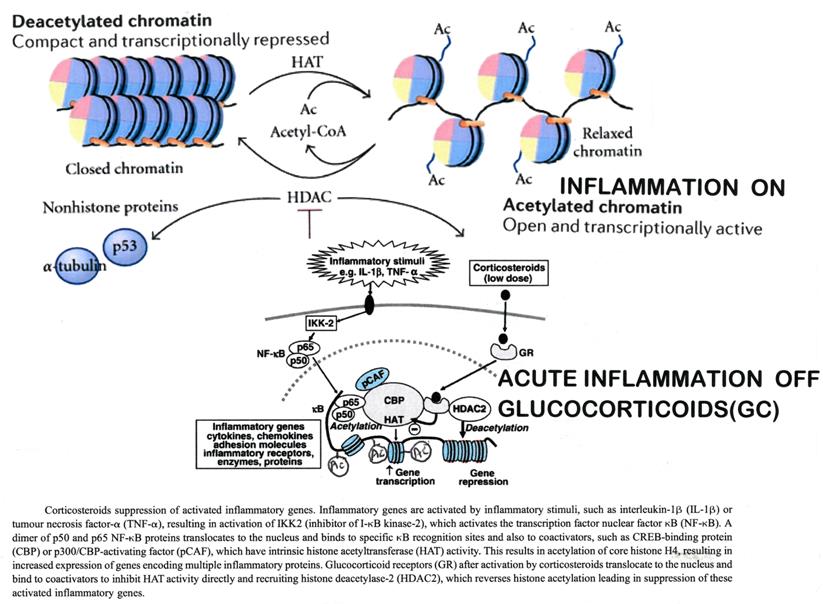
Before an area undergoes acute inflammation-The nuclear DNA of inflammatory cells is bound tightly with positive histone proteins in a structural circle (nucleosome) which bind quite strongly to the negative DNA on the outside of the nucleosome. The positive charge of the tightly bound histones is caused by epsilon amino groups of lysines that hang off the protein. When inflammatory signals are sent to the surface of inflammatory cells they are translated into the nucleus which activates the nuclear transcription factor and histone acetyl transferase (HAT). This activated HAT enzyme acetylates the epsilon amino groups of the histones which negates the positive charge and causes the disassociation of the histones from the DNA in the area of the inflammatory genes. The inflammatory genes are activated which stimulates the production of inflammatory proteins and their gene products. At this same time, macrophage inducible nitric oxide synthase starts producing extra nitric oxide free radical (.NO). In addition, the NADPH oxidase starts producing superoxide which is oxygen with a free radical electron. The nitric oxide and the superoxide react quickly at diffusion speed and the two free electrons pair producing (OON=O-) or peroxynitrite. This substance can react with carbon dioxide to become a more reactive peroxynitrite. Usually the amount of peroxynitrite formed is relatively small and it does not affect the acute inflammatory system in a major manner. However, if this acute inflammatory system is not terminated fairly quickly, it can in time (weeks) become chronic and highly damaging. Epigenetic control is a treatment unrelated to the sequence of DNA. This control attempts to regulate transcription factors and Bromodomain (BET) proteins which recognize and bind acetylated and some non-acetylated proteins like nuclear factor nf kappa b factors. However, in the acute inflammatory phase, if a person ingested an anti-inflammatory steroid- in the early inflammatory phase, it would likely cause the induction of histone deacetylase (HDAC) which removes the acetate groups from the acetylated histones and the positive charge returns – where it once again binds strongly to the DNA and inflammation is terminated. But if acute inflammation is not prevented-- it can become chronic inflammation which is almost impossible to treat without producing many enduring side effects. This occurs because chronic inflammation generates excessive peroxynitrite or its carbon dioxide derivative which creates cell death, permanent scarring, mutation of DNA, and enzymic damage so that energy control becomes defunct. Why does this occur- and why couldn’t we just use steroids to stop it? Steroids are essentially ineffective for chronic diseases. Why does this occur? It is because excessive peroxynitrite from chronic inflammation causes nitration to key tyrosines in the active site of histone deacetylase (HDAC-2) which totally inhibits the deacetylation and therefore inflammation continues instead of shutting off. Therefore-chronic cell death and conditions occur- which cannot maintain life -if excessive peroxynitrite is not controlled. Therefore, it is suggested that early epigenetic control could actually prevent type 1 and possibly even type2 diabetes. Recently Fu, et al. [3] published evidence that when the drug i-bet151 was given for 10 days early in development diabetes 1 to NOD mice- which normally develop type 1 diabetes spontaneously-were prevented from having type 1 diabetes. This drug converts inflammatory M1 macrophages from killing Beta cells and cause proliferators M2 macrophages to stimulate the production of Beta cells which make, store and release insulin (Figure 1).
Can Excessive Peroxynitrite – (A-Causal Factor in Diabetes) be Controlled Minusside Effects?
Since peroxynitrite is nitrating and oxidizing peroxide – it should be possible to control it using harmless substances which readily react with it. Therefore, substances that can be readily nitrated, nitrosylated or nitrosated- will cause OON=O- to disintegrate. But also these nitrating target substances have to distribute well, be in high concentration and be neither toxic before or after oxidation and/or nitration etc. Therefore, substances that have alternating double bonds and/or are targets of nitration should be important possible candidates to control the overproduction of peroxynitrite. Examples are tocotrienols, (forms of vitamin E), Fish oil fatty acids like DHA, and EPA or Flax seed oil, astaxanthin from Krill, Phospholipids from Krill oil, Vitamin C, and L- tyrosine and /or mono and di phenols.
References
-
(1966) Banting Frederick Grant 1891-1941 Codiscoverer of Insulin. JAMA 198(6): 660-661.
-
Van Dyke K, Ghareeb E, Hoeldtke R, Van Dyke M, Van Dyke C, et al. (2011) Can Diabetes and Early Blindness Be Prevented Using a Tylenol Combination which Inhibits Oxidative and Nitrosative Stress? ISRN Toxicology 2011: 461928.
-
Fu W, Farache J, Clardy SM, Hattori K, Mander P, et al. (2014) Epigenetic modulation of Type- 1 diabetes via a dual effect on pancreatic macrophages and beta cells. Elife 3: e04631.
- Investigation of Polymorphisms in PPAR-Ɣ and TRHR Genes and their Impact on Turkish Diabetic and Obese Individuals
- The Impact of Aircraft Noise Exposure on the Efficacy of Empagliflozin Therapy in an Animal Model of Obesity
- Rooibos Mitigates Metabolic and Inflammatory Dysfunctions in Mice Fed a High-Carbohydrate Diet
- Synergistic Effect of Combined Leaf Extract of Vernonia amygdalina, Ocimum gratissimum, and Zingiber officinale Tuber on Phytochemical Profile, Antioxidant Activity, Serum Insulin, and Biochemical Parameters in Streptozotocin-Induced Diabetic Rats
- Investigation of Cardiovascular Responses to Aerobic Exercise in Obese University Students
- A Look at the Phase Angle Obtained by Electrical Bioimpedance