
Hyperlipidimia, Hyperleptinemia and Insulin Resistance Intercorrelation with Obesity
The present study has shown a parallel increase of triacylglycerol, cholesterol, and low density lipoprotein (LDL) along with an increase in body mass and BMI of human obese subjects. Conversely a fall in HDL concentration was observed. Plasma leptin level increased proportionately with increase of body weight as obesity advanced from obese to morbid type. A positive correlation was observed between leptin and insulin concentrations in obese subjects. A parallel increase of plasma glucose concentration was followed with decreased expression of insulin receptor, measured in adipose tissue, with the progress of obesity. The decreased insulin receptor concentration might be the reason for seen insulin resistance and increased insulin level which marked the positive correlation with associated liptin level in obese subjects.
Introduction
World health organization (WHO) has defined overweight and obesity as abnormal or excessive accumulation of fat that presents a risk to health. Overweight and obesity are major risk factors for a chain of chronic diseases viz. diabetes, hypertension, atherosclerosis and heart attack [1, 2, 3, 4] in addition to the emergence of carcinoma [5, 6, 7] in long run. The life-threat from obesity is now a global concern towards medical intervention for reducing body mass to control other metabolic impairments.
There are checks in the homeostatic mechanism for balancing the calories obtained from diet by its expenditure through body’s energy-consuming activities [8, 9, 10]. If the consumed calories are more than the rate of expenditure by body’s energy-consuming activities, the homeostatic mechanism fails and then the extra calories remain stored in the body in the form of adipose tissue fat which increases body mass. An adipose tissue originated feedback signal by leptin, an adipokine released from adipose tissue, influences the brain centers to control eating behaviour and energy- spending activities [11, 12, 13, 14]. If this mechanism fails, obesity develops. In human obesity leptin resistance and hyper- leptinemia exist, failing the feedback regulation of brain center for body’s appetite controlling activities.
Since the hyper-leptinemia in human obesity bears similarities with metabolic disturbances developed for hyper-insulinomia in human diabetes, this study has taken an aim to inter-correlate hyperlipidimia and insulin resistance with existed hyperleptinemia in human obesity [15, 16, 17].
Materials and Methods
Estimation Kits for triacylglycerol, cholesterol, LDL and HDL were manufactured by Erba Diagnostics Mannheim, Germany. Kit for glucose estimation, glucose oxidase based, was obtained from Dia Sys Diagnostic Systems Gmbh, Holzheim, Germany. Insulin and Leptin estimation were based on sandwich elisa technique. Insulin estimation kit was purchased from Mercodia Ab, Sylveniusgatan 8a, Se- 754 50 Uppsala, Sweden. Leptin kit was from Diagnostics Biochem Canada Inc. Assays were done as per manufacturer’s direction. Polyclonal antibody for insulin receptor, (N-20): SC-710, was obtained from Santacruz, Biotechnology, Inc. CA, USA. This anti-insulin receptor antibody was used to see expression of insulin receptor (IR) on surface membrane of surgically removed human (male) abdominal adipose tissue carried out by immunohistochemistry as reported earlier [17]. The other chemicals to perform immunohistochemistry e.g. dab based substrate kit for peroxidase activity, secondary antibody and streptavidin peroxidase kit were brought from Vector Laboratories, Inc. Burlingame, La, USA. The quantitative evaluation of the stain on the histogram was performed by determining the integrated optical density (IOD) of the protein-stain as reported previously [18].
Results
BMI has been increased with the increase of body weight as the morbidity of obesity advances with time (Figure 1- A, B). Simultaneously triacylglycerol, total cholesterol, and LDL- cholesterols are also got increased parallel to the escalation of body mass (Figure 1- C, D, E). On the contrary HDL level has been decreased with the increase of body mass (Figure 1-F). This scenario represents the picture of associated dyslipidemia as the side effects of uncontrolled obesity.
Leptin, a 16 kDa adipokine secreted by white adipose tissue, has shown a positive correlation with the increase of body weight (Figure 2). This might be a cause of hyperleptinemia in obese subjects.
![Figure 1: Clinical parameters studied in control and obese group subjects [Mean ± SD].](/fulltextimages/5295/fig_1.jpeg)
![Figure 2: Correlation between body weight and leptin in various groups. Normal, obese and morbid obese Previous report from our laboratory has shown a rise of insulin and leptin levels with the progress of obesity in human subjects [17]. In present study, we have shown a positive correlation between the existed leptin and insulin levels in human obesity (Figure 3). Both the components increase in parallel with the advancement of human obesity.](/fulltextimages/5295/fig_2.png)
| Correlation coefficient (r) | P-value |
|---|---|
| 0.7777 | 0.0001 |
Figure 2: Correlation between body weight and leptin in various groups. Normal, obese and morbid obese Previous report from our laboratory has shown a rise of insulin and leptin levels with the progress of obesity in human subjects [17]. In present study, we have shown a positive correlation between the existed leptin and insulin levels in human obesity (Figure 3). Both the components increase in parallel with the advancement of human obesity.
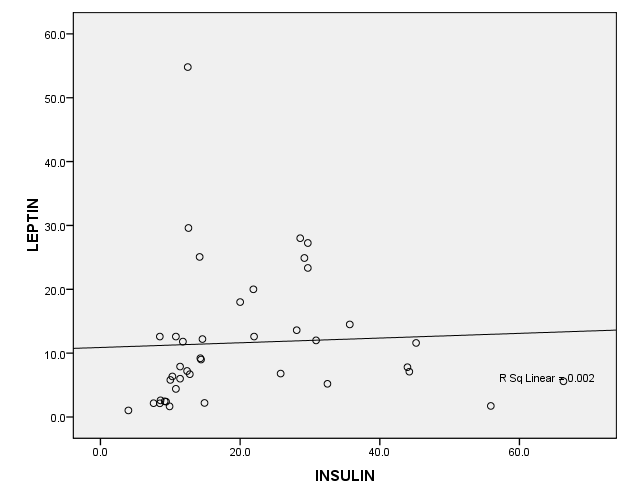
| Correlation coefficient (r) | P-value |
|---|---|
| 0.3803 | 0.0142 |
A plausible reason could be the insulin resistance due the insulin receptor inactivity which develops hyper- insulinomia. Since insulin stimulates leptin secretion from white adipose tissue, hyper-insulinomia might have an effect on hyper-secretion of leptin from its source. The immunohistochemistry of insulin receptor in white adipose tissue obtained from human obese male subjects has, in fact, shown a trend of decreasing mode of its expression with the advancement of obesity (Figure 4). A similar downhill on the insulin receptor expression is expected in other insulin dependent tissues for glucose utilization in obese subjects.
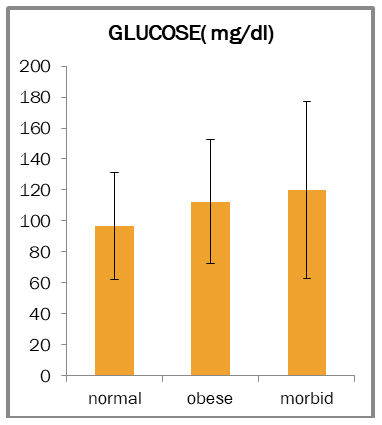
This could be another reason of developing hyperglycemia in obese subjects. The Figure 5 shows an increasing trend of plasma glucose value in human obese subjects.
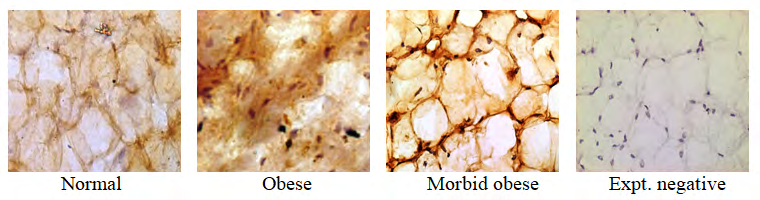
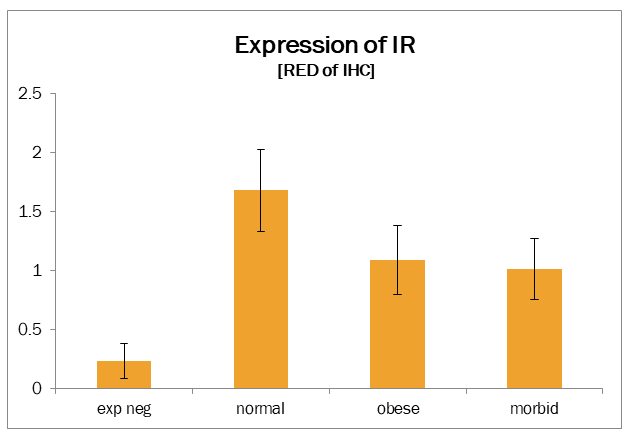
| Mean ± SD | P-value | |||
|---|---|---|---|---|
| Espt. Negative | Normal | Obese | Morbid obese | |
| 0.230 ± 0.15 | 1.680 ± 0.35 | 1.090 ± 0.29 | 1.010 ± 0.26 | 0.00001 |
Hence, human obesity can sequel a metabolic-X-disorder by jolting lipidimia, leptinemia and insulin resistance, preferably type-2 diabetes mellitus, associated glycaemia which precipitates the risk of other clinico-pathological abnormalities like hypertension, atherosclerosis and heart attack. Persistence of hyperlipoproteinemia, high plasma concentration of LDL, in obese subjects could also be a prime factor for initiating carcinoma in long run [19].
Discussion
Like other known reports this study has also shown that BMI increases with the increase of body mass. This study has also supported previous reports [20, 21, 22] showing dyslipidemia is a jolted incidence in human obesity. It is also apparent from this study that a positive association also exists between two entities, leptin and insulin, in obese subjects. While the lipostat theory postulates a feedback mechanism between metabolic and motor activity (eating behaviour and energy expenditure) [23, 24] where the adipocytes secreted factor, called Leptin, is involved in maintaining a balance between eating habit and expenditure of the acquired energy from the consumed food; the existed hyper-leptinemia in human obese subjects fails to sustain the above mentioned feedback regulatory mechanism. The previous report from our laboratory [17] has shown that leptin cannot be ferried through blood circulation to reach its cognate receptor, called satiety regulator, at the base of hypothalamus because of inadequate amount of soluble leptin receptors in blood circulation in obese human subjects that carry leptin across the blood vessel from its site of secretion to the site of blood brain barrier. So leptin remains abstained from its interaction with its hypothalamus based receptor. Again, insulin stimulates leptin secretion from adipose tissue and leptin does similar effect for insulin secretion from pancreatic β-cells. A laxity of this second feedback response over insulin and leptin secretions from pancreas and adipose tissue by their respective cross inducers, leptin and insulin, keep the secretary switch ‘ON’ for both the ligands viz. insulin and leptin. Such laxity has been reflected in present study. While leptin concentration gets increased with increase of body mass; insulin concentration also goes on increasing maintaining a positive correlation with leptin. The acquired hyper-insulinomia gradually turns chronic with the decreased functionality of inadequately expressed insulin receptor as is evidenced in this study after reviewing the immunohistochemistry of insulin receptor expression in white adipose tissue obtained from bariatric surgery of human obese male subjects. The immunohistochemistry of adipose tissue has shown a steep fall of insulin receptor expression. Similar result is also expected with insulin receptors in other tissues. Deficiency in insulin receptor concentration leads to poor transmission of message from insulin for glucose uptake, thus initiating induction of hyperglycemia as is encased in present study with the gradual increase of plasma glucose concentration parallel to the increase of insulin and leptin along with hypercholesterolemia and hyperlipoproteinemia (increased LDL level).
This study thus bears no conflict with unanimous understanding that in obesity, a decreased sensitivity to leptin occurs as similar as to insulin resistance found in type- 2 diabetes mellitus showing an inability to ascertain satiety in spite of having sufficient energy stores and high levels of leptin in systemic circulation [25].
References
-
Mahassni SH (2020) Overweight and obesity and the immune system, lipids and c-reactive protein in young and middle-aged saudi female university workers. J Biochem Tech 11(1): 49-56.
-
Kumar A (2019) The impact of obesity on cardiovascular disease risk factor. Asian Journal of Medical Sciences 10(1): 1-12.
-
Petrie JR, Guzik TJ, Touyz RM (2018) Diabetes, Hypertension, and Cardiovascular Disease: Clinical Insights and Vascular Mechanisms. Can J Cardiol 34(5): 575-584.
-
Akil L, Ahmad HA (2011) Relationships between Obesity and Cardiovascular Diseases in Four Southern States and Colorado. J Health Care Poor Underserved 22(S4): 61-72.
-
Koroukian SM, Dong W, Berger NA (2019) Changes in Age Distribution of Obesity-Associated Cancers. JAMA Netw Open 2(8): e199261.
-
Pischon T, Nimptsch K (2016) Obesity and Risk of Cancer: An Introductory Overview. Recent Results Cancer Res 208: 1-15.
-
Engin A (2017) Obesity-associated Breast Cancer: Analysis of risk factors. Adv Exp Med Biol 960: 571-606.
-
Friedman MI, Appel S (2019) Energy expenditure and body composition changes after an isocaloric ketogenic diet in overweight and obese men: A secondary analysis of energy expenditure and physical activity. PLoS ONE 14(12): e0222971.
-
Hall KD, Guo J (2017) Obesity Energetics: Body Weight Regulation and the Effects of Diet Composition. Gastroenterology 152(7): 1718-1727.e3.
-
Galgani J, Ravussin E (2008) Energy metabolism, fuel selection and body weight regulation. Int J Obes (Lond) 32(S7): S109-S119.
-
Kennedy GC (1953) The role of fat depot in the hypothalamic control of food intake in the rat. Proc R Soc Lond B Biol Sci 140(901): 578-596.
-
Cammisotto PG, Bendayan M (2007) Leptin secretion by white adipose tissue and gastric mucosa. Histol Histopathol 22(2): 199-210.
-
Stern JH, Rutkowski JM, Scherer PE (2016) Adiponectin, Leptin, and Fatty Acids in the Maintenance of Metabolic Homeostasis through Adipose Tissue Crosstalk. Cell Metabolism 23(5): 779-784.
-
Havel PJ (2000) Role of adipose tissue in body-weight regulation: mechanisms regulating leptin production and energy balance. Proc Nutr Soc 59(3): 359-371.
-
Wang J, Obici S, Morgan K, Barzilai N, Feng Z, et al. (2001) Overfeeding rapidly induces leptin and insulin resistance. Diabetes 50(12): 2786-2791.
-
Lustig RH, Sen S, Soberman JE, Velasquez-Mieyer PA (2004) Obesity, leptin resistance, and the effects of insulin reduction. Int J Obes Relat Metab Disord 28(10):1344-1348.
-
Beriwal P, Chandra NC (2019) Human Obesity: A noxious sequel of inverse intents of ligands and receptors. Diabetes Obes Int J 4(4): 000217.
-
Nabi G, Seth A, Dinda AK, Gupta NP (2004) Computer based receptogram approach: an objective way of assessing immunohistochemistry of androgen receptor staining and its correlation with hormonal response in metastatic carcinoma of prostate. J Clin Pathol 57(2): 146-150.
-
Bousquenaud M, Fico F, Solinas G, Rüeggand C, Santamaria-Martínez A (2018) Obesity promotes the expansion of metastasis-initiating cells in breast cancer. Breast Cancer Research 20(1): 104.
-
Feingold KR, Grunfeld C (2018) Obesity and Dyslipidemia. In: De Groot LJ, Chrousos G, Dungan K, (Eds.), MDText. com Inc; Endotext, South Dartmouth.
-
Sheth J, Shah A, Sheth F, Trivedi S, Nabar N, et al. (2015) The association of dyslipidemia and obesity with glycated haemoglobin. Clinical Diabetes and Endocrinology 1(6). DOI 10.1186/s40842-015-0004-6 (Open Access).
-
Bays HE, Toth PP, Kris-Etherton PM, Abate N, Aronne LJ, et al. (2013) Obesity, adiposity, and dyslipidemia: A consensus statement from the National Lipid Association. J Clin Lipidol 7(4): 304-383.
-
Anukulkitch C, Rao A, Dunshea FR, Clarke IJ (2009) A test of the lipostat theory in a seasonal (ovine) model under natural conditions reveals a close relationship between adiposity and melanin concentrating hormone expression. Domest Anim Endocrinol 36(3): 138-151.
-
Ahima RS, Antwi DA (2008) Brain regulation of appetite and satiety. Endocrinol Metab Clin North Am 37(4): 811- 823.
-
Pan H, Guo J, Su Z (2014) Advances in understanding the interrelations between leptin resistance and obesity. Physiology & Behavior 130: 157-169.
- Investigation of Polymorphisms in PPAR-Ɣ and TRHR Genes and their Impact on Turkish Diabetic and Obese Individuals
- The Impact of Aircraft Noise Exposure on the Efficacy of Empagliflozin Therapy in an Animal Model of Obesity
- Rooibos Mitigates Metabolic and Inflammatory Dysfunctions in Mice Fed a High-Carbohydrate Diet
- Synergistic Effect of Combined Leaf Extract of Vernonia amygdalina, Ocimum gratissimum, and Zingiber officinale Tuber on Phytochemical Profile, Antioxidant Activity, Serum Insulin, and Biochemical Parameters in Streptozotocin-Induced Diabetic Rats
- Investigation of Cardiovascular Responses to Aerobic Exercise in Obese University Students
- A Look at the Phase Angle Obtained by Electrical Bioimpedance