
A Designer’s Perspective on Ankylosing Spondylitis and its Impact on Quality of Life
The onset of symptoms of Ankylosing Spondylitis (AS) generally occurs between 20-40 years of age, which is the most active stage of any professional. The onset of symptoms beyond the age of 50 is less than 4%, so the target population is relatively younger than most of the chronic cases. For some, the condition might not have any implication at all but for a majority, it compromises the quality of life. With limited to no cure, non-pharmacological interventions are one of the predominant treatment methods for AS. The paper explores the human factors involved in the long-term management of AS and provides ergonomic recommendations for minimizing the impact of AS on the patient and society. Probing into ideal working conditions for a general population suffering from AS. The workplace management and design specifically for an AS patient is the sought goal of the research.
Introduction
Ankylosing spondylitis (AS), a common rheumatic disease, is a type of arthritis that mainly affects the user’s backbone. It’s one of a group of inflammatory conditions, referred to as spondyloarthritis.
The onset of symptoms generally occurs around 20 years of age, which is the most active stage of any professional [1]. The general trend in India is estimated to be between 0.1 and 0.2%.of the population. The onset of symptoms beyond the age of 50 is less than 4%, so the target population is relatively younger than most of the chronic cases [2]. For some, the condition might not have any implication at all but for a majority, it compromises the quality of life. With limited to no cure, non-pharmacological interventions are one of the predominant treatment methods for AS. Ankylosing spondylitis typically starts in the joints between the spine and pelvis (the sacroiliac joints), but it may spread up from spine to the neck. Seldom affecting other parts of the body, including joints, tendons, or even eyes.
Initial research provides a demographic background in relation to the prevalent trends and psychosocial opinions of patients in India. Further discussing the importance of ergonomics in designing an intervention, and how adjusting human factors involved might overcome work disability. A system design promoting more working flexibility is proposed, discussing how the long-term management of AS could be efficiently done using existing technology.
It is very often that the cases get undiagnosed as there are no clear testing procedures for the condition [1]. The variation of symptoms and effects opens a wide user profile for a design intervention. The needs of the patients can be very simple yet effective, like warm and cold therapy on the lower back. The condition affects the patient in various ways, primarily and most concerning is social exclusion [2]. As the condition often prevents active movement or sedentary tasks to be done. Outdoor and adventure activities are far from the daily routine of an AS patient. Riding a bike or driving to work is a challenging task in itself. Being chronic in nature AS can affect many aspects of a patient’s life. On an emotional scale it’s intimidating, frustrating, sad, and sometimes builds up anger. It becomes an important need to have the patient be aware of such emotions and changes building up [3].
A radical and more inclusive approach to design of an ergonomic intervention shall make the lives of AS patients much better.
Literature Survey
There are not enough efforts made to study chronic disease beyond pharmacological interests in India [1]. Various findings indicate that AS has long-term complex implications on the patients. Thus it is important not only has to study what changes had the condition brought in the patient’s life but also the patient’s response to those changes.
The physical pain improves over time in most cases but a small number of people might have long-term effects. At the worst an extra bone can fuse the bones in the spine together, stopping the spine from moving.
When compared to the healthy population the AS patients have a significantly lower quality of life which is also validated by a number of studies. The impact on a patient’s life leads to depression and such psychological issues [3]. The barriers like treatment side effects, concerns about appearance, the uncertainty of the future, inability to perform daily activities. An alarming number of patients find it difficult to meet the job requirements and withdraw. The un-employability and rate of withdrawal are substantially high with AS patients [4]. With minimal job securities and the trend of low working standards in India, most low- income groups are prone to withdrawal from employment [5]. Though the cost of treatment of AS is considerably lower than other chronic diseases of such category, work disability leads to monetary issues and dependency.
It is also reported that women find it more difficult to cope up with work disability. Based on previous studies it is estimated that due to physical limitations female AS patients report fatigue, stress, and other issues linked with the inability to perform better at work, two to three times more than the male AS patients.
Poor quality of life is directly linked to a low level of education [5]. In India, for AS patients it is difficult to find alternate means of livelihood specifically in cases where the patient was in a labor-intensive job [4].
Methodology
Not only are pharmacological and non-pharmacological modes complementary but they are of equal importance for optimal management of AS. In certain cases, non- pharmacological treatments are more needed to help the patient regain confidence and efficient pain management.
User Study
As stated earlier, the work disability in patients with AS has multiple aspects associated with it including demographic factors, job requirements, and psychosocial factors [6]. Various researches have examined the relative importance of such factors and predicted withdrawal from tasks. It was also observed that the patients are passive when coping up with the withdrawal. Validated technical and ergonomic adjustment of the workplace becomes important in reducing the risk of withdrawal. Understanding the ergonomic user requirements like frequent breaks, ergonomic arrangement of equipment would definitely bring a drastic change in the working efficiency and ease of an AS patient. Studies show patients are not inclined towards regular exercises though they are aware of the benefits.
AS results in both psychosocial and physical implications therefore optimal long-term management shall have a blend of pharmacological and psychosocial interventions. In the long-term healthcare costs, nonhealthcare costs, and income loss has a drastic monetary impact on the patients.
Methods
Patients employed in labour intensive jobs are at the risk of premature work cessation [2]. Though there are few studies conducted on work disability in arthritis and its types, the researchers suggest that work disability is directly related to job descriptions with high physical input [6]. There are many self-reported cases of inability to cope up with job activities, clearly stating the need for ergonomic intervention. A substantial number of Indians especially north Indians with the condition reported difficulty with the following work-related activities: long-hour desk job, bending of the neck, moving office articles, typing and kneeling. The most common activity is a sedentary job on the desk for a longer period of time.
The proposed solution not a single product but entire system architecture to help patients from support groups, individual tailor treatments. The sense of belongingness is often a major factor in making the life of the patient more comforting.
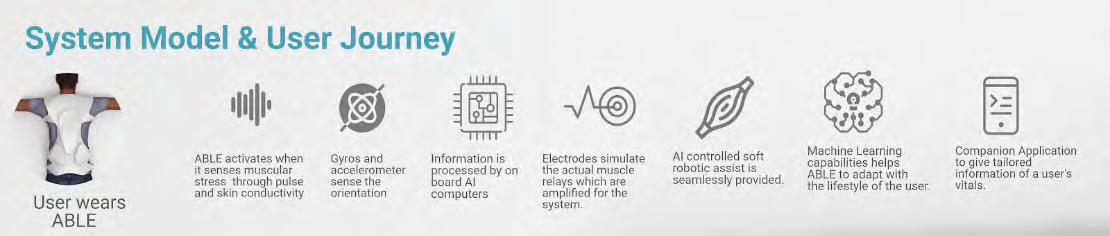
The idea explored is based on lines of working of fitness trackers and how they utilize the digital platform to form better community connections among the same user profile A simple wearable device has a set of sensing technology along with a relay medium to convey information (Figure 2). The smart wearables attached to the body are well capable of sensing various variables related to muscle movement, heart rate so on. Upon studying the numerous approaches to the medical aid and monitoring devices for arthritis, and similar conditions it was found that the aids fail to connect well to the user (Figure 3). They do not feel like an extension of the body but rather an exo-suite offering limited movement and flexibility.
Evaluation of any assistive intervention requires ergonomic assessment to provide a base for development. The traditional ergonomic assessment tools cannot be used for AS patients as the stress and various thresholds are decided based on the general population. The assessment tools also have limitations of being a body part specific or job- specific [6, 7]. The Ergonomic Assessment Tool for Arthritis (EATA) was designed to assess ergonomic risk factors for people with arthritis and to generate potential solutions for reducing that risk as well. EATA is a self-assessment tool combined with personal interviews as employees with AS might not be comfortable disclosing their condition. EATA is a completely adaptive tool that can be modified to an individual’s needs and job requirements [7].
Solution
The proposed solution Able is a framework of a viable system and product design which would have a much greater impact than the existing solutions (Figure 3). Leveraging the digital solutions and wide adoption of mobile computers and faster connectivity the project utilizes mobile connectivity. The lack of support groups for AS patients is major because of no existing platforms designed for social connectivity amongst a specific target demographic. The use of conventional connectivity platforms has limitations like - visibility to the wide network, privacy issues, no specific features or functions regarding the condition of AS. Typically an AS patient would require a single application for group activities, check-up appointments, regular statistics on the condition.
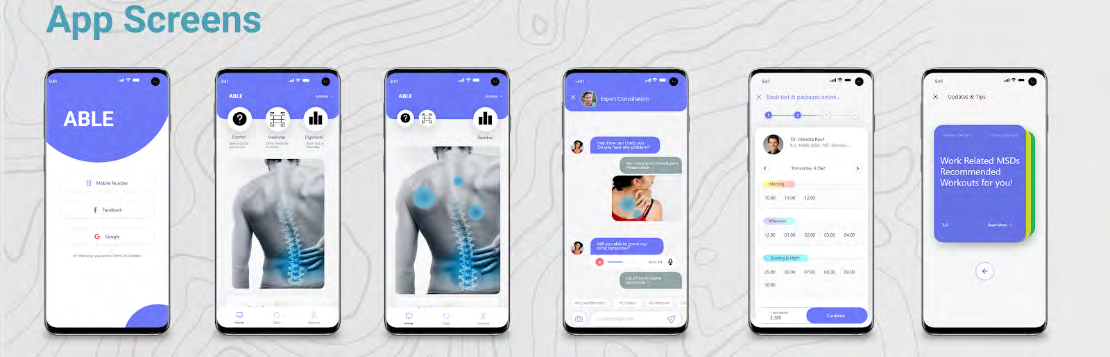
A part of the solution was aimed at designing the user interface of the companion application (Figure 4). The app has features like a representation of data from the Able wearable vest, instant messaging with the registered physician, regular community updates, and meeting information. Falling in line with the need for remote counseling/consultation during the COVID 19 crisis. Hospitals and health centers were out of reach for patients with long-term disabilities. The app solves the issues of physical appointments by screening regular check-ups from problems that require immediate involvement of the physician. This reduces the need of the major aspect of the solution is the design of a wearable vest based on existing technologies. The vest would have two features, the elastic and supporting straps to help maintain a good posture for a longer duration of sitting, record muscular movement and tensions to alert the user to take breaks. The vest had a hot and cool therapy feature that utilizes Peltier effect and provides the required amount of therapy for quick stress relaxation.
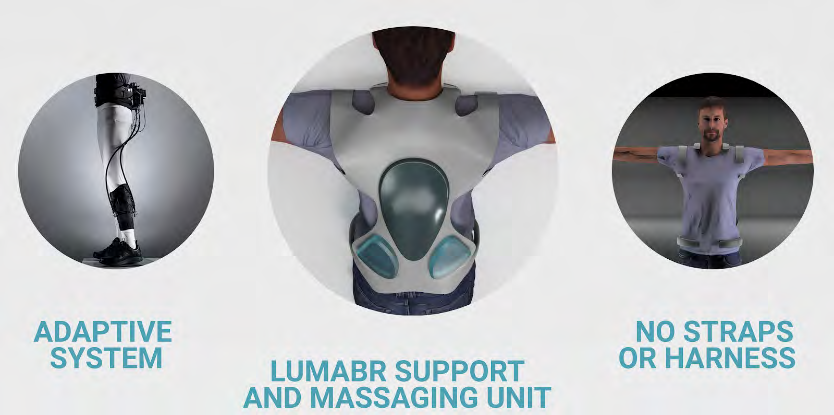
The present design construction and evaluation of the project are in the exploration stage. While the project does not develop new technology, it aims to utilize the existing technology to the fullest, consolidating it into a deliverable product concept. The concept design gives glimpses of how this system and product would bring about a change. The surfacing and computer-aided modeling were developed as part of the project with ready to manufacture construction. The contribution of the work done in developing the system architecture for further development, rigorous testing, and validation. Contextual inquiry, background research into the life, pattern, and demographics of AS patients in India led to the ideation of Able.
Conclusion
AS surely has a long-term economic implication, but also family, personal and social relationship implications as well. Work disability results in depression and stress among AS patients. The primary reason is speculated to be a lack of support groups (a community of AS patients for exchanging ideas and mutual support) and low social acceptance. The ergonomic assessment has proven effects in eliminating long-term work-related disabilities. The presented solution and system framework aim to solve physiological and psychosocial issues that the patients suffer. There is a need for the development and testing of the proposed framework to prove its efficacy. Adjusting the workplace to the needs of the patients, utilization of mobile computing and wearables are some of the many possibilities of holistically managing AS conditions in the long term.
References
-
Prakash Shivnil, Mehra Narinder, Bhargava Santosh, Vaidya M, Malaviya Anand (1984) Ankylosing spondylitis in North India: A clinical and immunogenetic study. Annals of rheumatic diseases 43(3): 381-385.
-
Kumthekar Anand, Deodhar Atul (2021) Axial Spondyloarthritis and Ankylosing Spondylitis. Physician Assistant Clinics 6(1): 135-147.
-
Zhao Sizheng, Thong Daniel, Miller Natasha, Duffield Stephen, Hughes David, et al. (2018) The prevalence of depression in axial spondyloarthritis and its association with disease activity: A systematic review and meta- analysis. Arthritis Research & Therapy.
-
Chorus Astrid, Miedema Harald, Linden SJ (2002) Employment perspectives of patients with ankylosing spondylitis. Annals of rheumatic diseases 61(8): 693- 699.
-
Mishra Akshita, Singh Ravindra, Tandon Puneet (2020) Ergonomics International Journal Ergonomics Risk Factors among Hairdressers Working in India: A Case Study. Ergonomics International Journal 4(4): 000252.
-
Boone Caroline, Albert Adelin, Mielants Herman (2014) Understanding Limitations in At-work Productivity in Patients with Active Ankylosing Spondylitis: The Role of Work-related Contextual Factors. The Journal of rheumatology 42(1): 93-100.
-
Prasad M, Wahlqvist P, Shikiar R, Shih YC (2004) A review of self-reported instruments measuring health-related productivity: a patient-reported outcomes perspective. Pharmacoeconomics 22(4): 225-244.
- The Expanding Landscape of Road Rage: A Systematic Review of Conflicts Involving Drivers, Pedestrians, and Micromobility
- Validating Cognitive Models of Royal Navy Performance on Control Systems
- Comparing Standard and State-of-the-art Firefighter Coats on Postural Balance and Gait in a Live Burn Environment
- Investigating the Integration of Telemedicine into Clinicians Workflow: A Review of Methods
- Risk Assessment of Ergonomic Factors in a Textile Firm by RULA, REBA and Fine Kinney Methods
- Impact of Self-Esteem Training on Individuals with Disabilities Aged 17-30