
Percentage Change in Reaction Time Can Predict Respiratory Quotient during Light Weight Schoolbag Carriage
While structured physical activity improves cardio-pulmonary parameters and Reaction Time (RT), heavy weight schoolbag carriage is detrimental. Schoolbag carriage may have either consequence. The purpose of this study is to explore the consequences of heavy and light weighing schoolbags on cardio-pulmonary parameters and RT. Healthy male participants (10-15 years) carrying schoolbags- 0%, 4%, 8%, 12%, 16% load of bodyweight walked (20-minutes) for 5 times each. For each of the 30 participants, during walks, COSMED k4b2 measured heart rate (HR), respiratory quotient (R), total energy expenditure (EEtot) and number of steps taken. Ruler-drop-test marked RT before and after each walk. RT improved after walking with schoolbags weighing 0%, 4% of bodyweight. RT didn’t improve for 8%, 12% carriage, worsened for 16% load carriage. HR and EEtot showed proportionality (r=0.24, p
Introduction
Each school-going child, irrespective of the background they belong to carry schoolbags. School curriculum demands heavy backpacks and absence of lockers mandates schoolbag carriage for children. The physiological cost of carrying heavy schoolbags is enormous and heavily documented, most common of which is low back pain, scoliosis, change in posture, and change in muscular activity [1, 2, 3]. Schoolchildren being in the expeditious growth and development phase are more vulnerable to the ill effects of the aforementioned musculo-skeletal symptoms [4]. Moreover, pain in childhood and adolescence persists even in adulthood [5] vitiating the emergent population.
Besides the musculo-skeletal effects, backpack carriage has cardio-respiratory consequences. Carrying heavier backpacks are denoted to cause increased heart rate, energy expenditure [6] and decreased pulmonary ventilation [7] indicating less oxygen availability. As bodily movement involving energy expenditure is termed as a physical activity which when performed regularly for a fixed duration of time, has physiological benefits [8]. Here, we explore schoolbag carriage in this context to understand the extent of benefits and risks posed to children due to schoolbag carriage.
Schoolbag carriage is also known to influence gait and posture in an individual with heavier loads showing adverse effects [9, 10]. Various alterations in posture are speculated to improve reactive performance [11]. We hypothesize that carrying lower backpack weights for a fixed duration may improve reactive performance or the reaction time measured for hand-eye coordination, that is, the motor ability.
Low reaction time or better motor ability is indicative of physiological well-being as slower reaction time is associated with increased mortality from all-causes and cardiovascular disease [12]. Physiological well-being is reflected in an important parameter associated with respiratory physiology- the respiratory quotient. Respiratory quotient (R) measures the carbon dioxide evolved relative to the oxygen consumed. The R value of 0.7 indicates lipid metabolism, R of 0.8 indicates protein metabolism while carbohydrate metabolism is indicative of an R-value 1 [13]. In conditions where aeration is possible, higher respiratory quotients indicate faulty air supply and presence of anaerobic zones in the system [14]. Higher R thereby denotes inefficient pulmonary ventilation. Lacunae remain in exploring the relationship between respiratory quotient and reaction time response in the foreground of physical activity, which we explore in this present study.
So, in this study, we explore the undetermined relationships between physical activity with backpack carriage, for particular time duration, and its effects on reaction time and respiratory quotient.
Methodology
Subject Selection
The total number of subjects (randomly taken) that participated in the study was 30. All subjects were healthy males belonging to the age group 10-15 years. Participants with any congenital disorder or visual impairment were excluded from the study. All data was collected in compliance to the guidelines set by the Institutional Ethical Committee (Human) of Presidency University, Kolkata and in accordance to Declaration of Helsinki. Since the participants were minors, participation was subject to obtaining consent forms signed by parents or guardians.
Experimental Protocol
Each subject was made to walk for 20 minutes at their preferred pace on a plane ground with a schoolbag weighing 0%, 4%, 8%, 12% and 16% of their body weight. The same schoolbag was placed in mid-back region on both shoulders for each participant to obtain consistent backpack placement. Each of the 30 participants walked 5 times, bringing the total number of walks to 150. Not every participant could complete all the walks and finally 102 walks were considered in the study (n=102). Each of the walks with different loads were conducted on separate days to remove the cumulative effect of consecutive walks and the percentage weights were randomly assigned to nullify the effect of graded load carriage. Temperature and humidity check was done each day and walks were not conducted if temperature exceeded 25oC or the relative humidity exceeded 50% and a parity of weather conditions were maintained for all walks for better results.
Measurement of Physiological Parameters
The vital parameters of each participant along with height and weight were all measured using laboratory equipment dedicated for study to minimize instrument errors and variations. Data on physiological parameters such as heart rate (HR), respiratory quotient (R) and total energy expenditure in kilo calories (EEtot) during walks was collected using COSMED k4b2.
Measurement of speed adopted by the participants
The speed adopted by each participant was derived based on the number of steps taken as recorded in the COSMED k4b2. The step length for each subject was derived from their heights [15] and based on the number of steps taken, the distance walked was evaluated. Since each subject walked for 20-minutes, speed adopted was calculated.
Measurement of Motor Ability
The motor ability of the participants was measured twice- before and after each walk using ruler drop test [16] which gives the reaction time for hand-eye coordination. A lower reaction time reflects better hand-eye coordination or motor ability. The percentage change in motor ability was evaluated and subsequently the percentage was dichotomized based on whether the change was negative or not.
Statistical Analysis
Graphical and tabulated representation was chosen for aforementioned parameters for each different load carriage. Correlogram was developed to pictorially represent the matrix of linear relationship between parameters. Significant correlations were used to evaluate linear regression model. Finally, ROC (Receiver-Operator Characteristic) curve was generated to check whether any physiological parameter during load carriage was able to predict the binary outcome of motor ability improved or not after 20 minutes of schoolbag carriage. All analysis was done using IBM SPSS (version 25) and R software (R Core Team and the R Foundation for Statistical Computing).
Results
Baseline Data for the Participants
The mean and standard deviation for height, weight, age of the participants is tabulated in Table 1. The participants belonged to the age range of 10-15 years, a period of rapid growth and development [4], which attributed to large standard deviations in weight and height within the sample.
| Mean | (±) Standard Deviation | |
|---|---|---|
| Age (years) | 11.7 | 1.29 |
| Height (cm) | 142.5 | 10.5 |
| Weight (kg) | 36.2 | 10.69 |
Table 1: Baseline data of the participants.
Speed Adopted by the Participants While Walking
Number of steps taken, heart rate, total energy expenditure and respiratory quotient (R) was measured when the participants walked with schoolbags weighing 0%, 4%, 8%, 12% and 16% of their body weight. Prior to placing the backpack, the subjects were made to wear the COSMED k4b2 instrument. Figure 1 depicts the entire experimental set-up. The instrument analyses all the aforementioned parameters breath-to-breath, thus generating parameter measures for each breath taken during the 20-minute walk.
The participants were asked to walk at their preferred pace to achieve realistic field conditions when they travel to school with their backpacks. Average speed adopted by the participants was significantly different across different weights carried as per ANOVA (p<0.05). The adopted speed decreased gradually with increase in the load of schoolbag carried while at no load conditions, most of the participants adopted a low, leisurely pace Figure 2A.
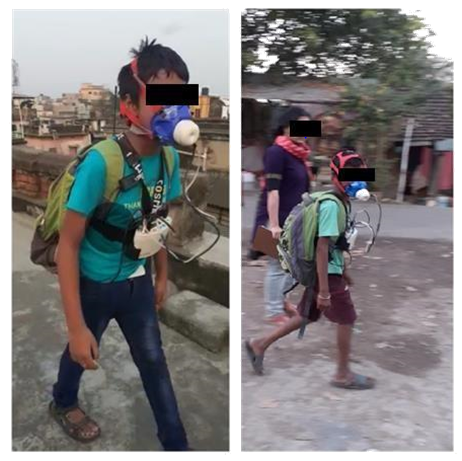
Heart rate of the participants while walking
The average heart rate (rounded up) when carrying any load (4%, 8%, 12% or 16% of body weight) was 118 beats per minute. The predicted maximum heart rate is 220 minus age [17]. Given the average age of the participants- 12 years (rounded up), the predicted maximum heart rate within this sample population is therefore 208 beats per minute which makes carrying schoolbags a physical activity eliciting 56.7% of predicted maximum heart rate. The percentage of maximum predicted heart rate when walking with different loads is represented in Table 2 which portrays that walking with any load of schoolbag is a moderate intensity physical activity as per the American Heart Association [18] when mean heart rate is considered. The average heart rate varied for different loads carried Figure 2B but the difference was not significant.
| HR (av) (bpm) | Age (Years) | Maximum predicted HR (bpm) | Percentage of maximum predicted HR (%) | Type of work | ||
|---|---|---|---|---|---|---|
| 0% | Minimum | 97 | 10 | 210 | 46.2 | Light intensity |
| 0% | Maximum | 140 | 14 | 206 | 68 | Moderate intensity |
| 0% | Mean (±) SD | 117 | 12 | 208 | 56.3 | Moderate intensity |
| 0% | Mean (±) SD | (±12) | 12 | 208 | 56.3 | Moderate intensity |
| 4% | Minimum | 80 | 10 | 210 | 38.1 | Light intensity |
| 4% | Maximum | 132 | 14 | 206 | 64.1 | Moderate intensity |
| 4% | Mean (±) SD | 113 | 12 | 208 | 54.3 | Moderate intensity |
| 4% | Mean (±) SD | (±12) | 12 | 208 | 54.3 | Moderate intensity |
| 8% | Minimum | 94 | 10 | 210 | 44.8 | Light intensity |
| 8% | Maximum | 162 | 14 | 206 | 78.6 | High intensity |
| 8% | Mean (±) SD | 122 | 12 | 208 | 58.7 | Moderate intensity |
| 8% | Mean (±) SD | (±20) | 12 | 208 | 58.7 | Moderate intensity |
| 12% | Minimum | 108 | 10 | 210 | Moderate intensity | |
| 12% | Maximum | 134 | 14 | 206 | Moderate intensity | |
| 12% | Mean (±) SD | 118 | 11 | 209 | 56.5 | Moderate intensity |
| 12% | Mean (±) SD | (±8) | 11 | 209 | 56.5 | Moderate intensity |
| 16% | Minimum | 94 | 10 | 210 | 44.8 | Light intensity |
| 16% | Maximum | 155 | 14 | 206 | 75.2 | High intensity |
| 16% | Mean (±) SD | 117 | 12 | 208 | 56.3 | Moderate intensity |
| 16% | Mean (±) SD | (±16) | 12 | 208 | 56.3 | Moderate intensity |
Table 2: The heart rate (HR)-maximum, minimum, mean (HR (av)) in beats per minute (bpm) and subsequent work intensities when walk
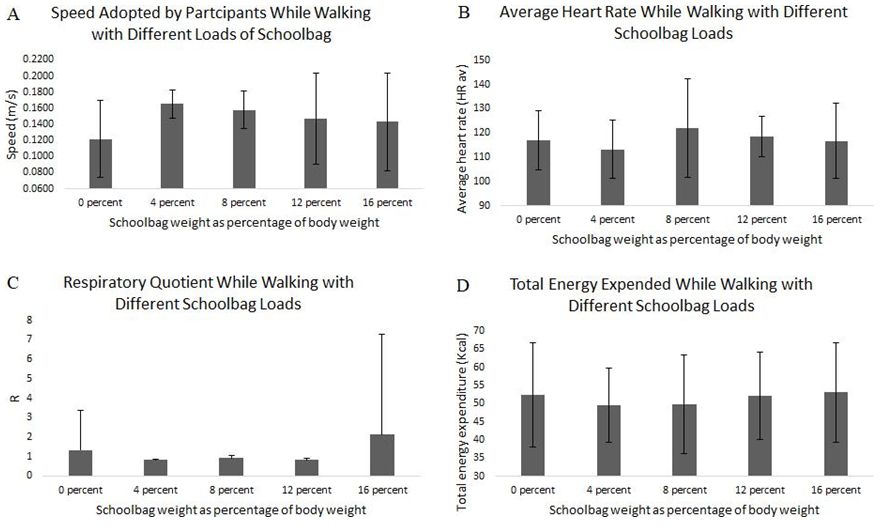
Figure 2: Speed and physiological parameters of the participants during 20 minutes of walk while carrying different loads of schoolbag- A: Speed adopted by the participants; B: Average heart rate during walks C: Respiratory quotients during walks; D: Total energy expenditure during walks. The speed adopted by the participants Figure A was significantly different as per ANOVA (p<0.05), none of the other parameters Figure B-D was significantly different.
Respiratory Quotient (R) of the Participants While Walking
The respiratory quotient was found to reach the highest value of 2.1 when carrying a load equivalent to 16% of the body weight Figure 2C indicating higher amounts of CO2 release. The average R for walks with 0%, 4%, 8% and 12% load of bodyweight was 0.1, 0.8, 0.9 and 0.8 respectively.
Total Energy Expenditure (EEtot) of the Participants While Walking
Total energy expended increased with higher loads carried Figure 2D. In no-load condition, the EEtot was 52.5 Kcal while for 4%, 8%, 12% and 16% load of bodyweight it was 49.5, 49.8, 52.1 and 53.0 Kcal respectively.
Motor Ability of the Participants Before and After Walking
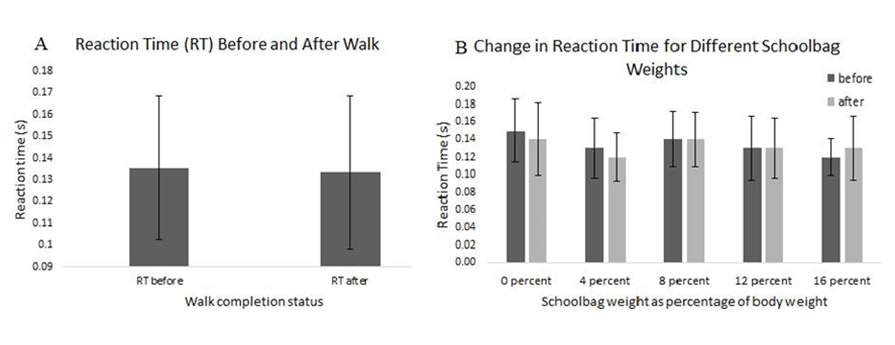
The motor ability of the participants was measured before and after each walk on basis of their reaction time via ruler drop test. The shortest reaction time (RT) measured was 0.07s, both before and after walk while the longest reaction time measured before walk was 0.21s and 0.25s after walk. On the whole, the motor ability showed improvement after the physical activity of schoolbag carriage for 20 minutes Figure 3A from 0.14s to 0.13s when all walks was considered together. However, on closer inspection, it was seen that reaction time decreased, improved when carrying no load (0.15s to 0.14s) and also while carrying a load pertaining to 4% of bodyweight (0.13s to 0.12s). It showed no change when carrying 8% and 12% load of bodyweight while it increased or worsened (0.12s to 0.13s) when carrying 16% load of body weight Figure 3B.
Linear Relationship Between Different Parameters
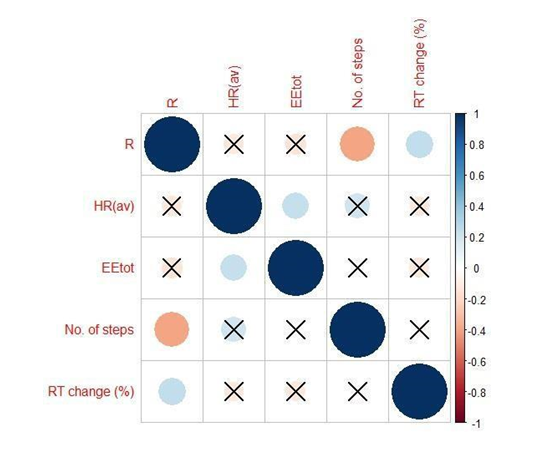
The trends visible via prior graphical representations indicated linear relationship and correlation was performed to evaluate the same Figure 4. Heart rate was observed to rise with increase in energy expenditure (r=0.24, p<0.05). The respiratory quotient was seen to have significant proportional relationship with percentage change in reaction time before and after walk (r=0.24, p<0.05) while it was inversely related to the number of steps taken during the walk (r=-0.40, p<0.01).
Prediction of Respiratory Quotient Based on Change in Motor Ability
Owing to the significant association between change in reaction time and respiratory quotient, we evaluated the linear regression of the two parameters. Since, ruler drop is an inexpensive, easy test to perform while respiratory quotient measurement expensive and tedious, we proceeded to develop a prediction model for R based on reaction time change Table 3. About 6% of the variance (R2=0.062) in R
could be explained by the percentage change in RT Table 3a. The model could significantly predict (p=0.016) the R Table 3b based on percent change in RT (R=1.223+0.028 (Percentage RT change)). The coefficients for the model (all significant, p<0.05) are listed in Table 3c.
| 3a: Model Summary | ||||
|---|---|---|---|---|
| Model | R | R Square | Adjusted R Square | Std. Error of the Estimate |
| 1 | 0.249a | 0.062 | 0.051 | 2.3625 |
| a. Predictors: (Constant), Percentage RT change |
| 3b: Model ANOVA a | ||||||
|---|---|---|---|---|---|---|
| Model | Sum of Squares | df | Mean Square | F | Sig. | |
| 1 | Regression | 33.45 | 1 | 33.45 | 5.993 | 0.016b |
| Residual | 507.924 | 91 | 5.582 | |||
| Total | 541.374 | 92 | ||||
| a. Dependent Variable: R | ||||||
| b. Predictors: (Constant), Percentage RT change |
3c: Coefficients a of the model Model Unstandardized Coefficients Standardized Coefficients t Sig.
1 Beta Std. Error Beta (Constant) 1.223 0.245 4.992 0 Percentage RT change 0.028 0.011 0.249 2.448 0.016 a. Dependent Variable: R Table 3 (a-c): Linear regression model.
The efficacy of the model was checked by plotting the actual R against the upper and lower bound of the 95% confidence interval Figure 5. Besides the two abnormally high respiratory quotients of 22.1 and 10.9, most of the actual cases fell within the predicted confidence interval indicating a good model fit.
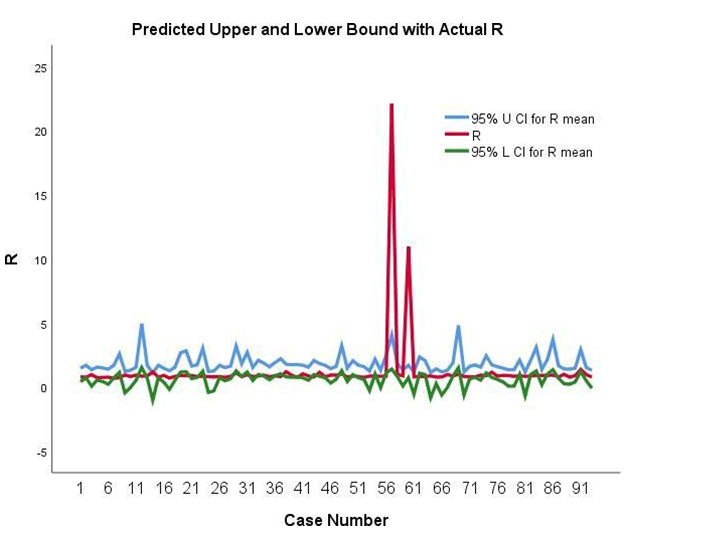
Figure 5: Actual respiratory quotient scores plotted against the upper and lower bound of predicted 95% confidence intervals. The red line indicates the actual Respiratory quotients (R) as measured during 20-minute walk. The blue and the green lines indicate the predicted upper (U) limit and predicted lower (L) limit of 95% confidence interval (CI) respectively. Mostly, the actual values fall within the predicted 95% CI indicating a good prediction model.
ROC Curve for Respiratory Quotient
ROC curve is valuable tool to evaluate predictive models having a binary outcome, where a good predictor acquires higher area under the curve (AUC). So, to emphasize the importance of the relationship between respiratory quotient and change in reaction time, a ROC curve was generated Figure 6. The percentage change in reaction time was dichotomized to worsened or not worsened and the respiratory quotient was used to evaluate this binary outcome. The area under the curve was significant (p<0.01) and evaluated to be 0.668 Table 4. AUC=0.668, 95% confidence interval: 0.558-0.779, p<0.01 indicates that respiratory quotient has predictive ability to discriminate whether or not reaction time worsens after carrying school bag for 20 minutes [19].
![Figure 6: The percentage change in reaction time was dichotomized to worsened or not worsened and the respiratory quotient was used to evaluate this binary outcome. The area under the curve was significant (p<0.01) and evaluated to be 0.668 Table 4. AUC=0.668, 95% confidence interval: 0.558-0.779, p<0.01 indicates that respiratory quotient has predictive ability to discriminate whether or not reaction time worsens after carrying school bag for 20 minutes [19].](/fulltextimages/8610/fig_6.png)
Figure 6: ROC curve depicting efficiency of respiratory quotient as a tool in predicting the binary outcome of whether or not the motor ability shows improvement after carrying schoolbag. The red line is the reference line while the blue line is the Respiratory quotient for all subjects during 20-minute walk. The area between the two lines, that is, the area under the curve (AUC) amounted to 0.668 (p<0.01).
| Area Under the Curve | ||||
|---|---|---|---|---|
| Test Result Variable(s): Respiratory quotient (R) | ||||
| Area | Std. Errora | Asymptotic Sig.b | Asymptotic 95% Confidence Interval | |
| Lower Bound | Upper Bound | |||
| 0.668 | 0.056 | 0.006 | 0.558 | 0.779 |
| a. Under the nonparametric assumption | ||||
| b. Null hypothesis: true area = 0.5 |
Table 5: Parameters for ROC curve.
Discussion
This study bolsters that schoolbag carriage is a physical activity regularly performed by children and resulting stress generated depends on the weight of the school bag. Backpack carriage (any load) was found to elicit an average heart rate equivalent to 56.7% of predicted maximum heart rate. As per the American Heart Association [18], the heart rate for moderate intensity activities is 50-70% of the maximal heart rate. This makes carrying schoolbags a moderately intense physical activity. This matches another study conducted by Hong and Brueggemann [9] that found the heart rate in 10-year-old boys to be 125 beats per minute (59.5% of predicted maximum heart rate) after walking for 20 minutes [9]. Another study in adolescents of 12.5 years of mean age showed the heart rate to be 107.4, 106.8 and 108.9 when carrying loads of 8%, 10.5% and 13% respectively [20] amounting to about 52% of predicted maximum heart rate.
ANOVA portrayed that the preferred speed adopted by participants differed significantly (p<0.05), gradually decreasing with increase in loads from 4% to 8%, 12% and 16% of body weight Figure 2A. This is in accordance to previous study where increase in load decreased the preferred walking speed [21]. Most muscles try to work under minimum effort criteria [10]. As the preferred walking pace matches the most energy efficient speed [22], the extra energy needed to carry the load is compensated by decreasing the walking pace [23].
In the context of physical activity oxygen consumption is a vital factor. The respiratory quotient takes into account not only oxygen consumption, but also carbon dioxide evolved besides evincing the metabolic fuel utilized [13]. A prior study denoted respiratory quotient to increase during load carriage indicating transition to carbohydrate oxidation and anaerobic metabolism. This implies maximal oxygen uptake at submaximal loads restricts daily activity capacity thus contributing to the risk for weight gain [24]. In accordance to this, our study found the respiratory quotient during 16% load carriage to exceed 2, thus designating it to be physiologically harmful.
Energy expenditure, although not significant, was found to increase with higher load carriage Figure 2D. This is in accordance with the findings by Hong et al., where energy expenditure in 10-year-olds was observed to increase gradually across 0%, 10%, 15% and 20% loads of body weight during a 20-minute treadmill walk [25]. A recent study also depicted similar findings where energy expenditure rose with increase in 0%, 5% and 10% load of bodyweight but the change was not significant [26].
This study found improvement in reaction time after the physical activity of carrying schoolbags in a 20-minute walk Figure 3A. Walking with no load condition and 4% loaded condition was seen to have improved reaction time in children Figure 3B. So, it can be said that carrying light backpacks for duration of 20 minutes can improve the reaction time in school-going children. A recent study by Patti et al., mentioned the physically active state to stimulate reaction time, cognitive performance and sensory stimulation [27]. The 8% and 12% load carriage did not alter reaction time whereas 16% load impaired the reaction time. This may be due to the sensation of over-exertion in children owing to maximal energy expenditure when carrying load 16% of body weight. Regular physical activity or exercise training has been seen to improve reaction time in children [28].
The percentage change in reaction time was found to be linearly associated with respiratory quotient Figure 4 and could significantly predict the same Table 3, Figure 5. Conversely, when percentage change in reaction time was dichotomized to whether it improved or not after the physical activity of schoolbag carriage, the respiratory quotient served as good tool indicating this binary outcome as depicted by the ROC curve Figure 6. A myriad of beneficial neurological processes emanates from regular physical activity induced cardio-respiratory fitness [29]. Respiratory quotient is a respiratory parameter whose high values are indicative of gain in body weight, fat mass [30] connoting the tendency to being overweight or obese. Maintenance and prediction of respiratory quotient is therefore vital.
To the best of our knowledge, this is the first study investigating schoolbag carriage as a regular physical activity which may have physiological benefits. We conclude that carrying light backpack weighing 4% of body weight on both shoulders and mid-back region can improve the reaction time. The percentage improvement in reaction time can significantly predict the respiratory quotient which is an important parameter that can conversely determine the binary outcome of whether reaction time improves or not after the physical activity of schoolbag carriage. The effects of load on the growing spinal cord, gait and posture were not studied which is a major limitation of this study. While carrying 4% load of body weight can be physiologically beneficial, carrying a load equivalent to 8% and 12% shows no such benefits while carrying a 16% load is positively deleterious to physiological health.
Conclusion and Future Prospects
Scientifically, through empirical findings, it can be confirmed that although carriage of light- weight bag on both shoulders is beneficial to children, heavy back pack carriage is physiologically harmful leading to cardio-pulmonary stress and delayed reaction time. These findings can help mitigate the harmful effects of heavy backpack carriage, separating them from beneficial ones that usually accompany regular structured physical activity.
The effect of physical activity on cognition is well documented. Physical activity is a commonly used method of improving cognitive function, not only in children, but also in adolescents and adults. Observations from our study show that schoolbag weighing 4% of body weight improves the reaction time in children when carried for 20 minutes. Hence our results pave the way for customized mode of improving cognitive function in a manner that can be self- applied. This may be extended to children with an otherwise dearth of physical activity, given that schoolbag carriage is performed regularly. This study may further be extended for other physical activities performed on a daily basis. It may be extrapolated to adult populations as well. Further, the study has ample scope to work on females to examine whether there are any gender differences in our observations.
Implementing physical activity logs for the day, created on basis of predicted respiratory quotient, can pave way for a healthy lifestyle in individuals.
Conflict of Interest
Authors declare no conflict of interest.
Acknowledgements
The work was ethically approved by Institutional Ethical Committee (Human), Presidency University, Kolkata (PU/IEC(H)/CL/A01/2018). We also acknowledge every participant and their guardian for their participation and support.
Funding
The funding for this work was provided by Department of Science & Technology and Biotechnology, Government of West Bengal(WBDST) under grant 114(Sanc.)/ST/P/ S&T/9G-3/2018 from 2018-2021.
References
-
Hossain FMA, Tonima MA (2017) A Study on the Effects of Heavy Backpack and Development of a Preventative Prototype. Journal of Sensors.
-
Li JX, Hong Y, Robinson PD (2003) The effect of load carriage on movement kinematics and respiratory parameters in children during walking. European Journal of Applied Physiology 90(1-2): 35-43.
-
Motmans RREE, Tomlow S, Vissers D (2006) Trunk muscle activity in different modes of carrying school bags. Ergonomics 49(2): 127-138.
-
Dockrell S, Kane C, O’keefe E (2006) School bag weight and the effects of school bag carriage on secondary school students. Ergonomics 9: 216-222.
-
Brattberg G (2004) Do pain problems in young school children persist into early adulthood? A 13-year follow- up. European Journal of Pain 8(3): 187-199.
-
Youlian H, Li JX, Wong ASK, Robinson PD (2000) Effects of load carriage on heart rate, blood pressure and energy expenditure in children. Ergonomics 43(6): 717-727.
-
Paolo BD, Sheel AW, Glen EF (2012) Effect of carrying a weighted backpack on lung mechanics during treadmill walking in healthy men. European Journal of Applied Physiology 112(6): 2001-2012.
-
Strath SJ, Kaminsky LA, Ainsworth BE, Ekelund U, Freedson PS, et al. (2013) Guide to the Assessment of Physical Activity: Clinical and Research Applications. Circulation 128(20): 2259-2279.
-
Youlian H, Brueggemann GP (2000) Changes in gait patterns in 10-year-old boys with increasing loads when walking on a treadmill. Gait & Posture 11(3): 254-259.
-
Youlian H, Cheung CK (2003) Gait and posture responses to backpack load during level walking in children. Gait and Posture 17(1): 28-33.
-
Vercruyssen M, Simonton K (2020) Effects of posture on mental performance : we think faster on our feet than on our seat. 1st (Edn.), Hard Facts about Soft Machines pp: 119-131.
-
Hagger-Johnson G, Deary IJ, Davies CA, Weiss A, Batty GD (2014) Reaction Time and Mortality from the Major Causes of Death: The NHANES-III Study. PLoS ONE 9(1): e82959.
-
Patel H, Kerndt CC, Bhardwaj A (2020) Physiology, Respiratory Quotient. StatPearls.
-
Rodríguez-León JA, de Carvalho JC, Pandey A, Soccol CR, Rodríguez- Fernández DE (2018) Kinetics of the Solid- State Fermentation Process. Current Developments in Biotechnology and Bioengineering, Cambridge, MA, United States, pp: 57-82.
-
Bumgardner W (2020) How to Set Your Pedometer or Fitness Band for Accuracy.
-
Chudler E (2009) Neuroscience for Kids - Reflexes. University of Washington in Seattle WA.
-
Fox SM 3rd, Naughton JP, Haskell WL (1971) Physical activity and the prevention of coronary heart disease. Annals of Clinical Research 3(6): 404-432.
-
American Heart Association. Target Heart Rates Chart, Greenville Ave, Dallas, Texas.
-
Hajian-Tilaki K (2013) Receiver Operating Characteristic (ROC) Curve Analysis for Medical Diagnostic Test Evaluation. Caspian J Intern Med 4(2): 627-635.
-
Daneshmandi H, Rahmani-Nia F, Hosseini SH (2008) Effect of carrying school backpacks on cardio-respiratory changes in adolescent students. Sport Sciences for Health 4(1-2): 7-14.
-
James WN, Peter M (1989) Acceptable loads and loco motor patterns selected in different carriage methods. Ergonomics 32(8): 945-957.
-
Martin PE, Morgan DW (1992) Biomechanical considerations for economical walking and running. Medicine and Science in Sports and Exercise 24(4): 467- 474.
-
Myles WS, Saunders PL (1979) The physiological cost of carrying light and heavy loads. European Journal of Applied Physiology and Occupational Physiology 42(2): 125-131.
-
Nilsson BM, Olsson RM, Öman A, Wiesel FA, Ekselius L, et al. (2012) Physical capacity, respiratory quotient and energy expenditure during exercise in male patients with schizophrenia compared with healthy controls. European Psychiatry 27(3): 206-212.
-
Hong Y (1999) Gait pattern, heart rate and blood pressure of children in load carriage. ISBS - Conference Proceedings Archive 17 International Symposium on Biomechanics in Sports, pp: 289-292.
-
Tamizhinian A, Panicker VV (2021) Influence of Backpack Load on Energy Expenditure during Walking. Lecture Notes in Mechanical Engineering, pp: 23-31.
-
Patti A, Zangla D, Sahin FN, Cataldi S, Lavanco G, et al. (2021) Physical exercise and prevention of falls. Effects of a Pilates training method compared with a general physical activity program: A randomized controlled trial. Medicine, 100(13): p e25289.
-
Riggs L, Piscione J, Laughlin S, Cunningham T, Timmons BW, et al. (2017). Exercise training for neural recovery in a restricted sample of pediatric brain tumor survivors: a controlled clinical trial with crossover of training versus no training. Neuro-Oncology 19(3): 440-450.
-
Hillman CH, Erickson KI, Kramer AF (2008) Be smart, exercise your heart: exercise effects on brain and cognition. Nature Reviews Neuroscience 9(1): 58-65.
-
Shook RP, Hand GA, Paluch AE, Wang X, Moran R, et al. (2015) High respiratory quotient is associated with increases in body weight and fat mass in young adults. European Journal of Clinical Nutrition 70(10): 1197- 1202.
- The Expanding Landscape of Road Rage: A Systematic Review of Conflicts Involving Drivers, Pedestrians, and Micromobility
- Validating Cognitive Models of Royal Navy Performance on Control Systems
- Comparing Standard and State-of-the-art Firefighter Coats on Postural Balance and Gait in a Live Burn Environment
- Investigating the Integration of Telemedicine into Clinicians Workflow: A Review of Methods
- Risk Assessment of Ergonomic Factors in a Textile Firm by RULA, REBA and Fine Kinney Methods
- Impact of Self-Esteem Training on Individuals with Disabilities Aged 17-30