
Visibilty Analysis Model to Traffic Light Using Digital Human Modeling
Traffic lights signalling equipment at crossroads are very important. To regulate the procedure for placing traffic lights signalling equipment in Indonesia, the Minister of Transportation of the Republic of Indonesia Regulation Number PM 49 of 2014 regarding Traffic signal system is issued. The regulation above does not regulate how far the minimum visibility from the driver to the traffic light is. The limited space in the queue became a problem related to the views of drivers. Researchers conducted a visibility analysis using Digital Human Modelling (DHM) Tecnomatix Jack. Input variable is the type of vehicle, namely motorcycles, sedans and jeeps and the measured output is the distance from traffic light to the vehicle. A traffic light survey was conducted in Denpasar City, Bali, Indonesia. The anthropometric data of the drivers used Indonesian men, around 50% percentiles with ages ranging from 17 to 47 years from the anthropometric data of Indonesians. The testing of waiting distance is using motorcycles, jeeps, and sedans. The traffic lights used are curved type with the visibility of side lights and top lights. The results obtained that the optimal distance for the left side of the traffic light for motorcycles, jeeps, and sedans are 6.57m, 6.77m, and 6.92m, respectively and side lights up to 11.9 m, 7.64 m and 8.74 m. From the survey results, several traffic lights in Denpasar City still do not meet the minimum required distance and some queues require additional lights that are placed in front of the driver so that they can tackle the limited queuing space.
Introduction
In all countries of the world, important information about road boundaries and conditions is presented to drivers as visual signals, such as traffic signs and traffic lanes. Traffic signs are an important part of road infrastructure to provide information about the current state of the road, prohibitions, warnings, and other useful information for navigation [1, 2]. In poor traffic conditions, drivers may inadvertently or deliberately not pay attention to traffic signs [3].
There are three main factors that can determine a car accident: the environment, the vehicle, and the driver. Of these factors, the most relevant is surely the human factor: it is estimated that in 20-40% of fatal accidents, the driver’s psychophysical condition is the main cause or contributing factor. The study of human factors and their interactions with vehicles may be useful for road safety [4]. The driver’s eye height from the ground is one of these variables [5]. This height is one of the parameters needed to determine the minimum radius at the vertical peak. Marginally, measurement must be considered in establishing the minimum side distance from the obstacle to the visibility on the horizontal curve.
Real-time measurement of traffic queue parameters is required in many traffic situations such as monitoring accidents and congestion and adjusting traffic light timings [6]. To detect and measure queuing parameters, two different algorithms have been used. The first algorithm is motion detection and the second is vehicle detection operation.
Visibility can directly reflect the driver’s visual area and blind spots operation. In Jack’s software, the View Cones simulation starts from the operator’s eye and sets the cone angle as the 40 degree visual angle of human physiological characteristics. Vision Analysis Simulation can intuitively reflect the span of the visual area from the visual angle of the human eye and judge the rationality of the design through the coverage area [7].
In Indonesia, regulations regarding traffic lights are regulated in the Regulation of the Minister of Transportation of the Republic of Indonesia Number PM 49 of 2014 concerning Traffic Signal Equipment [8]. The regulation does not regulate the minimum distance between the driver’s stop and the traffic light. So in this study the distance is simulated using a simulator.
Method and Procedure
Regulation of the Minister of Transportation of the Republic of Indonesia Number Pm 49 Of 2014
Regulation of the Minister of the Republic of Indonesia Number 49 of 2014 regulates Traffic Signal Equipment [8]. Traffic Signal Equipment with tricolor lights is used to regulate vehicles. Three-color lights consist of red, yellow, and green lights. The three-color lights are arranged vertically in sequence from top to bottom in the form of red, yellow, and green lights or horizontally from a point of view. The size and shape of the tricolor lights are shown in Figure 1 for Traffic Signal Equipment.
![Figure 1: Traffic light [8].](/fulltextimages/8944/fig_1.png)
Method
The study began with a survey of traffic lights in Denpasar City. Waiting distance measurement is using a laser meter. The data measured at the time of conducting the survey is the waiting distance for the front driver of the vehicle. Design of traffic signal lights using data from PM No. 49 of 2014. Queues are simulated using Tecnomatix Jack software version 9 [9]. Driver anthropometry data uses anthropometry of Indonesian men with 50% percentile, ages ranging from 17 to 38 years. Anthropometry uses data on the Indonesian Ergonomics Association (PEI) website [10]. Anthropometric data will be entered in the human model in the Jack software. There are 3 vehicles used by drivers, namely motorbikes, jeeps, and sedans. The shortest distance from the traffic light to the driver body posture is adjusted according to the vehicle that is being used.
Result
The traffic light survey was conducted in the city of Denpasar. The measurement of the distance of the light to the driver determined that there are 3 light positions as shown in Figure 2. On each light post there are 2 light positions, namely the position of the light at the top with code 1 shown in Figure 2, the position of the light on the left with code marked 2 and if it cannot be reached by the lamp on the pole then it is measured at the light placed across the street as indicated by the code marked 3.
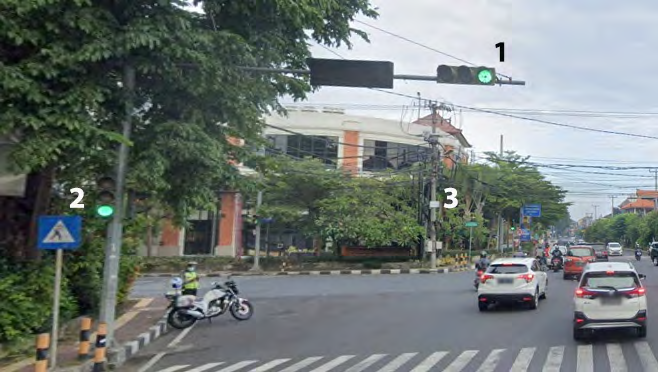
The results of the survey are shown in Table 1. The distance of the queue of drivers to the light on the left (code 2) and the top light (code 1) obtained the closest distance is 3.6 m while the distance of the farthest traffic light on the opposite side of the road with code 3 is obtained at a distance of 30.7 m. The farthest lamp is an additional lamp placed across the street. In Indonesia, the front queue is used for motorbike riders, while cars are in the queue after motorbikes. For some traffic lights in Denpasar City, motorbikes require a slightly forced head position view to be able to see traffic lights.
Table 1 shows several locations of traffic light that are in Denpasar using Google map links.
| No | Location | Location Link |
|---|---|---|
| 1 | Jl. Sidakarya, Sesetan, Denpasar Selatan, | https://goo.gl/maps/YWxT17xp6DkcfUzN7 |
| 2 | Jl. Tukad Yeh Aya, Panjer, Denpasar Selatan, | https://goo.gl/maps/AE3d5AiSKcpMFroSA |
| 3 | Jl. Tukad Batanghari Panjer, Denpasar Selatan, | https://goo.gl/maps/AE3d5AiSKcpMFroSA |
Table 1: Several traffic lights survey result using google maps.
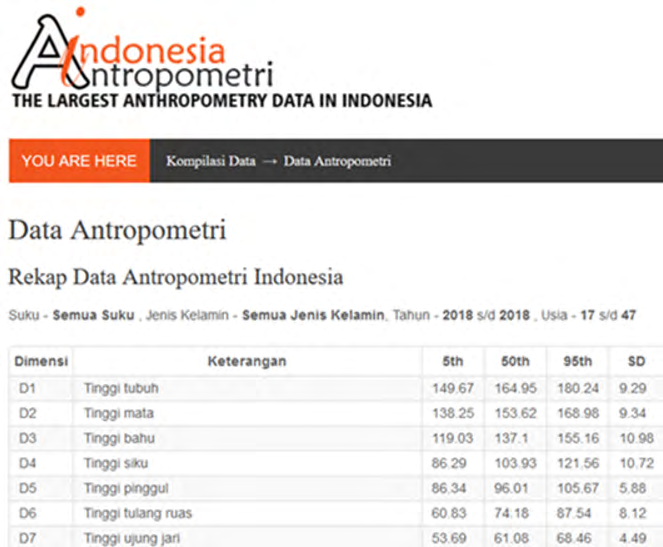
Anthropometric data for riders uses data obtained from the Indonesian Ergonomics Association website. Using data from Indonesian people with 50% male percentile ages 17-
47 years. As shown in Figure 3. This anthropometric data is used as input for the Tecnomatix Jack software as shown in Figure 4.
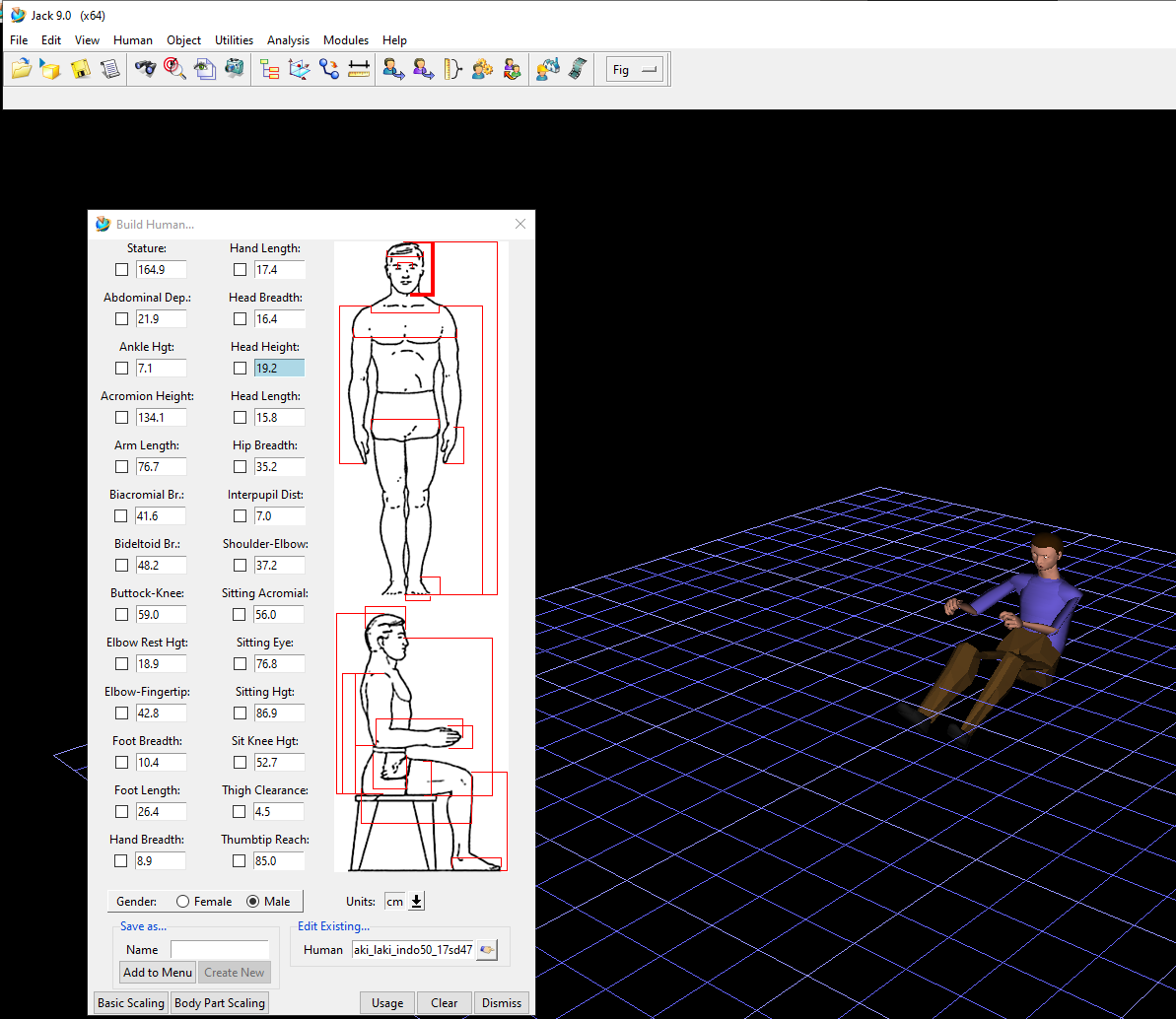
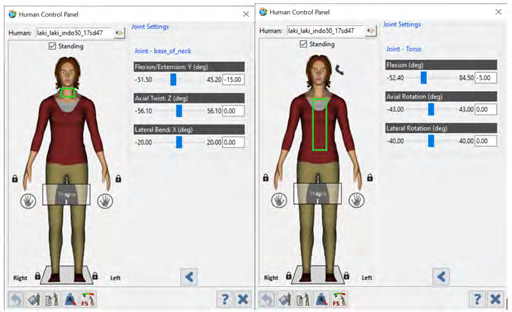
Anthropometric data will be entered into a human simulator on the Tecnomatix Jack software. It is followed by making vehicle models, namely motorcycles, Jeep cars and Sedan cars. The next stage is to make a simulation of vehicle queues at traffic lights using the Tecnomatix Jack software. In the simulation there are 3 vehicles used by the driver, namely motorcycles, jeeps, and sedans. The assumption in the simulation is that the driver is in the leading position at the traffic signal light. For the simulation of riders using motorbikes, the condition of the body parts is shown in Figure 4.
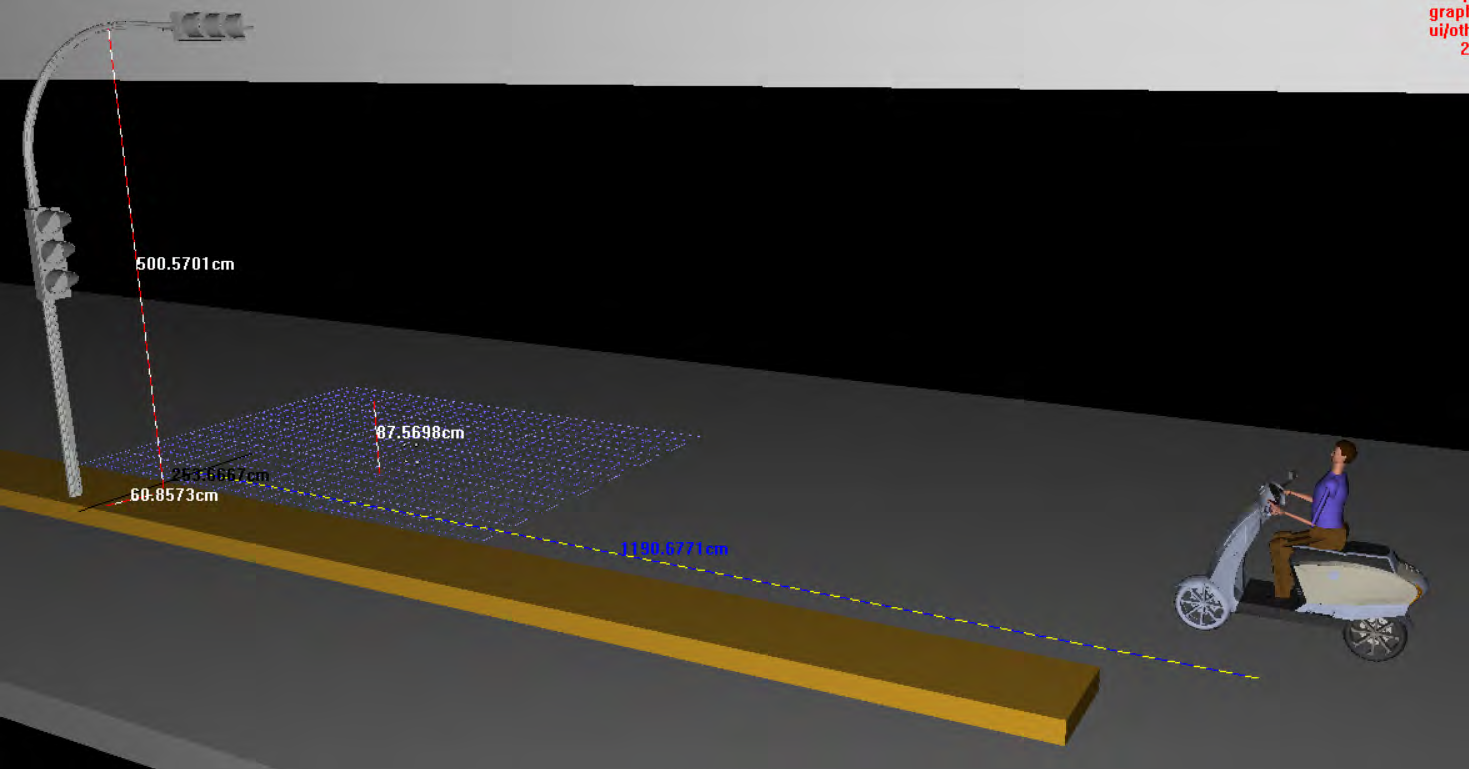
The simulation results of motorbike riders queuing at traffic lights are shown in Figure 5 for minimum visibility to the left side of the traffic light. with the minimum distance from the vehicle to the traffic light is 6.57 m and the minimum distance from the vehicle to the top traffic light is 11.9 m. Traffic lights that are in the city of Denpasar put a queue of motorbikes in the front position. This causes some traffic lights to require additional lights across the road to make it easier for riders to see traffic lights. There are several traffic lights in Denpasar City that do not meet these requirements.
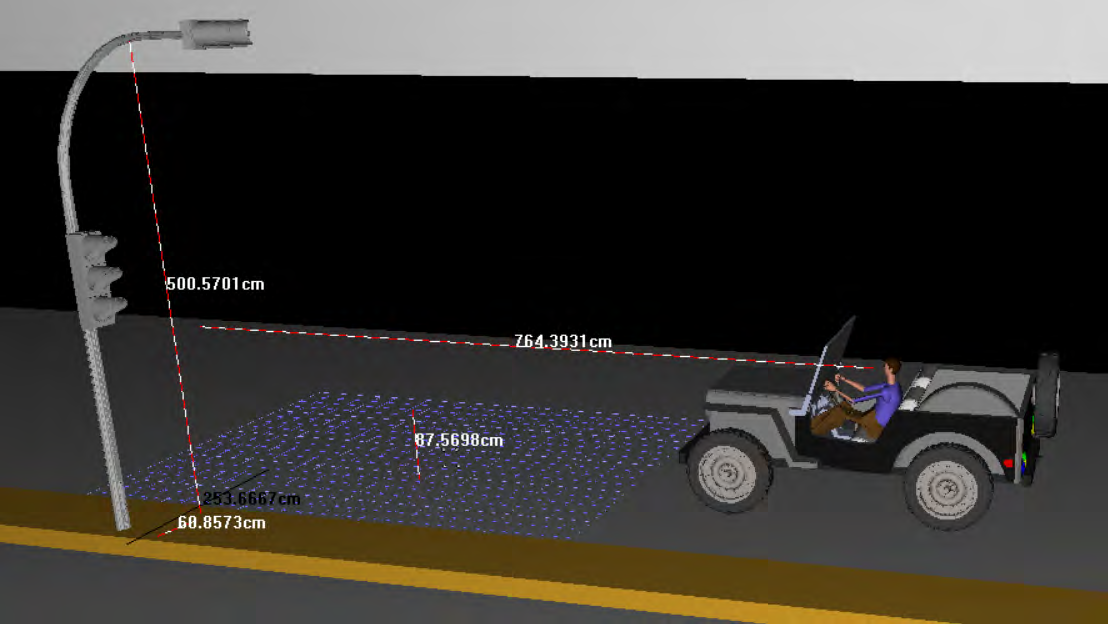
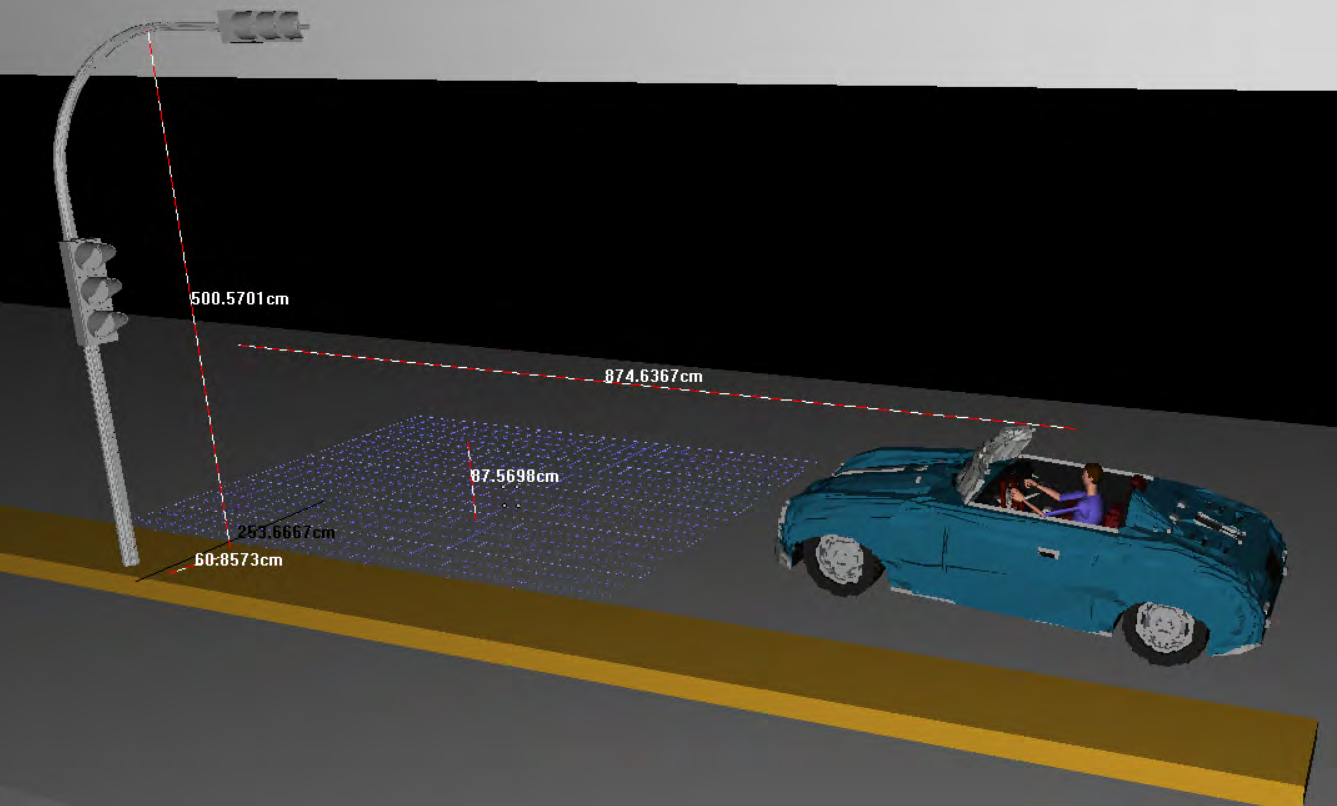
Queue simulation at traffic light uses two types of cars, namely jeeps and sedans. The two cars in the simulation differ in seat height from ground level. In addition, the position of the driver’s body in the vehicle is also different. The waiting distance on the jeep to the traffic light is shown in Figure 6 for the top traffic light position. Each gets a distance of
6.77m and 7.64m for the distance to the left traffic light and top traffic light. In a sedan, the waiting distance to the traffic light is shown in Figures 7& 8 for a view to the left light at a distance of 6.92 m and the waiting distance to the traffic light for the centre light is shown in far as 8.74 m.
Discussion
The determination of the driver’s visibility to the traffic light is largely determined by the height of the driver in the vehicle. For this reason, testing is needed on the lowest vehicle that usually passes through the traffic light. For drivers with a higher seat position, they will get better visibility. While for anthropometry, it needs to be considered for smaller percentiles. This is as a consideration because a higher anthropometric position has the possibility of wider visibility towards the traffic light. The placement of supporting lamp across the road ahead of the driver is required if there is not enough space for the driver queue. The size and light of the supporting lamp must take into account the size of the lamp and the light produced so that it can be seen clearly by the drivers.
Conclusion
- DHM Tecnomatix Jack can be used for visibility model form traffic light to driver.
- From the testing of the three vehicles tested, namely motorcycles, jeeps and sedans, the distance from the traffic light to the driver for the left side of the traffic light is on average 6.75m, while to the top traffic light is 11.9m, 7.64m, and 8.74m for motorbike, jeep and sedan
- If a comfortable distance from the traffic light to the driver cannot be achieved due to the unavailability of queues, this can be tackled by placing the traffic light across the road while taking into account the distance between the lights and the size of the lights.
Acknowledgments
In this occasion, researchers would like to express our gratitude to Siemens Digital Industries Software for free license software grant that is given to Faculty of Engineering at Udayana University for a year starts from November 2020- 2022. The software grant has helped researchers as a tool to analyse driver vision toward traffic light.
References
-
Alturki S (2018) Traffic Sign Detection and Recognition Using Adaptive Threshold Segmentation with Fuzzy Neural Network Classification. International Symposium on Networks, Computers and Communications pp: 1-7.
-
Satilmiş Y, Tufan F, Şara M, Karsli M, Eken S, et al. (2019) CNN Based Traffic Sign Recognition for Mini Autonomous Vehicles. In Advances In Intelligent Systems And Computing 853.
-
Saadna Y, Behloul A, Mezzoudj S (2019) Speed Limit Sign Detection And Recognition System Using SYM and MNIST Datasets. Neural Computing and Applications 31(9): 5005-5015.
-
Abbondati F, Capaldo FS, Biancardo SA, Mancini L (2016) Descriptors in Scenic Low-Volume Roads Analysis through Visual Evaluation. ARPN Journal of Engineering and Applied Sciences 11(23): 13845-13855.
-
Capaldo FS (2012) Driver Eye Height: Experimental Determination and Implications on Sight Distances. Procedia - Social and Behavioral Sciences 43: 375-383.
-
Siyal MY, Fathy M (1995) Real-Time Measurement Of Traffic Queue Parameters By Using Image Processing Techniques. Fifth International Conference on Image Processing and its Applications pp: 450-454.
-
Zhang J, Luo B (2020) Man-Machine-Environment Virtual Design and Jack Simulation of Rosa Roxburghii Picking Machine. In E3S Web of Conferences 179.
-
Perhubungan D (2020) Peraturan Menteri Perhubungan Nomor Pm 49 Tahun 2014. Pusat Data Dan Informasi Kementerian Perhubungan Republik Indonesia.
-
Plm S (2020) Academic Partner Program Grant Application. Siemens Industry Software Inc., US.
-
Indonesian Ergonomics Association The Largest Antropometri Data in Indonesia. Perhimpunan Ergonomi Indonesia PEI.
- The Expanding Landscape of Road Rage: A Systematic Review of Conflicts Involving Drivers, Pedestrians, and Micromobility
- Validating Cognitive Models of Royal Navy Performance on Control Systems
- Comparing Standard and State-of-the-art Firefighter Coats on Postural Balance and Gait in a Live Burn Environment
- Investigating the Integration of Telemedicine into Clinicians Workflow: A Review of Methods
- Risk Assessment of Ergonomic Factors in a Textile Firm by RULA, REBA and Fine Kinney Methods
- Impact of Self-Esteem Training on Individuals with Disabilities Aged 17-30