
The Concept of "Place" in Urban Studies
In the domain of organizational ergonomics, the discussion of ergonomics focuses on sociotechnical systems that are strongly influenced by the environment. This paper is a review of the development of “place” theories in urban studies which can later be implemented in organizational ergonomics. Humans live in a city which is a collective urban artifact of a long historical process. Urban space will form a place which is an intrinsic part of the interaction between residents and the city area. Through a meaning, individuals or communities change space into a place. Thus, place is the center of meaning formed by life experiences. The place factor is undeniably the main support for the formation of urban identity. In urban studies, the concept of place can be seen in terms of "rootedness" and a sense of “consciousness” that arises from associations with the urban socio-physical environment. From there emerged the concept of place attachment which explains the symbolic relationship formed by a person who culturally provides an understanding of emotional attachment to his urban environment. Through understanding the concept of "place" it is hoped that we can achieve an ergonomic design that focuses more on human characteristics and uniqueness.
Formation of Urban Space
Ergonomics is a scientific discipline that studies human interactions with other elements in a system that applies to all aspects of human activities. In ergonomics, there are 3 interacting domains, namely physical ergonomics, cognitive ergonomics, and organizational ergonomics. Of the three domains, organizational ergonomics has not been widely discussed because it focuses on sociotechnical systems which are strongly influenced by the environment where humans live and work [1]. This paper attempts to explain the “concept of place” in urban areas which can later be implemented in the domain of organizational ergonomics.
The city is not a man-made environment that was built in a short time but is an environment that was formed in a relatively long time. The current condition of urban areas is an accumulation of each stage of development that occurred previously and is influenced by various factors, both internal and external. It can also be said that the city is a collective urban artifact of a historical process [2].
Schulz [3] describes space as a man-made phenomenon with the organization of 3-dimensional elements. Space is used in several forms, namely absolute, relative, and relational (cognitive). Absolute space is the notion of space as something clear, physical, real, or an empirical entity. Relative space has aspects of location, distance between, and other phenomena (horizontal connections). Relational (cognitive) space can be interpreted as space and place which is an intrinsic part of our existence in this world, defined and measured in values, feelings, beliefs, and perceptions of humans towards locations, regions, and regions.
We are always in touch with the physical environment, so the relational space is consciously or unconsciously attached to our desires and actions Knox & Marston. Space is not fixed at a time, but is the result of a process over time, generated and cannot be separated from physical changes and social contexts [4]. In the decision-making process in urban design, the biggest activity is thinking about place. Lefebrve [4] in the theory of “production of space” divides the existence of space in an artificial environment into 3 groups, namely:
- Spatial practice (perceived space) Community owned space that is attached to social relations and depends on the user’s perception. This space can be mapped and measured, but not what architects, planners, or urban designers visualize.
- Representations of space (conceived space) This is more of a subjective space than a spatial practice. This is the space that comes from visualizing the thought process. Professionals and designers impose their ideology and understanding into the space for the user. They try to represent space for the user.
- Representational space (lived space) Space for users. Occurs from a natural process and has a historical memory of the formation of space. Occupied and constructed by its residents through everyday experiences. Users include their existence in the environment Figure 1.
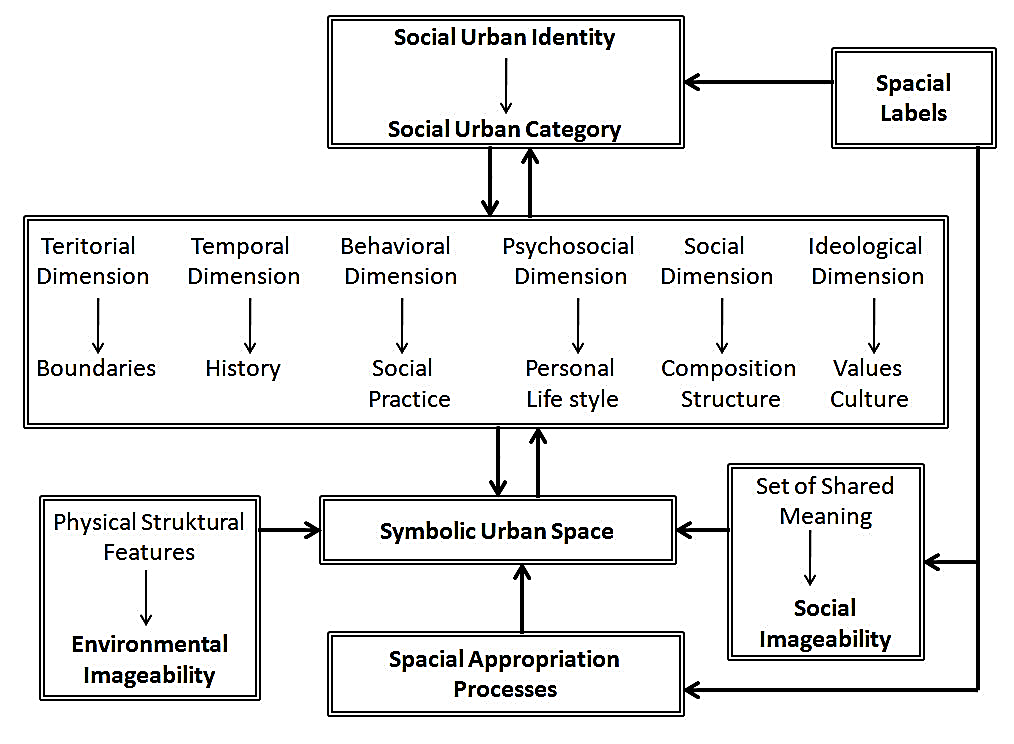
Source: Buttimer, 1977. Figure 1: Conflict between Conceived space and Perceived space.
Urban space that contains an artificial environment is a product of planning that is understood by planners, architects, and urban designers. The same environment is also perceived by users and is redefined through their life experiences. In this urban space, there can be a conflict between the conceived place and the perceived place. Buttimer [5] explains the gap between conceived & perceived space based on “outside” and “inside” perspectives. There is a disconnection of feelings towards loyalty and place from the perspective of outsiders who see place only from tangible attributes. To be able to understand place, outsiders must have an insider’s sense of perceived place (Figure 2).
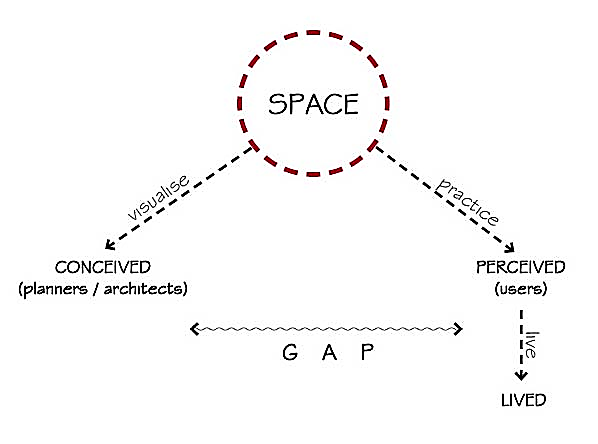
Source: Valera, 1997. Figure 2: The Relationship between Symbolic Urban Space and Urban Social Identity.
Symbolic urban space can be interpreted as an element of a city structure that is understood as part of a social category that identifies the relationship of a social group to its environment and distinguishes themselves from other groups based on the symbolic dimensions of the space [6]. Thus, space can be a property that facilitates the process of urban social identification and solid becomes a symbol of identity of a group associated with a particular urban environment. There are 2 basic characteristics to define urban symbolic space, namely:
- Environment image ability, namely the capacity to create a clear cognitive image [7] and
- Social image ability, namely the characteristics of the meaning system that is created socially and supported spatially.
The meaning that is formed socially according to Stokols & Shumaker [8] can be analyzed based on content, clarity, complexity, heterogeneity/homogeneity, distortion, and contradiction. No less important knows the spatial appropriation of individuals through the creation and acceptance of the symbolic meaning of space and associating it with their identity.
From Space to Place
Edward Relph with his book Place and Placelessness [9] was the first to describe phenomenologically about place. Relph [9] states that although we do not have a fixed form (amorphous) and intangible (intangible), when we feel and know a place. Through a meaning, individuals, groups, or communities change space into a place. Place is the center of meaning formed by life experiences.
According to Canter [10] place can be defined as the units of experience in which activity and physical form merge. Thus, place not only provides a good physical entity for measurement and a contextual variable for behavioral observation, but also contributes to a certain dialectical quality. In his book The Psychology of space, Canter [10] mentions that there are three components that make up place. These components are
- The physical attributes of the environment,
- The activities that occur in it, and
- The conception of humans who feel all of the above.
For example, a place is a class for students not only consisting of an arrangement of tables, chairs, and blackboards in a room but also the learning activities in it and the feelings of the people in it (Figure 3).
![Figure 3: ** The Three-Component Model of Sense of Place The concept of place is often emphasized on “ownership” and emotional attachment to place. Place can be seen in terms of “rootedness” (rootedness) and a sense of awareness (conscious sense) of certain associations. Humans are involved in the concept of place and they are an important component of place. Humans, their experiences, and their memory of space, transform space into place along with their identities and activities aimed at a function and validation of existence. What distinguishes place and space is the meaning given by the wearer, which will give it an identity [11].](/fulltextimages/8954/fig_3.png)
Source: Canter, 1977. Figure 3: The Three-Component Model of Sense of Place The concept of place is often emphasized on “ownership” and emotional attachment to place. Place can be seen in terms of “rootedness” (rootedness) and a sense of awareness (conscious sense) of certain associations. Humans are involved in the concept of place and they are an important component of place. Humans, their experiences, and their memory of space, transform space into place along with their identities and activities aimed at a function and validation of existence. What distinguishes place and space is the meaning given by the wearer, which will give it an identity [11].
Sense-of-place is considered as a human need for safety, security, and orientation [7]. Schulz explains the idea of genius loci (spirit of place) as the key to human identity in relation to nature. The individual’s sense of being-in-the-world is initially based on identification and orientation. Identification in this case is the statement of an identity that describes the human relationship to the place, which is the basis of sense- of-belonging. Identification is becoming “familiar” with a specific area, which implies that the environment provides a meaningful experience. In the identification process, society and culture are seen as the main elements forming a “feeling of belonging”. Orientation is explained as a function that allows humans to describe their world, which is used as a focus/direction in their lives. It allows humans to be part of their cultural and natural roots.
Schulz in his book Genius Loci states that a place is a space that has character. Since time immemorial, “genius loci” or “spirit of place” has been recognized as something real that humans face. The task of architects and urban designers is to create “meaningful spaces” that can help people to live well. Tuan [12] has argued that place is the “region of emotional attachment.” It is often a place of residence, where individuals or groups have a strong emotional connection. One even gets a sense of one’s identity from the place. Outside that place, start a space where the individual or group has knowledge about it but does not feel “at home” or has no influence on feelings. Tuan [12] uses two terms to describe a person’s emotions towards a place as follows:
• Topophilia Explain human love for place, human attachment for place. For example the place where we are born and grow up. Tuan revealed that this attachment differs in intensity from individual to individual and there is cultural variation in its expression. Topophilia often takes the form of beautifying a place or landscape. This shows that aesthetics is the main way that connects many people with their environment. Tuan points out that attachment to place is based on memory, pride in possession, or creation. Topophilia is therefore not only a response to places but also actively produces places for society.
• Topophobia It is the opposite of topophilia which is “rejection of place”. This can be a ‘landscape of fear’; a place where we may feel threatened.
Many arguments claim that humans need a sense of identity through a sense of belonging to a particular territory or group. Crang [13] states that place provides a basis for sharing experiences between humans in the continuity of time. Individuals need to express a sense of belonging to a collective entity or place and an individual identity that will be obtained through physical differences or certain feelings in entering certain areas. A Norberg-Schulz state that “being within” is a major concern in the concept of place. Likewise, Relph [9] states that the essence of place lies in the experience of “inside” which is different from “outside”. He distinguishes place identity based on the notion of “insiders and outsiders”.
The way people identify places differs from person to person. There are people who are in a city who feel completely unrelated to the place there. They are emotionally detached from the place and feel influenced by another place, or may feel unaffected by any place. Relph [9] tried to explain this phenomenon by constructing a series that has 7 levels from “existential insideness” to “existential outsideness”.
The concept of inside-outside is easiest to understand in terms of territoriality. Humans define and defend themselves physically and psychologically by making boundaries that are often exclusive domains Ardrey, 1967. Based on the understanding that humans form groups and define one another through the distinction between insiders and outsiders, territoriality is used as the basis for developing social differences that mold attitudes and shape the behavior of residents Knox & Pinch 2000.
Relph [9] claims that with mass communication and technologies being ubiquitous and constantly improving, places are becoming more and more alike so that locations that have a special sense of place are lost (placelessness). With increased personal mobility, it can be said that humans identify less with a place; the sense of interest in the city of origin also begins to decrease. There may be some meanings lost when place becomes homogeneous but new meanings emerge. For example, an urban group that refers to a particular style of music or city culture.
Van Eyck [14] emphasizes this in his famous description of place: “Whatever the meaning of space and time, places and events have more meaning.” Space in a person’s image is the place and time where an event occurs. The effect of events on place dramatically can be seen in the difference between full sports stadiums and people watching a match at the same sports stadium at empty times [15].
Place Attachments
Humans are bound by place through processes that reflect their behavior, cognitive experiences, and emotional experiences in their socio-physical environment. Place attachment involves attachment to positive experiences that often go unnoticed. It builds over time from the behavioral, affective, and cognitive bonds between individuals or groups and their socio-physical environment.
The beginning of research on place attachment was started by phenomenological researchers around the 1970s. A comprehensive discussion of place attachment is in the book “Place attachment of Human Behavior and Environment” edited by Altman and Low [16]. Until now, research on place attachment tends to be under the perspective of social construction with the umbrella of qualitative research.
Altman & Low [16] stated that place attachment is a symbolic relationship formed by a person who culturally gives emotional meaning to a land space that is the basis of a person or group of people in understanding their relationship with the environment. Thus, place attachment is more than just an emotional and theoretical experience. Place attachment also includes cultural beliefs and activities that connect a person to a place.
Research on population relocation shows a negative correlation between place attachment and adaptation to new housing areas Speller, Lyons & Twigger-Ross, 2002. Spatial compatibility plays an important role in place attachment and place identity. There are two components that affect compatibility, namely the transformation of action (behavioral component) and identification (symbolic component) of the person or group. Through symbolic interactions, a person or group recognizes themselves in their environment and uses the existing environmental qualities as part of their identity Moreno & Pol, 1999.
William & Carr 1993 stated that place understanding is based on one’s emotional attachment to a place. It is further stated that the bond can originate from real experience at the place or from the abstraction of its natural environment, as a result of a symbolic process at a certain time. Many researchers who investigate the meaning of a place agree that understanding a place is a personal, emotional process in which a person who interacts with a place becomes attached to that place (Figure 4).
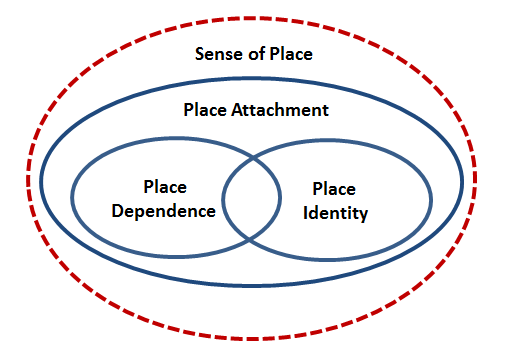
According to Williams & Roggenbuck [17], place attachment is divided into two dimensions, namely
- Place dependence, namely the value of a place for attributes related to activities in it, a setting for action
- Place identity, namely emotional attachment to place as a form of self-identity.
The place dependence dimension is usually used to determine the functional attachment of the community in a place. While the dimension of place identity is usually used to determine the emotional attachment between people and a place.
Williams & Roggenbuck [17] describe place dependence as a situation in which the value and importance of a place is based on the arrangement of attributes or resources in that place. It can make a person become associated with a place because of the use of the place to satisfy one’s needs and goals. In addition, it is known as functional or commodity meaning for a place, where the arrangement acts as a backdrop to enjoy a pleasant activity.
Typically, place identity (emotional attachment) is intertwined with strong emotional feelings. Often a place evokes such emotions when it is associated with an important historical event, an identifiable group, or symbolic of values, ideas, ideologies, and beliefs [18]. Williams, et al. (1992) argue that sometimes the emotional attachment to a place can be so strong that a person’s personal attachment to the place can be an important element in describing a person’s personality. Thus, “place identity” is defined as an interpretation that uses environmental meanings to signify or place a personal identity [19, 20].
Conclusion
Organizational ergonomics which is sometimes referred to as macroergonomics is an insight into how to design the entire work system in order to build an effective and optimal work climate. Understanding the concept of “place” that arises from the rooted aspect of human settlements that gives rise to a sense of identity and a sense of attachment is an important ergonomic variable. This is in line with the development of the main ergonomic values that “people are assets” and “technology is only a tool for humans”. In this process, stakeholder involvement is the most important point so that it can optimize two closely related outcomes, performance and well-being.
References
-
Bridger RS (2018) Introduction to Human Factors and Ergonomics. 4th (Edn.), Taylor & Francis Group, CRC Press, Boca Raton, Florida, USA, pp: 1-719.
-
Rapoport A (1982) Human Aspect Urban Form. New York: Van Nostrand Reinhold Company.
-
Norberg SC (1980) Genius Loci: Toward a Phenomenology of Architecture. New York: Rizzoli.
-
Henri L, Smith DN, Harvey D (1991) The Production of Space. Oxford: Blackwell Publishing, UK.
-
Anne B (1977) Insiders, Outsiders, and the Geography of Regional Life. Inpromptu Presentation at the Congress of Finnish Geographers, pp: 155-178.
-
Sergi V (1997) Public Space and Social Identity. In: Remesar A(Eds.), Urban Regeneration: A Challenge for Public Art, Universitat de Barcelona.
-
Kevin L (1960) The Image of The City. MIT Press, Massachusetts Institute of Technology, Cambridge, Massachusetts, London, England, pp: 1-194.
-
Stokols D, Shumaker SA (1981) People in Place: A Transactional View of Setting. In: Harvey JH (Eds.), Cognition, Social Behavior, and the Environment, New Jersey: Lawrence erlbaum Associates.
-
Relphs E (1976) Place and Placelessness_._ London: Pion Limited.
-
Canter, D. 1977. _The Psychology of Place_. London: Architectural Press.
-
Tim C (2004) Place: A Short Introduction. Malden MA (Eds.), Blackwell Pub Publishing Ltd, New York, USA.
-
Tuan YF (1976) Space and Place: The Perspective of Experience. University of Minnesota press, Minneapolis: London, pp: 1-235.
-
Mike C (1998) Cultural Geography. 1st (Edn.), London: Routledge, pp: 224.
-
Matthew C, Tim H, Taner O, Steve T (2003) Public Places-Urban Spaces: The Dimentions of Urban Design, Architectural Press Oxford, Boston, USA, pp: 312.
-
Bryan L (2001) Designing in Context. New york: DUP Science.
-
Low SM, Altman I (1992) Place Attachment. Human Behavior and Environment, Springer, Boston, Plenum Press, New York, pp: 1-12.
-
Williams DR, Roggenbuck JW (1989) Measuring place attachment: Some preliminary results. Proceedings of the National Recreation and Parks on Leisure Research. San Antonio, Texas, pp: 1-7.
-
Russell JA, Snodgrass J (1987) Handbook Of Environmental Psychology. New York: Springer.
-
Cuba L, Hummon DM (1993) A Place To Call Home: Identification With Dwelling, Community, and Region. The Sociological Quarterly 34(1): 111-131.
-
Knox P, Marton SA (1998) Places and Regions in a Global Context: Human Geography_._ Upper Saddle River: Pretice Hall.
- The Expanding Landscape of Road Rage: A Systematic Review of Conflicts Involving Drivers, Pedestrians, and Micromobility
- Validating Cognitive Models of Royal Navy Performance on Control Systems
- Comparing Standard and State-of-the-art Firefighter Coats on Postural Balance and Gait in a Live Burn Environment
- Investigating the Integration of Telemedicine into Clinicians Workflow: A Review of Methods
- Risk Assessment of Ergonomic Factors in a Textile Firm by RULA, REBA and Fine Kinney Methods
- Impact of Self-Esteem Training on Individuals with Disabilities Aged 17-30