
Performance Measurement and Evaluation of Public-Private Partnerships: A Systematic Literature Review
The theme regarding the procurement models implementation, under a Public-Private Partnership (PPP) regime has been widely discussed in the last decade, with a general lack of consensus regarding the forms of measuring and evaluating the outcome performance during their life cycle. The main objective of this paper is to contribute to a greater understanding, regarding the PPP forms of performance measurement and evaluation, answering the research question: How to measure and evaluate performance in PPP model? Simultaneously, by identifying both empirical studies, which enable performance measurement as well as theoretical papers, which point new paths for a correct evaluation of this type of procurement model (contracting). To answer the research question and achieve the proposed objectives, a Systematic Literature Review (SLR) was performed, having as data a set of 64 articles, published in specialized journals, available on the electronic platform “Web of Science”. The results allowed classifying the PPP models measurement and evaluation of the performance in three main clusters: • Evaluation Systems and Frameworks • Performance Measurement (KPIs) and • Conceptual - Theoretical Analysis Through this alignment, it becomes evident that there is no agreement among academics and researchers as to the most effective way to measure and evaluate the PPP model performance. This disagreement results from the application of different evaluation methods to PPP projects with different characteristics and the distinctive nature/objectives of the procurement projects, which leads to the uncertainty regarding the transversal applicability of evaluation models to all PPP projects. Finally, we propose as future investigation, the elaboration of a matrix, disaggregating the PPP model in its various typologies and by contracting scope, applying, for each case, the various models and frameworks proposed in the literature. This matrix could validate whether it will, in fact, be possible to associate a given measurement and evaluation model to a specific PPP typology vs. scope, in a consistent and transversal way. It is also proposed to apply efforts towards a conclusion regarding the VfM (Value for Money) indicator and its relation to the PPP outcome performance. Finally, it is proposed to accommodate conceptual studies to reach a contractual framework, which might mitigate the negative effects of the written contracts and enhance the positive impacts.
Introduction
The increasing turbulence and complexity of the current competitive context in the business environment make the role played by performance measurement and evaluation systems central in an attempt to create value and improve the organization’s results [1]. The attention, currently given to the development of performance measurement and evaluation systems, stems from the belief that an adequate management of specific conditions can improve the organizations performance [2], increasing efficiency in the use of resources and effectiveness in the implementation of defined strategies [3]. Now, if we start from the assumption that governments of each country are basically “Companies”, which, like other organizations, have the main objective of maximizing their operational results [4], it is imperative to measure and evaluate the various procurement models (contracting), which these “Companies” (Governments) adopt according to their chosen strategy.
Bearing in mind that the Public Private-Partnerships (PPPs) design, construction, operation, financing, ownership and risk transfer are country-specific, it is difficult to establish a clear definition for the PPP term [5]. However, the current literature tends to agree with the definition produced by the OECD [6], which defines PPP as “an agreement between the government and one or more private partners (which may include the operators and the financers) according to which the private partners deliver the service in such a manner that the service delivery objectives of the government are aligned with the profit objectives of the private partners and where the effectiveness of the alignment depends on a sufficient transfer of risk to the private partners” [6]. That is, in a PPP model, the private sector can play a crucial role, for example, in the development and maintenance of public infrastructure and services, which traditionally would have been under the responsibility of the public sector. From an economic perspective, one of the characteristics that can make the PPP model more efficient, in terms of costs, when compared to the purely “public” contracting model, is the risk transfer to the private partner [7]. This effective risk transfer leads to a more explicit treatment of it, increasing the private partner’s motivation for a more efficient production and cost model, and, consequently, for the implementation of performance measurement and evaluation systems throughout the production life cycle of that model.
As already identified by Sarmento JM, et al. [5], and the PPP theme has not been followed by a deep academic analysis focusing on all the involved actors. Thus, the present SLR aims to identify knowledge gaps or incongruent discoveries, under the PPP scope, specifically regarding the evaluation and performance measurement of this procurement model, thus suggesting future research questions on the subject under consideration. According to Denyer D, et al. [8], in the area of organizations and management studies, the value given to quantitative, qualitative and theoretical scientific contributions is respected in an identical way, which leads to a more inclusive and comprehensive approach regarding the quality criteria when preparing the syntheses.
Our synthesis might lead to clearly assess the current state of knowledge, concerning the different approaches already studied, to measure and evaluate the PPP model performance. There is still no consensus on the most appropriate model or framework for obtaining results across the various PPP methodologies. For this area of knowledge, Management and Organization Studies (MOS), with much to be explored, our greatest contribution is related to the aggregation of several models and indicators that can be used in practical cases, both by private and public partners.
Literature Review
The current pressing shift from the broad term “Government” to a “Government-Manager” perspective and the growing reliance on PPPs has already been extensively investigated. However, there is much less certainty as to how to measure and evaluate the performance of these procurement models [9]. The same authors refer to the importance of choosing appropriate metrics so that PPPs are responsible for the performance measured throughout its life cycle. On the other hand Yuan J, et al. [10], refers that during the PPP projects’ life cycle, their performance can be affected by several factors and interactions, which can result in inefficiency in the project’s execution. Still the same authors argue that the performance objectives and Key Performance Indicators (KPIs) can be used to identify the model’s strengths and weaknesses, and thus, become useful tools for effective management of the model performance. This idea is also supported by Roumboutsos A, et al. [11], which emphasizes the growing importance of performance management and measurement as an essential tool for obtaining more efficient and effective PPP projects, especially concerning managing stakeholder expectations.
The performance measurement and evaluation topic has been analyzed and applied in various management areas, framed in specific issues [12].
Focus on the question “How can we measure and evaluate the performance of a PPP?” The author used a methodology based on an analysis of a wide range of articles and case studies, elaborating his synthesis regarding the current view of the PPP performance and the different rhetoric present in the current literature. The authors obtain dubious conclusions, if, on the one hand, analyzing only the Value for Money (VfM) indicator, they can conclude the application of the PPP models as a success, on the other, when they look at the model as a whole, they highlight that there are omissions by the public partner, which raises doubts regarding the results presented. There is no clear conclusion as to the best way to evaluate performance, or regarding the results of applying the model, therefore Hodge G, et al. [12], suggest that the public partner must embark on a path that will lead to the complete mitigation of the identified gaps at the management level and implementation of new measurement and evaluation models.
The SLR methodology has been applied to assess the state of the art in many management fields. An example of this is the study carried out within the scope of public organizations, where articles were located to identify the factors of the measurement and evaluation systems capable of producing an effect on the performance of public organizations [13]. Several authors use different approaches in the elaboration of SLR, in their study Nolan CT, et al. [14] chose a more detailed approach, opting to classify, by rankings, of the journals of each publication of the sample articles, and choosing a more extensive database (5 sources), as recommended by Macpherson A, et al. [15].
Despite the various approaches presented in the literature, given the growing importance on the PPP model applicability and its implications for national economies, we identified the permanent need of a SLR elaboration in the scope under consideration, namely under the PPP performance measurement and evaluation, to contribute to the aggregation of the current knowledge and set new goals for the future.
Methodology
Model
SLR is a specific methodology, to locate studies already carried out in certain areas of knowledge, select and evaluate contributions, analyze and synthesize data resulting in a report that makes it possible to understand what is known and what is not about a certain topic or area of knowledge [8]. Performing an SLR in the MOS knowledge area is particularly challenging given its fragmented nature [16]. “The complicated state of MOS research makes it tough to know what we know, especially as specialization spawns research communities that often don’t and sometimes can’t talk with each other” [17], which leads the Investigators to take positions related to management practices and organizational decisions, for which there is no evidence aggregation or at least some of the evidence are under study [17].
For the elaboration of the present SLR, the model proposed by Denyer D, et al. [8] was followed, which contemplates five essential steps for the SLR elaboration, within the scope of business sciences, particularly MOS. The first step comprises the research question formulation, the second the location of the studies to include, the third the selection and evaluation of the selected studies, the fourth step the analysis and synthesis of the selected information, and finally, description of the results obtained in the previous steps. Figure 1 encodes the summary of the SLR process used in this article.
Regarding the approach adopted for aggregating and synthesizing information, we decided to group our sample of articles by categories (clusters). Cluster analysis is a technique for grouping multivariable that has the main objective of grouping objects based on their characteristics. There are numerous terminologies for the analysis of clusters, used in different areas of knowledge (psychology, biology, sociology, management and engineering), including Q Analysis, Typology Construction, Classification Analysis, and Numerical Taxonomy [18]. Taking into consideration the scope under investigation, an analytical classification of each group of variables was performed, which corresponds to individual contributions to the research question. While addressing the main topic, it becomes clear that two main clusters must be defined: measurement frameworks and evaluation systems.
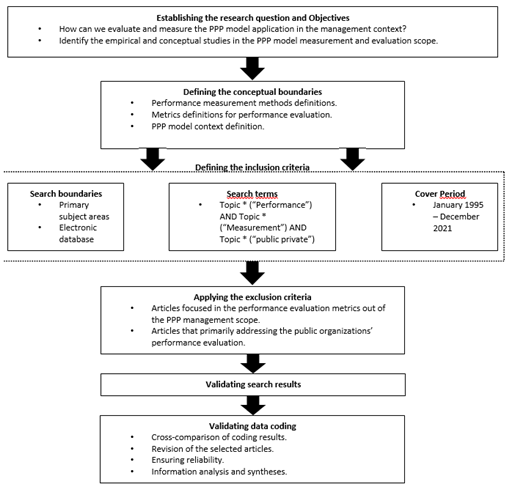
Source: Adapted from Denyer D, et al. [8]. Figure 1: SLR process summary.
Articles Identification
By defining the research question, the criteria for including primary studies in the SLR become clear. The question guides the review, defining which studies to include, which research strategy to identify and the relevant primary studies to be extracted from each investigation [19].
Thus, the present article tries to answer the following research question: “How to measure and evaluate performance in PPP model?” The aim is to identify both conceptual studies in the PPP model performance evaluation and as well, empirical studies where the model performance was, in fact, measured. Bearing in mind the research question, it was necessary to locate, select and evaluate scientific articles that allow addressing the research question. The article search was carried out in March 2022. 64 articles were found and analyzed, published or available in the electronic platform “Web of Science” database, between 1998 and 2021, divided by 14 reference journals. The list of articles analyzed represents the catalog of studies, considered most relevant for the area of “Performance Measurement and Evaluation”, adopting a managerial lens concerning PPP.
The results obtained took into account the application of research chains, grouping keywords and applying research conventions in the selected database WoS (Web of Science - The world’s largest publisher-neutral citation index and research intelligence platform). By adopting and combining Boolean operators with complex searches, a final string was built: Topic: (Performance) AND Topic: (Measurement) AND Topic: (public-private), the result being combined with a filter: Document Types = (ARTICLE) AND Languages = (ENGLISH). The terms searched as “topics” aimed to ensure that the results extracted from the WoS were predominantly relevant to this study and contribute to answering the research question.
Because of the research string applied, we obtained a comprehensive list of articles (primary contributions), which helped us to address the research question previously formulated. The complete articles were downloaded from the WoS database, whenever available. The articles that are not available for a full consultation, we recorded their abstract, in order to assess their pertinence to be part of the selectable articles.
Articles Selection and Evaluation
We gathered and stored the 64 articles found, using the Mendeley citation software tool, which allowed the identification and ordering of the articles. Subsequently, we proceeded to read and analyze the abstracts for the set of articles, to guarantee their relevance to the objectives of our study Denyer D, et al. [8]. propose four alternative principles to be applied when preparing an SLR, in the MOS studies area. Adopting the principles proposed by the author, the articles initially identified (64 articles) were tested, firstly, for their nature, regarding their transparency, inclusiveness and then concerning to the explanation provided and heuristic, regarding transparency, and taking into account the selected database (“Web of Science”), all 64 articles were initially inclusive in terms of transparency. The exclusion criteria were limited to the explanation provided by the article, and whether it contributes to meet the objective of the investigation, resulting in a final selection of 35 articles identified in Table 1.
| Author(s) | Title | Journal |
|---|---|---|
| Yong Kim S, et al. [20] | Life Cycle Performance Measurement in Public-Private Partnership Infrastructure Projects | Journal of Infrastructure Systems |
| Tang L, et al. [21] | Research on performance measurement and simulation of civil air defense PPP projects using system dynamics | Journal of Civil Engineering and Management |
| Wang D, et al. [22] | A performance measurement system for public-private partnerships: integrating stakeholder influence and process trans-period effect | International Journal of Productivity and Performance Management |
| Hossain M, et al. [23] | Performance indicators of public private partnership in Bangladesh An implication for developing countries | International Journal of Productivity and Performance Management |
| Liang Y, et al.[24] | Sustainable Performance Measurements for Public-Private Partnership Projects: Empirical Evidence from China | Sustainability |
| Ren G, et al. [25] | Developing an information exchange scheme concerning value for money assessment in Public-Private Partnerships | Journal of Building Engineering |
| Bao F, et al. [26] | Lifecycle Performance Measurement of Public-Private Partnerships: A case study in China’s Water Sector | International Journal of Strategic Property Management |
| Liu HJ, et al. [27] | From design to operations: a process management life- cycle performance measurement system for Public-Private Partnerships | Production Planning & Control |
| Liu HJ, et al. [28] | Evaluation of public private partnerships: A life-cycle Performance Prism for ensuring value for money | Environment and Planning C-Politics and Space |
| Saeed AM, et al. [29] | An enhanced framework for assessing the operational performance of public-private partnership school projects | Built Environment Project and Asset Management |
| Cappellaro G, et al. [30] | PPPs in health and social services: a performance measurement perspective | Public Money & Management |
| Liu J, et al. [31] | PPP Social Infrastructure Procurement: Examining the Feasibility of a Lifecycle Performance Measurement Framework | Journal of Infrastructure Systems |
| Sundararajan SK, et al. [32] | Managing Project Performance Risks under Uncertainty: Using a Dynamic Capital Structure Approach in Infrastructure Project Financing | Journal of Construction Engineering and Management |
| Klijn EH, et al. [33] | The impact of contract characteristics on the performance of public-private partnerships (PPPs) | Public Money & Management |
| Liu J, et al.[34] | Praxis of Performance Measurement in Public-Private Partnerships: Moving beyond the Iron Triangle | Journal of Management in Engineering |
| Love PED, et al. [35] | Future proofing PPPs: Life-cycle performance measurement and Building Information Modeling | Automation in Construction |
| Liu J, et al. [36] | Conceptual Framework for the Performance Measurement of Public-Private Partnerships | Journal of Infrastructure Systems |
| Liyanage C, et al. [37] | Measuring Success of PPP Transport Projects: A Cross-Case Analysis of Toll Roads | Transport Reviews |
| Gordon C, et al. [38] | Public-private contracting and incentives for public transport: Can anything be learned from the Sydney Metro experience? | Transport Policy |
| Panzer RJ, et al. [39] | Increasing Demands for Quality Measurement | Jama-Journal of the American Medical Association |
| Warner ME, et al. [40] | Private finance for public goods: social impact bonds | Journal of Economic Policy Reform |
| Diggs SN, et al. [41] | Understanding and Tracing Accountability in the Public Procurement Process Interpretations, Performance Measurements, and the Possibility of Developing Public-Private Partnerships | Public Performance & Management Review |
| Grossman SA, et al. [42] | The Management and Measurement of Public-Private Partnerships Toward an Integral and Balanced Approach | Public Performance & Management Review |
| Protopapas A, et al. [43] | Evaluation of Methodologies in Benefit-Cost and Economic Impact Analyses for Freight Rail Projects | Transportation Research Record |
| Tijssen RJW, et al. [44] | Co-authored research publications and strategic analysis of public-private collaboration | Research Evaluation |
| Yuan J, et al. [45] | Developing Key Performance Indicators for Public-Private Partnership Projects: Questionnaire Survey and Analysis | Journal of Management in Engineering |
| Abramo G,et al. [46] | Assessing public-private research collaboration: is it possible to compare university performance? | Scientometrics |
| English L, et al. [47] | The Changing Nature of Contracting and Trust in Public-Private Partnerships: The Case of Victorian PPP Prisons | Abacus-A Journal of Accounting Finance and Business Studies |
| Forrer J, et al. [48] | Public-Private Partnerships and the Public Accountability Question | Public Administration Review |
| Gullick D, et al. [49] | Application of partnering principles to a framework contract | Proceedings of the Institution of Civil Engineers-Municipal Engineer |
| Ellison JH, et al. [50] | National Public Health Performance Standards: Are they a means of evaluating the local public health system? | Journal of Public Health Management and Practice |
| Jackson A, et al. [51] | Falling from a great height: Principles of good practice in performance measurement and the perils of top down determination of performance indicators | Local Government Studies |
| Maxwell K, et al. [52] | Public private partnerships: building capacity while effecting change | Evaluation and Program Planning |
| Voytek KP, et al. [53] | Developing performance metrics for science and technology programs: The case of the manufacturing extension partnership program | Economic Development Quarterly |
| Revilla E, et al. [54] | Evaluating performance of public-private research collaborations: A DEA analysis | Journal of the Operational Research Society |
Table 1: Final selected articles.
Source: Own elaboration. Table 1: Final selected articles.
Status of PPP Assessment in Investigation
The present SLR emphasizes that the PPP model has been slightly investigated in the management field scope, specifically in the area of performance measurement and evaluation. It is not surprising to just start to identify articles published in 2003, taking into account that PPP models have become famous in the last two decades. The sample includes 15 empirical articles (divided between 10 qualitative and 5 quantitative) and 20 conceptual articles. It should also be noted that, we only registered five case studies (Table 2).
| Occurrences | % | |
|---|---|---|
| Empirical - Qualitative | 10 | 28,57% |
| Empirical - Quantitative | 5 | 14,29% |
| Conceptual- Qualitative | 14 | 40,00% |
| Conceptual - Quantitative | 6 | 17,14% |
| Total | 35 | 100,00% |
Table 2: Sampling division.
Source: Own elaboration. Table 2: Sampling division.
Thus, we concluded, in a clear way, that the subject under consideration was mostly explored in a conceptual way, lacking empirical studies that analyze, in a practical way, the performance evaluation measures of the PPP model.
It is not surprising that only the first articles on this topic appeared in 2003, taking into account the PPP model’s long period of operation (in a general way and according to Yong HK, et al. [55], 10 years for service operations life-cycle and 30 years for infrastructure maintenance). The interest of researchers in the PPP model, concerning the outcome performance, has been growing since 2003, having had its greatest focus in 2012 (Figure 2), with the largest number of publications in one year (n=5). In general, the selected articles are distributed by numerous journals in the area of Economics, Management and Infrastructure, four of which stand out, with two or more publications on the subject under consideration (Journal of Infrastructure Systems; Journal of Management in Engineering; Public Money & Management and Public Performance & Management Review). The growing interest of researchers is also demonstrated by the constant evolution of the number of citations over the past two decades (Figure 2).
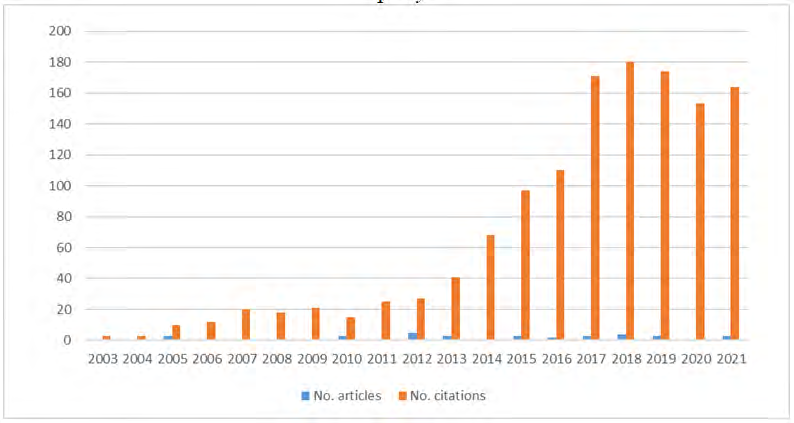
Source: Own elaboration. Figure 2: Articles and citations distribution per year.
Another relevant indicator, resulting from this SLR, is related to the geographic distribution of the articles. 71.43% of the selected articles were published in 2 countries: US, Australia, demonstrating the considerable importance recognized to the theme of measurement and evaluation of the performance of the PPP model, in the countries mentioned above (Table 3).
| Occurrences | % | |
|---|---|---|
| US | 18 | 51,43% |
| Australia | 7 | 20,00% |
| UK | 3 | 8,57% |
| Holanda | 2 | 5,71% |
| China | 3 | 8,57% |
| Hungria | 1 | 2,86% |
| Bangaldesh | 1 | 2,86% |
| Total | 35 | 100,00% |
Table 3: Country Distribution.
Source: Own elaboration. Table 3: Country Distribution.
Performance Measurement and Evaluation of PPP: Clusters Typology
The objective of the analysis and synthesis phase is directly related to the way we divide individual articles into consistent parts and the extent to which each part is related to the other, and thus to be able to assess associations between the selected data [8]. Our analysis cannot fail to highlight the increased attention shown by researchers to the topic, both in the number of published articles and in the evolution of citations (Figure 2), in line with the growth in the practical application of PPP models worldwide in the last two decades (Figure 2).
We must emphasize the fact that only in recent years there have been empirical studies that present real results related to the performance measurement and evaluation of PPP models. In order to assess the key contributions, we carefully analyze the articles included in our database before summarizing each one. During this process, we identified three groups (clusters) of research themes:
- Evaluation Systems and Frameworks
- Performance measurement (KPIs)
- Conceptual - Theoretical Analysis The analysis of clusters allowed us to group the most relevant themes, regarding the performance measurement and evaluation of the PPP models Table 4. The analytical classification of each group of variables illustrates the current state of the literature, concerning the approaches for effective performance measurement and evaluation. Table 4 shows the state-of-the-art inherent to each cluster obtained.
| Performance Categories | Measures | References |
|---|---|---|
| Evaluation systems & Frameworks | - Five dimensions system | Liang Y, et al. [24] |
| - System Process Management Life-Cycle PMS | Liu HJ, et al. [27] | |
| - System Dynamic capital structure | Sundararajan SK, et al. [32] | |
| - System Transacting parties and the transaction environment | English L, et al. [47] | |
| - Framework for governing and future proofing assets to ensure value for money. | Liu HJ, et al. [28] | |
| - Enhanced ex-post performance measurement framework for education departments | Saeed AM, et al. [29] | |
| - Lifecycle and stakeholder-oriented performance measurement framework (PMF) | Liu J, et al. [31] | |
| - Performance measurement framework based on four dimensions | Cappellaro G, et al. [30] | |
| - Framework for dynamic life-cycle | Liu H, et al. [36] | |
| Performance Measurement (KPIs) | - Value for money (VfM) | Liu J, et al. [34] |
| - Optimal risk allocation | Liu HJ, et al. [28] | |
| - Reasonable procurement, design and planning, effective process control | Yuan J, et al. [44] | |
| - Feasibility analysis | Hossain M, et al. [23] | |
| - Life cycle evaluation and monitoring | ||
| - Time, Cost & Quality | Liu J, et al. [34] | |
| - Conceptualisation, stakeholder approach, clarity, balance, ownership, usefulness, accuracy, contextualisation, dynamism and value for money | Jackson A, et al. [50] | |
| - Strategies, processes, capabilities, stakeholder contribution, and stakeholder satisfaction. | Yong KS, t al. [20] | |
| - Six Dimensions for Strengthening Accountability in PPPs | Forrer J, et al. [47] | |
| - Building Information Modelling (BIM) | Love PED, et al. [35] | |
| - Project management perspective | Liyanage C, et al. [37] | |
| - Stakeholder perspective | ||
| - Contract management perspective | ||
| - Rutgers University Business District Executive Management Certification Program - Return on investment (ROI); OMC; QOL | Grossman SA, et al. [41] | |
| Conceptual - Theoretical analyses | - dynamic performance measurement and simulation of CAD PPP project under different social states respectively | Tang L, et al. [21] |
| - Complete transfer process model that hierarchically displays the detailed composition of the TP (Transfer Phase) | Bao F, et al. [26] | |
| - Evolution of stakeholder influence and the trans- period effect (TPE) of process performance of PPPs. | Wang D, et al. [22] | |
| - Look beyond contract terms to properly understand and manage PPP performance | Klijn EH, et al. [33] | |
| - PPP Contractual structure | Gordon C, et al. [38] | |
| - PPC-based metrics and performance indicators | Tijssen RJW, et al. [43] | |
| - Model of performance measurement that accurately evaluates the complete and comprehensive PPP | Grossman SA, et al. [41] | |
| - Methodologies that estimate the benefits generated by freight rail projects | Protopapas A, et al. [42] | |
| - Analytical framework assessing PPPs | Forrer J, et al. [47] |
Table 4: Clusters definition.
Source: Own elaboration. Table 4: Clusters definition.
Evaluation Systems & Frameworks
Liu HJ, et al. in their research, call into question the conventional model of performance evaluation based on three dimensions (cost, time and quality), commonly called Iron Triangle. These three dimensions are evaluated ex post, that is, at the end of the project execution process. They concluded, through an interview method, that the application of a “PMS - Process Management Life-Cycle” model accurately reflects the parties’ intentions in evaluating the expected (exante) performance of PPP projects [28].
The proposed model accommodates the typical nuances of a dynamic business environment, incorporating performance measures, as well as a learning mechanism throughout the operation’s life cycle. The same investigation also concludes, empirically, that performance is normally measured during the construction and operation phases, using the metrics time, cost and quality. The authors suggest that the adoption of a measurement approach based on processes and oriented to the parties will be more suitable to evaluate the model´s performance. In the same identified the current scarcity of evaluation models, conceptualizing a model called Performance Measurement Framework that reveals itself, theoretically, as a reliable and robust model which can be used to guarantee a successful execution of PPP
projects, throughout each phase of its life cycle [31].
The proposed model provides governments and private entities with a tool that allows them to measure and control the performance of their future projects. Still, regarding evaluation models [48], were the first to propose a framework based on six dimensions: cost and benefit, social and political impacts, skills, collaboration, and performance measurement. Their framework had, as its main objective the assisting of public managers in determining accountability regarding the life cycle of the PPP project (ex post). For the author, the strategic thinking, on the manager’s side about the net gains for the public, obtained through the offer of the model, and the careful consideration of the six dimensions of accountability should result in a management structure. Social and political risks, costs and benefits, impact measurement, knowledge, collaboration, and performance must be monitored continuously throughout the life cycle of the partnership, thus leading to a PPP management structure that reflects a culture of public responsibility.
Grossman SA, et al. presents a performance measurement model, to accurately evaluate the PPP model, in a complete and comprehensive way, evaluating the metrics Quality of Life, Return on Investment and Management Capacity. For the author, a pragmatic performance evaluation, complete knowledge of the PPP nature, a balanced score of the referred metrics and growth capacity to develop the partnership, is not only necessary to effectively evaluate the performance, but also addresses the true nature of PPP [42]. For Saeed AM, et al. [29] there is no consistent approach that allows the performance of PPPs to be evaluated, presenting a framework (ex-post), for performance measurement developed based on criteria pointed out by the “NSW Auditor-General”, to develop a better performance in the evaluation and auditing practices, being, however, a framework limited to PPP projects for education. The presented framework aims to increase the taxpayers’ responsibility for the content and use of PPPs by the public partner. In the same line of framework proposals [30], set out to answer the question “how do performance measurement systems vary according to different PPP project configurations?”, proposing a performance evaluation structure for PPP projects based on services, based on four dimensions (financial, investment, process and result) and also a set of KPIs, applied to each dimension, to measure the partnerships success.
Several authors have carried out case studies, to assess the real performance of PPP models in progress or already completed [37]. Used three different perspectives to measure the success of four PPP projects in the area of transport:
project management perspective, stakeholder perspective, and contractual management perspective, combining them in a holistic way and obtaining contradictory results in what concerns the final result. The authors opted for a qualitative comparative analysis approach, proposing, in the end, a simple methodology to measure the success of PPP projects in the transport sector.
Gordon C, et al. [38] compared the contract signed by the Australian government, called Sydney Metro Contract, regarding the negotiated performance structure with the current contracts in force for public bus, train and boat transport in Sydney, concluding a slowdown in the performance results in requirements contractually established for the “Sydney Metro” project [26]. presented a case study where they describe a model for transferring assets at the end of the PPP contract. The authors decided to approach the water distribution sector in China, starting their investigation with a literature review in order to assess the status quo of asset transfer regime management in China. The authors present the results hierarchically, using the language method IDEF0, concluding that the model adopted for the water sector is deficient in several aspects, proposing a dynamic management model for the transfer of assets at the end of PPP projects. With the proposed model, it is intended to instruct public and private managers about mechanisms that aim to smooth the phase of transferring assets to other PPP projects that end their concession period.
Tijssen RJW, et al. [44] presents a series of empirical studies, where they investigated the performance of several PPP projects, identifying metrics applied in several PPC (Public-Private Co-publications) articles and performance indicators identified by several reference authors. The conclusions of the study point out that the applications of strategic and innovation metrics must take into account the different propensities of the PPCs of the research fields and related industrial sectors.
Performance Measurement (KPIs)
The present SLR makes it clear that, currently, academics disagree about the indicators used to measure and evaluate the performance of PPP models [23, 24, 34]. argue that the traditional KPI’s used: cost, time and quality, are not comprehensive enough to measure the performance of the PPP model.
The investigation was based on a PPP project developed in Australia, using a semi-structured interview methodology, concluding the existence of a great propensity for the use of TCQ (Time, Cost, and Quality) indicators during the design and construction phases of the projects. However, there was a broad consensus that the traditional approach to TCQ indicators is too simplistic in terms of capturing the inherent complexities of social infrastructure PPPs. The results of the investigation indicate that the measurement of the life cycle performance of PPP projects based on processes strategically translates VfM, and that it should be introduced to replace traditional ex ante and ex post evaluations [24]. Go further, and propose a new five-dimensional model, to evaluate the PPP model more effectively; carrying out a questionnaire- based investigation of PPP managers in China, concluding that the proposed model reflects the real performance of the project during its life cycle.
In the same Liu J, et al. [34], indicate VfM as one of the most relevant indicators to measure the success of the PPP model throughout its life cycle. Previously Love PED, et al. [35], concluded that a more comprehensive approach (project life cycle), will be necessary to “prove the future” performance of the model and ensure the delivery of VfM to the public sector, proposing the adoption of a Building Information Modelling (BIM) model for this purpose. For Jackson A, et al. [51], the ten principles of good performance measurement practices: conceptualization, stakeholder approach, clear balance, ownership, usability, precision, contextualization, dynamism and VfM, are not easily achievable and require adjustments that are difficult to implement in performance measurement systems, especially when trying to apply them to PPP contracting models.
Yuan J, et al. [45], proposes a conceptual model composed of five performance measures and 48 indicators, which give indications that the PPP model is highly influenced by the public sector’s hiring, design and planning actions, concluding the need for convergence between the interests of the public sector and private partner [36]. identified, as a critical factor for the successful implementation of PPP projects, an effective measurement of project performance. The authors carried out a comprehensive review of the normative literature associated with PPPs (for example, critical success factors, public sector roles, selection of dealerships, risk management, cost and time and finance issues) and propose a theoretical framework for the life cycle dynamics. This structure provides the public sector and private entities with an insight into effective and efficient performance measurement in the context of PPP infrastructure projects.
Yong Kim S, et al. [20] argues that ineffective performance evaluation is one of the leading causes of failure for PPP projects. The authors aimed to analyze the importance of performance measurement for the success of PPP infrastructure projects using five criteria:
strategies, processes, capabilities, stakeholder contribution, and stakeholder satisfaction. The results showed that the performance measurement in the partnership phase was the most important component in the success of PPP infrastructure projects.
Conceptual - Theoretical Analysis
In a more theoretical approach [47], carried out a study where they concluded that the influence, in complex PPP contracts, of the parties and the transaction environment were not properly recognized in the literature [33]. showed that the sanctions imposed, contractually, negatively influence the performance of the PPP model; however, they also demonstrated that the characteristics of the clause are the key factor for a positive performance of this type of models.
Sundararajan SK, et al. [32] addressed the question of uncertainty in this type of contracting, studying a dynamic capital structure that can add significant value to PPP projects, when the uncertainty variable is a problem. They concluded, through numerical tests, that the flexibility of the capital structure can mitigate the risk of deficit in the final result of the project.
Tang L, et al. [21] argued that it is necessary to comprehensively consider the project performance under different states to conduct scientific performance measurement. The author emphasis the research on the process of construction, operation, and handover of Civil Air Defense PPP projects. It was concluded that government plays an important role in Civil Air Defense PPP projects, when resources are limited and that the government should give priority to measures such as reducing tax rates and increasing subsidies to ensure project benefits.
Wang D, et al. [22] examined the evolution of stakeholder influence and the trans-period effect (TPE) of process performance of PPPs. The authors conclude that the performance in the five phases (e.g. initiation and planning, procurement, construction, operation and transition) of PPPs exhibits significant trans-period effect. The stakeholder network varies in different phases. The most influential stakeholder is a public authority, followed by a public initiator and a private consortium.
Following the model of representation used by Morais F, et al. [56], we chose to summarize the different areas of research and mutual interrelations, illustrated in (Figure 3) [57, 58, 59, 60, 61, 62, 63, 64].
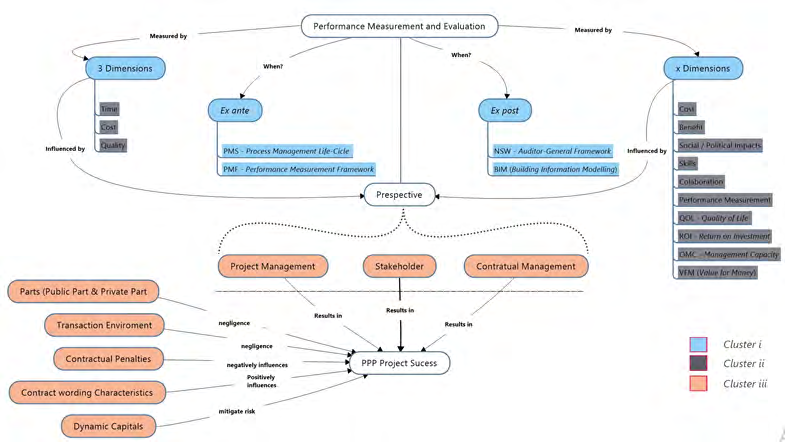
Source: Own elaboration. Figure 3: PPP performance measurement and evaluation critical factors.
Conclusions and Future Research
On the one hand, performance evaluation can be predicted through ex-ante models, anticipating a possible result of the partnership, and on the other, the measurement of ex-post performance transmits more reliable and comprehensive data. This SLR summarizes all the models and frameworks already investigated and proposed by the literature, with no consensus on the ideal way to measure and evaluate this type of model. The lack of consensus results from the applicability of different methods to PPP projects with their own, complexity, characteristics and differentiated procurement objectives. We can conclude that, currently, some methods of performance evaluation and measurement are studied and proven, but their transversal applicability to PPP models is not clear.
Evaluation Systems & Frameworks
In order to gather consensus and gauge a model or framework, as the most correct, to evaluate and measure PPP’s performance, it is crucial to invest in a segmented investigation, which empirically studies the various models when applied to PPP projects of an identical nature. It would be important to assess whether a given model or framework can be suitable when applied, for example, only to PPP projects implemented under a DBO (design, build, operate) regime in the road infrastructure scope or to a PPP projects implemented under the BOT (build, operate, transfer) regime in the health infrastructure scope. In other words, it is translated to the matrix elaboration where, on the one hand, the PPP model is drilldown into its various typologies, and on the other, it is divided into procurement scope (Infrastructure, Services, Healthcare etc.), applying, for each alignment, the various models/frameworks proposed in the literature. The proposed matrix could assist towards a validation, if in fact it is possible to associate a given measurement and evaluation model, with a specific PPP typology vs. scope, in a consistent and transversal way.
Performance Measurement (KPIs)
It becomes clear that, among academics, VfM is the most reliable indicator to measure PPP performance. Since VfM can be predicted before the PPP project execution (exante) and also confirmed after the conclusion (ex post), it is crucial to devote more efforts to empirical studies to conclude if in fact VfM is delivered according to the initial predictions. And also to conclude to each kind of PPP project this indicator can be sustainably applied. Cost indicator is also referred as a critical factor to determine the performance measurement, but it is not clear how the indicator can be applied and delivered when PPP projects are conducted in countries facing budgets constraints, resulting from central decisions (ex. European Central Bank) or temporary financial crises and at the same time must address the infrastructure gaps (recent data released by Global Infrastructure Hub, shows that $97 trillion is required to meet the world’s total infrastructure needs by 2040). It is important to empirically test if the cost indicator can or not be disregarded in situations when the private sector is the only option for governments.
Conceptual - Theoretical Analysis
The contractual wording and terms are often pointed out as a positive influence on the PPP outcome, but still, no empirical studies are indicating that the several worldwide PPP contracts are following a standard legal format in order to accommodate all the nuances present in this type of procurement and to enhance the performance of this kind of projects. Before the empirical studies, it is important to elaborate a conceptual analysis in order to propose a contractual framework that will be suitable to all PPP projects, despite their nature and objective, that will mitigate this risk of getting a negative influence of applying penalties resulting from non-compliances of the signed contracts and thus increasing the possibilities of a positive performance.
References
-
Manning R, White H (2014) Measuring results in development: the role of impact evaluation in agency- wide performance measurement systems. Journal of Development Effectiveness 6(4): 337-349.
-
Newcomer K, Baradei LEl, Garcia S (2013). Expectations and capacity of performance measurement in NGOS in the development context. Public Administration and Development 33(1): 62-79.
-
Li J (2015) the paradox of performance regimes: strategic responses to target regimes in Chinese local government. Public Administration 93(4): 1152-1167.
-
Child J (1974) Managerial and Organizational factors associated with Company Performance Part I. Journal of Management Studies 11(3): 175-189.
-
Sarmento JM, Renneboog L (2017) Anatomia das Parcerias Publico Privadas: A sua criacao, financiamento e renegociacoes. Julgar Online 10: 1-61.
-
OECD (2008) Public-Private Partnerships. In Pursuit of Risk Sharing and Value for Money.
-
Grout P (2005). Value-for-Money Measurement in Public-Private Partnerships. EIB Papers 10(2): 33-56.
-
Denyer D, Tranfield D (2009) Producing a Systematic Review of Literature. In: Buchanan D, et al. (Eds,). Handbook of Organizational Research Methods. Sage and London, pp: i671-689.
-
Koontz TM, Thomas CW (2012) Measuring the performance of public-private partnerships: A systematic method for distinguishing outputs from outcomes. Public Performance and Management Review 35(4): 769-786.
-
Yuan J, Zeng AY, Skibniewski MJ, Li Q (2009) Selection of performance objectives and key performance indicators in public-private partnership projects to achieve value for money. Construction Management and Economics 27(3): 253-270.
-
Mladenovic G, Vajdic N, Wündsch B, Salaj AT (2013) Use of key performance indicators for PPP transport projects to meet stakeholders’ performance objectives. Built Environment Project and Asset Management 3(2): 228-249.
-
Hodge G, Greve C (2008) The PPP phenomenon: performance and governance insights. Collaborative Governance 93-112.
-
Polese F, Troisi O, Torre C, Maione G (2017) Performance Evaluation and Measurement in Public Organizations: A Systematic Literature Review. International Journal of Business Administration 8(1): 106.
-
Nolan CT, Garavan TN (2016) Human Resource Development in SMEs: A Systematic Review of the Literature. International Journal of Management Reviews 18(1): 85-107.
-
Macpherson A, Jones O (2010) Editorial: Strategies for the Development of International Journal of Management Reviews. International Journal of Management Reviews 12(2): 107-113.
-
Whitley R (1984) the fragmented state of management studies: reasons and consequences. The Journal of Management Studies 21(3): 331-348.
-
Rousseau DM, Manning J, Denyer D (2008) Evidence in Management and Organizational Science: Assembling the Field’s Full Weight of Scientific Knowledge through Syntheses. The Academy of Management Annals 2(1): 475-515.
-
Hair JF (2010) Multivariate Data Analysis: A Global Perspective. 7th (Edn.), Pearson Prentice Hall.
-
Counsell C (1997) Formulating Questions and Locating Primary Studies for Inclusion in Systematic Reviews. Annals of Internal Medicine 127(5): 380-387.
-
Yong KS, Thuc LD (2021) Life Cycle Performance Measurement in Public-Private Partnership Infrastructure Projects. Journal of Infrastructure Systems 27(4).
-
Tang L, Yue Y, Xiahou X, Tang S, Li Q (2021) Research on performance measurement and simulation of civil air defence PPP projects using system dynamics. Journal of Civil Engineering and Management 27(5): 316-330.
-
Wang D, Wang X, Wang L, Liu HJ, Jia X (2021) A performance measurement system for public-private partnerships: integrating stakeholder influence and process trans-period effect. International Journal of Productivity and Performance Management.
-
Hossain M, Guest R, Smith C (2019) Performance indicators of public private partnership in Bangladesh: An implication for developing countries. International Journal of Productivity and Performance Management 68(1): 46-68.
-
Liang Y, Wang H (2019) Sustainable performance measurements for public-private partnership projects: Empirical evidence from China. Sustainability (Switzerland) 11(13): 1-15.
-
Ren G, Li H, Ding R, Zhang J, Boje C, et al. (2019) Developing an information exchange scheme concerning value for money assessment in Public-Private Partnerships. Journal of Building Engineering 25(6): 100828.
-
Bao F, Martek I, Chen C, Chan APC, Yu Y (2018) Lifecycle performance measurement of public-private partnerships: A case study in China’s water sector. International Journal of Strategic Property Management 22(6): 516-531.
-
Liu HJ, Love PED, Smith J, Irani Z, Hajli N, et al. (2018) From design to operations: a process management life- cycle performance measurement system for Public- Private Partnerships. Production Planning and Control 29(1): 68-83.
-
Liu HJ, Love PED, Smith J, Sing MCP, Matthews J (2018) Evaluation of public-private partnerships: A life-cycle Performance Prism for ensuring value for money. Environment and Planning C: Politics and Space 36(6): 1133-1153.
-
Saeed AM, Duffield C, Hui FKP (2018) an enhanced framework for assessing the operational performance of public-private partnership school projects. Built Environment Project and Asset Management 8(2): 194-
-
Cappellaro G, Ricci A (2017) PPPs in health and social services: a performance measurement perspective. Public Money and Management 37(6): 417-424.
-
Liu J, Love PED, Sing MCP, Smith J, Matthews J (2017) PPP social infrastructure procurement: Examining the feasibility of a lifecycle performance measurement framework. Journal of Infrastructure Systems 23(3).
-
Sundararajan SK, Tseng CL (2017) Managing Project Performance Risks under Uncertainty: Using a Dynamic Capital Structure Approach in Infrastructure Project Financing. Journal of Construction Engineering and Management 143(8).
-
Klijn EH, Koppenjan J (2016) The impact of contract characteristics on the performance of public-private partnerships (PPPs). Public Money and Management 36(6) 455-462.
-
Liu J, Love PED, Smith J, Matthews J, Sing CP (2016) Praxis of performance measurement in public-private partnerships: Moving beyond the iron triangle. Journal of Management in Engineering 32(4).
-
Love PED, Liu J, Matthews J, Sing CP, Smith J (2015) Future proofing PPPs: Life-cycle performance measurement and Building Information Modelling. Automation in Construction 56: 26-35.
-
Liu H, Peter D, Smith J, Regan M (2015) Conceptual Framework for the Performance Measurement of Public- Private Partnerships. Journal of Infrastructure Systems 21(1).
-
Liyanage C, Romero FV (2015) Measuring Success of PPP Transport Projects: A Cross-Case Analysis of Toll Roads. Transport Reviews 35(2): 140-161.
-
Gordon C, Mulley C, Stevens N, Daniels R (2013) Public- private contracting and incentives for public transport: Can anything be learned from the Sydney Metro experience?. Transport Policy 27: 73-84.
-
Panzer RJ, Gitomer RS, Greene WH, Webster PR., Landry KR, et al. (2013) Increasing Demands for Quality Measurement. JAMA 310(18): 1971.
-
Warner ME (2013) Private finance for public goods: Social impact bonds. Journal of Economic Policy Reform 16(4): 303-319.
-
Diggs SN, Roman AV (2012) Understanding and tracing accountability in the public procurement process: Interpretations, performance measurements, and the possibility of developing public-private partnerships. Public Performance and Management Review 36(2): 290-315.
-
Grossman SA (2012) The management and measurement of public-private partnerships: Toward an integral and balanced approach. Public Performance and Management Review 35(4): 595-616.
-
Protopapas A, Warner J, Morgan C (2012) Evaluation of methodologies in benefit-cost and economic impact analyses for freight rail projects. Transportation Research Record 2288(2288): 83-90.
-
Tijssen RJW (2012) Co-authored research publications and strategic analysis of public-private collaboration. Research Evaluation 21(3): 204-215.
-
Yuan J, Wang C, Skibniewski MJ, Li Q (2012) Developing key performance indicators for public-private partnership projects: Questionnaire survey and analysis. Journal of Management in Engineering 28(3): 252-264.
-
Abramo G, DAngelo CA, Solazzi M (2010) Assessing public-private research collaboration: Is it possible to compare university performance?. Scientometrics 84(1): 173-197.
-
English L, Baxter J (2010) The changing nature of contracting and trust in public-private partnerships: The case of Victorian PPP prisons. Abacus 46(3): 289-319.
-
Forrer J, Kee JE, Newcomer KE, Boyer E (2010) Public- private partnerships and the public accountability question. Public Administration Review 70(3): 475-484.
-
Gullick D, Cairns R, Kirk DP (2007) Application of partnering principles to a framework contract. Proceedings of the Institution of Civil Engineers: Municipal Engineer 160(3): 127-133.
-
Ellison JH (2005) National Public Health Performance Standards: Are They a Means of Evaluating the Local Public Health System?. Journal of Public Health Management and Practice 11: 433-436.
-
Jackson A (2005) Falling from a great height: Principles of good practice in performance measurement and the perils of top down determination of performance indicators. Local Government Studies 31(1): 21-38.
-
Maxwell K, Husain T (2005) Public private partnerships: Building capacity while effecting change. Evaluation and Program Planning 28(3): 349-353.
-
Voytek KP, Lellock KL, Schmit MA (2004) Developing performance metrics for science and technology programs: The case of the manufacturing extension partnership program. Economic Development Quarterly 18(2): 174-185.
-
Revilla E, Sarkis J, Modrego A (2003) Evaluating performance of public-private research collaborations: A DEA analysis. Journal of the Operational Research Society 54(2): 165-174.
-
Yong HK (2010) Public-private partnerships policy and practice: a reference guide. Commonwealth Secretariat
-
Morais F, Ferreira JJ (2019) SME internationalisation process: Key issues and contributions, existing gaps and the future search agenda. European Management Journal 38(1): 62-77.
-
Denyer D, Tranfield D, Van Ake JE (2008) Developing design propositions trough research synthesis. Organization Studies 29(3): 393-415.
-
Jingfeng Y, Chao W, Miroslaw S, Asce M, Li Q (2012) Safety- Knowledge Management in American Construction Organizations: Questionnaire Survey and Analysis. American Society of Civil Engineers 28(2): 252-264.
-
Kitchenham B (2004) Procedures for Performing Systematic Reviews. Keele University. Technical Report TR/SE-0401.
-
Mention AL (2012) Intellectual Capital, Innovation and Performance: a Systematic Review of the Literature. Business and Economic Research 2(1): 1-37.
-
Mohiuddin M (2010) Research on Offshore Outsourcing: A Systematic Literature Review. Journal of International Business Research 10(1): 1-16.
-
Mulrow CD (1994) Rationale for systematic reviews. British Medical Journal 309(6954): 597-599.
-
Stokes JR, Horvath A (2013) Sustainability of Natural Hazard Risk Mitigation: Life Cycle Analysis of Environmental Indicators for Bridge Infrastructure. Journal of Infrastructure Systems 17(12): 395-408.
-
Staples M, Niazi M (2007) Experiences using systematic review guidelines. Journal of Systems and Software 80(9): 1425-1437.
- The Expanding Landscape of Road Rage: A Systematic Review of Conflicts Involving Drivers, Pedestrians, and Micromobility
- Validating Cognitive Models of Royal Navy Performance on Control Systems
- Comparing Standard and State-of-the-art Firefighter Coats on Postural Balance and Gait in a Live Burn Environment
- Investigating the Integration of Telemedicine into Clinicians Workflow: A Review of Methods
- Risk Assessment of Ergonomic Factors in a Textile Firm by RULA, REBA and Fine Kinney Methods
- Impact of Self-Esteem Training on Individuals with Disabilities Aged 17-30