
Human Smell-Technology Initiatives: Can Smell Improve Road Safety?
Online communication until now has involved only two of our senses: sight and hearing. However, research is emerging to communicate smell in numerous human-based applications. This paper reviews several general applications of smell, discusses the status of implementing smell to improve road safety, and presents other vital considerations. The general applications include smelling screens, mobile notifications, virtual reality, highway landscaping, outdoor environments, video games, and presentation technology. The road safety implementation addresses driver performance, smell effects on driver performance (cognitive and psychological), and two emerging in-vehicle smell systems (empathetic-car system and CO2 filtration system). Based on this review, can smell be used to improve road safety? The answer is Yes and No since some smell scents positively affect drivers, while others adversely affect them. Other considerations include digital smell technology (DST), driving simulator studies, and online resources. In particular, with the DST, it is possible to sense, transmit, and receive smell through the internet.
Introduction
Sound and vision have traditionally been the main communication tools in human life. However, humans also use the sense of smell (olfaction) as a sensory information channel to experience the environment. Early studies have indicated that smell can substantially influence motivation, task performance, and alertness [1, 2, 3, 4]. More recent studies have confirmed the smell’s beneficial role [5, 6, 7, 8]. Research related to smell-based interactions started more than two decades ago; see Alaoui-Ismaili O, et al. [9], Brewster S, et al. [10], and Washburn DA, et al. [11]. In addition, recent studies have developed wearable devices that can improve interactions and feedback; for example, Blum JR, et al. [12], Choi Y, et al. [13], and Dobbelstein D, et al. [14].
The role of smell has been emerging in human-related applications. The applications are classified into general and road safety applications. The general applications include smelling screens [15], mobile notification [14], virtual reality [16], highway landscaping [17], outdoor environment [18], fruit picking games [19], presentation technology [20], and training and simulation [21]. In particular, the landscaping application included a framework incorporating the four human senses (hearing, seeing, smelling, and feeling) and several design principles. The road safety applications include in-vehicle smell systems, such as the empathetic- car system [22] and the In-Vehicle CO2 Filtration System [23]. For example, one device of the empathetic-car system disperses a relaxing pheromone synthesized from molecules in tears shed by women that calms the heartbeat and can be used to calm down a stressed driver. Another interesting smell-related development is digital scent technology (DST) which helps to sense, transmit, and receive scent-enabled digital media (e.g., web pages, movies, and music) [24]. This innovative technology has excellent potential for many applications.
The compound structure of the smell human sense and the molecular mechanism underlying odor perception were addressed by Potargowicz [25]. The author discussed the molecular mechanisms by which the olfactory stimuli are detected and transduced into electrical signals. There are a thousand volatile chemicals in the external environment that humans and other mammals can perceive as distinct odors. For more details on how the olfactory system detects such structurally diverse chemicals and how the nervous system translates the chemical structures into different odor perceptions, the reader is referred to Schulze P, et al. [26].
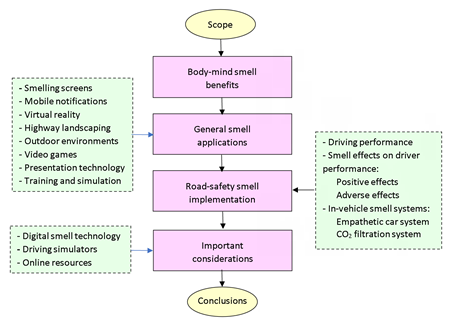
An excellent review of the recent advances in smellscape research for the built Environment is presented by Xiao J, et al. [27]. The authors discuss the trends and identify the challenges in smellscape research regarding methodology, artistic design, and odour policy making. The authors also identify future research areas regarding several aspects, including databases and social justice within odour control and management. The present paper is organized as follows (Figure 1). The next section briefly describes the body- mind benefits of smell. Section 3 presents the human-based applications of smell (general and road safety). Section 4 presents important considerations (digital smell technology, driving simulators, and online resources). Finally, Section 5 offers concluding remarks.
Smell Body-Mind Benefits
Researchers in the medicinal and cosmetic industries have shown that the fragrances, such as perfumes and room fresheners, significantly influence the psychophysiological activities of humans. In particular, the sense of smell has physiological effects on humans’ mood, stress, and working capacity. Using an electroencephalograph (EEG), many scientific studies have shown that various fragrances affect spontaneous brain activities and cognitive functions. The
EEG records the fluctuating electrical waveforms at the scalp of the human brain, providing information about its physiological state. Many scientific studies have suggested olfactory stimulation significantly alters cognition, mood, and social behavior. Sowndhararajan K, et al. [28] reviewed the available literature regarding the effect of fragrances on the psychophysiological activities of humans, focusing on EEG changes.
The fragrances help concentration, memory, and stress relief [29]. For example, spraying lavender (a common ingredient in soaps and sachets for scenting clothes) during tea breaks improved post-break production in Japan. Also, athletes who sniffed peppermint ran faster than those without the smell. Other studies showed that fresh strawberries helped children perform better at tests. As for memory, research has shown that aromas make memories more intense and more emotional. This may be attributed to the linkage between the brain part that processes smell and the one involved in emotion and memory [30].
Kadowaki A, et al. [31] stated that lavender could help improve sleep quality, promote relaxation, and relieve post- operative pain. The smell of coffee can also lead to a calming effect, and the vanilla fragrance has a calming effect, while the scent of roses reduces both breathing rate and blood pressure.
Smell Human-Based Applications
General Applications
Smelling Screens: A 2D olfactory display screen that can generate an odor distribution was proposed by Matsukura H, et al. [15]. The screen has four fans at the corners, and their generated airflows combine to create an airflow toward the user. The odor vapor is introduced into the airflows, making the user perceive the odor as emanating from a specific screen position, which can be shifted to a particular part of the screen by adjusting the airflows balance from the four fans. Since the airflow/perceived odor emanates from the display screen (rather than the fans), most users did not immediately notice the odor presentation mechanism. One vital feature of the system is that the user can set the airflow velocity below the sensation threshold so that the user perceives only the odor. The experimental results show the airflow field and the generated odor distribution. In addition, the sensory test results are presented to illustrate the user’s perception of the generated odor distribution and the issues to be considered in odor presentation.
Mobile Notifications: Dobbelstein D, et al. [14] introduced a wearable olfactory display attached to the mobile that allows the user to receive personal-scented notifications. The smell properties were used to amplify the received mobile messages using artificially emitted scents. When the mobile phone receives a message, the device releases the odor to prompt the user. The built-in in Scent is worn as a pendant around the neck and contains up to eight scents from small cartridges. The scent is vaporized and blown towards the user upon emission. In addition, the authors developed hardware and software that can be extended to add scents to mobile applications. An experimental study was conducted in which participants wore the inScent in public. Based on this study, the authors used semi-structured interviews and grounded theory to derive the lessons learned for using scents in mobile situations.
Virtual Reality: Virtual reality (VR) companies have begun to move beyond the limits of lighting and sound. One earlier work developed a projection-based olfactory device method to deliver smells spatially and temporally using a scent projector. Vortex rings are launched by two air cannons that collide at a target point and break to distribute the scent, making users feel like the smell came with a soft breeze [32]. In 2017, the VAQSO Company developed a VR device to simulate the sense of smell. The actual scents are generated from three cartridges inserted inside the device to match actions in a game [33]. In 2019, a more comprehensive smell device was integrated into VR by Craig E [16]. The new immersive scent device holds cartridges that generate nine scents, such as mint, gunpowder odor, lavender, and burned rubber. The device, a multisensory virtual reality mask, attaches via magnets and Bluetooth to the VR headset. The device weighs only seven ounces, which is very light compared to current VR headsets. The company plans to develop many scents that the users can mix and match as desired. Several popular VR games have adopted the device.
Tactile sensations have immense potential and could substantially structure the users’ experiences in VR in all fields, including transportation engineering. Furthermore, the FeelReal device can be integrated into all major VR headsets, including Oculus Rift, HTC Vive, Playstation VR, Oculus Quest, and Samsung Gear VR. Recently, a Japanese company developed a scent playback device that provides five scents simultaneously and can be loaded onto existing VR headsets, see Hara T [34]. In addition, the FeelReal Company designed a sensory mask that provides nine scents simultaneously using the smell generated by heat [16] (Figure 2).
![Figure 2: Smell device integrated into the VR headset [16].](/fulltextimages/9187/fig_2.png)
Highway Landscaping: The smell sense is not a part of highway landscapes, but it has been implemented in landscape areas such as hotels, retailers, and restaurants. Recently, researchers started to address the potential of using smell as part of the environment landscape, including Perkins C, et al. [35], Henshaw V [36], Henshaw V, et al. [37], Kang J, et al. [38], and Easa S, et al. [17]. The smell is thought to have the potential to influence emotional state and behavior at an unconscious level, without the implicit agreement or knowledge of the individual. Considering smell in urban environments presents valuable opportunities to improve the well-being of highway users. Integrating smell in urban design practice offers valuable opportunities for practitioners to potentially enhance the physiological and psychological state of highway users. How to incorporate smell into the highway landscape effectively is a challenge. However, it is possible to start integrating smell at strategic highway facilities, such as pedestrian facilities and bridges, cyclist routes, bus stops, and transit stations.
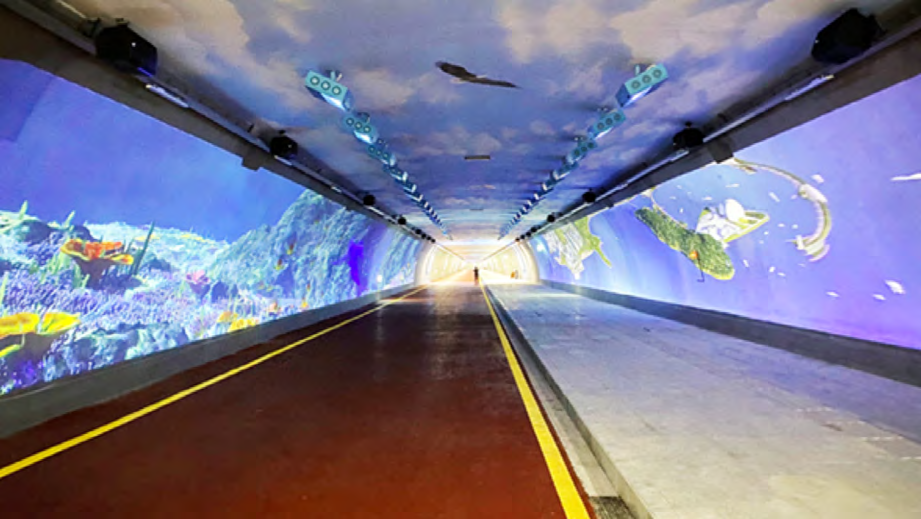
Figure 3 shows the landscape of a 1.2-km tunnel for non-motor vehicles (red road lane) and pedestrians in China [17]. The tunnel is decorated with 3D inkjet paintings of blue sky and white clouds on the ceiling, with flying birds, balloons, and spacecraft patterns. Such a tunnel is ideal for implementing smell.
![Figure 3: Interior landscaping of tunnels, China [17].](/fulltextimages/9187/fig_3.png)
Outdoor Environments: In the early prototype development of the smell-dispersing devices in 2006, Yamada T, et al. [18] developed an olfactory presentation device for outdoor use.
The authors presented the odor spatiality by controlling the odor strength based on the user’s positions and the odor source. With this device, the user can specify the odor position source in an outdoor environment. The device uses an inkjet head device to treat odor in the liquid state.
Video Games: The smell was introduced in video games more than a decade ago to allow the user to smell the games in addition to seeing and hearing them. Researchers and industrial companies have contributed to this development. For example, Hoshino S, et al. [19] proposed a device for harvesting fruit in 3D virtual space using an olfactory and haptic media display system. With the device, the user can pick fruit from a tree in the virtual area and perceive the smell of the harvested fruit. An olfactory display and the reaction force (while picking the fruit) were integrated through a haptic interface. Companies have also developed smell game devices now available in the market. For example, besides smell dispersion, some devices consider how every individual perceives an odor differently. One device, ScentScape, has pre-programmed 20 scents into the memory (e.g. roses, delicious foods, and pine forests), using cartridges lasting for 200 hours [39].
Presentation Technology: The visual and olfactory presentation technologies are fused in this system, developed by the Aiko Company. Control commands are generated based on the corresponding image interaction commands, and subsequently, the olfactory presentation device emits the scent, see Nambu A, et al. [20]. The system’s disadvantage is that it has a few aromas. Subsequently, Kadowaki A, et al. [31] have explored the fusion of olfactory presentation and auditory interaction. In this system, the user can control the tone of the voice to identify the corresponding perfume scent. These studies have paved the way for in-vehicle automated smell dispersal devices.
Training and Simulation: Smell training and simulation have been used in several fields, including firefighting, law enforcement, urban search and rescue, hazmat, and CBRNE (chemical, biological, radiological, nuclear, explosives). The simulated training environments make participants engage all their senses in action. The memory created by the immersive experience can be triggered in similar circumstances. For example, for military training and simulation, authentic medical, chemical, and battlefield odors and malodors are introduced into invasion, battle, conflict aggression, and fighting scenarios using scent generators. Examples of field odors include excrement, hookah, blood, burning flesh, cordite, and burning tires. The smoke effects include smoking buildings, car fires, and whiteouts. For more details about the preceding types of training and simulation, the reader is referred to SensoryCo [21].
Road Safety Implementation
Driver Performance: Driver fatigue is one of the most common causes of traffic collisions [40, 41, 42]. The causes of driver fatigue can be classified as sleep-related and task- related, whereas sleep disorders cause sleep-related fatigue, restriction, deprivation, and sleep associated with biological rhythms. Drowsiness is the most common type of driver fatigue caused by sleep deprivation, sleep disorders, alcohol, and medications. Sahayadhas A, et al. [43] stated that in the United States, drowsiness-related driving results in 100,000 collisions each year, with 1,000 fatalities, 70,000 injuries, and $10 billion in economic losses. In contrast, 25% of all deaths and injuries from road collisions in Germany are caused by driver fatigue. On the other hand, task-related fatigue results from the driving task and the external environment, such as environmental monotony [44]. Several strategies can be used to avoid driving fatigue, including smell dispersal.
Smell Effects on Driver Performance: Positive Effects. Certain smells can improve driver behavior, such as recognizing dangers sooner, staying more focused on the road ahead, and forgiving other people’s driving errors [45]. Many believe that the smell sense is the part of the brain most directly linked to processing responses. It has been demonstrated that scent affects people’s emotions. Mustafa M, et al. [46] found that the presence of the vanilla or lavender scent made the driver more emotionally calm, while Fruhata T, et al. [47] found that the stimulating scent enhanced arousal. In addition, other studies showed that mint and cinnamon scents increased driver alertness. Raudenbush B, et al. [48] showed that the vanilla scent helped drivers feel calmer, more concentrated, and more comfortable. The olfactory stimulation could lessen the driver’s fatigue, and recent research on releasing this stimulation at the right time is described later. An exciting study by Millot JL, et al. [49] compared subjects’ reaction times for ambient odor and no-odor conditions. The results showed that, in responses to visual or auditory stimulation, the reaction time was substantially less in the ambient odor conditions (regardless of the odor pleasantness) than in the no-odor state. Funato H, et al. [50] examined the fragrance presentation methods for drivers using an actual simulation vehicle cabin. The results showed that the intermittent fragrance presentation effectively kept the drivers alert. The best smells for driving are shown in Table 1.
| Scent | Positive Effect |
|---|---|
| Peppermint and cinnamon | Improve concentration levels and make drivers less irritable |
| Lemon and coffee | Help drivers achieve high concentration levels and clear thinking. |
| New-car smell a | Tend to make people more cautious about their driving and improve concentration. |
| Sea ozone | Salty sea air may make drivers breathe deeply, helping relieve stress, relax the muscles and calm the mind. |
Table 1: Best smells for driving [45].
a Combination of cleaning products and organic solvents. Table 1: Best smells for driving [45].
Adverse Effects. Certain smells may provoke drivers into dangerous behaviors, such as speeding, dozing off, succumbing to road rage, and getting into serious accidents [45]. As previously mentioned, the sense of smell is connected to the emotional center of the human brain. Therefore, in addition to the positive effects of good odors, some bad smells could result in a lack of concentration or overreaction to minor irritations on the road, which can turn into potentially life-threatening accidents. For example, the smell of food wrappers may make drivers feel hungry, increasing their irritability and making them more susceptible to road rage [45]. The worst smells for driving are shown in Table 2.
| Scent | Adverse Effect |
|---|---|
| Chamomile, jasmine, and lavender | Make drivers too relaxed. |
| Fast food wrappers, fresh bread, and pastry | Make drivers hungry and get something to eat, resulting in irritability and an increased risk of speeding and road rage. |
| Fresh-cut grass, pine woods, and roadside flowers | May bring a memory to the drivers such that their dreams take their minds off the road or speed. Also, drivers with allergies may sneeze and get watery eyes. |
| Leather seats and oil | Older drivers may become nostalgic, thinking back to the thrill of their first cars, and adopt risky driving behaviours. |
| Certain perfumes and aftershaves | May ignite sexual thoughts in both male and female drivers, making them focus on romance than on the road. |
Table 2: Worst smells for driving [45].
In-Vehicle Smell Systems: Empathetic-Car System. The Moodify Company intends to create an ‘Empathetic-Car’ system [22]. The system would use video cameras and monitors to analyze driver’s metrics (e.g. heart rate and body language). Then, if needed, the system would react to improve driver performance and road safety by emitting a specific smell. One company device, White Scent for Mobility, eliminates terrible odor perception by targeting distinct smells, such as cigarettes, that block the user’s ability to recognize the bad odor. This tiny computer device will be used by rental car agencies, service car businesses (like Uber or Lyft), and used-car sellers. The company is also working on a second product, Moodify ™ Blue. In this product, a relaxing pheromone synthesized from molecules in tears shed by women acts on the parasympathetic nervous system. The pheromone calms the heartbeat and can be used to calm down a stressed driver. A third product, Moodify ™ Green, will be used to increase alertness to combat drivers’ sleepiness. The device will emit the synthesized chemosignals in vehicles in two modes:
- Automated mode, where the device analyzes driving patterns and body language to determine whether the scent is needed.
- On-demand mode, where the driver could press a button to use the active scent as needed.
In-Vehicle CO2 Filtration System. Many studies have recognized the adverse influences of high CO2 levels on driver behaviors [51, 52, 53, 54]. Therefore, methods and procedures for monitoring and reducing or filtering in-vehicle CO2, particulate matter (PM), and other cabin air pollutants are receiving increasing attention from researchers in this area. Tessathan T, et al. [51] stated that rarely opened windows for commuting passenger cars in Thailand lead to an accumulation of CO2 in vehicle cabins. Results indicated that the amount of air exchange depends on the prevailing wind speed and direction, the number of doors opened, and the duration of the door opening. Cha Y, et al. [52] developed a low- cost mobile test method for monitoring in-vehicle PM and CO2 and evaluating the performances of cabin air filters in real-life driving conditions. The test results showed that recirculation ventilation could result in high PM2.5 removal efficiency regardless of the cabin air filter’s performance. The remarkable increase in CO2 in a short time is an obvious indicator of the activation of recirculation. Jung HS, et al. [53] proposed a fractional air recirculation system for reducing nanoparticle concentration while maintaining CO2 at a low level to reduce its adverse impacts on drivers.
Chen RY, et al. [54] reported that vehicle exposure to high CO2 levels might result in unpleasant feelings, fatigue, drowsiness, or lethargy among drivers and passengers. Four CO2 filtration modes were considered in their study: (1) fresh air from open windows without a CO2 filtration system (2) fresh air from an air conditioning system with closed windows (3) a false CO2 filtration system in operation (Off- mode), and (4) an actual CO2 filtration system in operation. Through real-world driving tests, the authors found that using a CO2 filtration system can reduce in-vehicle CO2 levels and modify the effect of in-vehicle CO2 on heart rate, blood pressure, and drowsiness among human subjects during driving.
Important Considerations
Digital Scent Technology
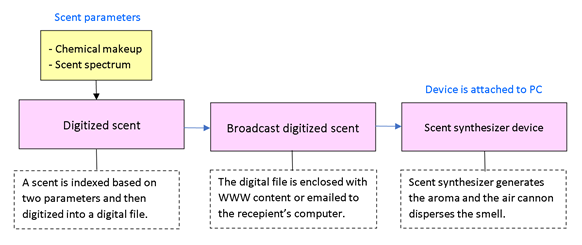
Digital scent technology helps to sense, transmit, and receive scent-enabled digital media (e.g., web pages, movies, video games, virtual reality, and music) using hardware devices consisting of gas sensors (e.g., e-nose) and scent synthesizer [24]. The technology started in the late 1950s with the Smell-O-Vision, a system that released scents during the film’s exhibition to allow viewers to smell what was happening. An exciting history of the technology can be found elsewhere [55]. The DST technology, which helps sense and generates different types of smells, refers to online communication using the human nose. and enables transmitting the odor over the internet. This innovative technology has excellent potential for many applications. The transmission model of the DST is illustrated in (Figure 4). The model consists of three stages. First, a scent is indexed based on its two parameters (chemical makeup and spectrum) and then digitized into a digital file. For example, a smell may be digitized as 101011. Second, the digital scent file is enclosed with the World Wide Web (WWW) content or emailed to the recipient’s computer. Finally, the scent synthesizer reads the digital scent file and generates the aroma, and the air cannon disperses the smell. The scent synthesizer is a device connected to the personal computer via a serial or USB Port that generates the aroma based on the transmitted digital file. For example, I Smell is a scent synthesizer, about the size of a pc speaker, and has cartridges that can be used and replaced, similar to ink cartridges for printers [56]. Research and technological advances in the DST are ongoing, and companies are adopting various strategies to expand their customer base. Leading companies operating in DST are Aryballe, Aromajoin Corporation, Aromyx, Olorama, ScentRealm, Inhalio, Moodify, and eNose. An exciting development is a We-nose project that aims to improve air quality monitoring in the port of Rotterdam by testing the possibility of automatic source recognition.
Driving Simulator Studies
Driving simulators have been used to evaluate the effect of fragrances on driver behavior. A study in 2009 by Raudenbush B, et al. [57] investigated the impact of the odors of peppermint and cinnamon using a driving simulator, expecting the presentation of peppermint or cinnamon odor while driving may produce a more alert and conscientious driver and minimize fatigue associated with prolonged driving. The participants were monitored under three odor conditions: peppermint, cinnamon, and no-odor. The authors added the odors to low-flow oxygen through an oxygen concentrator, and the cognitive performance, wakefulness, mood, and workload were assessed. The results showed that both cinnamon and peppermint increased ratings of alertness, decreased temporal demand, and decreased frustration. In addition, the peppermint scent reduced anxiety and fatigue. The authors suggested that periodic administration of these odors over prolonged driving may help maintain alertness and decrease highway collisions. A more recent study in 2016 by Mustafa M, et al. [46] assessed the effect of lavender and vanilla flavor fragrances on driver performance. The authors tested ten human subjects in three conditions:
• Driving with vanilla fragrance
• Driving with lavender fragrance
• Driving without fragrance. The results of the questionnaire, conducted after the experiments, indicated that fragrance did not affect the speed reduction. However, the fragrances positively affected driver emotions, such as feeling relaxed, more comfortable, and more alert. This study has evaluated the effect of fragrance based on the interviews of the subjects, and future studies should focus on measuring the physiological effects of the driver, such as EEG.
Online Resources
Most publications on smell-related applications and associated technologies are published at the annual conference sponsored by the Association for Computing Machinery (ACM). The ACM international joint conference on pervasive and ubiquitous computing (UbiComp) is the result of a merger of the two most renowned conferences in the field: Pervasive and UbiComp. These two conferences started separately in 2001 but have been held as a joint conference since 2012. UbiComp is a premier interdisciplinary venue in which leading international researchers, designers, developers, and practitioners in the field present and discuss novel results in all aspects of ubiquitous and pervasive computing. These aspects include designing, developing, and deploying ubiquitous and pervasive computing technologies and understanding these technologies’ human experiences and social impacts. The next ACM International Joint Conference on Pervasive and Ubiquitous Computing will be held in Atlanta on 11-15 September 2022. The conference covers many exciting topics, including devices and techniques, systems and infrastructures, methodologies and tools, applications and experiences, visions and wildcards, and theories and models [58].
Education and Training
This paper has shown that a substantial amount of research has been conducted, and a wealth of knowledge is available on the effect of smell on human beings. In addition, smellscape has been implemented in numerous applications and has the potential to improve road safety. However, there seems to be a gap between research on one hand and academia and practice on the other hand. In this regard, an undergraduate course (core or elective) may be developed in design-related disciplines to introduce students to the latest advances in smell-related concepts and applications.
Training providers may also create a course to inform professionals to promote practical smellscape applications. In another human sense, the need for soundscape education in undergraduate curricula has been recently advocated by Xiao J, et al. [59]. The authors outline how soundscape can be integrated into teaching building acoustics in undergraduate architectural courses.
Concluding Remarks
This paper has reviewed several general human- based applications of the smell sense and discussed its emerging use to improve road safety. In addition, other important considerations, such as digital scent technology, were presented. Finally, based on this study, the following comments are offered:
- It has been widely acknowledged that the smell sense is connected to the emotional center of human brains. Therefore, the odor may significantly influence the psychophysiological activities of humans. In particular, smell has physiological effects on humans’ mood, stress, and working capacity. In addition, many scientific studies using the electroencephalograph have demonstrated that various scents affect spontaneous brain activities and cognitive functions.
- The general applications of the smell discussed in this paper include smelling screens, mobile notifications, virtual reality, highway landscaping, outdoor environment, fruit picking game, and presentation technology. These application scenarios show the great potential of using the sense of smell to improve user experiences in numerous areas.
- Because the sense of smell may significantly affect humans’ psychophysiological activities, it can also be implemented to improve road safety. A good (bad) smell may positively (adversely) affect driver performance (cognitive and psychological). In this regard, some pleasant scents can increase drivers’ calmness and alertness, thus increasing driving safety. For instance, two emerging in-vehicle smell systems (empathetic-car system and CO2 filtration system) that implement smell were developed to improve driver performance.
- Research to develop VR devices beyond the smell is growing. Interestingly, the Free Real company plans to add tactile sensations that would make the immersive experience profoundly more realistic, including
- Water mist (the ultrasonic ionizing system allows users to feel the rain on their cheeks,
- Heat (sense the warmth of the desert with safe micro-heaters),
- Wind (enjoy the cool mountain breeze with two powerful micro-coolers), and
- Vibration (endure the impact when force-feedback haptic motors kick in).
• Other considerations include digital smell technology, driving simulator studies, and online resources. The DST enables transmitting the odor over the internet, which has excellent potential for many applications. However, research is needed to address the technology’s challenges, such as associated cost, the timing of the distribution of scents, understanding of human olfactory perception, and the health hazards of synthetic fragrances.
References
-
Kobal G, Hummel C (1988) Cerebral chemosensory evoked potentials elicited by chemical stimulation of the human olfactory and respiratory nasal mucosa. Electroencephalography and Clinical Neurophysiology 71(4): 241-250.
-
Dember WN, Warm JS, Parasuraman R (1996) Olfactory stimulation and sustained attention. In: Gilbert A (Ed.), Compendium of Olfactory Research, USA, pp: 39-46.
-
Ludvigson HW, Rottman TR (1989) Effects of ambient odors of lavender and cloves on cognition, memory, affect and mood. Chemical Senses 14: 525-536.
-
Lorig TS, Huffman E, DeMartino A (1991) The effects of low concentration odors on EEG activity and behavior. Journal of Psychophysiology 5(1): 69-77.
-
McGookin D, Escobar D (2016) Hajukone: Developing an open-source olfactory device. Proc., CHI Conference Extended Abstracts on Human Factors in Computing Systems, ACM, pp: 1721-1728.
-
Obrist M, Tuch AN, Hornbæk K (2014) Opportunities for odor: Experiences with smell and implications for technology. Proc., 32nd annual ACM conference on Human factors in computing systems, ACM, pp: 2843- 2852.
-
Schablitzky S, Pause BM (2014) Sadness might isolate you in a non-smelling world: Olfactory perception and depression. Applied Olfactory Cognition 5: 45.
-
Yanagida Y (2012) A survey of olfactory displays: Making and delivering scents. Sensors, IEEE, pp: 1-4.
-
Alaoui IO, Robin O, Rada H, Dittmar A, Vernet ME (1997) Basic emotions evoked by odorants: Comparison between autonomic responses and self-evaluation. Physiology & Behavior 62(4): 713-720.
-
Brewster S, McGookin D, Miller C (2006) Olfoto: Designing a smell-based interaction. Proc., SIGCHI Conference on Human Factors in Computing Systems, ACM, pp: 653-662.
-
Washburn DA, Jones LM (2004) Could olfactory displays improve data visualization? Computing in Science and Engineering 6(6): 80-83.
-
Blum JR, Frissen I, Cooperstock JR (2015) Improving haptic feedback on wearable devices through accelerometer measurements. Proc., 28th Annual ACM Symposium on User Interface Software & Technology, ACM, pp: 31-36.
-
Choi Y, Parsani R, Roman X, Pandey AV, Cheok AD (2012) Light perfume: Designing a wearable lighting and olfactory accessory for empathic interactions. Advances in Computer Entertainment, Springer, pp: 182-197.
-
Dobbelstein D, Herrdum S, Rukzio E (2017) InScent: A wearable olfactory display as an amplification for mobile notifications. Proc, ACM International Symposium on Wearable Computers, Association for Computing Machinery, New York, USA.
-
Matsukura H, Yoneda T, Ishida H (2013) Smelling screen: Development and evaluation of an olfactory display system for presenting a virtual odor source. IEEE Trans Vis Comput Graph 19(4): 606-615.
-
Craig E (2019) Feelreal-Smell in VR arrives on Kickstarter.
-
Easa SM, Yang YQ, Zheng XY, Ma Y, Zheng X (2021) Integrating four human senses into highway landscape process: A system approach. Ergonomics Inter J 5(5): 1-12.
-
Yamada T, Yokoyama S, Tanikawa T, Hirota K, Hirose M (2006) Wearable olfactory display: Using odor in outdoor environment. Paper presented at the IEEE Virtual Reality Conference, USA.
-
Hoshino S, Ishibashi Y, Fukushima N, Sugawara S (2011) QoE assessment in olfactory and haptic media transmission: Influence of inter-stream synchronization error. IEEE International Workshop Technical Committee on Communications Quality and Reliability (CQR), USA.
-
Nambu A, Narumi T, Nishimura K, Tanikawa T, Hirose M (2010) Visual-olfactory display using olfactory sensory map. Paper presented at the IEEE Virtual Reality Conference, USA.
-
SensoryCo (2022) Training & simulation.
-
Lisbona N (2022) Can the right smell make you more productive? BBC News.
-
Chen RY, Ho KF, Chang TY, Hong GB, Liu CW, et al. (2020) In-vehicle carbon dioxide and adverse effects: An air filtration-based intervention study. Sci Total Environ 723: 138047.
-
Mordor Intelligence (2022) Digital scent market-Growth, trends, covid-19 impact, and forecasts (2022-2027).
-
Potargowicz E (2008) Smell: The unappreciated human sense. Postepy Hig Med Dosw (Online) 62: 87-93.
-
Schulze P, Bestgen AK, Lech RK, Kuchinke L, Suchan B (2017) Preprocessing of emotional visual information in the human piriform cortex. Scientific Reports 7(1): 9191.
-
Xiao J, Aletta F, Radicchi A, McLean K, Shiner LE, et al. (2021) Recent advances in smellscape research for the built environment. Front. Psychol 12: 700514.
-
Sowndhararajan K, Kim S (2016) Influence of fragrances on human psychophysiological activity: with special reference to human electroencephalographic response. Sci Pharm 84(4): 724-752.
-
Khan AA (2020) How smell affects your body and mind. Saga Magazine.
-
Aqrabawi AJ, Kim JC (2018) Hippocampal projections to the anterior olfactory nucleus differentially convey spatiotemporal information during episodic odour memory. Nature Communications 9(1): 2735.
-
Kadowaki A, Sato J, Bannai Y, Okada K (2008) Measurement and modeling of olfactory responses to pulse ejection of odors. Japan Association on Odor Environment 39(1): 36-43.
-
Narumi T, Nishizaka S, Kajinami T, Tanikawa T, Hirose M (2011) Augmented reality flavors: Gustatory display based on edible marker and cross-modal interaction. Proc., SIGCHI conference on human factors in computing systems, ACM, pp: 93-102.
-
Nakaizumi F, Noma H, Hosaka K, Yanagida Y (2006) Spotscents: A novel method of natural scent delivery using multiple scent projectors. Virtual Reality Conference, IEEE, USA, pp: 207-214.
-
Hara T (2017) Now you can smell your games.
-
Perkins C, McLean K (2020) Smell walking and mapping. In Hall SM, Holmes H (Eds.), Mundane methods: Innovative ways to research the everyday. Manchester University Press, Manchester, United Kingdom, pp: 156- 173.
-
Henshaw V (2014) Urban smellscapes: Understanding and designing city smell environments, Routledge, London, pp: 272.
-
Henshaw V, McLean K, Medway D, Perkins C, Warnaby G (2017) Designing with Smell: Practices, techniques and challenges, London, Routledge, pp: 312.
-
Kang J, Tait M, Xiao J (2017) The design of urban smellscapes with fragrant plants and water features. In: Henshaw V, McLean K (Eds.), Designing with Smell, Routledge, London, pp: 83-95.
-
Fleming R (2011) New device will allow you to smell the games you play. Digital Trends Company. USA.
-
Sun W, Zhang X, Wang J, He J, Peeta S (2015) Blink number forecasting based on improved Bayesian fusion algorithm for fatigue driving detection. Mathematical Problems in Engineering. USA.
-
Sanjaya KH, Lee S, Katsuura T (2016) Review on the application of physiological and biomechanical measurement methods in driving fatigue detection. Journal of Mechatronics, Electrical Power, and Vehicular Technology 7(1): 35-48.
-
May JF, Baldwin CL (2009) Driver fatigue: The importance of identifying causal factors of fatigue when considering detection and countermeasure technologies. Transportation Research Part F: Traffic Psychology and Behaviour 12(3): 218-224.
-
Sahayadhas A, Sundaraj K, Murugappan M (2012) Detecting driver drowsiness based on sensors: A review. Sensors 12(12): 16937-16953.
-
Thiffault P, Bergeron J (2003) Monotony of road environment and driver fatigue: A simulator study. Accident Analysis & Prevention 35(3): 381-391.
-
SixWise (2022) Warning: Certain smells may make you a dangerous driver.
-
Mustafa M, Rustam N, Siran R (2016) The impact of vehicle fragrance on driving performance: What do we know? Procedia-Social and Behavioral Sciences 222: 807-815.
-
Fruhata T, Miyachi T, Adachi T, Iga S, Davaa T (2013) Doze sleepy driving prevention system (finger massage, high-density oxygen spray, grapefruit fragrance) with that involves chewing dried shredded squid. Procedia Computer Science 22: 790-799.
-
Raudenbush B, Grayhem R, Sears T, Wilson I (2009) Effects of peppermint and cinnamon odor administration on simulated driving alertness, mood nd workload. North American Journal of Psychology 11(2): 245-245.
-
Millot JL, Brand G, Morand N (2002) Effects of ambient odors on reaction time in humans. Neuroscience Letters 322(2): 79-82.
-
Funato H, Yoshikawa M, Kawasumi M, Yamamoto S, Yamada M, et al. (2009) Stimulation effects provided to drivers by fragrance presentation considering olfactory adaptation. Proc. Intelligent Vehicles Symposium, IEEE, pp: 881-886.
-
Tessathan T, De Silva P, Hussain R, Noomwongs N (2017) Cabin-ambient air exchanges and their relation to in- vehicle CO2 concentration. SAE Technical Papers, 13th International Conference on Automotive Engineering, ICAE, pp: 1-5.
-
Cha Y, Yin C, Du J, Xia T, An W, et al. (2022) Real-driving measurement of vehicle interior air quality and cabin air filtering performance by using low-cost sensors. SAE International Journal of Commercial Vehicles 15(4): 1-13.
-
Jung HS, Grady ML, Victoroff T, Miller AL (2017) Simultaneously reducing CO2 and particulate exposures via fractional recirculation of vehicle cabin air. Atmos. Environ 160: 77-88.
-
Chen RY, Ho KF, Chang TY, Hong GB, Liu CW, et al. (2020) In-vehicle carbon dioxide and adverse effects: An air filtration-based intervention study. Sci. Total Environ 723: 138047.
-
Digital scent technology.
-
Priscill BJ, Anandhavalli M (2018) Digital smell technology. Inter. J Emerging Techn In Compu Sci & Electro 25(5): 451-454.
-
Raudenbush B, Grayhem R, Sears T, Wilson I (2009) Effects of peppermint and cinnamon odor administration on simulated driving alertness, mood and workload. North American Journal of Psychology 11(2): 245-256.
-
Association for Computing Machinery (2022) UbiComp 2022: ACM International Joint Conference on Pervasive and Ubiquitous Computing.
-
Xiao J, Aletta F, Ali-Maclachlan I (2022) On the opportunities of the soundscape approach to revitalise acousticss training in undergraduate architectural courses. Sustainability 14(4): 1957.
- The Expanding Landscape of Road Rage: A Systematic Review of Conflicts Involving Drivers, Pedestrians, and Micromobility
- Validating Cognitive Models of Royal Navy Performance on Control Systems
- Comparing Standard and State-of-the-art Firefighter Coats on Postural Balance and Gait in a Live Burn Environment
- Investigating the Integration of Telemedicine into Clinicians Workflow: A Review of Methods
- Risk Assessment of Ergonomic Factors in a Textile Firm by RULA, REBA and Fine Kinney Methods
- Impact of Self-Esteem Training on Individuals with Disabilities Aged 17-30