
The Importance and Awareness Level of Ergonomics in Terms of office Workers
Ergonomics is a branch of science that aims to examine the behavioral and biological characteristics of human beings and to create suitable living and working environments. The main goal of ergonomics, which is especially important for office workers, is to improve the quality of business life and working environments. From this point of view, the importance of ergonomics emerges in different health problems ranging from musculoskeletal problems to psychological disorders. As a reflection of these reasons, within this study’s scope, a survey was conducted on the office workers working in institution A. While questions about personal information are asked in the first part of the survey, there are detailed questions about ergonomics in the second part. The results were very interesting and supported by an additional survey conducted with the office workers of institution B. As a result of the evaluation, it was seen that the knowledge and awareness levels of the office workers about the science of ergonomics were not at the desired level. However, it has been determined that the awareness of the science of ergonomics can be increased with appropriate training, and thus, the health problems arising from ergonomics can be minimized.
Introduction
Ergonomics comes from the Greek words ergon (work, study) and nomos (law, science). It is expressed as ‘Human Engineering’ or ‘Human Factors Engineering’ in the USA [1]. It is seen that many different definitions of ergonomics have been made so far, and it is possible to list some of the definitions as follows. Ergonomics is an interdisciplinary approach that aims to increase productivity and performance by harmonizing the individual with the tools and methods he/ she uses, in the light of information obtained from disciplines such as anatomy, psychology, and physiology [2]. Investigating the characteristics and abilities of the human organism, it provides the necessary conditions for the adaptation of work to man and man to work [3]. In other words, ergonomics is the science of individual work, and it investigates all the characteristics and abilities of the employees and fulfills all the conditions necessary for this work-worker adaptation [1, 4]. The scientific definition of ergonomics is as follows: Considering human anatomical qualities, anthropometric structure, physiological competence, and tolerance; it is a scientific discipline that explores the basic theories of work environment order and human-machine-environment harmony [5].
When we look at the definitions of ergonomics, we can say that the main goal to be explained is to provide a suitable working environment for optimum working conditions. In addition, we can say that especially to ensure a better quality of working life. The most important contribution of ergonomics is that it allows the effective use of equipment, office, and working order together with the health and safety of the employee to increase productivity and continuity [1].
Another purpose of ergonomics is to support people to design their lives uniquely. Arranging working hours, creating a working environment according to the physiological characteristics of the employees, and adapting the tools and equipment used according to the job and the employee are also counted among the goals of ergonomics [1]. Ergonomics is also concerned with the regularization of working conditions that adversely affect employee health in the working environment. For example; environment temperature, noise levels, lighting intensity, amount of vibration, chemicals, work environment design, desk-chair design, and work design. Apart from these, it is said that subjects such as working times, shift times, break times, and meal regimens are among the fields of interest in ergonomics.
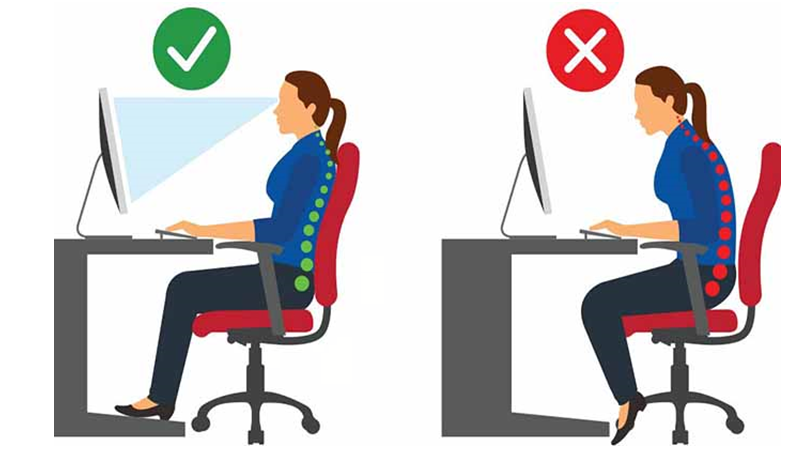
Office working environments are areas that need to be examined in terms of occupational diseases and work accidents. The fact that occupational accidents in the offices are at lower levels compared to the accidents in the construction, metal, and mining sectors has led to a decrease in the importance that should be given to these areas. The increase in the number of occupational diseases occurring in office working environments in recent years emerges as a result of how important the subject is [6]. Musculoskeletal disorders, circulatory system diseases, allergic diseases, and even psychological problems can be caused by ongoing ergonomic deficiencies in offices (Figure 1).
Within the scope of this study, office workers at a university (institution A) in Turkey were taken as a sample.
The awareness of the science of ergonomics was determined through a survey conducted on these people. The outputs of this research were compared with a small sample group from another university (institution B) in a neighboring province through the same survey study. The aim here is to determine the level of awareness of ergonomics in office environments in Turkey and to contribute to detecting and eliminating possible deficiencies. It is hoped that the results obtained will shed light on minimizing future shortcomings [7].
Method
In the concept of this study, volunteer help was received from the office workers (200 people) of institution A. A survey including questions about personal and ergonomics was applied to them. “Microsoft Excel” program was used to present the survey results graphically. In order to compare the results obtained with a different institution, the same survey was applied to 28 volunteer office workers from institution B.
Results and Discussion
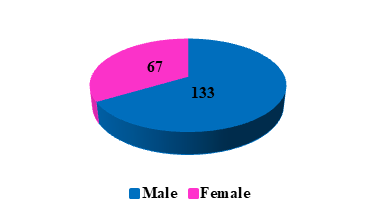
Within the scope of the survey, 200 office workers (academic, administrative, technical) from institution A participated. In the first part of the questionnaire, questions about the characteristics of the people were asked, and in the next stage, the knowledge levels and awareness of the individuals about ergonomics were investigated. 133 of the 200 participants in institution A were male and 67 were female (Figure 2).
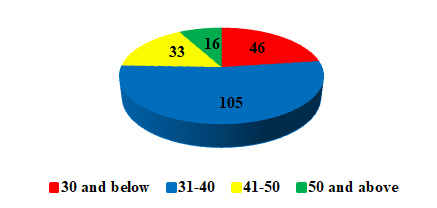
As can be seen from the age distribution graph, the majority of the respondents in institution A are in the young age category (Figure 3). This is seen as a positive situation for a healthy interpretation of the results of the survey. Since the concepts of occupational health and safety and ergonomics are new terms for Turkey, the young employee population is characterized as positive in terms of knowing and awareness of these concepts.
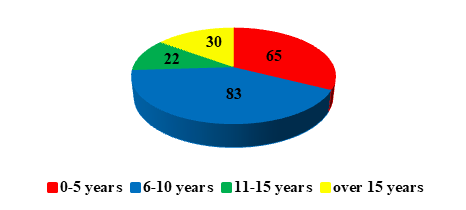
When the working time of the participants in institution A was examined, it was determined that 67.5% (135 people) of the total participants worked in the institution for more than 5 years (Figure 4). This is interpreted as an advantage in that most of the respondents are familiar with the positive and negative situations within the institution.
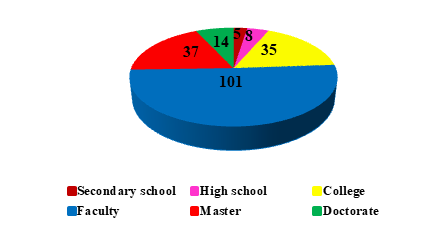
The graph drawn over the educational status of the respondents from institution A is given in Figure 5. When the graph is examined, it is seen that 93.5% (187 people) of the participants are associate, undergraduate, or graduate education graduates. This result gives rise to the idea that the educational status of the participants may contribute to their awareness of ergonomics.
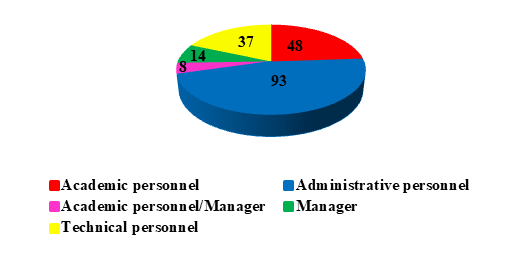
When the status of the respondents within institution A is examined, it is seen that the participant population is in a wide range (Figure 6). In addition, nearly half of the total number of participants are administrative personnel who spend almost all of their working hours in the office environment. This is an indication that this study was conducted for the right audience.
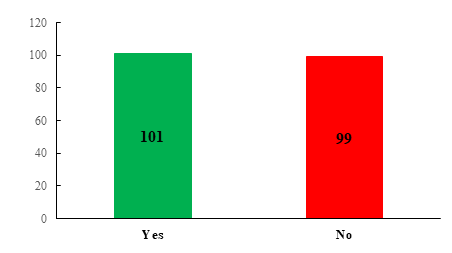
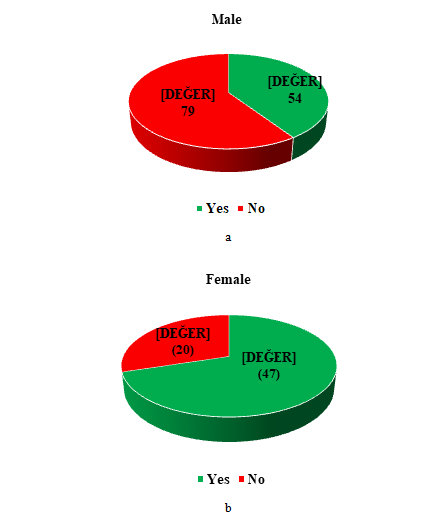
The answers of the participants in institution A to the question of whether they have heard of ergonomics before or not are almost equal as “Yes” or “No” (Figure 7). This result is below the expected “Yes” percentage. Another interesting statistic is that the “Yes” percentage of female employees who participated in the survey is much higher than that of male employees. While 70.15% of female participants stated that they had heard of ergonomics before, this rate remained at only 40.60% for male participants (Figure 8). Accordingly, it can be interpreted that the ergonomic awareness of the female participants in institution A may be higher than the male participants.
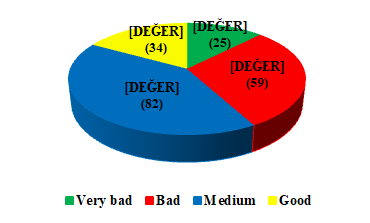
Participants in institution A were asked to evaluate their workplaces in terms of ergonomic designs. The data obtained according to the answers received are graphed in Figure 9. When the graph is examined, the rate of those who find the workplace “Good” in terms of ergonomics is only 17%. This result reveals that there is dissatisfaction throughout the institution.
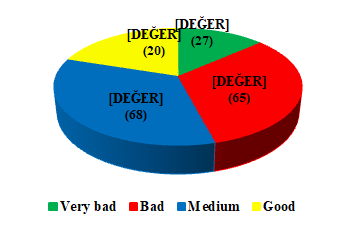
In the next stage, the personnel were asked to make an evaluation in terms of ergonomic improvements made or being made in their workplaces. The result obtained is close to the evaluation made in terms of ergonomic designs. Because the rate of those who describe the ergonomic improvements made or in progress as “Good” is only 20%. The data of this evaluation are also presented graphically in Figure 10.
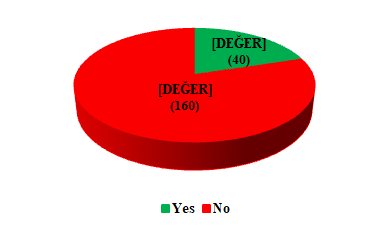
It was investigated whether the respondents in institution A had previously experienced any discomfort due to ergonomic factors in the workplace. According to the results obtained, the rate of those suffering from discomfort is 20% (Figure 11). Although this rate seems low compared to the total, it should be taken into account since the cause of discomfort is stated as ergonomic.
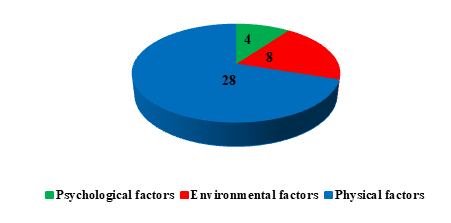
The reasons for the discomfort of 40 people who stated that they had discomfort due to ergonomic factors were investigated in more detail. According to the results of this research, it is seen that physical factors are more common (Figure 12).
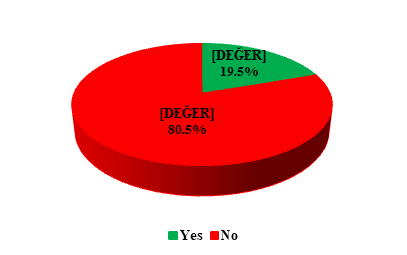
It was investigated whether the respondents in institution A received training on ergonomics and the results are presented in Figure 13. As can be seen from the graph, the rate of those who said “Yes” is 19.5%. This result is an indication that there is a lack of ergonomics training in the institution. At the same time, only 19 of 39 people who said that they received training on ergonomics stated that they applied what they learned in the training well in the office environment. This is also something that needs to be considered.
The same survey that was conducted with 200 office workers in institution A was applied to 28 office workers (15 Males, 13 Females) in institution B. 17 employees stated that they had heard of ergonomics before. This number corresponds to a rate of 60.71%. However, the rate of those who describe the workplace as “Good” in terms of ergonomic regulations is only 25%. The number of people who experience discomfort due to ergonomic factors in institution B is 6. 15 of the respondents stated that they had received training on ergonomics. There are 6 people who say that they apply the training well in the workplace. From this point of view, although those who say they have received training constitute 53.57% of the total participants, there is a significant deficiency in reflecting what was learned in the training into practice.
Conclusion
A survey was conducted on the science of ergonomics with 200 office workers in different job positions in institution A. The findings obtained from the research revealed that the level of ergonomics knowledge within the institution is insufficient. In addition, the participants declared that the institution is not in good condition in terms of ergonomic design and improvements. Another remarkable result is that 20% of the participants stated that they had discomfort due to ergonomic factors. Physical factors have been shown as the main cause of discomfort. The rate of those who stated that they received training in the science of ergonomics is 19.5%. This rate indicates a significant lack of education within the institution.
In the comparison study conducted with institution B, there is no significant difference between the institutions in question compared to institution A in terms of ergonomic awareness. There are important deficiencies in terms of the importance given to ergonomics, the training received/ given and the application of what is learned in the training in the workplace, as in institution A. As a result of all the research, it can be said that institution A does not have an institutional awareness of ergonomics. However, when the country in general and public institutions and organizations are evaluated collectively, it is a known fact that there are important deficiencies in terms of ergonomics. In parallel with this idea, the country must first create an occupational health and safety culture. An established occupational health and safety culture will bring ergonomic awareness. The important thing is to first realize the deficiencies and work diligently to make the necessary improvements.
As a suggestion, it is considered important to inform the office staff about the points to be considered in the use of computers and machinery equipment. In addition, it is thought that it would be beneficial to improve the office environment for the health of employers, institutions/ organizations, and employees, and to provide and increase the budget support, if any, in the supply of ergonomic tools and equipment.
References
-
Turan GO (2016) Evaluation of Ergonomic Risks in Office Work in Terms of Occupational Health and Safety, Master Thesis. Istanbul.
-
Tutar H (2000) Office Management Techniques in the Framework of Total Quality Management. Aktif Publishing House, Erzurum.
-
Simsek M (1994) Ergonomic Factors in Engineering, Marmara University Press, Istanbul.
-
Hasdemir GA (2013) Computer Aided Ergonomics and an Application Study, Master Thesis, Balıkesir.
-
Kaya S (2008) Ergonomics and its effects on employee productivity. R&D August Bulletin, pp: 25-35.
-
Zeyrek US (2012) Occupational Health and Safety in Offices. Institute of Occupational Health and Safety, Ankara.
-
(2022) What is Ergonomics? Ergonomics Examples.
- The Expanding Landscape of Road Rage: A Systematic Review of Conflicts Involving Drivers, Pedestrians, and Micromobility
- Validating Cognitive Models of Royal Navy Performance on Control Systems
- Comparing Standard and State-of-the-art Firefighter Coats on Postural Balance and Gait in a Live Burn Environment
- Investigating the Integration of Telemedicine into Clinicians Workflow: A Review of Methods
- Risk Assessment of Ergonomic Factors in a Textile Firm by RULA, REBA and Fine Kinney Methods
- Impact of Self-Esteem Training on Individuals with Disabilities Aged 17-30