
Product Innovation Possibilities by Designing the Smart Phone Exterior Outline Based on 3d Scans of the Hand Imprint
Much is happening in the innovation of smart phones. However, the physical form has still much room for improvement. In this study 3d scans of the hand imprint on a clay model are made and transformed into a smart phone exterior outline. The clay model was made by placing clay around a rectengular plate as clay alone would lead to rounded forms that are too far away from current smart phone models. Eleven participants made an imprint using the phone with one hand (right hand) and using the phone two handed. Of both imprints the average was taken and a 3d print was made. Also, a 3d print was made of a traditional phone of the same size. The comfort of these three 3d printed models was evaluated by 20 participants. The result was that the version based on holding the smart phone in the right hand showed more comfort related to the traditional smart phone of the same size. So, physical form adaptation is certainly an area to be studied in innovating smart phones.
Introduction
The Global Digital Report (2021) showed that mobile phone users has jumped to 66% of the world population in 2021. Smartphones have become a part of our daily lives. They are used for listening to music, watching a movie or series, texting, web browsing, checking email or travel time schedules [1]. In marketing and research much attention has been paid to optimizing the smartness, the systems and the mechanisms of smartphones to increase performance [2]. New versions of smartphones are often introduced in the market. However, not much innovation is focused on the exterior outline fitting to the human hand. There have been studies that show that the 90 mm wide smart phone results in more discomfort than the 60 mm wide and the medium sized smart phone with dimensions 138 x 70 mm x 8 mm is handy and preferred by the most mobile phone users [3]. These studies involve rectangular formed smart phones. However, the inside of the hand is not rectangular and it might be that an outline adapted to the inside form of the hand fits better and is more comfortable. 3D scanning technology offers many opportunities for product design to adapt products to the human body contour [4]. For instance in clothing design, there are 3d scans directly taken from humans influencing the shape of the clothing [5]. According to Apeagyei [5], with 3D body scanners the shape and size of a human body can be captured to further produce true-to-scale 3D body clothes models. However, this way of 3d scanning can not be used for smart phone design. To apply it to smart phone design the inside of the hand should be scanned, which is difficult as scanners can not reach all areas and the smart phone deforms the tissue, which is hard to record as well. There are also 3d scanning techniques, which measure indirectly the human contour, like did. They positioned humans in a rescue mat, fixated the rescue mat by deflating and scanned the imprint in the mat. This was an indication of the human body contour of buttock and back while seated and it was used to design a BMW car seat. Used this technique as well for designing a business class aircraft seat.
In this paper 3d scans of the human hand will be used to look for possibilities to adapt the smart phone exterior outline to the contour of the human hand. Also, indirect 3d scans are used. Two potential benefits might be achieved. One concerns reduction in discomfort, the other one might be better performance. Improving smartphone dimensions can reduce the grip discomfort [3]. There are indications in the literature that smart phone use could have an effect on health. Many smartphone users experience pain in the thumb/wrist [6]. Some researchers explain this by overuse of the Flexor Pollicis Longus tendon (FPL), overloading of the joints of the thumb and compression of the median nerve.
For right-hand pain the base of the thumb was the most common location with complaints. Researchers believe that hand-related injuries can be minimized with proper ergonomic design. When using a smart phone, it is common to hold the thumb in a flexed position of up to 90° at the interphalangeal joint [7].. For patients who have arthrosis of the interphalangeal joint, this position might be difficult [7]. So, it is worthwhile exploring a new ergonomically shaped smartphone. It might certainly not solve all pain problems, but at least it could reduce discomfort. The performance part is described as well. For instance, a study of Lee SC, et al. [8]. Showed that increasing width of a smart phone and decreasing bottom bezel lead to difficulties in performing touch behavior, which shows that form has effects on performance. Regarding the form concluded that phone width is a significant factor in grip comfort and design attractiveness, based on an empericle study. They conclude that the dimensions of 140 mm × 65 mm × 8 mm (close to the previous mentioned size) and 2.5 mm edge roundness are recommended. However, the average dimensions of the most sold smart phones in 2018 are: 152.9 x 74 x 8.2 mm (https://www.gsmarena.com/2018_half_year_report- news-31939.php) and the most sold smart phone of 2021 has the dimensions: 164 x 75.8 x 8.9 mm, which are different from the proposed values also used rectengular shapes with a rounded edge. The question is whether this rectengular shape fits best with the hand. Therefore in this study we explore whether an adjusted rectengular outline based on 3d scans might be more comfortable and has potential to be studied further.
The research question of this study is: Is an adjusted exterior outline of a rectengular formed smart phone based on 3d scans of the inside of the hand more comfortable than the current most used rectengular form?
Method
To answer the research question the inner form of the hand holding a smart phone was determined by 3d scanning of 11 participants (age varied between 24 and 65 years old, 6 male and 5 female). Persons were selected to have a large range of hand sizes. The dimensions of the hand of these 11 participants were measured. The different parts of the hand (finger length etc) were defined following the procedure described by Rhiu, et al. [9]. The hand size of the whole hand was recorded as described by Choi, et al. [10]. A clay layer was placed around a hard plastic rectengular formed object (114.8 mm x 50.6 mm x 3mm). In a pilot study only clay was used, but the form of the clay than becomes more round like a handle, which did not look like a smart phone anymore. To prevent this, the hard plastic rectengular plate was used. Around this plate a layer of clay was used with the dimensions 152 x 75 x 9 mm and subjects were asked to hold this plate with clay around it as if they were using their smart phone. Subjects are asked to use the smart phone with the right hand (the thumb imitating texting). They were also asked if there are areas with discomfort holding the clay (put a red cross in the handmap of fig. 1) and areas of comfort.
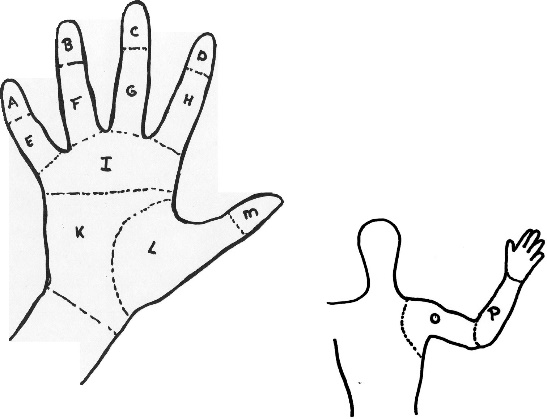
This indented clay model was kept aside. Then they were asked to use a new clay model with two hands simulating texting with the thumbs. There are many possible postures for people holding smartphones, such as double-hand and single-hand holding. The smart phones are used for many activities such as texting, playing games or listening to music [1]. Udomboonyanupap, et al. [1] also showed that the right hand and double hand (texting with thumbs) are used mostly for texting. That is why these positions were selected. The participants were seated and had the smart phone in the position the participants prefered. Also for the double handed texting the 11 participants were asked to point areas with discomfort and comfort. Made an overview of all comfort related questionnaires and advises for hand comfort research the map shown in Figure 1.
The in total 22 clay models were scanned using the 3d scanner (Artec EVA). The clay model was placed on a holder, holding the model on one side. Than it was scanned again placed upside down on the holder and the scans were merged into one. The digital scans were preprocessed. Unwanted parts were removed and misaligned areas were seperated. The CAD software (Artec Studio) was used for this and to mesh the data. As different scans have different meshes of the clay, these were made exactly the same by using the wrap3 software. The files of the scans were than uploaded in the software package ‘paraview’, which has a function to compute the averages of a limited number of scans dependent on the size. In our case after a tryout it was possible to make three averages of the scans. Therefore, first three categories were made:
- With rather deep impressions in clay,
- With more impression at the bottom part and
- With the sides rather straight when the participants do not touch the sides.
This was done for the right handed and double handed clay models. The average of these three groups was calculated in paraview. Then this 3d model was adapted to make it suitable for 3d printing. Additionally, a digital model of the dimension mentioned above was 3d printed (152 x 75 x 9 mm), which is called the traditional from now on. A 3d print was made of all three models: the traditional, the final digital model of the phone holding it in the right hand and the digital model holding it in both hands.
Twenty participants were asked to hold four times these 3d printed phones.
The instruction was to hold the traditional one with two hands and in the right hand and the ‘right hand phone’ in the right hand and the ‘double hand phone’ with two hands. While holding the phone they were asked to give a comfort score: 1-10, 1 being not comfortable at all and 10 extremely comfortable for all four conditions. Then they were asked to hold the right hand printed version and the traditional right handed and they were asked to put red crosses on a hand map (Figure 1) where they feel discomfort and green crosses where it felt nice compared with the traditional one. The same was done holding the double handed version and holding the traditional double handed. The hand width and length were recorded as described by Choi, et al. [10]. Also, the participants were asked to give comments after the test.
Results
The handsize and parts of the hand of the eleven participants are described in Table 1.
| Average left (mm) | Standard deviation | Average right (mm) | Standard deviation | |
|---|---|---|---|---|
| little finger length | 58.6 | 5.64 | 58 | 5.85 |
| ring finger length | 72.3 | 6.13 | 71.5 | 5.77 |
| middle finger length | 79 | 5.08 | 78.2 | 4.71 |
| index finger | 72.5 | 5.39 | 72 | 5.62 |
| thumb finger length | 65 | 7.19 | 64.9 | 7.19 |
| hand length | 180 | 11 | 180 | 10.46 |
| Hand width | 79.9 | 11.38 | 79.4 | 10.89 |
Table 1: Dimensions of handsize and parts of the hand of the eleven participants used for designing the new form.
| Areas of comfort right hand | Areas of discomfort right hand | Areas of comfort two hands | Areas of discomfort two hands | |
|---|---|---|---|---|
| AE | L | AE | L | |
| MH | L | MH | L | |
| BFCGDHI | LI | BFCGDHI | LI | |
| L | AEL | L | AEL | |
| CGI | H | CGI | H | |
| ABC | L | ABC | L | |
| L | DHAEL | L | DHAEL | |
| LD | CGI | |||
| L | ABC | |||
| EFG | L |
Table 2: Areas of comfort and discomfort reported while holding the 3d clay model.
The idea was that areas with much discomfort or comfort needed maybe more attention. However, the areas vary a lot (Table 2).
Using the traditional smart phone in the right hand resulted in 8 times discomfort in the L region. So, thenar rounding needs attention in making the 3d print and 7 times the region L was mentioned most for discomfort (7 out of 11), which means that also for the double handed version the thenar region needs attention. The 11 clay models are shown in Figure 2.
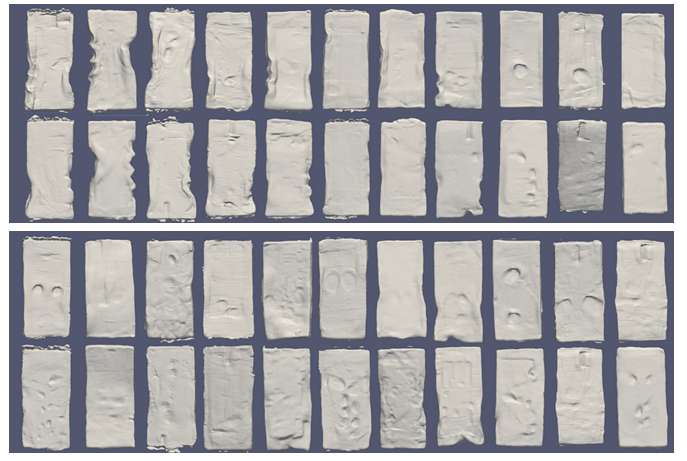
The scans had 66450 cells for each phone and with paraview the average shape was made based on these dots as described in the method.The 3d printed model of the right hand and of the model holding it with two hands and the traditional phone are presented in Figure 3.
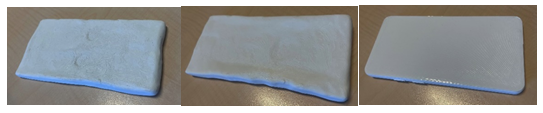
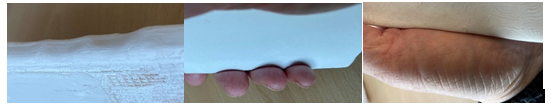
The deepest indents of the figers were 1 mm for the ring finger at the right handed smart phone (see fig 4). This had a 2.5 mm edge roundness at that area. The double handed print had maximal 0.6 mm indents at the thenar region (see fig 4) and roundness of 1.1 mm.
In Table 2 and Table 3 the comfort scores are shown for the three 3d printed smart phones (20 new participants were selected, average hand length 177mm (SD 11.6); average hand width 78.3 mm (sd 6.32). The comfort is significantly better (p<.05) for the right hand 3d printed smart phone than for the 3d printed traditional version (Wilcoxon paired test; z is-3.30; p-value is .001). For the double handed 3d version the comfort is not significantly different (p<.05) than for the 3d printed traditional version (Wilcoxon paired test; z is -1.41; the p-value is .156). For comfort of the right handed new 3d smart phone the most scored areas are in the fingers (FBGH) and thenar (L). Regarding discomfort holding the traditional smart phone in the right hand the little finger (E), palmar (K) and thenar (L) regions are mostly mentioned Figure 4 and Table 4.
| Right hand | |||||
|---|---|---|---|---|---|
| Comfort (1-10) New 3d | Comfort (1-10) Traditional | Comfort 3d | Comfort Trad | Discomfort 3d | Discomfort Trad |
| 8 | 7 | L | - | - | LIK |
| 7.5 | 6.5 | FG | CG | E | EA |
| 6 | 5 | - | LM | AE | - |
| 7 | 8 | ABEF | M | C | ABCH |
| 9 | 7 | ABCEFGH | ABC | M | KM |
| 8 | 6 | EFGH | - | - | - |
| 7 | 4 | KEFGH | K | G | M |
| 7.5 | 6.5 | EFGHL | - | - | EFL |
| 8 | 6.5 | ABCDKI | LMI | L | KEFGH |
| 8 | 6 | HI | ABCD | E | H |
| 7 | 5 | ABMLI | AB | - | LIEFCD |
| 7 | 8 | KI | E | - | |
| 6 | 4 | BCDFGH | ABCD | EA | MAKE |
| 8 | 7 | EFGH | - | L | L |
| 5 | 3 | KLB | - | I | KLI |
| 8 | 7 | ABCL | BCD | D | - |
| 9 | 8 | MLEFGH | ABCD | ABCDK | DEFGHK |
| 7 | 8 | M | ABCD | L | L |
| 8 | 5 | KLB | EFGH | EFGHABC | KLI |
| 9 | 7.5 | CMDL | MD | C | EFG |
| Avg 7.5 | Avg 6.25 | 75x | 39x | 28x | 48x |
Table 3: Comfort and discomfort scores for the 3d printed and traditional smart phone holding it in the right hand.
| Two hands | |||||
|---|---|---|---|---|---|
| Comfort 3d | Comfort Traditional | Comfort 3d | Comfort Trad | Discomfort 3d | Discomfort Trad |
| (1-10) | (1-10) | ||||
| 7 | 8 | CD | - | EFGH | AEI |
| 7 | 6.5 | H | - | B | HIF |
| 7.5 | 5 | A | H | - | DCEA |
| 7 | 8 | BCD | M | EA | AB |
| 9 | 7 | I | ABC | M | L |
| 6 | 7 | - | - | - | - |
| 7 | 4 | KL | - | M | LM |
| 8.5 | 7.5 | LMDC | - | K | ABEF |
| 7.5 | 7.5 | MD | C | - | L |
| 8.3 | 6.8 | EFGHA | - | CD | AEI |
| 6 | 5 | ABMLI | - | - | AE |
| 5 | 7 | EFGHABCD | ABCD | M | EFGH |
| 5 | 4 | AE | - | BCD | KL |
| 7 | 8 | - | - | MK | K |
| 4 | 5 | M | M | ABCD | KIL |
| 8 | 7 | H | K | M | - |
| 7.5 | 7 | LM | ML | ABCD | EFGH |
| 6.5 | 5 | GH | C | - | EFGH |
| 7 | 7 | EFGHILM | EFGHML | K | K |
| 8 | 7 | LMD | D | FA | FA |
| Avg 6.94 | Avg 6.46 | 52x | 22x | 30x | 46x |
Table 4: Comfort and discomfort scores for the 3d printed and traditional smart phone holding it with two hands.
For holding the smart phone with two hands the 3d printed version showed comfort in the regions of the thumb (L) pointing finger (DH) and thenar (M). The discomfort while holding the traditional smart phone with two hands was especially found in the little finger (AE). From the comments of the 20 participants experiencing all 3d printed phones, 18 out of 20 gave the comment that they liked the finger indents on the side where there is room for the fingers. Also, the overall shape was appreciated of the right hand smart phone. The traditional was appreciated as well as this is the one they are used to. Two persons even didn’t want to have the new one, but these still mentioned they like the finger indent with room for the fingers. One very small handed female prefered the two handed phone anyhow, also the 3d printed version based on the scans for two hands was prefered above the traditional phone.
Discussion
This exploratory study shows that an adjusted physical form can increase comfort and is an innovation worthwhile exploring further. The indented rectengular form smart phone with rounded edges based on 3d scans feels more comfortable than the current most used rectengular form when holdig the phone with the right hand. However, it was not a smart phone in use. It is just the first impression of feeling the form. It is just the first impression and further research is needed to study whether even long term effects could be found in real use.
The finger indent principle, which might contribute to the comfort, is not new [11]. Presented improved tool handle diameters with space for the index and middle finger indentations. However, indentations can also limit the use of a hand held device [12]. Indentations can be restrictive to change the grasp and large hands and smaller ones might need other indentations. In our case all 20 participants prefered the indentations, while there was some spread in the hand sizes. This could be because the identations were not that deep, which might have supported the result. Also, the roundness of the edges could have contributed to the comfort experience also report that a 2.5 mm edge roundness is recommended for the smart phone. The number of participants in this study is limited. This might have influenced the shape. Allthough adding more extreme large and small hands would probably not have changed the average that much, also because the indent is only 1 mm. The number of people testing the new form is limited as well. However, a significant difference was found. It shows the potential for taking the human hand contour into account in designing smart phones. Using the human contour in design has been done before and resulted in for instance comfortable car seats and clothing [13]. Now participants did hold the smart phone just a few minutes in the comfort testing, while long term testing is prefered with a functioning smart phone. However, than a full functional smart phone should be made, which is outside the scope of this paper. Only the shape is tested, while there are many other issues in using a smart phone.
Region L (the thenar) was an issue in the traditional phone, there was no focus on redesigning for this region. However, this region was less of an issue in the new 3d printed form as less people mention discomfort in this region L (only 3 out of 20 (15%); while it was 9 out of 11 (82%) in the traditional phone. Seven participants even mention comfort in the region L in the right handed situation. As was mentioned especially the right handed 3d printed phone was appreciated. Probably there is more to gain in using the smart phone with one hand [14]. Show that smartphone operation with one hand caused greater pain and induced increased upper extremity muscle activity, which might show that two handed use is preferable. Maybe therefore we gained more effect in the right handed version. A challenge is of course combining both scans (double handed and one handed) as it is hard to predict how the smart phone will be used. The rounded edges seems to be preferable which has been mentioned before in the literature [15]. And maybe some form of light indentation.
Conclusion
In this paper the innovation of smart phones is discussed from a new perspective: changing the physical form. 3d scans of the hand imprint were used to make a model of a smart phone that fits to the hand imprint. This model was 3d printed and tested again with new participants. The result was that the version based on holding the smart phone in the right hand showed an significant increase in comfort compared with a traditional smart phone form of the same size. The version based on holding the smart phone with two hands showed improvement in some regions of the hand compared with the traditional smart phone of the same size. The tests were performed holding 3d printed smart phones, which did not function. Further research is needed holding a functioning smart phone for a longer time, but the potential of adaptation to the inside form of the hand is shown in this paper.
References
-
Udomboonyanupap S, Boess S, Monteiro LR, Vink P (2021) Comfort and discomfort during smartphone use on a bed.
-
Jewell S (2011) Productivity via mobile phones: Using smartphone in smart ways. Journal of Electronic Resources in Medical Libraries 8(1): 81-86.
-
Chowdhury A, Kanetkar M (2017) Determination of most preferred mobile phone size based on hand anthropometry and mobile handiness. International Conference on Research into Design 1: 195-204.
-
Lee W, Lee B, Kim S, Jung H, Jeon E, et al. (2015) 3D scan to product design: Methods, techniques, and cases. In Proceedings of the 6th International Conference on 3D Body Scanning Technologies, Lugano, Switzerland.
-
Apeagyei P (2010) Application of 3D body scanning technology to human measurement for clothing Fit. International Journal of Digital Content Technology and its Applications 4(7): 58-68.
-
Baabdullah A, Bokhary D, Kabli Y, Saggaf O, Daiwali M, et al. (2020) The association between smartphone addiction and thumb/wrist pain A cross sectional study. Medicinal Baltimore 99(10): 19124.
-
Yao J, Park MJ, Davis D, Chang J (2012) Ideal position for thumb interphalangeal arthrodesis in the era of smartphones and text communication. Orthopedics 35(11): 955-957.
-
Lee SC, Cha MC, Hwangbo H, Mo S, Ji YG (2018) Smartphone form factors: Effects of width and bottom bezel on touch performance, workload, and physical demand. Applied ergonomics 67: 142-150.
-
Rhiu I, Kim W (2019) Estimation of stature from finger and phalange lengths in a Korean adolescent. Journal of physiological anthropology 38(1): 1-8.
-
Choi HS, Choi YH (2015) Accuracy of tablet counts estimated by members of the public and healthcare professionals. Clinical and experimental emergency medicine 2(3): 168-173.
-
Garneau CJ, Parkinson MB (2012) Optimization of product dimensions for discrete sizing applied to a tool handle. International Journal of Industrial Ergonomics 42(1): 56-64.
-
Serrano M, Finch J, Irani P, Lucero A, Roudaut A (2022) Mold-It: Understanding how Physical Shapes affect Interaction with Handheld Freeform Devices, pp: 1-14.
-
Wang Z, Zhong YQ, Chen KJ, Ruan JY, Zhu JC (2014) 3D human body data acquisition and fit evaluation of clothing. Advanced Materials Research Vols 989-994: 4161-4164.
-
Lee M, Hong Y, Lee S, Won J, Yang J, et al. (2015) The effects of smartphone use on upper extremity muscle activity and pain threshold. Journal of physical therapy science 27(6): 1743-1745.
-
Lee S, Kyung G, Lee J, Moon SK, Park KJ (2016) Grasp and index finger reach zone during one-handed smartphone rear interaction: effects of task type, phone width and hand length. Ergonomics 59(11): 1462-1472.
- The Expanding Landscape of Road Rage: A Systematic Review of Conflicts Involving Drivers, Pedestrians, and Micromobility
- Validating Cognitive Models of Royal Navy Performance on Control Systems
- Comparing Standard and State-of-the-art Firefighter Coats on Postural Balance and Gait in a Live Burn Environment
- Investigating the Integration of Telemedicine into Clinicians Workflow: A Review of Methods
- Risk Assessment of Ergonomic Factors in a Textile Firm by RULA, REBA and Fine Kinney Methods
- Impact of Self-Esteem Training on Individuals with Disabilities Aged 17-30