
Attitude and Knowledge of Voluntary Non-Remunerated Blood Donation among Clinical Medical Students in a Tertiary Institution in North-Central Nigeria
Background: Blood transfusion is an important component of the management of patients with various medical and surgical conditions. Blood is scarce and the efficiency of blood transfusion service relies on the availability of safe blood from voluntary non-remunerated donors. Medical students can serve as models to inculcate the habit of blood donation among other students and be a steady pool of voluntary blood donors. This study was to assess the knowledge, attitude, and practice of voluntary blood donation among clinical medical students in a private tertiary institution in the North-Central Zone of Nigeria. Methods: This was a descriptive cross-sectional study involving the clinical students of Bingham University Jos, Nigeria. Selfadministered structured questionnaires were used to collect the data. Data were analyzed using SPSS version 25. Results: A total of 304 clinical students participated in the study. The mean age of the respondents was 22.9 years with a standard deviation of 2.3years. Female participants were 163 (53.6%). Most of the respondents 206 (67.8%) had good knowledge of blood donation. The majority 254 (83.6%) of respondents had a good attitude toward voluntary blood donation. Most 226 (74. 3%) responded positively towards voluntary blood donation; however, only 98 (32. 2%) had ever donated blood. Most of the respondents who donated blood did it just once 62 (20.3%). The commonest reason for inertia to voluntary blood donation was fear of dizziness and fainting attacks 106 (34.9%). Many of the respondents would be motivated to donate blood if drinks 155 (51%) and food 151 (49.7%) were offered. There was a significant association between knowledge of blood donation and the participants’ gender (p = 0.038), class in medical school (p = 0.001), and their attitude (p = 0.001) to voluntary non-remunerated blood donation. Conclusion: The medical students had good knowledge and a good attitude toward voluntary non-remunerated blood donation. Although the majority expressed a good attitude towards voluntary blood donation, the practice was poor. Increased awareness and education about voluntary blood donation among medical students can increase the number of voluntary blood donors in Nigeria. In addition, the provision of food and drinks in blood donation stations can serve as motivation for voluntary blood donors.
Introduction
Blood transfusion is an important component of the management of patients with various medical and surgical conditions [1]. Blood transfusion has contributed to saving lives in various routine and emergency situations. Blood is scarce; and thus every country should strive for an efficient blood transfusion service to make safe blood accessible, affordable, and available in sufficient quantity. The World Health Organization (WHO) recommends that in order to meet a nation’s minimum requirement for blood, 1% of the population is recommended to donate blood yearly [2]. In Nigeria with a population of 217,000,000 [3], an estimated 1,239,000 units of blood are collected each year [4]. This is approximately 0.57% of the present population. The demand for blood exceeds the supply. The WHO and the International Federation of Red Cross and Red Crescent Societies (IFRC) through a publication on the global framework for an action committed to achieving 100% voluntary blood donation in all countries [2].
The existing government institution in Nigeria, the National Blood Transfusion Service (NBTS), was changed to the National Blood Service Commission (NBSC) through a legal mandate of NSBC Act 2021 to strengthen the responsibility of regulating and providing affordable, adequate safe blood and products through Voluntary Non- Remunerated Blood Donors (VNRBD) across the country [4].
There are three types of blood donors; VNRBD, family/ replacement, and paid donors [2]. Blood donation by VNRBD is out of altruistic reason with no financial inducement. They are the safest donors and have reduced chances of Transfusion Transmissible Infections (TTI) [5, 6]. Family / Replacement donors donate blood for family members, associates, or the community. It is common in Nigeria due to the strong extended family system and saves the cost of paying for blood [7]. The prevalence of TTI among family replacement donors is found to be higher than VNRBD [2, 8]. Paid donors donate blood for financial gain and other benefits. They are adjudged the worst blood donors for low blood quality and highest rate of TTIs [8].
According to the NBSC, 90% of blood collected in Nigeria is from paid commercial donors, with less than 5% from voluntary donors [4]. Statistics have shown that in Nigeria, unsafe blood transfusion accounts for the second largest source of HIV infection among the infected individuals [9]. The NBSC seeks to reduce blood-borne infections like HIV, Hepatitis B and C, Syphilis, and others by emphasizing VNRBD in Nigeria. In order to achieve 100% voluntary blood donation and sustainability of National blood supplies, the NBSC should consider medical students as a source of voluntary blood donors.
Medical students, particularly clinical students, by virtue of their training should be more informed about the benefits of voluntary blood donation. Therefore, they can serve as models to other undergraduates and their communities with regard to blood donation. Understanding the perspective of medical students as voluntary blood donors would provide a basis to select the most effective means of reaching them. This study is aimed at assessing the attitude and perspective of voluntary blood donation among clinical students at Bingham University Jos Nigeria with a view to recruiting them as regular voluntary blood donors.
Materials and Methods
This study was carried out among clinical students during their posting in Bingham University Teaching Hospital, under the College of Medicine and Health Sciences, Bingham University. A cross-sectional analytical study was conducted. The number of clinical students at Bingham University was 320 at a given time. A total of 304 students participated in this study, giving a response rate of 95.0%.
Data was collected over four weeks between February and March, 2021. A Participant Information Sheet (PIS) containing details of the study and a consent form were distributed to all the clinical students and only those that consented to participate in the study were recruited. A modified self-administered structured questionnaire used in some previous studies was given to students that consented [10, 11, 12, 13, 14, 15]. The study questionnaire contained the participants’ sociodemographic characteristics in Section A. The section B of the questionnaire had questions on the participants’ knowledge of blood donation whereas section C had questions on their attitude toward blood donation. The participants’ practice of blood donation was contained in section D. Sections E and F of the questionnaire had questions on inhibitory and motivational factors for blood donation respectively.
Data Analysis
Data obtained was analysed using the IBM Statistical Package for Social Sciences (SPSS) version 25.0. The participants’ ages were grouped into two based on the average of their ages; less than/equal to 22 years and more than/equal to 23 years. The participants’ class in clinical posting was divided based on their time of entry into the clinical arm of the University into; Class I was the youngest clinical students, class IIB was the next, class IIA was older, and class III was the oldest set in the clinical posting. Their level of knowledge was grouped into two using the questions on knowledge of blood donation. There were twenty (20) questions assessing the knowledge of blood donation. Correct responses were awarded one point and incorrect responses/ I don’t know were awarded zero points, these scores were summed up and converted into a percentage scale using the formulae int 20(max ) total number of po for yes imumobtainablescore x 100%. Levels of knowledge were categorized as poor (<50%) and good (≥ 50%). Similarly, the participants’ attitude toward blood donation was grouped into poor (<50%) and good (≥50%) attitude using the 10 questions assessing attitude as scores were summed up and converted into a percentage scale using the formulae int 10(max ) total number of po for yes imumobtainablescore x 100%. The descriptive analyses were expressed as frequencies and percentages, and charts. Chi-squared test was used to determine the association between the sociodemographic characteristics of the participants with attitude to blood donation and their knowledge of blood donation. The level of statistical significance was set at a p-value of < 0.05.
Ethical Consideration
Ethical approval to conduct this study was obtained from the Health Research Ethics Committee of Bingham University Teaching Hospital, Jos. The Participants’ Information Sheet (PIS) contained information about the study and the researcher’s contact details so that participants could contact the researcher if needed. The nature and purpose of the study were explained to the participants before recruitment into the study. Participants were also informed that they could withdraw from the study at any point without any repercussions. Informed written consent was obtained from the participants. Confidentiality and anonymity of the participants were ensured by removing any identification on the questionnaires and storing the data securely. Data will be kept for five years in a password-protected computer.
Results
A total of 304 medical students participated in the study. There was a female preponderance of 163 (53.6%). The mean age of the participants was 22.9 years with a standard deviation of 2.3 years. Many of the participants 171 (56.3%) were less than 23 years. Most of the participants were not married 297 (97.7%). The participants’ socio-demographic characteristics are shown in Table 1.
| Characteristics | Frequency (n = 304) | Percentage (%) |
|---|---|---|
| Age group (years) | ||
| < 22 | 133 | 43.8 |
| > 23 | 171 | 56.3 |
| Gender | ||
| Male | 141 | 46.4 |
| Female | 163 | 53.6 |
| Class | ||
| Class III | 72 | 23.7 |
| Class IIA | 56 | 18.4 |
| Class IIB | 103 | 33.9 |
| Class I | 73 | 24 |
| Marital status | ||
| Single | 297 | 97.7 |
| Married | 7 | 2.3 |
| State of origin | ||
| Kogi | 39 | 12.8 |
| Plateau | 26 | 8.6 |
| Benue | 22 | 7.2 |
| Kaduna | 21 | 6.9 |
| Imo | 20 | 6.6 |
| Edo | 19 | 6.3 |
| Anambra | 19 | 6.3 |
| Others | 138 | 45.4 |
Table 1: Distribution of the socio-demographic characteristics of the study participants.
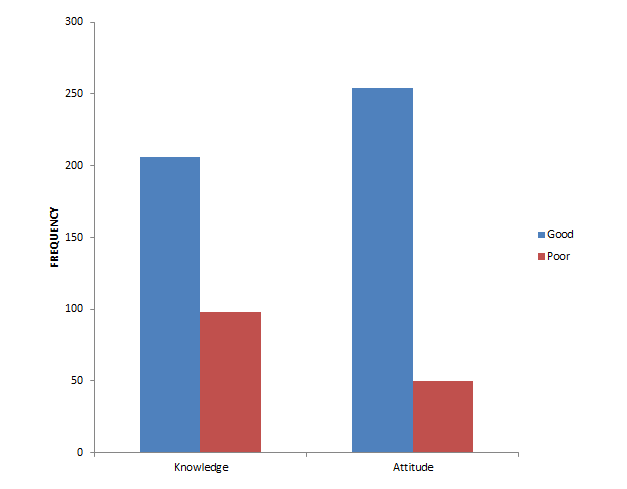
Many, 206 (67.8%) participants had good knowledge of voluntary blood donation. Most 254 (83.6%) of the participants had a good attitude toward voluntary blood donation. Figure 1 shows the distribution of the participants’ knowledge and attitude to blood donation.
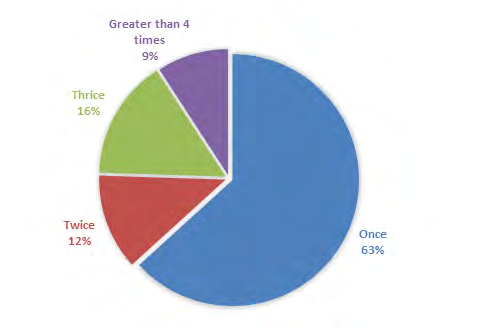
Pertaining to practice, while 226 (74.5%) responded positively to voluntary blood donation, only 98 (32.2%) had ever donated blood. Most of the participants who donated blood did it just once 62 (20.3%) whereas 37 (12.2%) had donated blood 2-5 times in their lifetime. Among those who donated blood, 11 (3.6%) were paid for the donation, 42 (13.8%) donated blood for friends or family members, and 48 (15.8%) donated blood voluntarily without any inducement. Table 2 shows the distribution of the practice of voluntary blood donation by the participants and Figure 2 shows the number of times the participant donated blood.
| Variables | Frequency (Percentage) | ||
|---|---|---|---|
| Yes | No | Do not know | |
| 1. Have you ever donated blood | 98 (32.2) | 206 (67.8) | 0 (0.0) |
| 2. Are you willing to donate blood voluntarily | 226 (74.3) | 32 (10.5) | 46 (15.1) |
| 3. Have you donated blood up to 2-5times | 37 (12.2) | 264 (86.8) | 3 (1.0) |
| 4. Are you scared of donating blood | 94 (30.9) | 193 (63.5) | 17 (5.6) |
| 5. Do you agree that money should be paid to blood donors | 59 (19.4) | 197 (64.8) | 48 (15.8) |
| 6. Have you donated blood for a relative | 18 (5.9) | 286 (94.1) | 0 (0.0) |
| 7. Have you donated blood for a friend | 24 (7.9) | 279 (91.8) | 1 (0.3) |
| 8. Have you ever been paid for donating blood | 11 (3.6) | 289 (95.1) | 4 (1.3) |
| 9. Have you ever donated blood in an organizational activity | 48 (15.8) | 255 (83.9) | 1 (0.3) |
| 10. Have you ever donated blood at a blood donation drive | 29 (9.5) | 271 (89.1) | 4 (1.3) |
| 11. Have you ever been influenced by peer pressure to donate blood | 21 (6.9) | 278 (91.4) | 5 (1.6) |
Table 2: Distribution of the practice of voluntary blood donation by the participants.
Table 3 shows reasons for inertia to voluntary blood donation. The diverse reasons given for not donating blood included fear of dizziness and fainting attacks 106 (34.9%), fear of needles 88 (28.9%), never been asked to donate blood
86 (28.3%), suspicion of sale of donated blood by blood bank staff 63 (20.7%) and fear of losing strength and not cope with academics 50 (16.4%).
| Variables | Frequency (Percentage) |
|---|---|
| I am afraid of needles | 88 (28.9) |
| I am afraid of discovering disease like hepatitis and HIV during the screening for infection | 36 (11.8) |
| I have not been asked to donate | 86 (28.3) |
| I do not have enough blood to spare | 34 (11.2) |
| I do not have time to donate | 48 (15.8) |
| My religion forbids it | 5 (1.6) |
| I am afraid of losing strength and would not cope with my academics | 50 (16.4) |
| Blood bank sell collected blood | 63 (20.7) |
| I am not medically fit to donate | 28 (9.2) |
| I may not be able to donate for my friends /relatives when needed | 15 (4.9) |
| The blood could be used for witchcraft and diabolical things | 7 (2.3) |
| I do not know where to go and donate | 17 (5.6) |
| Negative attitude of health workers discourages me | 49 (16.1) |
| I am afraid of dizziness and fainting attack | 106 (34.9) |
Table 3: Distribution of the reasons for inhibition to voluntary blood donation.
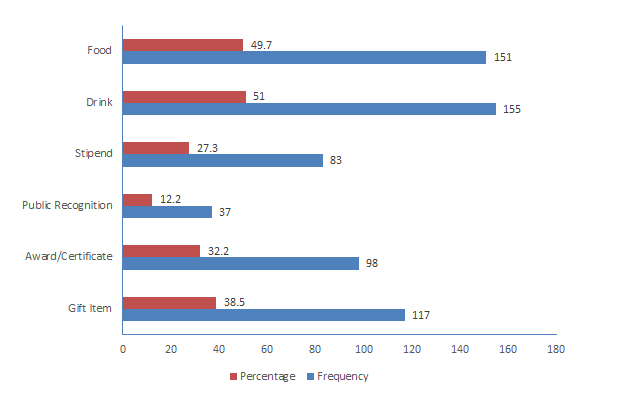
The commonest motivational factor toward blood donation cited by participants included the provision of soft drinks 155 (51%) and food 151 (49.7%). The details of the perception of motivation for blood donation are shown in Figure 3.
From Table 4, knowledge of blood donation was significantly associated with the participants’ gender (p = 0.038), their class in medical school (p = 0.001), and their attitude (p = 0.001) toward blood donation. The proportion of males (73.7%) with good knowledge was significantly higher compared to their female counterparts (62.6%). The medical students in higher classes had significantly more proportions (65.3%, 80.4%, and 77.7%) of students with good knowledge than those in a lower class (46.6%). Also, the participants with a good attitude and good knowledge (72.1%) were significantly higher than their counterparts (46.0%).
- Variables
- Knowledge
- Chi-square value, X2 p-value
- Poor
- Good
- Age group (years)
- < 22
- 49
- 84
- 2.296
- 1.13
- > 23
- 49
- 122
- Gender
- Male
- 37
- 104
- 4.328
- 0.038*
- Female
- 61
- 102
- Class
- III
- 25
- 47
- 23.89
- 0.001*
- IIA
- 11
- 45
- IIB
- 23
- 80
- I
- 39
- 34
- Attitude
- Poor
- 27
- 23
- 12.975
- 0.001*
- Good
- 71
- 183
Table 4: Association between the participants’ knowledge of blood donation and their socio-demographic characteristics with
Discussion
The establishment of the NBSC is a prerequisite for the achievement of 100% VNBD. Recruitment of consistent voluntary blood donors is important to achieve this goal. Every year, fresh medical students are admitted into various universities in the country. Medical students will be an important source of blood donors and through long-term commitment; they can donate blood regularly to maintain a safe blood supply for the nation. Part of the curriculum of medical school deals with blood donation, thus, they are better educated to develop a strong blood donation culture. This would influence other students in the university and the community to imbibe voluntary blood donation practices.
The mean age, 22.9 years, of the participants in this study, is similar to that observed by other studies on voluntary blood donation in Nigeria [10, 11, 12]. However, it differs from the study conducted in Benin City, Nigeria where the most prevalent age group was 25 to 29 [13]. Perhaps, the reason for this may be that the current mean age of entry into tertiary institutions is lower now compared to what it was some years ago. The population in this study was made up of young people and would form a large pool of blood donors in line with the Zimbabwe model of club 25 [14].
This study involved more females than males. This is different from findings from studies conducted in other parts of Nigeria [10, 11, 12]. The reason might be that the institution of the present study was a private institution compared to others that are public and more females are enrolled in the institution. Despite having more females in the study, their knowledge, attitude, and practice of blood donation fared lower than males.
In this study, many (67.8%) participants had good knowledge of voluntary blood donation. This however did not translate to good donation practice by 32.2% of the participants. This is similar to the finding of the study conducted by Ugwu, et al. and Oghoghodo, et al. who reported good knowledge about VNBD among the students [11, 12]. This is however not the case in Lagos, Nigeria where there was poor knowledge among the participants [10]. The reason may be that medical students receive lectures on blood transfusion. All the students who participated in this study were clinical students who had been or were being taught Haematology and Blood Transfusion. The study in Lagos was carried out on students who were not medical students. The significant relationship between the participants’ class and their knowledge of blood donation might be because they were at different levels of undergoing lectures in Haematology and Blood Transfusion during the period of their clinical posting. It is commendable that the participants in this study had a good knowledge of blood donation. Consolidation in further education will help to dispel superstition and cultural beliefs that hinder blood donation. The students can then give the right information on blood donation to other undergraduates to recruit more blood donors. The study found a significant relationship between knowledge about voluntary donation with gender, the participants’ class in clinical posting, and their attitude to voluntary donation.
Most participants (83.6%) had a good attitude toward blood donation. This was similar to the findings in previous other studies [10, 11, 12, 13]. Many participants expressed their willingness toward blood donation however, only 32.2% had ever donated blood. The findings of this study suggest that good education, positive attitude, and expressed willingness to donate blood do not translate to actual blood donation. The poor attitude toward blood donation has been reported in similar previous studies in Nigeria [10, 11, 12, 13]. This was different from the study that was done in South-East Nigeria among medical and pharmacy students where 59.5% had donated blood [15]. Good education and enthusiasm alone are not sufficient to invoke a strong conviction for the act of blood donation. A systemic thinking model should be constructed and adopted to increase voluntary blood donation [16]. It is a holistic approach that involves all the parts of the system in blood donation rather than concentrating on an aspect such as education.
Most of the blood donors were voluntary blood donors 15.8% followed by donations for relatives and friends 13.8% and paid donors 12.2%. It is interesting to note that a few of the participants among medical students were paid donors. This further buttresses the statistics that most blood donors in Nigeria are commercial donors [4]. There is a need for dissemination of the right information and education through the media, student union bodies, and university authorities to condemn the commercialization of blood donation, which is in breach of the fundamental principle of altruism that voluntary blood donation represents.
Most of the participants (62 out of 98) had donated blood just once. Donor retention is important to sustaining blood supply and implementing 100% voluntary blood donation. This was similar to a study in Benin, Nigeria where most of the blood donors donated blood once [13]. In order to sustain regular blood donations from donors, there is a need for effective donor communication and relationship. The blood banks must have trained staff that would adopt the strategy of communicating to donors through emails, text messages, and telephone calls for reminders and appointments for blood donation.
Various reasons given by participants for not donating blood included fear of dizziness and fainting attacks 34.9%, fear of needles 28.9%, never being asked to donate blood 28.3%, and suspicion of sale of donated blood by blood bank staff 20.7%. Providing adequate information and education about voluntary blood donation will dispel and allay lots of fears and false beliefs associated with blood donation. It is important for the community to have confidence in blood donation services and their staff. The negative perception is hazardous as some participants are not willing to donate blood for fear that blood bank staff would sell their blood. The blood bank should enshrine integrity and transparency among its staff.
Without motivational activities, few donors would be sufficiently self-motivated. Giving incentives such as badges, gift items, certificates and awards, refreshments, and haematinics can promote voluntary blood donation among the students. The participants indicated that they would be motivated to donate blood if they were given incentives. The majority of participants would be motivated by the provision of drinks 51% and food 49.7%. There have been findings in previous studies done in Nigeria that suggested that incentives motivated students to donate blood. Uche Ebele, et al. in Lagos, Nigeria showed that lack of incentive is an important deterrent to blood donation [10]. Similarly a study conducted in Ilorin, Nigeria by Salaudeen, et al. showed that giving incentives such as wristbands and T-shirts attracted students to donate blood voluntarily [12]. A study among adults in Mwanza Region Tanzania showed that the majority of people would donate blood only if given incentives [17]. The findings from this study indicate that provision of food and drinks for medical students who donate blood can enhance their motivation to donate.
Conclusion
Majority of the clinical students had good knowledge and attitude toward voluntary non-remunerated blood donation. This study has also highlighted the significant association between knowledge and attitude toward voluntary blood donation. Although the majority of participants expressed a positive attitude to voluntary blood donation, the practice was poor. Increased awareness and education about voluntary blood donation can increase the number of voluntary blood donors among medical students. From this study, the provision of food and drinks in blood donation stations can serve as motivation for voluntary blood donors. Therefore, there is a need to provide adequate information on blood donation to improve voluntary non-remunerated donation of blood in the country.
References
-
WHO (2006) Blood transfusion safety, World Health Organization, Geneva.
-
WHO & IFRC (2010) Towards 100% Voluntary Blood donation: A Global Framework for Action, World Health Organization & International Federation of Red Cross and Red Crescent.
-
(2022) National Population Commission, Nigeria.
-
NBSC (2022) You too can join us and save more lives, National Blood Service Commission.
-
WHO (2010) Universal Access to Safe Blood, World Health Organization.
-
Buseri FI, Muhibi MA, Jeremiah ZA (2009) Sero- epidemiology of transfusion-transmissible infectious diseases among blood donors in Osogbo, South-West Nigeria. Blood Transfusion 7: 293-299.
-
Osaro E, Charles AT (2011) The challenges of meeting the blood transfusion requirements in sub-Saharan Africa: The need for the development of alternatives to allogenic blood. J Blood Med 2: 7-21.
-
Sultan F, Mehmood T, Mahmood MT (2007) Infectious pathogens in volunteer and replacement blood donors in Pkistan: a ten year experience. Int J Infect Dis 11(5): 407-412.
-
Ugwu AO, Madu AJ, Efobi CC, Ibegbunam OG (2018) Pattern of blood donation and characteristics of blood donors in Enugu, Southeast Nigeria. Niger J Clin Pract 21(11): 1438‑1443.
-
Ebele U, Ayobami IK, Olusola OF, Akinsegun AA (2018) Assessment of Knowledge, Attitude and Practice of Voluntary Blood Donation among Undergraduate Students in Lagos State University. LASU Journal of Medical Sciences 3(2).
-
Ogboghodo EO, Ofili AN, Ogunbor OJ, Ogenyi CC, Okpala C (2015) Knowledge, attitude and practice of voluntary non‑remunerated blood donation among medical students in a tertiary institution in Southern Nigeria. J Med Biomed Res 14(2): 105‑117.
-
Ugwu NI, Oti WJO, Ugwu CN, Uneke CJ (2019) Voluntary non-remunerated blood donation: Awareness, perception, and attitude among potential blood donors in Abakaliki, Nigeria. Niger J Clin Pract 22(11): 1509- 1515.
-
Salaudeen AG, Odeh E (2011) Knowledge and behavior towards voluntary blood donation among students of a tertiary institution in Nigeria. Niger J Clin Pract 14(3): 303‑307.
-
WHO (2005) Club 25-where blood donors love lives, World Health Organization.
-
Nwabueze S, Nnebue C, Azuike E, Ezenyeaku C, Aniagboso C, et al. (2014) Perception of Blood Donation among Medical and Pharmaceutical Science Students of Nnamdi Azikiwe University, Awka. Open Journal of Preventive Medicine 4(7): 515-522.
-
Payne SL (1992) Critical systems thinking: A challenge or dilemma in its practice. Systemic Practice and Action Research 5: 237-249.
-
Jacob B, Berege ZA (1995) Attitudes and beliefs about blood donations among adults in Nwanza Region, Tanzania. East Afr Med J 72(6): 345-348.
- How to Identify and Overcome Barriers in Developing Blood Systems?
- Why Was Transfusion Medicine Not Recognized as a Clinical Discipline?
- Outcomes of Lenalidomide Relapsed/Refractory Patients
- Is Transfusion Always Necessary?
- The Logistics of Production and Use of Blood and Blood Components
- The Challenge for Component Therapies