
Phenomena of Brittle Target Materials under Bullet Impact- A Forensic Significance
At the crime spot, crime scene managers /investigating officer are often encounters the shooting through inanimate targets like wall, vehicle, window pane, glass doors, wooden doors etc. The marks of indentation may took place by sharp, blunt instrument or high speed impact like bullet indentations. To analyse source of fracture on various targets by high speed impact, the examination of indentation or hole is most powerful test techniques. In this paper, systematic investigation of deformation and fracture responses in different target materials has been discussed to evaluate critical mechanical parameters with more simplify and high accuracy. At the crime spot, investigating officer does not know the status of holes caused due to blunt or sharp weapons or due to firearms. In present work, an attempt has been made to investigate the behavior of different brittle and non-brittle target materials under bullet impact. Scientific study of behavior of target material under bullet impact can be useful to forensic scientists, investigating agencies/police officers to know the cause behind the fracture of origin.
Introduction
At the crime spot, crime scene managers/investigating officer are often encounters the shooting through inanimate targets like wall, vehicle, window pane, glass doors, wooden doors, solid and brittle materials etc. The marks of indentation may took place by sharp, blunt instrument or high speed impact like bullet indentations. To investigate source of fracture on various targets by high speed impact, the examination of indentation or hole is most powerful test techniques. A few research articles written on the subject on indentation analysis. The behavior of glass under bullet impact has also been studied in details by other workers [1, 2]. However, mostly engineering point of view. The nature and cause of fractures in glass together with conclusions of forensic interest that can be drawn from their study are fairly well known. A shotgun pellet ricochets studied [3, 4, 5, 6]. A high velocity projectile impact on a windowpane and the object of interest is suddenly and completely fragmented. Behavior of wounding power of 8mm/.315” on windowpane has elaborately studied by Waghmare, et al [7]. The technological development of plastics and their established claim to be new materials of construction with its remarkable properties. It is expected that they will come more and more in use of domestics as well as other facets of life. Hence, it is therefore, likely that may be involved in shooting incidents. it will be of more interest to investigate and analyses their behavior under bullet impact using different types of firearms and target materials.
When a bullet penetrate the glass target, it witnessed a large deviation from its normal flight path [8, 9]. They also reports much higher deviations of bullets when penetrate through glass sheet. However a small deviations was also observed [10]. A more research papers on measurement of deflections described [11, 12]. The effect of bullets fired through tempered glass has explained [13]. Experimental study on penetration of bullet showed that very little deviation of the bullet from its normal flight path. A Characteristics of bullets fired through tempered automobile window glass was well described [14]. Detailed observations on patterns of different types of bullet and shotgun pellets ricochet from metal plates were studied [15].
In broadly, plastics and glass can be classified under two categories namely, the thermo softening and thermo hardening plastics. It is also known as acrylic sheet. In glass, commercial windowpane glass, toughened glass etc. Out of numerous varieties available under each category ”Perspex” and paper reinforced “ Bakelite”, wall target, aluminum sheet, wooden planks, bricks have been studied in present paper. The paper reinforced “Bakelite” sheet was chosen on account of its easily available in the form of rigid sheet in the commercial market. There is a paucity of research work in the field of forensic ballistics to analyze brittle and non-brittle target materials with different firearms-ammunition combination specially country made,.410 musket and .315 sporting rifle manufactured by ordinance factory , India.
Methods and Materials
The firing was conducted on paper reinforced Bakelite plates measuring 1’ x 1’. The other target materials such as glass window pane 1’ x 1’ with different thickness, wooden planks, Aluminum sheet of 1’ x 1’ size, brick were chosen for test firing and these plates were held in a wooden frame specially designed for this purpose. The small arms such as Revolver, Pistol, Country-made Pistols, .303” Rifle, .315” Rifle, 7.62mm,5.56mm Rifles with ammunition combination were used for present experiment.
The factures after firing were studied scientifically under the following conditions:
- Bullets were fired in a direction normal (perpendicular) to the target material with full charge.
- Bullets were fired with full charge but in an inclined direction.
- Bullets were fired with full charge so as to produce bullet holes very near each other
The Photographs
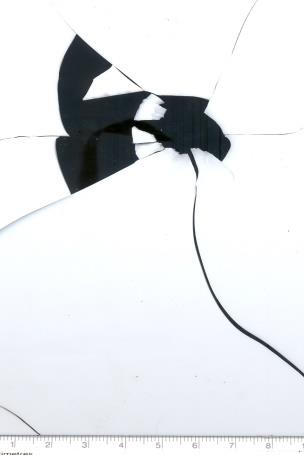
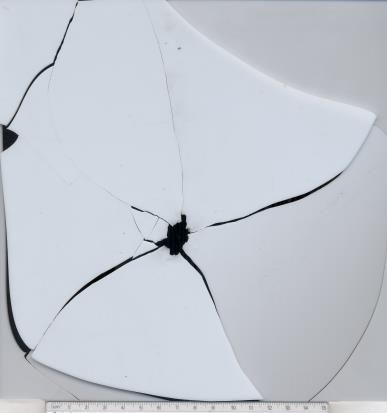
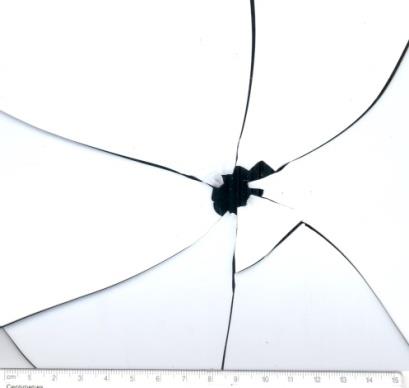
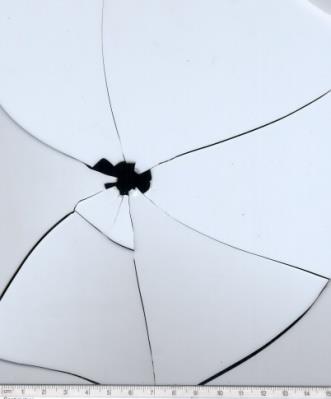
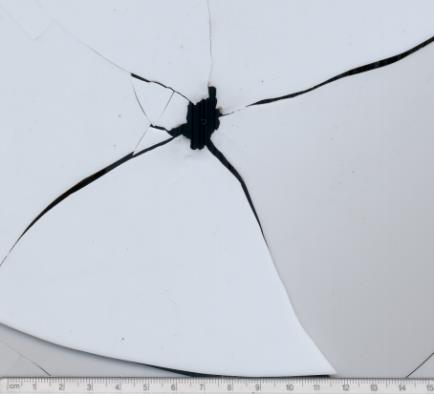
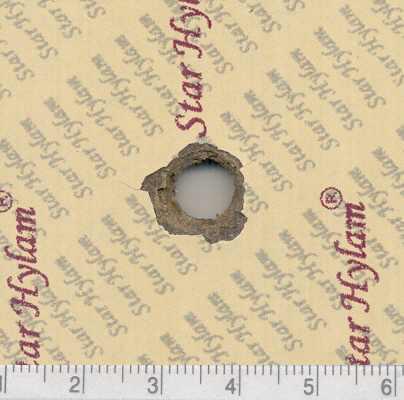
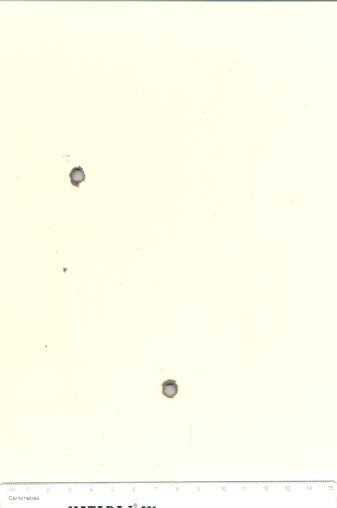
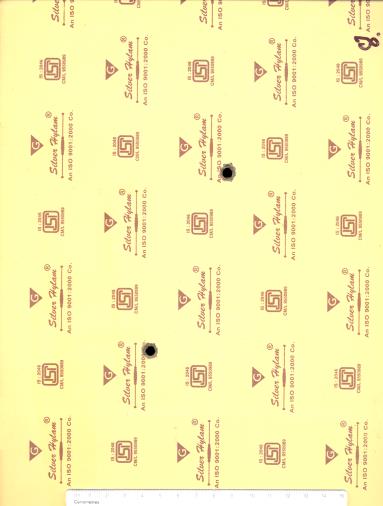
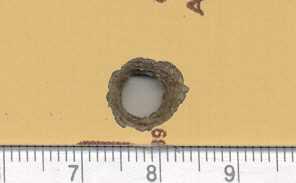
Shows the entrance side of a bullet hole produced by the bullets in case of following targets (Figures 1, 3, 5, 7, 9, 11, 13-15, 19, 21, 22, 25 & 27). These holes were produced by using different firearm-ammunition combination with relative distance between end of muzzle to the target. The radial fractions were observed on Figures 1 to 10 which shows that target material is made from the brittle material. The diameter of exit and entrance hole present on target was distinctly varies with each other. Figures 11 and 12 illustrate that entrance less than exit hole with beveled pattern on Bakelite material.

Result and Discussions
On the basis of experimental firing on various targets materials with different bullets revealed that the bullet hole in glass sheet could be characterized by three type of cracks i.e. a) Conical b) Radial c) Spiral In most of the cases, fractures were complete. On the glass sheet of similar the thickness as was found to shatter badly specially when fired upon by .410” clean holes of diameter roughly corresponding to the diameter of the ball were observed. The flaking around the hole revealed almost equal flaking around the hole in case of
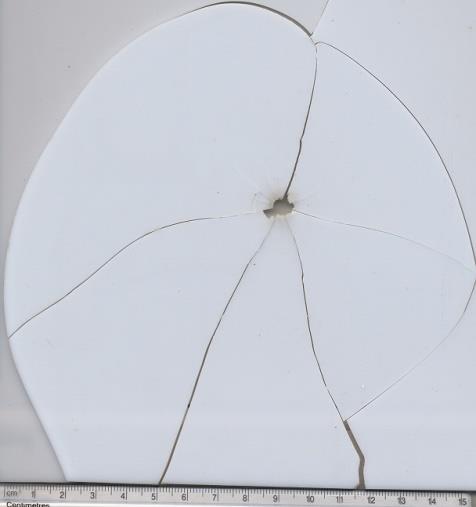
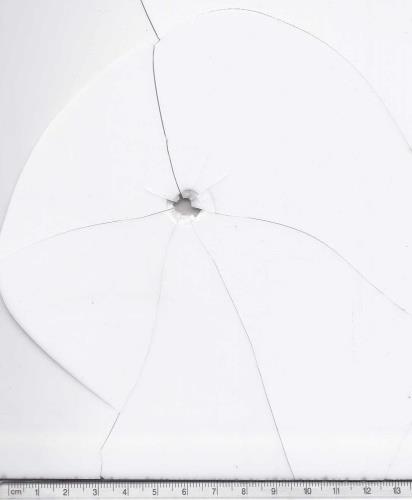
holes produced by fired bullets normally. When the bullets were fired in a direction inclined or right direction, more flaking was observed on the left direction and vice- versa. It was possible to determine the sequence of production of a numbers of closely spaced bullet holes by studying the interruption of cracks of one by the other. The background chipping phenomena was also observed in bakelite, glass targets. With the help of said pattern phenomena, we can estimate the range of firing in a case of shooting through (Perspex (acrylic), glass target Bakelite.) if the identity of these chips could be established with the Perspex (acrylic) plate. In a case of “Bakelite” this type of target did not show any radial or spiral cracks as observed in case of “Perspex” (acrylic). There was a clan bullet hole large in size on the exit side (Figures 1 to 8).
Phenomenon of Multiple Holes
On scientific investigation, an interesting phenomenon of multiple holes produced by a single shot was observed when holes produced by a single shot was observed when the Perspex (acrylic) and Bakelite, glass sheets exposed to the firing of .410 Ball 1 K.F. cartridge by .410 Musket rifle. Each of the above holes resembled a distinct bullet hole. The responsibility of additional holes was due to wads present in the musket cartridge (Figures 15-18).
The forensic implications of such phenomena have been discussed. Firearm expert /crime scene manager be careful not to disrupt any trace evidence in and around the bullet hole when determining its dimensions at scene of crime. In crime case of hole appears circular, a quick check of hole width in two directions shall be verify on target. It is observed that the bullet holes resulting from impacts at less than 90° will typically be oval shapes. In crime cases where a bullet hole is slightly longer than the diameter of bullet; it may be due to bullet enlargement upon impact. At crime spot the bullet hole may be expressively larger than the bullet diameter and irregular
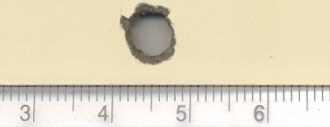
Figure 18: 8mm bullet exit 27.5” on Bakelite hole 27.5” on Bakelite. (Close up view) in shape due to tearing/stretching of the target material. It is most important to properly document the configuration of firearm, when it is fried at crime spot. It is therefore suggested that the hand written notes are especially important because photographs do not always show every details of specific interest.
When a jacketed or non jacketed bullets or pellet penetrates a target, the angle of impact may be calculated by using the dimensions of the bullet or individual pellet. The shape of the hole can tell, with information about the general impact angle. Bullets or shots found present at scene of crime can give information about the general impact of angle. Any angle of impact lesser than 90° results in an oval or oblong hole. When the smaller the angle of impact, the longer the hole. It is observed that width of the target hole approximates the caliber of bullet or projectile. It is conclude that angle of impact, the width and the length of the hole are, therefore, practicalities for caliber and the impact angle. In general forensic ballistics, firearm expert/ crime scene investigator use the sine function to express the relationship between the impact angle, the width and the length of the bullet.
Conclusion
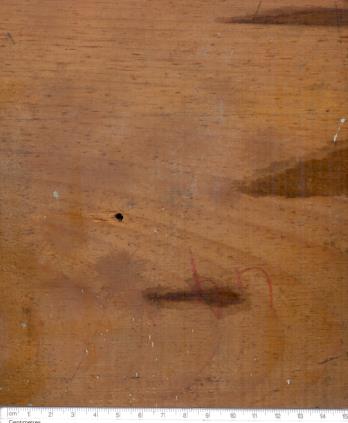
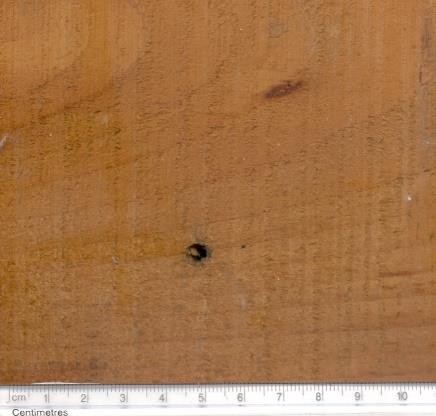
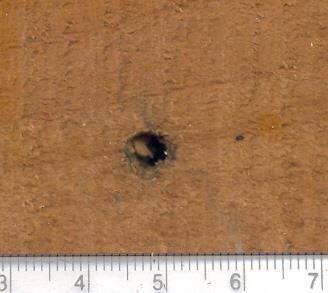
concentric fracture phenomena were observed along with mist, mirror zone phenomena by using 8mm bullet impact on glass sheet. It is pertinent to note that a key hole effect is present on both glass target materials. Similarly Figures 24 to 27 showed that circular and angular hole was produced by 8mm ammunition of wooden target. The shape of angular hole produced may be due to angular firing. Here, inverted and inverted phenomena also observed. Radial, cone or concentric phenomena were not observed when fired on wooden target by low as well as high velocity weapons may be due to structural material of target. Entry hole on entry side of wooden plate is more than exit hole. Some black ring or dirt ring surrounding the hole present at entry side of wooden hole not on exit side. It may also depend upon type of target material. Data analysis in present study may be useful to forensic scientist and crime scene manager, student and law enforcement agencies.
The radial cracks are found in acrylic sheet produced by 8mm bullet impact where as radial cracks were not observed in case of.303’’ bullet impact. However, cone or circular impact was found on them. In case of Bakelite sheet a circular shaped holes were produced by 8mm bullet impact and .410’musket. A circular shape of hole was produced by bullet impact of 5.56x45mm INSAS rifle and radial phenomenon was also observed on exit side of glass target (Figures 19 & 20). Normal phenomena of glass fracture also observed such as radial, concentric etc. A circular hole was found when aluminum plate used as a target by using 8mm soft nose bullet. It is noted that perforation mark produced by soft nose bullet is exclusively observed (Figure 21). However, if we test fired in high thickness of aluminum plate, dent marks will be present. Figures 22 and 23 showed that radial, and
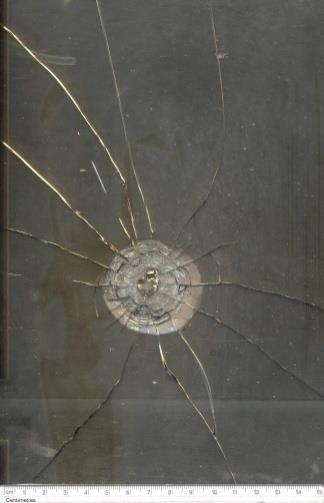
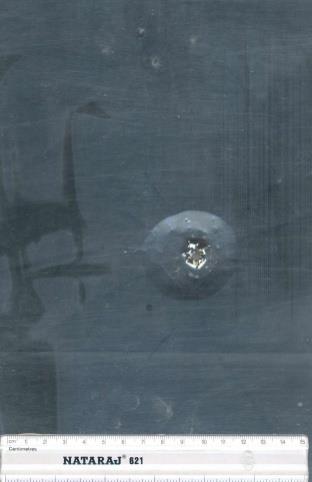
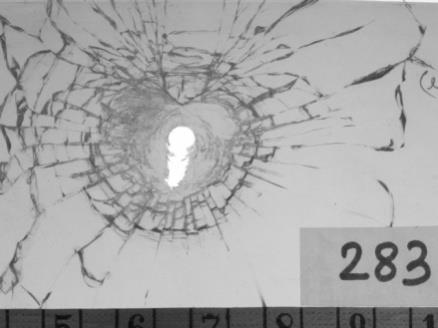
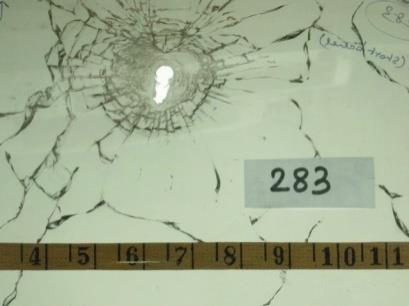
A. Shows the rib marks along one of the radial cracks. B. Shows the Rib marks along one of the radial cracks above.
References
-
Jauhari M, Chatterjee SM, Ghosh PK (1974) Remaining velocity of bullets fired through glass plates. Journal of Forensic Science Socienty 14(1): 3-7.
-
Jauhari M, Sinha JK (1964) Multiple holes due to single shot. Fourth police Science Congress Madres pp: 182-184.
-
Breitenecker R, Senior WJ (1967) Shotgun pattern: An experimental study of the interference of intermediate target. Journal of Forensic Science 12: 193-204.
-
McConnell MP, Triplett GM, Rowe WF (1981) A study of shotgun pellet ricochet. Journal of Forensic Sciences 26(4): 699-709.
-
Salferstein R (1982) Forensic Science Handbook, Prentice-Hall Inc., New Jersey, USA.
-
Howand RN (1944) The behavior of glass under impact and static loading. Journal of Glass Technology 28: 1-32.
-
Waghmare NP, Rao MS (2003) Wounding power of soft nose bullet fired on glass target. Journal of Forensic Communication.
-
Rathman GA (1987) Bullet ricochet and assorted phenomena. AFTE Journal 19(4): 374-381.
-
Thornton JI, Cashman PJ (1986) The effect of tempered glass on bullet trajectory. Journal of Forensic Sciences 31(2): 743-746.
-
Harper WW (1939) The behaviour of bullets fired through glass. Journal of Crimina Law & Criminology and Police Science 29(5): 718.
-
Haag LC (1987) The measurement of bullet deflection by intervening objects and a study of bullet behaviour after impact. AFTE Journal 19(4): 382-387.
-
Garrison DH (1995) Examining auto body penetration in the reconstruction of vehicle shootings. AFTE Journal 27: 209-212.
-
Bell P (1993) Characteristics of bullets fi red through tempered automobile window glass. Paper presented at The California Association of Criminalists Seminar, 1993.
-
Jauhari M (1969) Bullet ricochet from metal plates. Journal of Criminal Law, Criminology and Police Science 60(3): 387-383.
-
Hartline PC, Abraham G, Rowe WF (1982) Study of shotgun ricochet from steel surfaces. Journal of Forensic Sciences 27(3): 506-512.
- Forensic Implications of Adverse Drug Reactions in Schizophrenia A Case Series
- Narcotics and Digital Forensics: Bridging Crimes in the Digital Age
- Ethics in Forensic Psychiatry: Principles, Dilemmas, and Human Rights
- Impact of Acute Stress on Attentional Orienting to Social Cues
- Head Injury and Intracranial Hemorrhage in Western Region of Libya
- A Forensic Study on Handedness: Examination of Handwriting Features in Right and Left Handed Writers