
Diatoms Analysis of Well Water Sample of Different Districts of Punjab Region
In this research work we collect water samples from ten wells of different districts of Punjab region and made an attempt to identify the diatom species exists in wells by using different methods and techniques. Diatom plays an important role in establishing the death caused due to drowning. When a dead body is recover from water, a suspicion is generally there that weather the dead body is the case of ante-mortem or post-mortem drowning and weather the body was drowned before or after death. To identify the cause of the death in such cases, the presence of diatoms in the body tissues is very useful evidence. The presence of diatoms in the body is confirmed by various chemicals and other tests. The various types of diatoms found in the dead body tissues is compared with types of diatoms present in water bodies from the corpse is recovered to determine the scene of incident for reconstruction of events. By evaluating all these significant aspects and supportive evidence the conclusion is given
Introduction
The diatoms are unicellular algae of class Bacillariophyceae of the king Protista. They’re found in both fresh water and marine water. It is estimated that there are over 200 genera of living diatoms and around 100,000 species exists [1]. Usually similar forms of diatoms exist within the almost similar kind of water bodies. It’s been found that, a noticeable change within the diversity of diatoms with respect to seasonal changes. Climatic conditions significantly help in the quantitative and qualitative distribution of diatoms in water bodies [2]. This can be in fact is favorable for the forensic investigator involved in drowning investigations. Diatoms are studied by the Forensic biologist for manifesting the ante mortem or post mortem, a conceivable reason of death and also the presumed site of drowning. In the case of giving a positive opinion on the ante-mortem drowning, the “Criterion of Concordance” was believed to be adequate [3]. If the Criterion of Concordance cannot be followed then a minimal established limit, i.e. 20 diatom/100 μl of pellet and 05 complete diatoms from other body organs should be presented [4]. The concordance of the individual diatom distribution of the drowned body organs with the diatom species found in water samples can also be an exploratory tool in the investigation of suspected site of drowning [5]. The study of the diatom flora of various forms of water bodies and regions has direct forensic application. Since the earlier research studies have showed that the diatoms vary from one water body to another, which ultimately helps to generate diatom logical maps and diagnosis of the actual drowning site [6]. Only some attempts have earlier been made in order to study the distribution pattern diatom flora within the term of the forensic aspect in India [7]. So it was thought desirable to collect and analyze water samples from different types of water bodies.
Materials and Methods
Sample Collection
From the wells of different districts of Punjab region, the water samples were collected in neat and clean water bottles with tightly fitted cap so as to avoid contamination. The surface of the water bodies was disturbed before collecting the sample to allow the passage of the mud while collecting the water.50ml of water samples were collected from each of the ten wells from different districts. The bottles were labeled properly with the location of sampling area along with date and month.
Diatoms Extraction from Water Samples
Nitric Acid Digestion Method was used for the extraction of diatoms from water samples [8]. 50ml of water sample was taken and transferred into a separate 50ml acid washed and the beakers were properly labeled. 10ml of conc. nitric acid (HNO3) and a pinch of potassium dichromate were added to the sample. The samples were kept undisturbed as such for 24 hours. Then the samples were moved to properly label centrifuged tube and were centrifuged for 10 minutes at 3000rpm. The centrifugation was carried out repeatedly for three times by taking 5ml of sample each time to increase the concentration. The supernatant was removed carefully with the help of a dropper. Again the pellets formed were suspended in the distilled and centrifuged at 3000rpm to remove the acid contents.
Mounting
After washing, the pellet is transferred on slide with the help of dropper. Then these slides were dried by keeping them on the heating plate at 30-40∙C for 4-6minutes. A drop of DPX was added upon the dried portion on the slide and a cover slip was placed on it. Then the slide was kept aside carefully for air dry. Once the slide gets dried it was examined under the phase contrast microscope at magnification of 40X and digital images were taken with MICAPS camera connected to the Phase Contrast Microscope. The diatom species were identified on the basis of description given by Hartley B [9].
Result and Discussion
Diagnosis of drowning remains one of the foremost troublesome issues in forensic. Drowning is demonstrated as a cause of death when the sorts of diatoms found in corpse organs matches with the diatoms show within the expected drowning medium. But unwavering quality and applicability of quantitative and subjective diatom investigation within the determination of drowning is tendentious. According to Pollanen, nearness of diatoms in non-drowned bodies may well be due to defilement caused amid different forms of dissection and diatom test. Krstic et al recommended that quick passing seem anticipate the entrance of diatoms into the circulation system and their ensuing statement within the organs. Undoubtedly, the diatom test is still considered as the brilliant standard.
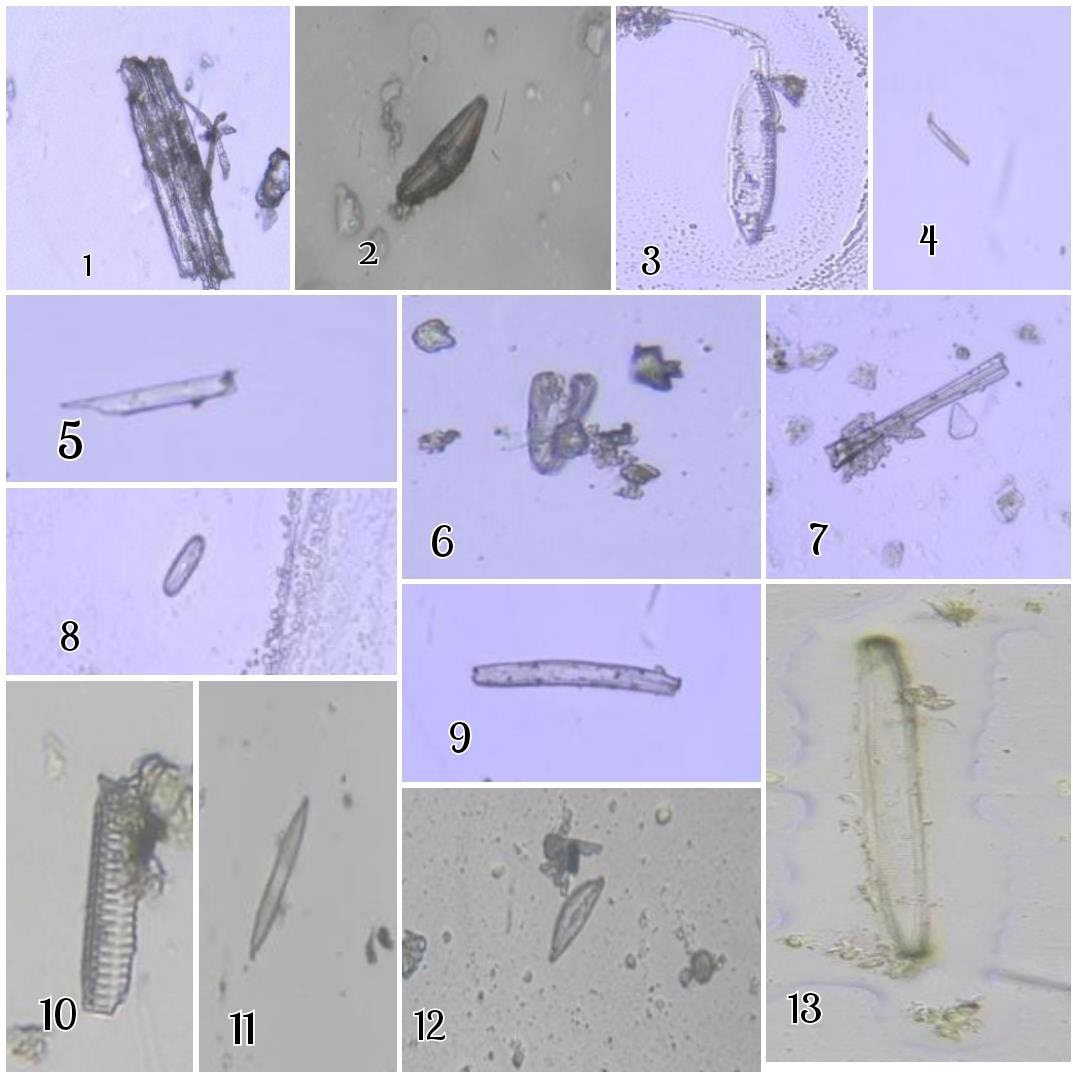
Since the samples were collected during the winter season, the climatic conditions were not in the favor of the diatom growth hence not many diatoms could be found. Most of the diatom species belong to the order ‘Pinnularia’ and ‘Fragilaria’ have been remarked as the most frequently occurring and dominating genera. Photomicrographs of few diatom genera have been given below. Due to poor photomicrographs, few diatoms could not be identified up to their species level. The growth of diatoms is declined in the winter season as the climatic conditions are not suitable for diatom growth, but few well water samples had a good population of diatoms. A remarkable diatom distribution has been in the present day study.
The nature of the existed diatom flora and the effect of climatic conditions on its growth are found to be similar with the earlier observations made by the scientist particularly related to Indian region [10].
A detailed and comparative survey of the diatom flora of 10 distinct types of water bodies of Punjab region (India) was conducted in all the four seasons from 2005-2007, which revealed some common, season, rare and site specific diatoms [11]. Analogous to our present day observations, diatoms like ‘Fragilaria’ and ‘Pinnularia’ have also been reported among the commonly found diatoms.
Conclusion
Forensic Diatom ology plays a vital role in resolving the drowning cases mysteries. It contributes remarkably not only in establishing the death cause, but equally helps to ascertain the site of drowning. The existence of adequate amount of diatoms in essential body organs can corroborate ante-mortem drowning upto a definite level. Scattering of diatom in any water body, and their interrelation with the diatom species recuperated from the drowned body can be the practice of choice to solve the query associated with the site of drowning. Diatom finding from the water as well as biological sample provides a lot of information regarding about the cause of death, locality and probable season.
There is a lot of dispute about the reliability of diatom tests. The diatoms are not only inhaled through water but can also be inhaled through air as they can also be found in the air and from there they can gain entry by the respiratory system, that is why many authors does not consider it as a valuable and a fool proof method. A positive conclusion can be drawn in the event that legitimate care is taken to maintain a strategic distance from each sort of defilement and by knowing all fundamental determination of the diatom test, it can give an extraordinary help within the examination of drowning cases.
A number of strategies are depicted for the absorption of the tissue for the confinement of diatoms by doing least harm to the frustules and if we watch definitely we will say that layer sifting strategy given by gives way better comes about.
Physical strategies are by and large troublesome to actualize, as rebellious for executing them are not effectively accomplished. Additionally, treatment forms cause extreme harm to diatoms, which influences the rate of diatom discovery. In this manner, physical strategies are once in a while utilized in case. Right now, the foremost common strategy is morphological examination based on absorption with solid acids. It is broadly utilized in forensics research facilities since of the effortlessly open and reasonable reagents and requiring no extraordinary hardware. Furthermore, the HCl assimilation, proteinase K absorption and MD-VF- Auto SEM strategies can protect the keenness and make strides the diatom discovery rate, which is noteworthy for subjective examination of diatoms. Strikingly, proteinase K is exceptionally touchy for identifying diatoms in a little sum of tissue, but it isn’t appropriate to large-scale cases due to the related high costs.
The objective of this preliminary study was to acknowledge the distributional pattern of diatoms in different wells of Punjab. Results have shown that diatom diversity somewhat changed a bit at a few locations under that similar conditions of temperature. Change in the diatom diversities in different wells can be very interesting and useful in forensic point of view. The data provided in this present research work would be valuable for the site specified by comparison of diatom between the water sample of drowning site and the viscera of corpse recovered.
References
-
Round EF, Crawford RM, Mann DG (1990) the Diatom Biology and Morphology of Genera. Cambridge University Press, Cambridge England, pp: 7-20.
-
Pollanen MS (1996) the diatom test for drowning in Ontario. J Can Soc Foren Sci 29(4): 205-211.
-
Pollanen MS (1998) Forensic Diatomology and Drowning, Elsevier.
-
Ludes B, Coste M, Tracqui A, Mangin P (1996) Continuous river monitoring of the diatoms in the diagnosis of drowning. J Forensic Sci 41(3): 425-428.
-
Kazutoshi AGO, Mihoko AGO, Mamoru OGATA (2004) The Distribution of Diatoms in Yoro The Yoronjima and Application of the Diatom Test for the Diagnosis of Death by Drowning in Open Sea Islands. Med J Kagoshima University 56(2): 25-29.
-
Ludes B, Coste M, North N, Doray S, Kintz P, et al. (1999) Diatom analysis in victim’s tissues an indicator of the site of drowning. Inter J Legal Med 112(3): 163-166.
-
Tyagi GD (1985) Diatoms of Delhi. Journal of Forensic Medicine and Toxicology 2(3): 18-23.
-
Singh R, Singh R, Singh R, Thakar MK (2006) Diatomological studies from three water bodies of Jaipur. Ind Internet J For Med & Toxi.
-
Hartley B (1996) an atlas of British diatoms. Biopress Ltd, Bristol, England.
-
Mukesh Kumar Thakar, Rajvinder Singh (2010) Diatomological mapping of water body for the diagnosis of drowning cases. J Forensic Leg Med 17(1): 18-25.
-
Gandhi HP (1964) The diatom flora of Chandola and Kankaria lakes, Nova Hedwigia 8: 347-402.
-
Hendey NI (1980) Diatom and drowning- a review. Medicine Science and Law 20(4): 289.
-
Timperman J (1962) The detection of diatoms in the marrow of sternum as evidence of Death by Drowning. J Forensic Medicine 9: 134-136.
-
Funayama M, Aoki Y, Sebetan MI, Sagisaka K (1987) Detection of Diatoms in blood by a combination of membrane filtering and chemical digestion. Forensic Sci Int 34(3): 175-182.
- Narcotics and Digital Forensics: Bridging Crimes in the Digital Age
- Ethics in Forensic Psychiatry: Principles, Dilemmas, and Human Rights
- Impact of Acute Stress on Attentional Orienting to Social Cues
- Head Injury and Intracranial Hemorrhage in Western Region of Libya
- A Forensic Study on Handedness: Examination of Handwriting Features in Right and Left Handed Writers
- Techniques for Latent Fingerprint Development Using Natural and Synthetic Powders: A Review