
Collection of Touch DNA from Rotten Banana Skin
Touch or trace DNA analysis can be used to connect suspects to crime scenes, especially when other types of biological evidence are unavailable. However, Touch DNA profiling is a challenging process and many variables affect the success of obtaining a good quality DNA profile, such as surface type and the time between deposition and recovery. This study aimed to investigate the influence of time between deposition and recovery of Touch DNA from banana skin surface at room temperature. The results showed that the amount of recovered DNA from the banana skin was not affected by time (over a week) at room temperature and a full DNA profile was generated even when the banana skin was rotten
Introduction
Touch or trace DNA analysis is a significant tool that can be used to connect suspects to crime scenes, especially when other types of biological evidence cannot be found. The process of Touch DNA profiling has evolved since it was first reported in 1997 [1] with the improvement of DNA profiling technology. Indeed, it has become an important routine of the forensic laboratory workload and unlocked new possibilities that led to the collection of DNA from a wide range of surfaces and items, such as tools, knives, clothing, firearms, etc. [2, 3].
Touch DNA profiling is challenging, and many variables can affect the success of obtaining a good quality DNA profile, such as surface type and the time between deposition and recovery [4, 5, 6]. Previous studies have mainly focused on improving DNA recovery from body fluids [7, 8], thus there is a gap in the research regarding Touch DNA [3].
During the examination of numerous home burglary crime scenes, while working for the General Department of Forensic Science and Criminology in Dubai Police, it was noted that some criminals consume food from the home, such as banana, and then leave the banana skin at the crime scene. Therefore, this study aimed to investigate the influence of time between deposition and recovery of Touch DNA from banana skin surface at room temperature.
Materials and Methods
Experimental Setup and Deposition
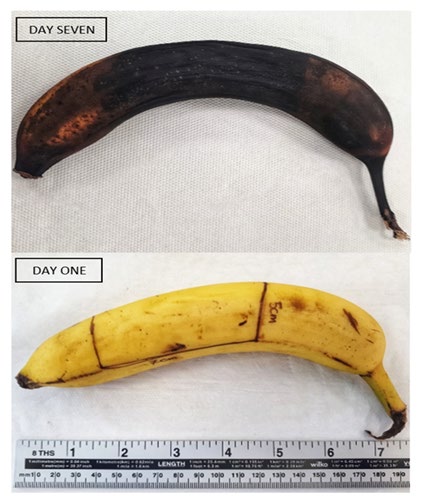
To assess the effect of time on the collection of Touch DNA from banana skin, it was stored at room temperature (RT) in moderate humidity (20 to 25°C/50%) (n=15) over five time periods (Zero hours, 3 hours, 12 hours, 24 hours and one week). This was done to test the possibility of collecting Touch DNA from rotten banana skin (Figure 1).
Before storing the items, surfaces were cleaned with viricidal disinfectant (2% virkon) and ultraviolet radiation (UV) for 15 min. The participant was asked to wash their hands with antibacterial soap and refrain from undertaking any activity for 10 minutes, then charge the fingers of both hands with eccrine sweat by touching behind their ears or forehead to load them with enough DNA. The participant was then asked to touch the surfaces using their index, middle, and ring fingers of both hands separately to deposit the DNA by applying medium pressure on a 5 x 7 cm surface area for 1 minute. The same procedure was repeated for each deposition.
DNA Recovery and Extraction
Samples were collected using a Copan 150C Cotton
swab (Copan, Brescia, Italy) moistened with 100 μL of sterile distilled water applied using a plastic spray bottle technique (developed in Dubai police forensic DNA lab; every single spray contains approximately 50 μL). Full swab heads were used for extraction immediately after collection using the PrepFiler Express BTA™ kit with AutoMate Express Forensic DNA Extraction System according to the manufacturer’s instructions (Thermo Fisher Scientific) and the final extracted sample elution was 50 μL.
DNA Quantification, Amplification and Analysis
Extracted samples were quantified using the Quantifiler® Human DNA Quantification Kit, QuantStudio 5 Real-Time PCR (qPCR) and HID Real-Time PCR analysis software v1.3 according to the manufacturer’s instructions (Thermo Fisher Scientific). Amplification was performed using the GlobalFiler™ PCR Amplification Kit (Thermo Fisher Scientific) and a 30-cycle protocol. The data were analysed using GeneMapper® ID-X Software Version 1.2 (Thermo Fisher Scientific) and statistical analysis was performed on the tested variables using RStudio and factorial analysis of variance (ANOVA). In ANOVA, the p-value is derived from the F-distribution which is different for every pair of degrees of freedom (df) values (F value = variance of the variables means (Mean Square Between) / mean of the within variables variances (Mean Squared Error). Blanks were taken from the surfaces after sterilisation, and negative controls for the collection and extraction methods, all of which proved negative for DNA when quantified.
Results and Discussion
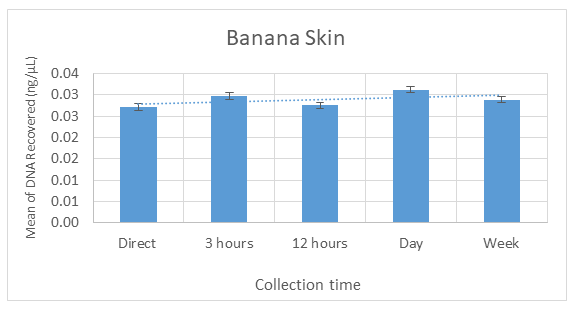
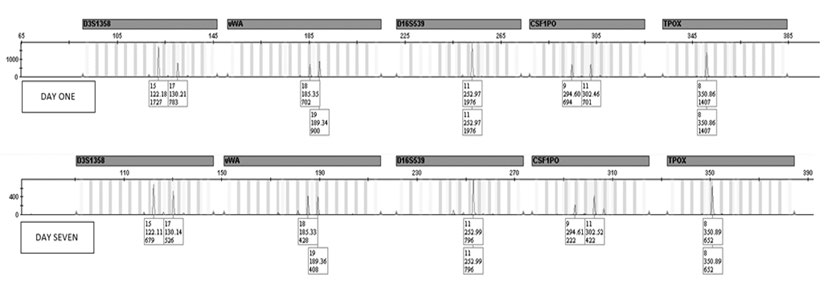
The amount of recovered DNA from the banana skin was not affected by time (over a week) at RT (F 4,5 = 0.33, p >0.05, mean = 0.03 ng/μL) (Figure 2), and a full DNA profile was generated even when the banana skin was rotten (Figure 3).
Conclusion
In conclusion, this experiment showed that collection of Touch DNA from fresh or rotten banana skin is possible if the banana skin surface was found indoors at room temperature with moderate humidity (20 to 25°C/50%) within one week of deposition. It is important to consider other elements that could influence the Touch DNA profiling process from surfaces, such as environmental conditions and contamination.
Conflict of Interest: None.
Acknowledgement
This study was approved by the General Department of Forensic Science and Criminology in Dubai Police and ethical approval was granted by the School of Forensic and Applied Sciences, and the University of Central Lancashire’s Research Ethics Committee (ref. no. STEMH 912). Many thanks to COPAN DIAGNOSTICS INC. for supporting this experiment with free swabs, and to ThermoFisher Scientific™ for the discounts on their products.
References
-
Van Oorschot RAH, Jones MK (1997) DNA fingerprints from fingerprints. Nature 387: 767.
-
Polley D, Mickiewicz P, Vaughn M, Miller T, Warburton R, et al. (2006) An investigation of DNA recovery from firearms and cartridge cases. J Canadian Soc Forensic Sci 39(4): 217-228.
-
Alketbi SK (2018) The affecting factors of Touch DNA. Journal of Forensic Research 9(3): 424.
-
Bille TW, Cromartie C, Farr M (2009) Effects of cyanoacrylate fuming, time after recovery, and location of biological material on the recovery and analysis of DNA from post, blast pipe bomb fragments. J Forensic Sci 54(5): 1059-1067.
-
Alketbi SK, Goodwin W (2019) The effect of surface type, collection and extraction methods on touch DNA. Forensic Science International. Genetics Supplement Series 7(1): 704-706.
-
Alketbi SK, Goodwin W (2019) The effect of time and environmental conditions on Touch DNA. Forensic Science International. Genetics Supplement Series 7(1): 701-703.
-
Verdon T, Mitchell R, Oorschot R (2014) Swabs as DNA Collection devices for sampling different biological materials from different substrates. Journal of Forensic Sciences 59(4): 1080-1089.
-
Plaza D, Mealy J, Lane J, Parsons M, Bathrick A, et al. (2016) Nondestructive biological evidence collection with alternative swabs and adhesive lifters. Journal of Forensic Sciences 61(2): 485-488.
- Narcotics and Digital Forensics: Bridging Crimes in the Digital Age
- Ethics in Forensic Psychiatry: Principles, Dilemmas, and Human Rights
- Impact of Acute Stress on Attentional Orienting to Social Cues
- Head Injury and Intracranial Hemorrhage in Western Region of Libya
- A Forensic Study on Handedness: Examination of Handwriting Features in Right and Left Handed Writers
- Techniques for Latent Fingerprint Development Using Natural and Synthetic Powders: A Review