
Crime Scene Investigation using Hyperspectral Imaging– Opportunities and Challenges
Hyperspectral imaging enables the mapping of a crime scene in both spatial and spectral domains. In many cases, the materials have a unique reflectance spectrum that enables their identification. HSI is often referred to as "chemical mapping" which is very appealing for forensic science. The main impediment in the application of this technique is spectral mixing between the target and benign material reflectance spectra. Different mixing mechanisms are discussed in relation to crime scene investigation. It seems that the primary gap today is nonlinear spectral mixing. Resolving this gap and providing a real-time data analysis algorithm will contribute to the accurate chemical mapping of crime scenes. Recent advances in nonlinear mixing lay the path towards this goal.
Short Communication
A key component in Crime Scene Investigation (CSI) is to locate forensic evidences, meticulous recording of their locations, and accurate identification. Hyperspectral imaging (HSI) provides both spatial and spectral information from each portion of the interrogated scene. The spectral information, i.e., the reflectance spectrum, can be obtained in the ultra-violet (UV), visible, and infrared parts in the electromagnetic spectrum. Different materials have different reflectance spectrum, which can be used for the identification of the material. Hence, HSI provides a chemical map [1] that guides the CSI process by providing a reliable tool to explore specimens’ chemical nature in the crime scene non- destructively. Once a sample is located and identified, it can also be taken to a certified forensic lab for further analysis.
There are several HSI methods; for example, a staring imager captures a series of images of the scene at different wavelengths by placing different filters in front of the imager before each shot [2]. Another common approach is the line-scanning hyperspectral imaging in which the imager samples a slice (“line”) of the scene in one dimension and disperse the incoming light in the second dimension. This process results in a reflectance spectrum of each point in the sampled line. Sampling different slices from the scene provide a complete spatial and spectral interrogation of the scene [3]. Regardless of the imager’s optical setup, in all cases, the final result is a “data-cube” in three dimensions ‘x’,’y’ (spatial), and λ (spectral). Each pixel in the scene is associates with a reflectance spectrum. Figure 1 depicts the data-cube obtained in HSI and demonstrate cutting it through the spatial and spectral dimensions.
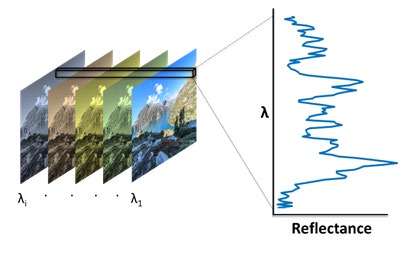
The capability to chemically map a scene is very appealing for forensic applications [4]. Malegori, et al. [5] used HSI for the detection of minute amounts of biological samples. Combining the spectral and spatial information and using chemometric techniques highlighted otherwise invisible traces of biological fluids placed on several benign materials. Polak, et al. [6] developed classification techniques for artwork authentication. Silva, et al. [7] employed HSI to identify document forgery. Qureshi, et al. [8] developed algorithms for document investigation using HSI. These generic methods can be employed for several applications such as signature extraction, ink, or document aging. Ferreira, et al. [9] studied HSI’s potential in the Visible/Near-Infrared to discriminate automotive paints in forensic investigations. Pereira, et al. [1] used near-infrared HSI combined with machine learning methods to detect Cannabis sativa L.
The amount of data and its complexity often requires dedicated algorithms to extract relevant information from the data-cube. Yang, et al. [10] compared data analysis algorithms for bloodstain detection. While bloodstains are valuable pieces of evidence in forensic investigation, it is sometimes hard to detect them by the unaided eye. A hyperspectral imaging system in the visible was used to detect bloodstains on a T-shirt and walls. The Topological Anomaly Detection (TAD) Algorithm outperformed Principal Component Analysis (PCA), SubSpace Reed Xiaoli (SSRX).
The main challenge in HSI application for CSI is the complexity of the scene. In many cases, the target materials such as biological fluids are known in advance, but all other materials (“background”) in the scene are unknown, and the resulted spectral signature can be a mixture of the target material and the unknown background material.
There two primary types of mixing situations linear and nonlinear. Linear mixing occurs when the target material occupies a portion of the pixel (sub-pixel), and the resulted spectral signatures are the sum of the target and background material signature [11]. Nonlinear mixing occurs when the photons are subjected to multipath effects. This results in a reflectance spectrum that is a product of the background material’s spectral signature and the target material. Figure 1 illustrates a linear (top) and nonlinear (bottom) spectral mixing in simplified scenarios. In the linear mixing incoming light beams interact seperatly with the background material (green) and the target material (red). Due to the limited spatial resolution of the sensor, the reflected light from both surfaces is sampled by the same pixel and the resulted spectrum is a sum of the red and green materials. In the nonlinear mixing, incoming light passes through the red material and reflected by the green material. Since both materials interact with the incoming light the resulted spectrum is a product of both green and red materials.
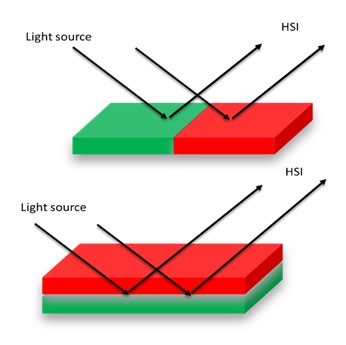
Figure 2: An illustration of two typical mixing situations. Top: Linear mixing – incoming light beams interact seperatly with the background material (green) and the target material (red). Due to the limited spatial resolution of the sensor the reflected light from both surfaces is sampled by the same pixel and the resulted spectrum is a sum of the red and green materials. Bottom: nonlinear mixing incoming light passes through the red material and reflected by the green material. Since both materials interact with the incoming light the resulted spectrum is a product of both green and red materials.
Nonlinear mixing is a well-known phenomenon; however, it got less attention over the years than the efforts to develop unmixing algorithms for linear mixing situations[11], which resulted in commercially available data analysis platforms such as “Environment for Visualizing Images “- ENVI™. Chen, et al. [12], Halimi, et al. [13, 14] and Dobigeon, et al. [15] developed nonlinear unmixing algorithms for hyperspectral images, but their application still lags behind algorithms aimed at resolving linear mixing [16].
Recently Kendler, et al. [17, 18] developed an algorithm that automatically resolves nonlinear mixing and enables identifying minute amounts of organic materials. This Algorithm was adapted for the identification of Bacillus anthracis inside paper envelopes [19]. These studies show great promise and lay the path for the utilization of non- linear mixing HSI in CSI procedures, unprecedented tools for the analysis.
By its nature CSI, involves the identification of small specimens that, in some cases, are absorbed by the supporting materials. Such interactions lead to both linear and nonlinear mixing between the target material’s spectral signature and that of the background material. The large variety of target materials adds a significant complication to the CSI. Hence, forensic science will benefit from the development of modern miniaturized HSI if new automatic and robust algorithms that can tackle the challenge of spectral mixing will be adopted to CSI applications. Such effective algorithms enable detailed chemical mapping of the crime scene that, in turn, will result in a speedy and accurate forensic investigation.
References
-
Pereira JFQ, Pimentel MF, Amigo JM, Honorato RS (2020) Detection and identification of Cannabis sativa L. using near infrared hyperspectral imaging and machine learning methods. A feasibility study. Spectrochim Acta A Mol Biomol Spectrosc 237: 118385.
-
Gupta N (2008) Hyperspectral imager development at Army Research Laboratory. In Infrared Technology and Applications 6940: 69401.
-
Park B, Yoon SC, Windham WR, Lawrence KC, Kim MS, et al. (2011) Line-scan hyperspectral imaging for real-time in-line poultry fecal detection. Sens Instrum Food Qual Saf 5(1): 25-32.
-
Edelman GJ, Gaston E, van Leeuwen TG, Cullen PJ, Aalders MCG (2012) Hyperspectral imaging for non- contact analysis of forensic traces. Forensic Science International 223(1-3): 28-39.
-
Malegori C (2020) Identification of invisible biological traces in forensic evidences by hyperspectral NIR imaging combined with chemometrics. Talanta 215(1): 120911.
-
Polak A (2017) Hyperspectral imaging combined with data classification techniques as an aid for artwork authentication. J Cult Herit 26: 1-11.
-
Silva CS, Pimentel MF, Honorato RS, Pasquini C, Montalbán JMP, et al. (2014) Near infrared hyperspectral imaging for forensic analysis of document forgery. Analyst 139(20): 5176-5184.
-
Qureshi R, Uzair M, Khurshid K, Yan H (2019) Hyperspectral document image processing: Applications, challenges and future prospects. Pattern Recognit 90: 12-22.
-
Ferreira KB, Oliveira AGG, Gonçalves AS, Gomes JA (2017) Evaluation of Hyperspectral Imaging Visible/Near Infrared Spectroscopy as a forensic tool for automotive paint distinction. Forensic Chem 5: 46-52.
-
Yang J, Messinger DW, Mathew JJ, Dube RR (2016) Comparison of algorithms for blood stain detection applied to forensic hyperspectral imagery. Algorithms and Technologies for Multispectral, Hyperspectral, and Ultraspectral Imagery XXII 9840: 98400X.
-
Bioucas Dias JM (2012) Hyperspectral Unmixing Overview: Geometrical, Statistical, and Sparse Regression-Based Approaches. IEEE J Sel Top Appl Earth Obs Remote Sens 5(2): 354-379.
-
Chen J (2018) A novel kernel-based nonlinear unmixing scheme of hyperspectral images. Proceeding 45th Asilomar Conference on Signals, Systems and Computers (ASILOMAR), Pacific Grove (CA), USA, pp: 1898-1902.
-
Halimi A, Altmann Y, Dobigeon N, Tourneret JY (2011) Nonlinear unmixing of hyperspectral images using a generalized bilinear model. IEEE Trans Geosci Remote Sens 49(11): 4153-4162.
-
Altmann Y, Halimi A, Dobigeon N, Tourneret JY (2012) Supervised Nonlinear Spectral Unmixing Using a Postnonlinear Mixing Model for Hyperspectral Imagery. IEEE Trans Image Process 21(6): 3017-3025.
-
Dobigeon N, Tourneret JY, Richard C, Bermudez JCM, McLaughlin S, et al. (2014) Nonlinear unmixing of hyperspectral images: Models and algorithms. IEEE Signal Process Mag 31(1): 82-94.
-
Manolakis D, Shaw G (2002) Detection algorithms for hyperspectral imaging applications. IEEE Signal Process Mag 19(1): 29-43.
-
Kendler S, Ron I, Cohen S, Raich R, Mano Z, et al. (2019) Detection and Identification of Sub-Millimeter Films of Organic Compounds on Environmental Surfaces Using Short-Wave Infrared Hyperspectral Imaging: Algorithm Development Using a Synthetic Set of Targets. IEEE Sens J 19(7): 2657-2664.
-
Hollis J, Raich R, Kim J, Fishbain B, Kendler S (2020) Foreground Signature Extraction for an Intimate Mixing Model in Hyperspectral Image Classification. IEEE International Conference on Acoustics, Speech and Signal Processing.
-
Kendler S (2019) Non-contact and non-destructive detection and identification of Bacillus anthracis inside paper envelopes. Forensic Sci Int 301: e55-e58.
- Narcotics and Digital Forensics: Bridging Crimes in the Digital Age
- Ethics in Forensic Psychiatry: Principles, Dilemmas, and Human Rights
- Impact of Acute Stress on Attentional Orienting to Social Cues
- Head Injury and Intracranial Hemorrhage in Western Region of Libya
- A Forensic Study on Handedness: Examination of Handwriting Features in Right and Left Handed Writers
- Techniques for Latent Fingerprint Development Using Natural and Synthetic Powders: A Review