
Superabsorbent Sanitary Pads as Evidence in Sexual Aggression Cases
Bodily fluids recovered from sexual assault cases are key evidence in forensic investigations. Through the detection and extraction of bodily fluids, it may be possible to recover male-cell DNA and obtain a genetic profile which might help identify the perpetrator. Nowadays, the recovery of bodily fluids as evidence for posterior genetic profiling still represents a difficult challenge. Firstly, the usual methods for bodily fluid identification can be partially destructive, using a portion of the sample for analysis. The difficulty increases when bodily fluids, mainly semen, must be extracted from substrates like superabsorbent sanitary pads, which provide intimate and recent evidence. Superabsorbent sanitary pads are composed of several layers with different compositions and absorbing capabilities. The lower layer is the most absorbent, composed of superabsorbent polymers (SAPs). Currently, only the upper SAP-free layers of superabsorbent pads are used for extracting bodily fluids after incubation with deionised water, since SAPs in the lower layer form a hydrogel when in contact with fluids. Thus, the validation and implementation of semen extraction procedures are currently needed to recover higher quantities of retained bodily fluids within the lower cores. Recently, some authors have suggested different strategies for the extraction of semen and male-cell DNA from SAPs, by both a chemical and physical treatment approach, to promote the dewaterisation and a physical separation of the SAPs from the biological material. The present work is a review of the up-to-date research on superabsorbent substrates like sanitary pads as an important evidence of sexual aggression cases at the forensic laboratory.
Introduction
The finding of relevant bodily fluids in sexual assault samples is of extreme importance for the forensic investigation. Their detection and recovery allow the characterisation of the perpetrator’s genetic profile, helping to associate or dismiss a suspect from involvement [1]. Swabs taken from the victim’s body are commonly used to collect the bodily fluids, as well as other samples like the victim’s underwear and other substrates – surfaces, sheets, and clothing - present during the aggression [2]. Similarly, superabsorbent sanitary pads or diapers used during and after the sexual assault might be collected for analysis. Immediately after sexual intercourse most of the semen flows back out. However, the remaining will be slowly expelled during the following several days to the underwear or superabsorbent sanitary pads [3, 4]. Superabsorbent sanitary pads are an important evidence when the samples collection is performed, within the 72 hours after the presumptive abuse, because they are likely to be used during or after the aggression [5, 6], so they may contain remains of the aggressor’s semen. Nevertheless, obtaining bodily fluids from this support material, for posterior genetic profiling, is still a challenge. Currently, the methods used for sperm cells recovery retained in pads do not consider their lower core, where more quantity of bodily fluids is retained within the superabsorbent polymers (SAPs) [7, 8].
Superabsorbent Sanitary Pads
Superabsorbent sanitary pads are composed of different layers with various compositions. According to literature and the manufacturers’ information [9, 10], the first layer is porous and made of hydrophobic polypropylene and polyethylene; and the lower layer, the absorbent core, is composed of cellulose and sodium polyacrylate salts. The sodium polyacrylate salts are crosslinked hydrophilic polymers and are called superabsorbent polymers (SAPs), as they are designed to swell, absorb and retain large volumes of water or other fluids in a ratio highly superior to their dried weight [11, 12, 13, 14, 15] (Figure 1). Thus, bodily fluids will be absorbed in the core by the cellulose and the SAPs, forming hydrogels. The aim of the hydrogel is to retain the fluidic materials, preventing a flow back into the surface of the pad, with a low dewaterisation capability [14, 16].
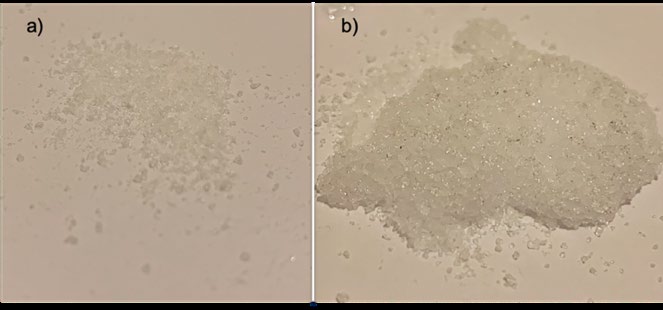
Considering the fact that these materials are in contact with the intimate parts of the victim and their capability to retain bodily fluids and, thus, maintaining the integrity of these fluids and their DNA [17], this type of evidence is of great importance in forensic genetics related to sexual aggression cases.
Detection of Bodily Fluids
Current analytical approaches for the bodily fluid detection at the forensic laboratory usually involve biochemical and immunological tests which require a portion of the sample. Specifically, to detect the presence of semen, forensic laboratories may perform the presumptive Acid Phosphatase assay, followed by the confirmatory observation of spermatozoa, by optical microscopy with Christmas-Tree staining, and the immunological tests of Prostate Specific Antigen (PSA) and Semenogelin antigen detection [18, 19, 20]. The mentioned assays require an initial elution of the sample in deionised water, which cannot be applied to superabsorbent pads. Thus, Gregório, et al. [21] proposed a non-destructive screening of bodily fluids, combining analytical vibrational spectroscopy and chemometric analysis of spectral data. This method is able to differentiate semen from other bodily fluids impregnated in superabsorbent pads, as well as in cotton fabric, and to identify spots with higher content of semen to improve the posterior male-cell DNA extraction.
Extraction of Semen for Genetic Profiling
Regarding the extraction of bodily fluids, the current protocols only consider the elution of the upper layers of sanitary pads, because SAPs from the lower layers would block the routinely used elution [4, 15]. Giusti, et al. [17] published the first article on the semen extraction considering all layers of the sanitary pads, by cutting the substrate into small pieces followed by an incubation with PBS and 2% Sarkosyl® at 4°C, and a filtration with a nylon membrane, which showed a minor recovery of male DNA. Later, Hulme, et al. [22] studied the semen/DNA recapture from the lower superabsorbent core of a panty-liner, eluting in water and a Sperm Elution® buffer, and the method resulted inefficient due to a hydrogel formation (partial STRs profile were obtained). More recently, Camarena, et al. [4] and Gregório, et al. [23] demonstrated that when considering solely the upper layers a significant lower sperm cells recovery is obtained, in comparison to a possible optimized elution protocol considering all layers of the substrate. Camarena, et al. [4] extracted semen from stained diapers through non-commercial fabric filters after an incubation in TNE buffer-salt solution, with a DNA yield recovery of 20-30% in the upper layers versus 40-50% considering the lower core with full STR profiles. The filtration step was necessary to separate SAPs to avoid hindering the sperm visualization and blocking the genetic profiling.
Gregório, et al. [24] compared the incubation results of different semen-embedded thick and thin sanitary napkins, panty-liners and diapers, considering the extraction from all layers after incubation in water, 0.1M NaCl, TNE buffer and isopropanol. The elution was followed by a physical shredding treatment and filtration with commercial 10µm- pore nylon membranes inserted in NAO®basket vials, which obtained promising results with regard to both spermatozoa recovery and male-cell DNA profiling, obtaining full STR profiles regardless of the chemical treatment and type of pad. Results suggested an enhanced recapture when extracting the whole core of the semen-embedded substrates (up to 64% DNA yield) in comparison to the recovery from the upper SAPs-free layers alone (up to 8.4% DNA yield) [23]. Besides, no SAP inhibition was proved to occur when obtaining the STRs genetic profiles of semen control samples [24]. The incubation in water and 100% isopropanol obtained higher DNA yields. In that way, it was possible to evaluate the implementation of a protocol at the forensic laboratory.
In 2020, O’Connor, et al. [25] have proposed a SAPSWash method for the extraction of spermatozoa, similarly from the lower core of sanitary napkins, considering an incubation in a 0.5M calcium chloride solution, followed by centrifugation of the substrate within commercial spin baskets. The calcium ions interacted with the carboxyle groups of the hydrogel leading to dewaterisation. Complete STR profiles were obtained, although some samples needed a previous Microcon clean-up procedure. The two-latter articles [24, 25] could extract semen after an incubation treatment and final commercial-filtering and showed protocols to either promote the dewaterisation of the hydrogels, altering their cross-linked network, or create a situation of molecular competition by increasing the water volume ration.
Conclusion
The maximization of the elution of bodily fluids from all layers of the sanitary pads should be pursued, by considering the chemical and physical properties of SAPs. Forensic practitioners must take into account the effects of the dewaterisation method on the viability of cells and the quality of their DNA for further genetic profiling. An incubation/filtration protocol could be easily implemented at the forensic laboratory for an enhanced recovery of bodily fluids from SAPs-containing sanitary pads.
References
-
Lounsbury JA, Nambiar SM, Karlsson A, Cunniffe H, Norris JV, et al. (2014) Enhanced recovery of spermatozoa and comprehensive lysis of epithelial cells from sexual assault samples having a low cell counts or aged up to one year. Forensic Sci Int Genetics 8(1): 84-89.
-
Martínez P, Santiago B, Alcalá B, Atienza I (2015) Semen searching when sperm is absent. Science & Justice 55(2): 118-123.
-
Norris JV, Manning K, Linke SJ, Ferrance JP, Landers JP (2007) Expedited, chemically enhanced sperm cell recovery from cotton swabs for rape kit analysis. J Forensic Sci 52(4): 800-805.
-
Camarena LR, Glasscock BK, Daniels D, Ackley N, Sciarretta M, et al. (2017) An Optimized Centrifugal Method for Separation of Semen from Superabsorbent Polymers for Forensic Analysis. J Forensic Sci 62(2): 411- 416.
-
Shewale JG, Sikka SC, Schneida E, Sinha SK (2003) DNA profiling of azoospermic semen samples from vasectomized males by using Y-PLEX 6 amplification kit. J Forensic Sci 48(1): 127-129.
-
Elliott K, Hill DS, Lambert C, Burroughes TR, Gill P (2003) Use of laser microdissection greatly improves the recovery of DNA from sperm on microscope slides. Forensic Sci Int 137(1): 28-36.
-
Gregorio I, Zapata F, Garcia Ruiz C (2017) Analysis of human bodily fluids on superabsorbent pads by ATR- FTIR. Talanta 162: 634-640.
-
Giles CB, Wren JD (2008) Large-scale directional relationship extraction and resolution. BMC bioinformatics 9: S11.
-
Hibbard KJ (1988) Sanitary napkin, Google Patents, US5704932.
-
(2020) Ayuda de producto. Dodot.
-
Buchholz FL (1996) Superabsorbent polymers: an idea whose time has come. J Chem Educ 73(6): 512-515.
-
Elliot M (2008) Superabsorbent polymers. Product Development Scientist for SAP BASF Aktiengesellschaft, BASF, Ludwigshafen, Germany, pp: 1-14.
-
Kiatkamjornwong S (2007) Superabsorbent polymers and superabsorbent polymer composites. Science Asia 33.
-
Zohuriaan Mehr MJ, Kabiri K (2008) Superabsorbent polymer materials: a review. Iranian Polymer J 17(6): 451-477.
-
Laftah WA, Hashim S, Ibrahim AN (2011) Polymer Hydrogels: A Review. Polymer-Plastics Technology and Engineering 50(14): 1475-1486.
-
Ganji F, Vasheghani Farahani S (2010) Theoretical description of hydrogel swelling: a review. Iranian Polymer J 19: 375-398.
-
Giusti A, Baird M, Pasquale S, Balazs I, Glassberg J (1986) Application of deoxyribonucleic acid (DNA) polymorphisms to the analysis of DNA recovered from sperm. J Forensic Sci 31(2): 409-417.
-
Harbison S, Fleming R (2016) Forensic body fluid identification: state of the art. Research and Reports in Forensic Medical Science 6: 11-23.
-
Zapata F, Gregório I, García Ruiz C (2015) Body fluids and spectroscopic techniques in forensics: a perfect match?. J Forens Med 1(1): 1000101.
-
Virkler K, Lednev IK (2009) Analysis of body fluids for forensic purposes: from laboratory testing to non- destructive rapid confirmatory identification at a crime scene. Forensic Sci Int 188(1-3): 1-17.
-
Gregorio I, Zapata F, Torre M, Garcia Ruiz C (2017) Statistical approach for ATR-FTIR screening of semen in sexual evidence. Talanta 174: 853-857.
-
Hulme P, Lewis J, Davidson G (2013) Sperm elution: An improved two-phased recovery method for sexual assault samples. Science and Justice 53(1): 28-33.
-
Gregório I, Martínez P (2017) Characterising sanitary napkins, panty-liners and diaper types: Intimate evidence for semen identification. Forensic Science International: Genetics Supplement Series 6: e582-e584.
-
Gregorio I, Garcia Ruiz C, Martinez P (2019) Maximizing semen extraction from sanitary pads by chemical and shredding treatments. Forensic science international. Genetics 42: 198-202.
-
O’Connor AM, Watts JEM (2020) The development of a rapid and reliable method (SAPSWash): For the extraction and recovery of spermatozoa from superabsorbent polymer containing products. Forensic Sci Int 316: 110501.
- Narcotics and Digital Forensics: Bridging Crimes in the Digital Age
- Ethics in Forensic Psychiatry: Principles, Dilemmas, and Human Rights
- Impact of Acute Stress on Attentional Orienting to Social Cues
- Head Injury and Intracranial Hemorrhage in Western Region of Libya
- A Forensic Study on Handedness: Examination of Handwriting Features in Right and Left Handed Writers
- Techniques for Latent Fingerprint Development Using Natural and Synthetic Powders: A Review