
Examination of Trademarks on the Basis of Chemical Examination: A Case Report
In the field of Forensic Physics, trademark examination of a material provides as a mean to identify the genuineness of goods of a particular manufacturer and gives an indication of its origin/owner, or establishes a connection in the course of trade. A Forensic Physics Expert mostly encounters cases related to identification of genuine trademark on the basis of comparison. The most prevalent method adopts by Experts to determine the genuineness of trademarks are based mainly on the comparison of the physical parameters/dimensions of the engraved mark like Logo, Brand Name, Serial Number, size, shape etc. However, there are instances where the Forensic Experts faces the problem of identifying the genuineness of trademarks in mechanical devices of motor vehicles as the engraved marks or punched marks on the duplicate spare parts shows similar trademark and physical dimensions/ parameters as that of a genuine one. Hence, a conclusive opinion is difficult to arrive at on the basis of such comparison. A solution to the above problem to restore a numeral or alphabet on a suspected surface is achieved by applying a chemical solution like the etching reagent. This reagent when applied on the surface of both genuine and suspected surface, the intensity of chemical reaction on symbols such as Logo, Brand Name, Serial number varies widely on the above two surfaces. This method hence proved that it is more effective in solving the problem of identification of genuine spare part from a duplicate one.
Introduction
With the advancement of Science and technology, we are now facing the problem of acquiring various duplicate spare parts of Motor vehicles which are freely available in the market at a cheaper rate. If consumer cannot differentiate the differences between symbol coming from an authentic source and a duplicate one, then the duplicate symbol has acquired the ‘source-identifying’ property of a trademark. These unauthorized duplicate items/spare parts supplied in the market are mainly manufactured by deceptively copying from the Genuine spare parts, the Graphical similarities like General visual impression, Type of font, Graphic spelling with account for character of letters (e.g. block or scripture letters; capital or small letters), Location of letters relative each other, Alphabet, Color or combination of colors etc. and Semantic similarities like Likeness of notions, ideas expressed by marks, i.e. coincidence of meanings in different languages, Coincidence of one of the elements of the marks, being under logical stress and having an independent meaning, Polarity of notions, ideas expressed by marks. This has created hurdle for the Authorized and registered company as it has dwindle down their supply in the market due to the availability of such duplicate spare parts at a cheaper rate when compared with the price of the genuine spare parts [1, 2, 3].
The role of a Forensic Expert is to help curb this problem by studying the Trademarks on objects to eliminate the circulation of duplicate spare parts to the public. Trademarks generally refer to a “Brand” or “Logo” or “Artistic Designed”. Trademark is a recognizable Sign, Design, or expression which identifies products or services of a particular source from those of others. Trademarks used to identify services are usually called service marks. The trademark owner can be an individual, business organisation, or any legal entity. Trademark may be located on package, a label, a voucher, or on product itself. Also trademark advertises the product and protects the user and/or purchaser from confusion and deception by identifying the source or origin of particular goods and services and thus distinguishes the genuine once from other similar products. It assures quality of the product and acts as a symbol representing the goodwill of the business [4, 5, 6, 7].
A trademark may be designated by the following symbols:
1. TM(the “trademark symbol”, which is the letters “TM” in superscript, for an unregistered trademark, a mark used to promote or brand goods)
2. SM(which is the letters “SM” in superscript, for an unregistered service mark, a mark used to promote or brand services) 3. ®(the letters “R” surrounded by a circle, for a registered trademark).
Materials and Method
A case was referred to the state FSL, Meghalaya, Shillong where according to the brief history of the case, one person
was authorized to survey the case that some suspected duplicate spare parts of motor vehicles were being sold in the market by copying the design, style and cover picture etc. of the original product. The suspected products were sold at a discount rate to the costumer thus cheating the innocent public which has caused hazard and damage to their vehicles. After seizing the suspected duplicate spare parts, the complainant has produced the original spare parts for examination and comparison to determine the genuineness of the products.
The spare part namely 4th speed gear 22 T GBS 18 of Tata Motor Ltd which was marked exhibit Ex-A serves as a control sample and the suspected spare part namely 4th speed gear Tata 709 was marked as exhibit Ex-B were sent to this Laboratory for examination. The opinion required in the above referred case was to determine the differences between the above mentioned Exhibits marked Ex-A (4th speed gear 22 T GBS 18 of Tata Motor Ltd) and Ex-B (4th speed gear Tata 709). The spare parts marked Ex-A and Ex-B was subjected to Microscopic examination. It was observed that the dissimilarities between the two spare parts marked Ex-A and Ex-B are of small-scale. Therefore, the Expert cannot pin- point the genuineness of the two spare parts marked Ex-A and Ex-B.
To come to a convincing and precise conclusion, the two spare parts marked Ex-A and Ex-B, was subjected to a non- destructive chemical examination. This method was adopted as long as the above two spare parts are not consumed or impaired during the process of examination.
The spare parts Marked Ex-A and Ex-B are cast steel materials. After a thorough examination of the impressions on both the exhibits, it was observed that the impressions on exhibits Ex- B appeared to be due to the process of stamping or punching method. From the point of Solid State Physics, it is understood that the crystalline structure of the metal are disturbed due to the stamping method. This disturbance penetrates to an appreciable distance inside the substance of the metal.
The technique involved required considerable skill and great patient and it is potentially hazardous and hence needed proper precaution and safety measure in handling the Etching reagent and conc. Hydrochloric acid. For the cast steel material under examination, the chemical Etching solution used on the two surfaces comprises of Solution 1 (Fry’s reagent) i.e. crystalline cupric chloride 90gms, Conc. Hydrochloric acid 120ml and water 100ml and Solution 2 i.e. 15 percent Nitric Acid).
Firstly, the metal surface of the spare parts marked Ex-A and Ex-B was cleaned with acetone to eliminate any form of grease or paint. The two surfaces were then subjected to rubbing with a emery paper to remove all scratches. Once the scratches are removed, the surfaces are now treated with solvent acetone to remove any dirt present and then left for a few minutes. Solution 1 Fry’s reagent was then simultaneously applied or swabbed on the surfaces of Ex-A and Ex-B with the help of a piece of cotton for approximately 1-2 minutes .The surfaces was again cleaned the with acetone.
Then, Solution 2 was swabbed with a piece of cotton on the surface of the spare parts of Ex-A and Ex-B and left for approximately 1 minute. This procedure was repeated for several times on both the surface of Ex-A and Ex-B and then observations was made.
Result
The following observations were made after applying the etching reagent on the surfaces of Exhibits marked Ex-A and Ex-B.
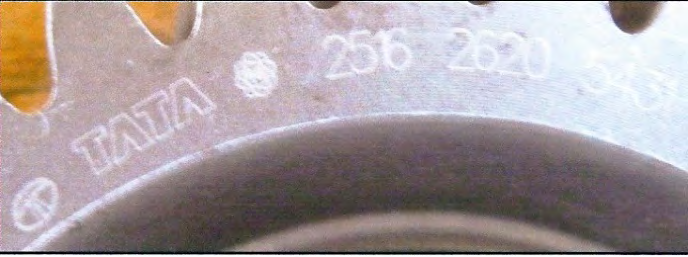
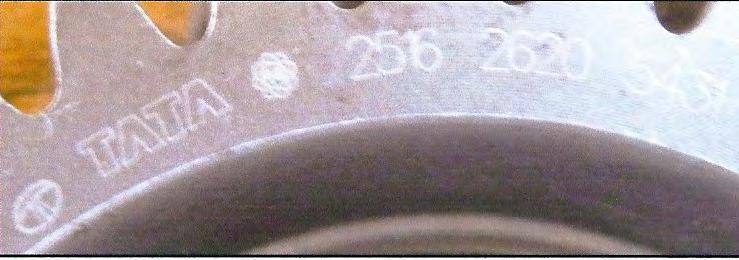
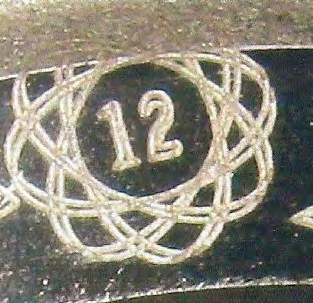
Figure 3 indicates the Logo and Artistic Design of Exhibit marked Ex-A before the application of etching reagent and Figures 4 and 7 represents the Logo and Artistic Design of Ex-A after the application of the etching reagent which clearly shows that the surfaces remains unchanged. The Logo and Artistic Designs remains sharp and distinct and exhibits almost zero effects.
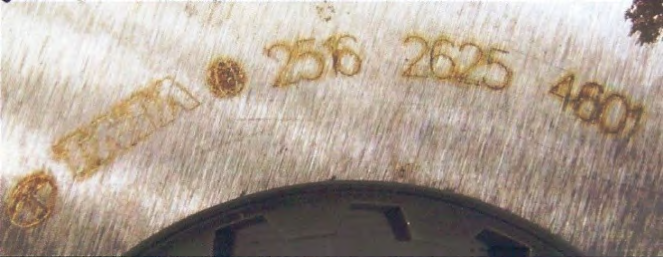
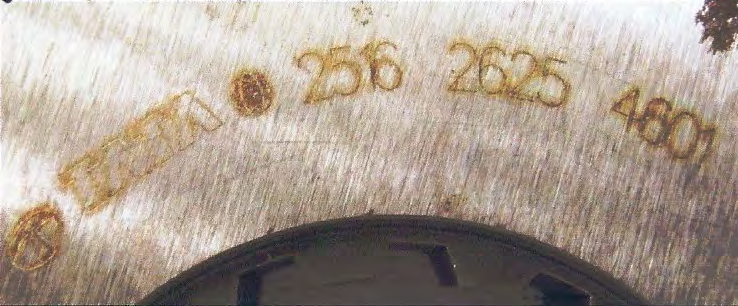
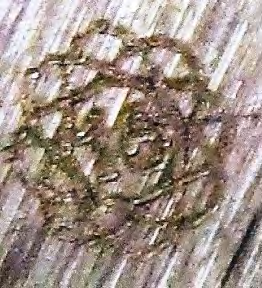
Similarly, Figure 5 indicates the Logo and Artistic Design of Exhibit marked Ex-B before the application of etching reagent and Figures 6 and 8 represents the Logo and Artistic Design of Ex-B after the application of the etching reagent. The above Figures (6 and 8) clearly points to the deformations gradually appearing on the surfaces as a result of the chemical reagent dissolving on its surfaces which appears as corrosions.
These changes/deformations are completely absent in the case of the surface of Ex- A. Another vital observation is that the stamping/punched marks of Logo and Artistic design on Ex-B are not so deep/immersed as that compared to the original spare part.
Discussion
On the basis of the above findings, the use of Etching Reagent on metallic surfaces has provided an important solution to Forensic Experts to help determine the differences between an original and a duplicate spare part and also giving an indication of the quality of a material based on the study of such corrosions and deformations observed on the surfaces. This method also proves to be the simplest and most effective as it does not requires any expensive equipment and it works well on any size or type of material in differentiating the original Spare parts from the duplicate one. Last but not the least, this decision entirely depends on the expertise and the discretion of the Expert concerned.
References
-
Katterwe H (1994) The recovery of Erased Numbers in Polymers. Journal of Forensic Science Society 34(1): 11- 16.
-
Springer E, Bargman P (1994) Application of Non- destructive Testing (NDT) in Vehicle Forgery Examination. Journal of Forensic Sciences 39(3): 751- 757.
-
Rao MB (Retd.) Forensic Science Laboratory, Haryana.
-
Nabar BN (2001) Forensic Science in Crime Investigation. 3rd (Edn.), pp: 215.
-
Thornton JI, Cash Man PJ (1976) The Mechanical of the Restoration of Obliteration Serial Numbers by Acid etching. J Forensic Sci Sco 16(1): 69-71.
-
Thirunavukkarasu G, hemalatha M, Kuppusamy R (2002) Restoration of Obliterated Painted Registration Number on Vehicle. J Forensic Sci 47(2): 374-376.
-
Kittel C (2005) Introduction to Solid State Physics. John Wiley & Sons, Inc.
- Forensic Implications of Adverse Drug Reactions in Schizophrenia A Case Series
- Narcotics and Digital Forensics: Bridging Crimes in the Digital Age
- Ethics in Forensic Psychiatry: Principles, Dilemmas, and Human Rights
- Impact of Acute Stress on Attentional Orienting to Social Cues
- Head Injury and Intracranial Hemorrhage in Western Region of Libya
- A Forensic Study on Handedness: Examination of Handwriting Features in Right and Left Handed Writers