
Firearm Fatalities in Benghazi from 2011 to 2013
The present work aimed to determine and analyze the pattern of firearm injuries among deaths at Benghazi Medico-Legal Center (Al Jala mortuary), Ministry of Justice, Libya, during 2011-2013. A retrospective study from 2011 to 2013 was conducted to evaluate firearm fatalities referred to the Medico-legal Center. Collected data were statistical analyzed. There were 181 firearm deaths received during the study period. More than half of fatalities were reported in 2011 as they represented 97 (53.6%) deaths, and 40 (22.1%) deaths occurred in 2012. The remaining deaths 44 (24.3%) occurred in 2013. Male gender was the predominant gender among the overall cases as they represented 173 cases (95.6%), overall mean age 29.53 (±10.6) years. The mean age was very close over the three years. The firearm injuries among the surveyed deaths through the three years were either gunshot (81.8%) or explosive injury (18.9%). Military homicidal manner of death was predominantly during 2011, on the other hand, civilian homicidal manner of death was more in 2012 and 2013.
Introduction
Libya, a Northern African country, was first inhabited by Berbers, followed by Phoenicians, Greeks, Romans, Arabs and Ottomans. Libya became independent in 1951 after a brief period as an Italian colony; it had been invaded by Italy in 1911. In February 2011 an uprising against the government occurred in Benghazi city. Benghazi is the second largest city in Libya.
Firearm fatalities are a cause mortality, with a higher incidence in developing and developed countries depending on weapon access, law and regulations as well as culture specifics [1]. The severity depends on the type of the gun and distant from which the victim was shot [2]. After the revolution of 2011, an expansion in the rate of violence was noted in Libya. The incidence and pattern of firearm deaths in Benghazi city have not previously been studied. The aim of the study was to evaluate firearm deaths. The objective of the study was to outline the pattern of firearms deaths in the Benghazi city and compare it with the pattern seen in other parts of the world.
In the city of Philadelphia, firearm homicide victims were between young (age 15-24 years) [3]. In Northern India, the deliberate firearm injuries were most common in 21 to 30 years age group [4]. In one of the densely populated Saudi Arabian areas, median age of the firearm and air gun victims was 32 years, ranging from 4 to 60 years old. The male to female ratio was 23.5:1. Majority of the cases were accidents or use of firearms as enjoyable tools [5]. Another study in New York City reviewed the firearm deaths caused by police over a-4years period showed that the average age was 31 years and ranged from 17 to 64 years, and all of deaths were male except one case was a female [6].
Methodology
It was a retrospective study related to fatal firearm cases between the years 2011 and 2013. One hundred eighty-one cases were collected from the files of the Medico-Legal Centre, Ministry of Justice, Benghazi city, Libya. Data collected were organized, tabulated, and statistically analysed using a SPSS software version.
Results
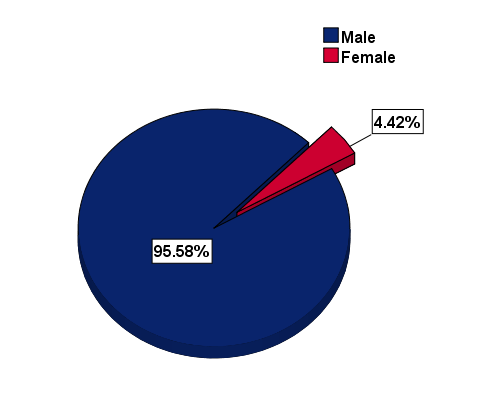
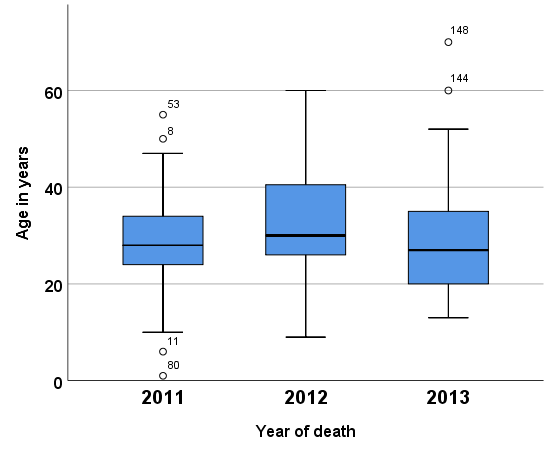
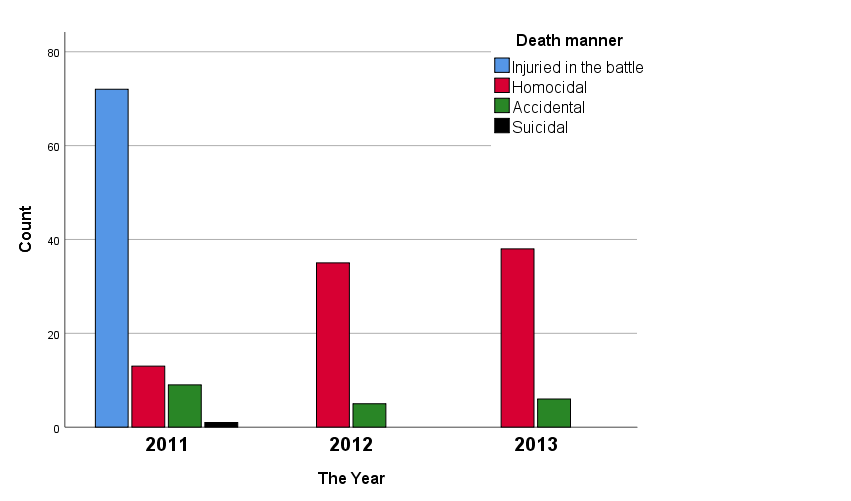
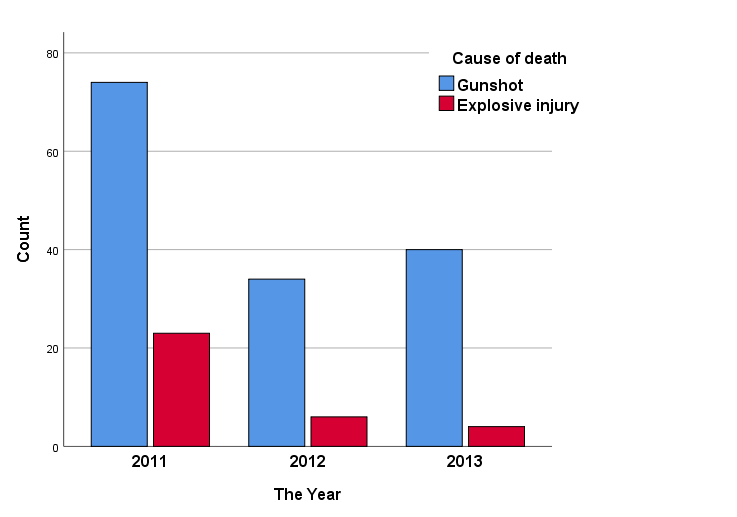
The overall sample size was 181 deaths. More than half of them were reported in 2011 as they represented 97 (53.6%) deaths, and 40 (22.1%) deaths occurred in 2012. The remaining deaths 44 (24.3%) occurred in 2013 (Table 1). Male gender was the predominant gender among the overall cases as they represented 95.6%, while female constituted 4.4%. Thus, throughout the three years males represented 96.9% of cases in 2011, 90% in 2012 and 97.7% in 2013 (Table 1 and Figure 1). Age of firearm deaths included in this survey ranged from 1 year to 70 years, with an overall mean age 29.53 (±10.6) years. The mean age was very close over the three years as the mean age of 2011 was 28.2 (±9.3) years, in 2012 was 32.7 (±11.1) years, and in 2013 was 29.6 (±12.6) years (Table 2). Some readings were detected by box plot as outlier (Figure 2), these were explored, four of them were in 2011 as found to be 55, 50, 6, and 1 year. Two were in 2013 (60 and 70 years). Analysis of variance (ANOVA) to compare the mean age over the three years showed no statistically significant difference between mean age across the three years (F= 2.58, P. value= 0.079). With regarding the manner of death of the surveyed sample, it showed that in 2011 there was 95 firearm deaths, about 75.8% of them (72 cases out of 95) were injured in the battle, 13.7% (13/95) were civilian homicidal, 9.5% (9/95) were accidental and one case was suicidal. While in 2012 there was 40 firearm deaths, about 87.5% (35/40) civilian homicidal, 12.5% (5/40) were accidental. Also, in 2013 there was 44 firearm deaths, about 86.4% (38/44) were homicidal and 13.6% (6/44) were accidental (Table 3 and Figure 3). The cause of the death in firearm injuries among the surveyed deaths through the three years were either gunshot in 81.8% (148/181) or explosive injury in 18.9% (33/181). Fifty percent of gunshot cases occurred in 2011, 23% in 2012 and 27% in 2013. While explosive injury caused death of 33 cases, 69.7% in 2011, 18.2% in 2012 and 12.1% in 2013 (Table 4 and Figure 4). Cross tabulation showed no significant association between cause of death and year of death (Chi-square = 4.7, P. value = 0.1).
| Year | Frequency % | Gender distribution | |
|---|---|---|---|
| Male | Female | ||
| 2011 | 97 (53.6%) | 94 (96.9%) | 3 (3.1%) |
| 2012 | 40 (22.1%) | 36 (90%) | 4 (10%) |
| 2013 | 44 (24.3%) | 43 (97.7%) | 1 (2.3%) |
| Overall | 181 (100%) | 173 (95.6%) | 8 (4.4%) |
Table 1: Distribution of firearm deaths according to year of death and gender.
| Statistics | All | 2011 | 2012 | 2013 | |
|---|---|---|---|---|---|
| N | Valid | 178 | 97 | 40 | 41 |
| Missing | 3 | 0 | 0 | 3 | |
| Mean | 29.53 | 28.19 | 32.68 | 29.63 | |
| SD | 10.6 | 9.3 | 11.1 | 12.6 | |
| Median | 28 | 28 | 30 | 27 | |
| Minimum | 1 | 1 | 9 | 13 | |
| Maximum | 70 | 55 | 60 | 70 |
Table 2: Age related statistics of firearm deaths (Benghazi city, Libya 2011-2013).
| Year | Death manner | Total | |||
|---|---|---|---|---|---|
| Injured in the battle | Homicidal | Accidental | Suicidal | ||
| 2011 | 72 | 13 | 9 | 1 | 95 |
| 2012 | 0 | 35 | 5 | 0 | 40 |
| 2013 | 0 | 38 | 6 | 0 | 44 |
| Total | 72 | 86 | 20 | 1 | 180 |
Table 3: Manner of death of the surveyed firearm sample (Benghazi city, Libya 2011-2013).
| Year | Cause of death | Total | ||
|---|---|---|---|---|
| Gunshot | Explosive injury | |||
| 2011 | Count | 74 | 23 | 97 |
| % | 50.00% | 69.70% | 53.60% | |
| 2012 | Count | 34 | 6 | 40 |
| % | 23.00% | 18.20% | 22.10% | |
| 2013 | Count | 40 | 4 | 44 |
| % | 27.00% | 12.10% | 24.30% | |
| Total | Count | 148 | 33 | 181 |
| % | 100.00% | 100.00% | 100.00% |
Table 4: Cause of death of the surveyed firearm sample (Benghazi city, Libya 2011-2013).
Discussion
The overall sample size was 181 deaths. More than half of them were reported in 2011 as they represented 53.6%, and 22.1% occurred in 2012. The remaining deaths (24.3%) occurred in 2013. This can be explained by the Libyan revolution that occurred in 2011, and therefore weapon availability made the rate of the firearm deaths increased. Various studies afford results for the theory that high approachability of guns is associated with an increased risk of deadly firearm injuries [7, 8]. More studies have supported the view that firearm rules are followed by a significantly decrease incidence of suicides [9, 10], homicides [11], and accidental deaths [12] caused by firearms. Therefore, assault by firearm happens all around the world, in countries in which guns are illegal [13].
Age of firearm deaths included in this survey ranged from 1 year to 70 years, with an overall mean age 29.53 (±10.6) years. Male gender was the predominant gender among the overall cases as they represented 95.6%, while female constituted 4.4%. In current study the manner of death was mainly military homicidal manner, and the cause of death was either gunshot in or explosive injury. The age and gender of the victims were consistent with the results of other studies, however, the manner of death was different as other studies were conducted in peace time, while our study was analysed the firearm deaths of war time.
Conclusion
More than half of fatalities were reported in 2011. Male gender was the predominant gender among the overall cases. Overall mean age 29.53 (±10.6) years. The mean age was very close over the three years. Firearm injuries among the surveyed deaths through the three years were either gunshot or explosive injury. Military homicidal manner of death was predominantly during 2011, on the other hand civilian homicidal manner of death was more in the years 2012 and 2013.
References
-
Streib EW, Hackworth J, Hayward TZ (2007) Firearm suicide: use of firearm injuries and death surveillance system. The Journal of Trauma 62(3): 730-734.
-
Meral O, Saglam C, Gullupinar B, Akturk OE, Beden S, et al. (2020) Investigation of Firearm Injury Cases Presented to Training and Research Hospital’s Emergency Services. Turkish Journal of Trauma and Emergency Surgery 26(1): 74-79.
-
McGonigal MD, Cole J, Schwab CW, Kauder DR, Rotondo MF, et al. (1993) Urban Firearm Deaths: a five-year perspective. The Journal of Trauma 35(4): 532-537.
-
Khan I, Shakeel M, Usmani JA, Hasan SA (2016) Emerging Trends of Intentional Firearm Injuries in Northern India. A study. Journal of Clinical and Diagnostic Research 10(10): HC01-HC04.
-
Morgan A, AlAqil NA, AlOkeil NA, AlGhaleb SA, AlOtaibi AF, et al. (2019) Firearm injuries in rural Saudi Arabia: incidence, patterns, management, and cost. Egyptian Journal of Forensic Science 9: 4.
-
Gill JR, Styles MP (2008) Firearm Deaths by Law Enforcement. Journal of Forensic Sciences 54(1): 185- 188.
-
Dahlberg LL, Ikeda RM, Kresnow M (2004) Guns in the home and risk of a violent death in the home: Findings from a national study’, American Journal of Epidemiology 160(10): 929-936.
-
Miller MB, Hemenway D (1999) The relationship between firearms and suicide: A review of the literature. Aggression and Violent Behavior 4(1): 59-75.
-
Gagné M, Robitaille Y, Hamel D, Laurent DS (2010) Firearms regulation and declining rates of male suicide in Quebec. Injury Prevention 16(4): 247-253.
-
Andres AR, Hempstead K (2011) Gun control and suicide: The impact of state firearm regulations in the United States, 1995–2004. Health Policy 101(1): 95-103.
-
Chapman S (2001) Advocacy in public health: Roles and challenges. International Journal of Epidemiology 30(6): 1226-1232.
-
Junuzovic M, Eriksson A (2011) Unintentional firearm hunting deaths in Sweden. Forensic Science International 216(1-3): 12-18.
-
Gun deaths by country 2022.
- Forensic Implications of Adverse Drug Reactions in Schizophrenia A Case Series
- Narcotics and Digital Forensics: Bridging Crimes in the Digital Age
- Ethics in Forensic Psychiatry: Principles, Dilemmas, and Human Rights
- Impact of Acute Stress on Attentional Orienting to Social Cues
- Head Injury and Intracranial Hemorrhage in Western Region of Libya
- A Forensic Study on Handedness: Examination of Handwriting Features in Right and Left Handed Writers