
Genetic Genealogy Using Y-STR Markers in Conjunction with Reverse Parentage Testing Aid Efforts in Human Identification and Familial Search Investigation (Case Study)
The personal identification of victim of mass disasters is one of the powers of forensic DNA typing. Genetic genealogy using Y-chromosome STR markers and reverse parentage testing (RPT) aid efforts in familial search investigation. A Dornier aircraft with commandants on board was declared overdue and a month later, skeletal remains found under sea, were subjected to DNA analysis. The case was quite challenging as the skeletal remains exhibited different rates of degradation. The skeletal remains along with reference samples from blood relatives of victims were subjected to different protocols to generate reproducible and typeable, amelogenin, autosomal and Y-STR profiles. Y-chromosome analysis in conjunction with RPT led to establishment of victim identity and rendered fruitful results in familial search investigation.
Usha Rani M, Mahalakshmi N*, Thilaga D and Jeevanathan A
DNA Division, Forensic Sciences Department, Chennai, India *Corresponding author: Dr Mahalakshmi N, DNA Division, Forensic Sciences Department, Chennai-600004, Tamilnadu, India, Email: mahaforensic@gmail.com; musharani.2007@ rediffmail.com
Case Report
In the year 2015, an Indian Coast Guard Dornier aircraft was tasked for Maritime Surveillance and reconnaissance sortie on naval mission. The aircraft was launched at 1805 hrs from an airfield for a 4 hours duration sortie and scheduled to land back at the airfield at 2200 hours. The aircraft was declared overdue as it did not return to base till 2230 hours and search was initiated. Preliminary investigations revealed that the aircraft had last communicated with ATC Radio at 2100 hours on its return to the airfield. During the communication, the aircraft had intimated ATC of their intention of returning to the airfield at 2200 hours estimated arrival time. Subsequently, the radar contact of the aircraft was lost at about 2125 hours .It is further submitted that the aircraft were manned by three coast guard officers who have also gone missing along with the aircraft. One month later, wreckage of above flight was found at the length of 990 meters with the help of Reliance vessel Olympic canyon which included data recorder, two engines, propellers, and airframe parts etc. The remotely operation vehicle that has been carrying out underwater searches also found remains under sea and were retrieved from seabed. The remains were subjected to DNA analysis involving Y-chromosome testing and reverse paternity testing for victim identification and familial search investigation.
Materials and Methods
Study Samples
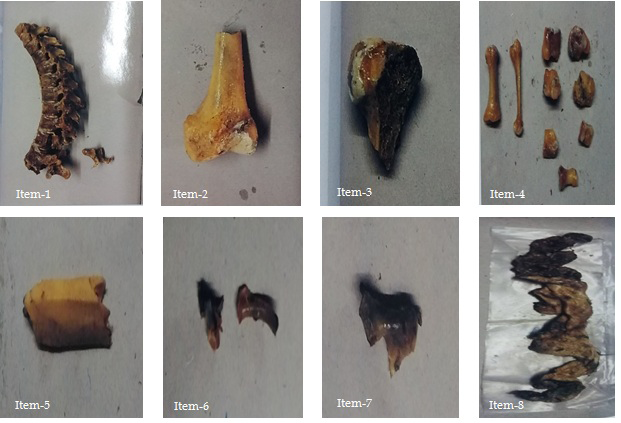
The following items of remains, the study samples were retrieved from seabed. (1) vertebra (12 nos, intact) (2) lower end of the femur (probable) (3) upper end of the humerus (probable) (4) nine pieces of bones (probable) (5) mid tibia and spinious process (probable) (6) part of rib (probable) (7) part of scapula (probable) (8) tissue mass (probable) (Figure 1).
Reference Samples
Blood samples collected from blood relatives of the victims (commandants) were used as the reference samples for comparison purpose.
DNA Extraction
DNA was extracted from the remains and blood samples using Automate Express DNA extraction system (Applied Biosystems). Bone items of the remains were processed using Prepfiler Express BTA Forensic DNA extraction method employing the protocol of bone and tooth. Tissue samples and blood samples from living relatives collected on FTA cards were processed using Prepfiler Express Forensic DNA extraction method employing the protocol of tissue and blood on FTA card.
DNA Quantification
The DNA quantity of the samples was determined by Real time - polymerase chain reaction (PCR) using Quantifiler Duo DNA Quantification kit (Applied Biosystems). Briefly, 2μL study sample was mixed with 23μL master mix containing 12.5μL reaction mix and 10.5μL primer and analyzed on ABI PRISM 7500 Sequence Detection Systems (Applied Biosystems) along with controls and standards; about 1ng DNA was used for further analysis.
PCR Amplification and DNA Denaturation
Following DNA isolation, specific short tandem repeat (STR) regions of DNA useful in forensic investigation are amplified by PCR using AmpFlSTR Identifiler Plus PCR Amplification kit for amelogenin sex locus and 15 autosomal STR loci namely D8S1179, D21S11, D7S820, CSF1PO, D3S1358, TH01, D13S317, D16S539, D2S1338, D19S433, vWA, TPOX, D18S51, D5S818 and FGA. Similarly, 17 Y-STR loci namely DYS456, DYS389I, DYS390, DYS389II, DYS458, DYS19, DYS385 a/b, DYS393, DYS391, DYS439, DYS635, DYS392, Y GATA H4, DYS437, DYS438, DYS448 was amplified by PCR using AmpFlSTR Y-Filer PCR Amplification kit.
Amplification was performed in MicroAmp Optical 96- well reaction plate (Applied Biosystems) in the GeneAmp PCR system 9700 with a gold-plated silver block (Applied Biosystems) using two-step PCR cycling protocol for DNA samples amplification consisting of enzyme activation at 95°C for 11 min, followed by 28 cycles of denaturation at 94°C for 0.2 min and annealing/extension at 59°C for 3 min. A final extension step was performed at 60°C for 10min, followed by a hold at 4°C. For Y-chromosome amplification, a three-step PCR cycling protocol consisting of enzyme activation at 95°C for 11 min, followed by 30 cycles of denaturation at 94°C for 0.2 min and annealing/extension at 61°C/72 °C each for 1 min. A final extension step was performed at 60°C for 80 min, followed by a hold at 4°C.
The amplified product which is double stranded in nature is converted into single strands by performing a denaturation step at 95ºC for 3 minutes followed by 4ºC for 3 minutes using Hi-Di formamide in a PCR thermal cycler (Biometra).
Sample Electrophoresis and Data Analysis
PCR products were separated and detected on the 3130xl Genetic Analyzer using the specified G5 variable binning modules (Applied Biosystems). Samples were prepared by adding 1μL of the PCR product or allelic ladder to 11μL of formamide-LIZ solution (10.7μL of deionized Hi- Di formamide and 0.3μL of GeneScan 500 LIZ size standard; Applied Biosystems). Capillary electrophoresis was carried out when samples were injected at 3 kV for 10 sec and electrophoresed at 15 kV for 1500 sec in performance optimized polymer-4 (POP-4) with a run temperature of 60°C. Following data collection, electrophoresis results were analyzed using GeneMapper ID-X software v1.5 (Applied Biosystems). Allele peaks were interpreted when the peak heights were ≥50 relative fluorescence units (RFU). Fluorescence based detection markers increased the sensitivity of measuring PCR-amplified STR alleles. After detecting the STR alleles sample genotyping was performed by determining the number of repeats in a DNA sequence.
Reverse Parentage Testing
The resulting DNA profile (amelogenin, autosomal and Y-STR) for each item of the remains is compared with DNA profiles obtained from reference blood samples collected from blood relatives (A; C,D; E,F) of the victims (1,2,3) for identification.
Results and Discussion
DNA analysis is a gold standard for identifying disaster victims. It is the main method of choice to identify individual disaster victims from severely fragmented, decomposed or skeletonized bodies [1]. It is one of the primary techniques to identify missing persons in a disaster, as defined by the Interpol Disaster Victim Identification Guide [2]. New innovations in DNA technology has made DNA analysis to be carried out in very small amounts of available DNA and in short duration of time. Vagish kumar, et al. [1] has demonstrated that DNA analysis significantly aids in the identification of mass-disaster victims.
Genetic characteristics on the human Y chromosome provide a lineage marker in the form of a single haplotype transferred directly from father to son. A haplotype is the set of STR alleles typed on a single Y chromosome. The uniparental nature of this marker has made the Y chromosome, a popular marker in genetic genealogy. Its popularity is based on its haploid character and its close association with the patrilineage behaviour [3]. Y-chromosome analysis and its implication in genealogical familial search investigation have undergone rapid improvements in recent years [4]. Because STR haplotypes are shared between paternally related men belonging to the same paternal lineage, Y STR haplotype analysis is employed in paternity disputes of male offspring and other types of paternal kinship testing, missing persons and disaster victim identification involving men [5].
Reverse parentage testing is also of high value in identification of remains as part of missing person’s investigations or mass disaster victim identification work [6]. In this testing, the question under consideration may be whether or not a child belongs to the mother and father tested or other biological reference available. This is essentially the opposite as that asked in parentage testing, namely given a child’s genotype who the parents are. Hence this testing was used in the present case to identify remains retrieved from seabed.
Disaster victim identification is very important for legal, administration and humanity reasons. DNA analysis is an important method of disaster victim identification particularly when other methods of identification are not possible or not conclusive [1]. Identification of the skeletal remains were quite challenging in this case. By the very nature of the disaster, there is typically damage done to the biological samples and hence the DNA molecules contained therein. Extreme environmental conditions both during and after the disaster impact the quality of the recovered skeletal remains. Hence the study samples which were in different states of degradation were subjected to different techniques and various types of protocols to generate amelogenein, autosomal STR and Y-STR profiles. These profiles were compared and analyzed by Y-STR and reverse parentage testing with the profiles generated from blood samples from living blood relatives of the victims.
In an individual, under each of the STR locus, one allele should be contributed by the biological mother (maternal) and the other allele should be contributed by the biological father (paternal). Of the two alleles under each of the 15 STR loci found in the deceased person 1, to whom the bones in item 1, item 4 (1-5 and 7-9) and item 6 (1 and 2) belong, one of the alleles is found to be present in Mr.A, the admitted father of the deceased person 1. Hence Mr.A is not found excluded from the paternity of the deceased person to whom the bones in item 1, item 4 (1-5 and 7-9) and item 6 (1 and 2) belong under any of the 15 STR loci tested. Also, the Y-STR haplotype detected in Mr.A and bones in item 1, item 4 (1-5 and 7-9) and item 6(1 and 2) have identical alleles under all the 17 Y-STR loci tested indicating the same family lineage (Table 1 and 2).
| Autosomal 15 STR loci | Victim 1 Vs reference samples | Victim 2 Vs Reference samples | Victim 3 Vs Reference samples | |||||
|---|---|---|---|---|---|---|---|---|
| Genotype | Genotype | Genotype | ||||||
| Mr.A | item 1, item 4 (1-5 and 7-9), and item 6 (1 and 2) | Mr.C | Item 3 | Mrs.D | Mr.E | Item 7 | Mrs.F | |
| D8S1179 | 10,12 | 12,12 | 10,15 | 10,15 | 10,12 | 11,15 | 10,15 | 10,10 |
| D21S11 | 32.2,34.2 | 31.2,32.2 | 30,32.2 | 32.2,32.2 | 32.2,32.2 | 29,33.2 | 29,33.2 | 30,33.2 |
| D7S820 | 8,8 | 8,11 | 10,12 | 10,13 | 10,13 | 10,10 | 10,10 | 10,12 |
| CSFIPO | 12,12 | 12,12 | 11,12 | 11,11 | 10,11 | 10,11 | 9,11 | 9,11 |
| D3S1358 | 17,17 | 17,17 | 15,17 | 15,17 | 15,17 | 15,17 | 14,15 | 14,18 |
| TH01 | 7,8 | 7,8 | 7,9 | 7,8 | 6,8 | 6,9 | 7,9 | 6,7 |
| D13S317 | 8,12 | 8,8 | 8,12 | 8,8 | 8,8 | 11,13 | 11,13 | 12,13 |
| D16S539 | 11,11 | 11,11 | 11,13 | 11,13 | 8,11 | 9,9 | 8,9 | 8,13 |
| D2S1338 | 18,18 | 18,20 | 23,24 | 23,24 | 18,23 | 19,23 | 23,23 | 23,24 |
| D19S433 | 15,15 | 15,16.2 | 14,15.2 | 14,15 | 13,15 | 12,15 | 15,15 | 15,16 |
| vWA | 14,18 | 14,15 | 16,18 | 16,17 | 17,17 | 17,18 | 14,18 | 14,14 |
| TPOX | 9,11 | 11,11 | 8,11 | 10,11 | 9,10 | 8,12 | 11,12 | 9,11 |
| D18S51 | 14,16 | 14,16 | 14,15 | 14,15 | 15,15 | 15,15 | 15,17 | 12,17 |
| D5S818 | 11,12 | 11,12 | 10,11 | 11,11 | 10,11 | 11,13 | 11,13 | 12,13 |
| FGA | 17,23 | 23,23 | 23,24 | 22,24 | 18,22 | 23,24 | 24,25 | 20,25 |
| Amelogenin | X,Y | X,Y | X,Y | X,Y | X,X | X,Y | X,Y | X,X |
Table 1: Genotype results on the study samples (remains) and reference samples of blood relatives of victims obtained with AmpFlS
| 17 Y-STR loci | Victim 1 Vs reference samples | Victim 2 Vs reference samples | Victim 3 Vs reference samples | |||
|---|---|---|---|---|---|---|
| Haplotype | Haplotype | Haplotype | ||||
| Mr.A | item 1, item 4 (1-5 and 7-9), and item 6 (1 and 2) | Mr.C | Item 3 | Mr.E | Item 7 | |
| DYS456 | 15 | 15 | 16 | 16 | 15 | 15 |
| DYS389I | 13 | 13 | 14 | 14 | 13 | 13 |
| DYS390 | 22 | 22 | 20 | 20 | 24 | 24 |
| DYS389II | 30 | 30 | 30 | 30 | 30 | 30 |
| DYS458 | 16 | 16 | 17 | 17 | 17 | 17 |
| DYS19 | 14 | 14 | 15 | 15 | 15 | 15 |
| DYS385 a/b | 12,14 | 12,14 | 12,18 | 12,18 | 13,18 | 13,18 |
| DYS393 | 13 | 13 | 13 | 13 | 12 | 12 |
| DYS391 | 11 | 11 | 9 | 9 | 10 | 10 |
| DYS439 | 10 | 10 | 12 | 12 | 11 | 11 |
| DYS635 | 23 | 23 | 24 | 24 | 20 | 20 |
| DYS392 | 11 | 11 | 11 | 11 | 11 | 11 |
| Y GATA H4 | 13 | 13 | 12 | 12 | 11 | 11 |
| DYS437 | 15 | 15 | 16 | 16 | 14 | 14 |
| DYS438 | 11 | 11 | 10 | 10 | 10 | 10 |
| DYS448 | 20 | 20 | 19 | 19 | 19 | 19 |
Table 2: Haplotype results on the study samples (remains) and reference samples of blood relatives of victims obtained with AmpFl
Similarly, of the two alleles under each of the 15 STR loci found in the deceased person 2, to whom the bone in item 3 belong, one allele was contributed by Mr.C and the other allele was contributed by Mrs.D, the admitted parents of the deceased person 2. Apart from the alleles accounted as present either in Mr.C or Mrs.D, no other unaccounted allele is present in the person to whom the bone piece in item 3 belongs. Hence Mr.C and Mrs.D are not found excluded from the paternity/maternity of the deceased person to whom the bone in item 3 belong under any of the 15 STR loci tested. Also, the haplotype detected in Mr.C and bones in item 3 have identical alleles indicating the same family lineage (Table 1 and 2).
Of the two alleles under each of the 15 STR loci found in the deceased person 3, to whom the bone in item 7 belong, one allele was contributed by Mr.E and the other allele was contributed by Mrs.F, the admitted parents of the deceased person 3. Apart from the alleles accounted as present either in Mr.E or Mrs.F, no other unaccounted allele is present in the person to whom the bone piece in item 7 belongs. Hence Mr.E and Mrs.F are not found excluded from the paternity/ maternity of the deceased person to whom the bone in item 7 belong under any of the 15 STR loci tested. Also, the 17 Y-STR haplotype detected in Mr.E and bone in item 7 have identical alleles indicating the same family lineage (Table 1 and 2).
DNA typing results of the skeletal remains and the blood samples collected from living blood relatives of the deceased victims demonstrated that 1) a) The deceased person 1 to whom the bones in item 1, item 4 (1-5 and 7-9), and item 6 (1 and 2) belong was the biological son of Mr.A. b) Mr.A and the deceased person 1 to whom the bones in item 1, item 4 (1-5 and 7-9), and item 6 (1 and 2) belong, come under the same family lineage. 2) a) The deceased person 2 to whom the bone in item 3 belong was the biological son of Mr.C and Mrs.D. b) Mr.C and the deceased person 2 to whom the bone in item 3 belong come under the same family lineage. 3) a) The deceased person 3 to whom the bone in item 7 belong was the biological son of Mr.E and Mrs.F. b) Mr.E and the deceased person 3 to whom the bone in item 7 belong, come under the same family lineage. The DNA extracted from item 2, item 4 (6), item 5 and item 8 could not be amplified and hence no DNA profile could be obtained.
Hence during identification of mass disaster victims, care has to be taken to collect and preserve body tissues for DNA extraction, since DNA begins to degrade and this degradation can be accelerated by environmental factors. Care should be taken to immediately preserve the collected DNA samples with available preservation methods and the collected samples should be processed as soon as possible. Utmost care should be taken not to contaminate the DNA samples. DNA analysis which was carried out on all the victim body and fragments enabled us to identify all the victims; one of the victims was identified with only a very small bone, thanks to our tireless efforts.
Conclusion
Genealogical studies using Y-chromosome STR markers and reverse parentage testing helped in the identification of victims. Chromosome Y testing also played immense role in aiding familial searching efforts by helping to screen out adventitious matches due to autosomal allele sharing. Victim identification is important considering humanitarian, legal and administrative aspects. Identification of victims based on our DNA report helped to inform the legal next of kin, resolve property issues, for criminal/civil litigation and for issuing of death certificates enabling the family to collect on life insurance policies. Also, the family members were able to get the remains to provide a proper burial and memorial service for their beloved ones. Hence DNA analysis should be considered and planned in every disaster incident. Apart from taking into consideration all the precautionary steps for DNA analysis, it must be ensured that all the victim body and fragments are subjected to DNA examination to hope for the identification of all the victims.
Acknowledgement
The authors thank Forensic Science Department, Chennai for the support and encouragement.
References
-
Blood samples collected from blood relatives of the victims (commandants) were used as the reference samples for comparison purpose.
- Forensic Implications of Adverse Drug Reactions in Schizophrenia A Case Series
- Narcotics and Digital Forensics: Bridging Crimes in the Digital Age
- Ethics in Forensic Psychiatry: Principles, Dilemmas, and Human Rights
- Impact of Acute Stress on Attentional Orienting to Social Cues
- Head Injury and Intracranial Hemorrhage in Western Region of Libya
- A Forensic Study on Handedness: Examination of Handwriting Features in Right and Left Handed Writers