
Sexual Violence by Means of Chemical Submission in the Context of Nightlife
Although chemical submission and vulnerability have already been described in forensic medical literature since the beginning of the 18th century, it is in the last two decades that this phenomenon has acquired great importance due to the increase in cases in which sexual violence is perpetuated on victims whose intellectual and volitional capacities are compromised, derived from the introduction of substances into their organism that on many occasions is related to their leisure activities. This article is based on a retrospective study carried out in the Autonomous Community of La Rioja (Spain) of cases of sexual violence that have required forensic medical intervention, between 2009-2020. In a sample of 202 cases of female victims over 12 years of age, variables such as the consumption of alcohol or other substances that facilitate sexual aggression and their relationship with nightlife, the hours of greatest incidence of this type of violence, and the public or private spaces in which these substance-mediated aggressions take place are evaluated. It is concluded that there are no significant differences in blood alcohol levels in victims of different ages, that the time in which assaults under chemical submission predominantly take place is at night, and the training of professionals is proposed for the adequate attendance to these people and awareness of the vulnerability associated with the abusive consumption of alcohol and substances.
Introduction
Chemical submission, as a phenomenon that facilitates sexual aggression, has acquired great social relevance in recent times, although classic authors such as Foderé [1] already described it more than two hundred years ago: “A person can be abused, although we do not know too many examples, after they have been made to take a narcotic drug with their food or drink: this crime must be classified as rape, indecent assault, executed with violence.” Today, Welner M, et al. [2] define the use of Drugs Facilitating Sexual Assault as the use of an agent, legal or illegal, to manipulate an unsuspecting person and, without their consent, have sexual relations or a gratifying psychosexual act. Chemical Submission has also been defined by Kintz P, et al. [3] and by Saint MP, et al. [4] as the administration of psychoactive substances to a person for delinquent and/or criminal purposes, being basically of a sexual nature.
The defining element of drug-facilitated sexual assault is the incapacitated state of the victim as a result of the ingestion of alcohol and/or other substances.
The other critical variable, from the victim’s perspective, is whether the disabling drug was surreptitiously given to the victim without their knowledge or consent, or were they misled as to its nature and effects. Hence, the scientific literature distinguishes between: premeditated or proactive submission, which takes place when the victim is given an incapacitating and disinhibiting substance without their knowledge; opportunistic submission (or chemical vulnerability), which occurs when the perpetrator takes advantage of the vulnerability of the victim who is in a state of unconsciousness due to some substance that they have voluntarily consumed; and mixed submission in which the voluntary intake of substances is compounded with covert administration [5].
The substances that can be used are diverse, but their common characteristics are [6]:
- Tasteless, colorless and odorless substances
- Fast acting and of short duration
- With effects at low doses. And the effects that are usually sought are:
- Anterograde amnesia
- Sedation
- Hallucinogenic effects
- Disinhibition.
The Guide of the World Health Organization [7], a reference in attending to victims of sexual violence, states that alcohol has been used for a long time to facilitate sexual relations without consent and continues to be the most popular “drug” of choice. In recent years, however, the use of “date rape” drugs has been implicated in an increasing number of cases of sexual violence. This WHO Guide gives indications for suspecting the possible use of drugs and alcohol, in the event that the victim presents any of the following symptoms:
- Altered state of consciousness, memory loss, disorientation or confusion
- Impaired speech or coordination
- Unexplained signs of trauma, particularly genital trauma
- Apparent intoxication that does not correspond to the declared alcohol consumption
- Unexplained loss or rearrangement of clothing
- Reference to having an “out-of-body experience.” A study conducted in the forensic unit of a hospital in Cape Town, South Africa found that in 12% of sexual assault cases, the patient and/or physician suspected DFSA. For those patients with suspected DFSA, blood, urine, and/or hair samples were analyzed to assess for common drugs of abuse. Drugs other than alcohol were detected in 56% of patients and included methamphetamine, cocaine, sedatives, and benzodiazepines [8].
The review study conducted by Souza YR, et al. [9] in 2020 highlights the importance of disseminating knowledge of facilitating substances and their pharmacological and diagnostic mechanisms, and especially sensitivity tests and the time the drug remains in the body, with which an approach could be achieved for the validation of analysis that allows the testing for the use of these substances in abuse. The most common substances, according to this study, are ethanol, benzodiazepines, gamma-hydroxybutyrate (GHB) and ketamine (KET).
The detection of cases of sexual assault by Chemical Submission is made difficult by a series of factors that come together, such as the delay in requesting help by the victim ‒facilitating the elimination of the toxicant‒, the low doses used and the easy confusion of this clinical situation with that of voluntary alcohol intoxication. At the time of clinical examination in the emergency department, the symptoms are nonspecific, usually neurological, and the history is complicated by the patient’s anxiety, amnesia, and confused state.
The report of the National Institute of Toxicology and Forensic Sciences on investigations into crimes against sexual liberty and indemnity [10] shows that legal and illegal substances frequently used in the general population are detected in the victims of these cases: alcohol, cocaine, cannabinoids, stimulants, prescription drugs (benzodiazepines, antipsychotics, antiepileptics, etc.) and non-prescription drugs (such as antihistamines). Other highly publicized substances, such as ketamine or GHB, have a very minor presence in the results. Alcohol consumption during leisure hours increases and, therefore, it is common for victims to report having consumed it, which is why it is found in the analyses of a large proportion of cases. Alcohol is by far the single most detected substance. In addition, there are times when no substance is detected in the tests, but the victim reports having ingested alcohol. Cases that combine alcohol with some of the substances frequently consumed in the population are also numerous [10].
A bibliographic review carried out by Panyella MN, et al. [11] in 2021 revealed that these crimes are committed mainly in nightlife situations and during weekends, the authors agreeing that the enabling risk factor is alcohol consumption [11].
On the other hand, the detection of more than one drug in positive samples from victims of sexual assault is quite common [12]. The use of more than one substance that can affect the function of the CNS exposes the victims to a situation of greater vulnerability, intensifying their loss of perception and reaction capacity. In addition, it can increase the risk of intoxication [9].
Methodology
The objectives of this retrospective study are to determine vulnerability factors related to the introduction of chemical substances into the body of female victims of sexual violence and their relationship with nightlife.
A review of the 278 forensic medical evaluations carried out on victims of sexual assault in La Rioja (Spain) between 2009 and 2020 was carried out, establishing as case criteria the female sex in those over 12 years of age who report non- consensual sexual contact, with a sample n=202 cases.
Different variables were analyzed, such as the level of alcohol in the blood and its relationship with age, the simultaneous consumption of different substances, the hours in which the victims with a positive result for substances in the toxicological examination were abused, as well as the day of the week in which the events took place.
Results and Discussion
Of the 202 cases that make up the sample, consumption of alcohol and/or toxic substances was detected in 51.5% of them (n=104). In 82 cases (40.6% of the sample) the substance detected was alcohol, in 18 of which the simultaneous presence of other psychoactive substances (psychopharmaceuticals and/or substances of abuse) was found. In 26 cases (12.9%) the victims had ingested benzodiazepines or other psychotropic drugs, exclusively in a third of them, and combined with substances of abuse such as cocaine, cannabis and amphetamine derivatives in the other two thirds of the cases. It can also be added that of the 26 cases in which benzodiazepines and psychotropic drugs appear alone or in combination with other substances, in 11 of them there was the presence of alcohol in the blood, with the consequent amplification of the depressant effects and the consequent increase in vulnerability.
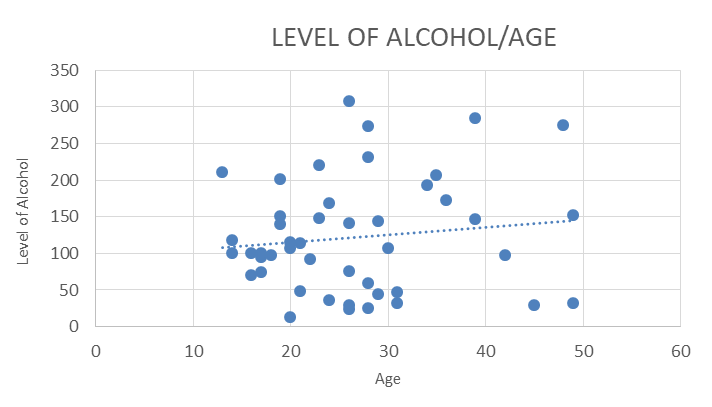
The study of the variable of alcohol consumption in the victims of sexual violence allows us to observe in the quantified cases that even though there are no significant age differences, a slightly ascending trend line is seen that shows the increase in the age of the victim along with the level of alcohol in the blood, revealing cases of young victims with relatively high blood alcohol levels (13-year-old, 211 mgr/ dL) and other older victims with higher alcohol consumption (26-year-old woman, 307 mgr/dL; 39-year-old, 284 mgr/dL; and 48-year-old woman, 275 mgr/dL) (Figure1).
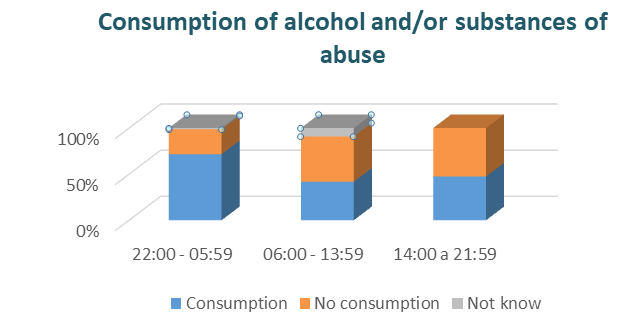
A multivariable study was carried out between the consumption of alcohol and/or substances of abuse and the different time slots in which the sexual assault took place, establishing that of the 74 assaults that took place at night (between 10:00 p.m. 5:59 a.m.) in 71.6% of the cases that occurred, alcohol or substances of abuse were involved, identifying differences between the sexual violence suffered at night with respect to that suffered in the morning (n=55) and afternoon (n=40), in which the proportion of alcohol or other toxic consumption in the victims is significantly lower, decreasing to 45.5% (n=23) and 47.5% (n=19), respectively (Figure 2). This analysis does not include the repeated violence that took place at multiple times, or those in which the time of the commission of the crime is not recorded.
Identified the night time (from 10:00 p.m. to 6:00 a.m.) as that in which the chemical vulnerability due to the consumption of alcohol and other substances is mostly present, we proceeded to study the day of the week in which this type of assaults was produced, resulting in a predominance on the night of Saturday to Sunday, when of the 22 sexual assaults, 86.4% of the victims (n=19) had some facilitating substance in their body. On the night of Friday to Saturday, the positives were 66% (n=8) of the 12 cases evaluated; from Thursday to Friday 60% (n=6) of the 10 cases evaluated; from Wednesday to Thursday 40% (n=2); from Tuesday to Wednesday 71.4% (n=5); from Monday to Tuesday 57.1% (n=4) and from Sunday to Monday 63.6% (n=7).
The study also allows us to observe an increase in the proportion of victims who present alcohol and/or drugs in direct relation to the increase in age. While in the group between 12 and 16 years old, chemical vulnerability did not reach 15%, the presence of substances between 17 and 22 years old is greater than 55% of cases and more than 65% between 23 and 30 years old, this being the age group in which consumption is most accentuated. From here, it decreases again between 31 and 40 years (61%) being the second age range in which the presence of substances is higher. In the victims between the ages of 41 and 50, the presence of facilitating substances was detected in 36% of the cases, while in two women between the ages of 51 and 52 there was no intake of alcohol or other substances and in a third, there was no data in this regard.
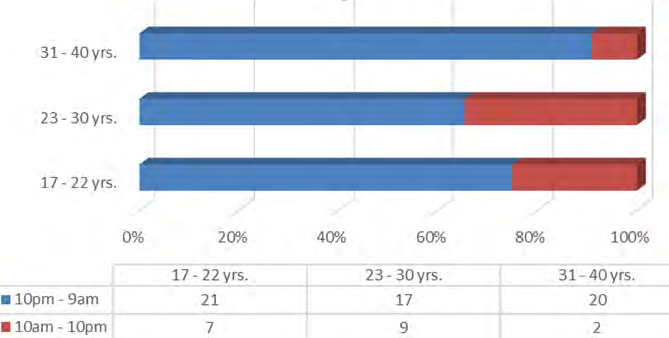
From here, the relationship of the previous variables with the time at which the sexual assault took place was established. In the case of the youngest group of victims in a situation of vulnerability with the presence of facilitating substances in their body, it is noted that 75% of them (n=21) were attacked at night, between 10 p.m. and 9 a.m. in the morning of the next day. Likewise, about 65% of the victims between the ages of 23 and 30 (n=17) confronted their aggressor between the same hours of the night. Finally, in the case of the age group from 31 to 40 years, more than 90% (n=20) of this type of sexual assault occurred at night. From this analysis it can be deduced that victims in a situation of vulnerability due to the introduction of facilitating substances into their bodies are attacked mainly at night.
In this regard, and as a fact that, although not of great importance in terms of planning possible prevention strategies, it is observed in the study that between 9 and 10 in the morning there are no cases of sexual assault in which alcohol or drug use is involved.
Finally, a multivariable study was done on the relationship between the time of the attack, the consumption of substances that influence vulnerability and the place of the events, comparing sexual violence in these circumstances in open public spaces and at home (Figures 4 and 5).
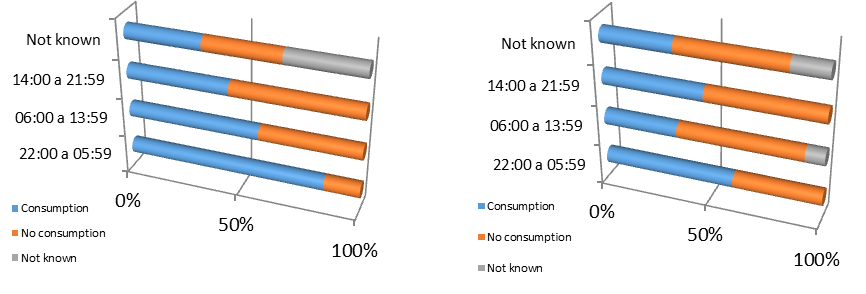
Figure 4 and 5: Relationship between aggressions that occurred in open public spaces or at home, with alcohol and/or substance use according to time.
In cases of sexual assault in open spaces, we can observe that 85% of the victims (n=17) who were assaulted between 10 p.m. and 6 a.m. the next day had consumed alcohol or some type of substance. This percentage decreases significantly between 6:00 a.m. and 2:00 p.m., down to 57% (n=4), although the number of victims attacked at that time was much lower. Finally, between 2 p.m. and 10 p.m., 44% (n=4) of the victims of sexual assault had toxic substances in their body. On the other hand, in cases of sexual assault perpetrated in the private homes either of the victim, the aggressor or a third party, between 10 p.m. and 6 a.m., toxic substances or alcohol were found in 60% (n=21) of the victims, decreasing this percentage to 37% (n=12), in cases of sexual assault between 6 and 2 p.m., while in the time slot between 2 p.m. and 10 p.m. 43% (n= 7) of the victims had consumed some type of toxic substance. Therefore, significant differences are observed regarding the greater vulnerability of the victims who were under the influence of substances and were attacked at night compared to those who had not consumed any substance, this difference being even greater in the victims who had some toxic substance in their body and were assaulted in open spaces compared to those that were assaulted in private homes, at the same hour of the night or morning.
Conclusion
The consumption of alcohol and/or psychoactive substances is present in 51% of the victims of sexual assault. Alcohol stands out as the main facilitating substance, as it is present in 40.6% of cases, and should be considered a first- order vulnerability factor.
Alcohol or other substances are present in 71.6% of the victims who suffer sexual assault at night, showing significant differences with respect to other time slots.
Although there is a slight upward trend, no significant differences have been identified between the amounts of alcohol ingested for recreational purposes according to the different age groups.
The training of professionals who evaluate these victims is essential to provide the adequate care that allows the rapid collection of biological samples, essential for toxicological analysis.
It is necessary to increase awareness campaigns regarding the vulnerability resulting from the abuse of alcohol or other toxic substances and about the possible risk of compounding the effects of these when taken together.
References
-
Foderé FE (1813) Treatise on Legal Medicine and Public Hygiene. The Mame Printing House, Paris, pp: 353-376.
-
Welner M, Welner B (2017) Drug-Facilitated Sex Assault Michael Welner and Barbara Welner. 5th (Edn.), In: Practical Aspects of rape investigation A Multidisciplinary Approach. Boca Raton: CRC Press, pp: 355-371.
-
Kintz P, Cirimele V, Villain M, Tracqui A, Ludes B (2002) Chemical Submission: Practical Approaches in Forensic Toxicology. Annals of Analytical Toxicology 14(4): 361-
-
Saint MP, Furet Y, O’Byrne P, Bouyssy M, Paintaud G, Autret-Leca E (2006) Chemical submission: a review of the literature. Therapy 61(2): 145-150.
-
Ministry of Justice, General Technical Secretariat (2022) Guide to good practices for forensic action before the victim of a crime facilitated by psychoactive substances: intervention on suspicion of chemical submission.
-
Vega P (2012) Instructions for action in cases of sexual assault with suspicion of intoxication. Ministry of Justice.
-
World Health Organization (2003) Guidelines for medico-legal care for victims of sexual violence., pp: 1-154.
-
Tiemensma M, Davies B (2018) Investigating drug- facilitated sexual assault at a dedicated forensic centre in Cape Town, South Africa. Forensic Science International 288: 115-122.
-
Souza YR, Lavorato SN, Carvalho JJ (2020) Violence against women and drug-facilitated sexual assault (DFSA): A review of the main drugs. Journal of Forensic and Legal Medicine 74: 102020.
-
National Institute of Toxicology and Forensic Sciences (2018) Report on investigations into crimes against sexual freedom and indemnity.
-
Panyella MN, Agustina JR, Martin FC (2019) Chemical submission versus chemical vulnerability: criminological analysis of sexual crimes facilitated by the use of psychoactive substances from a sample of sentences. Spanish Journal of Criminological Research 15(17): 1-23.
-
Anderson LJ, Flynn A, Pilgrim JL (2017) A global epidemiological perspective on the toxicology of drug- facilitated sexual assault: A systematic review. Journal of Forensic and Legal Medicine 47: 46-54.
- Forensic Implications of Adverse Drug Reactions in Schizophrenia A Case Series
- Narcotics and Digital Forensics: Bridging Crimes in the Digital Age
- Ethics in Forensic Psychiatry: Principles, Dilemmas, and Human Rights
- Impact of Acute Stress on Attentional Orienting to Social Cues
- Head Injury and Intracranial Hemorrhage in Western Region of Libya
- A Forensic Study on Handedness: Examination of Handwriting Features in Right and Left Handed Writers