
Identification of Ivory Using a Handheld XRF Spectrometer
Handheld XRF can be used as a screening tool, allowing rapid elemental analysis of materials in-situ. In this study, 280 ivory samples from 7 different species and 20 bone samples from 15 species were analyzed using a SciAps X-50 handheld XRF spectrometer. The data collected were used to establish a light element (LE) percentage range of 50.3% to 75.5%, and a calcium (Ca) percentage range of 24.5% to 49.5%. All ivory samples fall within these ranges, which represent the overall variation observed in ivory. Additionally, the XRF device was used to analyze the elemental composition of 123 samples from 10 biological and nonbiological material types frequently used as ivory substitutes (i.e, ivory look-alikes). The results showed that all look-alike values, except for bone, fall outside the experimental ranges established for ivory. Moreover, some materials have higher concentrations of other elements not present in ivory, such as titanium (Ti). The composition of bones was similar to ivory and could not be distinguished from ivory using this method alone. A significant difference in LE and Ca proportions was observed between cementum and dentin tissues in ivory from elephant. However, this difference falls within the overall variation when all species are considered. Multivariate analysis showed that species of origin of ivory samples could not be determined using this method. Six (6) blind validation samples were analyzed and correctly classified as ivory or substitutes using the established ranges. Our conclusion is that handheld XRF analysis can effectively assist in identifying genuine ivory and ivory look-alike materials, along with traditional morphological analysis, especially when Schreger lines are not visible on small carved objects.
Introduction
Handheld XRF devices are commonly used for earth science applications to determine the mineral composition of rocks and sediments, in metallurgy to analyze metals and alloys, and to identify heavy metal presence in contamination sites [1]. Many studies have also used portable XRF instruments for art conservation and archeological in-situ analysis [2]. The utility of such devices has found forensic applications, particularly in forensic anthropology, where it has been used to distinguish osseous and dental tissue from nonbone material [3, 4] and for species identification of human and non-human bones [1, 5] used handheld XRF to calculate Ca/P ratios and LE percentages to discriminate ivory from antlers, bones and non-ivory items in the wildlife trade. Their analysis showed that biological materials such as keratin, hides, seashells, wood, and vegetable ivory, as well as plastics, could be differentiated from ivory. Plastics and resins showed high standard deviations in their elemental composition.
Budhacahat K, et al. [1] used a handheld XRF device to differentiate between Asian and African elephant (Elephas maximus and Loxodonta africana), by scanning cementum from whole tusks. They detected a total of 26 elements, 21 of which differed significantly between the two species. Most of them also varied depending on the tusk region scanned. Nine elements (Si, S, Cl, Ti, Mn, Ag, Sb, W, and Zr) were subsequently used to develop a statistical model to discriminate between both species.
In this study our goal is to investigate if the analysis of ivory using a non-invasive, non- destructive SciAps X-50 handheld XRF spectrometer can differentiate among species commonly seen in museum collections and commercial trade [6]. This hypothesis will also investigate if cementum and dentin have similar elemental profiles and determine if ivory look-alikes can be identified with this analytical approach.
Materials and Methods
Ivory and Look-Alike Specimens
Ivory items from eight different species frequently encountered in the ivory trade were selected for analysis [6, 7]. Tooth and tusk specimens were selected for African and Asian elephants (Loxodonta africana, Elephas maximus), mammoth (Mammuthus sp.), walrus (Odobenus rosmarus), sperm whale (Physeter macrocephalus), narwhal (Monodon monoceros), warthog (Phacocherus sp.) and hippopotamus (Hippopotamus amphibius). African and Asian elephant specimens were pooled in one group. Analyses was performed on the cementum (n=20) and dentin (n=20) for each taxa on specimens that were either intact teeth or tusks or on carved items. Our assumption is that each specimen originated from a different individual. Additionally, 20 bone samples from 15 different species were selected for XRF analysis including tiger (Panthera tigris), lion (Pantera leo), gorilla (Gorilla gorilla), snow leopard (Panthera unica), hyena (Hyaena hyaena), leopard (Panthera pardus), wolf (Canis lupus), New Guinea singing dog (Canis hallstromi), California sea lion (Zalophus californianus), lynx (Lynx rufus), Stellar sea lion (Eumetopias jubatus), black colobus (Colobus satanas), American black bear (Ursus americanus), Asian black bear (Ursus tibetanus), and North American river otter (Lutrcanadenis). All the specimens used in this study are listed in the Microsoft Excel file labeled “Supplemental Data”.
To determine intra-specimen variability, 20 scans were collected from a single elephant and mammoth tusk, at various dentin locations.
Different biological and manufactured materials that could be mistaken for ivory (i.e. ivory look-alikes) were included in this study. Natural materials consisted of vegetable ivory from tagua nuts (Phytelephus macrocarpa) and alabaster (CaSO4 · 2H2O). Synthetic materials included Resin-Ivory+STM, Celluloid, Casein based Ivorina from 3 different manufacturers, Vigopas, Dekorit, Ivorite, Epoxy resin composite (Epoxy + ivory dust), and Alabrite from 2 different sources. For each material, 20 spectra were measured, except for Vigopas, Dekorit, Ivorite, Epoxy composite, and the Alabrite casts, where 3 replicas were collected for each material, due to the small quantity of specimens available. (Table 1) shows a summary of the composition and main distributor of the synthetic ivory substitutes used in this study.
| Trade Name | Composition | Manufacturer or Distributor | Source |
|---|---|---|---|
| Celluloid | Cellulose nitrate and camphor | No longer produced | www.sciencehistory.org/distillations/cell uloid-the-eternal-substitute |
| Dekorit 203 Dekorit V384 | Phenol- formaldehyde thermosetting resin | Raschig, Gmbh, Ludwigshafen, Germany | www.plastiquarian.com/?page_id=1431 7 Falabella R. (2016) |
| Ivorite | Casein and hardener | Yamaha Corporation, Japan | www.livingpianos.com/fake-ivory- piano- keys/ |
| Resin-Ivory+S | Alkyd resin | David Warther & Co., Dover Ohio | www.guitarpartsandmore.com/product Category.php?Resin-Ivory-S-trade-S- Grade- Knife-Handle-Blocks-125 |
| Vigopas | Polyester resin | Raschig, Gmbh, Ludwigshafen, Germany | Craddock P [8] |
| Alabrite | Calcium carbonate and binder | No longer produced | Craddock P [8] |
| Epoxy+Ivory | Ivory dust and epoxy resin | ||
| Ivorina | Casein based plastic | www.plastiquarian.com/?page_id=1422 8 |
Table 1: Description of the Synthetic Ivory Substitutes.
All items selected for this study were part of the Reference Material Collection of the National Fish and Wildlife Service Forensic Laboratory.
XRF Device
XRF analyses of the ivory and ivory look-alike items was conducted using a SciAps X- 50 handheld XRF Analyzer (SciAps Inc., Boston, MA). The spectrometer measured the elemental composition of each specimen for 10 seconds. The percentage of light elements (LE) corresponded to the sum of the elements lighter than calcium (Ca, atomic number 20). Prior to each scanning session, the device was calibrated using the included Geo-mining protocol. Measurements were taken on the flattest parts of each sample to optimize the contact between the surface of the item and the scanning window.
Data Analysis
Elemental composition values were transcribed to a Microsoft Excel data spreadsheet. The raw data are shown in Microsoft Excel file labeled “Supplemental Data”.
To evaluate the quantitative variation of the XRF relative percentage, the mean (µ) and standard deviations (σ) were calculated from 20 measurements obtained from a single elephant and mammoth tusk.
To evaluate if dentin and cementum had the same elemental composition, the relative percentage for 20 unique specimens per species (i.e., each specimen was from a different individual) were measured and the mean (µ) and standard deviation (σ) were calculated. To evaluate if the percentage of LE and Ca was significantly different between cementum and dentin, t-tests were performed, using the values obtained from elephant and mammoth samples. Statistical analysis was conducted, and results were plotted using the software JASP.
A Linear Discriminant analysis (LDA) was firstly conducted to show the separation between ivory items and non-ivory items based on elemental composition. Since LE and Ca relative percentage are much higher than other elements, a Z-score normalization was applied. A second LDA was performed in the same way, to investigate whether ivory species and bone could be separated, based on their elemental composition. The software PAST (Paleontological statistics, Version 4.08) was used for this purpose.
Blind Test Validation Samples
Six items not used in the database development were selected to be used as validation samples. Three replicate XRF spectra were collected for each item and the mean (µ) and standard deviations (σ) were calculated. Their relative percentage results were then analyzed to determine whether they were ivory or a substitute.
Results
Handheld XRF devices allow rapid and non-destructive analysis of suspected ivory items in- situ. Different portable XRF devices are available on the market and can be equipped with various calibration methods and data collection settings. As a result, the range of elements that can be detected varies according to the instrument and the calibration used on the particular portable XRF. Numerous studies have used LE percentages and Ca/P ratios as a parameter to discriminate ivory from other materials [1, 5]. However, the XRF device used in the present study did not detect the presence of P, therefore hindering a comparison of the present study with the research of others.
Consequently, handheld XRF results and the inferences made thereof, is not easily exported to instruments manufactured by other vendors and databases require de- novo data collection.
XRF Reproducibility
The intra-variation measurements of dentin in an elephant and a mammoth tusk were determined by collecting 20 spectra from a single of each taxa.
| Dentin | |||||||
|---|---|---|---|---|---|---|---|
| Species | LE % | Ca % | Fe ppm | Ni ppm | Zn ppm | Sr ppm | |
| Elephant n = 20 | Mean | 68.8 | 31.2 | 162.4 | 230.1 | 41.4 | 164.4 |
| Variance | 1.2 | 1.2 | 623.2 | 1013.3 | 103.8 | 430.3 | |
| Std Dev | 1.1 | 1.1 | 25 | 31.9 | 10.2 | 20.7 | |
| Mammoth n = 20 | Mean | 70.6 | 29.3 | 229.8 | 230.8 | 179 | 199.3 |
| Variance | 2.1 | 2.1 | 2384.4 | 573.3 | 3159.2 | 288.2 | |
| Std Dev | 1.5 | 1.5 | 48.8 | 23.9 | 56.2 | 17 |
Table 2: Summary of Mean and Standard Deviation (N=20 Spectra) to Determine Reproducibility of a Handheld XRF.
Table 2 shows that the elemental composition varied little within a single specimen; summary values are shown and individual measurement for each data collection is shown in supplemental (Table 1). The standard deviations for LE and Ca did not exceed 1.1% for elephant and 1.5% for mammoth which demonstrates the accurate semi-quantitative reproducibility of the handheld XRF.
Tissue Type
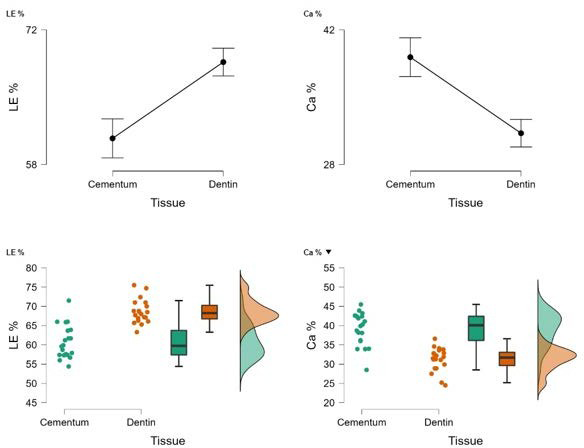
On unmodified teeth and tusks, XRF measurements are mostly conducted on the exterior cementum tissue, since it forms the outer layer of the tusk. In contrast, most carved items consist of dentin, which is the tissue beneath the cementum layer. In museums, art galleries or in trade, both raw and carved items can be encountered. Therefore, it is of importance to determine whether the elemental composition of both tissues is significantly different. Table 3 shows the summary of mean and standard deviation of the elemental composition measured in cementum (Cem) and dentin (Den) from all the species used in this study. The t-tests analysis conducted on the relative percentage from elephant showed that the percentage of LE was significantly higher in dentin, whereas cementum contained significantly more Ca (p-value < 0,001) (Figure 1).
Relative Percentage Results of Ivory and Look- Alike Specimens
Figures 2 & 3 show the percentage of LE and Ca of all ivory species and ivory substitutes. The raw data is shown in the supplemental Microsoft Excel spreadsheet labeled “Ivory and Look-alikes Supplement File” The XRF measurement of ivory and bone samples showed that these two tissue types had a similar elemental composition. All ivory samples had a percentage of LE ranging from 50.3% to 75.5 %, and Ca from 24.5 % to 49.5% regardless of the species or tissue. As expected, Ca was the most abundant element detected while other elements detected at trace levels were Fe, Ni, Zn, Sr, and occasionally Cu. However, Cu, when detected, was only present in small proportions and with a large variability within species. Fe, Zn, and Sr were generally more abundant in cementum than in dentin and presented a relatively large intra- and inter- variability. The proportions of Fe varied greatly between samples, especially in cementum, giving sometimes relatively high values. These results are possibly due to the presence of blood contamination on the surface of the tusks or teeth. The relative percentage of Ni showed relatively little variability between species. Mn was detected in cementum for some hippopotamus specimens, which could also be due to surface contaminations. The percentage of Ca detected was overall higher in comparison to values reported by other studies [1, 5]. Non-ivory items presented a wider variability in elemental composition and those results are shown in Table 4.
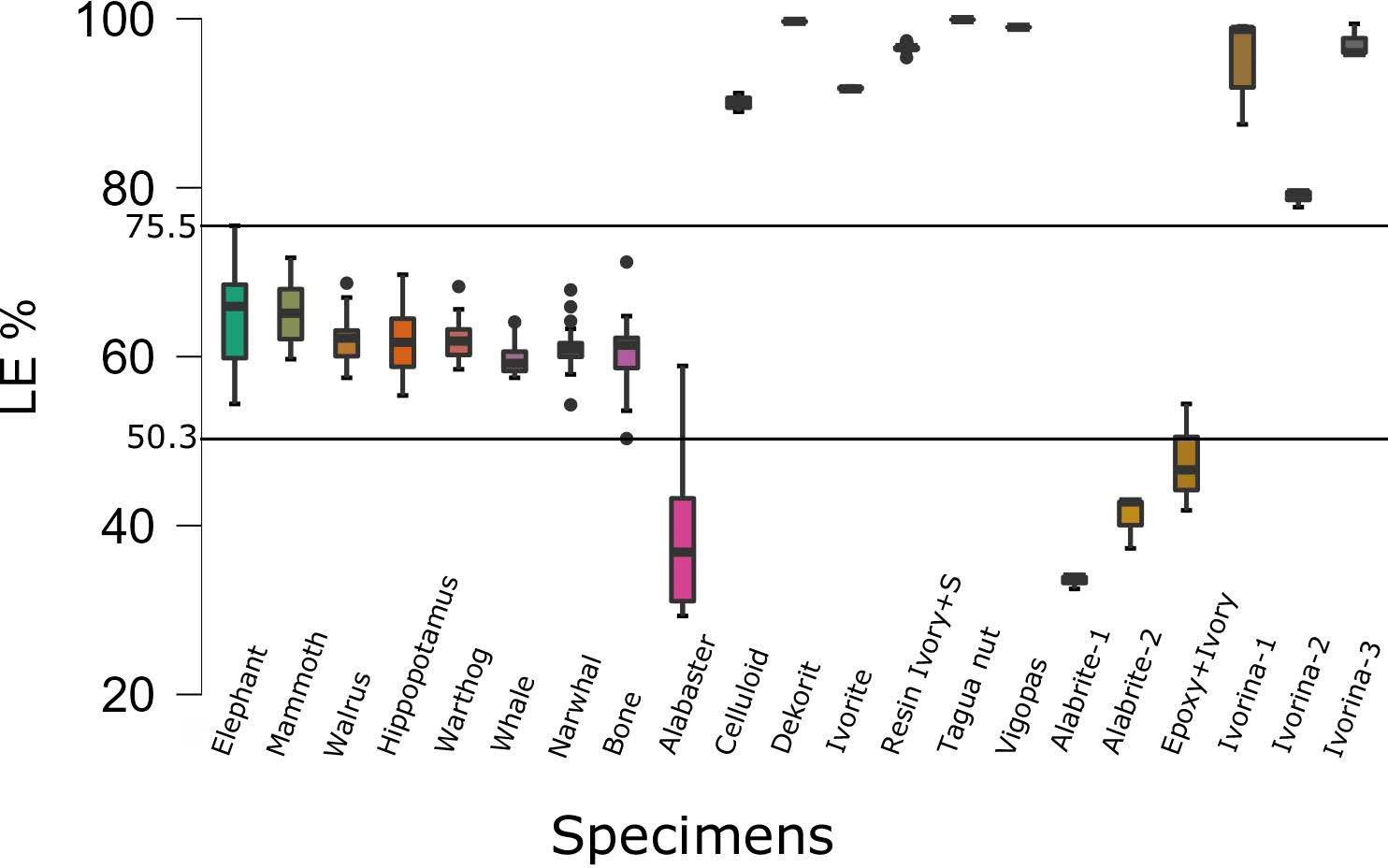
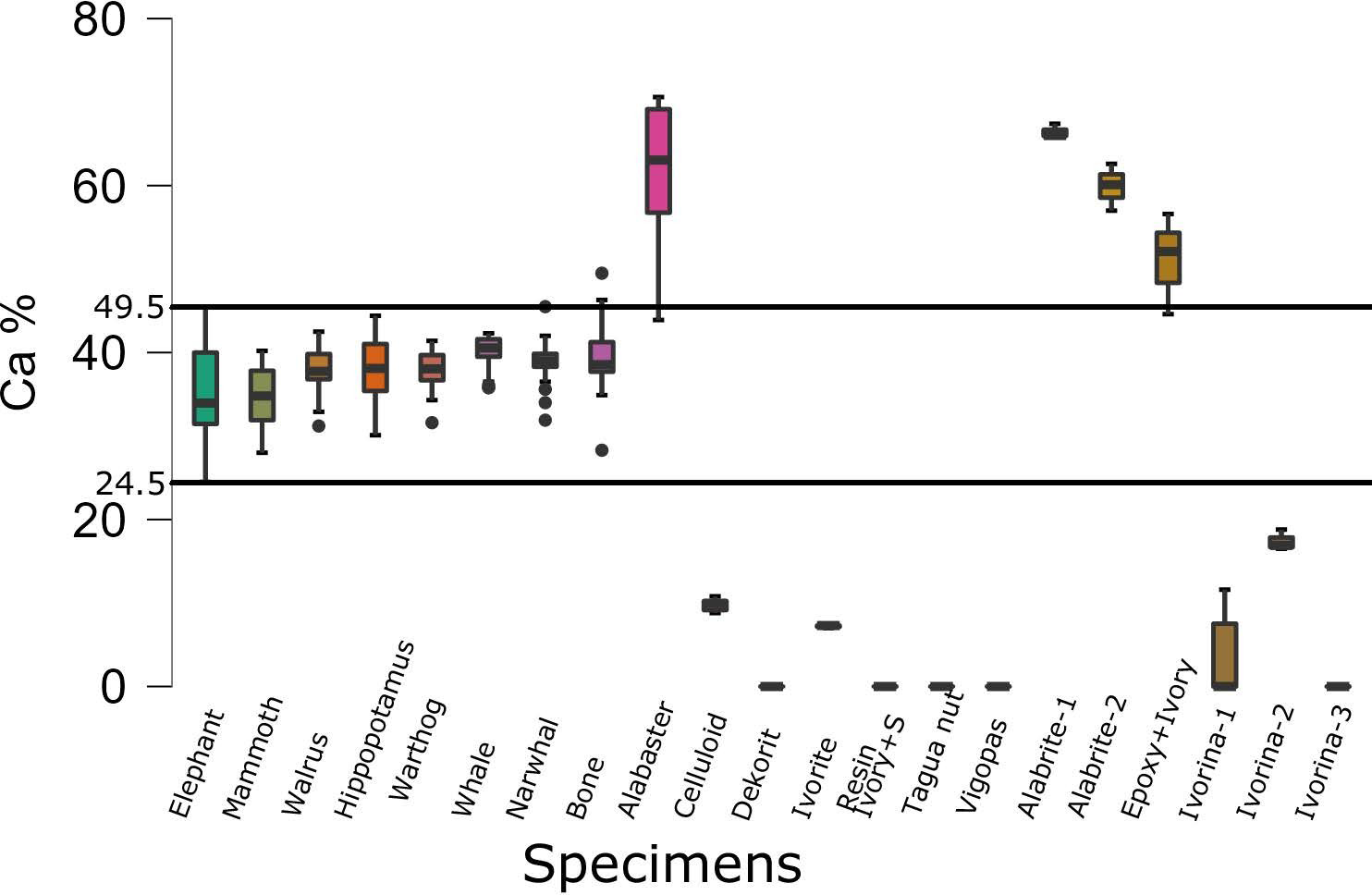
Analysis of the look-alike materials revealed differences in the semiquantitative levels of LE% and Ca%. For example, Celluloid, Dekorit, Ivorina, Ivorite, Resin-Ivory+S, vegetable ivory from tagua nut, and Vigopas all had a high concentration of LE (> 78.9 %), and a low percentage of Ca (< 18.8 %), which was not detected at all in Dekorit, Resin-Ivory+S, vegetable ivory, and Vigopas. On the other hand, the average percentage of Ca measured in Alabaster, Alabrite, and Epoxy resin was on average higher than in Ivory. Additionally, all synthetic materials except Alabrite showed relatively high percentages of Ti. Therefore, the semi quantitative concentration of LE and Ca in the described range by XRF analyses confirms that a particular material is either bone or ivory regardless if the analysis was of the dentin or cementum. XRF detection of other elements (Table 3) or concentrations outside of the biological range (Figures 2 & 3) for ivory infers that material is an ivory substitute.
The elemental composition of bones was similar to ivory and could not be differentiated, regardless of the species and tissue. A t-test showed no significant statistical difference (p- value = 0.813).
| LE % | Ca % | Fe ppm | Ni ppm | Zn ppm | Sr ppm | |||||||
|---|---|---|---|---|---|---|---|---|---|---|---|---|
| Species | Cem | Den | Cem | Den | Cem | Den | Cem | Den | Cem | Den | Cem | Den |
| Elephant | 60.7 | 68.6 | 39.2 | 31.3 | 261.7 | 221.6 | 265.2 | 244.3 | 145.4 | 61 | 325.6 | 392.5 |
| ±4.2 | ±3.0 | ±4.2 | ±3.0 | ±115.4 | ±106.7 | ±43.2 | ±42.3 | ±7.4 | ±36.3 | ±72.3 | ±148.7 | |
| Mammoth | 62.8 | 67.6 | 37.2 | 32.3 | 206.5 | 172.6 | 242 | 240.5 | 63.6 | 42.2 | 202.4 | 189.7 |
| ±2.2 | ±2.2 | ±2.2 | ±2.3 | ±59.9 | ±45.7 | ±33.3 | ±27.4 | ±21.5 | ±6.7 | ±53.7 | ± 50.6 | |
| Walrus | 61 | 62.9 | 38.8 | 39 | 301 | 178 | 239.9 | 244.7 | 237.7 | 79.2 | 196.2 | 162.5 |
| ±2.8 | ±1.5 | ±2.8 | ±1.4 | ±134.4 | ±41.7 | ±31.3 | ±37.6 | ±135.3 | ±37.5 | ±77.1 | ±40.0 | |
| Hippo | 59.4 | 63.9 | 40.4 | 36 | 495.9 | 204.1 | 227.8 | 254.4 | 414.4 | 79.4 | 363.9 | 304.4 |
| ±2.4 | ±2.3 | ±2.4 | ±2.3 | ±167.1 | ±54.1 | ±36.5 | ±44.5 | ±100.4 | ±48.7 | ±65.8 | ±124.7 | |
| Warthog | 62.4 | 61.6 | 37.5 | 38.3 | 385.3 | 216.1 | 239.4 | 247.6 | 175.3 | 90.8 | 238.5 | 335.9 |
| ±2.6 | ±1.6 | ±2.6 | ±1.3 | ±222.3 | ±104.3 | ±53.6 | ±34.4 | ±123.8 | ±53.6 | ±93.6 | ±127.7 | |
| Whale | 60.5 | 58.8 | 39.2 | 41.1 | 1006.4 | 194.4 | 232.5 | 241.3 | 553.3 | 407.3 | 669.5 | 745.9 |
| ±1.7 | ±1.4 | ±1.7 | ±1.4 | ±817.9 | ± 2.6 | ±28.2 | ±34.0 | ±104.2 | ±96.3 | ±101.5 | ±46.5 | |
| Narwhal | 61 | 60.9 | 38.9 | 38.7 | 417.8 | 216.9 | 245.2 | 232.4 | 563.1 | 143 | 353.9 | 263.1 |
| ±2.7 | ±1.4 | ±2.7 | ±1.7 | ±165.0 | ±49.4 | ±32.7 | ±29.2 | ±120.0 | ±26.7 | ±201.7 | ±37.6 |
Table 3: Elemental Composition by Species for Cementum (Cem) and Dentin (Den).
| Category | n | LE % | Ca % | Fe ppm | Ni ppm | Cu ppm | Zn ppm | Sr ppm | Ti % | Co ppm | V ppm | Mn ppm | Pb ppm |
|---|---|---|---|---|---|---|---|---|---|---|---|---|---|
| Elephant | 40 | 64.7 | 35.2 | 244 | 254.8 | 54.6 | 108.2 | 359.1 | |||||
| ± 5.5 | ± 5.4 | ± 115.1 | ± 44.6 | ± 10.3 | ± 65.6 | ± 123.2 | |||||||
| Mammoth | 40 | 65.2 | 34.7 | 189.5 | 241.2 | 61.5 | 54.3 | 196.1 | |||||
| ± 3.3 | ± 3.4 | ± 56.6 | ± 30.9 | ± 19.0 | ± 20.2 | ± 53.2 | |||||||
| Walrus | 40 | 62 | 37.9 | 239.5 | 242.3 | 158.5 | 179.3 | ||||||
| ± 2.5 | ± 2.5 | ± 118.7 | ± 35.1 | ± 128.7 | ± 64.5 | ||||||||
| Hippo | 40 | 61.6 | 38.2 | 357.7 | 241.1 | 82.3 | 282.4 | 334.1 | 315 | ||||
| ± 3.3 | ± 3.3 | ± 195.7 | ± 43.3 | ± 70.3 | ± 186.8 | ± 105.4 | ± 93.2 | ||||||
| Warthog | 40 | 62 | 37.9 | 305.7 | 243.5 | 67.9 | 135.3 | 287.2 | |||||
| ± 2.1 | ± 2.1 | ± 199.0 | ± 45.8 | ± 14.0 | ± 107.3 | ± 123.6 | |||||||
| Whale | 40 | 59.6 | 40.2 | 600.4 | 236.9 | 65.2 | 480.3 | 707.7 | |||||
| ± 1.8 | ± 1.8 | ± 716.7 | ± 31.9 | ± 12.3 | ± 125.7 | ± 88.8 | |||||||
| Narwhal | 40 | 60.9 | 38.9 | 325.5 | 238.8 | 103.7 | 353 | 308.5 | |||||
| ± 2.2 | ± 2.2 | ± 163.0 | ± 32.0 | ± 85.3 | ± 230.2 | ± 153.9 | |||||||
| Bones | 20 | 60.4 | 39.4 | 465.7 | 196.7 | 92.6 | 450.7 | 169.1 | |||||
| ± 4.4 | ± 4.4 | ± 346.2 | ± 42.8 | ± 74.6 | ± 552.7 | ± 134.2 | |||||||
| Vegetable | 20 | 99.9 | 253.8 | 481.5 | 82.3 | 55.5 | 21.4 | ||||||
| ± 0.0 | ± 69.6 | ± 44.1 | ± 13.1 | ± 16.1 | ± 3.8 | ||||||||
| Alabaster | 20 | 38.8 | 61.4 | 286.6 | 291.2 | 92.1 | 111.5 | ||||||
| ± 8.9 | ± 8.6 | ± 77.1 | ± 56.5 | ± 30.2 | ± 24.5 | ||||||||
| Resin-Ivory+S | 20 | 96.6 | 209.7 | 432.7 | 67.2 | 409.3 | 3.4 | ||||||
| ± 0.4 | ± 99.9 | ± 42.1 | ± 5.8 | ± 50.6 | ± 0.4 | ||||||||
| Celluloid | 20 | 90 | 9.8 | 195.9 | 404.4 | 73.5 | 420.7 | 18.7 | 0.2 | ||||
| ± 0.7 | ± 0.7 | ± 32.8 | ± 45.6 | ± 21.9 | ± 91.6 | ± 3.2 | ± 0.1 | ||||||
| Vigopas | 3 | 99 | 180 | 441.9 | 63 | 0.9 | |||||||
| ± 0.0 | ± 13.2 | ± 0.1 | |||||||||||
| Dekorit | 3 | 99.7 | 367.7 | 0.2 | |||||||||
| ± 0.1 | ± 263.2 | ± 0.1 | |||||||||||
| Ivorite | 3 | 91.8 | 7.2 | 143.5 | 176.4 | 37.4 | 278 | 0.4 | |||||
| ± 0.2 | ± 0.2 | ± 21.9 | ± 19.4 | ± 3.1 | ± 14.1 | ± 0.5 | |||||||
| Ivorina type 1 | 20 | 96.3 | 9 | 391 | 62.2 | 377.4 | 16.5 | 0.9 | 172.8 | ||||
| ± 4.1 | ± 2.0 | ± 58.1 | ± 4.1 | ± 106.1 | ± 2.6 | ± 0.3 | ± 56.0 | ||||||
| Ivorina type 2 | 3 | 78.9 | 17.4 | 203.5 | 291.3 | 1800 | 169.3 | 1.5 | 309.7 | 1854.6 | 599.8 | ||
| ± 1.0 | ± 1.2 | ± 28.4 | ± 3.2 | ± 100.0 | ± 8.7 | ± 0.2 | ± 36.0 | ±79.7 | ± 590.7 | ||||
| Ivorina type 3 | 3 | 97.1 | 319.2 | 181.6 | 2150 | 256.4 | 1.1 | 487.6 | 1862.7 | 528.8 | |||
| ±2. | ± 103.3 | ± 4.5 | ± 70.7 | ± 10.1 | ± 0.6 | ± 175.5 | ± 491.9 | ± 64.8 | |||||
| Alabrite type 1 | 3 | 33.4 | 66.4 | 268 | 323.8 | 62.2 | |||||||
| ± 0.8 | ± 0.8 | ± 74.3 | ± 23.3 | ± 9.8 | |||||||||
| Alabrite type 2 | 3 | 41 | 59.9 | 424 | 295.8 | 175.9 | |||||||
| ± 3.2 | ± 2.8 | ± 65.0 | ± 48.0 | ± 24.1 | |||||||||
| Epoxy Resin | 3 | 47.6 | 51.1 | 661.9 | 322.9 | 119.3 | 1.2 | ||||||
| ± 6.4 | ± 6.1 | ± 159.1 | ± 48.0 | ± 19.2 | ± 0.3 |
Table 4: Elemental Composition by Species and Material.
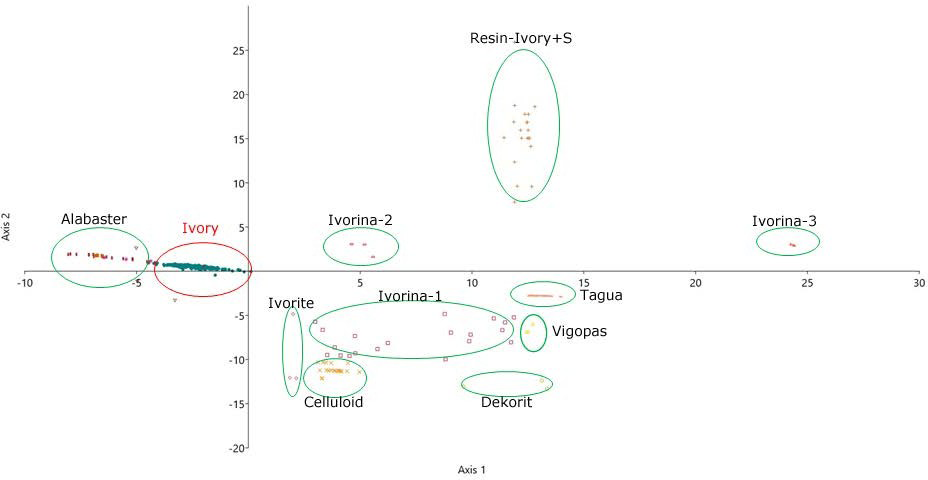
The LDA conducted on all the dataset is shown in Figure 4. The model shows good separation between ivory and ivory look-alike items with a performance index of 92.45 %. All the ivory and bone specimen were included in one group, since the objective is to discriminate between genuine ivory and look-alikes.
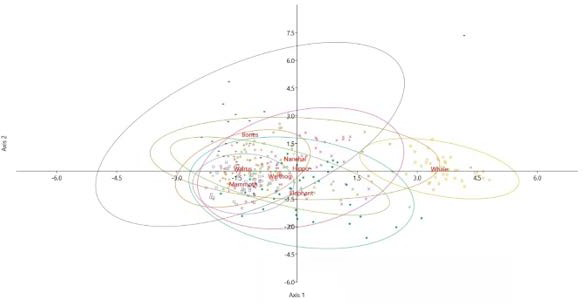
A second LDA analysis was performed on the ivory and bones to determine if handheld XRF data can distinguish among species and the graphical result is shown in Figure 5. The variables selected here were LE, Ca, Ni, Zn, and Sr. Fe was eliminated due to the significant variability observed within species. The performance index in this case is 45.67 %. The model shows that the species of origin of an ivory item cannot be identified based on its elemental composition using a SciAps X-50 handheld XRF spectrometer.
Blind Test Validation Samples
XRF analyses was conducted on 6 blind validation samples. Validation samples 3 and 6 were easily excluded as ivory based on the proportion of LE, which was above 90%.
The proportion of Zn was also significantly higher. The other four validation samples had a similar elemental composition to ivory, and therefore, could not be excluded as ivory. Table 5 shows the elemental composition of the validation samples.
| Specimen | n | LE % | Ca % | Fe ppm | Ni ppm | Cu ppm | Zn ppm | Sr ppm | Mn ppm | Ta ppm | Pb ppm |
|---|---|---|---|---|---|---|---|---|---|---|---|
| Validation 1 | 3 | 67.7 | 32.5 | 149.3 | 257.3 | 49.7 | 296.9 | 149 | |||
| ± 0.4 | ± 0.4 | ± 13.9 | ± 26.6 | ± 1.8 | ± 323.6 | ±36.8 | |||||
| Validation 2 | 3 | 65.4 | 34.5 | 138.8 | 218 | 58.2 | 342 | ||||
| ± 0.8 | ± 0.8 | ± 19.5 | ± 39.0 | ± 9.7 | ± 95.3 | ||||||
| Validation 3 | 3 | 92.8 | 0.3 | 172.5 | 283.9 | 6800 | 156 | ||||
| ± 0.1 | ± 0.0 | ± 14.1 | ± 24.3 | ± 100.0 | ± 21.4 | ||||||
| Validation 4 | 3 | 67.8 | 32.1 | 204.8 | 271.5 | 73.9 | 544.5 | ||||
| ± 1.2 | ± 1.2 | ± 11.7 | ± 38.1 | ± 28.2 | ± 133.4 | ||||||
| Validation 5 | 3 | 59.3 | 40.5 | 236.5 | 297.2 | 63.8 | 575.1 | 755.2 | |||
| ± 0.9 | ± 0.9 | ± 19.1 | ± 34.8 | ± 1.1 | ± 13.1 | ± 106.8 | |||||
| Validation 6 | 3 | 91.2 | 7.9 | 218.8 | 575.7 | 8500 | 124.6 | 226.9 | 183.9 | ||
| ± 0.5 | ± 1.3 | ±32.8 | ± 9.9 | ± 478.4 | ± 8.0 | ± 41.2 | ± 15.4 |
Table 5: Elemental composition of validation samples.
Among the validation samples, samples 3 and 6 were excluded as ivory due to the LE and Ca proportions which fall outside of the range observed for ivory and bone materials. These carvings were made out of celluloid. The values measured of these unknown samples are consistent with results obtained for celluloid analyzed in the first part of this study (paragraph 3.3), and allowed correct classification as look-alikes. The other samples couldn’t be excluded as ivory, as the proportions of LE and Ca fall into the range established for ivory and bone specimen. Samples 1 and 2 were African elephant dentin, specimen 4 was Asian elephant dentin and sample 5 was whale cementum. These objects had been identified via traditional morphological analysis and are part of the specimen collection at the National Fish and Wildlife Forensic Laboratory.
Discussion
XRF Criteria and Tissue Type
Handheld XRF analysis is a quick in-situ screening tool. The experimental range determined for ivory aids the traditional morphological analysis in identifying materials of unknown origin. In order to obtain accurate results, the item scanned must be larger than the scanning window (diameter of 9.5 mm). Carved objects can have curves and intricate shapes that can make the analysis more difficult. When the XRF device was not in immediate proximity to the object occasional spurious data was reported; if an elemental concentration seems inconsistent, a second scanning is advised.
It must be noted that XRF instruments from different manufacturers have different instrument settings, and also have different calibration parameters based on the material being tested. Preset instrumental parameters are optimized for the elements of interest. Because of this, the presence and / or concentrations of certain elements vary depending on calibration or instrument manufacturer. Moreover, single spectrometer instruments, like the SciAps X-50 used in this study, can only detect a defined number of elements, which are determined by the manufacturer. This set of elements can be customized according to the desired application. As a result, different instruments, even from the same manufacturer and model, will not detect the same elements, if programmed differently. Therefore, the results presented in the present study cannot be compared to results obtained using a different instrument, or with different settings.
Scientists conducting XRF measurements must consider the relative percentage variation between dentin and cementum to avoid spurious conclusions. The distinction between both tissue types has not been addressed in previous studies of ivory identification using handheld XRF spectrometers. We have shown a significant statistical difference between the concentration of LE and Ca in the dentin and cementum of the elephant analysis. Nevertheless, even though LE and Ca percentages varied between dentin and cementum, the overall semi-quantitative results for each species is relatively similar, and different from ivory look- alikes. Therefore, in the absence of morphological characters, it is feasible to determine a material is from an ivory source or an ivory look-alike. Ivory objects have a range of LE 50.3% – 75.5% and Ca 24.5% and 49.5%, whereas ivory look-alike materials fall outside this range. This is useful to infer the presence of ivory in the analysis of small, carved ivory objects when morphological features are absent. The experimental range was corroborated by the analysis of validation blind samples, which were correctly identified as ivory or look- alike materials.
There are synthetic materials manufactured is such a manner to resemble the presence of the proboscidean diagnostic Schreger lines [7]. For example, Casein based Ivorina and Resin-Ivory+S (Resin-Ivory+STM) show lines that imitate Schreger lines. Based on our empirical studies, XRF analysis is a good technique to apply to delicate art objects that appear to show Schreger lines, especially when the suspected material cannot be removed from the art. As the data shown in the Figures 2 and Figures 3, handheld XRF analysis easily excludes all synthetic ivory look-alikes even in the presence of imitation Schreger lines.
In conclusion, the XRF device used in this study can be used to distinguish between ivory and non-ivory items. If the analysis of a suspected item falls within the diagnostic range (LE 50.3% – 75.5% and Ca 24.5% and 49.5%) then a robust inference can be made that the material is ivory or bone, regardless if the tissue sampled was cementum or dentin.
Additionally, XRF analysis allowed to quickly eliminate most non-ivory materials (except bone). The data produced by this research also indicates that the taxonomic species source cannot be determined using the criteria defined in the manuscript [8, 9, 10, 11, 12, 13, 14, 15].
References
-
Buddhachat K, Thitaram C, Brown JL, Klinhom S, Bansiddhi P, et al. (2016) Use of handheld X-ray fluorescence as a non-invasive method to distinguish between Asian and African elephant tusks. Sci Rep 6: 24845.
-
Shugar AN, Mass JL (2012) Handheld XRF for Art and Archeology Leuven University Press, Belgium.
-
Zimmermann HA, Schultz JJ, Sigman ME (2015) Preliminary Validation of Handheld X- Ray Fluorescence Spectrometry: Distinguishing Osseous and Dental Tissue from Nonbone Material of Similar Chemical Composition. J Forensic Sci 60(2): 382-390.
-
Kuzel AR, Christensen AM, Marvin SM (2016) Calcium and Phosphorus Detection Using Benchtop Versus Handheld X-ray Fluorescence Spectrometer. J Forensic Sci 61(1): S190-S192.
-
McLellan MJ, Carrothers KL, Spicer AM (2022) Investigating the utility of a handheld X- ray fluorescence (XRF) device as a field test for suspected ivory. Forensic Science International. Animals. And Environments 2: 100041.
-
Baker B, Jacobs R, Mann M, Espinoza E, Grein G (2020) Identification Guide for Ivory and Ivory Substitutes, In: 4th (Edn.), World Wildlife Fund Inc, Washington DC, USA, pp: 1-98.
-
Espinoza EO, Mann MJ (1991) Identification Guide for Ivory and Ivory Substitutes. TRAFFIC USA/ CITES UN. World Wildlife Fund Publ., Baltimore, MD.
-
Craddock P (2020) Scientific Investigation of Copies, Fakes and Forgeries In: 1st (Edn.), Routledge, UK, pp:1- 640.
-
Fake Ivory Piano Keys? Fake Ivory Key Tops.
-
Falabella R (2016) Imitation Amber Beads of Phenolic Resin from African Trade. BEADS: Journal of the Society of Bead Researchers 28(4): 3-15.
-
(2012) The International Ivory Society, Common Ivory Terms.
-
Resin-Ivory+STM “S” Grade.
-
Wells A Trade Names: C-D. In: The plastics Historical Society.
-
Espinoza EO, Mann MJ (1993) The history and significance of the Schreger pattern in proboscidean ivory identification. Journal of the American Institute for Conservation 32(3): 241-248.
-
Nganvongpanit K, Buddhachat K, Klinhom S, Kaewmong P, Thitaram C, et al. (2016) Determining comparative element profile using handheld X-ray fluorescence in humans, elephants, dogs, and dolphins: Preliminary study for species identififcation. Forensic science international 263: 101-106.
- Narcotics and Digital Forensics: Bridging Crimes in the Digital Age
- Ethics in Forensic Psychiatry: Principles, Dilemmas, and Human Rights
- Impact of Acute Stress on Attentional Orienting to Social Cues
- Head Injury and Intracranial Hemorrhage in Western Region of Libya
- A Forensic Study on Handedness: Examination of Handwriting Features in Right and Left Handed Writers
- Techniques for Latent Fingerprint Development Using Natural and Synthetic Powders: A Review