
Comparative Study of Two Methods of DNA Extraction from Dental Pieces
Colombia is a country with an internal armed conflict of more than 60 years, where forensic sciences claim a vital role in strengthening transitional justice within the framework of the peace process. Just look at the statistics of unidentified bodies, to realize how far behind the identification process is in Colombia; where according to Life application: There are some 26,660 to 35476 unidentified bodies that, despite the joint efforts of agencies such as the Missing Persons Search Unit, Forensic Medicine and the Attorney General’s Office, have not yet been handed over to their relatives. For this reason, it is necessary to recognize the massive task of forensic specialists to propose new methods that optimize the identification process. Responding to this call, the IdentiGEN Laboratory compared two methods of extracting DNA from teeth, the ChargeSwitch Forensic DNA Purification Kit (Invitrogen) and the QIAamp DNA Mini Kit (Qiagen) to determine which of the two allowed optimization, not only the time of analysis but the costs of application with respect to the conventional method used for these matrices. To do this, DNA extraction was performed with each kit and subsequently extracts were quantified by fluorometry, demonstrating that although both methods are highly efficient in time and cost; the QIAamp method DNA Mini Kit (Qiagen) has a higher yield in terms of the amount of genetic material obtained. Finally, the dental parts analyzed using the PowerPlex Fusion System (Promega) commercial kit were successfully typified, showing not only that these matrices present a viable source of DNA collection but that it is possible to continue improving extraction methods so that they are increasingly simple, economical and effective.
Introduction
Colombia is a country with an internal armed conflict of more than 60 years, where forensic sciences claim a vital role in strengthening transitional justice within the framework of the peace process. Just look at the statistics of unidentified bodies, to realize how far behind the identification process is in Colombia; where according to Life application: There are some 26,660 to 35476 unidentified bodies that, despite the joint efforts of agencies such as the Missing Persons Search
Unit, Forensic Medicine and the Attorney General’s Office, have not yet been handed over to their relatives [1]. For this reason, it is necessary to recognize the massive task of forensic specialists to propose new methods that optimize the identification process.
Consequently, the IdentiGEN Laboratory compared two methods of tooth DNA extraction, the ChargeSwitch Forensic DNA Purification Kit (Invitrogen) and the QIAamp DNA Mini Kit (Qiagen) with the conventional method used in the laboratory for these matrices (QIAquick PCR Purification Kit-Qiagen), to determine which of the two could optimize processing time and application costs, without affecting the quality of the results.
Material and Methods
To compare the effectiveness of both methods in extracting DNA from dental pulp, samples were collected from 10 different individuals, two pieces per person; 5 temporary pieces and 5 permanent pieces were obtained for each method, for a total of 20 analyzed samples.
To access the dental pulp (matrix from which the DNA was obtained) in the permanent parts, a transversal cut was made with moto-tool at neck height (union between the crown and the root) of the tooth. While in the temporal pieces, which suffer from the root resorption phenomenon, the pulp chamber is exposed, so the piece is taken complete to the lysis buffer.
For both methods, the dental pulp and the complete part were taken to the respective lysis buffer per hour and a half and subsequently, the supernatant obtained, was extracted with pearls (Charge Switch) or columns (QiaAmp). Once the purified genetic material was obtained, it was quantified by fluorometry and the PCR was performed with the Powerplex Fusion kit (Promega).
Results
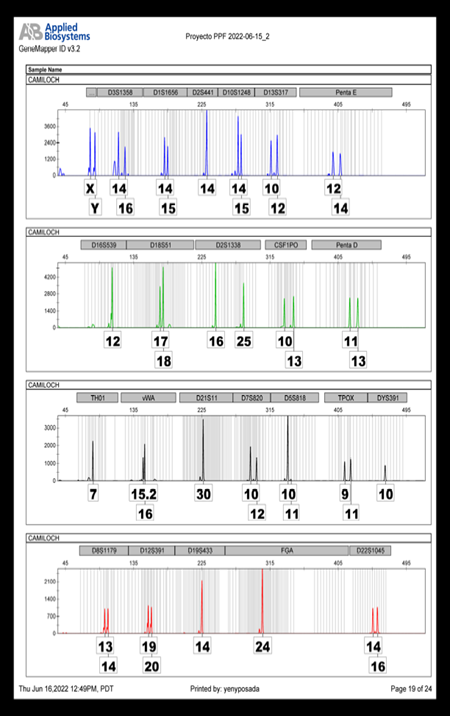
With both methods sufficient genetic material was obtained to perform the PCR and the dental parts used were successfully typified; obtaining profiles free of amplification artifacts and with well-defined allelic peaks as shown in (Figure 1).
For all cases, a higher DNA concentration was obtained from the samples processed with the QIAamp DNA mini kit as evidenced in the graph in (Figure 2), However, this implied that it was necessary to dilute the extracts to use the PowerPlex Fusion System kit, as it works with concentrations between 0.5ng/uL and 1.5ng/Ul [2].
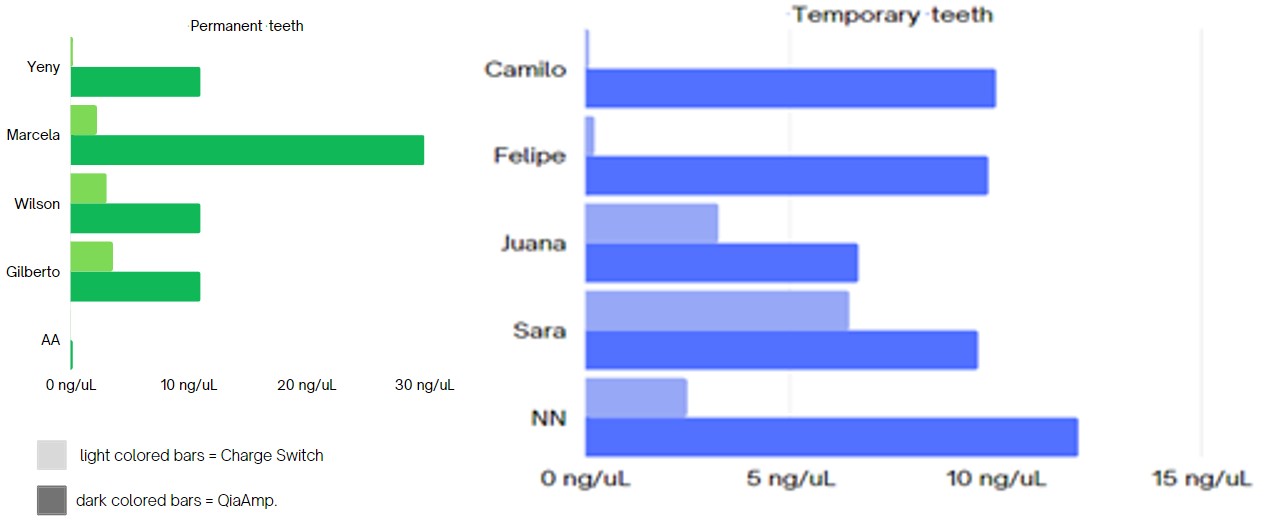
Figure 2: Quantification of the genetic material obtained after extraction with the different methods used. The light colored top bars represent the quantification of the extracted DNA with Charge Switch, while the dark colored bottom bars represent the quantification after extraction with QiaAmp. * the cuatification was performed by fluorometry with a Qubit fluorometer. ** the names of the samples are pseudonymous donors.
Discussion
| Processing time | [DNA] in sample | Profile quality | Cost* | |
|---|---|---|---|---|
| QIAamp DNA Mini Kit | 2,5 - 3 h | 0,169 ng/uL - 12 ng/uL | Alleles with high URF, Without "drop-outs", Without drop-ins | Reduces processing costs by 81 % |
| ChargeSwitch™ Forensic DNA Purification Kit | 2,5 - 3 h | 0,0352 ng/uL - 6.43 ng/uL | Alleles with high URF, Without "drop-outs", Without drop-ins | Reduces processing costs by 85% |
Table 1: The table shows the criteria evaluated in the comparison of the two methods. The processing time (from the lysis of the
Table 1: The table shows the criteria evaluated in the comparison of the two methods. The processing time (from the lysis of the sample to the extraction of DNA ), the minimum and maximum concentration of DNA obtained in the samples, the quality of the profiles and the processing costs*. *processing costs were calculated against the value of the conventional method used in the laboratory.
In terms of processing time, both methods are considerably more effective than the conventional method (which takes up to 22 hours not continuous), as well as in terms of the DNA concentration obtained and the quality of the profiles, both offer considerably high ranges for such matrices and generate “clean” profiles which, while requiring samples to be diluted in order to perform PCR, give the researcher the assurance that there is sufficient genetic material in the sample, In addition both methods represent a great saving (more than 80%), compared to the conventional method [3], mainly because they do not need the step of concentration prior to purification.
Conclusion
Both methods offer a significant reduction in processing time and cost compared to the conventional method. Both allow to extract abundant amounts of DNA (considering that the PCR works with volumes and concentrations from 0.5ng/uL) and none requires too specialized equipment (the MagnaRack for the Charge Switch and a centrifuge for the QIAamp). As for the performance, QIAamp allows to extract greater quantities of genetic material. The decision of which is better depends on the needs of the laboratory, both kits unquestionably demonstrate that it is possible to optimize DNA extraction techniques and offer a fast and economical alternative to working with this matrix [4].
Acknowledgments
In gratitude to the whole team of IdentiGEN, for offering their support and knowledge in the realization of this project
Conflict of Interest Statement
All authors declare that they have no conflicts of interest.
References
-
UBPD (2020) The challenges of identifying 25,000 bodies in Colombia.
-
(2018) Powerplex Fusion commercial DNA amplification kit. IdentiGEN WORD, pp: 5.
-
(2017) DNA extraction by Qiaquick method PCR Purification Kit from bone samples. IdentiGEN WORD, pp: 7.
-
(2021) Analytical Methods Validation Report. DentiGEN pp: 15.
- Narcotics and Digital Forensics: Bridging Crimes in the Digital Age
- Ethics in Forensic Psychiatry: Principles, Dilemmas, and Human Rights
- Impact of Acute Stress on Attentional Orienting to Social Cues
- Head Injury and Intracranial Hemorrhage in Western Region of Libya
- A Forensic Study on Handedness: Examination of Handwriting Features in Right and Left Handed Writers
- Techniques for Latent Fingerprint Development Using Natural and Synthetic Powders: A Review