
Forensic Pathological Study of 115 Deaths in Custody in China
Deaths in custody or during contact with law enforcement attract considerable public concern. A retrospective study was undertaken involving 115 autopsied cases of people who died in custody from 2000 to 2009. The cases are from the files of the Department of Forensic Pathology, Tongji Medical College, HUST, Wuhan. There was a preponderance of males (113 cases) with only two (2) deaths of women. The age range of the males was from 15 to 77 years. 96 (83.5%) of these males were young adults ranging in age from 20 to 49 year. 70 (60.9%) were peasants. The interval between death and autopsy of 53 (46.1%) cases was within 48 h. Of the 111 cases with known causes of death, most of them (83 cases, 72.1%) died of natural disease and the remainder were violent deaths. Regarding the manner of death: 83 cases were natural deaths, of which 39 (47%) were from cardiovascular disease; 23 cases were suicide; 5 cases were accidental death; 4 cases were undetermined. These data are consistent with the fact that most criminal offenders are young adult men and that the main causes of death in custody are natural. Suicide is a well-recognized phenomenon amongst deaths in custody globally and prevention of suicide is a significant challenge for custodial authorities. It is suggested that all police and law enforcement units should strengthen efforts to prevent and manage natural disease in custody.
Introduction
Deaths in custody or during contact with law enforcement attract considerable public concern in China and in the rest of world [1, 2, 3, 4, 5, 6, 7, 8], with questions frequently asked about potential violation of procedures or use of illegal practices by police or custodial officers. Due to differences in political and judicial systems as well as statistical methods, deaths in custody vary from country to country. A comparative study from the USA National Vital Statistics System (NVSS) to three non-governmental, open-source databases on police violence, found that more than half of all deaths due to police violence that we estimated in the USA from 1980 to 2018 were unreported in the NVSS [9]. A retrospective review of the autopsy findings in 115 custody deaths in Wuhan and the adjacent central part of China was therefore carried out to look at the causes and manners of death and to identify other characteristic features.
Methods
The data for all the 115 cases were retrieved from the files in the Department of Forensic Pathology, Tongji Medical College, Huazhong University of Science and Technology, Wuhan, China. The deaths occurred from 2000 to 2009, and do not included cases undertaken in other forensic departments of Wuhan. Wuhan is a big metropolis with a population of 10 million. Our department carries out the most medico-legal autopsies in Wuhan and we receive some cases from adjacent cities in Hubei, Hunan and Henan provinces. Comprehensive autopsy and histopathological examinations were performed in each case, and some also had laboratory tests such as toxicological analysis or biochemical examination of blood and other body fluids. Each autopsy was approved by the family of the deceased and all information published is with the consent of the families of the deceased.
Each file was reviewed and registered carefully with a view to establishing the following: the proportion of the cases who died in custody among all autopsied cases for every year; gender, age, occupation; the detention time and place; the time and the place of death; the time interval between death and autopsy; and the cause and manner of death. Occupation of the deceased was mainly divided into 6 groups: peasants, workers, public servants, students/ pupil, unemployed and unknown vocation. The place of death includes custody, prison, drug rehabilitation center, detention centers and interrogation rooms of police stations, hospitals and on the way to hospital, (if the patients who were in prison were sent to hospital). The manner of death was divided into natural and unnatural deaths. Natural death means that the deceased died of natural disease, including sudden unexpected natural death caused by different diseases. An unnatural manner of death means death from suicide, homicide or accident. The medical cause of death contained mechanical injury, mechanical asphyxia, poisoning and diseases (including sudden death). Sudden death was grouped into diseases of the cardiovascular system, central nervous system, respiratory and digestive system and so on. Finally, statistical analysis and comparative studies were performed on all the data.
Result
The Incident of Autopsy Per Year
From January, 2000 to December, 2009, 2595 medicolegal cases involving autopsy were undertaken altogether in our department. 115 of these autopsied cases died in custody. Thus, 4.4% of all of our cases in the 10 years covered by this paper were deaths in custody (Table 1, Figure 1).
| Year | 2000 | 2001 | 2002 | 2003 | 2004 | 2005 | 2006 | 2007 | 2008 | 2009 | Total |
|---|---|---|---|---|---|---|---|---|---|---|---|
| Total | 227 | 220 | 216 | 200 | 212 | 258 | 271 | 321 | 354 | 316 | 2595 |
| Custody | 18 | 12 | 13 | 9 | 11 | 20 | 8 | 9 | 6 | 9 | 115 |
| % | 7.9 | 5.5 | 6 | 4.5 | 5.2 | 7.8 | 3 | 2.8 | 1.7 | 2.9 | 4.4 |
Table 1: Deaths in Custody as a Proportion of all Cases.
Note*: The total number includes various medico legal autopsy cases in each year, and custody only refers to the number of cases who died in custody and other sites mentioned in the previously context. Table 1: Deaths in Custody as a Proportion of all Cases.
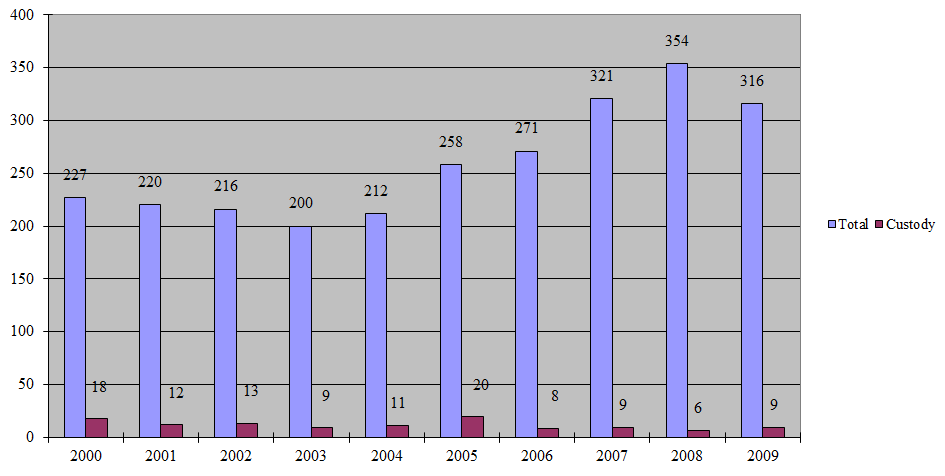
Note*: The total number includes various medico legal autopsy cases in each year, and custody only refers to the number of cases who died in custody and other sites mentioned in the previously context. Figure 1: Deaths in Custody as a Proportion of all Cases*.
Gender and Age
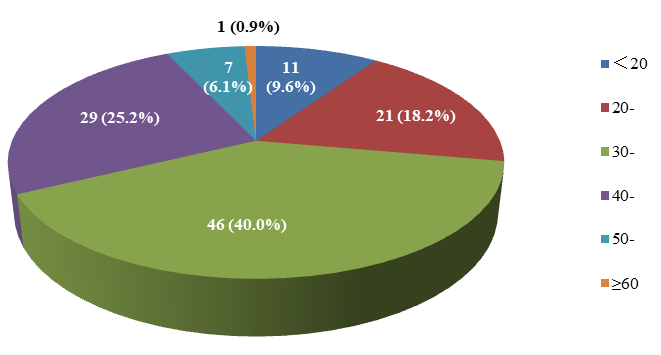
There were 113 males (98.3%), and 2 females (1.7%). Their ages ranged from 15 to 77 years (Figure 2), with most deaths in the 30-39 years age group. 96 cases (83.5%) were young and middle aged males ranging from 20 to 49 years. The two female cases were 23 and 42 years old respectively (Table 2).
| Age | <20 | 20-29 | 30-39 | 40-49 | 50-59 | ≥60 | Total |
|---|---|---|---|---|---|---|---|
| Cases | 11 | 21 | 46 | 29 | 7 | 1 | 115 |
| % | 9.56 | 18.26 | 40 | 25.22 | 6.09 | 0.9 | 100 |
Table 2: Age Distribution of the 115 Deaths in Custody.
Occupation
Of the 115 cases, 70 (60.9%) were peasants; 27 were unemployed; there were 2 workers, 2 public servants and 2 students; the occupation of the remaining 12 deceased was unknown.
Detention Time
The detention time is the time between being detained and death. This ranged from 25 min to 5 years and 7 months. Of the 115 deaths, 63 (54.8%) died in under a month; 29 (25.2%) died between 1-6 months; 9 (7.8%) died between 7- 12months; and 14 (12.2%) died after more than a year.
Interval Time between Death and Autopsy
Interval time between death and autopsy was from 5 hours to 7 days except in one case where the patient was autopsied 209 days after death. Of the 115 deaths, 17 (14.8%) cases were autopsied within 24 hours and 53 (46.1%) autopsied within 48 hours.
The Place of Death
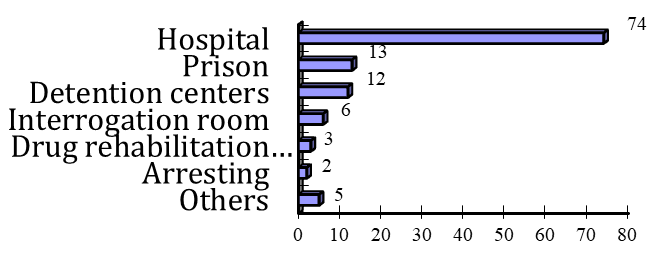
The place of death, as shown in Table 3, indicates that most cases died in hospital.
| Place of death | Cases | % |
|---|---|---|
| Hospital | 74 | 64.4 |
| Police station | 18 | 15.7 |
| Prison | 13 | 11.3 |
| Drug rehabilitation center | 3 | 2.61 |
| Others* | 7 | 6.09 |
*The others including 4 cases who died on the way to the hospital, 2 cases on the way to the police station and 1 case on the road, where the person jumped off the police car after he was arrested by police. Table 3: The Place of Death in 115 Deaths in Custody.
Manner of Death
Of the 115 cases, 83 (72.2%) were natural deaths, of which 38 were sudden deaths. 28 cases were unnatural deaths, including 23 cases of suicide and 5 cases of accidental deaths; the manner of death in 4 cases remained unknown; and there were no deaths concluded to be homicides. Of the 23 suicides, there were 10 hangings; three drowned in pools belonging to the prison; three died from poisoning (these prisoners obtained poisons illegally from outside the prison); three died as a result of injuries sustained by self-injury (hitting themselves against the prison cell wall); two died as a result of falling from a high building; one died from injuries sustained as a result of jumping out of a moving car; one died from self-inflicted hemorrhagic shock, where the prisoner punctured his own femoral artery. Regarding the accidental deaths, these were mainly caused due to mechanical injuries, including three persons who fell on the floor in prison and two prisoners who fell from a higher platform and a truck.
Cause of Death
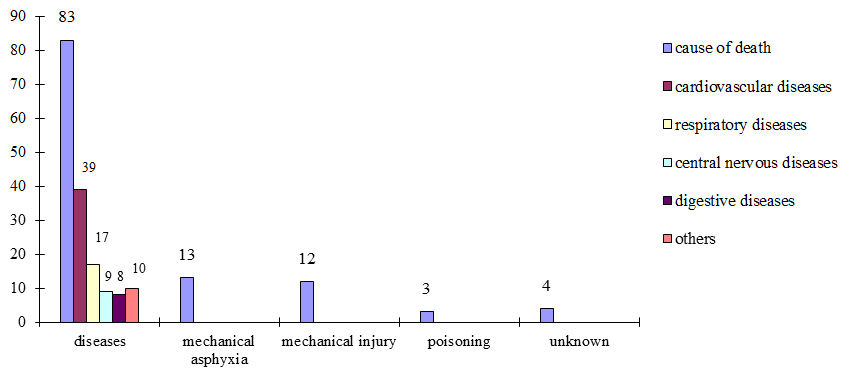
As shown in Table 4, most deceased died of diseases (83 cases, 72.2%), including 38 cases of sudden death. Of the 83 cases, the highest numbers of cases were cardiovascular disease (39 cases, 47%): 17 of these were due to coronary atherosclerotic heart disease, 6 due to myocarditis, 4 from cardiomyopathy, three had aortic dissection, three had coronary artery anomalies, two had cardiac conduction system abnormalities, two had hypertensive heart disease, and there was one case of each of rheumatic heart disease and hyperthyroid heart disease. The second highest number of natural deaths was due to diseases of the respiratory system, including 8 cases of pulmonary tuberculosis, 7 deaths from lobular and lobar pneumonia, and two deaths from bronchial asthma. The third highest was deaths from diseases of the central nervous system, including 5 deaths from hypertensive cerebral hemorrhage, three deaths from ruptured arteriovenous malformations and one death from epilepsy. Finally there were also some cases involving the gastro-intestinal system, including three deaths from hemorrhage from gastro duodenal ulcers, two from acute severe hepatitis, two cases of acute hemorrhagic necrotic pancreatitis and one death from acute peritonitis. The remainder was four deaths from sudden manhood death syndrome [10]. Two deaths from vagal inhibition and one case each of diabetes mellitus, pheocromocytoma, Addison’s disease and sudden death from anaphylactic shock.
Cause of Death
As shown in Table 4, most deceased died of diseases (83 cases, 72.2%), including 38 cases of sudden death. Of the 83 cases, the highest numbers of cases were cardiovascular disease (39 cases, 47%): 17 of these were due to coronary atherosclerotic heart disease, 6 due to myocarditis, 4 from cardiomyopathy, three had aortic dissection, three had coronary artery anomalies, two had cardiac conduction system abnormalities, two had hypertensive heart disease, and there was one case of each of rheumatic heart disease and hyperthyroid heart disease. The second highest number of natural deaths was due to diseases of the respiratory system, including 8 cases of pulmonary tuberculosis, 7 deaths from lobular and lobar pneumonia, and two deaths from bronchial asthma. The third highest was deaths from diseases of the central nervous system, including 5 deaths from hypertensive cerebral hemorrhage, three deaths from ruptured arteriovenous malformations and one death from epilepsy. Finally there were also some cases involving the gastro- intestinal system, including three deaths from hemorrhage from gastro duodenal ulcers, two from acute severe hepatitis, two cases of acute hemorrhagic necrotic pancreatitis and one death from acute peritonitis. The remainder were four deaths from sudden manhood death syndrome[8]. two deaths from vagal inhibition, and one case each of diabetes mellitus, pheocromocytoma, Addison’s disease and sudden death from anaphylactic shock (Figure 4).
| Cause of death | Cases | % |
|---|---|---|
| Diseases | 83 | 72 |
| 1. cardiovascular diseases | 39 | 47 |
| 2. respiratory diseases | 17 | 21 |
| 3. central nervous diseases | 9 | 11 |
| 4. digestive diseases | 8 | 9.6 |
| 5. others | 10 | 12 |
| Mechanical asphyxia | 13 | 11 |
| Mechanical injury | 12 | 10 |
| Poisoning | 3 | 2.6 |
| Unknown | 4 | 3.5 |
Table 4: The Cause of Death in 115 Deaths in Custody.
Discussion
The Proportion of the Cases who Died in Custody Per Year
As shown in (Table 1), although deaths in custody, as a proportion of all cases autopsied in our department, varied from year to year, there is no statistical difference between them. This differs from Grant’s report revealing trends of decreased mortality [7].
The Gender, Age and Occupation of the 115 Deceased
The fact that an overwhelming majority of the deaths (113/115) were males is consistent with most criminal offenders are men [6, 7, 11]. In the two female deaths, one of them was a student, who was suffering from severe tuberculosis and died of systemic multi-organ failure. The second woman was unemployed and jumped from a moving car on her way to the police station and died of serious cranio- cerebral injury. In relation to age, there were 96 (83.5%) deceased whose ages ranged from 20 to 49 years old. This is consistent with the fact that most crimes are committed by young adults and with other literature on deaths in custody [6, 11, 12]. In the distribution of occupation, 97 (84.4%) of the deceased were either peasants or unemployed, which is similar to the occupational categories of offenders generally. Therefore, the government should make efforts to increase employment and farmers’ incomes in order to help reduce crime.
Detention Time, Interval between Death and Autopsy, and the Place of Death
In Shaw’s report on 172 self-inflicted deaths of prisoners, there were 55 (32%) cases which occurred within 7 days of reception into prison [13]. In the present study, the detention time in 63 cases is less than a month (54.8%), which suggests that chance of death is greater in early stages than the other time in custody. Thus psychological counseling and health examinations should be strengthened for them, and accidents in custody should be actively prevented. This is because some of deaths in custody can be prevented [3, 6, 12]. As for the time interval between death and autopsy, most cases were within 72 hours (78 cases, accounting for 67.8%). As an on-time autopsy is significant for finding the cause of death and evaluating other related issues [11], it should be done as early as possible in order to ascertain facts and remove doubt about the investigation from the prisoner’s families and the public. The fact that 74 (64.4%) cases died in hospital or on the way to hospital indicates that improvement is possible to the guardianship of prisoners’ health and that of others under surveillance and that some of the sicker prisoners should be released for medical treatment earlier.
Causes of Death and Manners of Death
In this cohort, 83 (72.2%) deaths were natural which is the same as the majority of reports [2, 6, 12]. Most deaths were from cardiovascular disease (39 cases), accounting for about half, including 17 cases of coronary atherosclerotic heart disease (43.6%). That may be relative to such factors as environment suppression in custody, mental stress of prisoners, which may cause sudden coronary death in vulnerable individuals. It is almost the same with Grandmaison’s and Mirza’s paper, in which it was reported, that cardiovascular diseases were the main cause of sudden death [9, 14]. It is a little different from Wobeser’s report, in which over half (59%) of the 283 deaths in custody in Ontario were from violent causes and natural causes only accounted for 115 (41%) [15]. It is very different from Heide’s report, in which the commonest cause of death was acute alcoholic intoxication, followed by cerebrocranial trauma, internal diseases and fatal poisonings with medical or illegal drugs [16]. Some of these differences will be explained by differences in the custodial settings. But in our case, it demonstrates that it is necessary for the custodial authorities to further improve the management and education and to arrange for a medical examination and set up a health file for each person according to their physical condition in order to prevent death [6, 12]. Special attentions should be paid to the physical conditions of prisoner with serious diseases, who should be sent to hospital for medical treatment if they cannot be treated in custody. Why there is a high rate of cardiovascular natural deaths in the young and middle aged group of population in our cohort is worthy of further study, but we think it is related to the fact that cardiovascular disease is the commonest natural disease causing sudden death and that the predominance of prisoners in custody and at the police station were the young and middle aged in our autopsied cases.
Of 28 cases of unnatural deaths, 23 cases (82.1%) were suicide. Almost half of these (10 deaths, 43.5%) were from hanging. It is similar to Shaw’s report where the commonest method of suicide was hanging or self-strangulation (92%) [13].
In addition, there are 4 cases (3.5%) whose medical causes of death still remained unknown. This may be related to following factors. First, there are limitations to the current scientific and technological level of autopsy, and although a whole and comprehensive systemic autopsy had been undertaken, the cause of death still could not be established. Secondly, the autopsy may not have been done in time, post mortem changes affecting its result. Thus, the autopsy should be performed as early as possible in order to maximize the chances of finding the cause of death [11].
Conclusion
Deaths in custody or custody-related are one of main points of public concern. This retrospective study reported 115 autopsied cases of people who died in custody from 2000 to 2009. It shown a preponderance of males with only two deaths of women. The age range of the males was from 15 to 77 years and most of them were young adults males Of the 111 cases with known causes of death, most of them died of natural disease and the remainder were violent deaths. These data in China are consistent with the fact that most criminal offenders are young adult men and that the main causes of death in custody are natural. All police and law enforcement units should strengthen efforts to prevent and manage natural disease in custody.
Special Version
This paper presented orally in The AAFS 65th Annual Scientific Meeting on Feb.18-23, 2013, Washington, USA. The original title is “Pathological study of 125 autopsied cases where subjects died in custody”.
Conflict of Interest
The authors declare that conflicts of interest: none.
References
-
Barnett R, Stirling C, Pandyan AD (2012) A review of the scientific literature related to the adverse impact of physical restraint: gaining a clearer understanding of the physiological factors involved in cases of restraint- related death. Med Sci Law 52(3): 137-142.
-
Okoye CN, Okoye M, Lynch DT (2012) An analysis and report of custodial deaths in Nebraska, USA: Part II. Journal of Forensic and Legal Medicine 19 (8): 465-469.
-
Otahbachi M, Cevik C, Bagdure S, Nugent K (2010) Excited delirium, restraints, and unexpected death: a review of pathogenesis. Am J Forensic Med Pathol 31 (2): 107-112.
-
Kinner SA, Lennox N, Williams GM, Carroll M, Quinn B, et al. (2013) Randomized controlled trial of a service brokerage intervention for ex-prisoners in Australia. Contemporary Clinical Trials 36(1): 198-206.
-
Walmsley R (2011) World prison population list In: (9th edtn) International Centre for Prison Studies, Kings College, London, UK, pp: 1-6.
-
Rajesh B, Pradeep D (2011) Natural deaths in custody A 10 year mortality study. Journal of Indian Academy of Forensic Medicine 33(4): 328-331.
-
Grant JR, Southall PE, Fowler DR, Mealey J, Thomas EJ, et al. (2007) Death in custody: a historical analysis. Journal of the Forensic Science 52(5): 1177-1181.
-
Weedn V, Steinberg A, Speth P (2022) Prone restraint cardiac arrest in in-custody and rrest-related deaths [J]. Journal of Forensic Sciences 67 (5): 1899-1914.
-
GBD 2019 Police Violence Collaborators (2021) Fatal police violence by race and state in the USA, 1980-2019: A network meta-regression. Lancet 398(10307): 1239- 1255.
-
He K, Xu J, Wang Z (1986) Dependence analysis between sudden manhood death syndrome and mutation of SCN5A. Chinese Journal of Forensic Medicine 21(6): 36- 38.
-
Mirza FH, Memon AA, Adil SE, Paryar HA (2012) Audit of custodial deaths in Karachi--an autopsy-based study. J Pak Med Assoc 62(8): 752-755.
-
Afandi D (2012) Profile of medicolegal autopsies in Pekanbaru, Indonesia 2007-2011. Malays J Pathol 34(2): 123-126.
-
Shaw J, Baker D, Hunt IM, Moloney A, Appleby L (2004) Suicide by prisoners national clinical survey. The British Journal of Psychiatry 184: 263-267.
-
Grandmaison GL, Durigon M (2002) sudden adult death: a medico-legal series of 77 cases between 1995 and 2000. Med Sci Law 42 (3): 225-232.
-
Wobeser WL, Datema J, Bechard B, Ford P (2002) causes of death among people in custody in Ontario, 1990– 1999. CMAJ 167 (10): 1109-1113.
-
Heide S, Kleiber M, Hanke S, Stiller D (2009) Death in German police custody. European Journal of Public Health 19 (6): 597-601.
- Narcotics and Digital Forensics: Bridging Crimes in the Digital Age
- Ethics in Forensic Psychiatry: Principles, Dilemmas, and Human Rights
- Impact of Acute Stress on Attentional Orienting to Social Cues
- Head Injury and Intracranial Hemorrhage in Western Region of Libya
- A Forensic Study on Handedness: Examination of Handwriting Features in Right and Left Handed Writers
- Techniques for Latent Fingerprint Development Using Natural and Synthetic Powders: A Review