
Forensic Genetics and the Differentiation of Monozygotic Twins by Mitochondrial DNA Analysis
Forensic genetics uses STR markers as the gold standard for human identification. However, this technique does not allow the differentiation of monozygotic twins, since they originate from the fertilization of a single egg and a single sperm. Studies aiming to solve this problem have been developed and the complete sequencing of mitochondrial DNA has shown to be relevant. The present study aimed to verify the possibility of differentiating monozygotic twins through the analysis of the d-loop region of mitochondrial DNA, using the Sanger sequencing technique in blood and oral mucosa samples. Twelve pairs of volunteer monozygotic twins were selected, zygosity was confirmed by analyzing the genetic profile generated using STR markers. Regarding analyses of the d-loop region of mitochondrial DNA, a single pair of twins (gm46) showed a point heteroplasmy at position 16,290 (HV1). However, this finding was not able to differentiate between individuals of the same pair, since both showed the heteroplasmy in both biological samples (blood and oral mucosa). No other genetic variation was detected in the pairs of twins analyzed that could differentiate them. We suggest analyzing the mitochondrial DNA molecule as a whole in an attempt to identify a greater amount of potential variation by applying the Massive Parallel Sequencing technique.
Introduction
STR (Short Tandem Repeat) type molecular markers are used in forensic analysis for human identification and are considered the gold standard for this purpose. This methodology consists in performing comparisons of genetic Investigation Paper profiles in order to individualize a person and a sample and can be used both in the criminal judicial field, for example, to genetically identify victims or criminals and missing persons, and in the civil judicial field, for paternity testing and other parental relationships [1, 2, 3].
The analysis is based on the concept that each individual is genetically unique, with the exception of monozygotic (MZ) twins, who are indistinguishable by performing the standard genetic test for human identification using nuclear DNA (Deoxyribonucleic Acid) analysis [1, 4].
Studies involving the differentiation of twins MZ have been performed using mitochondrial DNA (mtDNA) sequencing which identified an extremely rare Single Nucleotide Polymorphism (SNP) that allowed such differentiation [5, 6, 7].
The mtDNA has a smaller portion composed of a “non-coding” region, known as the control region or D-loop (Displacement Loop). This region has three highly polymorphic segments known as Hypervariable Regions (HV) 1, 2 and 3. Compared to nuclear DNA, where the point mutation rate in the genome is about 10-9 base per year, this rate in mtDNA is about 10 times higher in the coding region (10-8 base per year) and 100 times higher in the D-loop (10- 7 base per year) [8, 9, 10].
Studies have pointed out that the worldwide twin birth rate has reached a historical peak, 15 births per 1,000 in richer countries and 10 births per 1,000 in poorer countries [11]. In Brazil, the birth rate of MZ twins is approximately 3 in 1,000 births [12, 13] and the birth rate per day is 13.9 births per 1,000 [14].
Considering the worldwide increase in the birth rate of twins and the lack of studies on the subject, the genetic differentiation of these individuals is extremely important for forensic genetics. Thus, the present study aimed to verify the possibility of differentiating MZ twins by analyzing the D-loop region of mtDNA in two biological samples, blood and oral mucosa.
Materials and Methods
For this study twenty pairs of volunteers twins were included, who reported being monozygotic, healthy, of both genders, and over 18 years old. The volunteers signed an Informed Consent Form after approval by the Ethics Committee for Analysis of Research Projects - CAPPesq of HCFMUSP. All individuals answered a formal questionnaire with sociodemographic information, data related to twins and related to their ethnic origin.
Five ml of peripheral blood were collected from all participants by venipuncture of the forearm, as well as samples of the oral mucosa, by swabbing. DNA extraction from peripheral blood was performed by the Salting-out method, according to the protocol of Miller. DNA extractions from swab containing cells from the oral mucosa were carried out using the 5% Chelex solution method, according to the manufacturer’s protocol.
The confirmation of zygosity was performed by investigating the concordance in regards to the genetic profile generated with the use of STR-type markers. This analysis was performed only on the blood samples. DNA amplification was performed by multiplex Polymerase Chain Reaction (PCR) using the PowerPlex® Fusion System kit (Promega), which has primers for the amplification of 23 autosomal STR markers, which include the loci D3S1358, D1S1656, D2S441, D10S1248, D13S317, D16S539, D18S51, D2S1338, CSF1PO, TH01, vWA, D21S11, D7S820, D5S818, TPOX, D8S1179, D12S391, D19S433, D22S1045, and FGA plus Penta E and Penta D, in addition to DYS391 and amelogenin, according to the methodology described by the manufacturer.
The HV1, HV2, and HV3 regions of the mtDNA D-Loop in the blood samples were amplified in all individuals by a single PCR reaction using primer pair H727 (5’AGGGTGAACTCACTGGAACG3’) and L15781 (5’CCCTTTTACCATCATTGGACA 3’), already standardized in the laboratory. Regarding the oral mucosa swab samples, the HV1, HV2 and HV3 regions were amplified by a simple PCR reaction using primer pairs H727 (5’AGGGTGAACTCGACTGAACG 3’), L15781 (5’CCCTTTTACCATCATTGGACA 3’), H16478 (5’GCTACCCCCAAGTGTTTATGG3’) and L109 (5’GCACCCTATGTCGCAGTATCT3’), H408 (5’TGTTAAAAGTGCATACCGCC3’).
PCR reactions were conducted in a total volume of 25µl, which consisted of 50ng of DNA, 0.75µl of MgCl2 (50mM), 2.5pMol of each primer, 4µl dNTP (1.25mM) and 0.4µl Taq polymerase. Thermal cycling was conducted in the Eppendorf Mastercycler thermal cycler, with initial denaturation conditions of 95ºC for 1 minute, followed by 36 cycles, with denaturation at 95ºC for 1 minute, annealing at 59ºC for 1 minute, and extension at 72ºC for 1 minute. The final extension was 72ºC for 7 minutes. After this procedure, purification of the PCR products was performed using Exonuclease I and Shrimp Alkaline Phosphatase (EXO/SAP, Thermo Scientific Tools), according to the manufacturer’s recommendations.
The PCR products were sequenced using the BigDye Terminator Cycle Sequencing Kit (Applied Biosystems, Foster City, CA), according to the manufacturer’s protocol. After sequencing, capillary electrophoresis was performed using POP7 in an ABI3130 sequencer (Applied Biosystems, Foster City, CA) and the results were analyzed in BioEdit software (http://www.mbio.ncsu.edu/BioEdit/BioEdit.html).
Individual sequences were compared to the standard revised Anderson sequence, also known as Revised Cambridge Reference Sequence (rCRS), the alignment was performed using BioEdit software and polymorphisms were noted. Polymorphisms were presented as differences from the rCRS reference sequence. All polymorphisms and eventual heteroplasmy observed were only considered real when confirmed by reverse-tape sequencing, and were annotated following specifications of international committees and literature in the area [15, 16, 17, 18].
Results
From the 20 volunteer pairs, eight were excluded because they presented genotyping results consistent with dizygotic twins, i.e., different STR profiles. Of the 12 twin pairs whose STR genotyping confirmed they were MZ, six were female and six were male. In this sample, ages ranged from 18 to 63 years.
ORAL MUCOSA BLOOD
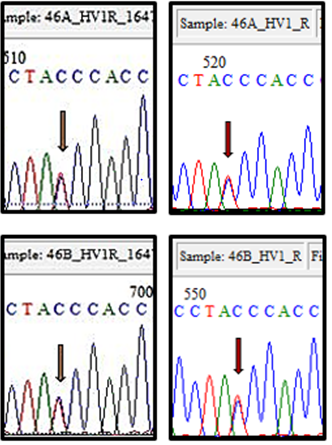
Based on sequencing of the mtDNA regions HV1, HV2 and HV3 and analysis of the haplotypes generated from the peripheral blood samples, we observed no difference between twins of the same pair. A total of eight length heteroplasmies were observed among the 12 pairs analyzed. One Point Heteroplasmy (PHP) was observed at position 16290T/C of HV1 in the two individuals of twin pair 46 (Figure 1).
FONTE: Laboratório de Genética Forense da Faculdade de Medicina da Universidade de São Paulo, 2018. Figure 1: Point Heteroplasmy at Position 16,290 Related to T/C Bases Found in the 2 Individuals of Twin Pair 46, in Both Samples, Oral Mucosa and Blood. A: Individual 46A; B: Individual 46B.
The haplotype results of the oral mucosal samples also showed no difference between the twins of the corresponding pairs, and the sequences were concordant with the blood results (Table 1).
| TIPO DE AMOSTRA | ID | HAPLÓTIPO | ||||||||||||||||||
|---|---|---|---|---|---|---|---|---|---|---|---|---|---|---|---|---|---|---|---|---|
| Blood | 20_A | 16069T | 16126C | 16192T | 16261T | 16288C | 73G | 185A | 188G | 222T | 228A | 263G | 295T | 315.1C | 462T | 489C | 523.1A | 524.1C | ||
| 20_B | 16069T | 16126C | 16192T | 16261T | 16288C | 73G | 185A | 188G | 222T | 228A | 263G | 295T | 315.1C | 462T | 489C | 523.1A | 524.1C | |||
| Oral Mucosa | 20_A | 16069T | 16126C | 16192T | 16261T | 16288C | 73G | 185A | 188G | 222T | 228A | 263G | 295T | 315.1C | 462T | 489C | 523.1A | 524.1C | ||
| 20_B | 16069T | 16126C | 16192T | 16261T | 16288C | 73G | 185A | 188G | 222T | 228A | 263G | 295T | 315.1C | 462T | 489C | 523.1A | 524.1C | |||
| Blood | 22_A | 16093C | 16148T | 16172C | 16187T | 16188G | 16189C | 16223T | 16230G | 16311C | 16320T | 93G | 152C | 189G | 236C | 247A | 263G | 315.1C | 523d | 524d |
| 22_B | 16093C | 16148T | 16172C | 16187T | 16188G | 16189C | 16223T | 16230G | 16311C | 16320T | 93G | 152C | 189G | 236C | 247A | 263G | 315.1C | 523d | 524d | |
| Oral Mucosa | 22_A | 16093C | 16148T | 16172C | 16187T | 16188G | 16189C | 16223T | 16230G | 16311C | 16320T | 93G | 152C | 189G | 236C | 247A | 263G | 315.1C | 523d | 524d |
| 22_B | 16093C | 16148T | 16172C | 16187T | 16188G | 16189C | 16223T | 16230G | 16311C | 16320T | 93G | 152C | 189G | 236C | 247A | 263G | 315.1C | 523d | 524d | |
| Blood | 35_A | 16178C | 16183C | 16189C | 16193.3C | 16217C | 73G | 263G | 315.1C | 499A | ||||||||||
| 35_B | 16178C | 16183C | 16189C | 16193.3C | 16217C | 73G | 263G | 315.1C | 499A | |||||||||||
| Oral Mucosa | 35_A | 16178C | 16183C | 16189C | 16193.3C | 16217C | 73G | 263G | 315.1C | 499A | ||||||||||
| 35_B | 16178C | 16183C | 16189C | 16193.3C | 16217C | 73G | 263G | 315.1C | 499A | |||||||||||
| Blood | 46_A | 16069T | 16093C | 16126C | 16278T | 16290T/C | 16366T | 73G | 185A | 188G | 228A | 263G | 295T | 315.1C | 462T | 489C | 523d | 524d | ||
| 46_B | 16069T | 16093C | 16126C | 16278T | 16290T/C | 16366T | 73G | 185A | 188G | 228A | 263G | 295T | 315.1C | 462T | 489C | 523d | 524d | |||
| Oral Mucosa | 46_A | 16069T | 16093C | 16126C | 16278T | 16290T/C | 16366T | 73G | 185A | 188G | 228A | 263G | 295T | 315.1C | 462T | 489C | 523d | 524d | ||
| 46_B | 16069T | 16093C | 16126C | 16278T | 16290T/C | 16366T | 73G | 185A | 188G | 228A | 263G | 295T | 315.1C | 462T | 489C | 523d | 524d | |||
| Blood | 53_A | 16223T | 16291T | 16295T | 16325C | 16362C | 73G | 263G | 309.1C | 315.1C | 489C | |||||||||
| 53_B | 16223T | 16291T | 16295T | 16325C | 16362C | 73G | 263G | 309.1C | 315.1C | 489C | ||||||||||
| Oral Mucosa | 53_A | 16223T | 16291T | 16295T | 16325C | 16362C | 73G | 263G | 309.1C | 315.1C | 489C | |||||||||
| 53_B | 16223T | 16291T | 16295T | 16325C | 16362C | 73G | 263G | 309.1C | 315.1C | 489C | ||||||||||
| Blood | 54_ A | 16182C | 16183C | 16189C | 16217C | 16240C | 16241G | 73G | 103A | 152C | 263G | 309T | 315.1C | 499A | ||||||
| 54_B | 16182C | 16183C | 16189C | 16217C | 16240C | 16241G | 73G | 103A | 152C | 263G | 309T | 315.1C | 499A | |||||||
| Oral Mucosa | 54_ A | 16182C | 16183C | 16189C | 16217C | 16240C | 16241G | 73G | 103A | 152C | 263G | 309T | 315.1C | 499A | ||||||
| 54_B | 16182C | 16183C | 16189C | 16217C | 16240C | 16241G | 73G | 103A | 152C | 263G | 309T | 315.1C | 499A | |||||||
| Blood | 74_A | 16051G | 16093C | 16172C | 16223T | 16295T | 16298C | 16325C | 16327T | 16335G | 73G | 194T | 249d | 263G | 290d | 291d | 315.1C | 489C | ||
| 74_B | 16051G | 16093C | 16172C | 16223T | 16295T | 16298C | 16325C | 16327T | 16335G | 73G | 194T | 249d | 263G | 290d | 291d | 315.1C | 489C | |||
| Oral Mucosa | 74_A | 16051G | 16093C | 16172C | 16223T | 16295T | 16298C | 16325C | 16327T | 16335G | 73G | 194T | 249d | 263G | 290d | 291d | 315.1C | 489C | ||
| 74_B | 16051G | 16093C | 16172C | 16223T | 16295T | 16298C | 16325C | 16327T | 16335G | 73G | 194T | 249d | 263G | 290d | 291d | 315.1C | 489C | |||
| Blood | 77_A | 16362C | 150T | 239C | 263G | 309.1C | 315.1C | |||||||||||||
| 77_B | 16362C | 150T | 239C | 263G | 309.1C | 315.1C | ||||||||||||||
| Oral Mucosa | 77_A | 16362C | 150T | 239C | 263G | 309.1C | 315.1C | |||||||||||||
| 77_B | 16362C | 150T | 239C | 263G | 309.1C | 315.1C | ||||||||||||||
| Blood | 96_A | 16298C | 16355T | 195C | 263G | 309.1C | 315.1C | |||||||||||||
| 96_B | 16298C | 16355T | 195C | 263G | 309.1C | 315.1C | ||||||||||||||
| Oral Mucosa | 96_A | 16298C | 16355T | 195C | 263G | 309.1C | 315.1C | |||||||||||||
| 96_B | 16298C | 16355T | 195C | 263G | 309.1C | 315.1C | ||||||||||||||
| Blood | 101_A | 16223T | 16298C | 16325C | 16327T | 73G | 249d | 263G | 290d | 291d | 309.1C | 315.1C | 489C | 493G | 523d | 524d | ||||
| 101_B | 16223T | 16298C | 16325C | 16327T | 73G | 249d | 263G | 290d | 291d | 309.1C | 315.1C | 489C | 493G | 523d | 524d | |||||
| Oral Mucosa | 101_A | 16223T | 16298C | 16325C | 16327T | 73G | 249d | 263G | 290d | 291d | 309.1C | 315.1C | 489C | 493G | 523d | 524d | ||||
| 101_B | 16223T | 16298C | 16325C | 16327T | 73G | 249d | 263G | 290d | 291d | 309.1C | 315.1C | 489C | 493G | 523d | 524d | |||||
| Blood | 103_A | 16075C | 16126C | 16271C | 16294T | 16296T | 16304C | 16362C | 73G | 151T | 263G | 309.1C | 315.1C | |||||||
| 103_B | 16075C | 16126C | 16271C | 16294T | 16296T | 16304C | 16362C | 73G | 151T | 263G | 309.1C | 315.1C | ||||||||
| Oral Mucosa | 103_A | 16075C | 16126C | 16271C | 16294T | 16296T | 16304C | 16362C | 73G | 151T | 263G | 309.1C | 315.1C | |||||||
| 103_B | 16075C | 16126C | 16271C | 16294T | 16296T | 16304C | 16362C | 73G | 151T | 263G | 309.1C | 315.1C | ||||||||
| Blood | 104_A | 16172C | 16304C | 16311C | 263G | 315.1C | 444G | 456T | 523d | 524d | ||||||||||
| 104_B | 16172C | 16304C | 16311C | 263G | 315.1C | 444G | 456T | 523d | 524d | |||||||||||
| Oral Mucosa | 104_A | 16172C | 16304C | 16311C | 263G | 315.1C | 444G | 456T | 523d | 524d | ||||||||||
| 104_B | 16172C | 16304C | 16311C | 263G | 315.1C | 444G | 456T | 523d | 524d |
Table 1: Comparison of Haplotypes Found in Two Different Biological Samples: Blood and Oral Mucosa. ID = Individual.
Therefore, no variation observed in this study from the analyses of the D-Loop region of mtDNA was able to differentiate MZ twins.
Discussion
Before genetics was applied to determine the zygosity of twins, methods were used that relied on an assessment of phenotypic similarity or the condition of the membranes at birth. It is known that consecutive errors occurred through these analyses, and genetic testing, following human identification standards, began to be used for the actual determination of zygosity in twins [19].
Increasingly, zygosity determination has been applied to clinical practice to elucidate diagnoses when the disease appears in only one of the twins, as well as it has presented itself as a current challenge in the forensic area as new cases involving twins have been reported, both in the civil and criminal fields [3].
The length heteroplasmies observed in this study was found in the C-Stretch regions (positions 16,189C 16,193.3C - HV1; positions 309.1C; 315.1C in HV2 and positions 523 and 524 in HV3). These regions are susceptible to a threshold of instability and, therefore, when differences in these length heteroplasmies are observed between members of the same maternal lineage, or between different tissues of the same individual, they are not considered for identification or differentiation purposes [20, 21].
Length heteroplasmy of position 16.189C (HV1) was observed in 25% of the volunteers analyzed, heterosplamies of positions 16.193.3C (HV1), 523.1A and 524.1C (HV3) in 0.8%, those of position 309.1C (HV2) in 41.7%, those of position 315.1C (HV2) in 100% and those of positions 523d and 524d (HV3) in 33.3% of the twin MZ individuals studied.
According to Irwin, et al. [22], the frequency of appearance of length heteroplasmies in the world population varies between 1% and 9.5% for blood samples and between 4.3% and 15.5% for oral mucosa samples. The factors affecting the occurrence of these variations can be the age of the volunteers and the health condition they were in at the time of sampling, as these are factors that can cause mutations in mtDNA.
Cells of the oral mucosa are of epithelial origin and, therefore, are prone to gene-environment interactions. They can be exposed, for example, to tobacco smoke, nutrients and drugs through direct contact with the oral mucosa and the circulation pathways [23], thus they are more likely to have potential variations able to differentiate MZ twins.
In this study, the pairs of MZ twins analyzed showed different haplotypes between each other, as expected, since they are unrelated, and each represents a maternal lineage. However, among individuals of the same pair, differentiation was not possible.
Some studies have observed SNPs and heteroplasmies capable of genetically differentiating MZ twins when comparing different tissues, such as blood, oral mucosa, and hair [6, 24, 25].
However, only the analysis of the D-Loop region of mtDNA in our study was not able to differentiate MZ twins, as the variations found appear in both individuals and equally in different types of biological samples.
The MPS methodology provides the sequencing of a large amount of DNA segments, generating a much larger amount of information and therefore reading more fragments in a shorter amount of time when compared to Sanger Sequencing, used in this study [3, 26, 27].
The researchers who were able to differentiate MZ twins by analyzing mtDNA analyzed the molecule as a whole, using MPS. In the year 2023, a study was published using probe hybridization to enrich mtDNA and increase the depth of sequencing, making it possible to differentiate MZ twins by means of MPS. However, it is a technique that needs to be further developed for forensic investigations [3, 5, 6, 28].
Another study involving mtDNA was published proposing to analyze blood, saliva, and hair in seven pairs of MZ twins. It was possible to confirm that the coding region of the mitochondrial genome has more PHP than the control region in all analyzed samples, and that hair strand samples have higher discrimination power of these individuals, affirming the importance of mtGenome sequencing [29, 30, 31].
Conclusion
According to the results of this study, analysis of the D-loop region of mtDNA was not sufficient to differentiate MZ twins in blood and oral mucosa samples. However, after the completion of this study, groups of researchers were successful in analyzing the entire mtDNA molecule with the MPS technique in three different types of samples.
Therefore, we affirm the need for further studies involving mtGenome with the MPS technique on different samples for forensic practice.
Conflicts of Interest
We´d like to declare that the paper is not under consideration elsewhere; none of the paper’s contents have been previously published. All authors have read and approved the manuscript and there is no conflict of interest involving the authors or the data in the manuscript.
Acknowledgements
Financial Support: CAPES; LIM40; HCFMUSP. We would
like to thank Dra. Mari Maki Síria Godoy Cardena for technical help.
References
-
BUTLER JM (2011) Advanced Topics in Forensic DNA typing: Methodology. 1 ed. Elsevier Academic Press. London, pp: 257-330.
-
Zieger M, Utz S (2015) About DNA databasing and investigative genetic analysis of externally visible characteristics: A public survey. Forensic Science International Genetics 17: 163-172.
-
Rolf B, Krawczak M (2021) The germlines of male monozygotic (MZ) twins: Very similar, but not identical. Forensic Science Genetics 50: 102408.
-
Brown TA (2003) Genetic cloning and DNA analysis. Artmed Porto Alegre pp: 335-345.
-
Wang Z, Zhu R, Zhang S, Bian Y, Lu D, et al. (2015) Differentiating between monozygotic twins through next-generation mitochondrial genome sequencing. Analytical Biochemistry 490: 1-6.
-
Ming T, Wang M, Zheng M, Zhou Y, Hou Y, et al. (2019) Exploring of rare differences in mtGenomes between MZ twins using massively parallel sequencing. Forensic Science International: Genetics Supplement Series 7(1): 70-72.
-
Yuan L, Chen X, Liu Z, Liu Q, Song A et al. (2020a) Identification of the perpetrator among identical twins using next-generation sequencing technology: A case report. Forensic Science International: Genetics 44: 102167.
-
Ingman M, Kaessmann H, Pääbo S, Gyllensten U (2000) Mitochondrial genome variation and the origin of modern humans. Nature 408(6813): 708-713.
-
Paneto GG (2010) Mitochondrial DNA polymorphism analysis in individuals residing in greater São Paulo for human identification application. Thesis (Doctorate in biosciences and biotechnology applied to pharmacy). Paulist State University “Julius of Mosque Son” – UNESP, Araraquara – SP.
-
Dias Filho CR, Rodrigues EL, Malaghini M, Abdon Da Costa Francez P, Garrido RG (2019) Introduction to Forensic Genetics. Millennium Campinas-SP Brasil pp: 343-367.
-
Monden C, Pison G, Smits J (2021) Twin Peaks: more twinning in humans than ever before. Human Reproduction pp: 1-8.
-
Bortolus R, Parazzini F, Chatenoud L (1999) The epidemiology of multiple births, Hum Reprod Update (5): 179-187.
-
Trevisan R, Tunes S (2014) Cases of twins double in the world; experts explain. Universidade Federal de Juiz de Fora-MG.
-
IBEGE (2018) Taxa de natalidade por dia no Brasil. Acesso em Dez.
-
Bandelt HJ, Parson W (2008) Consistent treatment of length variants in the human mtDNA control region: a reappraisal. Int J Legal Med 1: 11-21.
-
Lee HR, Johnson KA (2006) Fidelity of the human mitochondrial DNA polymerase. Journal of Biological Chemistry (281): 36236-36240.
-
Salas A, CArracedo A, Macaulay (2005) A practical guide to mitochondrial DNA error prevention in clinical, forensic, and population genetics. Biochem Biophys Res Commun (3): 891-899.
-
Wilson MR, Allard MW, Monson K (2002) Recommendations for consistent treatment of length variants in the human mitochondrial DNA control region. Forensic Sci Int (1): 35-42.
-
Stranchan T, Read A (2013) Genética Molecular Humana. Artmed pp: 430-547.
-
Cavelier L (2000) MtDNA substitution rate and segregation of heteroplasmy in coding and noncoding regions. Human Genetics 107(1): 45-50.
-
Pfeiffer H, Lutz-Bonengel S, Pollak S, Fimmers R, Baur MP, et al. (2004) Mitochondrial DNA control region diversity in hairs and body fluids of monozygotic triplets. International Journal Legal Medicine 118(2): 71-74.
-
Irwin JA, Saunier JL, Niederstatter H, Strouss KM, Sturk KA, et al. (2009) Investigation of Heteroplasmy in the Human Mitochondrial DNA Control Region: A Synthesis of Observations from More Than 5000 Global Population Samples. J Mol Evol 68(5): 516-527.
-
Spivack SD, Hurteau GJ, Jain R, Kumar SV, Aldous KM, et al. (2004) Gene-environment interaction singtures by quantitative mRNA profiling in exfoliated buccal mucosal cells. Cancer Res 64(18): 6805-6813.
-
Wang LF, Yang Y, Zhang XN, Quan XL, Wu YM (2015) Tri-allelic pattern of short tandem repeats identifies the murderer among identical twins and suggests an embryonic mutational origin. Forensic Science International Genetics 16: 239-245.
-
Yuan Y, Ju YS, Kim Y, Li J, Wang Y, et al. (2020b) Comprehensive molecular characterization of mitochondrial genomes in human cancers. Nature Genetics 52(3): 342-352.
-
Gettings KB, Kiesler KM, Faith SA, Montano E, Baker CH, et al. (2016) Sequence variation of 22 autossomal STR loci detected by next Generation sequencing. Forensic Science International Genetics 21: 15-21.
-
Xu J, Fu G, Yan L, Craig JM, Zhang X, et al. (2015) LINE- 1 DNA methylation: A potential forensic marker for discriminating monozygotic twins. Forensic Science International Genetics 19: 136-145.
-
Zhong Y, Zeng K, Adnan A, Li YZ, Hou XK, et al. (2023) Discrimination of monozygotic twins using mtDNA heteroplasmy through probe capture enrichment and massively parallel sequencing. International Journal of Legal Medicine 34: 186-196.
-
Liu J, Zhang S, Wen Y, Su Y, Jiang L, et al. (2023) Exploring rare differences in mitochondrial genome between MZ twinsusing Ion Torrent semiconductor sequencing. Forensic Science International 348: 111708.
-
Du Q, Zhu G, Fu G, Zhang X, Fu L, et al. (2015) A Genome-Wide Scan of DNA Methylation Markers for Distinguishing Monozygotic Twins. Twin Research and Human Genetics 18(6): 670-679.
-
Lee HY, Yoo JE, Park MJ, Chung U, Shin KJ (2006) Mitochondrial DNA control region sequences in Koreans: identification of useful variable sites and phylogenetic analysis for mtDNA data quality control. Int J Legal Med 120(1): 5-14.
- Forensic Implications of Adverse Drug Reactions in Schizophrenia A Case Series
- Narcotics and Digital Forensics: Bridging Crimes in the Digital Age
- Ethics in Forensic Psychiatry: Principles, Dilemmas, and Human Rights
- Impact of Acute Stress on Attentional Orienting to Social Cues
- Head Injury and Intracranial Hemorrhage in Western Region of Libya
- A Forensic Study on Handedness: Examination of Handwriting Features in Right and Left Handed Writers