
Separation of Amphetamine from Captagon Tablets and Analysis by Fourier Transform Infrared Spectroscopy
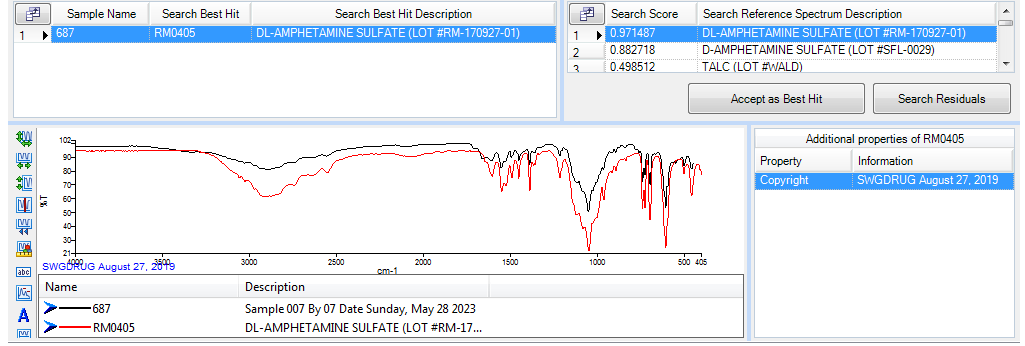
Effective and rapid detection methods in the field of forensic drug analysis are crucial for reducing overall analysis time and improving reliability. The purpose of this study is to develop a simple and rapid method for the separation of amphetamine from captagon tablets and analysis by means of Fourier transform infrared spectroscopy (FTIR). In this study, the separation of amphetamine using a variety of solvents, including chloroform, Acetonitrile, dichloromethane, methanol and water, were studied. The results obtained show that the separation using a mix of acetonitrile (ACN) with methanol (MeOH) gives a matching percentage close to 97.14% of amphetamine sulfate when compared with the IR spectrum given in the reference (SWGDRUG) library. This method can be used as a confirmatory test for positive results within minutes without false positives
Introduction
Nowadays, drug abuse is growing alarmingly in many societies. Narcotic drugs are usually prescribed for analgesia and euphoria. The most available substances for the treatment of mild depression, and malaise are amphetamine and methamphetamine [1]. In 2015, about 1.3 million people used amphetamine and methamphetamine. In 2016 the World Drug Report showed that amphetamine drug consumption is on the rise, and it is the second largest illegal drug [2] Captagon was the brand name of a psychoactive medicine produced in the 1960s by the German company Degussa Pharma Gruppe. It was sold as whitish colored tablets marked with a characteristic logo comprising two half-moons (Figure 1) [3]. Captagon tablets contained 50 milligrams of fenethylline, a synthetic drug of the phenethylamine family to which amphetamine also belongs. Captagon is metabolized into amphetamine (24.5% of oral dose) and theophylline (13.7% of oral dose) a natural alkaloid, bronchodilator and mild stimulant from the same family as caffeine, and so it can be difficult to determine by forensic investigation if fenethylline, or a combination of amphetamine and theophylline, has been consumed [3, 4].
![Figure 1: Captagon Tablets [3].](/fulltextimages/10708/fig_1.png)
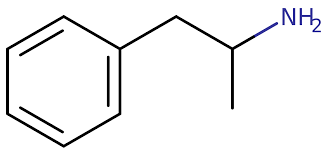
The common point of all the published research analyses of captagon tablets is the absence of fenethylline and the presence of amphetamine in combination with caffeine, quinine and several other substances [5, 6]. Amphetamine (Figure 2), is a central nervous system (CNS) stimulator that can increase alertness, boost concentration/physical performance, and provide a feeling of well-being, confidence, and aggression [7].
The ability of the amphetamine and it’s like compounds to promote the release of newly generated dopamine from the dopaminergic neurons is the main mechanism by which they work. Due to the serious toxic effects that are dose dependent, including hallucinations, disorientation, tremors, cardiac arrhythmias, and hypertension, extreme depression, lethargy, sleep deprivation, heart and blood vessel toxicity, and malnutrition; these medications are subject to legal restrictions [8, 9, 10]. The separation of drugs from biological matrices or other types of chemicals are one of the most important objects in investigations on the toxicological and pharmaceutical properties of drugs. Liquid–liquid or solid- liquid separation methods are widely used for extracting and purifying drugs and medicines from biological materials [11]. Different methods for measuring amphetamines have been reported separately or simultaneously [12], including high performance liquid chromatography (HPLC) and gas chromatography (GC) [13, 14, 15, 16, 17, 18]. However, these methods involve laborious, intensive, and expensive preparatory procedures. In addition, the organic solvents used are toxic to both the humans and the environment. Therefore, recent investigations have focused on methods to reduce the sample volume required, the analytical time, and the cost, and to eliminate the use of chlorinated solvents. Separation and extraction techniques are the basis of many analytical procedures for the preparation of samples and they are reported in the official methods of analysis [19]. However many separation methods are robust and cost effective for the separation of amphetamines from biological samples and are still widely used in analytical toxicology [20]. A number of publications have appeared addressing extracting using solvents such as diethyl ether [21, 22], ethyl acetate [23, 24], 1-chlorobutan [25, 26] and various mixtures of solvents [27, 28] that were used in the isolation of amphetamines from biological samples but not from a tablets. More recently, Fourier transform infrared spectroscopy (FTIR) and diffuse reflectance near infrared have been used for qualitative and quantitative analysis of drugs such as Amphetamine [29], Methylamphetamine [30], Diacetylmorphine (heroin) [31], and Cocaine [32]. The present study aims to develop a method based on separation of amphetamine from captagon tablets and analyzed using Fourier transform infrared (FTIR) and UV/VIS spectroscopy.
Materials and Methods
Chemicals & Equipment
Acetonitrile ACN, Chloroform, Methanol MeOH, Dichloromethane DCM, Formaldehyde, Sodium nitrite, Sulfuric acid were purchased from Sigma Aldrich (Germany) and Himedia from india. All chemicals were of HPLC grade. UV/VIS (D-LAP – SP UV1100) made in CHINA, Centrifuge plc series (model : PLC -03 ) made in Taiwan , NABPCO Electrical balance (model JA-210) and FTIR (spectrum two FTIR spectroscopy, PerkinElmer) made in USA.
Sample Preparation
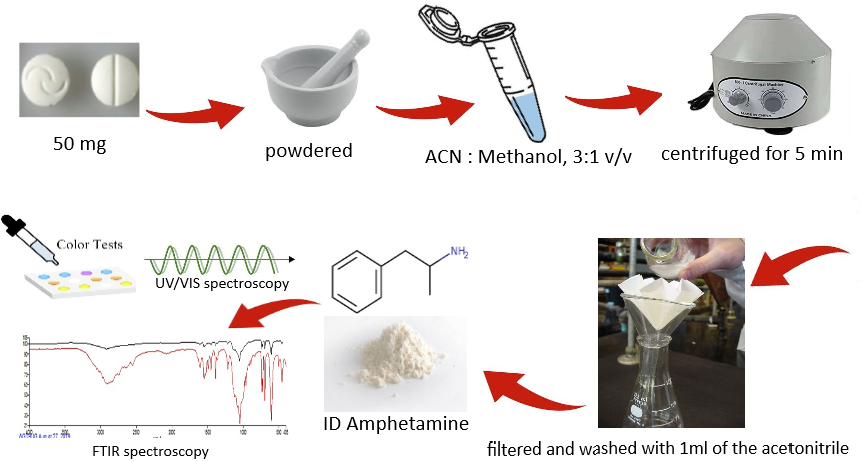
Briefly, a quarter tablet (50 mg) was crushed into a fine powder and dissolved in 3 ml of acetonitrile and 1 ml of methanol, mixed properly for at least 5 seconds, then centrifuged at 4000 rpm for 5 minutes at room temperature. Subsequently, the aqueous phase was discarded and the organic solid was filtered through a filter paper of 10–15 µm, and the solid was washed with 1 ml of the acetonitrile as shown in (Figure 3). Finally, the organic solid separated was analyzed using FTIR and UV/VIS spectroscopy.
Result and Discussion
Presumptive Color Tests
One of the simplest analytical procedures used in a forensic chemistry laboratory is broadly classified under color tests. Color tests or spot tests are chemical tests that involve the reaction of a sample with a reagent or a series of reagents to produce a color or a change in color. The biggest advantages of color tests are their simplicity and ease of use. A negative result for a color test is helpful, for example, in excluding a drug or a class of drugs, depending on the test performed [33]. Color tests remain an important tool for the preliminary identification of illicit drugs despite the developments in instrumental technology, as no complex devices are required and the time needed to perform the test is short. There are a large number of color tests that have been developed over the years to screen for the presence of certain drugs or drug classes [33, 34]. The most two common color tests used for the identification of amphetamine are the Marquis test and the Liebermann test.
Marquis Test
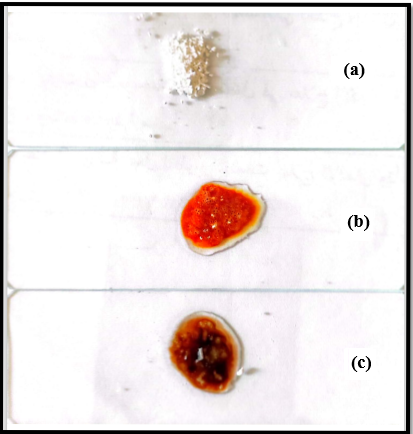
The reagent is composed of 10% of 37% formaldehyde in concentrated sulfuric acid [34]. When added one drop of Marquis reagent to the separated sample the orange- brown color gives a positive indication of the presence of amphetamine, as shown in Figure 4.
Liebermann Test
The reagent is prepared by adding 5 g of sodium nitrite in 50 ml of sulfuric acid [33]. When one drop of Liebermann reagent is added to the separated sample, the red-orange color gives a positive indication of the presence of amphetamine, as shown in Figure 4.
Volume of the Separation Solvent
Various volumes of solvents were used in order to find the optimum quantity of the separation solvent volume. Specifically 1, 2 and 3 ml of all the solvents were applied for the separation of amphetamine from captagon tablets, and then a mixture of solvents was used. Four experiments were carried out for each volume of the solvents. The best result was obtained using acetonitrile. The percentage of amphetamine was approximately the same (85.50 and 87.8) when 1 and 2 ml of acetonitrile were used as solvent. When 3 ml of acetonitrile was used, the matching reached 92.2% with the SWGDRUG library amphetamine sulfate standard using FTIR. Hence, a volume of 3 ml was selected for the rest of the study.
Selection of the Separation Solvent
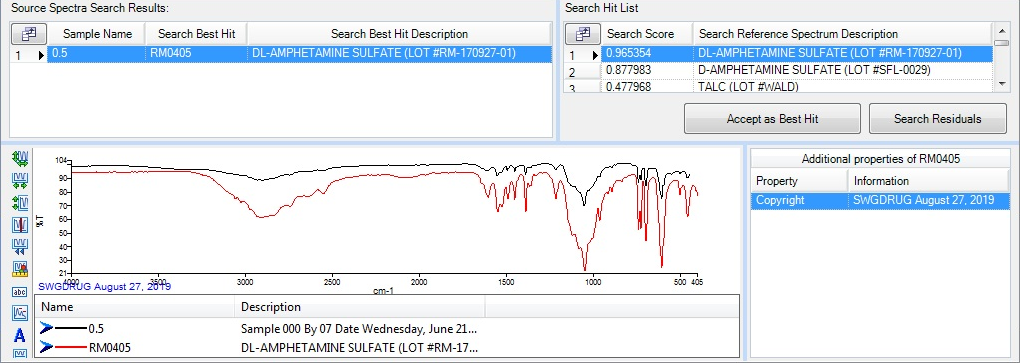
The separation procedures were carried out using different solvents. Five solvents (Acetonitrile, Chloroform, H2O, Dichloromethane, and Methanol) and a mixture of solvents (Chloroform: MeOH, 3:1 v/v), (ACN: MeOH, 3:1 v/v), (ACN: H2O, 3:1 v/v), and (ACN: MeOH: DCM, 0.5: 0.5: 0.5 v/v) were used in order to find out the best solvent for the separation of amphetamine in the solutions. At least, four experiments for each solvent were carried out. Table 1 shows that the percentage separation of amphetamine was achieved by a 3:1 acetonitrile and methanol mixture; this result indicates that the addition of methanol to acetonitrile increased the efficiency of the separation.
| Percentage of Matching (%) | |
|---|---|
| Dichloromethane | 91.12 |
| Chloroform | 84 |
| Acetonitrile | 92.2 |
| Acetonitrile: Methanol (3:1 v/v) | 97.14 |
| Chloroform: Methanol (3:1 v/v) | 93.9 |
| Acetonitrile: H2O (3:1 v/v) | 83.4 |
| Acetonitrile: Methanol: Dichloromethane (0.5: 0.5: 0.5 v/v) | 96.21 |
| Dichloromethane: Methanol (3: 1 v/v) | 95.1 |
| Dichloromethane: Acetonitrile (3: 1 v/v) | 94.61 |
| Dichloromethane: Acetonitrile (1: 1 v/v) | 93.22 |
Table 1: Comparison between the Matching of Amphetamine Separated with Amphetamine Sulfate in the FTIR Library by SWGDRUG.
UV/VIS Analysis of Captagon Tablets
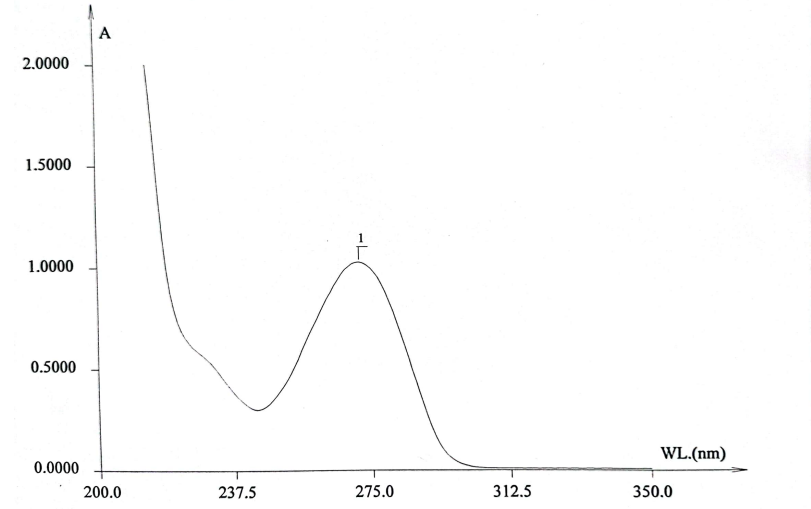
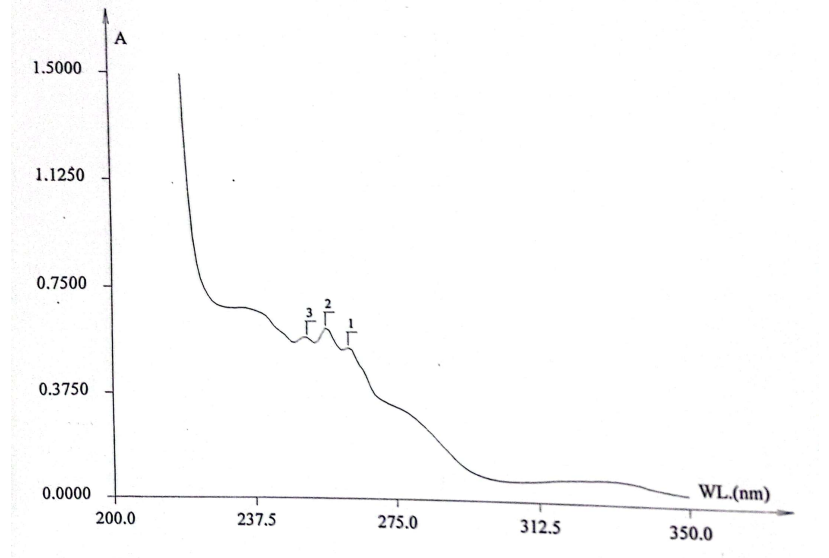
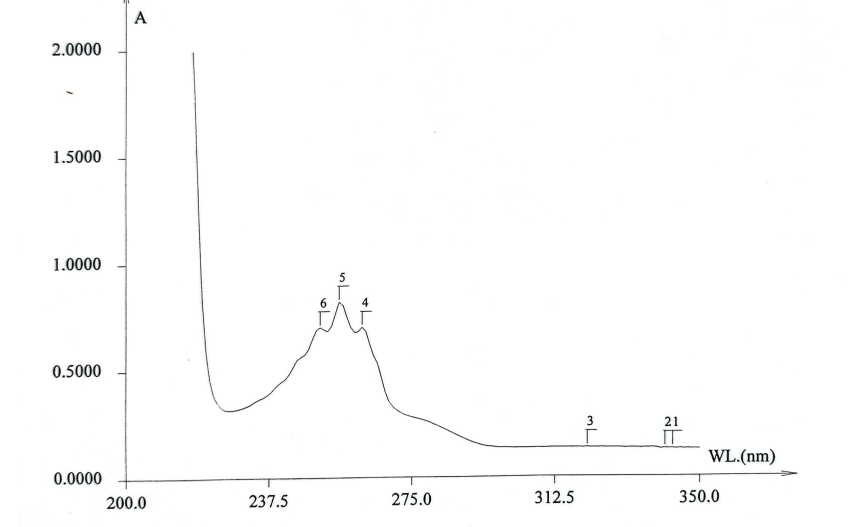
The captagon tablets before separation contain a compound giving UV absorption at 278 nm due to the presence of caffeine in the tablets, as shown in (Figure 5). Figure 6 represents the UV spectrum of amphetamine according to Moffett et al. (2011) [35]. According to Figures
7 & 8, after separation using ACN and (ACN: MeOH) the captagon tablets were found to contain a compound giving UV absorption at 262 nm, 256 nm, and 251 nm using deionized water as solvent; this solid, when compared with the UV/VIS spectrum given in the reference [35], gives an exact match with amphetamine.
![Figure 5: UV Spectra of Amphetamine Sulfate by Anthony MC, et al. [35].](/fulltextimages/10708/fig_5.png)
IR Analysis of Captagon Tablets
The principal way that FTIR is currently used in the analysis of illicit drugs is through the use of spectral libraries to match the spectra of known compounds to the unknown (often a mixture). This technique is commonly used in identifying illicit drugs, precursors, and other chemicals related to the process [36].
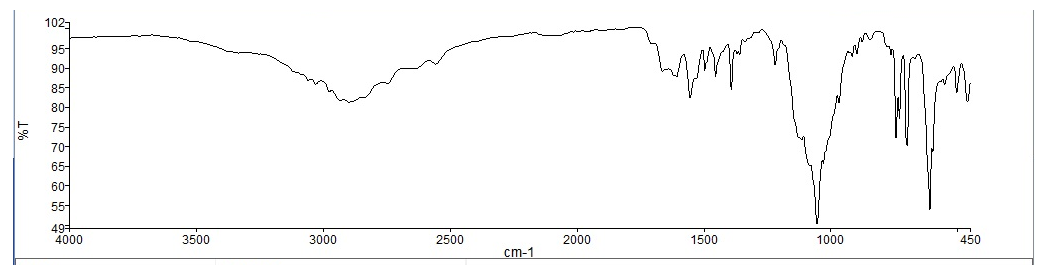
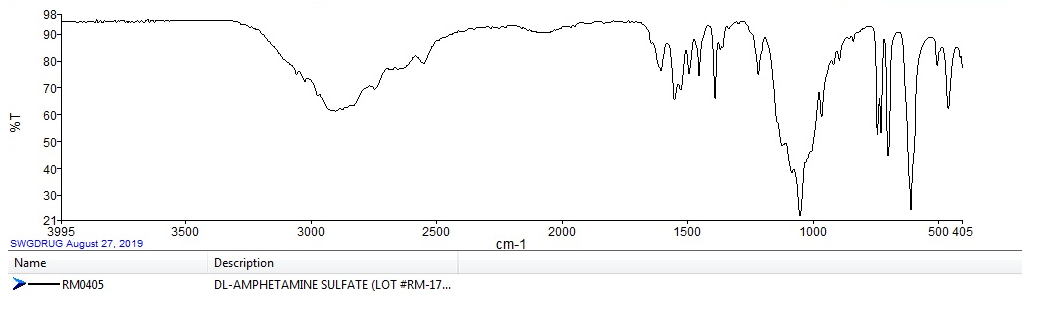
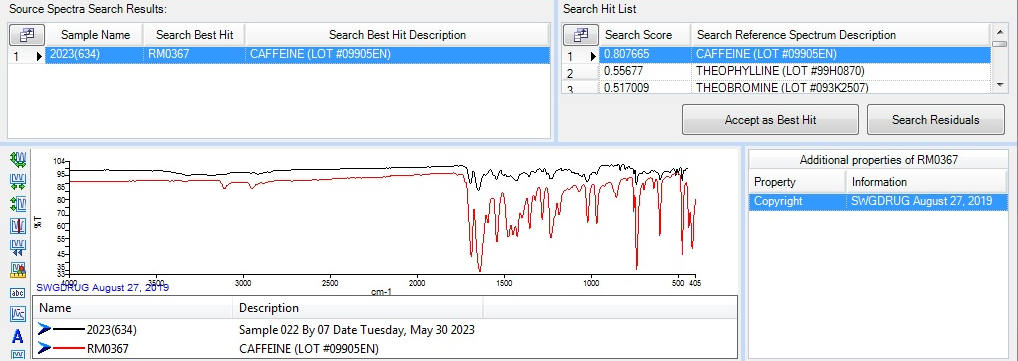
The characteristics of IR bands and major functional groups detected are summarized for captagon tablets after separation using ACN (3 ml), ACN: MeOH (3:1 v/v), and ACN: MeOH: DCM (0.5: 0.5: 0.5 v/v) in (Figures 9-11), respectively. In IR spectra analysis, the bands appear clearly at 1600 cm-1, 1490 cm-1, 1219 cm-1, 1086 cm-1, 810 cm-1, 745 cm-1, and 702 cm-1; this result, when compared with the amphetamine sulfate FTIR spectrum from the library given in the reference of (SWGDRUG) [37], appears to match a percentage of DL-amphetamine sulfate (97.14%). This result is evidence that the efficiency of the separation method was achieved. On the other hand, Figure 12 represents the IR spectrum of amphetamine by SWGDRUG, and Figure 13 refers to captagon tablets without separation. In this figure, the functional groups of the major compound, which is caffeine, appear. Caffeine is more polar than amphetamine [38], so the more polar compounds will be separated from the tablets and settle in the liquid phase, while the less polar one (amphetamine) is still in the solid phase. The separation of amphetamine can be optimized by increasing the volume of the solvent to 3 ml of ACN and increasing the solvent polarity by adding 1 ml of MeOH. This led to a complete dissolution of caffeine and a clear separation of amphetamine from all components present in the captagon tablets.
Conclusion
Sample preparation is an important step in the isolation of target compounds from complex matrices to perform their reliable and accurate analysis. This study examined the separation of amphetamine from captagon tablets using different solvents. The effects of the type and volume of the solvent on the separation were studied. The results showed that the separation using a mixture of ACN: MeOH (3: 1 ml) closely matches 97.1 % of amphetamine sulfate when compared with the FTIR spectrum given in (SWGDRUG). The UV-Vis spectra of amphetamine separated show three absorptions with a maximum at 262 nm, 256 nm and 251 nm. Finally, this study might be able to address the demand for both qualitative forensic investigations and fast reliable confirmation for amphetamine detection in captagon tablets, and it showed that FTIR is a promising technique for the in- field detection of illicit drugs.
Acknowledgements
The authors would like to acknowledge Prof. Nasser M Abu Ghalwa (Al Azhar University - Gaza – Palestine) for encouragement, support and providing facilities for research.
References
-
Badakhshan D, Ramezani M (2020) Determination of Amphetamine and Methamphetamine by Dispersive Liquid Phase Micro-separation: A Novel Experimental Approac. Iran J Toxicol 14(4): 253-262.
-
Ruan X, Xing L, Peng J, Li S, Song Y et al. (2020) A simplified fabric phase sorptive separation method for the determination of amphetamine drugs in water samples using liquid chromatography-mass spectrometry. RSC Adv 10: 10854-10866.
-
(2018) European Monitoring Centre for Drugs and Drug Addiction, Captagon: understanding today’s illicit market, EMCDDA Papers, Publications Office of the European Union, Luxembourg.
-
Wu N, Feng Z, He X, Kwon W, Wang J, et al. (2019) Insight of Captagon Abuse by Chemogenomics Knowledge base guided Systems Pharmacology Target Mapping Analyses. Scientific Reports 9: 2268.
-
Dabbagh R, Rawson R (2019) Captagon Use in Saudi Arabia: What Do we Know? International Addiction Review.
-
Vajs V, Petrovic S, Stevic SB, Nevescanin M (2008) Analysis of amphetamines illegally produced in Serbia. Journal of the Serbian Chemical Society 73(7): 691-701.
-
Katselou M, Papoutsis I, Nikolaou P, Qammaz S, Spiliopoulou C, et al. (2016) Fenthylline (Captagon) abuse - local problems from an old drug become universal. Basic Clin Pharmacol Toxicol 119(2): 133-140.
-
Stahl SM (2017) Stahl’s Essential Psychopharmacology Prescriber’s Guide. In: 6th (Edn.), Cambridge, United Kingdom: Cambridge University Press, pp: 45-51.
-
Alhazmi HA, Ahsan W, Al Bratty M, Javed SA, El- Sharkawy KA, et al. (2020) Analysis of amphetamine and methamphetamine contents in seized tablets from Jazan, Saudi Arabia by liquid chromatography-mass spectroscopy (LC-MS/MS) and chemometric techniques. Saudi Pharm J 28(6): 703-709.
-
(2003) Fenethylline and the Middle East. A Brief Summary, Drug Enforcement Administration. USA DEA- 03046.
-
Nameraa A, Nakamoto A, Nishidaa M, Saito T, Kishiyama I, et al. (2008) Extraction of amphetamines and methylenedioxyamphetamines from urine using a monolithic silica disk-packed spin column and high- performance liquid chromatography–diode array detection. J Chromatogr A 1208(1-2): 71-75.
-
Leardi R (2009) Experimental design in chemistry: A tutorial. Anal Chim Acta 652(1-2): 161-172.
-
Bruce RB, Maynard WR (1969) Determination of amphetamine and related amines in blood by gas chromatography. Anal Chem 41(7): 977-979.
-
Chen L, Yu Y, Duan G, Wang X, Shen B, et al. (2019) Simultaneous determination of selegiline, desmethylselegiline, R/S-methamphetamine, and R/S- amphetamine on dried urine spots by LC/MS/MS: Application to a pharmacokinetic study in urine. Front Chem 7: 248.
-
Marquet P, Lacassie E, Battu C, Faubert H, Lachâtreab G (1997) Simultaneous determination of amphetamine and its analogs in human whole blood by gas chromatography-mass spectrometry. J Chromatogr B Biome Sci Applic 700(1-2): 77-82.
-
Nakahara Y, Takahashi K, Shimamine M, Takeda Y (1991) Hair Analysis for Drug Abuse: I. Determination of Methamphetamine and Amphetamine in Hair by Stable Isotope Dilution Gas Chromatography/Mass Spectrometry Method. J Forensic Sci 36(1): 70-78.
-
Skender L, Karacic V, Brcic I, Bagaricb A (2002) Quantitative Determination of Amphetamines, Cocaine, and Opiates in Human Hair by Gas Chromatography/ Mass Spectrometry. Forensic Sci Int 125(2-3): 120-126.
-
Wozniak MK, Wiergowski M, Aszyk J, Kubica P, Namiesnik J, et al. (2018) Application of Gas Chromatography- Tandem Mass Spectrometry for the Determination of Amphetamine-Type Stimulants in Blood And Urine. J Pharm Biomed Anal 148: 58-64.
-
AOAC Method (1990) Official Methods of Analysis of the AOAC, 15th (Edn.), Association of Official Analytical Chemists: Washington DC, USA.
-
Raikos N, Spagou K, Vlachou M, Pouliopoulos AE, Thessalonikeos E, et al. (2009) Development of a Liquid-Liquid Extraction Procedure for the Analysis of Amphetamine in Biological Specimens by GC-FID. The Open Forensic Science Journal 2: 12-15.
-
Marquet P, Lacassle E, Battu C, Faubert H, Lachatre GJ (1997) Simultaneous determination of amphetamine and its analogs in human whole blood by gas chromatography-mass spectrometry. J Chromatogr B Biomed Sci Appl 700(1-2): 77-82.
-
Concheiro M, Maria S, Simoes S, Quintela O, Castro A, et al. (2007) Fast LC–MS/MS method for the determination of amphetamine, methamphetamine, MDA, MDMA, MDEA, MBDB and PMA in urine Forensic Sci Int 171(1): 44-51.
-
Sato M, Mitsui TJ (1997) Rapid and simple determination of methamphetamine and amphetamine in blood by simultaneous extraction-derivatization. Journal of Pharmaceutical and Biomedical Analysis Biomed 16(1): 139-145.
-
Kuwayama K, Inoue H, Kanamori T, Tsujikawa K, Miyaguchi H, et al. (2007) Contribution of thermal desorption and liquid–liquid extraction for identification and profiling of impurities in methamphetamine by gas chromatography–mass spectrometry Forensic Sci Int 171(1): 9-15.
-
Geiser L, Cherkaoui S, Veuthey JL (2000) Simultaneous analysis of some amphetamine derivatives in urine by nonaqueous capillary electrophoresis coupled to electrospray ionization mass spectrometry. Journal of Chromatography A 895(1-2): 111-121.
-
Drummer OH, Gerostamoulos D, Chu M, Swann P, Boorman M, et al. (2007) Drugs in oral fluid in randomly selected drivers. Forensic Science International 170(2- 3): 105-110.
-
Wang G, Fan G, Lin M, Chen Y, Zhaoa W, et al. (2007) Development and validation of a liquid chromatography/ tandem mass spectrometry assay for the simultaneous determination of d-amphetamine and diphenhydramine in beagle dog plasma and its application to a pharmacokinetic study. Journal of Chromatography B 854(1-2): 48-56.
-
Pizzolato TM, Lopez de Alda MJ, Barcelo D (2007) LC- based analysis of drugs of abuse and their metabolites in urine. TrAC Trends in Analytical Chemistry 26(6): 609- 624.
-
Dobsikova K, Michal P, Spalovska D, Martin K, Radek J, et al. (2023) Conformational Analysis of Amphetamine and Methamphetamine: A Comprehensive Approach by Vibrational and Chiroptical Spectroscopy. Analyst 148: 1337-1348.
-
Yong Goh C, Wilhelm VB, Colin P (2008) Rapid Nondestructive on-Site Screening of Methylamphetamine Seizures by Attenuated Total Reflection Fourier Transform Infrared Spectroscopy. Applied Spectroscopy 62(6): 640-648.
-
Melucci D, Monti D, D’ Elia M, Luciano G (2012) Rapid In Situ Repeatable Analysis of Drugs in Powder Form Using Reflectance Near-Infrared Spectroscopy and Multivariate Calibration. Journal of Forensic Sciences 57(1): 86-92.
-
Rodrigues NVS, Cardoso EM, Andrade MVO, Donnici CL, Senal MM (2013) Analysis of Seized Cocaine Samples by using Chemometric Methods and FTIR Spectroscopy. J Braz Chem Soc 24(3): 507-517.
-
Burks R, Winokur A (2023) Presumptive Chemical Tests. Encyclopedia of Forensic Sciences, Third Edition 3rd (Edn.) 4: 263-277.
-
Toole KE, Fu S, Shimmon RG, Kraymen N, Taflage S (2007) Color Tests for the Preliminary Identification of Methcathinone and Analogues of Methcathinone. Microgram Journal 9(1): 27-32.
-
Anthony MC, Osselton MD, Watts WB (2011) Clarke’s Analysis of Drugs and Poisons, 4th (Edn.), Pharmaceutical Press.
-
Hughes J, Ayoko G, Collett S, Golding G (2013) Rapid Quantification of Methamphetamine: Using Attenuated Total Reflectance Fourier Transform Infrared Spectroscopy (ATR-FTIR) and Chemometrics. PLOS ONE 8(7): e69609.
-
(2019) Scientific Working Group for the Analysis of Seized Drugs (SWGDRUG) Website, Searchable Infrared Library Version 2.1.
-
Simasatitkul V (1990) The Use of Reverse-phase HPLC for the Analysis of Illicit Ya-Ma. Journal of Health Research 4(1): 1-10.
- Forensic Implications of Adverse Drug Reactions in Schizophrenia A Case Series
- Narcotics and Digital Forensics: Bridging Crimes in the Digital Age
- Ethics in Forensic Psychiatry: Principles, Dilemmas, and Human Rights
- Impact of Acute Stress on Attentional Orienting to Social Cues
- Head Injury and Intracranial Hemorrhage in Western Region of Libya
- A Forensic Study on Handedness: Examination of Handwriting Features in Right and Left Handed Writers