
Traffic Accident Injury and the Possibility of Mechanical Asphyxia Leading to Death Co-Exist in a Case Report of Forensic Investigation
The case analysis of forensic medicine of deaths as a result of the traffic accident, if the effect of trauma is clear that is not difficult to make a forensic expert opinion, but if combined with other special reasons may arouse speculation of the parties, so it’s necessary to screening and attention in details. This paper reports a death case caused by a traffic accident, in the process of autopsy we found the deceased with severe craniocerebral injury, minor cyanosis in his lips and hands nail bed, besides, a foreign body which was identified as an apple core was also found at the entrance above his throat. The driver suspected that the dead died of mechanical asphyxia caused by the apple core. After comprehensive and systematic autopsy, forensic histopathological examination and toxic drug examination, it was determined that the victim died of craniocerebral injury caused by traffic accident, and asphyxia caused by foreign bodies was excluded. It is uncommon for mechanical asphyxiation obstructed by a foreign body and traffic accident injuries to coexist in the same case. The case reported in this article is coincidental, rare, and has caused controversy. It is worth the attention of forensic professionals.
Introduction
For the forensic identification of road traffic accidents, if combined with other special causes of injury, it may increase the difficulty of the case [1], if the role of trauma is clear, generally speaking, the difficulty of identification will be reduced. Road traffic accidents are an important cause of accidental death [2], and these rapid death are usually due to brain herniation caused by severe craniocerebral injury or brain edema [3], and direct damage to the brainstem, which can be followed by signs and symptoms such as pulmonary bruise edema, multi-organ vasodilatation bruise, and cyanosis of the nail bed of the mouth, lips, and fingers [4]. In mechanical asphyxia cases, common signs also include pulmonary bruising and edema, multi-organ vasodilatation bruising, and cyanosis of the nail beds of the mouth, lips, and fingers. Have some of the same pathologic signs and sometimes need to be identified [5]. This case report provides lessons and references for forensic science identification in related cases.
Brief Case
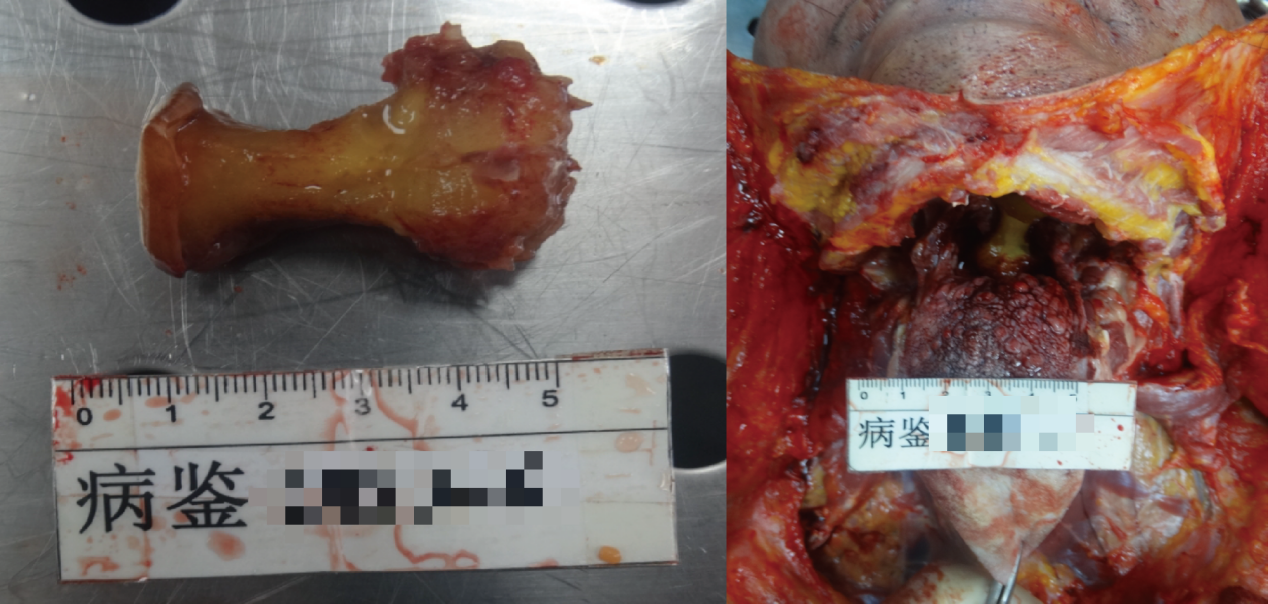
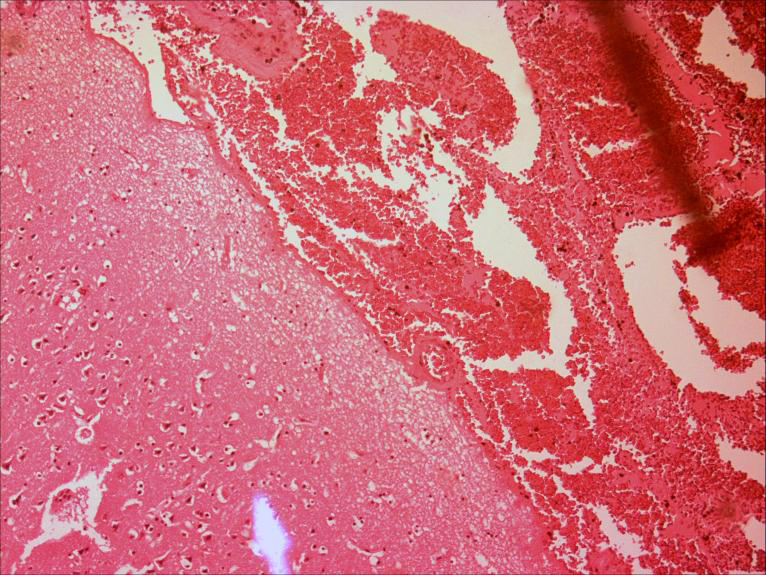
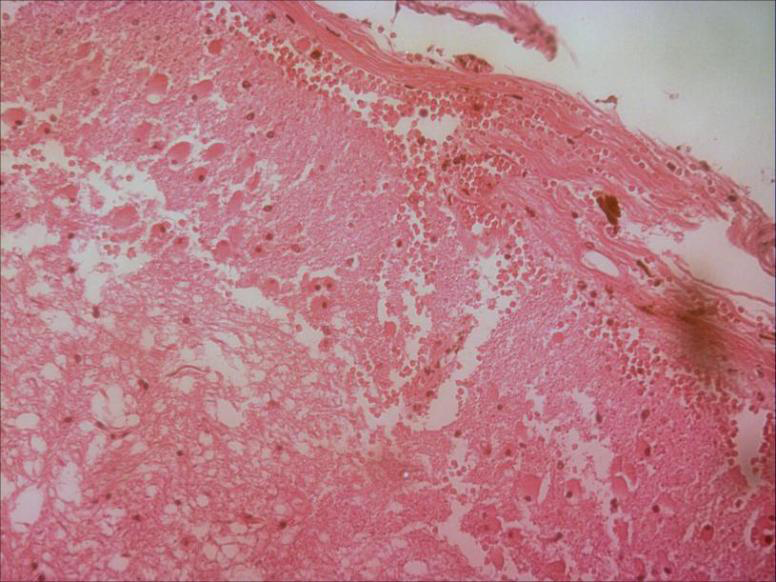
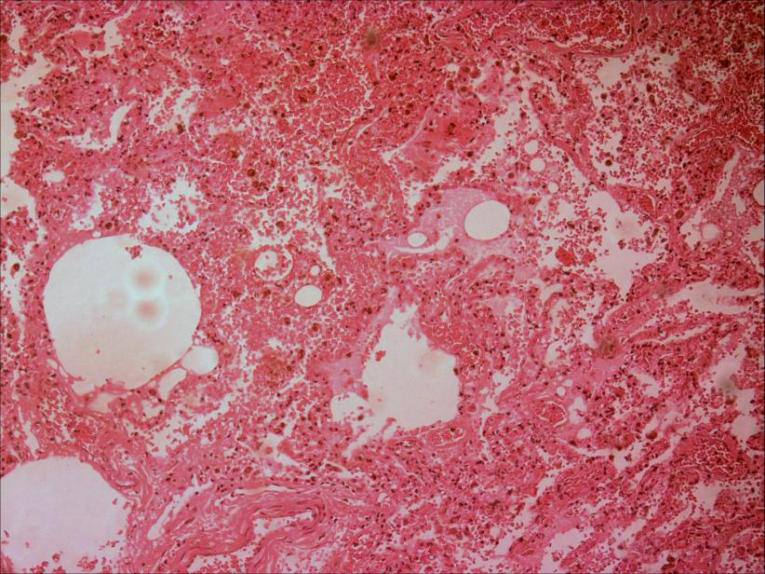
Wu, male, aged 38. On a certain date in February 2023, Wu was walking when he was hit by a small SUV and died on the spot. Surface examination of the decedent’s body, autopsy and forensic histopathological examination revealed the following major findings: Corpse External Examination: A 7cm×5cm bruised and swollen area with abrasions and contusions was detected in the middle of the forehead, a lamellar abrasion on the right forehead above the lateral arch of the eyebrow was found; streaky abrasions and contusions were on the right side of the face and right submandibular area; bloody fluid seen in the right external auditory canal, oral cavity, and nasal cavity; the mouth and lips were mildly cyanotic, and no damage to the oral mucosa was observed; mild cyanosis was found of the nail beds on both hands. Medico-Legal Autopsy: A subscalp hematoma was formed in the top of the right forehead within 12cm×10cm; there was no skull fracture, no rupture of the dura mater, no hemorrhage outside the dura mater or under the dura mater, and no hemorrhage in the accavities. An 3.5cm×2cm×1.5cm apple core, which was loose to touch and easily displaced, with no adhesions to the surrounding tissues and no mucus adhering to the surface, was seen covering the larynx above the pharynx in the oral cavity (Figure 1). Small subcutaneous hemorrhages were seen in the left lumbar region (110 cm from the sole of the feet) and in the left buttock(95 cm from the sole of the feet). Examination of internal organs revealed: a localized subarachnoid hemorrhage was seen in the bilateral parietal and right frontal lobes of the brain, suspected contusion hemorrhage was seen locally in the pontocerebral section; was no damage to the pharyngeal mucosa; both lungs were full, foamy, bloody fluid was seen in the lumen of the trachea and bronchi, bloody foamy fluid was seen on both sections of lung. No abnormalities were found in the remaining organs and tissues. Microscopic Observation: The subarachnoid space of the brain tissue in the bilateral parietal and left frontal lobes was dilated and hemorrhaged significantly, no brain contusion was seen. Highly congested meningeal and parenchymal blood vessels were found (Figure 2); the nerve cells of the brain, cerebellum, and brainstem were structurally normal, the nerve cells and small vessel perimeters were widened, leakage hemorrhage was seen around some of the vessels; local tissue of the pontine brain can be examined for luminal contusion hemorrhage (Figure 3); bilateral alveolar capillaries were evident, eosin-tropic edema fluid was seen in some alveoli, more red blood cells were seen in some parts of the alveolar space (Figure 4); the laryngeal mucosa was intact, with a small number of mononuclear and lymphocytic infiltrates scattered in the mucosa and submucosa. No other anomalies were observed. Medico-Legal Toxicological Analysis: Wu’s heart blood was drawn for toxic drug testing, the method and results are as follows:
- Qualitative and quantitative testing of toxic components (drug components): in accordance with the relevant “Forensic Toxicology Forensic Identification Technical Specification” of the People’s Republic of China (Standard No: SF/ZJD0107005-2016, SF/ZJD0107008-2010, SF/ ZJD0107014-2015, SF/ZJD0107018-2018) perform the qualitative testing, as a result, no toxic drug components were detected.
- Qualitative and quantitative testing of common drugs: in accordance with the relevant “forensic toxicology test forensic technical specifications and industry standards” of the People’s Republic of China (Standard No: SF/ ZJD0107005-2016, SF/T0116-2021, SF/T0114-2021) performs the qualitative testing, as a result, no drug components were detected.
Discussion
Craniocerebral injury is the main cause of death of individuals in road traffic accidents, and it is often easy to judge when the craniocerebral injury is severe [6]. In this case, the deceased was found to have brainstem hemorrhage by autopsy, and injuries in this area often cause respiratory and circulatory failure and death of the injured person [7]. The brainstem is located in the center of the brain, under which is clival regions, immediately adjacent to the cerebrum and cerebellum. When external forces act on the head, the brainstem may be directly impacted on the hard clivus bone, but may also be stretched, twisted, squeezed, and impacted by the cerebrum and cerebellum leading to injury, among which whiplash, torsion, and posterior occipital violence cause the most damage to the brainstem [8]. Brainstem injury usually occurs when the frontal area is injured, which can cause the brainstem to impact the clivus area.
On examination of the deceased in this case, the deceased was found with a bruised and swollen area with abrasions and contusions in the middle of his forehead, abrasions and contusions on the lateral side of the right frontal arch of the eyebrow, and a subscalp hematoma formation was found on the top of the right forehead, these injuries were all consistent with these above injury mechanisms [9]. Acute pulmonary edema found at autopsy was consistent with neurogenic pulmonary edema due to the brain injury. During the autopsy, although the autopsy did not reveal any obvious abnormalities in his waist and buttocks, small pieces of subcutaneous bleeding were detected in his left wrist and left buttocks after his skin was cut open, which was compared with the accident vehicle, in line with the vehicle impact, according to restoring the deceased’s death process in line with the left side of the waist and hip was hit after the head and face on the ground due to injury. That warning us, in forensic events encountered in complex, difficult cases, should be as far as possible to cut open the skin of the lumbar back to discover the possible existence of invisible injuries.
The special and complicated part of this case was that an apple core was found at the entrance above the throat of the deceased during the autopsy, and the parties, therefore, suspected that the deceased died of asphyxiation due to the apple core obstruction, and the controversy about the cause of death of the deceased made the case difficult to conclude. Therefore, according to the need to solve this case, it is necessary to screen whether the apple core can lead to asphyxiation of the deceased, whether the degree of death, and whether the post-mortem movement of the body led to obstruction. In this case, it was found that the deceased’s body surface asphyxiation signs were not obvious, mild cyanosis of the lips and nail beds of the hands can be secondary to pulmonary edema bruising. The apple core was located above the pharynx, moving loosely and easily displaced, with no adhesion to the surrounding structure, no mucus adhesion on the surface, no damage to the pharyngeal mucosa, and the laryngeal mucosa was intact, none of the above is consistent with the manifestation of the organism’s vital reaction after prebiotic foreign body obstruction, and it can be assumed that the foreign body did not reach the level of obstruction or that no foreign body-induced airway obstruction occurred. Combined with the process of carrying the body after the accident, the individual died with muscle and smooth muscle relaxation and no damage to the pharynx, the foreign body can also be considered to have slipped into the pharynx after death. In summary, our appraisal concluded that the traffic accident caused cranio-cerebral injury resulting in death, rather than asphyxiation caused by a foreign body.
This case has special characteristics, if not carefully examined and analyzed, it is highly likely that the cause of death will be incorrectly identified as mechanical asphyxia caused by the obstruction of the apple core above the throat, so it should be alerted in the forensic practice. In cases where trauma is combined with other specific findings, it is particularly important that specific problems are analyzed in detail whether the injury occurred antemortem or postmortem and to analyze the specific problem. In this case, the presence of the apple core in the pharynx and the signs of asphyxia due to pulmonary bruising and edema caused by the craniocerebral injury made forensic identification more challenging and easily confused with the true cause of death.
Scientific fairness is the prerequisite for successful forensic identification, so forensic experts not only need the accumulation of knowledge advancing with the times, but also need a solid practical foundation, specific analysis of specific problems, and to be able to use them flexibly. This article reports on a controversial case in which two possibilities for death by traffic accident or death by asphyxiation of a foreign body coexisted, alerting forensic practitioners to conduct not only comprehensive and systematic post-mortem examinations, but also to analyze them from an objective and scientific perspective according to the specific circumstances, with great attention to the distinction between injuries during life and those resulting from postmortem handling, and to clarify the correlation between the findings of the forensic pathology examination and the cause of death [10]. All of the above require forensic practitioners in the prosecution of cases, not only to have a wealth of solid basic knowledge, but also to do flexible use, to avoid making wrong identification opinions.
Funding
- National Natural Science Foundation of China:Grant No. 81560304
- National Natural Science Foundation of China:Grant No. 82060341
- Supported by the specific research fund of The Innovation Platform for Academicians of Hainan Province No. YSPTZX202134
- Innovative Scientific Research Project for Postgraduates of Hainan Medical College: Grant No. HYYS2022B12
References
-
Kibayashi K, Shimada R, Nakao KI (2021) Analysis of autopsy cases involving individuals who experienced cardiopulmonary arrest immediately after sustaining minor head injuries. Journal of Forensic and Legal Medicine 81: 102205.
-
Ernstberger A, Joeris A, Daigl M, Kiss M, Angerpointner K, et al. (2015) Decrease of morbidity in road traffic accidents in a high income country – an analysis of 24,405 accidents in a 21 year period. Injury 46(S4): S135-S143.
-
Davceva N, Janevska V, Ilievski B, Spasevska L, Popeska Z (2012) Dilemmas concerning the diffuse axonal injury as a clinicopathological entity in forensic medical practice. Journal of Forensic and Legal Medicine 19(7): 413-418.
-
Hayakawa A, Sano R, Takahashi Y, Fukuda H, Okawa T, et al. (2023) Post-traumatic cerebral infarction caused by thrombus in the middle cerebral artery. Journal of Forensic and Legal Medicine 93: 102474.
-
Lanzillotta F, Visonà SD, Ballardini M, Javan GT, Osculati A (2020) A unique case of traumatic pulmonary food embolism. Journal of Forensic and Legal Medicine 70: 101907.
-
Thoma V, Geisenberger D, Schuldis D, Lickert A, Pollak S, et al. (2023) Incomplete decapitation with exenteration of the brain in a motorcyclist run over by a semitrailer. Legal Medicine 62: 102246.
-
Ţolescu RŞ, Zorilă MV, Şerbănescu MS, Kamal KC, Zorilă GL, et al. (2020) Severe traumatic brain injury (TBI) – a seven-year comparative study in a Department of Forensic Medicine. Romanian Journal of Morphology and Embryology 61(1): 95-103.
-
Zhang YL, Wang DS, Yang XA, Yang TF, Zhang F, et al. (2022) Mechanism of transverse fracture of the skull base caused by blunt force to the mandible. Legal Medicine 54: 101996.
-
Asirdizer M, Kartal E, Ekiz A, Oymak I, Tilki I, et al. (2021) The effect of the presence or absence of skull fractures on intracranial lesion development in road traffic accidents. Journal of Forensic and Legal Medicine 84: 102269.
-
Madea B, Doberentz E, Jackowski C (2019) Vital reactions – An updated overview. Forensic Science International 305: 110029.
- Forensic Implications of Adverse Drug Reactions in Schizophrenia A Case Series
- Narcotics and Digital Forensics: Bridging Crimes in the Digital Age
- Ethics in Forensic Psychiatry: Principles, Dilemmas, and Human Rights
- Impact of Acute Stress on Attentional Orienting to Social Cues
- Head Injury and Intracranial Hemorrhage in Western Region of Libya
- A Forensic Study on Handedness: Examination of Handwriting Features in Right and Left Handed Writers