
Inadequacies in Serological ABO Typing of Ancient Artifacts: The Shroud of Turin as a Case Example
Serological determination of ABO blood type is extremely valuable in evaluation of fresh blood but has major drawbacks in the analysis of aged objects. The Shroud of Turin is a full-size linen cloth bearing the ventral and dorsal images of man containing wounds consistent with scourging and crucifixion. Controversy exists regarding the authenticity and age of the artifact; it has been proposed to be the two-thousand-year-old burial cloth of Jesus, or alternatively, a clever, medieval hoax. During the last public exhibition in 2015, approximately 2 million visitors came to view the cloth for just a few minutes at short distance. It is widely reported that the Shroud bloodstains are blood type AB, based on previous findings that were never published in a peer-reviewed format. Here, the shortfalls of using serological testing for ABO determination of ancient objects are discussed using the Shroud of Turin as a case example. It is determined that the AB designation for the Shroud bloodstains is inconclusive and should be considered as type unknown pending further testing.
Results
The Shroud of Turin is an approximately fourteen- foot-long cloth with the faint image of a man containing bloodstains consistent with scourging and crucifixion. Carbon-14 dating tests performed in 1988 assigned the Shroud a proposed date 1260-1390 [14] although such results have recently been questioned, both in terms of data homogeneity and whole cloth representation [15, 16, 17]. The bloodstains contain authentic blood components including hemoglobin, albumin, and immunoglobulin, although the species of origin remains to be demonstrated [18, 19, 20]. In the early 80’s, Baima Bollone reported a designation of AB in a Shroud-specialty journal, resulting from experiments using the mixed agglutinin (forward typing) method [21]. In this technique, multivalent antibodies specific for a particular blood group antigen are added to the sample; unbound antibodies are removed by washing, and fresh RBCs of the same type as the antibody are added. For a positive result, a type of clumping, or agglutination or RBCs is observed (Figure 1, left-hand side). In aged archaeological samples, this method is typically problematic, in typing of fresh blood (left), antibodies bind to red blood cell antigens and after washing, new red blood cells of the identical type are added, forming a type of sandwich (agglutinin), which is visible under a microscope. With aged blood, antibodies may recognize similar antigens present on bacteria (shown) and fungi, resulting in a false positive result (Figure 1, right-hand side), (Table 2), a limitation acknowledged by the original researchers, [21] (Table 2). Note that antigens, antibodies, and red blood cells are not drawn to scale in this figure.
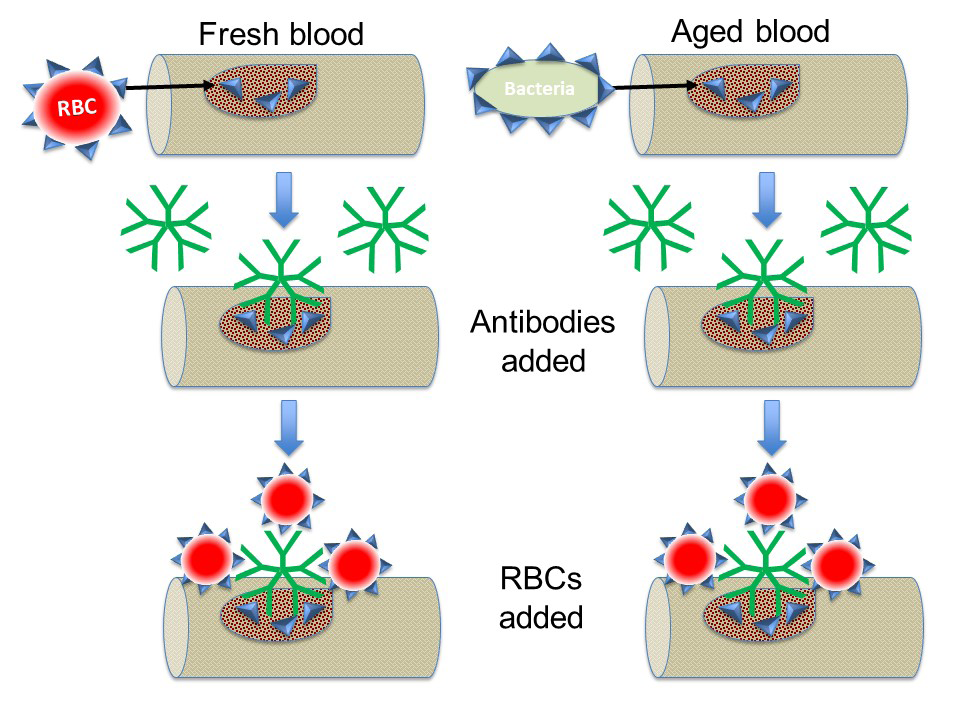
As a control in these studies, white fibers adjacent to the bloodstain were included, which tested negative [21], indicating that contamination was not widespread. It could be argued, however, that contamination would be greatest in the most nutrient rich areas of the cloth, i.e., the bloodstains. Regarding this issue, a microscopic examination of bloodstained threads taken from the Shroud showed heavy contamination by both bacteria and fungi; threads chosen from other areas, less so [22].
In a follow up study, a different method (immuno chemistry) involved peroxidase-labeled antibodies. These studies yielded similar results as before, type AB [22]; however, this experimental design suffers from the same limitations as the original studies, false positives resulting from contamination cannot be excluded [9].
To cross-check the forward typing results, a reverse typing method (Lattes technique) was used to evaluate the presence or absence of anti-A and anti-B antibodies (Table 1). Unfortunately, this technique is even more problematic with aged samples than forward typing, as it is extremely unlikely that antibodies remain functionally stable over time [9]. Typically, reverse typing is never used in studies of ancient material because the most likely result is AB, regardless of the original (true) blood type (Table 3). Not unexpectedly, this was the reported result [21]. Note that even if the designation of AB for Shroud fibers was correct, this method cannot distinguish between a true AB result and a negative finding with another blood type due to antibody instability and loss of function (Figure 2). With any blood type other than AB, verification is possible, but since the serum of AB individuals does not contain anti-A or anti-B antibodies to begin with (Table 1), the contention is exceptionally circular. Therefore, these findings are not useful for cross-checking or confirmation of blood typing of older samples [9].
| Fresh Blood | Aged Blood | ||
|---|---|---|---|
| Blood Type | Expected Result | Blood Type | Expected Result |
| A | A | A | AB |
| B | B | B | AB |
| AB | AB | AB | AB |
| O | O | O | AB |
Table 3: Reversing Typing Methods in Fresh Vs Aged Samples.
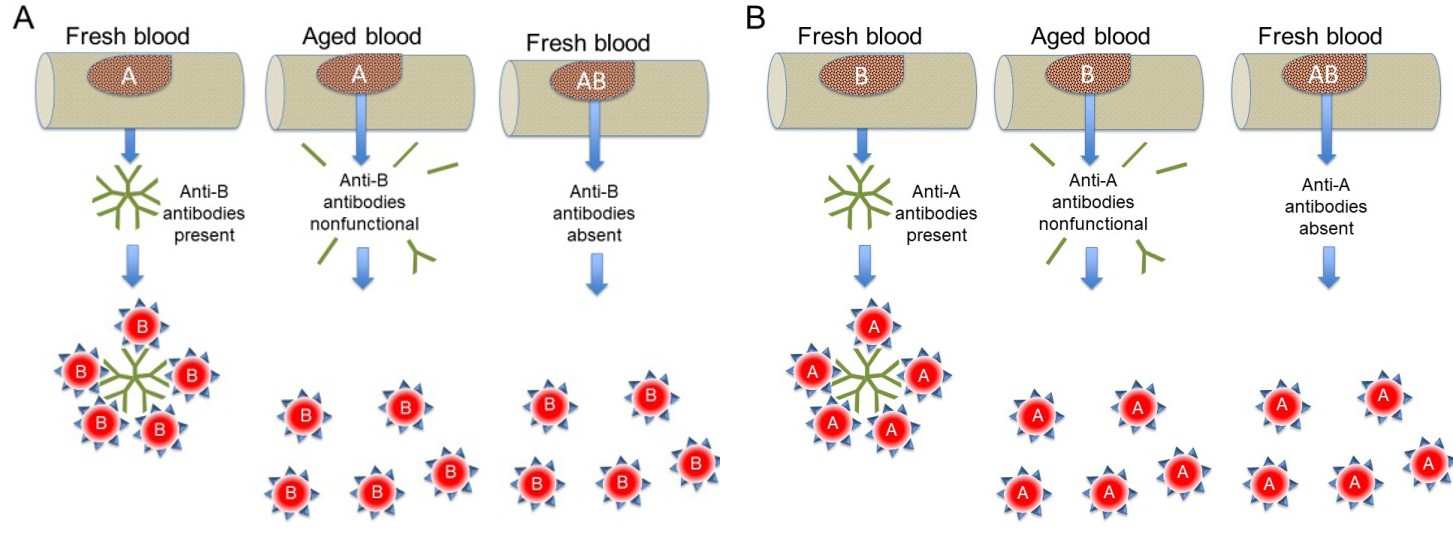
Figure 2: Mixed Agglutinin Method for Forward Typing of Fresh Vs Aged Samples. In (A), fresh and aged blood samples that are type A are evaluated using the Lattes method. A visible reaction is not observed with aged blood as antibodies have become nonfunctional over time (compare left and middle); note that this result is the same as a person having AB blood (right). (B) Similar to (A), except that an example is shown using red blood cells of the B type. Note that antigens, antibodies, and red blood cells are not drawn to scale in this figure.
- Keywords: ABO; Blood Typing; Immunology; Turin Shroud; Serology particular A and B antigens they lack. For example, the serum of O individuals contains both anti-A and anti-B, whereas the serum of type AB persons has neither (Table 1).
- Blood Type
- RBC antigen
- Serum antibodies
- A
- A
- Anti-B
- B
- B
- Anti-A
- AB
- AB
- -
- O
- O
- Anti-A, Anti-B
Table 1: The ABO Blood Groups.
| Fresh Blood | Aged Blood | ||
|---|---|---|---|
| Blood Type | Expected Result | Blood Type | Expected Result |
| A | A | A | A,AB |
| B | B | B | B,AB |
| AB | AB | AB | AB |
| O | O | O | A,B,AB |
Table 2: Forward Typing Methods in Fresh Vs Aged Samples.
Discussion
Serological blood typing of ancient artifacts is particularly challenging when little to no background information exists regarding the genotype of the sample in question. With articles such as skeletal remains or relatively well-preserved
mummies, environmental or familial information may be available to help corroborate blood type findings. For objects like the Shroud, where bloodstains are relatively solitary in terms of typing evidence, reliability on the data is essential for confidence in the results.
As each artifact is accompanied by unique and special circumstances of preservation, storage, and exposure to environmental conditions, the limitations of techniques must be determined on an individual basis. Thus, what may work for one object does not guarantee success with another. Ideally, having results from both serological and molecular biology studies on the same object to cross-check and verify one other is ideal, although this is not always possible. As use of serological methods for blood typing of older materials is frequently unreliable, the strictest caution must be used in the interpretation of the results, especially those for which contamination has already been established. In consideration of the current serological data that exists, the blood type designation for the Shroud bloodstains is best described as inconclusive and should be considered type unknown pending further testing.
Conclusions
The current perspective has evaluated the existing blood typing data for the bloodstains on the Shroud of Turin. As discussed, unreliability in serological evaluation of aged materials limits the conclusions that may be drawn from such results. After modern review and evaluation, the designation for the Shroud of Turin bloodstains should be listed as inconclusive, type unknown.
References
-
Hillyer CD, Silberstein LE, Ness PM, Anderson KC, Roback JD (2006) Blood banking and Transfusion medicine: Basic principles and practice, In 2nd (Edn.), Churchill Livingstone, Philadelphia, USA, pp: 1-912.
-
Reid ME (2009) Milestones in laboratory procedures and techniques. Immunohematology 25(2): 39-43.
-
Storry JR, Olsson ML (2009) The ABO blood group system revisited: a review and update. Immunohematology 25(2): 48-59.
-
Fürst D, Tsamadou C, Neuchel C, Schrezenmeier H, Mytilineos J, et al. (2020) Next-Generation Sequencing Technologies in Blood Group Typing. Transfus Med Hemother 47(1): 4-13.
-
Hummel S, Schmidt D, Kahle M, Herrmann B (2002) ABO blood group genotyping of ancient DNA by PCR-RFLP. Int J Legal Med 116(6): 327-333.
-
Crainic K, Durigon M, Oriol R (1989) ABO Tissue antigens of Egyptian mummies. Forensic Science International 43(2): 113-124.
-
Micle E, Kobilyansky E, Nathan M, Arensburg B, Nathan H (1977) ABO-typing of ancient skeletons from Israel. Am J Phys Anthrop 47(1): 89-91.
-
Grunebaum A (2020) Ethnic Distribution of Blood Types. Baby Med.
-
Gosh S (2022) ABO Typing in Forensic Analysis: to be or not to be in the epoch of genotyping. International Journal of Forensic Science & Pathology (IJFP) 9(3):487- 494.
-
Spalter SH, Kaveri SV, Bonnin E, Mani JC, Cartron JP, et al. (1999) Normal human serum contains natural antibodies reactive with autologous ABO blood group antigens. Blood 93(12): 4418-4424.
-
Van Oss CJ (2004) Letter to the Editor: Natural versus Regular Antibodies. The Protein Journal 23: 357.
-
Hooft P, Van de Voorde H, Van Dijck P (2004) Bloodgroup simulating activity in aerobic gram negative oral bacteria cultured from fresh corpses. Forensic Science International 50(2): 263-268.
-
Hart GV (1980) Blood group testing of ancient materia. Masca J 1: 141-145.
-
Damon P, Donahue D, Gore B, Hatheway AL, Jull AJT, et al. (1989) Radiocarbon dating of the Shroud of Turin. Nature 337: 611-615.
-
Rogers RN (2005) Studies on the radiocarbon sample from the Shroud of Turin. Thermochimica Acta 425(1- 2): 189-194.
-
Casabianca T, Marinelli E, Torrisi B (2019) The radiocarbon dating of the Turin Shroud: New evidence from raw data. Archaeometry 61(5): 1223-1231.
-
Marino JGG (2020) The 1988 C-14 dating of the Shroud of Turin: A stunning expose. Joseph Gerald Marino Publishing.
-
Jumper EJ, Adler AD, Jumper EJ (1984) A comprehensive examination of the various stains and images on the Shroud of Turin. Archaeological Chemistry III 205(22): 447-476.
-
Jackson J (2019) Critical Summary of Shroud Observations, Data and Hypotheses. Colorado Springs, CO: Turin Shroud Center of Colorado Publishing.
-
Kearse KP (2020) Unanticipated issues in serological analysis of blood species: the Shroud of Turin as a case example. For Sci International Reports 2: 100073.
-
Baima Bollone PL (1983) Identification of the group of the traces of human blood on the Shroud. Shroud Spectrum International 6: 3-6.
-
Garza-Valdes L (1999) The DNA of God?. Doubleday, Holy Shroud, USA.
-
Baima Bollone PL, Gaglio A (1984) Further research on the group of traces of human blood on the Shroud. Sindon 33: 9-14.
- Forensic Implications of Adverse Drug Reactions in Schizophrenia A Case Series
- Narcotics and Digital Forensics: Bridging Crimes in the Digital Age
- Ethics in Forensic Psychiatry: Principles, Dilemmas, and Human Rights
- Impact of Acute Stress on Attentional Orienting to Social Cues
- Head Injury and Intracranial Hemorrhage in Western Region of Libya
- A Forensic Study on Handedness: Examination of Handwriting Features in Right and Left Handed Writers