
Morphological and Metric Identification of Earprint between Sexes
The observable morphological features of the outer ear are used in criminal investigations. An ear print is a two-dimensional replica of the parts of the outer ear (such as the helix, antihelix, tragus, and antitragus) that contact the surface and create pressure. It is often found in burglary cases (breaking into the home or workplace). Although the unique structure of the ear and its usefulness in identification has been recognised by researchers, there are very few studies in which its uniqueness is stated with certainty. There is no numerically precise data on which these studies are based. As the number of sources in the literature is limited and does not provide the expected results with certainty, this study aims to fill this gap in the relevant literature. In the study, the ear prints of the subjects were taken by a printing method, digitised, and analysed from a forensic point of view. The individual-specific structure of the external ear morphology was analysed based on observational and metric measurements, and a reliable database was presented for future studies.
Introduction
Biometric characteristic identification is one of the most convenient and secure authentication methods through biometric features (i.e. face, fingerprint and iris) and behavioural features (i.e. voice, handwriting, and gait). These biometric identifiers essentially represent the identity of individuals [1]. Security systems are a vast industry and research area. Of the many topics related to security technologies, biometric recognition systems are emerging as an active area that attracts the attention of researchers and consumers. The utility of automatic identification technologies based on biometric features in forensic cases has been recognised by both the research and industry communities [2].
Ear print is a two-dimensional copy of the parts of the auricle that come into contact with a surface that is formed as a result of ear contact with any surface. The lipids on the skin surface that form ear prints are secreted from the sebaceous gland [3].
Fingerprints and palm prints are the most popular biometric features for identification [4], but ear prints are also used in criminal investigations [2]. Ear prints obtained at crime scenes are used as secondary evidence in solving the case by comparing the ear prints of the person(s) involved in the incident (i.e. perpetrator, victim) [5]. Although many anthropological studies have been conducted on the ear, there have not been enough studies on the usefulness of developing latent, invisible ear prints for forensic investigations [6].
Moreover, the uniqueness of ear prints is still under debate. There are not yet enough studies in this field to be able to speak as clearly as the uniqueness of fingerprints. It is quite difficult to determine the uniqueness of the human ear. In order to match an ear print to an ear, it is necessary to be able to clearly identify that the print on the hand is more similar to other prints from the same ear than it is similar to prints from other ears. It is first necessary to analyse multiple impressions from an ear sample to do this.
The inter-individual variation should then be compared with the intra-individual variation over an appropriate and measurable feature set [5]. How ear print features are selected and used should be standardised to strengthen the basis for ear print individualization. In addition, information about the determinants of variation in ear prints should be obtained. The source of variation should be investigated, identified and taken into account at various stages [7].
Moreover, formal protocols for collecting ear prints do not yet exist, and the scientific community generally accepts no specific method for analysing ear prints [8].
The biological uniqueness of the ear print has been evaluated in the courts in recent years. However, other researchers consider this situation as lack of a scientific foundation and convey it as an expert’s personal perspective [2, 9]. The various morphological structures of the auricle vary in height and flexibility. Therefore, some parts may leave a print, while others may not or may leave a print only partially. The absence of this feature in print can provide information about both the listener’s situation and the morphology of the ear [5].
However, the acceptance of ear prints as evidence in criminal investigations is still questionable. While the uniqueness of the ear [8, 10] and its success in identifying a person are recognised, it is necessary to identify such distinctive parts in ear prints [2].
Individual and inter-individual variation determines the value of ear prints as evidence in forensic research. To develop the scientific foundation for ear print individualization, it is crucial to learn how to choose and use ear print features and the reasons that cause variance in ear prints [8]. This can be achieved only by increasing the number and improving the quality of studies in this field.
Studies have shown that ear prints can be used as one of the supporting tools for identification in forensic cases. The information obtained from ear prints is reliable as evidence because they cannot be spoilt or accidentally placed at the crime scene. Unless there is real friction, it is resistant to damage, and prints typically appear when someone purposely hears a door or window [8]. Therefore, they are often left on walls, doors, mirrors or other hard surfaces [5]. It is also an attractive alternative means of evidence. This is because it is cheaper than DNA as evidence and is helpful in the absence of fingerprints or DNA at the crime scene. Furthermore, not all types of evidence may be equally available at the crime scene [8].
Although the morphological variation in different people’s ears does not automatically lead to a similar variation in ear prints, examining this variation in morphology will nevertheless provide information on this subject. It will help to interpret the features in print and facilitate the discrimination between inter-individual variation [5]. In this sense, a better understanding of how to select and use ear print features is needed to strengthen the scientific basis for the individuality of ear prints. The limits of individual variation can be determined with more knowledge of the factors that determine the range of personal variation.
This study aims to standardise the ear print’s morphological identification and increase its reliability and utility in identification studies by testing differences between sexes. With the results obtained in this direction, morphological evaluation of the individual-specific structure of the outer ear and analysis with anthropometric measurements were made. This research attempted to address a gap in the literature on the subject, especially in the fields of forensic sciences and engineering.
Material and Method
Creation of Ear Prints
The study included a total of 100 volunteer and healthy individuals aged 18-56 years, 54 female and 46 male, whose informed consent was obtained. Subjects were asked to remove accessories such as earrings during the ear printing phase. The surfaces on which the ear prints were detected at the crime scenes were generally non-porous (glass, metal, plastic, varnished wood etc.) and glass surfaces were preferred for easy photographing of the ear print. Photographs of the morphological appearance of the ear caused by contact between the ear and the glass surface were taken from a distance of one metre. In order to determine the shape of the print of both ears of the volunteer when they come into contact with the glass surfaces, each print was photographed. No special instructions were given to the subjects in order to obtain realistic data on forensic events from the ear prints. During normal activities and without any preparation, a 4x6 cm glass surface was applied on the ear surface with a moderate (~500 g) pressure force for an average of 5 seconds to transfer the ear prints to the glass surfaces.
Development of Ear Prints
For the development of ear prints, the dusting method, one of the fingerprint development reagents, was applied to the prepared glass surfaces [11]. In the dusting method, black or white powder (Sırchıe, USA) applied on glass surfaces was moved over the surfaces with a standard-size fibreglass brush (Sırchıe, USA) with a plastic handle and care was taken to ensure that the brush did not create physical friction on the surface with fibreglass filaments. As the print development was observed, the excess dust on the surfaces was cleaned with a fibreglass brush, and the developed ear prints were photographed.
Ear Print Analysis
For the highest resolution photographs of the ear print, the Nikon D7200 camera and Sigma 105 mm f 2.8 EX DG OS HSM Macro Lens were used, fixed with a tripod at a distance of 25-30 cm on a scaled photographic bench parallel to the ear print. The print cards were not transferred with tape foil to prevent data loss. The ear print to be photographed was placed on this scaled photographic bench. The details of the ear prints were visualised with a white light source (Gemlight, Türkiye) applied from different angles and the developing ear prints were photographed. Synchronisation in mm was performed in ImageJ 1.53h to ensure metric standardisation of the ear prints. The metric measurements taken between anthropometric points and anthropometric points were used in the study.
The anthropometric points used in the study are as follows (Figure 1a)
- Otobasion superior (Obs)
- Otobasion inferior (Obi)
- Superaurale (Sa)
- Subaurale (Sba)
- Preaurale (Pra)
- Postaurale (Pa)
- Intertragic notch (Intno)
- Lobule anterior (LA)
- Lobule posterior (LP)
- Tragus (T)
- Posterior cavum concha (PC)
- Superior cavum concha (SCC) The metric measurements taken between the anthropometric points listed above are as follows (Figure 1b):
- Obs-Obi
- Sa-Sba
- Pra-Pa
- Intno-Sba
- LA-LP
- T-PC
- Intno-SCC
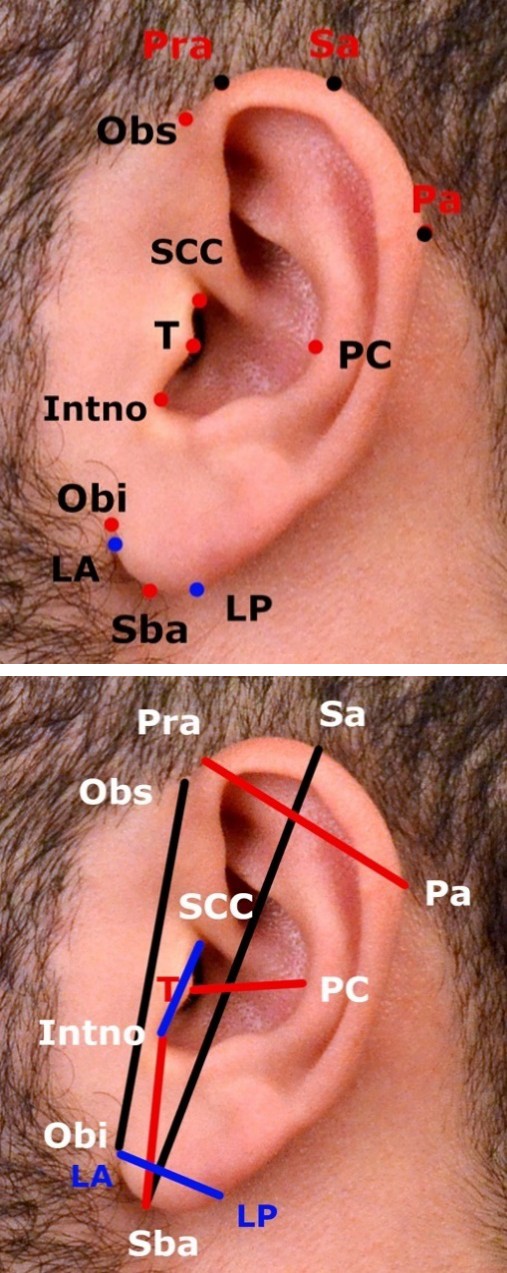
Figure 1a: Anthropometric Points.
Figure 1b: Measurements.
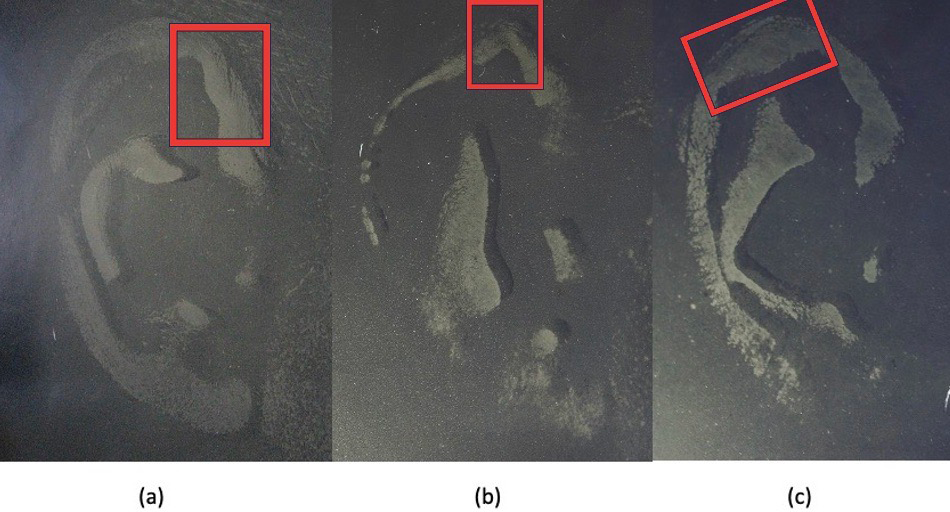
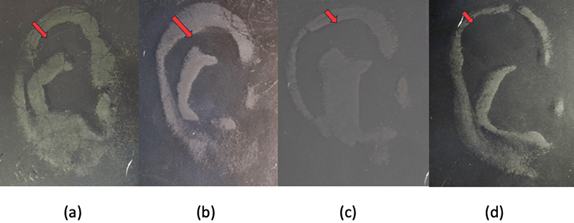
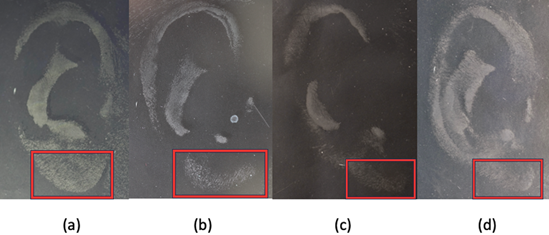
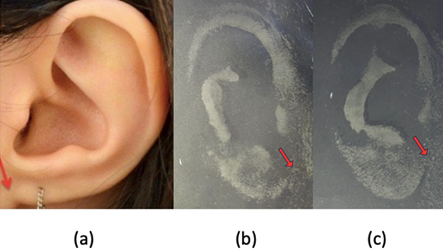
The auricle was categorised according to four morphological features: Darwin’s tubercle, helix forms, ear lobe forms and ear lobe attachments (Figures 2-5). In Figure 5a, the digital image of the ear was used to analyze ear lobe attachments because the “attached” form could not be detected from the ear print.
Statistical Analysis
Statistical analysis of the metric measurements of the ear prints was performed by frequency analysis, discriminant analysis, Wilk’s Lambda, Mann-Whitney U test and Student T-tests with SPSS (SPSS, Chicago, IL, USA) software. Statistical significance was determined as p<0.05.
Results
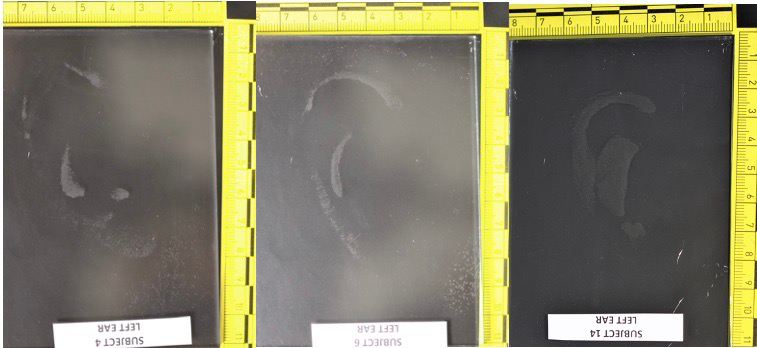
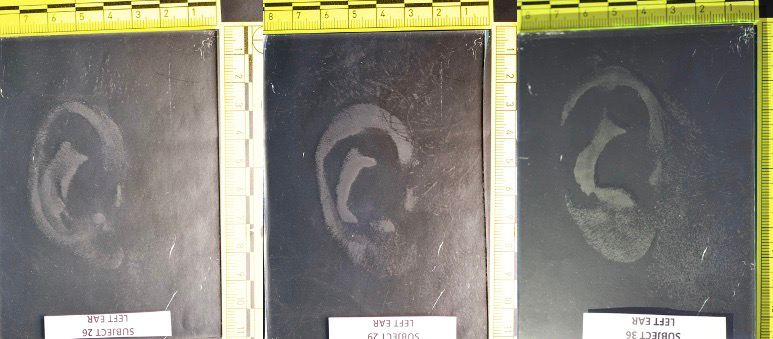
Due to its morphology, which varies from person to person, it was noted whether the parameters used in the morphological and metric evaluation of ear prints could be identified. Figures 6 & 7 show examples of the most obscured and visible prints, despite sexes. There is no specific device to be used in ear print acquisition. Therefore, it is thought that the observed ambiguities may be due to differences in pressure force. In addition, due to individual differences, it is observed that in some people, the thin structure of the auricle, the ear lobe being further back than the ear body, and the remaining parts being more vague due to the prominent antihelix cause the ear prints to be insufficiently visible.
The detectability of morphological and metric measurements in the ear print was tested, and the Obs-Obi distance was not included in the study due to the high rate (97%) of non-detectability. In morphological features, the highest detectability rate was observed in the helix form in both sexes (female 100%; male 95.7%). When metric measurements were analysed, the Pra-Pa distance was detected in both sexes (female 98.1%; male 100%) (Table 1).
| Female | Male | ||||
|---|---|---|---|---|---|
| Detected (%) | Not detected (%) | Detected (%) | Not detected (%) | ||
| Morphological | Darwin’s tubercle | 87,0 | 13,0 | 82,6 | 17,4 |
| Helix form | 100,0 | 0 | 95,7 | 4,3 | |
| Ear lobe form | 75,9 | 24,1 | 78,3 | 21,7 | |
| Ear lobe attachements | 20,4 | 79,6 | 23,9 | 76,1 | |
| Metric | Obs-Obi | 1,9 | 98,1 | 4,3 | 95,7 |
| Sa-Sba | 94,4 | 5,6 | 89,1 | 10,9 | |
| Pra-Pa | 98,1 | 1,9 | 100,0 | 0 | |
| Intno-Sba | 22,2 | 77,8 | 26,1 | 73,9 | |
| La-Lp | 81,5 | 18,5 | 69,6 | 30,4 | |
| T-Pc | 57,4 | 42,6 | 69,6 | 30,4 | |
| Intno-SCC | 42,6 | 57,4 | 56,5 | 43,5 |
Table 1: Detection Rates of Morphological and Metric Values on the Ear Prints.
Table 2 shows the distribution of ear print morphology according to sex. Darwin’s tubercle predominantly displayed a “none” category in both sexes (female 72.2%; male 56.5%). Analysing the helix form, a normally rolled form was most prevalent in both sexes (female 48.1%; male 47.8%). The earlobe morphology was predominantly square in females (25.9%) and tongue in males (34.8%). However, the prevalence of earlobe attachements was low in both sexes; nevertheless, where detectable, free earlobe attachement was predominant in both sexes (female 20.4%; male 19.6%).
| Morphological Feature | Female | Male | P value | |||
|---|---|---|---|---|---|---|
| N | % | N | % | |||
| Darwin’s tubercle | 39 | 72,2 | 26 | 56,5 | 0,567 | |
| Nodosity | 1 | 1,9 | 1 | 2,2 | ||
| Projection | 2 | 3,7 | 3 | 6,5 | ||
| Enlargement | 5 | 9,3 | 8 | 17,4 | ||
| Not detected | 7 | 13,0 | 8 | 17,4 | ||
| Helix form | Not detected | 0 | 0 | 2 | 4,3 | 0,228 |
| Normally rolled | 26 | 48,1 | 22 | 47,8 | ||
| Wide covering scapha | 6 | 11,1 | 9 | 19,6 | ||
| Concave margine | 12 | 22,2 | 6 | 13,0 | ||
| Flat | 10 | 18,5 | 7 | 15,2 | ||
| Ear lobe form | Not detected | 13 | 24,1 | 10 | 21,7 | 0,649 |
| Tongue | 13 | 24,1 | 16 | 34,8 | ||
| Square | 14 | 25,9 | 13 | 28,3 | ||
| Arched | 2 | 3,7 | 1 | 2,2 | ||
| Triangular | 12 | 22,2 | 6 | 13,0 | ||
| Ear lobe attachements | Not detected | 43 | 79,6 | 35 | 76,1 | 0,207 |
| Partially attachement | 0 | 0 | 2 | 4,3 | ||
| Free | 11 | 20,4 | 9 | 19,6 |
Table 2: Comparative Analysis of Ear Print Morphology According to Sex.
| Distances | Mean | SD | ||
|---|---|---|---|---|
| Female | Sa-Sba | 59,71 | 15,55 | |
| Pra-Pa | 31,51 | 5,43 | ||
| Intno-Sba | 3,65 | 7,00 | ||
| La-Lp | 11,97 | 6,26 | ||
| T-Pc | 9,41 | 8,54 | ||
| Intno-SCC | 6,00 | 7,25 | ||
| Male | Sa-Sba | 56,17 | 20,56 | |
| Pra-Pa | 32,41 | 4,41 | ||
| Intno-Sba | 4,34 | 7,53 | ||
| La-Lp | 10,32 | 7,47 | ||
| T-Pc | 10,65 | 7,53 | ||
| Intno-SCC | 5,93 | 7,11 | ||
| Total | Sa-Sba | 58,08 | 18,02 | |
| Pra-Pa | 31,92 | 4,98 | ||
| Intno-Sba | 3,96 | 7,22 | ||
| La-Lp | 11,21 | 6,86 | ||
| T-Pc | 9,98 | 8,07 | ||
| Intno-SCC | 5,97 | 7,15 | ||
| Sexes | N | Ranked Means | Sig. | |
| Sa-Sba | Male | 46 | 49,28 | 0,698 |
| Female | 54 | 51,54 | ||
| Total | 100 | |||
| Pra-Pa | Male | 46 | 53,78 | 0,296 |
| Female | 54 | 47,70 | ||
| Total | 100 | |||
| Intno-Sba | Male | 46 | 51,52 | 0,664 |
| Female | 54 | 49,63 | ||
| Total | 100 | |||
| La-Lp | Male | 46 | 48,20 | 0,460 |
| Female | 54 | 52,46 | ||
| Total | 100 | |||
| T-PC | Male | 46 | 52,04 | 0,614 |
| Female | 54 | 49,19 | ||
| Total | 100 | |||
| Intno-SCC | Male | 46 | 50,13 | 0,896 |
| Female | 54 | 50,81 | ||
| Total | 100 |
Table 3: Descriptive Statistics of Metric Measures by Sex.
Table 3 shows the descriptive statistics of metric measurements according to sex. Ear length (females 59.71%; males 56.17%), ear lobe width (females 11.97%; males 10.32%) and tragus base width (Intno-SCC) (females 6%; males 5.93%) were found to be higher in females than males.
Discriminant function analysis was performed to measure the usability of ear print metric measurements in sex classification. This analysis resulted in a Wilk’s Lambda value of 0.671, which was not statistically significant (p<0.05). Classification results were determined as 58%, sensitivity rate 56% and specificity rate 59% on average for all groups. Accordingly, it was observed that earprint metric measurements did not give significant results in sex classification.
According to the preliminary tests, it was concluded that the data were suitable for non-parametric analysis. Therefore, the Mann-Whitney U test was used to analyse the significance of metric measurements between sexes. The result was not statistically significant for all parameters (p<0.05) (Table 4).
Discussion and Conclusion
The usability of properly collected and developed ear prints in identifying and excluding individuals has been tested in some studies [6, 7, 12, 13]. It has been observed that some ears may be useful for excluding potential suspects despite their inability to produce prints with sufficient detail [7].
Anthropologists and forensic scientists examine the diversity of morphological features on many body parts to contribute to the field of identification. As a result of these analyses, many techniques, such as footprints, fingerprints, and dental records, have been developed. Each technique has its own disadvantages. The external ear has been studied more frequently in recent years as an essential facial feature, especially because it remains constant throughout life [12].
In their study, Rani, et al. [12] observed the helix as the most prominent feature of the ear. Meijerman, et al. [5] were able to observe the helix in the ear print in all cases. Similarly, Dhanda, et al. [6] recorded the helix form as the most observable in both sexes (female 96%; male 92%). Similarly, in this study, the helix was the most frequently detected of all morphological features (female 100%; male 95.7%).
Dhanda, et al. [6] were able to observe the ear lobe 37% of the time. In this study, the ear lobe was identified in 75% of females and 78% of males.
Dhanda, et al. [6] stated that the ear lobe print was less common in females than in males (females 12%; males 60%). In this study, the ear lobe was less observable in females than in males, with a smaller difference (75.9% female; 78.3% male). The effect of the fact that all of the subjects were taken by removing accessories such as earrings may be considered in the fact that it was found to be observable at a similar rate in both sexes.
According to the results of descriptive statistics of metric measurements in terms of sex, ear length, ear lobe width and tragus base width were found to be higher in females than in males. This is thought to be due to females’ use of accessories such as earrings. Taking into account that males also use similar accessories, it is anticipated that accessories will have less impact on male ears due to the fewer number of males among the subjects and the more minimal preferences of males compared to females in terms of the effect of the weights of accessories on female ears.
Studies on the usability of the ear for identification have shown that indices and ear morphology provide corroborative evidence and are helpful in personal identification (exclusion or inclusion) [14]. Many studies have emphasised that there are sex differences in the external ear [15, 16, 17, 18, 19, 20, 21]. Based on these results, in this study, it was discussed whether the morphological and metric features that can be observed in the outer ear can also be observed in the ear print. It was observed that factors such as individual morphological features of the ear, possible abnormalities and the pressure applied by the researcher had an effect on the detectability of these features on the ear print. In this study, the fact that the difference between sexes was not statistically significant may be attributed to the insufficient sample size. However, it is also thought that individual differences (skin oiliness, ear height varies, etc.) are affected in terms of obtaining fully visible ear prints.
Several studies on the pressure applied to the ear print Meijerman L, et al. [5, 22, 23] have shown that the amount of pressure can affect the ear print. The deformation of the ear prints is precisely related to the pressure applied to the ear prints. The applied pressure can change the size of the morphological features of the prints. For this reason, Rani, et al. [12] chose constant pressure, which is the time during which the pressure is kept constant and tried to establish a certain standard by paying attention to the pressure applied while taking the prints. A similar method was preferred in this study, but it is possible that this process is prone to error. In future studies, the margin of error can be minimised by developing a device where constant pressure can be applied.
The morphology and metric values of the ear lobe prints vary according to the accessory used and the person’s ear height. In this study, the subjects were asked to remove their accessories while taking the ear prints. Therefore, the fact that the print does not show the full shape or partial shape is related to the ear structure of the person.
As a result, the ear print can be said to be a biometric that helps identification. It is recommended to develop a standard device for taking ear prints, apply a certain and constant pressure, expand the sample size and make comparative analyses between populations to strengthen this statement.
Acknowledgements
This work has been supported by Kutahya Health Sciences University Scientific Research Projects Coordination Unit under grant number FBA-2021-80.
References
-
Wang T, Zheng Z, Bashir AK, Jolfaei A, Xu Y (2018) FinPrivacy: A Privacy-Preserving Mechanism for Fingerprint Identification. JACM 37(4): 111-116.
-
Morales A, Diaz M, Llinas-Sanchez G, Ferrer MA (2015) Earprint recognition based on an ensemble of global and local features. The 49th Annual IEEE International Carnahan Conference on Security Technology (s. 253- 258). Carnahan: IEEE Xplore.
-
Ricci C, Phiriyavityopas P, Curum N, Andrew Chan KL, Jickells S, et al. (2007) Chemical ımaging of latent fingerprint residues. Applied Spectroscopy 61(5): 514- 522.
-
Jain AK, Feng J (2008) Latent palmprint matching. IEEE Trans on Pattern Anal Mach Intell 31(6): 1032-1047.
-
Meijerman L, Sholl S, Conti FD, Giacon M, Der Lugt CV, et al. (2004) Exploratory study on classification and individualisation of earprints. Forensic Science International 140(1): 91-99.
-
Dhanda V, Badhan JS, Garg RK (2011) Studies on the development of latent ear prints and their significance in personal identificaiton. Problems of Forensic Sciences 88: 285-295.
-
Zulkifli N, Rashid RA (2018) Preliminary study of human earprints: Method development on sampling and enhancement technique of earprints on a non- porous surface In: 1st (Edn.), Bioresources Technology in Sustainable Agriculture, Apple Academic Press, Waretown, USA, pp: 139-151
-
Meijerman L, Thean A, Maat G (2005) Earprints in Forensic Investigations. Forensic Science Medicine and Pathology 1: 247-256.
-
Alberink IB, Ruifrok ACC, Kieckhhoefer H (2006) Interoperator Test for Anatomical Annotation of Earprints. Journal of Forensic Science 51(6): 1246-1254.
-
Champod IC, Evett IW, Kuchler B (2001) Earmarks as evidence: a critical review. Journal of Forensic Science 46(6): 1275-1284.
-
Bleay SM, Croxton RS, De Puit M (2018) Fingerprint development techniques: Theory and application. John Wiley & Sons Ltd, NJ, USA, pp: 1-500.
-
Rani D, Krishan K, Sahani R, Shrestha R, Kanchan T (2022a) Characteristic features of ear and ear-prints in forensic identification, J Craniofac Surg 33(4): 1093- 1098.
-
Rani D, Krishan K, Kanchan T (2022b) Association among the morphological characteristics of the human ear – An approach towards forensic identification. For Sci Int: Reports 6(100295): 1-14.
-
Chattopadhyay PK, Bhatia S (2009) Morphological examination of ear: A study of an Indian population. Legal Med 11(S190-S193).
-
Sforza C, Grandi G, Binelli M, Tommasi DG, Rosati R, et al. (2009) Age- and sex-related changes in the normal human ear. Forensic Sci Int 187(1-3): 110.e1-110.e7.
-
Bozkır MG, Karakaş P, Yavuz M, Dere F (2006) Morphometry of the external ear in our adult population. Aesth Plast Surg 30(1): 81-85.
-
Singh P, Purkit R (2006) Anthropological Study of Human Auricle. J Ind Acad Forensic Med 28(2): 971-973.
-
Alexander KS, Stott DJ, Shivkumar B, Kang N (2011) A morphometric study of the human ear. J Plast Reconstr Aesthet Surg 64(1): 41-47.
-
Deopa D, Thakkar HK, Prakash C, Niranjan R, Barua MP (2013) Anthropological measurements of external ear of medical students in Uttarakhand region. J Anat Soc India 62(1): 79-83.
-
Verma K, Bhawana J, Kumar V (2014) Morphological Variation of ear for Individual Identification in Forensic Cases: A study of an Indian Population. Res J Forensic Sci 2(1): 2321-1792.
-
Verma P, Sandhu HK, Verma KG, Goyal S, Sudan M, et al. (2016) Morphological Varia- tions and Biometrics of Ear: An Aid to Personal Identification. J Clin Diagn Res 10(5): ZC138-ZC142.
-
Van der Lugt C (2001) (Ears and) Ear prints, individualising crime scene marks. Prob Forensic Sci 46: 38-45.
-
Kasprzak J (2001) Identification of ear impression in polish forensic practice. Prob Forensic Sci 47: 168-174.
- Forensic Implications of Adverse Drug Reactions in Schizophrenia A Case Series
- Narcotics and Digital Forensics: Bridging Crimes in the Digital Age
- Ethics in Forensic Psychiatry: Principles, Dilemmas, and Human Rights
- Impact of Acute Stress on Attentional Orienting to Social Cues
- Head Injury and Intracranial Hemorrhage in Western Region of Libya
- A Forensic Study on Handedness: Examination of Handwriting Features in Right and Left Handed Writers