
The Wrong Place at the Wrong Time
The defendant, Treveon Harris, a known Los Angeles gang member, was wounded twice during the fatal shooting of the victim. The homicide occurred in the mailboxes/laundry room of an apartment complex. Bullet strike angles on a washing machine and the walls of the scene room show there was a struggle for a .40 caliber pistol by the victim and his attacker. The victim lost the struggle for the pistol with two bullets to his head. The victim also received three perforating bullet wounds (unknown caliber) to his legs outside the mailboxes/laundry room. Harris received a ricochet bullet core to his left forearm and had a bracelet shot off his left wrist. Even though Harris was twice wounded when he chanced on the shooting, he was charged and convicted of the homicide. The prosecution presented a shooting scenario that ignored exculpatory evidence. Despite the trial defense attorney being informed of the exculpatory evidence, he refused to present it.
Introduction
The defendant, Treveon Harris, visited an apartment on the first floor of a two-story apartment building (above a subterranean parking garage) (Figure 1) in Torrance, California. After a conversation at the door of apartment 12 with the occupant, Yvette Hamilton, Harris departed, walking down the stairs, and descended into the subterranean parking area. The driveway into the parking area was the only entrance/exit of the building. Adjacent to the parking area was a small room with mailboxes, two washing, and two (stacked) dryer machines (Figure 1). The entrance to the mailboxes/laundry room was directly across the stairway to the first floor of the building. According to defendant Harris, when he was at the bottom of the stairs in the parking garage, he saw a person with a gun on the driveway outside the building and fled to “hide” in the mailboxes/ laundry room (Harris, personal communication). Harris encountered victim Alexander Anene and another person in the mailboxes/laundry room. Quickly following Harris’ entry into the mailboxes/laundry room, gunshots were fired (Harris, personal communication).
Anene died from two bullets to his forehead. Harris was twice bullet wounded to his left arm and was bleeding when he fled the apartment complex. He was apparently picked up by an associate at a driveway across the street from the apartment building.
Materials and Methods
The discovery, the “Murder Book” [1] used in this shooting reconstruction can be downloaded, and Bates page numbering was applied, which has the following sections:
- Police reports and witness accounts: pages 1 to 549
- Case photographs: Pages 550 to 915:
- Scene: 550 to 821
- Defendant Harris: 822 to 830; Harris’ left arm wounds: 828 – 830;
- Victim Anene autopsy images: 839 – 915. The autopsy report [2] was also used in this report. Photoshop (version CS5) was used for the analysis and preparation of the figures for this study. Changes in image sizes and gamma were made. Figure images and Bates page numbers [1] are on the lower right of the images.
The apartment building where the shooting occurred was visited by the author three years after the shooting. The building owner allowed the inspection, and some tenets provided additional details of the shooting, which were helpful in the reconstruction presented in this paper.
The Shooting Scene
An incorrect drawing Figure 1A of the subterranean parking level and part of the first floor overlay of the apartment building was supplied in the discovery [1] (p 95) where the shooting occurred. The subterranean-parking level included the mailboxes/laundry room. The correct rendering is shown in Figure 1B, which is from Figure 1A, and is also modified to show the locations of apartments 7 (victim’s residence) and 12 (Harris visiting) as well as other corrections.
The short time it took for Harris to travel from apartment 12 to the bottom of the stairs in the parking level and the initiation of firearm discharges is an important consideration for the shooting timeline. Figure 1B also shows the locations of DNA analyzed blood samples 2, 3 and 4.
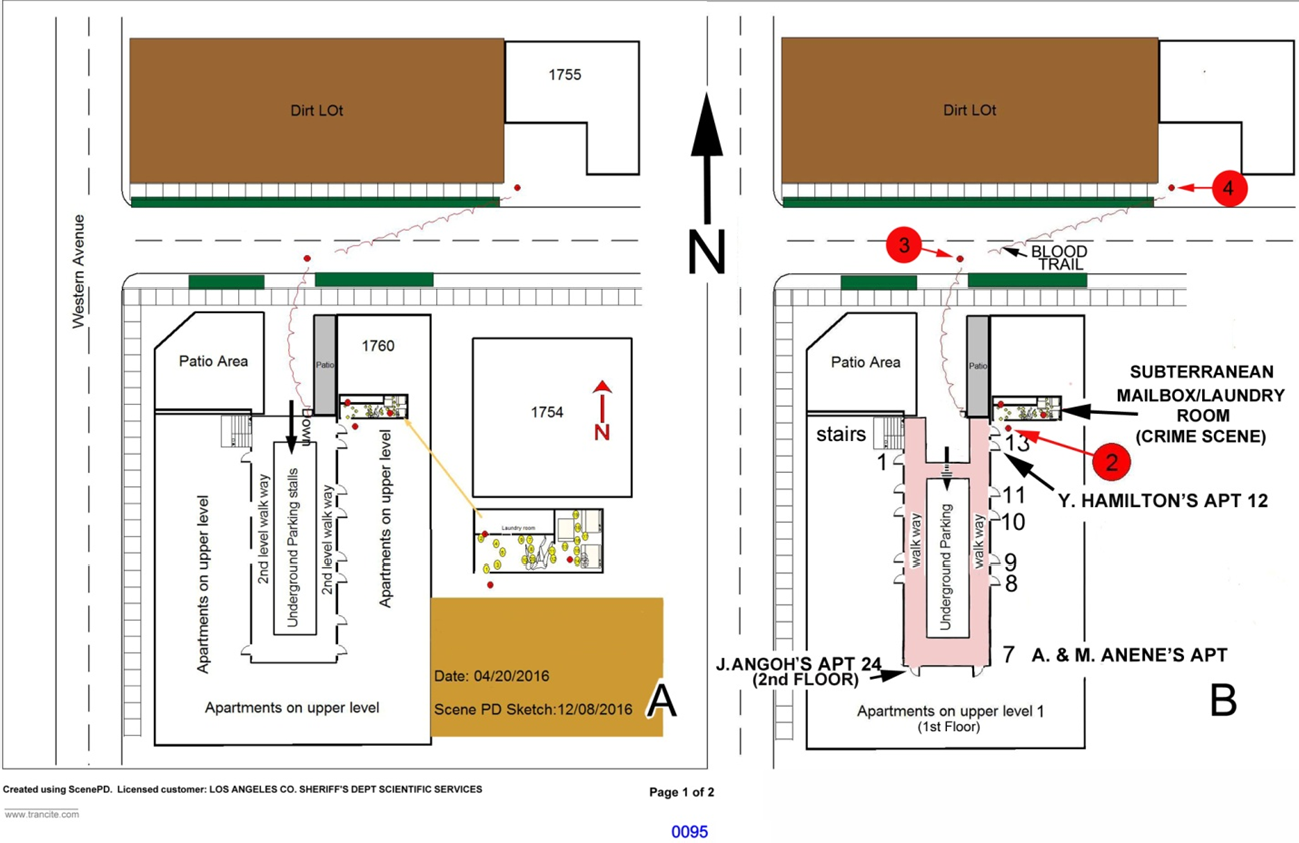
Figure 1. A. Building design submitted in the discovery showing where the shooting occurred and the location of the mailboxes/ laundry room on the ground (parking) floor; included in this graphic is a representation of a blood trail from the laundry room to a driveway across the street. B. Graphic taken from A which shows the apartment door locations and the locations of Apartment 12 that Harris visited prior to the shooting and Apartment 7 where the victim lived; the crosswalk between east and west side of the building is correctly positioned. The apartment door locations are indicated from shooting scene images and investigator diagram. Bloodstain 2 is on the front step into the mailboxes/ laundry room off the subterranean parking area. Bloodstains 3 (on the street) and 4 (on a driveway across the street), which were sampled for DNA, are shown. These bloodstains were from Harris.
Figure 2A shows the shooting scene graphic presented in the case discovery [1] (p 96). This prosecution graphic is of little use for the shooting reconstruction in that 1) it is not to scale, 2) the relative positions of the evidence items are inaccurate, 3) the location of evidence item 6 is missing, 4) the architectural rendering is wrong (e.g., there are two doors on the north wall), and the victim drawing is wrong in that his left arm’s position should be closer to the body and the head/upper body closer, actually touching, the south wall.
Using the scene measurements provided in the discovery [1] (pp 91- 94), the shooting scene room is rendered to scale with the positions of the evidence items at their measured positions (Figure 2B). Other features of the scene diagram, such as the locations of the .40 caliber casings, bullets/ bullet fragments, blood stains, and jewelry, are portrayed in separate colors in Figure 2B.
Witnesses to the Shooting
Outside of Harris, there were no visual witnesses to the shooting. However, there were audio witnesses.
Table 1 presents the audio accounts of the residences of the apartment building where the shooting occurred. These witnesses, with one exception, established that the shooting within the laundry room was a single volley of shots. Audio witness Johnson, who lived in apartment 24 on the second floor, noted that there were nine shots that he termed “rapid.” However, in an interview with the author, Johnson noted that he heard three shots “outside of my bedroom, quite close.” His bedroom was facing west (Figure 1B). The mother of the victim, M. Anene, in apartment 7 on the first floor, heard a series of three shots that were fainter than the following six louder shots. These two audio witnesses indicate there were two shooting scenes, which is supported by the evidence: one outside on the west side of the building and the other within the mailboxes/laundry room. The time between the two volleys is uncertain.
![Figure 2: A. The Crime-Lab Generated Graphic of the Shooting Scene from [1] (I. C. P 96), which Shows Inaccurate Locations of the Evidence Items in Relation to the Inaccurately Drawn Architectural Features and Appliances in the Mailboxes/Laundry Room. B. The Shooting Scene Graphic to Scale Constructed by the Author Using Measurements Provided by [1] (I. C. P 91 To 94) and Corrects the Inaccuracies Presented in the Prosecution’s Scene Graphic Shown in a; this Shows the Relative Positions of the Evidence Items and their Type (Key Above this Graphic). The Dimensions of the Dryer Stack and Washers were Obtained from the Author’s Machines. Some of the Item Locations are Estimated from the Images of the Shooting Scene to Put them in Context with the Victim’s Body and Room. Red Letters A Through E at the Arrows Indicate the Locations of The Washing Machine and Wall Bullet Strikes. The Large Blood Pool and Bloodspatter were Estimated by the Author from the Scene Images. The Left Arm and Body Positions of the Victim were Corrected from the Scene Images. Evidence Item 19, which Appears to Be Part of the Victim’s Cell Phone, was Erroneously Determined to Be “Not Evidence.”](/fulltextimages/11625/fig_2.png)
Figure 2. A. The Crime-Lab Generated Graphic of the Shooting Scene from [1] (I. C. P 96), which Shows Inaccurate Locations of the Evidence Items in Relation to the Inaccurately Drawn Architectural Features and Appliances in the Mailboxes/Laundry Room. B. The Shooting Scene Graphic to Scale Constructed by the Author Using Measurements Provided by [1] (I. C. P 91 To 94) and Corrects the Inaccuracies Presented in the Prosecution’s Scene Graphic Shown in a; this Shows the Relative Positions of the Evidence Items and their Type (Key Above this Graphic). The Dimensions of the Dryer Stack and Washers were Obtained from the Author’s Machines. Some of the Item Locations are Estimated from the Images of the Shooting Scene to Put them in Context with the Victim’s Body and Room. Red Letters A Through E at the Arrows Indicate the Locations of The Washing Machine and Wall Bullet Strikes. The Large Blood Pool and Bloodspatter were Estimated by the Author from the Scene Images. The Left Arm and Body Positions of the Victim were Corrected from the Scene Images. Evidence Item 19, which Appears to Be Part of the Victim’s Cell Phone, was Erroneously Determined to Be “Not Evidence.”
| Resident Name | Apartment # | Number Gunshots | Comments |
|---|---|---|---|
| First Level Apartments | |||
| Carrillo, M. | 1 | 5 | |
| Ouedraogo, B. | 3 | 5-6 | |
| Anene, M. | 7 | 3 | Followed by 6 |
| Coleman, S. | 8 | 5 | |
| Hamilton, Y. | 12 | 5 | |
| Williams, B | 13 | 7 | |
| Second level Apartments | |||
| Awosika, V. | 18 | 7-8 | |
| Caytona, M. | 19 | 5-6 | |
| Johnson, A. | 24 | 9* | Rapid Gunshots |
| Uchu, E. | 22 | 3 |
Table 1: ** Audio witnesses to the shooting (from [1] pp 8 to 30); Anene, M. (apartment 7) as well as Johnson (apartment 24) note
*Later Interview: "Three Shots Outside My Bedroom” Followed By 6. Table 1: Audio witnesses to the shooting (from [1] pp 8 to 30); Anene, M. (apartment 7) as well as Johnson (apartment 24) noted there were two volleys of firearm discharges (Fig. 1B).
The Preliminary Trial Transcript
The District Attorney filed a murder charge against Harris, which was affirmed in the preliminary hearing [3].
Discussion
The Victim: Autopsy Report-Abrasions, Bleeding, and Hot Cell Phone
The autopsy images [1] (pp 839 - 915) and report [2] indicate the victim was involved in a physical altercation prior the shooting. This physical attack on the victim prior to Harris entering the mailboxes/laundry room occurred in the mailboxes/laundry room and outside, likely on the west side of the apartment building.
The victim sustained abrasions on his back (Figure 3A). Figure 3A inset is an enlargement of the rectangle area that shows shallow abrasions on the victim’s back where he appeared to have been moved up and down relative to the object(s) that created these abrasions. A survey of the images of the mailboxes/laundry room indicated that the likely location where he received these abrasions was the mailboxes. The lock mechanisms project from the surfaces of the mailboxes (Figures 3C & 3D). The abrasions on the back of the victim appear to have been created by him being pushed hard against the mailboxes. Apparent blood can be seen on the mailbox lock projections (Figure 3D). The scene processors missed this evidence.
![Figure 3: A. Images of the abrasions on the victim’s back (at arrows) and described in the autopsy report ([1] p 186) that appear to have been caused by the victim being hard-pressed against the mailboxes. Inset: enlargement of indicated area on the victim’s back showing three vertical shallow abrasions to the body that occurred premortem. B. Shooting scene looking west showing the mailboxes on the south wall; the lock faces project which could have been the source of the abrasions and scratches on the unclothed back of the victim. C. The bank of mailboxes. D. An image of the mailboxes face showing the lock mechanisms project from the surfaces of the mailboxes; two of the lock projections (arrows) for mailboxes 11 and 13 (top row) appears to have blood on their upper surfaces (arrows).](/fulltextimages/11625/fig_3.png)
Figure 3. A. Images of the abrasions on the victim’s back (at arrows) and described in the autopsy report ([1] p 186) that appear to have been caused by the victim being hard-pressed against the mailboxes. Inset: enlargement of indicated area on the victim’s back showing three vertical shallow abrasions to the body that occurred premortem. B. Shooting scene looking west showing the mailboxes on the south wall; the lock faces project which could have been the source of the abrasions and scratches on the unclothed back of the victim. C. The bank of mailboxes. D. An image of the mailboxes face showing the lock mechanisms project from the surfaces of the mailboxes; two of the lock projections (arrows) for mailboxes 11 and 13 (top row) appears to have blood on their upper surfaces (arrows).
The victim had his cell phone in the right pocket of his sweatpants when he was found (Figure 4A) white arrow at circled area). The cell phone had sustained extensive damage (Figure 4B) and was hot while in the victim’s pocket, thereby searing his right thigh (Figures 4D & 4E). This did not occur by the victim falling upon it (Figure 4A) at the time of the two shots to his head; rather, it likely occurred prior to the shooting in the mailboxes/laundry room, by perhaps being dropped (item 19 appears to be part of the phone). However, an investigator noted the close proximity of a butane lighter to the phone, which was also in the victim’s pocket: “It appeared as though the lighter had ignited and created a fire, burning his cell phone and right hip” [1] (p 31).
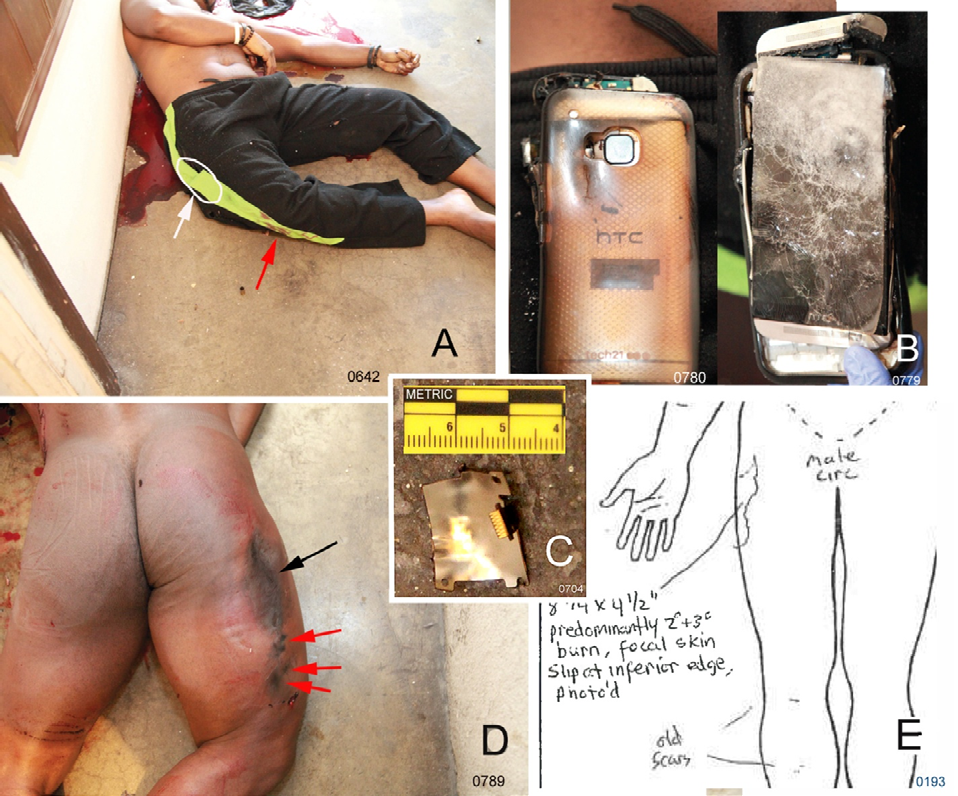
Figure 4. A. The victim at the shooting scene; his cell phone was in a pocket in his sweatpants at white arrow; bloodstains on the yellow stripe (red arrow) of the sweatpants indicate a bleeding event occurred prior to the fatal shooting into the head of the victim. The lack of burning the pant leg over the cell phone indicates the hot surface of the cell phone was against the victim’s skin and was the heat source that caused second and third degree burns to his right thigh. B. The crushed and heat damaged cell phone which was removed from the sweatpants without disturbing the body position; left, the back of the phone; right, the screen side of the phone. C. Evidence item 19 was determined by a crime lab criminalist to be not part of the shooting scene, which is likely incorrect. This is a piece of the victim’s cell phone indicating it fragmented perhaps when dropped on the floor. D. The victim’s body at the scene with sweatpants removed showing the burn area on his right thigh (black arrow) which places the phone in the approximate position at the white arrow in A when the thigh burn occurred; red arrows point to apparent additional burns distal to the main burn. E. Pathologist’s diagram describing the burn on the victim’s right thigh as second and third degree burns.
The sweatpants’ fabric exterior to the pocket was not burned (Figure 4A), which would be expected if the lighter was responsible for the damage to the cell phone and the burns on the victim’s right hip (i.e., only the cell phone’s over heating battery was responsible). Additional skin burn spots distal to the main skin burn (Figure 4D), red arrows) indicate the hot cell phone had moved down on his leg, likely having burned through the pocket fabric. The upper body was lifted by the person who discovered the victim before the scene processing (see above), which could have caused the hot cell phone to move distally after burning through the pocket fabric.
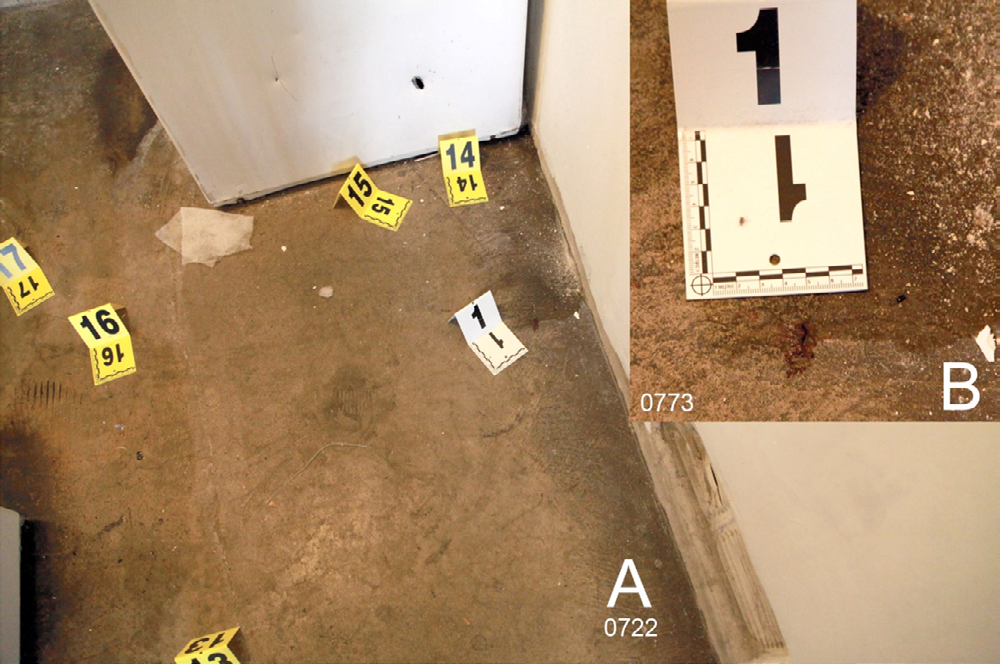
The victim was bleeding prior to the shooting. Bloodstain 1 (Figure 2B) in the mailboxes/laundry room (Figure 5A) was DNA matched to the victim [1] (p 130). A close-up of the bloodstain on the floor (Figure 5B) shows it was either a smeared bloodstain by being stepped on after deposition or a transfer, although there do not appear to be any subsequent nearby transfers from this or the source bloodstain in the scene images. Regardless, the distance of bloodstain 1 from the victim’s blood pool that surrounds his body and its proximity to the south wall indicates it was likely deposited prior to his death, and not a transfer by the witness who found the body or scene processor.
Three additional bloodstains indicate bleeding event(s) occurred prior to the right hand wound and the two head wounds. In Figure 4A, there appears to be transfer bloodstains on the yellow stripe of the victim’s sweatpants or these stains could be a bleed-through from the bullet wound exit 3 (see below).
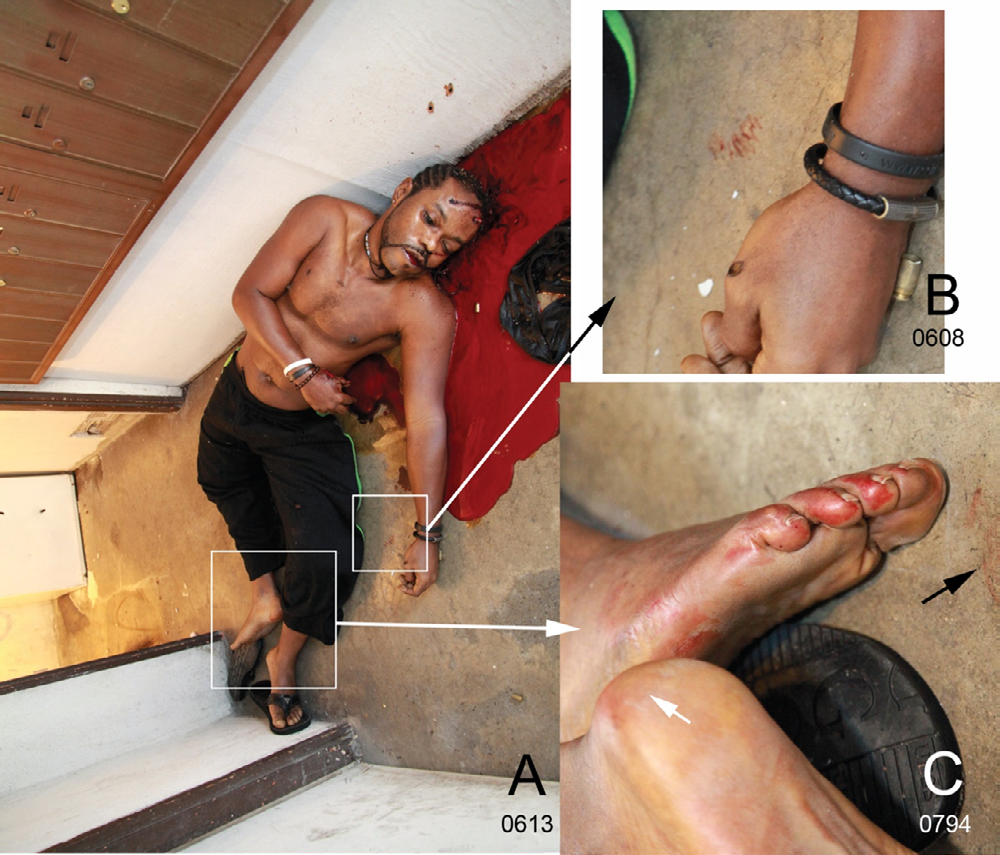
Figure 6. Blood transfers associated with the victim that occurred prior to the shooting, indicate the victim was bleeding. A. The victim; the areas within the squares show bloodstains that were deposited prior to the main bloodletting event caused by the shooting of the victim. B. A transfer bloodstain near the victim’s left hand. C. Transfer blood on the victim’s right foot sole and toes of his left foot; right heel (white arrow) was sampled for DNA in which revealed this blood to be from the victim. The black arrow points to a light blood transfer on the concrete floor.
Additional bloodstains (Figure 6A) were observed on the concrete floor near the left hand (Figure 6B) and on the victim’s left foot and right heel (Figures 6A&6C). The heel blood was from the victim [1] p 131.
The victim acquired bloodstains on his feet while standing. He was bleeding before the right hand wound and the two shots to his head. The wound to the victim’s right hand could not have been the source of the blood and likely occurred just before the final four shots (A, B (Figure 2B) and two head).
Autopsy Report: the Victim’s Gunshot Wounds
The two head wounds (Figure 7A, wounds 1 & 2) were fatal. The gunshot wound to the right hand (Figures 7B & 7C appears to have been at close range because of extensive tissue tearing, although no contact searing or near contact gunpowder stippling was noted by the pathologist. Regardless, the pathologist who conducted the autopsy assigned this as a gunshot wound.
The bullets that caused the victim’s three leg wounds (Figure 7A) did not hit bone. The victim was still ambulatory after receiving these wounds and was likely bleeding.
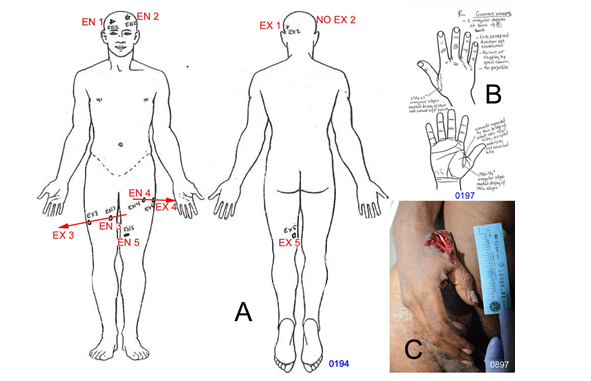
Figure 7. Autopsy of the victim. A. Anterior and posterior drawing of the body of the victim showing the locations and tracks of bullet wounds 1 through 5; red notes and arrows by the author. The lack of bullet strikes on the mailroom/ laundry walls from the bullets through the legs indicate these shots occurred elsewhere prior to the shots in the mailboxes/laundry room. B. Drawings made of the victim’s right hand showing the bullet wound; the extensive tissue tearing suggest a close-range shot, although no searing or gunpowder was observed associated with the wound. C. Image of the right hand gunshot wound at autopsy.
Pre- And Post-Mortem Victim Bleeding: Summary
A blood pool (Figure 6A) likely covered evidence of prior bleeding, at least two bullet strikes on the floor, and bullet fragments. The victim’s blood was documented near the washing machine (Figure 5), which occurred prior to the right hand wound. There was also blood on the victim’s feet (Figure 6C) and a transfer on the concrete floor near the victim’s left hand. The bloodstains on the yellow right strip on the right pant leg could have been transferred by the wounded right hand during the shooting volley in the mailboxes/laundry room. Regardless of the uncertainty of the right pant bloodstain, bleeding from the wounds on the victim’s back (Figure 3A) and the three leg wounds (Figure 7A) occurred before the start of the shooting in the mailboxes/laundry room and Harris’ involvement.
![Figure 8: Bullet strikes C in the wall and D and E on the front of the washing machine. A. The two bullet defects in the washing machine and the bullet-caused defect in the wall. B. The bullet defect on the concrete wall near the washing machine; part of the bullet jacket is embedded in the concrete wall (inset). The length of the embedded jacket is 16 mm and 11 mm width at its widest. The approximate trajectory angle is 30 degrees upward. This defect is 28 ½ inches (72.5 cm) from the floor ([1] p 69). C. Bullet strikes D and E on the washing machine; the trajectory angles are shown. *: the vertical angles to the metal of the washing machine are shown estimated on ([5] p 272). Defect D is 17 inches from the floor ([1] p 69).](/fulltextimages/11625/fig_8.png)
Figure 8. Bullet strikes C in the wall and D and E on the front of the washing machine. A. The two bullet defects in the washing machine and the bullet-caused defect in the wall. B. The bullet defect on the concrete wall near the washing machine; part of the bullet jacket is embedded in the concrete wall (inset). The length of the embedded jacket is 16 mm and 11 mm width at its widest. The approximate trajectory angle is 30 degrees upward. This defect is 28 ½ inches (72.5 cm) from the floor ([1] p 69). C. Bullet strikes D and E on the washing machine; the trajectory angles are shown. *: the vertical angles to the metal of the washing machine are shown estimated on ([5] p 272). Defect D is 17 inches from the floor ([1] p 69).
Evidence of a Struggle for the Gun
The two bullet strikes in front of the washing machine and on the nearby concrete wall (Figure 8A) indicate that a struggle for the pistol occurred. In the wall bullet strike C (Figure 8B), half of the jacket was embedded in the wall (Figure 8B inset). The approximate 30-degree upward angle of the wall strike and the low angles downward of the bullet strikes D and E to the vertical surface of the washing machine (Figure 8C) indicate a struggle for the gun started at the washing machines and continued into the mailboxes part of the room where two shots were fired (Figure 9), downward and at low angles to the wall. The right hand wound of the victim (Figure 7C) occurred before shots A and B, and the two head wounds (Figure 9) indicate the struggle for the gun ended at the final position of the victim when his head was close to the floor. The bullet from the perforating head wound was delivered when the victim’s head was close to the floor.
The two discharges of the .40 caliber pistol that resulted in bullet strikes A and B occurred when the victim’s head was close to these bullet strikes, which resulted in the spraying of wood fragments onto his hair (Figure 9A, inset).
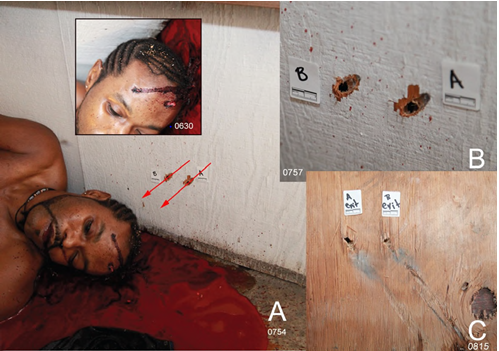
Figure 9. A. Bullet strikes A and B under the mailboxes in painted plywood which show the estimated bullet trajectories (red arrows – base on C, image 0815); inset: wood fragments on the victim’s hair. B. Close-up image of bullet strike defects A and B. C. The exit bullet holes with the plywood removed shows the low trajectory angles to the vertical plywood of both bullet tracks by the bullet gouges in the plywood extending to near the floor.
Of the nine shots fired in the mail boxes / laundry room, as indicated by the number of casings, at least five were fired during the struggle for the gun within the 5 - 6 s of the volley (see above).
The struggle covered approximately 11 feet (3.4 m) from east to west. The assailant ultimately retained possession of the .40 caliber pistol immediately following the shots, at close range, into the plywood under the mailboxes (Figure 9). Bullet trajectories and locations of shots to defects A and B (Figures 9B&9C) are nearly identical and indicate these bullets were fired within a second. Quickly following the shots fired during the struggle, the assailant took full possession of the gun and then fired two shots into the victim’s head. The perforating head shot (bullet wound 2) (Figure 7A) occurred when the victim’s head position was angled such that one perforating bullet likely hit the floor.
Casing Locations and Bullet Strikes
The locations of the bullets, bullet jackets, jacket fragments, and a single bullet lead core are shown in Figure 2B. All bullets and fragments, except the two bullet strikes under the mailboxes, are located in the eastern half of the shooting scene room.
| Evidence Item | Description | Shot # | Foreign Material Associated |
|---|---|---|---|
| 11 | Small Jack Fragment | - | “Unknown White Material” (Concrete?) |
| 13 | Small Jack Fragment | - | “Hair + Illegible Notes |
| 14 | Bullet | 1 | “Unknown White Material” (Concrete?) |
| 15 | Jacket | 2 | Illegible Notes |
| 16 | Jacket | 3 | “Unknown White Material” (Concrete?) |
| 17 | Lead Core | - | - |
| 18 | Jacket | 4 | “ Possible Biological, paint” |
| 21(D) | Bullet | 5 | (Washing Machine) |
| 21€ | Bullet | 6 | (Washing Machine) |
| 23(A) | Bullet | 7 | (wall Under Mail Boxes) |
| 23(B) | Bullet | 8 | (wall Under Mail Boxes) |
| 36 | Bullet | 9 | (Recovered at Autopsy) |
Table 2: Summary of the full bullets (jacket + lead core), jackets (without lead cores), jacket fragments and one lead core recov
Table 2. Summary of the full bullets (jacket + lead core), jackets (without lead cores), jacket fragments and one lead core recovered and examined by the firearms/toolmark examiner, A. Davis, whose notes can be found in [1] pp. 102 to 105. The “white material” and “unknown white material” (Items 11, 14 and 16) are could be powderized concrete, although no identifiable bullet strikes were found on the concrete floor in the visit to the scene three years after the shooting by the author who observed the concrete floor was extremely hard and may not have shown bullet strikes. Gypsum (wall board north wall. Fig. 2B) is unlikely since there were no bullet strikes on gypsum wall board at the scene observed by the criminalists, or the photographs or at the author’s visit to the site.
The .40 caliber casings are mostly in western half of the room. Although it is clear the pistol was fired at least twice (shots D and E into the washing machine, Figures 2B, 8A&8B) and once into the south wall in the eastern half of the room (shot C, Figures 2B&8B), the casings from these shots either bounced off the south wall onto the floor in front of the mailboxes or were ejected directly onto the floor in front of the mailboxes.
Shot numbering (Table 2) is not an attempt to estimate the order of discharge, but a tabulation of intact or partially intact bullets plus bullet jackets (not the smaller jacket fragments) recovered at the scene. The bullet count fired in mailboxes/laundry room (Table 2) is nine, which is also the casing count.
One of the bullet lead cores remained in Harris’ left hand and was extracted while he was in police custody. The missing bullet core may have been hidden in the blood pool under and around the victim.
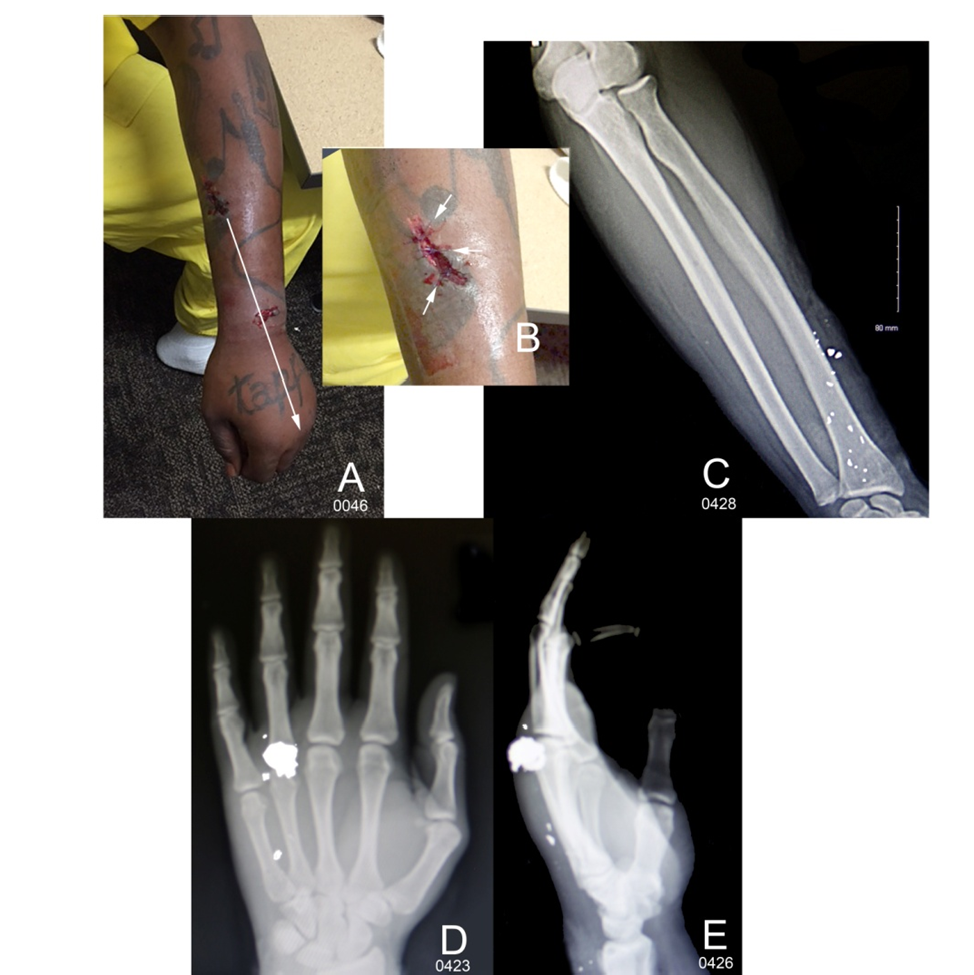
Figure 10. Bullet wound into the left forearm Harris; the bullet was only the lead core which was separated from its jacket upon hitting an intermediate target (either the concrete floor of the room or more likely the ricochet from the bullet which created the wall defect C (Fig. 8B)). A. The defendant’s left arm showing the extremely ragged entrance wound; the arrow shows the core travel within the arm to the dorsal hand. B. A close-up image of the wound; arrows point to sutures. C. X-ray image showing the lead debris track (small white spots) left by the lead core as it traveled distally to the hand. D and E. X-rays of the lead bullet core in the dorsal hand.
Harris Left Forearm Wound
Harris sustained a massive entrance bullet wound to his left forearm (Figures 10A & 10B), and x-rays of his arm (Figure 10C) and hand (Figures 10D & 10E) indicated that this projectile was a bullet core that had hit an intermediate target and lost its jacket before striking Harris’ arm. To create such a massive entrance wound (Figure10B - the wound had been sutured in this image), the lead core was distorted, fragmented (Figure 10C), and likely tumbling when it hit Harris’ arm. The travel direction of the bullet core and entrance wound skin tearing indicates Harris’ arm was fully outstretched, elevated, and at a low angle to the bullet core trajectory, judging from the length of skin tearing and travel to his hand. The bullet core ricocheted from the wall strike C (Figure 2B & 8B) and likely had the elevation and direction to be this wounding projectile. The core also had lost momentum, so the bone did not fracture at impact; it only slid distally along the bone to the dorsal hand (Figure 10D & 10E). Remarkably, there was no serious muscle, blood vessel, or nerve damage. The lead bullet core was removed from Harris’ hand while he was in custody and not retained.
Harris Wrist Wound and his Bracelet
A bracelet was found at the scene (Figure 2B, item 4) and its clasp was found in pieces (Figure 2B, items 1 and 9). Harris sustained a minor wound on his left wrist (Figure 11) caused by the violent removal of his bracelet at the scene.
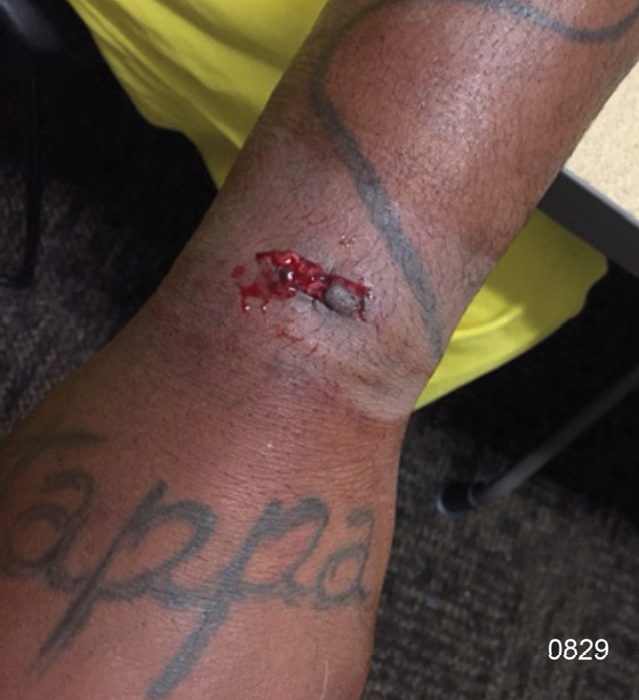
The bracelet was associated with Harris’ and victim Anene’s DNA [1] (p 131). The mother of the victim noted that her son did not own the bracelet [6, 7] (p 25).
The bracelet had two link types: a series of small links connected to larger links (Figure 12A). One of the larger links was distorted (Figure 12A), at arrow and inset at arrow).
A link in the bracelet was filed by the author, which generated particles that were examined by scanning electron microscopy/energy dispersive X-ray spectroscopy (SEM/EDS). The analysis of these particles showed that the bracelet base material is brass (copper/zinc, CuZn) (Figure 12B, right).
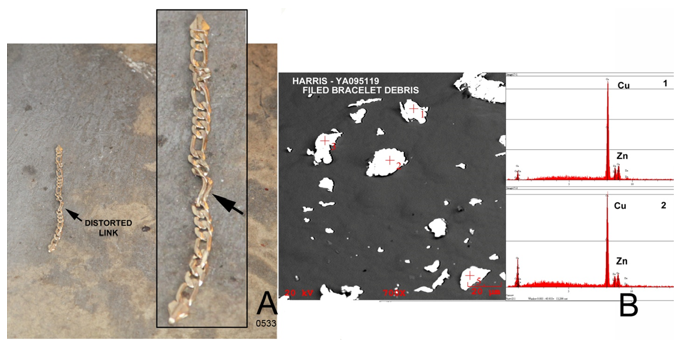
Figure 12. A. The bracelet at the shooting scene; inset enlargement of the bracelet shows the distorted link at arrow. B. Scanning electron microscope backscatter electron image of the particles from the filing of one link of the bracelet showing heavy backscatter electron particles which are brass (copper + zinc); the bracelet is brass with probable gold plating. Scanning electron microscope image and spectra taken by the author.
![Figure 13: A. Composition of the bullet jackets (highlighted) from ([1] p. 0103). B. Electron backscatter image (upper left) of dried tissue showing numerous heavy electron backscattering particles which by element analysis are copper (shown by the four spectra); the copper peaks are without zinc and are from the bullet jacket transfer when it contacted skin (?) and distorted the bracelet link. Scanning electron microscope image and spectra by the author.](/fulltextimages/11625/fig_13.png)
Figure 13. A. Composition of the bullet jackets (highlighted) from ([1] p. 0103). B. Electron backscatter image (upper left) of dried tissue showing numerous heavy electron backscattering particles which by element analysis are copper (shown by the four spectra); the copper peaks are without zinc and are from the bullet jacket transfer when it contacted skin (?) and distorted the bracelet link. Scanning electron microscope image and spectra by the author.
The bullet jackets, both free and associated with bullets, were identified as being composed of copper (Cu) by the sheriff’s crime lab firearms expert (Figure13A, highlighted). Tape lift of the distorted link pulled off tissue and inorganic particles. Associated with the bracelet were numerous heavy electron backscattering particles (Figure 13B, upper left) that were identified by EDS as copper particles (Figure 13B, spectra). Copper particles were also found on the bracelet links that were not associated with tissue.
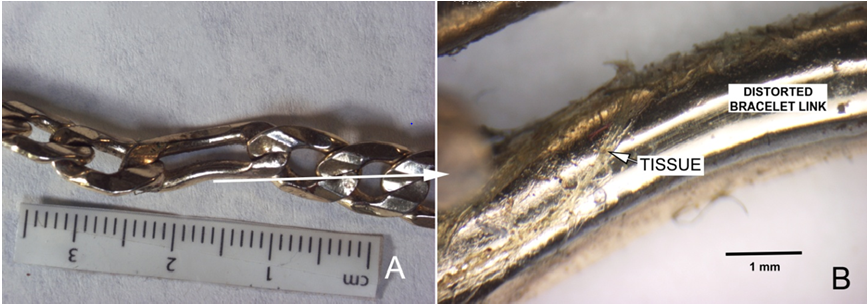
Macro-imaging of the distorted link Figure 14A shows the distorted link with the associated dried tissue (Figure 14B).
The bracelet was hit with a bullet while on Harris’ wrist, not pulled off by the victim as proposed by the prosecution.
The entire link was distorted, indicating that the bullet hit involved both sides of the link simulated in Figure 15 and the skin. The wrist wound indicates that both the bracelet and bullet were involved in the wrist wound (Figure 11), where tissue was deposited on the bracelet link (Figure 14B).
![Figure 15: Simulation of a semiwadcutter FMJ .40 caliber bullet at the distorted link; this shows a fit of the flat bullet nose to the distorted bracelet link; apparent semiwadcutter bullets were involved in this shooting. Evidence item 14 bullet design is described as a “FMJ flat tip” ([1] p 103) which could be the bullet that hit Harris’ wrist/bracelet.](/fulltextimages/11625/fig_15.png)
Figure 15. Simulation of a semiwadcutter FMJ .40 caliber bullet at the distorted link; this shows a fit of the flat bullet nose to the distorted bracelet link; apparent semiwadcutter bullets were involved in this shooting. Evidence item 14 bullet design is described as a “FMJ flat tip” ([1] p 103) which could be the bullet that hit Harris’ wrist/bracelet.
Postmortem Movement of the Body
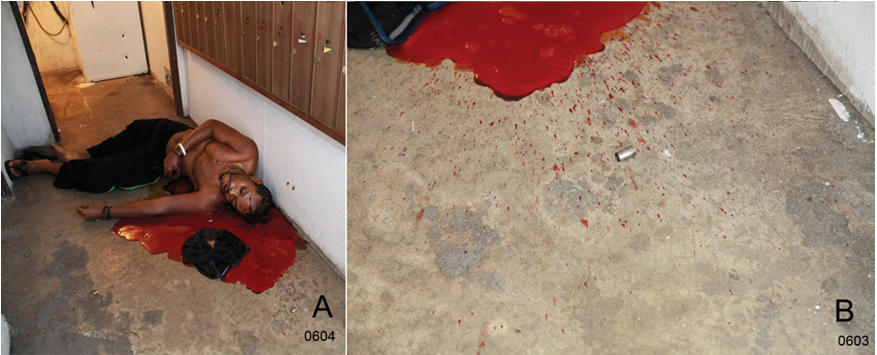
The resident of apartment 11, A. Olugbemi, discovered the body when he went to check his mail box. “He then saw a person lying on the ground in a pool of blood. He attempted to move the person, but the person was unresponsive” [1] (p 8, boldface by the author). There was no description of how the body was moved, but it is clear that the upper torso and head were lifted off the floor and then released, causing blood to spatter over the floor, which radiated out from the blood pool (Figure 16) and likely caused the hot cell phone in the victim’s right pocket to shift distally on his leg (Figures 4D&4E).
Audio Witness Accounts: the Shooting Time Constraint
The occupants of the apartment building heard a volley of three to nine gunshots. But what constitutes a volley in shots/second? For a trained shooter, in order to maintain accurate target hits, shoots approximately one shot/second with a volley of four to five shots [4]. Burnett [6] reported a case where four shots by a .40 caliber pistol, all on target, were made in just over one second. The maximum number of seconds for this shooting of one volley of nine shots, at four/ second, would be 2 to 3 seconds. The scene reconstruction, to allow for the movements of the shooter and victim, would not support such a rapid number of shots. The minimum of one shot per second for nine shots would, of course, be nine seconds. There was a struggle for the gun during which six shots occurred represented by bullet strikes A, B, G, D, and E and one through the victim’s right hand where the bullet hit the floor, the strike defect was hidden by the blood pool. The two shots, bullet strikes A and B, into the plywood under the mailboxes (Figures 2B&29) due to similar impact angles would occur within a second and likely the same for strikes D and E into the washing machine (Figures 2B, 8A&8C). The two shots to the victim’s head would also likely occur within a second. These considerations give an estimated time of the volley of eight shots of five to six seconds. The ninth and final shot was likely at Harris and the one which removed his bracelet.
The time gap between shots was insufficient for the nine shots to be separated into more than one volley the audio witnesses. However, audio witness, M. Anene, in apartment 7 heard three shots that followed a short time later (estimated time not provided) a louder series of shots. Johnson in second floor apartment 24 (Figure 1B) heard three shots outside his west-facing bedroom window before the louder six.
Conclusions
The Number of Casings Equals the Number of Bullets at the Scene (Table 2)
Evidence items 11 and 13 are jacket fragments that likely originated from two of the bullet jackets of evidence items 14, 15, and 16. Items 14 and 16 had white material that could be concrete debris. Intact and bullet fragments on the floor of the shooting scene account for four bullets (evidence items 14, 15, 16 and 18). There are three victim and Harris bullet wounds where the responsible bullets and fragments were on the mailboxes/laundry room floor:
- Wound 2 through the head of the victim (Figures 7A & 9A).
- Right hand wound of the victim (Figures 7B & 7C).
- Left wrist wound of Harris (Figure 11).
These bullets and mostly complete bullet jackets found at the scene account for all the .40 caliber casings at the scene, leaving the three victim leg wounds that did not occur in the mailboxes/laundry room.
Shooting Outside Mailboxes/Laundry Room
The .40 caliber casing count at the shooting scene excludes the bullets that caused three perforating leg bullet wounds to the victim. Not finding these casings in the vicinity of the apartment building and mailboxes/laundry room suggests that either a revolver was involved, or this second scene was not discovered by the police. Three perforating bullet wounds in the victim’s legs (Figure 7A) occurred outside the mail boxes/laundry room. This conclusion is supported by:
- There was no evidence of wall or dryer/washing machine bullet strikes from these three bullets if the victim was standing. If the victim was not fully standing, the three bullet strikes in the washing machine (Figure 2B at D and E) and under the mailboxes (Figure 2B, at A and B) could not have had the victim as intermediate targets for these bullet strikes, it would be impossible for the victim to attain such alignment. The length of time and for these shots and those in the mailboxes/laundry room, as heard by the two audio witnesses, indicates that the victim was near the apartment building and mobile after he received these leg wounds. The three bullets to his legs were not crippling.
- As noted above, nine casings and bullets are counted in the mailboxes/laundry room (Table 2 & Figure 2B) without including the bullets and possible casings associated with the three leg wounds.
- Audio witnesses, M. Anene (apartment 7), testified [7] (p 26) and A. Johnson (Johnson, personal communication) said that they heard three shots before hearing the firearm discharges from the mailboxes/laundry room. They likely heard the three shots to the victim’s legs. Both were incorrect as to the number of shots that occurred in the second volley, as were the other audio witnesses.
The victim was outside the mailboxes/laundry room when he received the three leg wounds.
There is no evidence to indicate that there was more than one assailant/shooter in the mailboxes/laundry room. There is no evidence in either bullet tool marks [1] (pp 100 - 105) or casing tool marks [1] (pp 172 - 178) that more than one firearm was involved in the shooting within the mailboxes/ laundry room. The three bullet leg wounds sustained by the victim were outside the mailboxes/laundry room and could have been from a different firearm, as noted above.
Evidence the Victim, Alexander Anene, was in a Physical Altercation before the Shooting
The abrasions on the back of the victim Figure 3A show that he was assaulted before the shooting in the mailboxes/ laundry room. The apparent blood on the mailbox lock mechanisms indicates that part of this attack on the victim occurred at the mailboxes (Figure 3D). The victim’s cell phone was heavily damaged (Figure 4B) before the mailboxes/laundry room shooting and did not occur by the victim collapsing on it (Figure 4A) at his death.
Evidence Harris was a Victim
The time from Harris’ departure from apartment 12 to the time of the shooting is too short (10 to 15 seconds, [1] p 30 and [1] p 385) for Harris to have assaulted the victim, shoot him outside of the mailboxes/laundry room, and then discharged a firearm in the mailboxes/laundry room with a struggle for that firearm. The resident of apartment 12, Hamilton, noted [1] (p 8), “Approximately 15 seconds after Treyvion [sic] left her door, I [Hamilton] heard 4-5 gunshots coming from the parking garage” of the building.
Harris received a ricochet bullet core, likely while he was in the east part of the mailboxes/laundry room (Figure 17A). There was no evidence that it was self-inflicted. However, if Harris was the shooter, he could have received the ricochet of the bullet he had fired.
Harris also had his bracelet removed from his wrist by a bullet in the west part of the mailboxes/laundry room. The shooter likely shot at Harris. The association of the victim’s DNA with the bracelet [1] (p 131) occurred either by the bracelet being touched by a scene processor after becoming contaminated with the victim’s blood or blood spatter hit the bracelet from the spattering event (Figure 16). The bracelet link was distorted by a bullet impact, as simulated in Figure 15. The interaction between the bullet and the bracelet link produced copper particles from the bullet jacket, as shown in Figure 13B. Because the bracelet is composed of brass (Figure 12B) with nickel plating (documented but not shown) and apparent gold plating (not detected in the analysis) on top of the nickel plating, the copper particles came from the bullet’s copper jacket. The bullet removal of the bracelet and wrist wound could not have been a self-inflicted gunshot because of the lack of stippling or tattooing on his wrist (Figure 11), the presence of which would document an intermediate range shot.
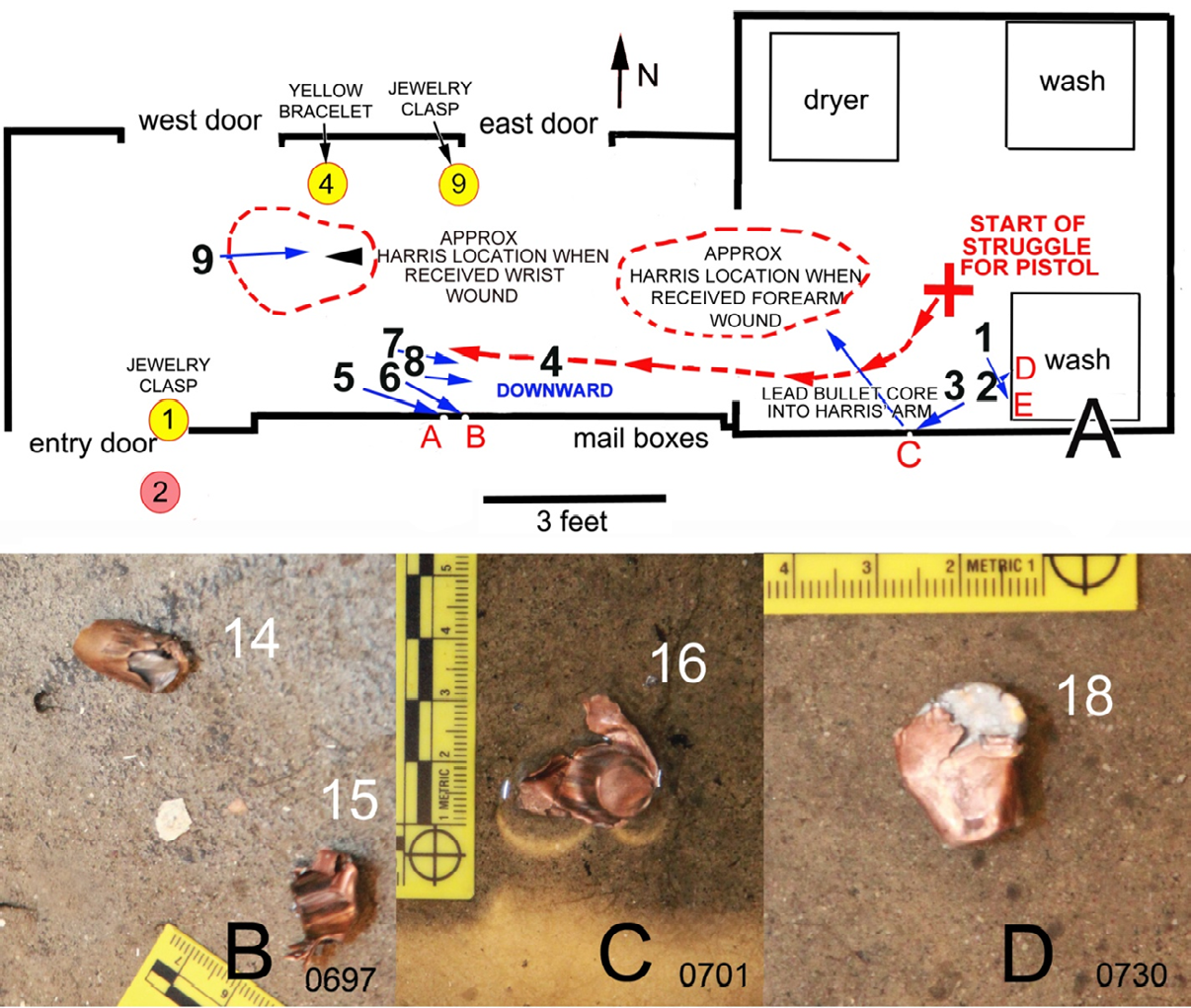
Figure 17. A. Reconstruction of the shooting; red arrow dash line traces the route of the assailant and victim took during the struggle for the pistol. The black numbers represent the discharge sequence number of the 9 shots. The blue arrows show the direction of the bullets for each discharge. Shot 4 was downward. The proposed positions of Harris at each of his two wounds on his left arm are shown. B. Bullet fragment 14 and partial jacket 15. C. Bullet jacket 16. D. Partial bullet 18 (described as a jacket ionly, but lead can be seen associated with the jacket).
The Mail boxes/Laundry Room
The number of casings and bullets (full and jacket + cores) are accounted for. Figure 17A summarizes the path of the assailant and victim in their struggle for the .40 caliber pistol. Also shown are the estimated positions of Harris when he received his two bullet wounds. Harris’ upper left arm injury was from a bullet lead core, likely from the bullet wall hit (Figure 17A at 3) which caused a separation of the jacket from the core with half of the jacket remaining in the wall. The deflected bullet core was elevated enough from the floor to hit Harris’ left arm if he had it outstretched 90 + degrees from his body (Figure 17A) and was facing the washing machines. It is less likely that the lead bullet core was from shot 4, which could have ricocheted off the concrete floor. The bullets and jackets on the concrete floor of the mailboxes/ laundry room are shown (Figures 17B-17D).
Shot 4 (Figure 7A at C) was discharged (likely downward) during the midpoint of the struggle. The lack of bloodspatter associated with the two bullet strikes on the washing machines (Figures 8A & 8C) and on the nearby south wall (Figure 8B) indicates that the close-range shot to the victim’s right hand likely occurred with shot 4 of the volley near the final position of the victim (Figure 17A). Shots 5 and 6 (Figure 17A) were fired into the plywood under the mailboxes (Figure 9) and occurred at the end of the struggle for the pistol while the victim was falling and the shooter was off balance. Either shot 7 or 8 (Figure 9A) to the victim’s head was perforating. Shots 7 and 8 of the volley occurred when the victim was down, with his head close to the floor. The rapidity of the 9 shots (audio witness accounts) indicated that following hand shot 4 of the volley, the victim fell and could not have stepped on the blood/tissue spatter from that shot (RE: the blood smear or transfer, Figure 5). From the location of the bracelet fragments, shot 9 of the volley, which hit the bracelet, was at Harris when he was in the west part of the mailboxes/laundry room removing the bracelet and abrading his wrist (Figure 11).
This evidence also indicates, based on the witness Yvette Hamilton (the person Harris visited at apartment 12), that the time that Harris left her door to hearing the gunshots (15 seconds [1] (p 8), followed by another interview account of 15 seconds, and with another interviewer, “10 -15 sec later heard 923” (“923” is police code for “illegal shooting ;” [1] (p 385)) was insufficient for Harris to have participated in the physical assault on the victim before the shots in the mailboxes/laundry room.
The Trial and Sentencing Hearing
The trial transcript (parts missing) is provided [7].
There are many features of the shooting scene that were ignored in the prosecution’s reconstruction. The prosecutor inappropriately acted as an expert presenting to the court a reconstruction of the shooting, clearly demonstrating both motivational bias (the defendant was a gang member) and cognitive bias (ignored exculpatory evidence).
The evidence that was ignored:
- Abrasions on the victim’s back (Figure 3)
- Blood on the victim’s feet (Figure 6C)
- Three bullet wounds on the victim’s legs (Figure 7A) that had no evidence of being sustained within the mailboxes/laundry room, and
- The bracelet was shot off Harris’ wrist by a distant shot (Figure 11); there is no evidence that it was a self- inflicted shot.
The exculpatory evidence described here was ignored by the defense attorney. The Court dismissed the defense attorney and appointed a new one upon notification by the author of the exculpatory evidence. In the sentencing hearing [8], that attorney described why he did not have the author testify. This attorney did not provide a foundation for his decision not to put the author on the stand, and the author was not provided an opportunity to rebut while on the stand. A declaration rebutting the defense attorney’s testimony was submitted to the Court after the hearing [9].
Treveon Harris was in the wrong place at the wrong time. He is now serving fifty years to life for this homicide.
Post-trial: Appeal transcript [10].
Appellate Court Ruling [11].
Disclaimer
“Remember that a reconstruction is the putting together the physical evidence and eyewitness accounts into a meaningful scenario that best explains a crime scene. There is always uncertainty, where new or missed evidence might significantly alter that scenario.” Joseph Orantes, former head of the San Diego Police Crime Laboratory (ca. 1996).
References
-
www.meixatech.com/HARRISMURDERBOOK.pdf.
-
www.meixatech.com/HARRISAUTOPSYREPORT.pdf.
-
www.meixatech.com/HARRISPHTRANSCRIPT.pdf.
-
Krell BE (2015) Discharge analysis of the struggle over a firearm. Investigative sciences journal 7(1): 1-20.
-
Haag MA, Haag LC (2011) Shooting incident reconstruction, In: 2nd (Edn.), Academic Press, San Diego CA, USA, pp: 1-18.
-
Burnett BR (2010) Ill-fated beer run: The shooting of Christopher St. Louis. Investigative Sciences Journal 2(1):1-32.
-
www.meixatech.com/HARRISTRIALTRANSCRIPT.pdf.
-
www.meixatech.com/HARRISSENTENCINGHEARING. pdf.
-
www.meixatech.com/HARRISBURNETTDECLARATION. PDF.
-
www.meixatech.com/HARRISAPPEAL.pdf.
-
www.meixatech.com/HARRISAPPELLATERULING.pdf.
- Forensic Implications of Adverse Drug Reactions in Schizophrenia A Case Series
- Narcotics and Digital Forensics: Bridging Crimes in the Digital Age
- Ethics in Forensic Psychiatry: Principles, Dilemmas, and Human Rights
- Impact of Acute Stress on Attentional Orienting to Social Cues
- Head Injury and Intracranial Hemorrhage in Western Region of Libya
- A Forensic Study on Handedness: Examination of Handwriting Features in Right and Left Handed Writers