
Application of the X-Chromosomal STRs and the FamLinkX Software for Solving Complex Kinship Forensic Genetics Cases in Colombia
X-chromosome short tandem repeats (X-STRs) genotyping is a powerful ¬tool in forensic genetics for resolving intricate kinship cases due to its distinctive inheritance pattern. It proves particularly valuable in scenarios where the application of autosomal (A-STR) and Y-chromosomal STR (Y-STR) markers falls short in addressing such cases, especially those involving complex situations and kinship analyses encompassing extensive and incomplete pedigrees. The recent advancement and implementation of the Argus X-12 QS kit along with the FamilinkX software for X-STR analysis have facilitated the resolution of forensic cases that were formerly inconclusive or not received by the laboratory due to their high complexity. This article delineates seven intricate cases of kinship and identification conducted at the Forensic Genetics Laboratory of the National Institute of Legal Medicine and Forensic Sciences in Bogotá, Colombia, in instances where autosomal STRs yielded non-conclusive or weak likelihood ratio (LR) values, the combination of the Argus X-12 QS kit and the FamilinkX software proved instrumental in elucidating and enhancing LR values, thereby leading to conclusive outcomes. The article details a case involving the confirmation of the identity of a body retrieved from water, which was subsequently returned to the institute by its relatives for identification. It also encompasses cases involving maternal half-siblings, complex pedigrees with paternal half-aunts, and others. In each scenario, the total LR was estimated by combining the LR of autosomal STRs (LR AS-STR) with the LR of X-STRs (LR X-STR), utilizing the population frequency database specific to Colombia. Additionally, the LRs of X-STRs obtained using population frequency data from Colombia were compared with those from Mexico. The data derived from both the Mexican and Colombian populations exhibited a high degree of similarity. The collective LR values substantiate the efficacy of X-STR markers, particularly in resolving cases of maternal half-siblings. The analysis underscores the robust informativeness of the 12 X-STR loci examined in the context of forensic testing.
Introduction
The X chromosome is considered one of the most stable nuclear chromosomes, with an approximate size of 155 million base pairs (Mb), making up nearly 5% of the human genome. It displays a unique inheritance pattern based on gender (male/female). In this manner, males are heterogametic, possessing a single copy of the X chromosome inherited from their biological mother, while females are homogametic, having two copies of the X chromosome inherited from each of their parents. Males transmit the X chromosome to all their female offspring largely unchanged, except for recombination processes between their X and Y chromosomes in the pseudoautosomal regions PAR1 and PAR2. Females transmit one of their X chromosomes to both their male and female offspring, following a recombination process during meiosis, similar to autosomal chromosomes (Figure 1) [1].
![Figure 1: Inheritance of the X Chromosome. Male and Female Offspring Inherit a Recombined Maternal X Chromosome that Results from Female Meiosis. The Female Offspring Inherits an Unchanged Paternal X Chromosome, due to the Lack of Recombination [2].](/fulltextimages/11656/fig_1.png)
Furthermore, Szibor, et al. [3] have established an online X-STR database (www.chrx-str.org, accessed on July 1, 2023), which compiles the latest research on X-chromosome markers used for forensic purposes, evolutionary anthropology and other genetic investigations. This database provides comprehensive information about X-STRs, including their physical and genetic localization, repetitive structure, allele nomenclature, mutation rates, and population genetics, among other relevant details. Currently, it contains information on 55 distinct X-STRs (Figure 2).
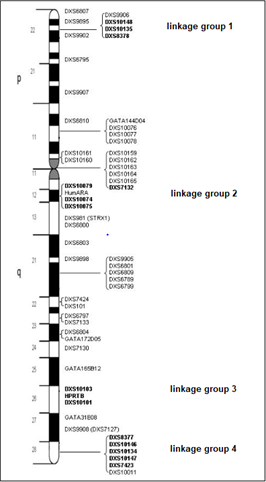
Given the X chromosome’s length of approximately 155 Mb (approximately 180 cM), the selection of a maximum of 3–4 X-chromosomal markers, spaced more than 50 cM apart, is feasible. These markers would exhibit independent segregation as distinct clusters or linkage groups (LGs) [4].
It was postulated that the genetic distance within each STR cluster would be under 1 cM when closely linked markers are considered [3, 4]. In cases where markers are closely linked and do not segregate independently, alleles at these linked markers combine to establish haplotypes [5, 6]. Consequently, the likelihood of meiotic recombination within each of the four clusters is estimated to be less than 0.5% [7, 8]. If the distance between clusters is approximately 50 cM or greater, the outcome is that each of the four STR clusters encompasses a stable haplotype that could potentially undergo recombination during meiosis, forming distinct ‘blocks’ [7, 8, 9].
Some X-STR loci express strong linkage disequilibrium (LD) and segregate together as haplotypes [10], particularly markers located in proximity to the centromere, where recombination rates are diminished. [9, 10, 11, 12].
The inheritance characteristics of X-chromosomal markers make the genotyping of X-chromosome short tandem repeats (X-STRs) a powerful tool in forensic genetics, primarily for resolving complex kinship cases [5, 8, 13, 14], such as those where the sample of the alleged father or mother is unavailable and it becomes necessary to rely on less closely related relatives. X-STRs are also valuable in cases where the analysis of autosomal STRs is not informative and requires an increase in the number of exclusions or likelihood ratios (LR). Furthermore, X-STRs are particularly useful in cases of incest, where the exclusion power of autosomal STRs is significantly reduced due to increased homozygosity. This is particularly evident in cases of father-daughter incest, where the father is also the maternal grandfather, leading to the daughter being homozygous for all X-STR markers or sharing the same genotype as the mother. X-STRs have also demonstrated utility in cases involving sisters or half-sisters sharing the same biological father; in such instances, they will share one allele in each X-STR. Similarly, they are applicable in complex kinship cases involving only a few individuals with distant relationships available for genetic analysis. This is especially relevant when the mother is absent, as seen in situations involving missing persons, mass disasters, and the need to identify victims, as well as immigration scenarios [1].
Due to the inheritance pattern exhibited by X-chromosomal markers, which varies based on individuals’ gender, a specialized approach is required for statistical evaluation. Additionally, careful consideration must be given to linkage disequilibrium (LD), owing to the short distances between different markers on the same chromosome. This underscores the essential need for appropriate computer software that takes into account the linkage and LD between loci, as well as mutations. Hence, the significance of adhering to the guidelines for the use of X-STRs in kinship analysis set forth by the DNA Commission of the International Society for Forensic Genetics (ISFG) [4].
The most widely utilized software for statistical assessments of kinship involving X-chromosomal markers is FamLinkX. It provides probability calculation functions for familial relationships/pedigrees utilizing data from X-chromosomal genetic markers. This software takes into consideration linkage, linkage disequilibrium, and mutations of X-STR markers [15]. It is freely available for use at http:// www.FamLink.se. The application of this software has been demonstrated and validated in forensic cases [16]. FamLinkX was developed by Daniel Kling at the Norwegian Institute of Public Health, Norway; Andreas Tillmar at the National Board of Forensic Medicine, Sweden; Thore Egeland at the Norwegian University of Life Sciences; and Petter Mostad at Chalmers University of Technology, Sweden, in the Mathematical Sciences Department.
X-STRs possess features that facilitate their implementation in forensic laboratories. These include their high discriminatory power, easy analysis through multiplex PCR and fluorescent detection on capillary electrophoresis equipment. Additionally, the short fragments they generate allow for analysis in limited and partially degraded samples [2].
X-STRs are highly standardized with numerous markers, methodologies and databases. Commercial kits are available in the market, for instance: Mentype Argus X-8 (5), X-chromosome pentaplex [10], Goldeneye™ DNA ID 17X [17], Microreader™ 19X ID System [18], AGCU X19 STR [2], GHEP- ISFG decaplex [19], MiSeq FGx™ Forensic Genomics [20] and Investigator® Argus X-12 QS Kit (Qiagen GmbH, Hilden, Germany) which is widely being used for population studies around the world [21] kit that allows co-amplification of 12 X chromosomal markers belonging to four linkage groups (LGs) [22] located at Xp22.2, Xq12, Xq26, and Xq28 [23] each containing three closely linked markers per group [24] linkage group 1: (DXS10148-DXS10135-DXS8378); linkage group 2: (DXS7132-DXS10079- DXS10074); linkage group 3: (DXS10103-HPRTB-DXS10101); linkage group 4: (DXS10146-DXS10134-DXS7423) [23], which simultaneously detects 12 X-STR markers plus Amelogenin and D21S11 [25, 26] the autosomal marker D21S11 was added to enable alignment of the Investigator Argus X-12 QS Kit profile with a profile from any other autosomal STR kit and to minimize the risk of sample mix-ups Quality Sensor (QS) was introduced as an internal control to monitor PCR performance. SNP primers were added to overcome allele drop out due to known mutations in primer binding sites. The most informative and polymorphic marker observed was DXS10135 [22, 27, 28, 29].This marker had a total of 27 alleles, [22, 27] The least polymorphic marker was DXS8378 with six alleles [22]. This study presents seven distinct types of highly complex forensic cases, showcasing the significant utility of X-STR markers for their resolution.
This article delineates seven intricate cases of kinship and identification conducted at the Forensic Genetics Laboratory of the National Institute of Legal Medicine and Forensic Sciences in Bogotá, Colombia, in instances where autosomal STRs yielded non-conclusive or weak likelihood ratio (LR) values.
Materials and Methods
Samples and DNA Extraction
In this study, 18 blood samples collected on Whatman® FTA® cards were analyzed. These samples were derived from routine cases of body identification and parentage received at our laboratory. The samples were processed individually and extraction was performed in parallel with a reagent blank control accompanying the samples during the assay.
Total DNA was isolated from samples using chelating resins - Chelex-100, following standardized laboratory procedures [30].
PCR Amplification and Typing
DNA quantification was conducted using an Applied Biosystems 7500 Real-Time PCR System, employing the PowerQuant® quantification kit from Promega Corporation. All samples were normalized to approximately 0.1 ng/μL. Amplification was carried out using the Investigator® Argus X-12 QS kit (Qiagen, Hilden, Germany) on a C1000™ Thermal Cycler with BioRAD.
Amplification A-STR was carried out using the GlobalFiler™ PCR Amplification Kit, VeriFiler™ Plus PCR Amplification Kit of Applied Biosystems, PowerPlex® CS7 System - Promega Corporation and Y-STRs using the AmpFlSTR® Yfiler® Plus kit (Life Technologies The amplified products were separated and detected using an ABI 3500xL Genetic Analyzer (Applied Biosystems, Foster City, CA, USA).
All procedures and protocols were carried out following the manufacturer’s instructions, the internal validation and routine methods of the laboratory.
Likelihood Ratio Calculation and Pedigrees
Likelihood ratios (LRs) were computed using Familias software version 3.2.9 and FamLinkX v2.9.2, both available for free at http://www.famlink.se. The probability calculations were based on allelic frequencies of X-STR markers in the Mexican population [16, 31, 32], using 188 as the lambda average value. Frequencies from the Colombian population were also compared, using 183 as the lambda average value, and the values were compared across both populations [16, 31, 32]. The lambda values were calculated using FamLinkX v2.9.2 and Rx64 v4.1.2:
The lambda values obtained for the Colombian population for each of the clusters were:
232,4697; 171,4882; 105,6876; 223.0223.
λ λ λ λ = = = =
Cluster1 Cluster2 Cluster3 Cluster4
( )
4 183,167.
λ λ λ λ λ λ = + + + = =
Average Cluster1 Cluster2 Cluster3 Cluster4 Average
The lambda values obtained for the mexican, population for each of the clusters were:
242,3173; 188,9193; 143,2703; 178,7526.
λ λ λ λ = = = =
Cluster1 Cluster2 Cluster3 Cluster4
( )
4 188,3149.
λ λ λ λ λ λ = + + + = =
Average Cluster1 Cluster2 Cluster3 Cluster4 Average
Pedegrees were created in software Familias versión 3.2.8, FamLinkX v2.9.2 and plot en Rx64 v4.1.2.
Results
Case 1
This case involves the remains of a male individual whose decomposing body was recovered from the Yomasa creek in the City of Bogotá D.C. Initially, the body was identified through fingerprint analysis conducted by the dactyloscopy laboratory at the National Institute of Legal Medicine and Forensic Sciences. The analysis, however, required amputation of the distal phalanges of the hands. Despite this initial identification, the facial alterations caused by putrefaction rendered the body unrecognizable to the relatives. Consequently, the body was returned by the family to the Institute for further investigation, seeking definitive confirmation of the victim’s identity as their relative (brother), for which a genetic comparison was requested to address the family’s doubts regarding identification. For the genetic identification study, DNA samples were obtained from three male subjects who claimed to be full brothers of the victim. Initially, all the subjects and the victim were tested for 23 autosomal STRs, resulting in the formulation of two hypotheses: H1: All three brothers are full siblings of the victim. H2: Unrelated.
An LR value of 0 was calculated using the Familias version 3.2.9 software in favor of hypothesis H2: unrelated.
In light of these findings, the investigation was expanded to include Y-chromosome markers. The male subjects and the victim were typed for 27 Y-STRs. Analysis of the Y chromosome revealed three distinct haplotypes, with only F1 and F3 sharing the same Y-chromosomal haplotype. This result indicated the presence of three different fathers within this family group, suggesting potential maternal half-siblings rather than full siblings (Figure 3).
Considering this new finding, the data underwent reevaluation using Familias version 3.2.9. The resulting LR value indicated a weak likelihood ratio of 756 in favor of the hypothesis of maternal half-brotherhood versus being unrelated.
The study was further extended to analyze the X-chromosome. A profile of twelve X-STRs was obtained using the Investigator Argus X-12 QS kit. Upon reviewing the X-STR genotypes of F1, F2 and F3, it became possible to reconstruct nearly the entire genotype of their common biological mother (M1) for the X-STR linkage groups (LG1, LG2, LG3, and LG4), except for one cluster within LG1 (DXS8378, DXS10135, and DXS10148) (Figure 3). It was evident that the victim shared all linkage groups with the inferred maternal profile, except for the cluster where full reconstruction was not achieved.
The FamLinkX program was used to calculate the likelihood of the genotypes, considering two hypotheses: maternal half-brotherhood (H1) versus unrelated (H2). Likelihood calculations were based on published X-STR allele frequencies specific to the Colombian population. A notably strong likelihood ratio value (LR Cluster=3.1066e+006) favored the hypothesis of maternal half-brotherhood. As both hipothesis with autosomal markers and with Chromosome X were the same, when combining both LR results, the likelihood ratio value reached LR=2.3486e+009.
Therefore, the X-chromosome haplotyping, combined with autosomal STR results, strongly supported the assertion that the victim (V1) is a maternal half-brother of F1, F2, and F3.
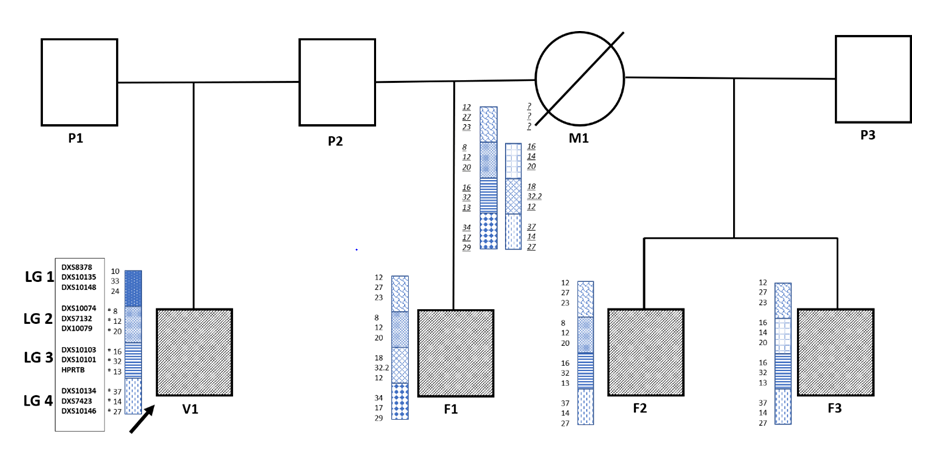
Figure 3: Case 1: Pedigree Representing Hypothesis 1. Genetic Identification of a Male Individual through Kinship Analysis with his Three Maternal Half-Siblings. X-STR Genotypes are Shown in the Order of Locus Represented within the Box on the Lower Left of the Graph, the Arrow Indicates the Victim to Identify. Inferred Genotypes of Mother are Underlined and Given in Italics; (?) Question Mark Alleles that Could not be Reconstructed. (*) Asterisk Mark Alleles that the Victim Shares with the Genetic Profile Deduced from the Mother. The Individuals with the Hatched Pattern Denote the Individuals with which a Sample was Available and from whom a Genetic Profile was Obtained. Each different X-Chromosome Linkage Group is Distinguished by a Characteristic Framework. V1: Victim 1, F1: Maternal Half-Brother 1, F2: Maternal Half-Brother 2, F3: Maternal Half-Brother 3. M1: Mother, P1: Father 1, P2: Father 2, P3: Father 3. LG: Linkage Groups (Or Clusters).
Case 2
Kinship case reconstruction with six paternal half-aunts. The autosomal LR with the five half aunts by families you get a weak LR: 3786 which is low to draw a conclusion for legal purposes in Colombia. The study with X chromosome is extended, observing the profiles and reconstructing the X chromosome from both grandparents (Figure 4 in blue), an isolated exclusion is found in the DXS10135 system in the presumed mean aunt 2 (Figure 4). Consistent with what is reported in the literature as the most informative and polymorphic marker [22, 27, 28, 29] likelihood ratio calculated with FamLinkX and considering that FamlinkX does not allow calculating with mutation for created pedigrees, the presumed paternal half-aunt 2 was removed from the calculation getting a STR-X LR Cluster: 5.0283e+008e and based on the genetic findings for the two types of autosomal and X chromosome markers and using a combined likelihood ratio, a very strong LR value is obtained: 1.7981e+012 (Figure 4).
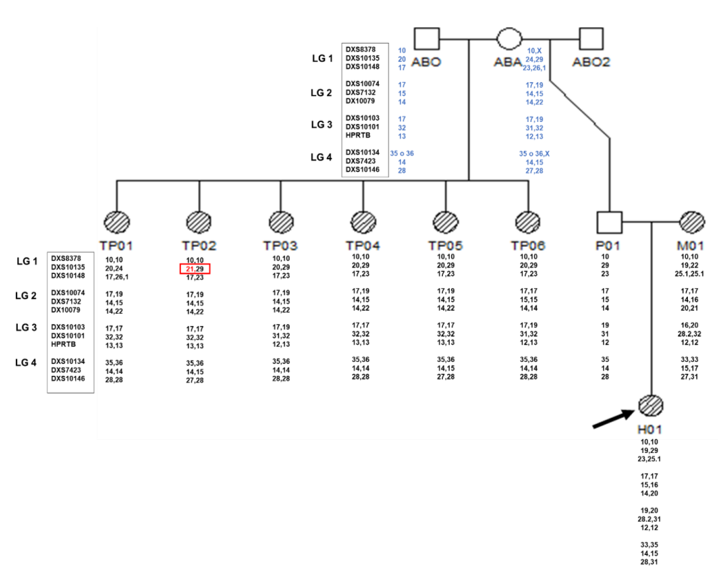
Figure 4: Case 2: Pedigree Representing Hypothesis 1. Paternity a Female Individual through Kinship Analysis with his Six Paternal Half Aunts and Mother. The Arrow Indicates the Female Individual to Recognize. The Individuals with the Hatched Pattern Denote the Individuals with which a Sample was Available and from whom a Genetic Profile was obtained. ABO, ABA, ABO2: Grandparents not Available, TP: Paternal Half Aunts, P01: Father 1, M01: Mother, H01: Female Individual to Recognize. In Blue the Reconstructed Profile of the Paternal Grandparents is Presented and Inside the Red Box the Isolated Inconsistency or a Possible Grandpaternal Mutation from Allele 20 to 21 in the TOP2 in the DXS10135 System is Marked, the Mutated Allele is also Shown in Red. LG: Linkage Groups (or Clusters).
Case 3
Identification case where there is a male victim to be identified with a mother, there is a null allele in the D1S1656 and an isolated inconsistency in the F13B system. Taking these two events into account, an LR of 3.9591E+005 was obtained with autosomal markers.
Given these two mutational events together in the same case, in order to increase the maternal index (MI) and obtain more reliable results, a set of 12 X-linked STR markers was added. It is observed that mother and son share at least one allele for all X markers. An exact LR of 6.3946E+006e is obtained.
Combining the LRs of the autosomal markers and the X chromosome, a very strong LR value 2.5316e+0012 is obtained.
Case 4
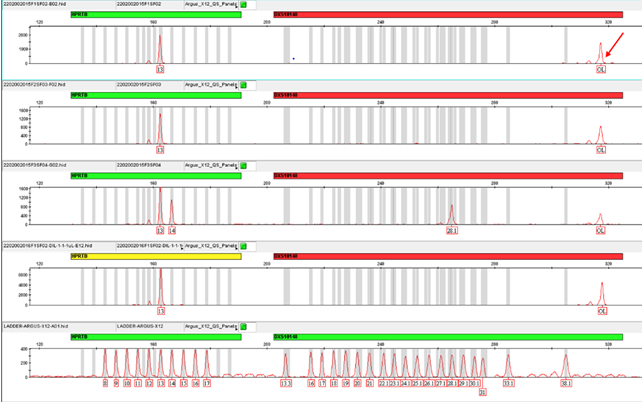
This case involves two stateless identical twin children, for whom establishing parentage with two maternal half- siblings is required. Analysis of 21 biparental A-STR markers and two Y-chromosome markers was conducted, resulting in an LR value of 11,503. Upon supplementing the studies with X-STR analysis, it was discovered that all individuals possess a novel off ladder allele not present in the reference ladder, within the DXS10148 system. Through application of a formula, the allele was identified as >38.1, with an additional 12.14 base pairs. This variant has not been documented in existing literature. By integrating the LR values of autosomal markers and the X chromosome, an LR value of 6.3406E+006 was calculated (Figure 5).
A total of 7 complex cases Identification and kinship were analyzed with the Investigator Argus X-12 Kit. LR values were obtained for all cases with FamLinkX. The results are shown in the Table 2, where the LR values obtained using the frequencies for the Mexican and Colombian populations are compared.
| Likehood Radio | ||||||
|---|---|---|---|---|---|---|
| Case | Type | Relationship | A-STR | Argus X-12 QS LR λ: (188) Mexican | Argus X-12 QS LR λ: (183) Colombian | Combined LR: A-STR x Argus X-12 QS Colombian frecuencies |
| 1 | ID | Three Maternal half-siblings and Victim. | 7.5600E+002 | 1.7198E+006c | 3.1066E+006c | 2.3486E+009 |
| 2 | K | Five paternal half-aunts, isolated exclusion in DXS10135. | 3.5760E+003 | 8.9210E+008c | 5.0283E+008c | 1.7981E+012 |
| 3 | ID | Mother-daughter, isolated exclusion in F13B and null allele in D1S1656. | 3.9591E+005 | 2.6251E+007e | 6.3946E+006e | 2.5316E+0012 |
| 4 | K | Maternal half-siblings (twin brothers - female) with new allele in DXS10148 system | 1.1500E+001 | 2.5642E+007e | 5.5135E+005e | 6.3406E+006 |
| 5 | K | Paternal Grandmother- Granddaughter. | 5.3000E-001 | 1.2506E+007e | 1.4776E+006e | 7.8313E+005 |
| 6 | ID | Maternal half-siblings (Male victim- famele reference) | 3.2650E+002 | 2.0330E+003e | 3.1300E+003e | 1.0219E+006 |
| 7 | ID | Maternal half-siblings (Male victim- famele reference) | 5.6890E+001 | 5.2944E+004e | 8.6518E+004e | 4.9220E+006 |
Table 1: Likehood Radios (LR) Calculated with Familias Sofware for Autosomal STRs (AS-STRs), and with Famlinkx for X Chromosome S
Table 1: Likehood Radios (LR) Calculated with Familias Sofware for Autosomal STRs (AS-STRs), and with Famlinkx for X Chromosome STRS (X-STR) Using Colombia Population X-STR Databases For X-STR With Argus X-12 QS, Lambda Λ: 183 and Mexican Population Lambda Λ: 188 and Combined Likehood Radio of A-STR X LR Argus X-12 QS. In Complex Cases. ID: Human Identification, K: Kinship Testing. eLR(Exact), CLR(Cluster).
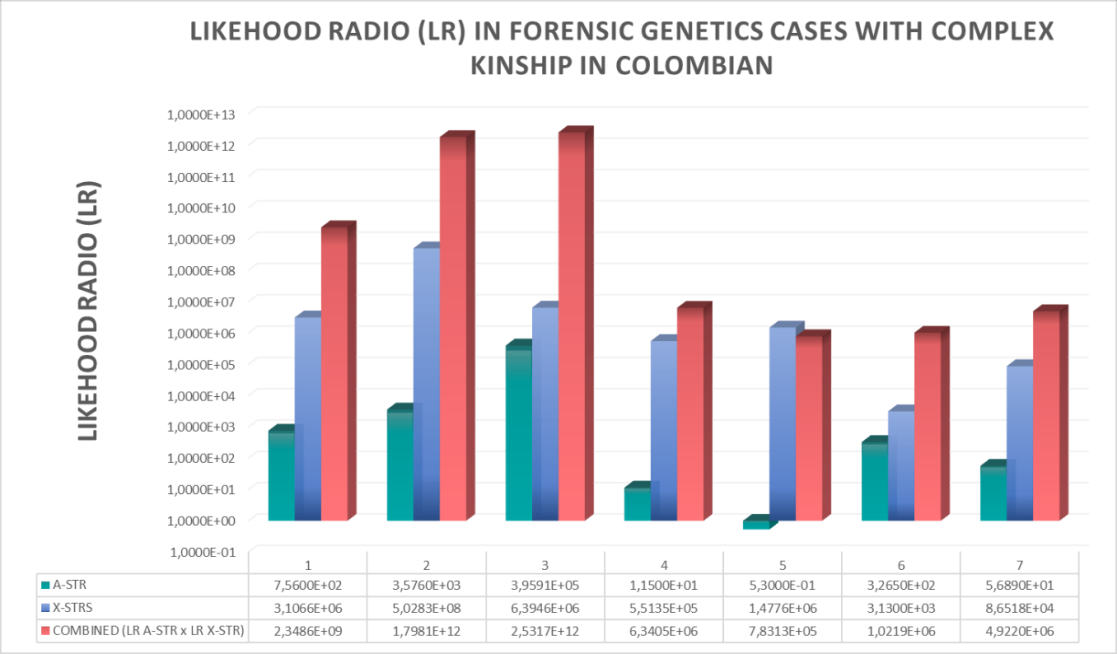
In Table 1 and Figure 6, it is evident that in all seven cases, both identification and kinship scenarios, the use of X-chromosome markers proved to be highly valuable for case resolution. The routine biparental STRs alone would not have been enough for these cases. As previously discussed, even in instances where the nature of kinship was uncertain, X-STRs allowed for the exclusion of paternal relationships, thereby enabling more accurate statistical assessments.
Furthermore, it can be observed that in cases 3, 4, and 5, the LR calculations exhibited significant differences when employing the Mexican and Colombian populations. This highlights the importance of utilizing an appropriate reference population when conducting probabilistic calculations. Despite the assumption that both populations belong to Latin American populations with somewhat similar ancestral components, disparities in LR values were evident. Notably, in all cases, the LR values were higher for the Mexican population.
Discussion
In the presented cases, the significant value of utilizing X-chromosome markers for resolving complex forensic cases was evident. These cases had previously been examined using routine genetic systems in the laboratory, yet remained unresolved. In the first case, X-chromosome markers were instrumental in clarifying presumed relationships among relatives. This led to the determination that they were indeed maternal half-siblings. This clarification prompted the revision of initial hypotheses, resulting in case resolution. Additionally, these findings supported the initial identification and ensured the conclusive identification of the individual.
In the second case, confirmation of parentage was achieved, and furthermore, the paternal origin of an isolated inconsistency could be discerned. Although this particular isolated inconsistency did not impact the outcome, it highlights the need to establish statistical evaluation mechanisms for considering mutation rates in complex cases involving isolated inconsistencies with X-STR markers.
The third case proved valuable in excluding the possibility of true filiation exclusion. It was confirmed that the inconsistency observed in the F13B system indeed corresponded to an isolated mutation.
In the fourth case, the utilization of X-chromosome markers facilitated the determination of kinship probabilities, leading to case resolution. Without these analyses, the case would have remained unresolved.
Undoubtedly, the advantages of employing X-chromosome markers for resolving complex forensic cases are evident. However, it is crucial that their use adheres to all the analysis and interpretation guidelines provided by the ISFG (4). As demonstrated, improper application of population frequencies can lead to errors in statistical assessments. Additionally, the use of haplotypic frequencies and suitable software is of paramount importance, enabling the analysis of various inheritance patterns that may manifest in a single case. Importantly, having a range of genetic markers with different inheritance patterns is advisable, enhancing the accuracy of assessing potential findings before rendering conclusions.
Conclusion
In certain cases involving complex paternity relationships and identifications, autosomal short tandem repeats (A-STRs) may not yield high probabilities of paternity and yet do not provide evidence of exclusion. X-chromosomal short tandem repeats (X-STRs), on the other hand, have been employed to enhance likelihood ratios (LRs), becoming a powerful tool in resolving intricate cases [33].
The combined utilization of the Investigator Argus X-12 QS kit and the FamLinkX software has enabled the resolution of more forensic cases involving both identification and paternity that were previously inconclusive or even declined for analysis due to their high complexity.
Colombia currently faces a significant challenge due to extensive migratory events in recent years, leading to the need to address cases of stateless children under government protection. Only counting with relatives such as maternal and paternal grandmothers, aunts, and others further complicate these cases.
Forensic complex cases have been on the rise, particularly in identification scenarios with maternal siblings, some of these cases turn out to be really half brotherhoods, use of X-STRs proves particularly valuable in identifying and assessing kinship with maternal half-siblings and has been facilitated by use commercial human identification kits like the Argus X-12 QS kit (Qiagen), while the freely accessible FamLinkX software has encouraged the integration of X-STR genetic systems, simplifying the statistical interpretation of haplotype data in forensic investigations (16,31). Employing suitable computer software that considers linkage, linkage disequilibrium among loci, and mutations is essential.
Although mitochondrial DNA sequencing can demonstrate maternity, it can be expensive and may not always yield the required level of certainty in forensic science, particularly when dealing with individuals lacking appropriate population genetic data. Thus, the typing of ChrX STRs offers a sensible alternative for evaluating maternity.
In our country’s routine molecular forensic practice, the focus is mainly on autosomal, Y-chromosomal STR, and mitochondrial DNA analysis. Our findings underscore the increasing necessity and importance of including X-STR analysis in numerous forensic cases. Therefore, we recommend conducting X-STR analysis whenever faced with situations involving exclusion of siblings and the potential presence of maternal half-sibilins.
Conflict of Interest
The authors declare that they have no conflicts of interest.
Acknowledgments
Dr. Juan José Builes Gómez Scientific Director Genes SAS Laboratory for sharing his data and file of population frequencies for Colombia, and to Dr. Joseph Alape Ariza forensic scientist in Forensic Genetics Group, National Institute of Legal Medicine and Forensic Science for all his efforts to obtain information.
References
-
Garcia FM, Bessa BGO, Dos Santos EVW, Pereira JDP, Alves LNR, et al. (2022) Forensic Applications of Markers Present on the X Chromosome. Genes 13(9): 1597.
-
Gomes I, Pinto N, Antão-Sousa S, Gomes V, Gusmão L, et al. (2020) Twenty Years Later: A Comprehensive Review of the X Chromosome Use in Forensic Genetics. Frontiers in Genetics 11: 1-17.
-
Szibor R, Hering S, Edelmann J (2006) A new Web site compiling forensic chromosome X research is now online. International Journal of Legal Medicine 120(4): 252-254.
-
Tillmar AO, Kling D, Butler JM, Parson W, Prinz M, et al. (2017) DNA Commission of the International Society for Forensic Genetics (ISFG): Guidelines on the use of X-STRs in kinship analysis. Forensic Sci Int Genet 29: 269-275.
-
Becker D, Rodig H, Augustin C, Edelmann J, Götz F, et al. (2008) Population genetic evaluation of eight X-chromosomal short tandem repeat loci using Mentype Argus X-8 PCR amplification kit. Forensic Sci Int Genet 2(1): 69-74.
-
Hundertmark T, Hering S, Edelmann J, Augustin C, Plate I, et al. (2008) The STR cluster DXS10148-DXS8378- DXS10135 provides a powerful tool for X-chromosomal haplotyping at Xp22. International Journal of Legal Medicine 122(6): 489-492.
-
Szibor R (2007) X-chromosomal markers: Past, present and future. Forensic Science International Genetics 1(2): 93-99.
-
Szibor R, Krawczak M, Hering S, Edelmann J, Kuhlisch E, et al. (2023) Use of X-linked markers for forensic purposes. Int J Legal Med 117(2): 67-74.
-
Diegoli TM (2015) Forensic typing of short tandem repeat markers on the X and Y chromosomes Forensic Science International Genetics 18: 140-151.
-
Ferreira Da Silva IH, Barbosa AG, Azevedo DA, Sánchez- Diz P, Gusmão L, et al. (2010) An X-chromosome pentaplex in two linkage groups: Haplotype data in Alagoas and Rio de Janeiro populations from Brazil. Forensic Sci Int Genet 4(4): 95-100.
-
Edelmann J, Hering S, Augustin C, Kalis S, Szibor R (2010) Validation of six closely linked STRs located in the chromosome X centromere region. Int J Legal Med 124(1): 83-87.
-
Edelmann J, Hering S, Augustin C, Immel UD, Szibor R (2009) Chromosome X centromere region-Haplotype frequencies for different populations. Forensic Science International: Genetics Supplement Series 2(1): 398- 399.
-
Bini C, Riccardi LN, Ceccardi S, Carano F, Sarno S, et al. (2015) Expanding X-chromosomal forensic haplotype frequencies database: Italian population data of four linkage groups. Forensic Sci Int Genet 15: 127-130.
-
García MG, Gusmão L, Catanesi CI, Penacino GA, Pinto N (2017) Mutation rate of 12 X-STRs from investigator Argus X-12 kit in Argentine population. Forensic Science International: Genetics Supplement Series 6: e562-e564.
-
Shyla A, Borovko SR, Tillmar AO, Kuzub NN, Kotova SA, et al. (2015) Belarusian experience of the use of FamLinkX for solving complex kinship cases involving X-STR markers. Forensic Science International: Genetics Supplement Series 5: e539-e541.
-
Kling D, Dell’Amico B, Tillmar AO (2015) FamLinkX - Implementation of a general model for likelihood computations for X-chromosomal marker data. Forensic Sci Int Genet 17: 1-7.
-
Gao H, Wang C, Zhang R, Wu H, Sun S, et al. (2019) Application of CPI cutoff value based on parentage testing of duos and trios typed by four autosomal kits. PLoS One 14(11): e0225174.
-
Lin L, Li J, Hu Y, Wang H, Marah FA, et al. (2020) Genetic characterization of 19 X-STRs in Sierra Leone population from Freetown. Int J Legal Med 134(5): 1659-1661.
-
Gusmão L, Sánchez-Diz P, Alves C, Gomes I, Zarrabeitia MT, et al. (2009) A GEP-ISFG collaborative study on the optimization of an X-STR decaplex: Data on 15 Iberian and Latin American populations. Int J Legal Med 123(3): 227-234.
-
Jäger AC, Alvarez ML, Davis CP, Guzmán E, Han Y, et al. (2017) Developmental validation of the MiSeq FGx Forensic Genomics System for Targeted Next Generation Sequencing in Forensic DNA Casework and Database Laboratories. Forensic Sci Int Genet 28: 52-70.
-
Perera N, Galhena G, Ranawaka G (2021) Development of a 16 X-STR multiplex PCR system for kinship analysis and its applicability for the Sinhalese population in Sri Lanka. Int J Legal Med 135(1): 161-166.
-
Crnjac J, Ozretić P, Merkaš S, Ratko M, Lozančić M, et al. (2017) Investigator argus X-12 study on the population of northern Croatia. Genet Mol Biol 40(1): 80-83.
-
Cainé L, Costa S, Pinheiro MF (2013) Population data of 12 X-STR loci in a North of Portugal sample. Int J Legal Med 127(1): 63-64.
-
Edelmann J, Lutz-Bonengel S, Naue J, Hering S (2012) X-chromosomal haplotype frequencies of four linkage groups using the Investigator Argus X-12 Kit. Forensic Science International Genetics 6(1): 24-34.
-
Elakkary S, Hoffmeister-Ullerich S, Schulze C, Seif E, Sheta A, et al. (2014) Genetic polymorphisms of twelve X-STRs of the investigator Argus X-12 kit and additional six X-STR centromere region loci in an Egyptian population sample. Forensic Sci Int Genet 11(1): 26-30.
-
Scherer M, König M, Bussmann M, Prochnow A, Peist R (2015) Development and validation of the new Investigator® Argus X-12 QS Kit. Forensic Sci Int Genet Suppl Ser 5: 256-257.
-
Ferragut JF, Bentayebi K, Castro JA, Ramon C, Picornell A (2015) Genetic analysis of 12 X-chromosome STRs in Western Mediterranean populations. International Journal of Legal Medicine 129: 253-255.
-
García MG, Catanesi CI, Penacino GA, Gusmão L, Pinto N (2019) X-chromosome data for 12 STRs: Towards an Argentinian database of forensic haplotype frequencies. Forensic Sci Int Genet 41: 8-13.
-
Guo F (2017) Population genetic data for 12 X-STR loci in the Northern Han Chinese and StatsX package as tools for population statistics on X-STR. Forensic Sci Int Genet 26: 1-8.
-
Walsh PS, Metzger D, Higuchi R (1991) Chelex 100 as Medium for Simple Extraction of DNA for PCR-Based Typing from Forensic Material. Biotechniques 10(4): 506-513.
-
Cortés-Trujillo I, Zuñiga-Chiquette F, Ramos-González B, Chávez-Briones M de L, Islas-González KL, et al. (2019) Allele and haplotype frequencies of 12 X-STRs in Mexican population Forensic Science International Genetics 38: 11-13.
-
Builes JJ, Mendoza L, Gaviria A, Zambrano AK, Suarez ND, et al. (2017) Genetic characterization of four Colombian populations using Investigator® Argus X-12 kit. Forensic Sci Int Genet Suppl Ser 6: 263-264.
-
Hatsch D, Keyser C, Hienne R, Bertrand L (2007) Resolving paternity relationships using X-chromosome STRs and Bayesian networks. J Forensic Sci 52(4): 895- 897.
- Forensic Implications of Adverse Drug Reactions in Schizophrenia A Case Series
- Narcotics and Digital Forensics: Bridging Crimes in the Digital Age
- Ethics in Forensic Psychiatry: Principles, Dilemmas, and Human Rights
- Impact of Acute Stress on Attentional Orienting to Social Cues
- Head Injury and Intracranial Hemorrhage in Western Region of Libya
- A Forensic Study on Handedness: Examination of Handwriting Features in Right and Left Handed Writers