
Investigating the Illicit Manufacture of Pharmaceutical Drugs in Sri Lanka-A Case Study on the Underworld of Counterfeit Drugs
The pharmaceutical drug industry is engaged in the research, development, manufacture and marketing of drugs and medications, which plays a major role in the healthcare industry. The global demand for the pharmaceutical drugs is on the rise, and unfortunately there is a concurrent increase in the illicit production of these drugs worldwide. This surge can be attributed to factors such as high demand, potential for profit, weak regulatory oversight and desire to exploit gaps in the legal market. Despite pharmaceutical drugs are intended for the treatment of medical conditions and pain relief, there is growing trend of illicit drug abusers to misusing these substances. Reports indicate a significant number of unlicensed pharmacies in Sri Lanka, but fewer accounts of illicit manufacturing of pharmaceutical drugs. In April 2023, the Police Narcotic Bureau officers arrested a building in a densely populated area in Colombo, Sri Lanka, suspecting it to be a clandestine laboratory for the production of illicit drugs. Subsequently, the Government Analyst of Sri Lanka was tasked with investigating the suspected clandestine laboratory. A team of forensic analysts from Government Analyst’s Department (GAD) visited the site, scrutinized the location, examined the equipment and chemicals and collected samples for further analysis. Although the clandestine laboratory was abandoned at the time of visit, evidence of machinery used for filling capsules, various chemicals, chemical glassware and other equipment were observed. Preliminary tests for illicit drugs and handheld Raman Spectroscopy testing were conducted at the scene. Gas Chromatography – Mass Spectroscopy (GCMS) was performed on the collected samples in the GAD laboratory. The analysis revealed the samples collected from the clandestine laboratory contained the substances considered pharmaceutical drugs namely, Tramadol, Lidocaine, Niacinamide, Menthol and Chlorpheniramine.
Introduction
The pharmaceutical industry allocates substantial number of resources to discover new cures and treatment options, aiming to combat various illnesses and diseases that impact the global community [1]. It stands out as one of the industries with substantial demand and significant financial investments [1].
Pharmaceutical drug manufacturers bear the responsibility of prioritizing patient well-being by upholding high standards in laboratory practices, clinical trials, manufacturing processes, distribution and storage facilities. However, the industry faces challenges such as increased demand, profit potential, weak regulatory oversight and a tendency to exploit legal market gaps contributing to the simultaneous rise of the illicit pharmaceutical industry.
The illicit manufacturing of pharmaceutical drugs has emerged as a pressing global concern, casting a shadow over the integrity of the pharmaceutical industry and posing threats towards the public health and safety [2]. In recent years, number of clandestine laboratories worldwide, which are engaged in the production of counterfeit and substandard medications has reached alarming levels. The illicit manufacture of pharmaceutical drugs not only undermines the principles of patient well-being but also erodes trust in the health care system. As the demand for pharmaceutical drugs increase worldwide driven by factors such as the population growth, higher incidence of diseases and improved access to healthcare, the illicit manufacture of drugs has found a suitable ground for its growth.
The widespread and intricate issue of drug addicts misusing pharmaceutical drugs contributes significantly to the substance abuse crisis. The illicit pharmaceutical drug market has experienced exponential growth in recent years, fueled by the escalating demand from individuals struggling with substance abuse disorders [3]. Originally designed to alleviate pain and treat medical conditions, prescription drugs transform into tools of dependency in the hands of drug addicts, resulting in numerous social, health and economic consequences [4].
Case Study
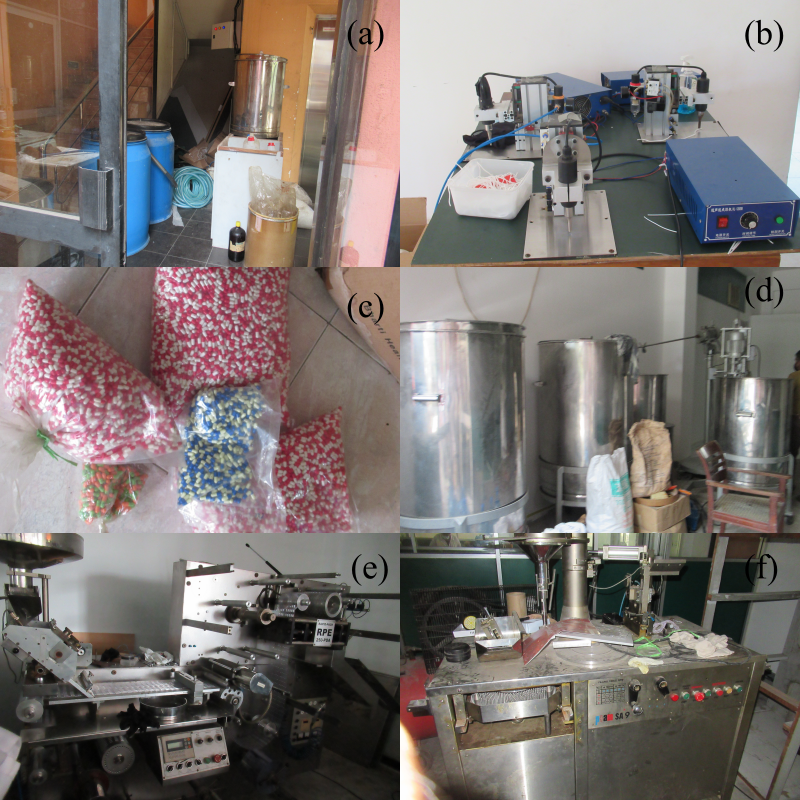
In April 2023, a six storied building, situated in a densely populated area in Colombo, Sri Lanka was apprehended by officers of the Police Narcotic Bureau, suspecting it’s involvement in the clandestine manufacture of illegal drugs. The individual in custody has rented out four floors of the building (ground to third floor) for the manufacturing process of drugs. Following a report to the courts, the magistrate of the area instructed the Government Analyst of Sri Lanka to conduct a thorough investigation of the apprehended building. A team of Forensic analysts from GAD visited the site and observed a range of materials including chemicals, machinery, machinery components, plastic containers, chemical glassware, balances, various coloured powders and differently coloured empty capsules stored within the premises. The forensic analysts inspected the equipment and chemicals, carried out preliminary and screening tests on- site and collected samples for further analysis in the laboratory.
The screening test conducted with the hand-held Raman analyser revealed the presence of tramadol in the samples collected from the site. Further analysis was performed utilizing the Gas Chromatography – Mass Spectroscopy (GCMS) technique (Figure 1).
Methodology
Chemicals and Reagents
Methanol (AR) was obtained from VWR PROLABO chemicals, France. Chloroform (AR) was purchased from Sisco research laboratory, India. Ammonium hydroxide (AR) and Hydrochloric acid (AR) were purchased from Loba chemie Ltd, India. Diethyl ether was purchased from Techno Pharmchem, India.
Handheld Raman Spectroscopy
Rigaku Progeny ResQ handheld Raman analyser was used to identify the compounds in the unknown samples in the site of clandestine laboratory.
GC-MS Analysis
Presence of pharmaceutical drugs in the samples collected from clandestine laboratory was confirmed using Agilent 7890 A Gas Chromatograph equipped with a 5975C Mass Spectrometer (GC-MS).
GC Conditions
HP 5 MS (5% phenyl methyl siloxane) column (30 m x 0.250 mm x 0.25µm) was used. Carrier gas was Helium with a flow of 0.6 mL/min, and injection mode was split less. Initial temperature was 90°C and held for 2 minutes. Then temperature was increased from 90°C to 300°C at 14°C/ min ramp and held for 10 minutes. The total run time is 27 minutes. Data analysis was done using the Agilent MSD Chemstation software.
MS Conditions
Solvent delay 3 minutes, low mass 50 and high mass was 550.
Sample Preparation For GCMS
10 milligrams of the sample was dissolved in 10 mL of methanol to get a solution of 1mg/mL concentration and this was injected to GCMS. When satisfactory chromatographic separation was not achieved, the samples were extracted according to the following procedure and injected to GCMS.
10 milligrams of the sample was dissolved in 10 mL of water and acidified with 1 mL of concentrated hydrochloric acid. This solution was heated for 30 minutes in a water bath. The solution was filtered and the filtrate was extracted into diethyl ether. The remaining aqueous layer was made basic with ammonia and was extracted with chloroform. Both the diethyl ether fraction and chloroform fraction were injected to GCMS.
Results and Discussion
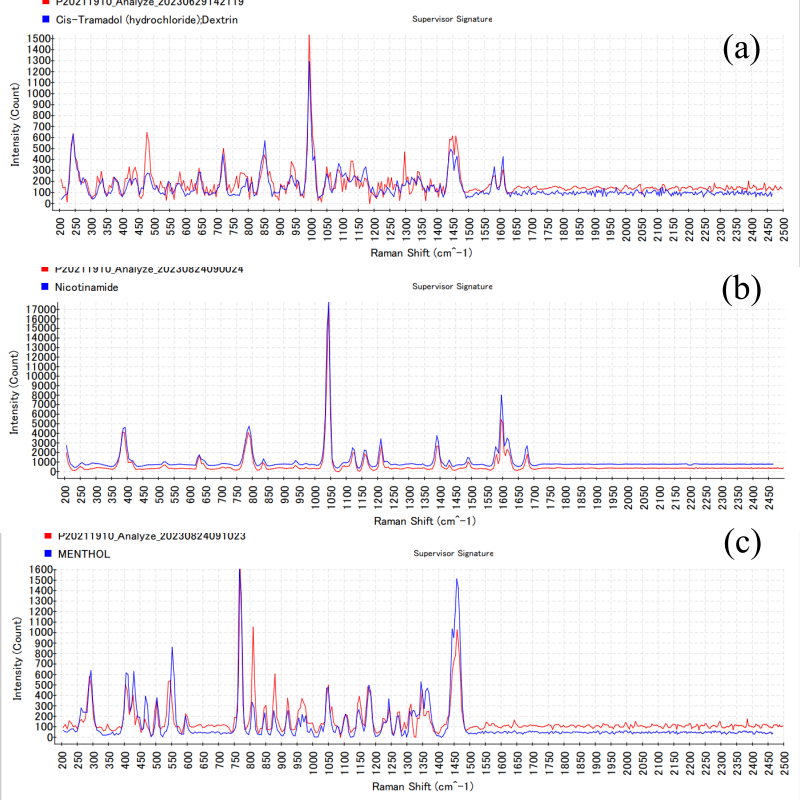
Raman Spectroscopy results revealed the presence of tramadol in the white powder in the green-coloured capsules and powder spilled over a machine in first floor, menthol in a white crystalline substance stored in a plastic bag and nicotinamide in an off-white powder stored in a plastic container (Figure 2).
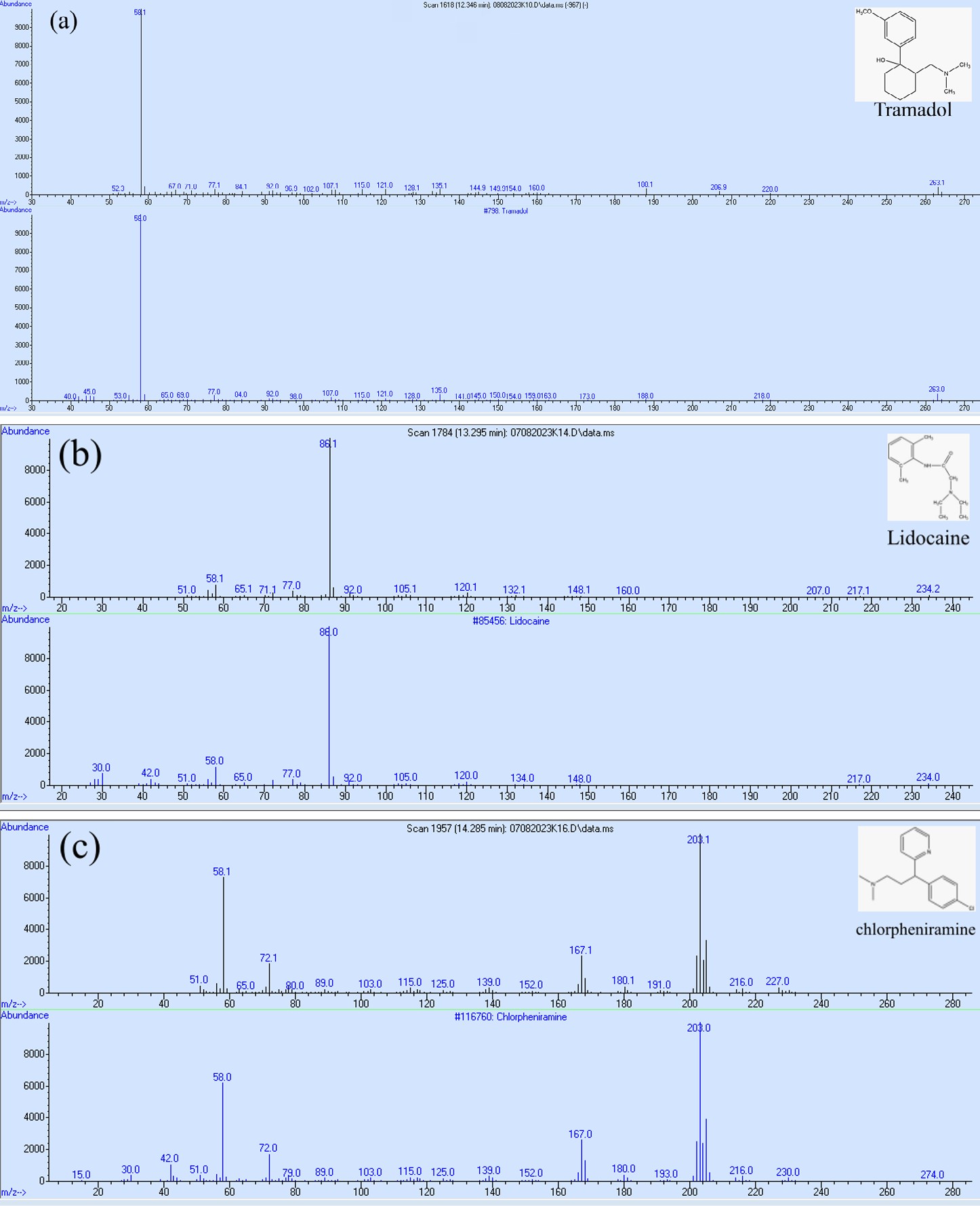
Presence of Tramadol, Lidocaine, Chlorphenamine, Nicotinamide and Menthol in the samples collected from the site was confirmed by the GCMS analysis.
The retention time for tramadol in the Total Ion Chromatogram (TIC) was 12.354 minutes. Characteristic mass peaks with m/z values of 58, 263, 135 and 188 were identified in both the mass spectrum of the sample and the library search result, confirming the presence of tramadol (Figure 3a).
The retention time for lidocaine in the TIC was 13.300 minutes. The mass peaks m/z at 86, 58, 120, 217 and 234, characteristic for lidocaine were observed in the sample (Figure 3b).
The retention time for Chlorphenamine in TIC was 14.258 minutes. Characteristic mass peaks with m/z values of 58, 72, 167, 203 and 216 were identified in both the mass spectrum of the sample and the library search result, confirming the presence of chlorphenamine (Figure 3c).
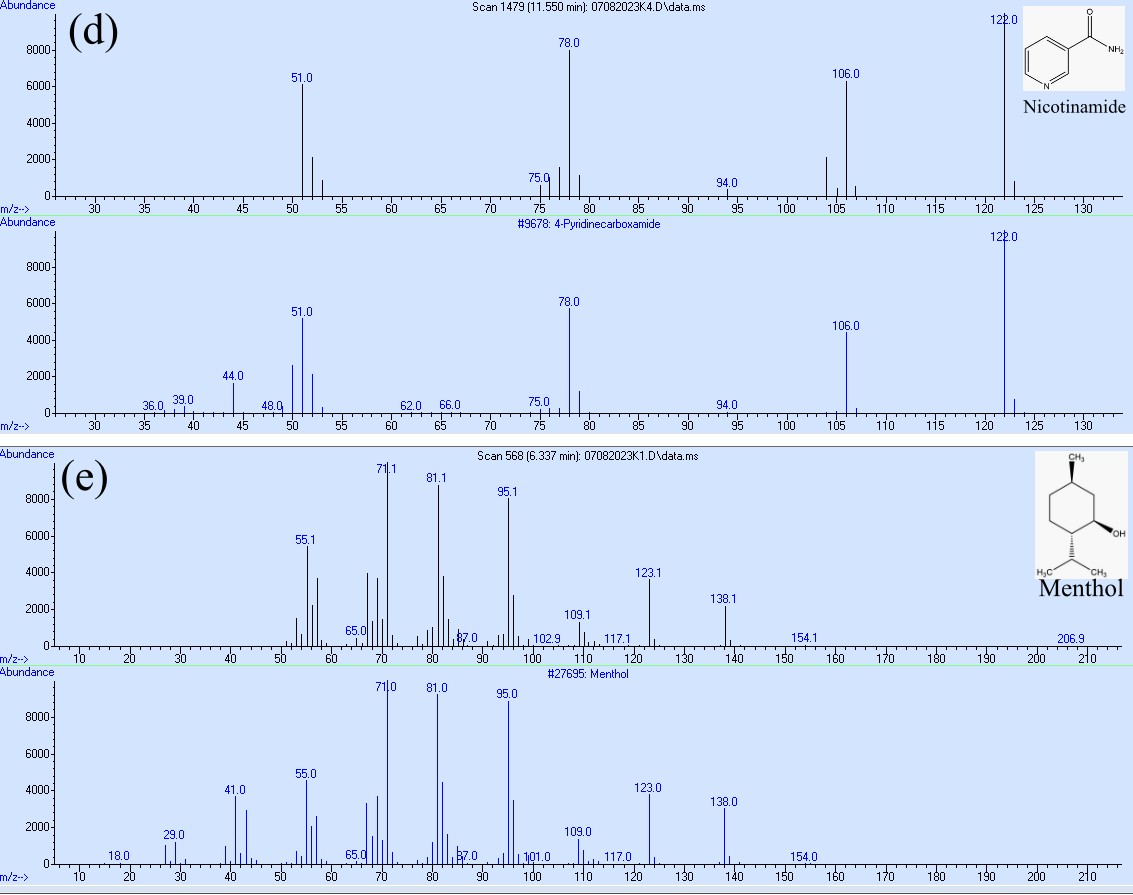
Nicotinamide has a retention time at 11.550 minutes and mass peaks m/z at 51, 78, 94, 106 and 122. The library search results matched with that of the sample, confirming the presence of Nicotinamide (Figure 3d).
Menthol has a retention time at 6.333 minutes with characteristic mass peaks m/z at 55,71,81,95,109,123 and 138. The library search results aligned with that of the sample, confirming the presence of menthol (Figure 3e).
Tramadol is a synthetic opioid analgesic used to manage moderate to moderately severe pain [5].
However, non-medical use of tramadol has become a global problem. The incidence of tramadol related deaths and tramadol overdosing has notably risen over the past 10-15 years [6]. In the last decade, Sri Lanka has witnessed the abuse of tramadol, prompting its classification as a controlled drug under the “Poison, Opium and Dangerous Drugs “Ordinance, starting from November 2022.
Lidocaine is a local anesthetic which is commonly used for various medical procedures, including dental work, minor surgeries and certain diagnostic tests [7, 8]. Limited records are available regarding lidocaine misuse or overdoses, but existing data suggests that lidocaine can lead to toxicity when used frequently or inappropriately [9, 10].
Chlorphenamine is a first-generation antihistamine that is commonly used to relieve symptoms associated with allergic conditions, such as hay fever, allergic rhinitis and hives [11]. Adverse effects of the drug include sedation, nausea and vomiting, and diarrhea or constipation [12]. Acute chlorphenamine poisoning case has also been reported due to higher oral dose of the drug [13].
Natural menthol is isolated from the plant Mentha canadensis and is also synthesized on a large scale [14]. This compound is generally considered safe, and toxic effects and overdoses are rarely reported [14]. However, a case study has documented fatal menthol toxicity following acute exposure to menthol vapor [15]. In Sri Lanka, menthol has been found to be abused to adulterate methamphetamine, primarily due to its similar physical appearance to ice-like structures.
Nicotinamide is a form of Vitamin B3 and primarily used to treat the nutritional niacin deficiency [16]. However, abuse or overdose may lead to side effects, including skin irritation, flushing, nausea, itching, headache, vomiting and epigastric pain [17]. While cases of niacin toxicity have been reported, they are typically non-fatal [17, 18, 19, 20].
Conclusion
Forensic analysts have offered effective support to the law enforcement officials during this investigation of illicit manufacture of pharmaceutical drugs. Portable Raman Analyser proved to be an effective instrument for identifying drugs in the field. GCMS analysis confirmed the types of pharmaceutical drugs present in the samples collected from the site.
This discovery of illicit drug manufacturing laboratory raises concerns about potential public health risks associated with the production of counterfeit drugs or the misuse of legitimate pharmaceutical ingredients. The relevant authorities are expected to take further actions, including potential arrests, prosecutions and regulatory measures to enhance oversight and prevent such illicit activities in the future.
References
-
Durrant C (2001) The responsibility of Pharmaceutical Industry. Clinical microbiology and Infections 7(6): 2-4.
-
Andrews C (2021) Illicit pharmaceutical Industry and its impact on Public Health. UAB Institute of Human Rights Blog.
-
Frank RS, Sobol SP (1990) Clandestine Drug Manufacturing Laboratories. Forensic Science Progress 4: 1-23.
-
Blumstein A (1995) Youth Violence, Guns, and the Illicit- Drug Industry. Journal of Criminal Law and Criminology 86(1): 10-36.
-
(2017) Conference room paper on the non-medical use and abuse, the illicit manufacture and the illicit domestic and international distribution of tramadol. Commission on Narcotic Drugs, 60th session, Item 8, Vienna, Austria.
-
Elhabiby M (2015) Non-medical use of Synthetic Opioids Highlighting Tramadol. National Drug Survey in Egypt, Egypt, pp: 1-32.
-
(2022) Lidocaine (Rx). Medscape.
-
Beecham GB, Nessel TA, Goyal A (2022) Lidocaine. StatPearls Publishing, Tampa, Florida, United States.
-
Yamashita S, Sato S, Kakiuchi Y, Miyabe M, Yamaguchi H (2002) Lidocaine Toxicity During Frequent Viscous Lidocaine Use for Painful Tongue Ulcer. Journal of Pain and Symptom Management 24(5): 543-545.
-
Centini F, Fiore C, Riezzo I, Rossi G, Fineschi V (2007) Suicide due to oral ingestion of lidocaine: a case report and review of the literature. Forensic Science International 171(1): 57-62.
-
(2022) Chlorpheniramine (Rx). Medscape.
-
Minigh J (2008) Chlorpheniramine. XPharm: The Comprehensive Pharmacology reference pp: 1-6.
-
Guo Q, Lin H, Lin J (2022) Chlorpheniramine poisoning as a potential cause of rhabdomyolysis. American Journal of Emergency Medicine 57: 236e1-236e3.
-
Kamatou GPP, Vermaak I, Viljoen AM, Lawrence BM (2013) Menthol: A simple monoterpene with remarkable biological properties. Phytochemistry 96: 15-25.
-
Kumar A, Bartha U, Aggarwal P, Nayar J (2016) A fatal case of menthol poisoning. International Journal of Applied Basic Medical Research 6(2): 137-139.
-
Niacinamide- uses, side effects and more. WebMD.
-
Habibe MN, Kella JZ (2023) Niacin Toxicity. StatPearls Publishing, Tampa, Florida, United States.
-
(2022) World Drug Report 2022. United Nations Office on Drugs and Crime. New York, United Nations.
-
Ripanda AS, Rwiza MJ, Nyanza EC, Machunda RL, Vuai SH (2022) Contribution of Illicit Drug Use to Pharmaceutical Load in the Environment: A Focus on Sub-Saharan Africa. Journal of Environmental and Public Health pp: 1-13.
-
Conca AJ, Worthen DR (2012) Nonprescription Drug Abuse. Journal of Pharmacy Practice 25(1): 13-21.
- Forensic Implications of Adverse Drug Reactions in Schizophrenia A Case Series
- Narcotics and Digital Forensics: Bridging Crimes in the Digital Age
- Ethics in Forensic Psychiatry: Principles, Dilemmas, and Human Rights
- Impact of Acute Stress on Attentional Orienting to Social Cues
- Head Injury and Intracranial Hemorrhage in Western Region of Libya
- A Forensic Study on Handedness: Examination of Handwriting Features in Right and Left Handed Writers