
Heroin Smuggling-Ingenious Techniques-A Case Study on the Development of a Suitable Extraction Procedure for Identification and Quantification of Heroin Impregnated in Rubber Carpets
The method of impregnation of heroin into some material is a very crafty modus operandi deployed by the drug smugglers globally. The complicated nature of this method makes it extremely challenging for the boarder protection authorities as well as the forensic scientists to apprehend and identify the contraband. A case of heroin impregnated into the fabric bath towels was received by Government Analyst’s Department (GAD) of Sri Lanka in 2010 which was successfully identified and quantified. Ten years after the first detection, the officers of the Police Narcotic Bureau (PNB) of Sri Lanka handed over a case with three heroin impregnated rubber carpets and powders of heroin sandwiched between rubber layers. This is the first time the Government Analyst’s Department of Sri Lanka received such a case after heroin impregnated towels.
Introduction
Drug trafficking is one of the most widespread and lucrative organized crime operation in the modern world. In the recent years methods used for illegal trafficking and transportation of drugs in the world has become more complex and complicated [1]. Drug traffickers often take the advantage of gaps and loopholes in preferential policies, regulations, procedures and management mechanism to commit offences. Drug traffickers always come up with more ingenious methods and use diversity of routes from a drug trafficking ring in order to illegally transport the drugs across the borders. They usually hide drugs in luggages dispatched by air and sea. Further they also use body packers [2].
Heroin is smuggled into Sri Lanka using various methods through courier service providers, sea cargo as well as personal baggage. A huge array of concealment methods were used, including those that require chemical extraction in the laboratory.
Diacetylmorphine (DAM), or heroin, is a highly addictive opioid derived from morphine. Originally developed for medical purposes, its illicit use has drastically increased, contributing to a global public health crisis. Despite the threat associated with its abuse, understanding the drug is crucial in addressing the issues surrounding its use. Use of heroin poses severe risks to both physical and mental health. Short-term effects include euphoria, pain relief, and sedation, while long-term use can lead to devastating consequences such as collapsed veins, respiratory failure, and increased susceptibility to infectious diseases. Moreover, heroin addiction can shatter relationships, hinder employment prospects, and drive individuals to engage in criminal activities to sustain their habits [3, 4].
Case Details
Case I
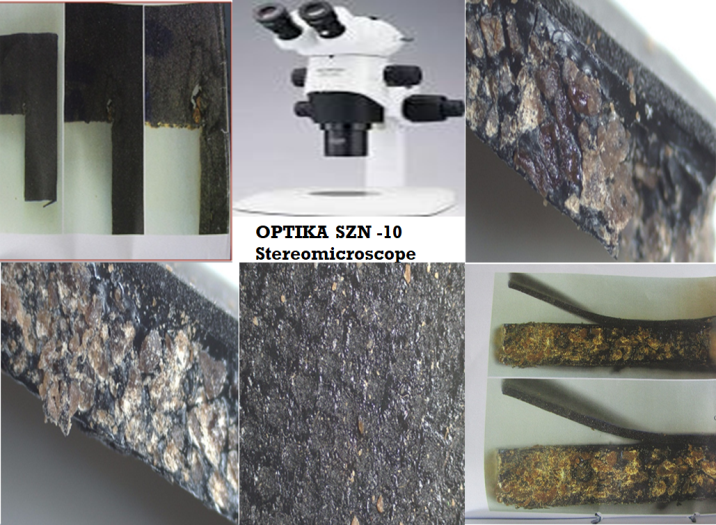
This case was detected by the officers of the Police Narcotic Bureau (PNB) of Sri Lanka, where a Pakistani person carrying a traveling bag was arrested based on information at the Katunayake Bandaranayke International Airport. When the bag was examined, carpets with impregnated heroin concealed in a bag were found and the items were handed over to the Government Analyst’s Department for further examination (Figure 1).
Case II
The Officers of PNB arrested a suspect based on information received, at the Wellawatta in Sri Lanka with a traveling bag concealing carpets with impregnated heroin in false pockets of the bag.
Chemicals and Reagents
Methanol (AR) was obtained from VWR PROLABO chemicals, France. Chloroform (AR) was purchased from Sisco research laboratory, India. Ammonium hydroxide (AR), Hydrochloric acid (AR) Cyclohexane (AR) and diethyl amine (AR) were purchased from Loba chemie Ltd, India. Chemicals, India. Platinic chloride (AR) Acetaldehyde (AR) and 2,2,2-Triphenylacetaphenone were obtained from Sigma Aldrich, USA. Potassium Iodide (AR) was obtained from Research Lab Fine Chem Industries, India. The Certified reference Material (CRM) of Diacetylmorphine (Heroin) was purchased from Lipomed, Switzerland.
Instruments and Equipments
Analytical balance (Mettler, AE 100, Poland) was used for necessary weighing procedures while Millipore filters (Nylon, 0.45 µm, Agilent Technologies, USA) were used to filter sample solutions. Digital vortex mixer (VELP, Scientifica) was used during the sample preparation to mix the solutions. SILICA 60 F- 254 plates (20 cm x 20 cm with 0.25 mm film thickness) for Thin Layer Chromatography (TLC) were purchased from Merck, Germany. FTIR spectrophotometer (Thermo Scientific Nicolet IS10), Optika SZN-10 Stereomicroscope, GC-MS (Agilent technologies 7890 N gas chromatograph with 5975C mass spectrometer) were used for qualitative analysis.
Extraction Procedure
Three carpets of the case 01 were marked as K-01, K-02, and K-03 respectively and the carpets of the case 02 were marked as A, B, and C respectively. The weight of each carpet was measured prior to analysis.
Pieces of carpet from each item was taken for the presumptive tests due to the difficulty of extracting the whole carpet. Pieces of carpets were taken randomly for the extraction of the drug. Suitable solvent for the extraction of substance was checked by using methanol, chloroform and acetonitrile.
Nine patches with same dimension (2.5x2.5cm2) were cut from each K01, K02 and K03 carpets. These nine patches cut from K01 are categorized into 03 groups having 03 pieces for each group and weight taken separately for each group. Then rubber pieces in each group was cut into smaller pieces and put into 03 separate conical flasks and extracted for one hour. The same procedure was followed for K02 and K03 making the total nine sets of patches. The extraction was repeated for five times using 25 ml aliquots of extracting solvents. The combined extracts were transferred to pre-weighed glass crucibles and solvent was evaporated to dryness on a water bath until a constant weight was obtained. Thereafter the evaporated samples were left in the desiccator for few hours. Then the weight was taken for each group.
Extracted substance from each carpet was subjected to presumptive colour test, TLC, GC-MS, FTIR and GC-FID.
Presumptive Test
Presumptive colour test (Marquis Test) for heroin (DAM) was performed to the pieces of carpets as well as for the extracted substance.
TLC
TLC was performed as the screening technique to identify the presence of DAM. The extracted substance along with primary reference samples of DAM were spotted on the TLC plates and developed in the solvent system of methanol and ammonia in 100:1.5 ratios. Acidified potassium iodoplatinate was prepared by dissolving 0.25 grams of platinic chloride and 5 grams of potassium iodide in 100 ml of water and then adding 5 ml of concentrated hydrochloric acid. This reagent was sprayed on the TLC plates to visualize the spots and retardation factor (RF) was calculated for the samples and the standards.
FTIR
Presence of DAM was confirmed using the Thermo Scientific Nicolet iS10 FTIR.
GC-MS Analysis
Presence of DAM was confirmed using the Agilent 7890 Gas Chromatograph equipped with a 5975C Mass Spectrometer (GC-MS). HP 5 (5% phenyl methyl siloxane) column with dimensions 30 m x 0.250 mm x 0.25µm was used. Carrier gas was helium with a flow of 0.6 ml/ min. Splitless injection mode was used for the injection volume of 1 µl. Injector temperature was set to 280°C. Oven temperature programme was set starting from 90°C and held for 2 minutes. Then temperature was increased from 90°C to 300°C at 14°C/ min ramp and held for 10 minutes. The total run time was 27 minutes. Data analysis of the samples and standards were done using the Agilent MSD Chemstation software. Solvent delay was set to 3 minutes.
Extracted substance from each carpet was dissolved in methanol and diluted samples were injected along with the standard solution of diacetylmorphine CRM to the GCMS. The mass spectrums obtained for the extracted substance were compared with that of diacetylmorphine CRM.
GC-FID Conditions
HP 5 (5% phenyl methyl siloxane) column (30m x 0.250mm x 0.25µm) was used. Nitrogen was used as the carrier gas with a flow rate of 1.5 ml/min and a split ratio of 20:1 was used for the injection volume of 1 µl. Injector temperature was set to 250°C. Initial oven temperature was 200°C and held for 2 minutes. Then temperature was increased from 200°C to 280°C for 9 minutes. The total run time was 10.0 minutes. Detector temperature was 300°C.
Preparation of Standard Series of DAM
A stock solution of diacetylmorphine (1.0 mg/ml) was prepared using 2,2,2-Triphenylacetaphenone as the internal standard. Calibration curve was constructed using the diacetylmorphine standard series of 0.1 mg/ml, 0.2 mg/ml, 0.4 mg/ml, 0.6 mg/ml, 0.8 mg/ml and 1.0 mg/ml. Known weight of extracted substance from each carpet was dissolved in 25 ml of the solvent mixture consisting of the internal standard. Then 100 µl was taken out from the volumetric flask and diluted into 10 ml. These samples were injected to GC-FID and purity of diacetylmorphine was calculated using the constructed calibration curve.
Results and Discussion
According to the visual and physical examinations it was observed that the thickness of the carpets were more or less equal, and thereby, random patches of the carpets were taken for analysis assuming that the drugs were equally distributed within the layers of carpets.
Table 1 illustrates the variation of the percentage extracted in selected solvents chloroform, methanol and acetonitrile. According to the results obtained for the case 01, it is revealed that the best solvent for the extraction of DAM in rubber carpets was Chloroform. Therefore chloroform was the best solvent for the extraction of DAM from the carpets in the case 01. Therefore extraction procedure of the case 02 was carried out using chloroform as the solvent.
| Number of carpet patches | Weight of the patch taken for extraction/g | Weight of the substance extracted/g | Percentage Yield of substance Extracted (% extracted) | ||||||
|---|---|---|---|---|---|---|---|---|---|
| Chloroform | Methanol | Acetonitrile | Chloroform | Methanol | Acetonitrile | Chloroform | Methanol | Acetonitrile | |
| K01-1 | 7.7667 | 7.5368 | 7.9849 | 5.2031 | 3.715 | 2.8725 | 66.99 | 49.29 | 35.97 |
| K01-2 | 7.6847 | 7.4125 | 7.762 | 5.1233 | 3.6741 | 2.7693 | 66.67 | 49.57 | 35.68 |
| K01-3 | 7.9487 | 7.6611 | 7.9073 | 5.2743 | 3.7629 | 2.9584 | 66.35 | 49.12 | 37.41 |
| K02-1 | 7.365 | 7.1788 | 7.3989 | 4.5034 | 3.0214 | 2.0418 | 61.15 | 42.09 | 27.59 |
| K02-2 | 7.2561 | 7.2088 | 7.2062 | 4.4439 | 2.9851 | 1.9834 | 61.24 | 41.41 | 27.52 |
| K02-3 | 7.4739 | 7.2135 | 7.2385 | 4.5569 | 3.0979 | 1.925 | 60.97 | 42.93 | 26.59 |
| K03-1 | 7.5298 | 7.8162 | 7.3989 | 4.4949 | 2.984 | 1.925 | 59.7 | 38.18 | 26.02 |
| K03-2 | 7.5062 | 7.6859 | 7.4213 | 4.4278 | 2.8046 | 1.9302 | 58.99 | 36.49 | 26.09 |
| K03-3 | 7.5315 | 7.6298 | 7.3285 | 4.5088 | 2.7911 | 1.9122 | 59.87 | 36.58 | 26.09 |
Table 1: Percentage Extracted (by Weight) of Substance in Chloroform, Methanol and Acetonitrile for the Case 01.
| Weight of the patch taken for extraction/g (Chloroform) | Weight of the substance extracted/g (Chloroform) | Percentage Yield of substance Extracted (% extracted)(Chloroform) | |
|---|---|---|---|
| A-1 | 12.8667 | 5.203 | 40.438 |
| A-2 | 12.365 | 5.02 | 40.598 |
| A-3 | 12.5298 | 5.162 | 41.197 |
| B-1 | 11.365 | 4.332 | 38.117 |
| B-2 | 11.1788 | 4.316 | 38.609 |
| B-3 | 11.8162 | 4.478 | 37.897 |
| C-1 | 11.5298 | 4.416 | 38.301 |
| C-2 | 11.8162 | 4.504 | 38.117 |
| C-3 | 10.6919 | 4.132 | 38.646 |
Table 2: Percentage Extracted (by Weight) of Substance in Chloroform for Case 02.
Presence of DAM in extracted substance was qualitatively identified by marquis test and TLC, while further confirmed by FTIR and GC-MS. In the marquis test, development of a purple colour indicated the presence of an opium alkaloid in the extracted substance from all carpets. The Retardation factor for the TLC 0.54 was obtained for the methanol, ammonia solvent system and 0.39 was obtained for the Cyclohexane, Chloroform and Diethyl amine solvent system with the DAM standard and that of the extracted substance (Figure 2).
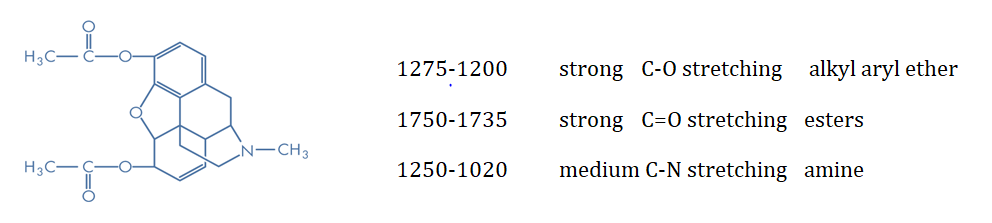
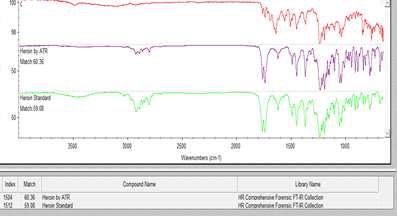
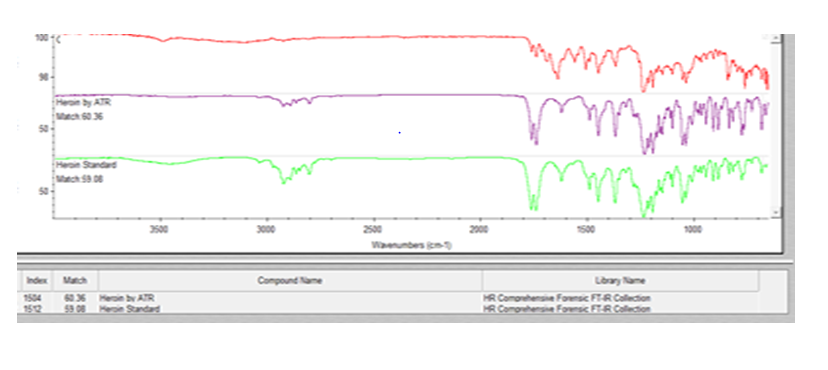
The FTIR results illustrate in the Figure 3 & Figure 4 confirmed the presence of DAM in the extracted substance from the carpets.
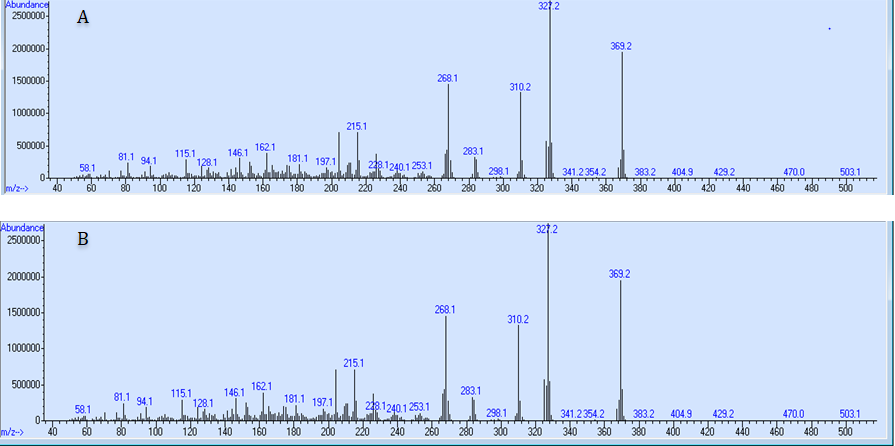
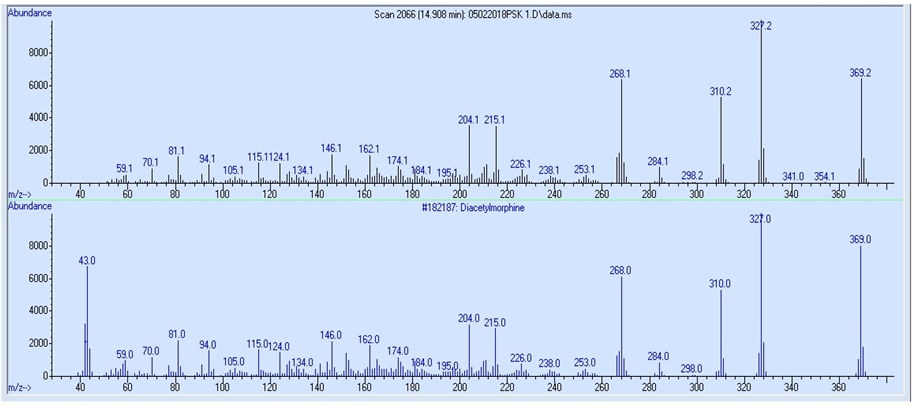
The GC-MS results confirmed the presence of DAM with respect to standard DAM, in all the extracted substances. The mass peaks m/z at 327, 268, 310, 215, 204, 162 and 369 (base peak) which are characteristic for DAM molecule were observed in the mass spectrums for the samples.
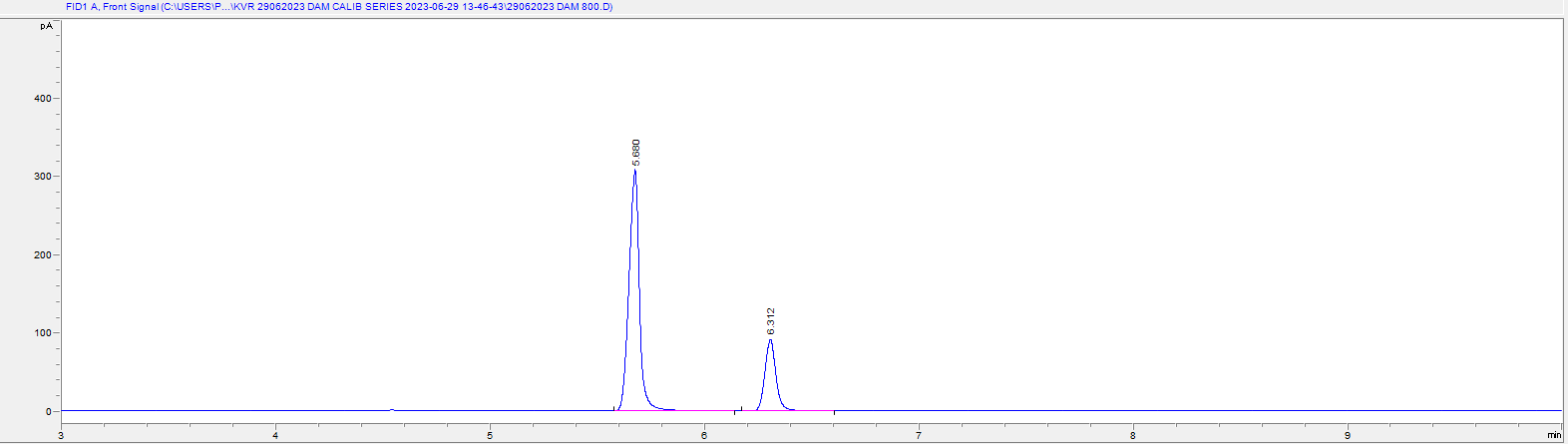
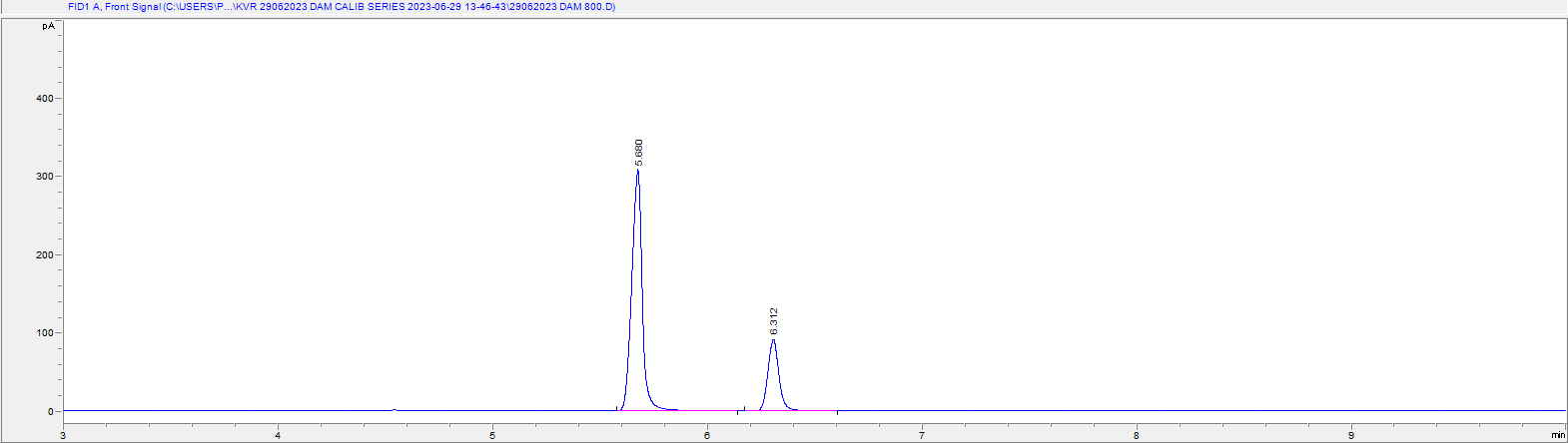
The chromatographic peak at the retention time of 5.68 minutes for the standard DAM in the GC-FID, also appeared in the extracted samples. This confirmed the presence of DAM in the extracted substances from all the carpets.
Calibration curve with 0.998 coefficient of regression (r2) was utilized for the quantification of purity of DAM in the extracted substance in to chloroform. The percentages of DAM in the extracted substance from each carpet are given in the Table 3.
Formula for the calculation of the percentage of heroin using GC –FID is given below;
$$ \% \mathrm {o f} D A M = \left(\frac {A \times V \times D i a l u t i o n f a c t o r \times P}{M \times 1 0 0}\right) $$
A-Concentration of DAM from the calibration plot (mg/ml)
M-Weight of the sample taken from extracted sample for
analysis (mg)
V-Volume of the dissolved sample (ml)
P-Purity of the standard (CRM)
| Carpet Number | Case 01 | Case 02 | ||||
|---|---|---|---|---|---|---|
| K-01 | K-02 | K-03 | A | B | C | |
| %of DAM in the extracted substance | 65.8 | 61.8 | 63.6 | 25.8 | 22 | 22.4 |
Table 3: Percentage of DAM in the Extracted Substances in Each Carpet in the Case 01 and 02.
The purity of DAM quantified using a validated method for the quantification of heroin. The percentages of DAM in the extracted substance in the case 01 vary from 61.76% to 65.77%. These results indicate that the same substance containing DAM has been impregnated to the carpets in case 01. Similarly, the percentages of DAM in the extracted substance in the case 02 vary from 22.40% to 25.83% indicates a separate substance containing DAM has been impregnated to the carpets in case 02.
Weights of pure heroin impregnated in each carpet were calculated separately and tabulated in the table 04. It can be clearly seen that the impregnation was done effectively in the case 01 when compared to case 02. This may be due to the variability of the carpet material or the technique used for impregnation. Additionally the values indicate impregnation method is an effective method of drug smuggling [5, 6, 7].
| Carpet Number | Weight of the carpet/g | Average % of impregnated substance | % purity of heroin | Weight of pure heroin/g |
|---|---|---|---|---|
| K 01 | 554 | 66.67 | 65.77 | 243 |
| K 02 | 542 | 61.12 | 61.76 | 205 |
| K 03 | 244 | 59.52 | 63.56 | 92 |
| Total in case 01 | 1340 | 540 | ||
| A | 3742 | 40.74 | 25.83 | 394 |
| B | 856 | 38.21 | 22.4 | 73 |
| C | 880 | 38.35 | 22.44 | 76 |
| Total in case 02 | 5478 | 543 |
Table 4: Weights of Pure Heroin Impregnated in Each Carpet.
Conclusion
According to the results it can be concluded that, in cases where Heroin impregnated carpets are considered that the best extraction solvent is Chloroform. Further, marquis Test & TLC could be used as screening tests while GC-MS and FTIR can be used for the confirmation. The used validated GC-FID method is suitable for quantitative analysis of Heroin. Therefore this case study follows a simple and accurate procedure which can be applied for the identification and quantification of Heroin where the drug is smuggled using impregnation into any substance.
References
-
Donnermeyer JF (2015) International Encyclopedia of the Social & Behavioral Sciences In: 2nd (Edn.), Oxford: Elsevier, USA, 11: 695-702.
-
(1998) Recommended methods for testing opium, morphine and heroin. United Nations International Drug Control Programme, United Nations, pp: 1-82.
-
Sen S (1991) Heroin Trafficking in the Golden Triangle. Police Journal 64(3): 241-248.
-
UNODC (2022) International narcotics control board report 2021. Vienna: USA.
-
Ali EMA, Edwards HGM, Hargreaves MD, Scowen IJ (2010) In Situ detection of cocaine hydrochloride in clothing impregnated with the drug using benchtop and portable Raman spectroscopy. Journal of Raman spectroscopy 41(9): 938-943.
-
McDermott SD, Power JD (2005) Drug smuggling using clothing impregnated with cocaine. Journal of Forensic science 50(6): 1423-1425.
-
Moffat AC, Osselton MD, Widdop B, Watts J (2011) Clarke’s Analysis of Drugs and Poisons: in pharmaceuticals, body fluids and postmortem material. In: 4th (Edn.), Pharmaceutical Press, London, UK.
- Forensic Implications of Adverse Drug Reactions in Schizophrenia A Case Series
- Narcotics and Digital Forensics: Bridging Crimes in the Digital Age
- Ethics in Forensic Psychiatry: Principles, Dilemmas, and Human Rights
- Impact of Acute Stress on Attentional Orienting to Social Cues
- Head Injury and Intracranial Hemorrhage in Western Region of Libya
- A Forensic Study on Handedness: Examination of Handwriting Features in Right and Left Handed Writers