
Exploring Forensic Challenges and Insights: Implications of Genetic Analyses on Degraded DNA Samples
Identifying missing persons from different types of body parts poses an intricate challenge for law enforcement and forensic experts. Identification through human remains is challenging when the available body parts don't contain distinctive features, commonly used for anthropological analysis. The complexities arise from the fragmentation of remains and difficulties in obtaining viable biological samples due to decomposition and expose to other factors enhancing degradation. The absence of personal information and known reference samples for familial identification further amplifies the complexities in the process. When dealing with different types of human remains and lacking additional information of those missing individuals, the analysis centered on DNA as the most dependable and potentially definitive method for identification. In such scenario, it is imperative to select ideal tissue among different tissue types for DNA extraction followed by optimized DNA extraction protocols and STR amplification kits with different markers to achieve consistent DNA profiling in identification purposes.
Introduction
Identifying victims is a fundamental step in resolving a criminal case, and it becomes particularly challenging when the remains are badly decomposed or skeletonized. Utilizing multidisciplinary techniques, including anthropology, may not be as effective in identification because bone samples in human remains lack prominent morphological features [1, 2]. Visual and traditional presumptive methods of identification typically involve the examination of remains by relatives or associates of the missing person. However these methods should be exclusively relied upon for identification when the bodies are intact, without decomposition or mutilation. On the other hand the risk becomes more significant on these presumptive methods when the number of deceased individuals increased [3]. Criminals may engage in the mutilation and employ diverse methods of a dead body to remove any identifiable features.
This destructive behavior is intended to eliminate all traces that could be used for identification purpose [4].
All these common factors coupled with the absence of reference material, make difficulty for authorities to determine the identity of the deceased individual, creating challenges in the investigation process. As of our current knowledge, there are no standardized guidelines for such incident and analysis based on DNA as a primary identifier [5].
The current best practice following in the DNA laboratory in government Analyst’s Department for human remains identification from damaged and degraded samples involves employing optimized methods for various tissue types. This involves using different extraction methods for different tissue types, expanded STR markers to enhance resolution and integrating lineage markers for specific applications. The varied methods for extraction and amplification provide more precise and effective approach in current investigations. However, we stay updated with the latest technologies and protocols to address challenges, especially in situations involving degraded human remains.
The article details three case studies in which human remains sent to the Government Analyst’s Department
for identification of missing individuals. In all three cases, samples were retrieved from decomposed human remains by judicial medical officers and produced to Government Analyst’s Department by police through court order. Relatives of missing persons were produced to the department in accordance with the court order to undergo blood collection.
Case Study-1
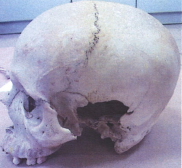
Body parts, showing signs of damages and partial decomposition, were discovered in two distinct locations within proximity of nearly 1 kilometer, in Western Province in Sri Lanka, all within the duration of one week. Notably, there have been no reports of missing persons from public corresponding to these remains. In first location, a partially decomposed body lacking both head and limbs was found. Piece of bone sample and muscle sample was recovered. In the second location, partially decomposed lower limb was uncovered, and muscle sample was recovered.
Figure 1 and Figure 2 represents images of human remains discovered in two locations Piece of bone Sample of muscle Figure 1: The Piece of Bone and Muscle Sample Recovered from Decomposed Body (Case Study-1, Location 1)
Case Study-2
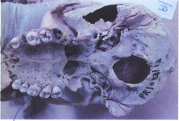
A man went missing in Colombo, Western Province in Sri Lanka. Mother is the sole close relative of the missing person and reported the disappearance to the police two days after the individual went missing. A person living close to the missing individual was arrested after about two years by the police following a comprehensive investigation. During questioning, the individual admitted of killing the missing person and burying the body in his garden. However, the person later removed the decayed skeletal remains from his garden and disposed them into nearby river, leaving only the skull with teeth accidentally at the burial site. Skull with teeth was produced for DNA identification. A blood sample from of missing person’s mother was submitted for identification purposes. Figure 3 represents images of human remains discovered in the garden of suspect.
Case Study-3
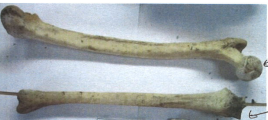
In a village near the jungle in North Province of Sri Lanka, a person was mysteriously disappeared, leaving no traces or clues. The only close relative, his father reported his son’s disappearance to the police. After several months, someone hunting in a jungle near the village accidentally found sample of bones. Two long bones were recovered by police and produced to DNA analysis. Blood sample of missing person’s father was produced for identification. Figure 4 represents images of human remains discovered in the jungle.
Materials and Methods
Sample Information
To eliminate potential contaminants and dirt, bone samples were subjected to surface scraping using a variable speed dental milling drill (Dermal, Racine, WI, USA). Following this, the samples underwent two-step cleaning process, washed twice with 10% sodium hypochlorite followed by two rinses with sterile water for 5 minutes each and allowed to air-dry overnight. Similar cleaning procedure followed for teeth recovered from the skull by surface scraping using a scalpel blade and cleaned with a bleach solution, followed by rinsing with sterile water and left to air-dry. Dried bone and teeth were placed in plastic containers and immersed with 0.5M EDTA pH 8.0. The containers were incubated on a shaking rotator at 56°C for duration of two weeks. After first week, the EDTA solution was replaced with an equal volume of fresh 0.5M EDTA solution. After two-week incubation period, the samples were washed with distilled water and dried using blotting papers. Following this, the dried samples were finely cut into small pieces for DNA extraction.
The muscle samples were cleaned to remove visible foreign materials from their surfaces by trimming with sterile forceps. Subsequently, the samples were subjected to washing procedure with sterile water at 56°C for 15 minutes under shaking conditions, followed by 3 minutes wash with 70% ethanol.
DNA Analysis
Muscle samples, finely cut bone and teeth (approximately 2 grams) and reference blood samples were subjected to extraction using QIAmp DNA Investigator kit (Qiagen) following optimized extraction protocol for each sample type. DNA quantification was performed with Quantifier™ Human DNA Quantification Kit (Applied Biosystems, USA) according to manufacturer’s protocol. PCR Amplification was carried out with currently available multiplex STR typing kits: AmpFlSTR Identifiler Plus PCR Amplification Kit (Applied Biosystems, USA), PowerPlex® Fusion System (Promega Corp, Madison, WI, USA), PowerPlex® Y23 System (Promega Corp, Madison, WI, USA) and Qiagen, Investigator® Argus X-12 QS amplification kit. Separation of amplified PCR products was carried out on Genetic Analyser 3500 (Applied Biosystems, Life Technologies, Foster City, CA, USA) and analyzed with GeneMapper ID, version 3.2, from Applied Biosystems using standard procedures.
Results and Discussion
The primary objective in presenting these three case studies was to emphasize the significance of novel DNA identification methods in human remains identification and to highlight potential areas for future improvements in analyzing such challenging biological samples.
The quality and reliability of DNA testing is significantly influenced by setup of the DNA extraction laboratory. We consistently employ DNA-free chemicals and consumables while enforcing rigorous contamination control measures and assess all safety protocols. Through the development of advanced DNA extraction and typing procedures, currently we successfully conducted DNA analysis on these critical scenarios. However, in highly degraded or samples containing inhibitors, it is crucial to implement further improvements to ensure a more accurate identification on human remains.
The result of DNA profiles derived from human remains found in each location in case study-1 is summarized in the following Table 1.
| Loci | Sample of bone Location-1 | Sample of muscle Location-2 |
|---|---|---|
| D8S1179 | 12,14 | 11,14 |
| D21S11 | 28,30.2 | 29,30 |
| D7S820 | 10,10 | 11,11 |
| CSF1PO | 12,12 | 12,12 |
| D3S1358 | 18,18 | 15,16 |
| TH01 | 7,10 | 8,9 |
| D13S317 | 10,11 | 11,11 |
| D16S539 | 10,12 | 8,10 |
| D2S1338 | 18,23 | 16,21 |
| D19S433 | 14,14 | 12,15 |
| vWA | 17,19 | 15,19 |
| TPOX | 8,9 | 11,11 |
| D18S51 | 14,14 | 13,14 |
| D5S818 | 10,13 | 11,12 |
| FGA | 24,26 | 23,25 |
| Amel | X,Y | X,Y |
| Loci | Sample of teeth | Blood sample of Mother |
| D3S1358 | 14,15 | 14,17 |
| D1S1656 | 16,17 | 16,17 |
| D2S441 | 10,10 | 10,10 |
| D10S1248 | 11,16 | 11,14 |
| D13S317 | 9,12 | 11,12 |
| Penta E | 11,17 | 13,17 |
| D16S539 | 10,14 | 11,14 |
| D18S51 | 14,16 | 13,14 |
| D2S1338 | 19,21 | 18,19 |
| CSF1PO | 11,12 | 11,12 |
| Penta D | 9,9 | 9,13 |
| TH01 | 6,6 | 6,9 |
| vWA | 17,18 | 18,18 |
| D21S11 | 30,31.2 | 31.2,33.2 |
| D7S820 | 12,13 | 12,13 |
| D5S818 | 11,12 | 11,12 |
| TPOX | 9,12 | 9,12 |
| DYS391 | 10 | - |
| D8S1179 | 13,14 | 13,15 |
| D12S391 | 18,18 | 18,18 |
| D19S433 | 14,15 | 15,16.2 |
| FGA | 20,21 | 20,20 |
| D22S1045 | 15,16 | 11,16 |
| Amel | X,Y | X,X |
Table 1: The Identifiler Plus, DNA Profiles Details for Human Remains Found on Lacation-1 and Location-2 (Case Study-1).
According to results from two locations two different male persons were identified. The muscle sample obtained from location-1 not given positive results for none of the STR kits. This could be attributed to severe degradation or the presence of DNA inhibitors in the extracted DNA. Additional efforts to search for the missing individuals cannot be initiated as the family members have not reported the disappearance of each person.
The DNA profiles obtained from human remains discovered in the garden in Case Study-2 are presented in the following Table 2.
A complete DNA profile was not obtained for the skull and teeth when using the Identifier kit containing minimum quantity of DNA. Skull being thin and often exposed is more susceptible to DNA degradation compared to teeth. Hence, it’s imperative to understand the susceptibility of various skeletal elements to DNA degradation. This becomes effective when choosing skeletal elements that are less susceptible to degradation, like long bones, to enhance likelihood of obtaining viable DNA samples. However, complete DNA profile was obtained for teeth when using the PowerPlex Fusion kit. Hence, it can be assumed PowePlexFusion could be more suitable in scenario with low quantity of DNA, offering not only successful profiling but also demonstrating high discriminating power.
The profile details of teeth from missing person revealed, each marker shared allele with the mother’s genotype profile. The statistical analysis for maternal relationship was calculated using eDNA 2.3 softwear package, further revealed the relationship of the missing person with mother. The table below presents a Summary Matrix for the distribution of corresponding alleles along with the calculated probability value for both samples (Table 3).
| Summary Matrix | ||||||||
|---|---|---|---|---|---|---|---|---|
| System | Child | Mother | PI | Mutation Code | Pattern | Rule | ||
| D3S1358 | 14 | 15 | 14 | 17 | 8.8246 | /PQ/PR | 1/4P wher P equals .0283 | |
| D1S1656 | 16 | 17 | 16 | 17 | 5.3655 | /PQ/PQ | (P+Q)/4PQ where P equals .1150 and Q equals .0783 | |
| D2S441 | 10 | 10 | 3.2258 | /P/P | 1/P wher P equals .3100 | |||
| D10S1248 | 11 | 16 | 11 | 14 | 30.012 | /PQ/PR | 1/4P where P equals .0083 | |
| D13S317 | 9 | 12 | 11 | 12 | 1.25 | /PQ/QR | 1/4Q where Q equals .2000 | |
| penta E | 11 | 17 | 13 | 17 | 2.2727 | /PQ/QR | 1/4Q where Q equals .1100 | |
| D16S539 | 10 | 14 | 11 | 14 | 13.6388 | /PQ/QR | 1/4Q where Q equals .0183 | |
| D18S51 | 14 | 16 | 13 | 14 | 0.8108 | /PQ/PR | 1/4P wher P equals .3083 | |
| D2S1338 | 19 | 21 | 18 | 19 | 1.7045 | /PQ/PR | 1/4P wher P equals .1467 | |
| CSF1PO | 11 | 12 | 11 | 12 | 1.4923 | /PQ/PQ | (P+Q)/4PQ where P equals .29.0 and Q equals .3967 | |
| Penta D | 9 | 9 | 13 | 1.7857 | /P/PQ | 1/2P Where P equals .2800 | ||
| TH01 | 6 | 6 | 9 | 2.1126 | /P/PQ | 1/2P Where P equals .2367 | ||
| Vwa | 17 | 18 | 18 | 2.4793 | /PQ/P | 1/2Q Where Q equals .2017 | ||
| D21S11 | 30 | 31.2 | 31.2 | 33.2 | 2.2387 | /PQ/QR | 1/4Q where Q equals .1117 | |
| D7S820 | 12 | 13 | 12 | 13 | 11.4151 | /PQ/PQ | (P+Q)/4PQ where P equals .1767 and Q equals .0250 | |
| D5S818 | 11 | 12 | 11 | 12 | 1.5647 | /PQ/PQ | (P+Q)/4PQ where P equals .3533 and Q equals .2917 | |
| TPOX | 9 | 12 | 9 | 12 | 10.8162 | /PQ/PQ | (P+Q)/4PQ where P equals .1733 and Q equals .0267 | |
| D8S1179 | 13 | 14 | 13 | 15 | 1.8519 | /PQ/PR | 1/4P where P equals .1350 | |
| D19S433 | 14 | 15 | 15 | 16.2 | 0.25 | /PQ/QR | 1/4Q where Q equals 1.0000 | |
| FGA | 20 | 21 | 20 | 3.5714 | /PQ/P | 1/2P where P equals .1400 | ||
| D22S1045 | 15 | 16 | 11 | 16 | 1.8073 | /PQ/QR | 1/4Q where Q equals .1383 | |
| CRI POP = 4,428,132,371.8883 | ||||||||
| Probability = 99.9999% |
Table 2: The Summary Matrix for Allele Distribution of Human Remains of Teeth and Blood Sample of Mother (Case Study-2).
In order to find the maternal linage, the samples were analyzed with Investigator® Argus X-12 kit. The results are illustrated in the following Table 4.
| Loci | Sample of teeth | Blood sample of mother |
| DXS10103 | 16 | 16 |
| DXS8378 | 11 | 11 |
| DXS10101 | 34 | 34 |
| DXS10134 | 36 | 36 |
| DXS10074 | 16 | 16,19 |
| DXS7132 | 16 | 13,16 |
| DXS10135 | 20 | 20,25 |
| DXS7423 | 15 | 14,15 |
| DXS10148 | 32 | 27,32 |
| DXS10079 | 19 | 18,19 |
| HPRTB | 13 | 13,14 |
| DXS10146 | 21.1 | 18,25.1 |
| D21S11 | 30,31.2 | 31.2,33.2 |
| Amel | X,Y | X,X |
Table 3: The Investigator Argus X-12, DNA Profiles for Human Remains Found in the Garden and Reference Sample of Missing Person’s
X chromosome results further revealed the relationship between missing person with his mother.
The resulting DNA profiles from human remains discovered in the jungle in Case Study-3 are outlined in the following table.
| Loci | Sample of bone | Blood sample of father |
|---|---|---|
| D8S1179 | 9,16 | 14,16 |
| D21S11 | 30,32.2 | 30,31 |
| D7S820 | 7,12 | 12,12 |
| CSF1PO | 12,12 | 11,12 |
| D3S1358 | 16,16 | 14,16 |
| TH01 | 9,9 | 9,9 |
| D13S317 | 8,13 | 8,14 |
| D16S539 | 12,12 | 11,12 |
| D2S1338 | 16,23 | 16,25 |
| D19S433 | 13,14 | 14,14.2 |
| vWA | 17,18 | 18,18 |
| TPOX | 11,13 | 8,13 |
| D18S51 | 13,14 | 14,20 |
| D5S818 | 10,12 | 10,13 |
| FGA | 21,24.2 | 23,24.2 |
| Amel | X,Y | X,Y |
Table 4: The Identifiler plus DNA Profiles for Human Remains Found in the Jungle and Reference Sample of Missing Person’s Father
The profile details of bone sample from missing person indicated each marker shared allele with father’s DNA profile. The statistical analysis for paternal relationship further revealed the relationship between missing person with his father. The table below presents a Summary Matrix for the distribution of corresponding alleles along with the calculated probability value for both samples.
| Summary Matrix | ||||||||||
|---|---|---|---|---|---|---|---|---|---|---|
| System | Mother | Child | Alleged Father | PI | Mutation Code | Pattern | Rule | |||
| D8S1179 | 9 | 16 | 14 | 16 | 2.9412 | /PQ/QR | 1/4Q where Q equals .0850 | |||
| D21S11 | 30 | 32.2 | 30 | 31 | 1.4706 | /PQ/PR | 1/4P where P equals .1700 | |||
| D7S820 | 7 | 12 | 12 | 2.8301 | /PQ/Q | 1/2Q where Q equals .1767 | ||||
| CSF1PO | 12 | 11 | 12 | 1.2605 | /P/PQ | 1/2P where P equals .3967 | ||||
| D3S1358 | 16 | 14 | 16 | 1.6129 | /P/PQ | 1/2P where P equals .3100 | ||||
| TH01 | 9 | 9 | 2.9703 | /P/P | 1/P where P equals .3367 | |||||
| D13S317 | 8 | 13 | 8 | 14 | 1.2 | /PQ/PR | 1/4P where P equals .2083 | |||
| D16S539 | 12 | 11 | 12 | 2.5641 | /P/PQ | 1/2P where P equals .1950 | ||||
| D2S1338 | 16 | 23 | 16 | 25 | 30.012 | /PQ/PR | 1/4P where P equals .0083 | |||
| D19S433 | 13 | 14 | 14 | 14.2 | 0.25 | /PQ/QR | 1/4Q where Q equals 1.0000 | |||
| vWA | 17 | 18 | 18 | 2.4793 | /PQ/Q | 1/2Q where Q equals .2017 | ||||
| TPOX | 11 | 13 | 8 | 13 | 30.012 | /PQ/QR | 1/4Q where Q equals .0083 | |||
| D18S51 | 13 | 14 | 14 | 20 | 0.8108 | /PQ/QR | 1/4Q where Q equals .3083 | |||
| D5S818 | 10 | 12 | 10 | 13 | 2.2727 | /PQ/PR | 1/4P where P equals .1100 | |||
| FGA | 21 | 24.2 | 23 | 24.2 | 30.012 | /PQ/QR | 1/4Q where Q equals .0083 | |||
| CRI Pop = 7,022,840.0759 | ||||||||||
| Probability = 99.9999% |
Table 5: The Summary Matrix for Allele Distribution of Human Remains of Bone and Blood Sample of Father (Case Study-3). To establ
| Loci | Sample of bone | Blood sample of father |
|---|---|---|
| DYS576 | 17 | 17 |
| DYS3891 | 12 | 12 |
| DYS448 | 21 | 21 |
| DYS389II | 30 | 30 |
| DYS19 | 17 | 17 |
| DYS391 | 10 | 10 |
| DYS481 | 25 | 25 |
| DYS549 | 13 | 13 |
| DYS533 | 10 | 10 |
| DYS438 | 10 | 10 |
| DYS437 | 14 | 14 |
| DYS570 | 20 | 20 |
| DYS635 | 21 | 21 |
| DYS390 | 24 | 24 |
| DYS439 | 12 | 12 |
| DYS392 | 12 | 12 |
| DYS643 | 11 | 11 |
| DYS393 | 13 | 13 |
| DYS458 | 18 | 18 |
| DYS385 | 15,17 | 15,17 |
| DYS456 | 15 | 15 |
| YGATH4 | 11 | 11 |
Table 6: The Powerplex Y23 System, DNA Profiles for Human Remains Found in the Jungle and Reference Sample of Missing Person’s Fa
The Y-chromosome haplotypes of the missing person’s bone sample and blood sample of father matched at all of the Y-chromosome STR loci tested, indicating that they are likely to share the same paternal line.
The outcomes of these case studies describe the importance of adapting DNA recovery and amplification strategies to the unique characteristics of each forensic scenario. The advancements employing in these studies not only contribute to the scientific understanding of degraded human remains but also have practical implications for improving the reliability of forensic testing in challenging conditions.
Conclusion
Forensic genetics encounters significant challenges when identifying human remains and establishing links to missing persons, especially when DNA fingerprinting is the sole viable option. This challenge arises due to the advanced decomposition or degradation of the human remains and other morphological or alternative methods are impractical or unfeasible. In such cases, DNA analysis becomes crucial for providing valuable insights into the identity and potential connections of the deceased individual with missing person’s relatives. However when there are no missing person’s information and reference samples of relatives, create significant challenges. At present, Government Analyst’s Department doesn’t have a dedicated database for identifying missing persons. In future, enhancing DNA databases to missing person identification will enhance victim identification, particularly in cases where reference samples are absent.
Conducting DNA analysis on human remains is complex and involving lengthy process. Therefore, dealing with a large volume of skeletal remains collected from a scene can present challenges. Understanding the susceptibility of various skeletal remains to DNA degradation is vital when determining suitable materials for analysis. In cases where DNA preservation is paramount, choosing bones that are less prone to degradation, such as long bones, improve the chances of obtaining viable DNA samples. This strategic selection ensures a higher likelihood of successful DNA analysis and aids in the accurate identification of individuals in decomposed human remains.
The current best practice applying in the DNA laboratory in Government Analyst’s Department for identifying human remains involves optimized extraction methods tailored to different tissue types, employing different types of STR amplification kits depending on quality and quantity of the extracted DNA and utilizing lineage markers for further identification. This approach serves as currently following guideline for effective identification of human remains under challenging conditions. Continuous advancements in forensic technologies, specifically the improvement of DNA analysis techniques are helping us to make more accurate identifications. We are strategically collaborating with international forensic laboratories to enhance our capabilities concentrating on improving forensic technologies to ensure greater precision in DNA analysis of decomposed human remain identification. However, further improvement is imperative and could involve incorporating newly developed technologies in analyzing severely degraded samples and enhancing missing person databases to expedite identification processes, ultimately leading to more precise identifications in human remains cases.
Ethical Issues
The study adhered to the guidelines set forth by the Government Analyst’s Department and was conducted in accordance with principled standards.
References
-
Belcher WR, Shiroma CY, Chesson LA, Berg GE, Jans MJ (2021) The role of forensic anthropological techniques in identifying America’s war dead from past conflicts. Wires Forensic Science 4(3): 1-18.
-
De Boer HH, Blau S, Delabarde T, Hackman L (2019) The role of forensic anthropology in disaster victim identification (DVI): recent developments and future prospects. Forensic Science Research 4(4): 303-315.
-
Senst A, Caliebe A, Drum M, Cossu C, Zieger M, et al. (2023) Recommendations for the successful identification of altered human remains using standard and emerging technologies: Results of a systematic approach. Forensic Science International: Genetics 62: 102790.
-
Ajay K, Dasari H, Amandeep S, Kulbhushan, Sunil KGA (2014) Unknown Dead Bodies: Problems and Solutions. Journal of Indian Academy of Forensic Medicine 36(1): 76-80.
-
Senst A, Scheurer E, Gerlach K, Schulz I (2021) Which tissue to take? A retrospective study of the identification success of altered human remains. Journal of Forensic and Legal Medicine 84: 102271.
- Forensic Implications of Adverse Drug Reactions in Schizophrenia A Case Series
- Narcotics and Digital Forensics: Bridging Crimes in the Digital Age
- Ethics in Forensic Psychiatry: Principles, Dilemmas, and Human Rights
- Impact of Acute Stress on Attentional Orienting to Social Cues
- Head Injury and Intracranial Hemorrhage in Western Region of Libya
- A Forensic Study on Handedness: Examination of Handwriting Features in Right and Left Handed Writers