
Identification of Precursors of MDMA in Unknown Substances in Sri Lanka
Government Analyst’s Department of Sri Lanka has observed a significant increase in the number of court case samples received for the analysis with regards to the synthetic drugs, amphetamine type stimulants (ATS), and synthetic cannabinoids recently. ‘Ecstasy’ or 3,4-methylenedioxymethampthetamine (MDMA) is an amphetamine type, synthetic and psychoactive drug. The main precursors used for the synthesis of MDMA was 3,4- methylenedioxyphenyl- 2-propernone (3,4-MDP-2-P), Safrole and Isosafrole. The global control of the precursor compound led to decrease in the market supply of these drugs. The case containing four polysac bags marked 1, 2, 3 and 4 respectively with white powder suspected to be MDMA was submitted to the Narcotic Laboratory of the Government Analyst’s Department (GAD) of Sri Lanka by the 0fficers of the Police Narcotic Bureau (PNB) for further examination of narcotic drug if any. After the extraction of the samples comprehensive analytical scheme including TLC, GC-MS and RAMAN spectroscopy was applied for the qualitative analysis. The results obtained from GCMS method confirmed the presence of 3,4-methlenedioxyphenyl-2-propernone (MDP-2-P) in the unknown substances in four samples and Isosafrole glycol in the sample no 1and 2. This is the first time 3,4-MDP-2-P and Isosafrole glycol was identified in the Narcotic Laboratory of the Government Analyst’ s Department. However, MDP -2-P and Isosafrole are precursor Chemicals listed in the Table 1 of first schedule of the convention Against illicit Traffic in Narcotic Drugs and psychotropic substance Act No.1 of 2008 in Sri Lanka. The majority of the precursor chemicals that can be used in the illicit manufacture of synthetic drugs have widespread licit use in the chemical and pharmaceutical industries. As such, their diversion from licit trade by drug trafficking organizations is the primary source of precursor chemicals used in the illicit manufacture of synthetic drugs.
Introduction
Drug precursors, also referred to as precursor chemicals or simply precursors, are substances which are known to be used in the illegal manufacture of illicit drugs. Most precursors also have legitimate commercial uses and are legally used in a wide variety of industrial processes and consumer products, such as medicines, flavorings, and fragrances. The local government and international bodies like the United Nations often establish laws and regulations to control the trade, sale, and distribution of potentially harmful psychoactive substances in the market. Therefore, drug dealers tend to export precursor chemicals rather than synthesized drugs through the borders. Then local drug dealers can manufacture the desired drug within the clandestine laboratory.
ATS comprise a number of substances under international control, primarily amphetamine, methamphetamine, ecstasy group substances MDMA, 3,4–methelenedioxyethylamphetamine (MDE), 3,4-methylenedioxyamphetamine (MDA) and methcathinone. There are numerous methods for the synthesis of these substances and a wide range of precursor chemicals can be used.
The majority of the precursor chemicals that can be used in the illicit manufacture of ATS and synthetic drugs have widespread licit use in the chemical and pharmaceutical industries. As such, their diversion from licit trade by drug trafficking organizations is the primary source of precursor chemicals used in the illicit manufacture of synthetic drugs [1].
Ecstasy is a psychoactive, synthetic drug which is commonly known as “molly”. The chemical name for ecstasy is MDMA. MDMA is an amphetamine type stimulant which is synthesized by altering the structure of the parent compound alpha-methylphenethylamine. The chemical name for ecstasy is MDMA. One of the precursors used for the synthesis of MDMA was 3,4-MDP-2-P (Figure 1). The global control of this precursor compound led to decrease in the market supply of ecstasy [2].
Since most of the precursors of MDMA are controlled by the act, quantities of MDMA as the active ingredient are decreasing and the quantities of adulterants, as well as substitution with other psychoactive substances are increasing in the ecstasy tablets in the market at the present [2, 3].
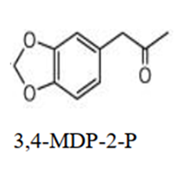
The IUPAC name for 3,4-MDP-2P is 3,4-Methylenedioxphenyl-2-propanone and synonyms a 3,4-methylenedioxyphenylacetone,2-propanone,1-(1,3- benzodioxol-5-yl),2-prponone,1-(3,4 ethylenedioxyphenyl).
Most illicit MDMA is synthesized using 3,4-MDP-2P as the precursor. 3,4-MDP-2P is generally synthesized from piperonal, safrole or isosafrole. Safrole is converted into 3,4-MDP-2-P by 3,4 Wacker oxidation method in the presence of PdCl2, p-benzoquinone and methanol (Figure 2).
In the other method, safrole is isomerized to isosafrole in the presence of a strong base, and then oxidize isosafrole to 3,4-MDP-2P (Figure 3).
The nitropropane method involves the reaction of piperonal with nitroethane in the presence of basic catalyst, commonly n-butylamine to obtain the nitrogen intermediate. The intermediate is reduced to produce 3,4-MDP-2P (Figure 4 & Figure 5).
The control of these precursor chemicals, such as 3,4-MDP-2-P, impacts the availability of MDMA in the market. When certain precursors are globally controlled, it can lead to a decrease in the supply of MDMA, prompting illicit manufacturers to seek alternative precursors or adulterants.
Understanding these structures is crucial for identifying precursor chemicals in unknown substances through chemical analysis or forensic investigation.
Various synthesis pathways are discussed, which involve precursor chemicals like safrole, isosafrole, piperonal, and 3,4-MDP-2-P. Knowing these pathways can help forensic chemists trace back the origin of MDMA and identify precursor chemicals present in seized or unknown substances. Understanding these structures is crucial for identifying precursor chemicals in unknown substances through chemical analysis or forensic investigation.
The conventional precursor MDP2P, also known as piperonyl methyl ketone (PMK), has limited legitimate uses, whereas other conventional precursors like safrole, isosafrole, and piperonal, though controlled, find some legitimate applications in fragrance and flavor industries and can be sourced from natural origins. On the other hand, vanillin, its derivative vanillic acid, and catechol are considered novel precursors for the synthesis of MDA and MDMA. Unlike traditional precursors, these compounds lack a 3,4-methylenedioxy ring but have legitimate applications and remain unregulated. They can be termed as “pre-precursors” since they can be utilized to produce traditional precursors such as safrole, isosafrole, and piperonal.
The production of MDMA, as reported by the United Nations Office on Drugs and Crime and the European Monitoring Centre for Drugs and Drug Addiction, is primarily concentrated in specific European regions and is distributed globally. While plant-derived precursors like safrole, isosafrole, and piperonal have historically been the mainstay for MDMA production, there’s an increasing trend towards utilizing alternative precursors and pre-precursors [4, 5, 6].
Due to regulatory control over certain precursors, the market for MDMA may experience changes such as a decrease in MDMA content in tablets and an increase in adulterants or substitution with other psychoactive substances. Understanding these market dynamics is essential for law enforcement agencies and policymakers to develop effective strategies for combating illicit drug manufacturing and trafficking.
Overall, the interrelation between the synthesis process, regulatory control, chemical structures, synthesis pathways, and market dynamics elucidates how precursor chemicals are identified in unknown substances related to MDMA manufacturing. This knowledge is valuable for forensic analysis, law enforcement efforts, and policy development aimed at reducing illicit drug production and trafficking.
Case Study
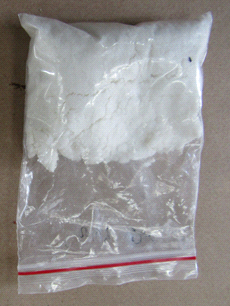
A person was arrested by information while travelling Pettah to Mount Lavinia by the officers of PNB in July 2023 with four samples of polysac bags marked 01, 02, 03 and 04 respectively containing a suspicious white powder. The polysac bag 01 contained 25kg 800 g, the bag marked 02 contained 25kg 670g and bag marked 03 contained 25 kg 820g and the polysac bag marked 04 contained 25 kg 790 g of white powder suspected as MDMA was submitted to the Narcotic laboratory of the Government Analyst’s Department in August 2023 for further examination.
Methodology
White Powders in four polysac bags were subjected to a comprehensive analytical scheme including colour tests, Thin Layer Chromatograpy (TLC) and Raman spectroscopy as screening methods, Gas Chromatography coupled with Mass Spectrometry (GC-MS) for qualitative analysis.
Chemicals and Reagents
Concentrated sulfuric acid, Cyclohexane, 37% Formaldehyde solution, Concentrated ammonia, Diethylamine, Sodium carbonate, Sodium nitroprusside purchased from Fisher, UK, Acetaldehyde, Diphenylamine, anhydroussodium sulphate (Alpha chemika, India), Chloroform (Loba Chemie, India), Ethyl acetate (Sigma Aldrich, US), Methanol (AR) purchased from Sigma Aldrich, Chloroform (AR) were purchased from VWR, UK used for analysis process.
Instruments
Analytical balance (Mettler, AE 100, Poland) was used for necessary weighing procedures while Millipore filters (Nylon, 0.45µm, Agilent Technologies, USA) were used to filter sample solutions. Digital vortex mixer (VELP, Scientifica) was used during the sample preparation to mix the solutions. SILICA 60 F-254 purchased from Merk, Germany was used for Thin Layer Chromatography (TLC) procedures. GC-MS (Agilent technologies 7890 N gas chromatograph with 5975C mass spectrometer) and Raman spectroscopy (Rigaku Progeny ResQ handheld Raman analyser) were used for qualitative analysis.
Colour Tests
Colour Tests for opium alkaloids, cocaine, amphetamines were performed using marquis test, Scott test, Simon’s test respectively for each sample.
Simons Test for Amphetamines
Aqueous Sodium Carbonate solution (2%). 1% aqueous Sodium Nitroprusside solution and 50%(v/v) Ethanolic acetaldehyde solution were prepared for the Simons test. Approximately 2 mg of the suspected material was placed in a depression on a spot plate. One drop of aqueous Sodium Carbonate was added and stirred. Then one drop of aqueous sodium Nitroprusside solution was added and finally one drop of Ethanolic acetaldehyde solution was added. The colour change was observed for each sample.
Thin Layer Chromatography-TLC
TLC for samples and primary standards of methamphetamine, MDMA, was performed using the mixture of Cyclohexane, Toluene and Diethylamine in 75:15:10 (v/v) ratio and visualized under the UV light and then sprayed with Potasium Iodoplatinate reagent and retardation factors were calculated for each sample. TLC for samples and primary standards of cocaine were performed using the mixture of methanol, ammonia in 100:1.5(v/v) ratio and visualized under the UV light and then sprayed with Potasium Iodoplatinate reagent and retardation factors were calculated for each sample.
Extraction of Samples
An amount of 100 mg of the Sample was weighed and transferred into a 25.0 ml volumetric flask and made up to the mark with water. Then 10.0 ml of above solution was transferred into a separatory funnel and 3 drops of concentrated ammonia was added to basify the solution. Extracting solvent, 5.0 ml of ethyl acetate was added, stoppered and shaken well. Then it was kept stand until the layers to separate. The ethyl acetate layer was taken through anhydrous sodium sulphate layer to a GC vial and injected to GC-MS. This procedure was duplicated for each sample.
GC-MS Analysis
In GC-MS, the separation was conducted on Shimadzu GCMS SH-Rtx-BAC2 (30m x 0.32mmx 1.2 µm) under the constant flow. Sample (1 µl) was injected using an auto injector needle under the split mode. Helium (purity>99.99%) was used as the carrier gas. Inlet temperature was 240 0C. EI ion source was used. Oven temperature was initially held at 90 0C for 2 mins and then programmed to ramp up at 14 0C/ min to 300 0C. The carrier gas flow rate is adjusted to 1 ml/ min. The total run time was 27 minutes.
Raman Spectroscopy
Rigaku Progeny ResQ handled Raman analyser was used to identify the compounds in the unknown samples.
By employing these analytical techniques and instruments, the forensic laboratory aimed to identify the presence of MDMA or any related substances in the suspicious white powder samples. The combination of color tests, TLC, GC-MS, and Raman spectroscopy allows for comprehensive analysis and characterization of the unknown substances.
Results and Discussion
The analytical results obtained from testing samples suspected to contain illicit substances such as MDMA, amphetamine, methamphetamine, and cocaine. However, negative results were obtained from Thin Layer Chromatography (TLC), indicating the absence of these substances. Instead, Raman spectroscopy identified the presence of Isopropylbenzylamine, which could be either diluents or impurities in the samples.
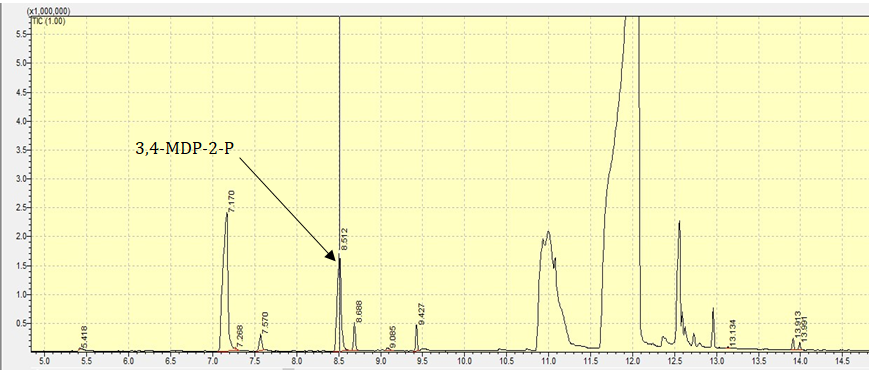
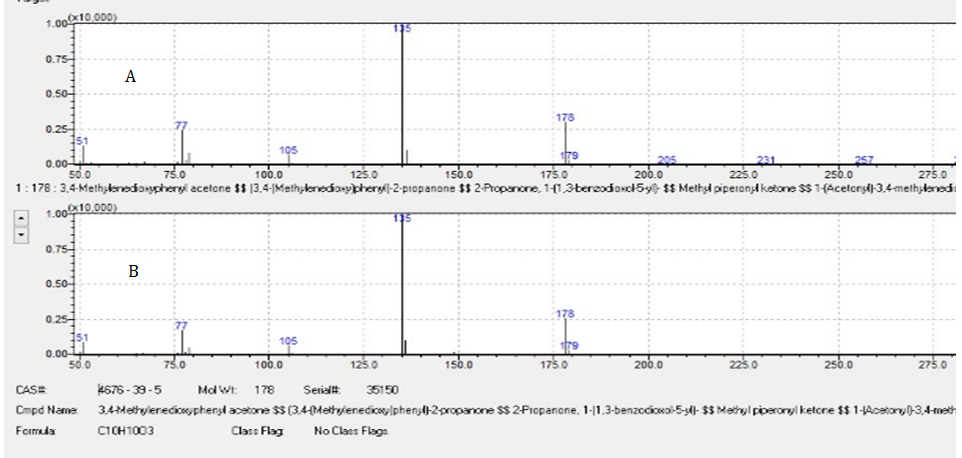
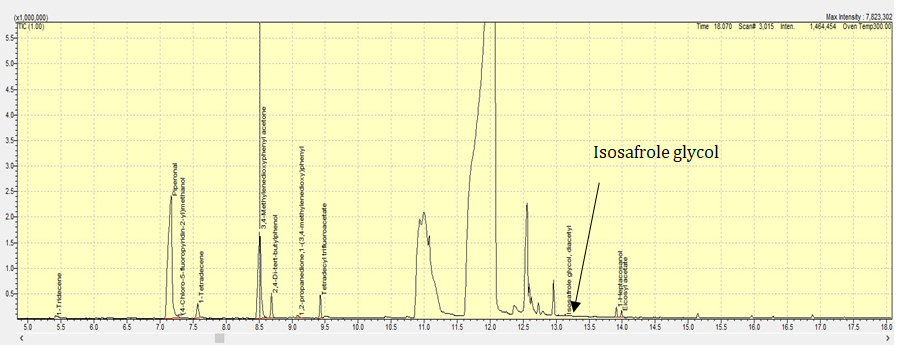
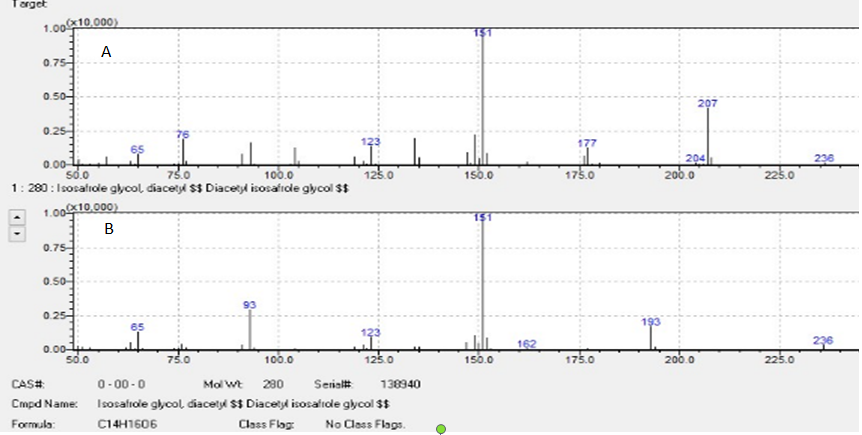
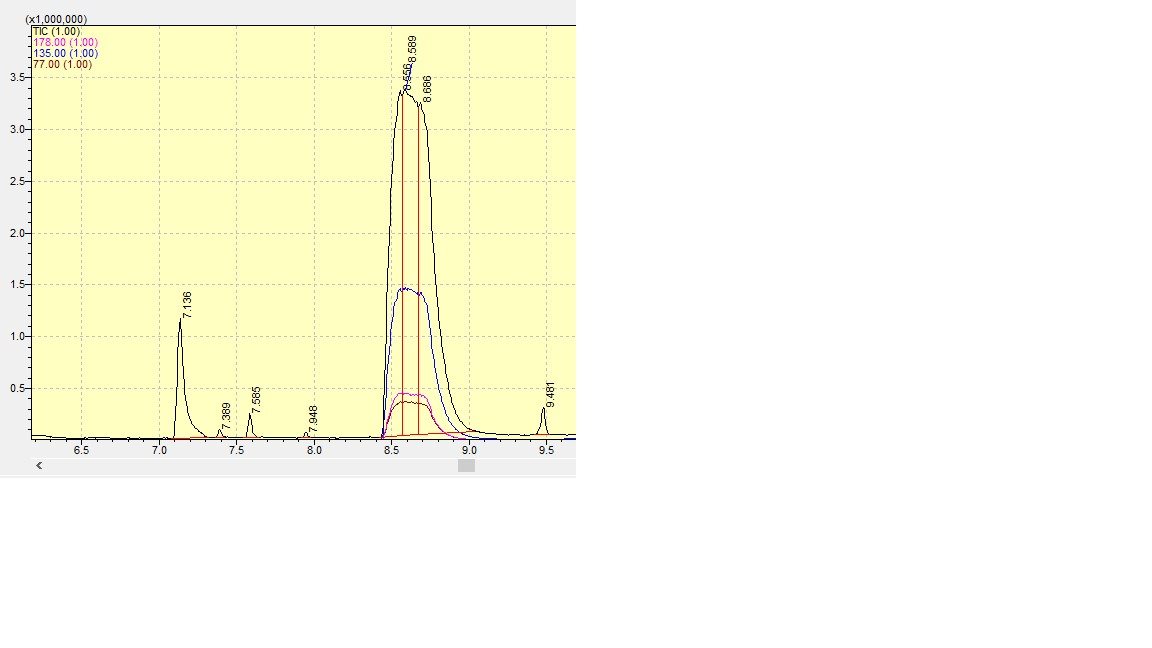
Further analysis using Gas Chromatography-Mass Spectrometry (GCMS) revealed the presence of 3,4-MDP- 2-P (3,4-methylenedioxyphenyl-2-propanone) in all samples, with Isosafrole glycol present in samples 1 and 2. The retention time for 3,4-MDP-2-P was found to be 8.512 minutes, in the Total Ion Chromatogram (TIC) (Figure 7) with characteristic mass peaks at m/z 178, 135, and 77 confirming its presence (Figures 8A & 8B). Isosafrole glycol was observed with a retention time of 13.135 minutes (TIC) Figure 9, accompanied by mass peaks at m/z 151, 123, and 65 in samples 1 and 2 (Figures 10A & 10B).
Further confirmation of 3,4-MDP-2-P was achieved through Extract Ion Chromatogram analysis, where peaks at m/z 178, 135, and 77 were observed, consistent with the mass spectrum results (Figure 11).
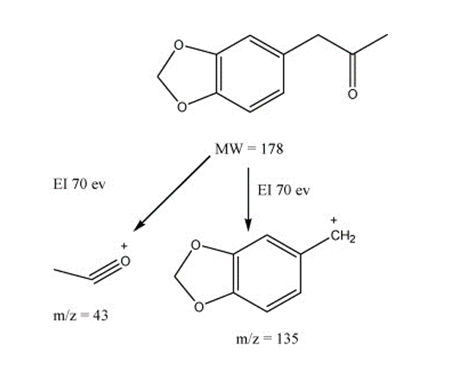
The mass spectrum of 3,4-methylenedioxyphenyl-2- propanone displayed a molecular ion at m/z 178, with major fragment ions at m/z 135/136 and m/z 43 indicating the presence of the acetyl (CH3CO) + fragment. It’s noted that various isomeric forms of methoxy methyl phenylacetone can yield similar mass spectra due to their equivalent molecular weights and potential to produce similar fragment ions (Figure 12).
Overall, the analytical findings suggest the absence of common illicit substances like MDMA, amphetamine, methamphetamine, and cocaine, with the presence of 3,4-MDP-2-P and Isosafrole glycol identified instead. These findings indicate the potential for synthesis or presence of precursor compounds rather than the presence of the final illicit substances themselves.
Conclusion
In conclusion, the analysis conducted on the unknown substances revealed the presence of 3,4-MDP-2-P and Isosafrole glycol, indicative of potential clandestine drug manufacturing activities, specifically relating to MDMA. The absence of commonly known drugs in the samples underscores the need for comprehensive and specialized analytical techniques to detect emerging substances used in illicit drug production.
3,4-MDP-2-P and Isosafrole glycol were identified for the first time in the Narcotic Laboratory of the Government Analyst’s Department during the analysis of these samples. Additionally, approximately 20 kg of methylamine was recently discovered by law enforcement officers. Given that Methylamine is used in the synthesis of MDMA, particularly with MDM-2-P, it strongly suggests the presence of an illegal MDMA manufacturing clandestine laboratory within the country.
The findings highlight the importance of continuous vigilance and cooperation between forensic laboratories and law enforcement agencies to identify and dismantle clandestine drug operations. Further studies, particularly utilizing Nuclear Magnetic Resonance (NMR) spectroscopy, are recommended for complete structural elucidation of the detected compounds.
Prior investigations have extended their validation of MDMA precursors through the precise techniques of Isotope Ratio Mass Spectrometry (IRS) and proton nuclear magnetic resonance spectroscopy (HNMR) [7, 8]. However, the primary objective of this study remains to ascertain the presence of controlled substances or precursor compounds. The results obtained from GCMS, our pursuit aims to unveil the chemical constituents within the specimens, thereby laying the groundwork for their potential utilization in subsequent forensic analysis.
The discovery of these substances within the Narcotic Laboratory of the Government Analyst’s Department signifies the importance of ongoing research and development efforts to keep pace with evolving trends in illicit drug manufacturing. It is imperative for law enforcement agencies to intensify efforts to locate and shut down clandestine drug laboratories to prevent the proliferation of illegal drugs within the country [9, 10].
References
-
Gallagher R, Shimmon R, McDonagh AM (2012) Synthesis and impurity profiling of MDMA prepared from commonly available starting materials. Forensic Science International 223(1-3): 306-313.
-
(2006) Recommended methods for the identification and analysis of amphetamine, methamphetamine and their ring-substituted analogues in seized materials. United Nations Office on Drugs and Crimes, USA, pp: 1-88.
-
(1988) United Nations Conventions Against Illicit Traffic in Narcotic Drugs and Psychotrpic Substances. New York, United Nations, pp: 1-31.
-
Cormick J, Carter JF, Currie T, Matheson C, Cresswell SL (2021) A survey of novel MDA and MDMA precursors by isotope ratio mass spectrometry. Forensic Chemistry 24: 100341.
-
Heather E, Shimmon R, McDonagh A (2020). Organic impurity profiling of 3,4-methylenedioxymethamphetamine (MDMA) synthesised from catechol and eugenol via 4-allylcatechol, Forensic Science International 309: 110176.
-
Meikle J, Cresswell SL, Boyd SE, Carter JF, Collett SP (2019) A stable isotope ratio approach to investigate the origins of illicit methylamphetamine in Queensland, Australia. Forensic Chemistry 16: 100174.
-
Nicolodi C, Slominski WH, Parabocz GC, Pericolo S, Da Col JA, et al. (2024) Headspace solid-phase microextraction - gas chromatography - mass spectrometry qualitative screening method for active compounds, adulterants and impurities in ecstasy tablets seized in Northern Santa Catarina State, Brazil. Forensic Science International 355: 111932.
-
Mercieca AL, Fursman HC, Alonzo M, Chadwick S, McDonagh AM (2023) Organic impurity profiling of 3,4-methylenedioxyamphetamine (MDA) synthesised from helional. Forensic Science International 350: 111788.
-
Cormick J, Carter JF, Currie T, Matheson C, Cresswell SL (2022) The synthesis of MDA from helional and characterisation by isotope ratio mass spectrometry. Forensic Chemistry 30: 100433.
-
(2004) World Drug Report. United Nations Office on Drugs and Crimes.
- Forensic Implications of Adverse Drug Reactions in Schizophrenia A Case Series
- Narcotics and Digital Forensics: Bridging Crimes in the Digital Age
- Ethics in Forensic Psychiatry: Principles, Dilemmas, and Human Rights
- Impact of Acute Stress on Attentional Orienting to Social Cues
- Head Injury and Intracranial Hemorrhage in Western Region of Libya
- A Forensic Study on Handedness: Examination of Handwriting Features in Right and Left Handed Writers