
A Multidisciplinary Analysis of the Kurt Cobain Death*
The violent death of Kurt Cobain, the lead guitarist and singer of the popular rock band Nirvana, was estimated by the King County Medical Examiner (ME) in Seattle, Washington, USA to have occurred on April 5, 1994. Cobain’s body was discovered on April 8, 1994. The Seattle Police Department (SPD) detectives, the ME investigator, the Assistant ME, and the Chief ME concluded that Cobain died by suicide. However, the police reports, 37 scene images released in 2014, followed in 2016 by 5 images of a SPD detective holding Cobain’s shotgun, and the recent disclosures of the autopsy (December, 2023) and firearm/ toolmark (January 2025) reports, have provided new insight into the manner of Cobain’s death. Kurt Cobain, based solely on publicly available discovery and analyzed through a multidisciplinary critical method, was a homicide victim. His body was moved from the site of the homicide and staged to appear as a suicide.
Abbreviations
ME: Medical Examiner; SPD: Seattle Police Department; OAL: The Overall Length.
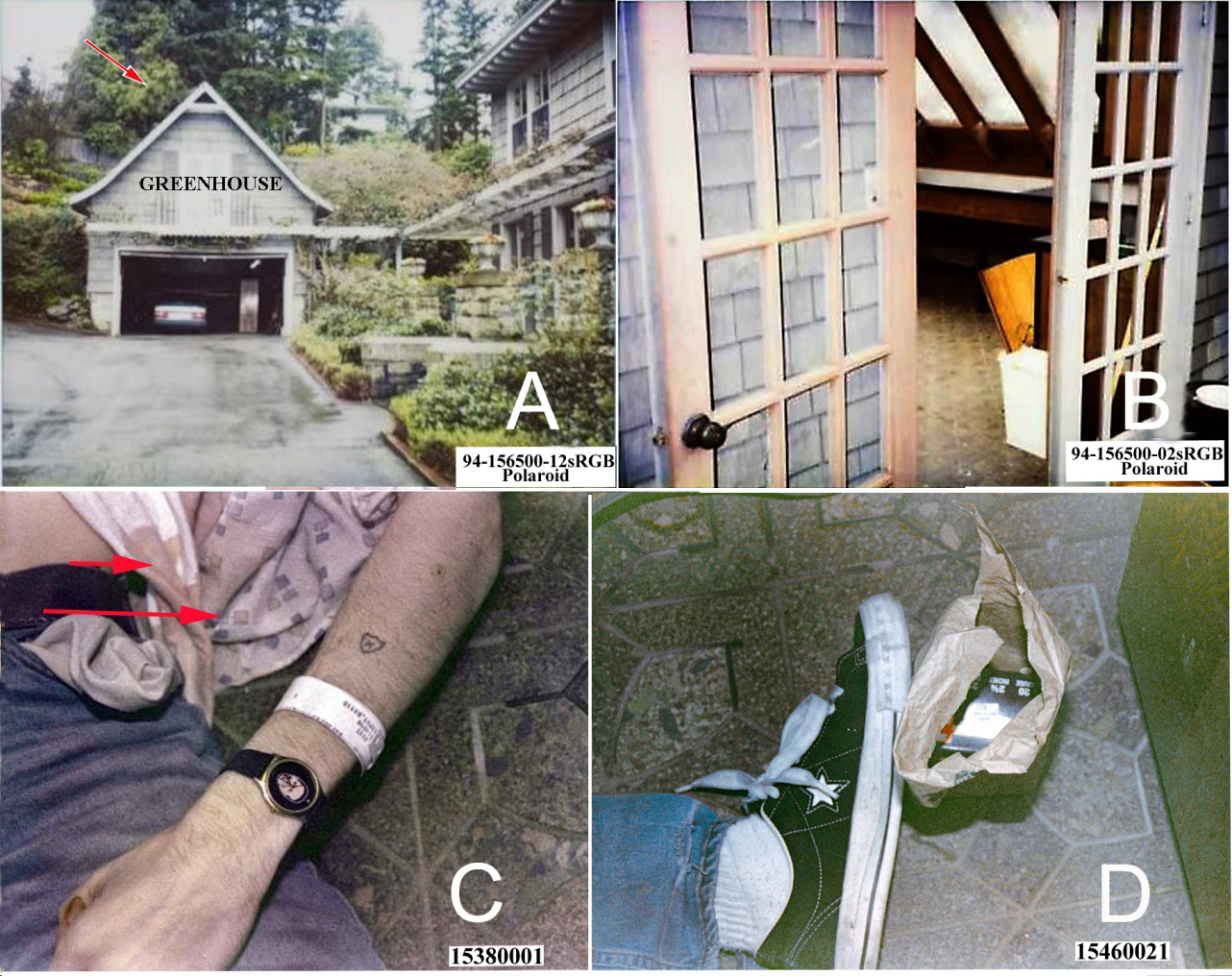
Figure 1. The Kurt Cobain death scene from images released by the SPD in 2014. The original image file names are at the lower right of each image. Images were gamma adjusted and sharpened in Photoshop by author BB. A. The greenhouse or atrium over Cobain’s garage where his body was discovered on April 8, 1994; entry to his home is on the right and entry to the greenhouse is at the back of the garage/greenhouse. Seattle Times reporter Tom Reese was on the other side of the fence in a tree (approximately at red arrow) when he took photographs of the greenhouse entry and one of the right side of Cobain’s body (see Figure 9). B. The double door entry to the greenhouse; the windowpane below the doorknob was broken. The doorknob is keyed and likely could be secured by closing the door from the outside when in the locked position. C. Left dorsal arm and hand of Cobain; a white hospital band from an unknown Seattle hospital or clinic is on his wrist. The long-sleeved button-down shirt and the white undershirt are bloodstained (arrows). D. The lower left leg and foot of Cobain; a bag containing a box of 20-gauge shotgun cartridges is by his foot.
Introduction
Kurt Cobain, lead guitarist and vocalist for the popular rock band Nirvana, was found lying on the floor of the greenhouse above his garage (Figure 1A) in Seattle, Washington, United States on April 8, 1994 by an electrician on a service call to the Cobain residence. The electrician spotted Cobain’s body through the window of the locked French doors to the greenhouse (Figure 1B). The window below the doorknob was broken by an emergency medical team member, and it was determined that Cobain was deceased.
The investigating detectives from the Seattle Police Department (SPD), the King County Medical Examiner (ME) investigator, Assistant ME, Dr. Hartshorne, and Chief ME, Dr. Reay, concluded Cobain committed suicide by an intraoral shotgun discharge. It was estimated that Cobain died three days earlier on April 5, 1994 [1]. The toxicology report that accompanied the autopsy report showed Cobain had also received a lethal dose of heroin. Despite the determination of suicide by the ME [1] and SPD [2], the SPD’s investigation continued for years following Cobain’s death [3].
Since Cobain’s death, there has been continued public speculation that he was a homicide victim (e.g., [3]).
In 2014, the SPD released 37 images of the exterior of Cobain’s house and garage/greenhouse, and the greenhouse interior taken the day of the discovery of Cobain’s body [4]. Images of his head and/or entire body were not included. In the 2014 release of the investigators’ notes and reports [2], there were four rolls of undeveloped 35 mm film documenting the death scene in the greenhouse. These were developed in 2014, and some of those images are in this release [5]. Two images from the SPD release show parts of Cobain’s body (Figures 1C&1D) which were used in our analysis. In 2016, 5 images of SPD Detective Ciesynski holding Cobain’s 20-gauge shotgun were released [6]. All the original images from the SPD releases are available [7].
There were also unauthorized photographs taken by Tom Reese of the Seattle Times newspaper on April 8, 1994. He had climbed a tree on the other side of the fence (Figure 1A red arrow) on the east side of the Cobain property. There were photographs taken of the south side of the garage/ greenhouse and an unknown number of the east-facing greenhouse porch and entry door documenting SPD and ME personnel going in and out of the greenhouse. One of Reese’s photographs was of the interior of the greenhouse through the open French doors which shows the right side of Cobain’s body (see Figure 9). This image was published April 14, 1994 in the Seattle Times, and can also be found on social media. The latter image’s credit suggests that Reese, who died in 2017, owned the copyright to that image.
There were two Apple QuickTake 100 digital cameras [8] also at the scene (details below). These have date stamps on the lower right of the images. This appears to be the first use of a digital camera to document a death scene by law enforcement.
Likely due to the continual public interest in the manner of Cobain’s death following the limited 2014 release of scene images, a lawsuit was filed in 2015 in Seattle Superior Court to force the release of all Cobain death scene photographs. This was blocked by the Court due to a family privacy request [3, 9], which was affirmed by the Washington Appellate Court in 2018 [10].
The Kurt Cobain autopsy report was provided to the SPD investigators on June 20, 1994 but was not publicly released at that time. However, it had been in the possession of Cobain’s late grandfather Leland Cobain, since 2012 according to a copy of a handwritten letter request to the SPD that was included with the autopsy report [1]. The report was publicly released by Kurt Cobain’s uncle, Gary Cobain, in late 2023. Unfortunately, pages 2 and 3 are missing from this copy of the report (see below).
The complete firearm/toolmark report from the Washington State Patrol Crime Laboratory was released to our group in January 2025 [11].
The lack of access to most of the death scene images due to the issue of privacy [2, 9, 10] has been a hindrance for an independent investigation into the manner of Kurt Cobain’s death for 30 years. However, the recently released autopsy [1] and firearm/toolmark [11] reports coupled with the police reports [2] and the small number of death scene photographs [7] has now provided sufficient evidence to determine, with reasonable certainty, the manner of Kurt Cobain’s death. Our study identified significant findings via analysis of bloodstain patterns, shotgun performance, and heroin toxicology that may not have been fully recognized by the SPD and King County ME. This may have hindered their ability to reach a reliable determination of the manner of his death.
Pettler [12] noted that “Investigating the staged crime is daunting. It is very different from investigating many other types of crimes.” In cases where there is a lack of experience in detecting staged suicides by investigators (e.g., bloodstains inconsistent with a suicide, evidence of scene manipulation, etc.) the investigative process can result in a miscarriage of justice, which occurred in the investigation of Kurt Cobain’s death by the SPD and the ME.
Suicide Scenario
Cobain committed suicide by first injecting himself with a lethal dose of heroin [1, 13]. After the injection of the heroin, he remained conscious long enough to be able to put the protective cap back onto the syringe, place it back into the cigar box near him, close it, get up to sit at a different location in the greenhouse, and while seated or supine on the floor, take the shotgun with the compensator on its muzzle, put the compensator muzzle in his mouth (partially contacting his superior hard palate), and depress the trigger with his right hand while his left hand held the shotgun barrel at the base of the compensator near his mouth. The elevated shotgun was unsupported. This suicide scenario was described by SPD Detective Ciesynski in 2014 [14].
Homicide Scenario
Cobain was accosted by an assailant with a syringe who injected a lethal dose of heroin into his left dorsal proximal forearm. He collapsed, and while supine on the floor, the 20-gauge shotgun with the compensator on its muzzle was forcefully inserted into his mouth, likely pushing his head back and jaw down with the compensator side against his upper front teeth, its muzzle in partial contact on his superior hard palate, and the shotgun was discharged. The body was carried by two persons from the site of the homicide to the place in the greenhouse where the body was found. The scene and body were then staged to appear to be a suicide.
The Photographic Documentation of the Death Scene
Images Released by the Seattle Police Department in 2014
Thirty seven images of the Cobain property and death scene taken on April 8 1994 were released by the SPD in April 2014. The metadata associated with the original images released by the SPD [7] identified a Hasselblad H3DII-31 camera and a Noritsu Koki scanner as the devices used to produce these images:
- Polaroid prints were copied, likely on a copy stand, by the Hasselblad H3DII-31 digital camera. Twenty- three Polaroid photographs were taken by SPD Officer Levandowski [2 p 110]. Only 9 of these images were released [4].
- 35 mm film, likely negatives, were scanned by the Noritsu Koki scanner: 1 roll taken by SPD Sergeant Getchman [2 p 110]. 1 roll taken by SPD Officer Fewel [2 p 110]. 1 roll taken by Assistant ME Dr. Hartshorne [2 p 111]. 1 roll taken by an unknown person, perhaps of the autopsy during Dr. Hartshorne’s examination [1]. Only 22 of these images were released [4].
- Images from two Apple QuickTake 100 cameras (640x480 pixels/image) [15], printed on dye-sub printer paper, and scanned at high resolution (6096x4042 pixels/image) by the Noritsu Koki scanner. Twelve of these images were taken, of which 6 were released.
![Figure 2: The scanner image of a dye-sub print of the greenhouse planter near the victim with the alleged suicide note impaled by a pen into the planter soil; the image, likely originally from an Apple QuickTake 100 camera, has not been processed (i.e., gamma adjusted, sharpened, etc.). The arrows point to white defects in the print caused by dust on the print paper, a common defect of dye-sub prints [16]. The date stamp on the lower right was applied to the image when it was downloaded from the Apple QuickTake 100 camera to an Apple or a PC computer [16].](/fulltextimages/14041/fig_2.png)
Figure 2: The scanner image of a dye-sub print of the greenhouse planter near the victim with the alleged suicide note impaled by a pen into the planter soil; the image, likely originally from an Apple QuickTake 100 camera, has not been processed (i.e., gamma adjusted, sharpened, etc.). The arrows point to white defects in the print caused by dust on the print paper, a common defect of dye-sub prints [16]. The date stamp on the lower right was applied to the image when it was downloaded from the Apple QuickTake 100 camera to an Apple or a PC computer [16].
All the 35-mm images, including the printouts from the digital cameras that were scanned by the Noritsu Koki scanner, were too dark (e.g., Figure 2), indicating either the scanner’s illuminator was defective or there was an electronics issue.
The Seattle Times Photographs
Reporter Tom Reese of the Seattle Times newspaper was near the Cobain house on April 8, 1994, when he learned of Cobain’s death, likely via a police scanner. He had a camera with a telephoto lens. When he arrived at the Cobain house, the SPD detectives were at an early stage of their investigation. Reese realized there was viewing access to the Cobain greenhouse entry from the west side of 39th Avenue East (Figure 1A red arrow), which bordered the east side of the Cobain property. He climbed a tree on the west side of 39th Avenue East (Figure 1A red arrow) to get a view of the greenhouse entry on the east side of the building, which allowed him to view and photograph the right side of Cobain’s body with his telephoto lens through the open French doors [17]. He likely had to wait for a police officer to leave the front of the french doors (standing on the porch entry in the photograph of the south side of the garage/ greenhouse) in order to take that photograph. Reese took the photograph of Cobain’s body through the branches of the tree he had climbed. The police detectives, became aware of him in the tree, closed the french doors and covered their windows with a tablecloth after he took the photograph. Reese had also taken photographs of the ME technicians removing the body on a gurney. Those photographs are now in the possession of the Seattle Museum of History and Industry, but Reese apparently maintained possession of the photograph showing the right side of Cobain’s body. We used a portion of this image in our analysis of Cobain’s death (see Figure 9).
Digital Camera at the Scene – Bryan Burnett
Noteworthy and not previously reported, a SPD officer or criminalist took images of the scene with two Apple QuickTake 100 cameras. The Apple QuickTake 100 digital camera was introduced at a trade show in Japan, February 1994. The camera and image display software for the Mac and PC were commercially released in June 1994 [15]. Apple provided a pre-release to law enforcement. (Author BB was working at an independent crime laboratory at the time recalls Apple making that offer.) Five, possibly six, of these images were released. Four were of the Cobain house and garage/greenhouse, and one was inside the greenhouse (Figure 2). The latter image shows the alleged suicide letter, which was on an elevated stainless-steel-lined, dirt-filled garden planter. These images were identified as originally digital due to the orange date stamp on the lower right of the images (e.g., Figure 2), which was a feature advertised by Apple. Four of the images with date stamps have white spots (e.g., Figure 2, arrows), which indicate the images were scanned from dye-sub prints [16]. The file names with the first four numbers (1550) are different four first numbers from the 35 mm film image file names that were applied by the Noritsu Koki scanner. There was one image file with the same base file name (1550) as the other digital-origin images, but without an image, print defects or date stamp. The sixth image file, 15500011, of a QuickTake 100 dye-sub print is an image of the elevated planter box at the scene (Figure 2). The gap of five image files, 15500006 -15500010, before 15500011 indicates there was a second QuickTake 100 camera at the scene because the maximum storage capacity for this camera is six images. The maximum resolution for images taken by an Apple QuickTake 100 is 640x480 pixels [15].
Images of the “Suicide” Letter
The images used for the handwriting analysis appear to have been a separate release from the scene images in 2014 (Figure 17).
The Reports
Police Reports
There are two files of compiled investigative police reports (notebook1 [2] and notebook2 [3]). If the death was determined to be a homicide, the file name would be “murderbook.” However, since the manner of death was determined to be suicide, these police report compilations had the filenames “notebook1.pdf” and “notebook 2.pdf” The two files have documents in common. Usually the police “murderbook” file includes the autopsy and the medical examiner investigator reports (as experienced by author BB), but neither notebook include these. In 2014, Seattle Police Department Detective Ciesynski summarized the suicide opinion according to the SPD [5]. The complete firearm/ toolmark report [11] was released to our group in January 2025.
The Autopsy Report
The autopsy report [1] also contains the ME investigator’s report and the toxicology report (a summary of the full report?). Pages 2 and 3 are missing from this copy of the autopsy report.
The police documentation of a violent suicide or accidental death in the 1990s usually consisted of a small number (between 1 and 5) of Polaroid photographs (e.g., [18]) and short reports from the police (officer or detective) and medical examiner investigator. The age, health status, and lack of suspicious issues with the deceased or surroundings determine whether an autopsy should be performed [19]. Despite Cobain’s death being ruled a suicide, investigators kept the case open for years after his death (e.g., [3]).
![Figure 3: A. Seattle Police Department Detective Ciesynski holding Cobain’s Remington M11 shotgun; the compensator on the shotgun’s muzzle directs a portion of the propellant gases upward, thus stabilizing the barrel horizontally for a quicker acquisition of the target after discharge [20]. Image from the SPD’s 2016 release. B. Orange peel held over the dorsal and ventral Cutts compensator on the test Remington M11 20-gauge shotgun showing soot and singeing by the discharge gas; this documents the venting of the discharge gas through the dorsal compensator ports and a much smaller amount through the ventral ports. The test shotgun compensator is the same design as the one on Cobain’s shotgun. Test performed and image provided by author MG.](/fulltextimages/14041/fig_3.png)
Figure 3. A. Seattle Police Department Detective Ciesynski holding Cobain’s Remington M11 shotgun; the compensator on the shotgun’s muzzle directs a portion of the propellant gases upward, thus stabilizing the barrel horizontally for a quicker acquisition of the target after discharge [20]. Image from the SPD’s 2016 release. B. Orange peel held over the dorsal and ventral Cutts compensator on the test Remington M11 20-gauge shotgun showing soot and singeing by the discharge gas; this documents the venting of the discharge gas through the dorsal compensator ports and a much smaller amount through the ventral ports. The test shotgun compensator is the same design as the one on Cobain’s shotgun. Test performed and image provided by author MG.
Examination
Remington M11 20-Gauge Shotgun with Cutts Compensator - Michael Gregory
Cobain’s shotgun was a semiautomatic Remington Model M11 Sportsman 20-gauge shotgun (Figure 3A). The shotgun had a Cutts compensator on its muzzle, which functions to redirect the discharge gas upward 90 degrees from the compensator [20]. This was verified by showing that the discharge gas was vented through the dorsal ports of the compensator, causing singeing and soot deposition documented by the orange peel overlap (Figure 3B). A much smaller amount of soot deposition or singeing was from the ventral ports (Figure 3B).
![Figure 4: The Remington M11 20-gauge shotgun. A. Seattle Police Department Detective Ciesynski holding Cobain’s Remington M11 20-gauge shotgun with the Cutts compensator on the muzzle. Image from the SPD’s 2016 release. B. A volunteer holding the test Remington M11; its barrel appears shorter than that of Cobain’s shotgun due to a longer forestock or foregrip and a compensator that was shorter than the Cutts compensator. Image by author MG. C. Comparison of the test M11 shotgun with the Cobain Remington M11 shotgun; Top. The test Remington M11 shotgun, in which the old compensator (shown in B) was replaced with the Cutts compensator of the same design as the one on Cobain’s shotgun (shown in A). Image provided by author MG. Bottom. The Cobain shotgun; the fore stock or foregrip is shorter than in the test shotgun. Image from [11].](/fulltextimages/14041/fig_4.png)
Figure 4. The Remington M11 20-gauge shotgun. A. Seattle Police Department Detective Ciesynski holding Cobain’s Remington M11 20-gauge shotgun with the Cutts compensator on the muzzle. Image from the SPD’s 2016 release. B. A volunteer holding the test Remington M11; its barrel appears shorter than that of Cobain’s shotgun due to a longer forestock or foregrip and a compensator that was shorter than the Cutts compensator. Image by author MG. C. Comparison of the test M11 shotgun with the Cobain Remington M11 shotgun; Top. The test Remington M11 shotgun, in which the old compensator (shown in B) was replaced with the Cutts compensator of the same design as the one on Cobain’s shotgun (shown in A). Image provided by author MG. Bottom. The Cobain shotgun; the fore stock or foregrip is shorter than in the test shotgun. Image from [11].
The Cobain Remington M11 20-gauge shotgun was submitted to the Washington State Patrol Crime Laboratory for examination. The shotgun was unavailable for our examination, and we obtained a standard Remington M11 20-gauge shotgun of approximately the same manufacture year (ca. 1947). Cobain’s shotgun was a M11 Sportsman with a magazine capacity of two cartridges. The test shotgun was a standard M11 with a four-cartridge magazine capacity. The shorter compensator on the test shotgun (Figure 4B) was replaced with the longer Cutts compensator (Figure 4C top) of the same design as the compensator on Cobain’s shotgun (Figure 4C bottom), which made the distance from the compensator muzzle to the trigger the same for both shotguns. The overall length (OAL) of the Cobain Remington M11 shotgun was reported as “45 - 5/8 inches” (116 cm) [11].
The test M11’s OAL also measures 45 - 5/8 (116 cm), and the barrel from where the approximate bolt face touches the chamber (where the shell-casing seats) to the muzzle, before the compensator, is 22 inches (56 cm). Added are the 4 inches (10.1 cm) of the Cobain and test shotgun compensators (both Cutts compensators), from the muzzle to the end of the modified choke attachment on the compensator. The OAL of the barrel is 26 inches (66 cm). This, plus the remaining 19.6 inches (49.8 cm) of the receiver to the butt of the test shotgun, makes for an OAL of 45 5/8 inches (116 cm). The difference between the two shotguns is that the test shotgun is a standard M11 and has a longer fore grip to compensate for the tubular magazine holding four rounds, which is two more than the Cobain shotgun. This does not hinder comparison of the operation or capability between the two. The measurements of the test M11 shotgun do not differ from those of the Cobain shotgun (Figure 4C).
The 20-gauge shotgun casing was found “on top of a corduroy jacket which is on top of a beige nylon shotgun case. These items were just to the left of the victim and under one of the stainless-steel garden trays” [2].
The Remington M11 shotguns use a long recoil process where upon firing, the barrel recedes into the receiver along with the bolt to eject the fired round. Upon ejection, the barrel moves fully forward, while the bolt temporarily holds back to cycle the next live round. If the barrel’s recoiling operation is obstructed (e.g., by Cobain’s left hand gripping the barrel as in the suicide scenario [2]), the recoil movement of the shotgun will be impeded, and the spent casing will not fully eject. With the test M11 shotgun and the left-hand gripping of the barrel as in the suicide scenario, we fired over 30 rounds [21] of comparable 20-gauge ammo and did not observe one instance of successful casing ejection. Any obstruction (e.g., a hand gripping the barrel) to the long recoil process will cause the shotgun to not eject the fired casing, which remains stuck in the shotgun’s receiver. A video demonstrating this effect is available on YouTube.
The death scene description noted that Cobain was gripping the shotgun barrel just behind the compensator with his left hand [2]. The spent casing would not have been ejected with Cobain gripping the barrel at discharge and should have remained in the shotgun’s receiver.
![Figure 5: Wound and shotgun pellet path by the intraoral shotgun discharge. A. Rough sketch of the inferior view of the maxilla from the Cobain autopsy report of the entrance/exit wound on the superior hard palate [1]. B. Approximate size and location of the wound defect (red oval) in the hard palate in this inferior view of the skull without the mandible; the shotgun compensator muzzle was at contact or near contact and was at an angle to the hard palate at discharge. The autopsy report indicated that the superior portion of the defect had a distance of ½ inch (1.3 cm) from the back of the front maxillary teeth, which likely means that the shotgun compensator was against the upper rear of the teeth. Graphic by author BB. C. Illustration of a cross-section of the oral region showing the usual suicide position of the firearm barrel in the mouth of the victim; the entrance wound would be in the posterior hard palate/soft palate and about 60 degrees to the long axis of the body. From [22] with permission. D. Illustration of a cross-section of the oral region of the homicide position of a firearm barrel; in a typical homicide, the angle with the victim’s head is at 90 degrees and the entrance wound is in the posterior oral cavity. From [22] with permission. E. Illustration of a cross-section of the oral region of the position of the firearm muzzle or shotgun compensator/muzzle with the path (between the red lines) of the shotgun pellets based on the Cobain autopsy report [1]; the angle is approximately 35 degrees to the midline. Destruction and damage were to the bones at the base of the skull (frontal orbital bone) and the parietal and frontal lobes of the brain. The occipital lobes were partially destroyed [1]. Drawing modified from D by author BB.](/fulltextimages/14041/fig_5.png)
Figure 5. Wound and shotgun pellet path by the intraoral shotgun discharge. A. Rough sketch of the inferior view of the maxilla from the Cobain autopsy report of the entrance/exit wound on the superior hard palate [1]. B. Approximate size and location of the wound defect (red oval) in the hard palate in this inferior view of the skull without the mandible; the shotgun compensator muzzle was at contact or near contact and was at an angle to the hard palate at discharge. The autopsy report indicated that the superior portion of the defect had a distance of ½ inch (1.3 cm) from the back of the front maxillary teeth, which likely means that the shotgun compensator was against the upper rear of the teeth. Graphic by author BB. C. Illustration of a cross-section of the oral region showing the usual suicide position of the firearm barrel in the mouth of the victim; the entrance wound would be in the posterior hard palate/soft palate and about 60 degrees to the long axis of the body. From [22] with permission. D. Illustration of a cross-section of the oral region of the homicide position of a firearm barrel; in a typical homicide, the angle with the victim’s head is at 90 degrees and the entrance wound is in the posterior oral cavity. From [22] with permission. E. Illustration of a cross-section of the oral region of the position of the firearm muzzle or shotgun compensator/muzzle with the path (between the red lines) of the shotgun pellets based on the Cobain autopsy report [1]; the angle is approximately 35 degrees to the midline. Destruction and damage were to the bones at the base of the skull (frontal orbital bone) and the parietal and frontal lobes of the brain. The occipital lobes were partially destroyed [1]. Drawing modified from D by author BB.
The Autopsy Report: The Shotgun Pellet Path – Bryan Burnett
The autopsy report is often critical in ascertaining a bullet or shotgun pellet path for distinguishing between suicide, accident or homicide in a firearm death investigation [23]. The decision of a violent death investigation usually involves the investigating detectives and medical examiner investigator viewing the death scene and then taking into account the autopsy findings.
The ME or Assistant ME, if present, usually coordinates the processing of the scene. How the scene is processed and documented often depends on that initial decision (e.g., [18]). If the decision is suicide, usually limited photographic documentation of the death scene occurs. For the Cobain death, it seems likely that the detectives on the scene and the forensic pathologist had limited experience (Hartshorne was 30 at the time and not yet board certified) and missed evidence showing that the Cobain death scene was a staged suicide. The ME determined “suicide” as the manner of death in Cobain’s autopsy report [1] and death certificate [24 p 57].
Dr. Hartshorne illustrated the entrance wound (also the exit wound - Figure 5A). According to his description, the entrance wound was located “on the superior hard palate 1/2 inch [1.3 cm] posterior to the anterior incisors” and “… is a 3/4 inch [1.9 cm] x 1-1/4 inch [3.2 cm] oval shaped entrance shotgun wound defect (Figs. 5A, 5B). The distal posterior margins are remarkable for six 1/4 inch [0.6 cm] to 1/3 inch [0.9 cm] linear lacerations leaving 1/3 inch [0.9 cm] skin tags hanging from the posterior edge.” The wound overall is described as a “contact penetrating shotgun wound to the head” [1].
The presence of soot (Figure 5A) indicates a contact or near contact of the shotgun compensator muzzle to the hard palate. Zietlow and Hawley [21] summarized the typical locations of the muzzle in intraoral firearm deaths. In suicide, the barrel is typically at 60 degrees to the body midline (Figure 5C), which assumes the victim is sitting in a chair when the firearm is discharged. For homicide, the barrel is approximately 90 degrees (Figure 5D) or parallel to the horizontal plane (e.g., [25]). For Cobain, the barrel was approximately 35 degrees (Figure 5E).
In the suicide scenario, Cobain was either sitting on the floor, legs outstretched where the shotgun was at an angle with the stock on the floor or supine with the shotgun unsupported (i.e., held midair only by his hands). Upon discharge in either the suicide or homicide scenarios, the compensator/muzzle recoiled out of his mouth (see below).
The shotgun was ventral side up (trigger up) when Cobain’s body was found [1].
Bloodstains and Backspatter at Death Scenes - Bryan Burnett and Gabriele Rotter
Bloodstains are usually key for a homicide investigator to understand the manner of death when there is bloodletting at a death scene. They document the fatally wounded victim moving (e.g., [27]) and/or if the body was manipulated after death. The latter can be a feature of a death scene and may indicate a staged suicide - a homicide in which the perpetrator deliberately arranges the scene, evidence, or victim’s body to create the false appearance of a self-inflicted death (e.g., [25, 26]). The cranial backspatter pattern in particular may consist of staining of nearby objects by a blood spray or it may be composed of only a few bloodstains or even be absent [28]. The amount of blood flowing from cranial wounds can be particularly high in gunshot wounds to the head where the brainstem remains intact allowing the heart to continue beating, often to exsanguination [29].
Seattle Police Department Detective Ciesynski noted that Cobain bled from both the left ear canal and the nose [14]. Blood had flowed onto Cobain’s undershirt and shirt (Figure 1C arrows) from these sources (see below).
The reddish-brownish stains found at the crime scene, on the victim’s clothing, and on the shotgun have been treated as blood, and not as any other substance, for this analysis. This assumption was made solely in light of the reconstruction of the crime dynamics, even though there is no record that the stains were ever subjected to forensic analysis by the investigators.
![Figure 6: A. Evidence of backspatter from a head-penetrating 16-gauge shotgun discharge with muzzle contact or near-contact to the victim’s left head at his ear; the shooter had broken the vehicle window, while the door was open, from the exterior side prior to the victim being positioned by other assailants on the interior side of the door with the shooter discharging the shotgun [26]. The entrance wound was also the exit, resulting in a substantial backspatter of blood and other tissue, as shown on the fractured tempered window glass. Inset. Photoshop-enhanced close-up image of the blood and other tissue spatter on the window. Images from [26]. B. Spatter on the glasses of the shooter; the muzzle of his 10 mm pistol was at contact or near contact on the victim’s head when it discharged. The backspatter covered him as evidenced by the spatter on his glasses. Image from author BB. C. The 10 mm pistol used by the shooter in the same case as B; in the assailant’s rush to clean off blood on himself and the pistol, he neglected to thoroughly clean the pistol where he had transferred blood to the rear of the pistol. Image from author BB.](/fulltextimages/14041/fig_6.png)
Figure 6. A. Evidence of backspatter from a head-penetrating 16-gauge shotgun discharge with muzzle contact or near-contact to the victim’s left head at his ear; the shooter had broken the vehicle window, while the door was open, from the exterior side prior to the victim being positioned by other assailants on the interior side of the door with the shooter discharging the shotgun [26]. The entrance wound was also the exit, resulting in a substantial backspatter of blood and other tissue, as shown on the fractured tempered window glass. Inset. Photoshop-enhanced close-up image of the blood and other tissue spatter on the window. Images from [26]. B. Spatter on the glasses of the shooter; the muzzle of his 10 mm pistol was at contact or near contact on the victim’s head when it discharged. The backspatter covered him as evidenced by the spatter on his glasses. Image from author BB. C. The 10 mm pistol used by the shooter in the same case as B; in the assailant’s rush to clean off blood on himself and the pistol, he neglected to thoroughly clean the pistol where he had transferred blood to the rear of the pistol. Image from author BB.
Muzzle Discharge Contact or Near-Contact to the Head: Backspatter - Bryan Burnett and Gabriele Rotter
A contact or near-contact firearm discharge into the head, which results in either a penetrating or perforating wound will usually have backspatter of blood [30 p 264, 31 p 75, 32 p 137, 33 p 188]. Blood is projected from the entrance wound, covering nearby objects (e.g., Figures 6A&6B). To use an example, in a homicide with a 10 mm pistol with its muzzle at contact or near contact to the victim’s head at discharge, the shooter cleaned off the backspatter on him by washing his face and hands and changing his clothing. He neglected to clean his glasses, which were left on a table near the victim (Figure 6B) showing that he was close to her, which he denied, when the firearm discharged. The shooter acquired blood on his hands when he staged the body which was transferred to the pistol. He cleaned the spatter from the pistol but he missed transfer stains at the rear of the pistol (Figure 6C).
The morphological characteristics of the backspatter pattern depend on the type of firearm and ammunition, the distance between the muzzle and the target [30], and the presence of obstacles that may impede blood expulsion, such as the victim’s hair or clothing [30]. Regarding the influence of shooting distance on bloodstain pattern formation, it is important to note that, due to the extremely small mass of the blood droplets generated by the collapse of the temporary cavity [29], these droplets can travel through the air for approximately 4 meters horizontally before falling [31]. However, discharge gas injected into the victim’s skull when the muzzle is at contact or near contact, can result in substantial blood ejection (backspatter) from the entrance wound (e.g., Figures 6A&6B) and large tissue fragments can be projected considerable distances (e.g., [26]).
![Figure 7: The Cobain shotgun with its Cutts compensator and associated bloodstaining. Image compositions by author BB from the SPD 2016 release. A. The composition of the compensator is steel with a black finish [34]; its angular ports have apparent encrusted blood, documenting that backspatter occurred when the shotgun was discharged in Cobain’s mouth. However, the surface of the compensator and the shotgun barrel to the stain at the black arrow appear free of stain, suggesting surface blood had been rubbed off. B. The compensator muzzle shows a patterned bloodstain which occurred when it was in Cobain’s mouth at the backspatter event; the shotgun was in the dorsal position up (trigger down) when the discharge occurred, contrary to the shotgun’s ventral position up (trigger-up) when Cobain’s body was found. C. The ventral side of the compensator does not show blood in the vents or on the barrel surface.](/fulltextimages/14041/fig_7.png)
Figure 7. The Cobain shotgun with its Cutts compensator and associated bloodstaining. Image compositions by author BB from the SPD 2016 release. A. The composition of the compensator is steel with a black finish [34]; its angular ports have apparent encrusted blood, documenting that backspatter occurred when the shotgun was discharged in Cobain’s mouth. However, the surface of the compensator and the shotgun barrel to the stain at the black arrow appear free of stain, suggesting surface blood had been rubbed off. B. The compensator muzzle shows a patterned bloodstain which occurred when it was in Cobain’s mouth at the backspatter event; the shotgun was in the dorsal position up (trigger down) when the discharge occurred, contrary to the shotgun’s ventral position up (trigger-up) when Cobain’s body was found. C. The ventral side of the compensator does not show blood in the vents or on the barrel surface.
Backspatter from Cobain’s Intraoral Shotgun Discharge - Bryan Burnett and Gabriele Rotter
The shotgun discharged gas and pellets into Cobain’s superior hard palate (Figure 5A). This was a contact or near- contact penetrating wound [1], and the cranial injection of the shotgun’s gas, which also exited through the entrance wound, resulted in the backspatter of blood and other biological tissues (e.g., Figure 6A) onto nearby objects, including the firearm [30].
The Cutts compensator on the muzzle of the shotgun is made of steel with a black finish and angular ports [34]. The dorsal compensator vents (shotgun trigger-side down) exhibited brownish stains that we attribute to dried blood (Figure 7A). The compensator was in contact or near contact with the victim’s superior hard palate at the moment of the shotgun’s discharge [1]. Another brownish stain, that we also attribute to dried blood, was present on the dorsal surface of the shotgun barrel (Figure 7A black arrow).
Stains do not appear to be present on the compensator surface or the shotgun barrel from the compensator to the stain at the black arrow (Figure 7A) and appear to have been rubbed off the shotgun barrel and compensator likely due to assailant handling when the blood was wet.
No stains were present on the ventral surface of the compensator or barrel (Figure 7B).
![Figure 8: Cobain’s left hand. A. Enlargement of Fig. 1C showing Cobain’s left hand at the scene; the lack of backspatter on the dorsal surfaces of the hand indicates that his left hand was not holding the shotgun barrel near the mouth when it discharged. His long sleeve shirt likely had been pulled up to his upper arm by the SPD detectives when this image was taken. B. Higher magnification of this probable blood transfer; indicating the thumb came into contact with wet blood after a bleeding event, likely when it was applied to wet blood on the shotgun barrel. C. Drawing from the autopsy report showing the “groove of barrel” impression on the left thumb due to the early stage of putrefaction [1]. The transfer bloodstain outlines this defect.](/fulltextimages/14041/fig_8.png)
Figure 8. Cobain’s left hand. A. Enlargement of Fig. 1C showing Cobain’s left hand at the scene; the lack of backspatter on the dorsal surfaces of the hand indicates that his left hand was not holding the shotgun barrel near the mouth when it discharged. His long sleeve shirt likely had been pulled up to his upper arm by the SPD detectives when this image was taken. B. Higher magnification of this probable blood transfer; indicating the thumb came into contact with wet blood after a bleeding event, likely when it was applied to wet blood on the shotgun barrel. C. Drawing from the autopsy report showing the “groove of barrel” impression on the left thumb due to the early stage of putrefaction [1]. The transfer bloodstain outlines this defect.
Cobain’s Left Hand Transfer Bloodstain - Bryan Burnett, Gabriele Rotter and Cataldo Raffino
Seattle Police Department investigators described Cobain’s left hand gripping the shotgun barrel [2]. Cobain’s left dorsal hand is shown in Figure 8A. The proximity of the left hand to the mouth, in the context of the suicide scenario in which he was allegedly gripping the shotgun barrel, should have resulted in bloodstaining of the hand by backspatter, but this was not present. Blowback, creating a backspatter, did occur as shown by the blood within the compensator grooves (Figure 7A). Furthermore, on the proximal phalanx of the thumb, an oval-shaped stain is present, characterized by regular margins and a darker color compared to the central area (Figure 8B). According to the police reports [2], there is no indication that this stain has been previously recognized. However, it is plausible to assume that it was formed due to the transfer of blood directly from the previously bloodied shotgun barrel. The stain outlines the “groove of barrel” (Figure 8C) on the thumb from the shotgun [1]. Curiously, SPD detective Ciesynski reevaluated the case in 2014, and said in an interview [14] that he thought this was an abrasion. There was a hand abrasion, but on the right hand and was described as being “over the dorsal surface of the right middle finger … distal to the knuckle…” [1].
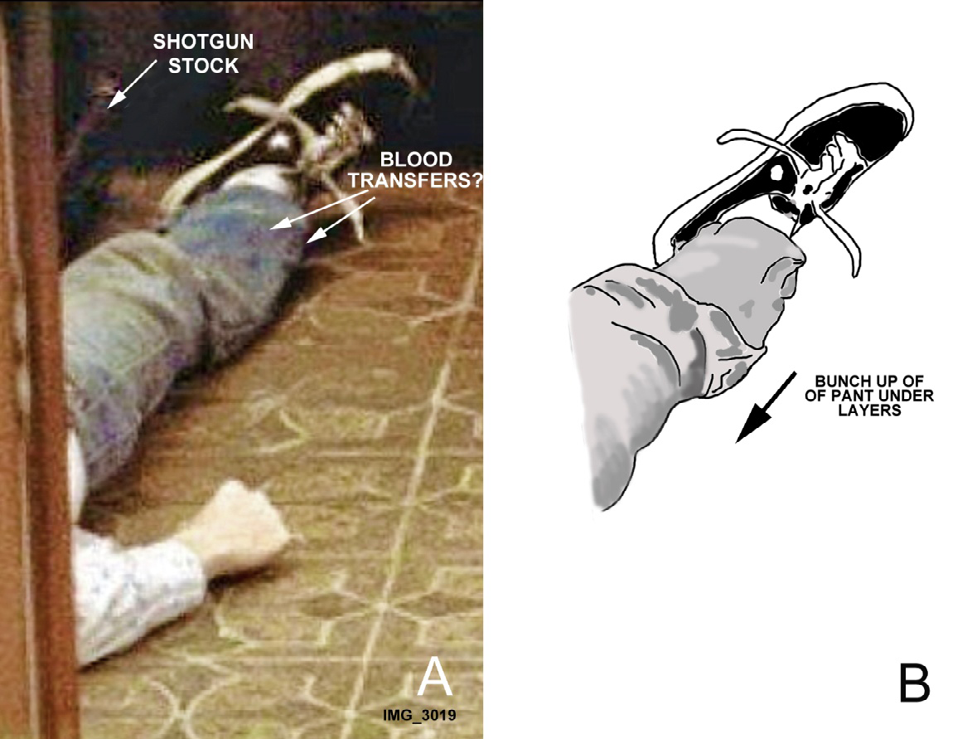
Figure 9. A. Cobain’s right leg, partial right arm, and hand; there appear to be transfer bloodstains on the lower leg pant (arrows), but these are not clearly discernible due to low image resolution. No other bloodstains were obvious on the thigh pant, long sleeve shirt, and hand. The shotgun stock is partially shown. Image cropped from image. B. Drawing from A by author BB that graphically shows the bunching up on Cobain’s thigh three layers of clothing that were under his blue jeans.
The Photograph of the Right Side of Cobain’s Body
Tom Reese, the Seattle Times reporter, took the photograph of the right side of Cobain’s body. The partial digital image of that photograph (Figure 9A) shows:
- No blood spatter or bloodstains were apparent on Cobain’s right shirt sleeve and hand or on the pant leg (Figure 9A) except perhaps on the lower right pant (Figure 9A at arrows), but uncertain due to the low resolution of the image.
- Cobain’s right arm is abducted by approximately thirty degrees from his torso.
- The shirt that Cobain was wearing had small dark squares on a cream backgrouynd indicating the other image of the shirt (Figure 1C) was bloodstained.
- Cobain had three layers of clothing under his jeans, “… an underlying pair of camouflage pants, an underlying pair of grey sweat pants and an underlying pair of white thermal underwear...” [1].
The image of his right side shows that these layers on his lower right leg had been pushed up to his thigh, creating an overstuffed pillow appearance, whereas over his lower leg the pant denim fabric appeared flat (Figure 9).
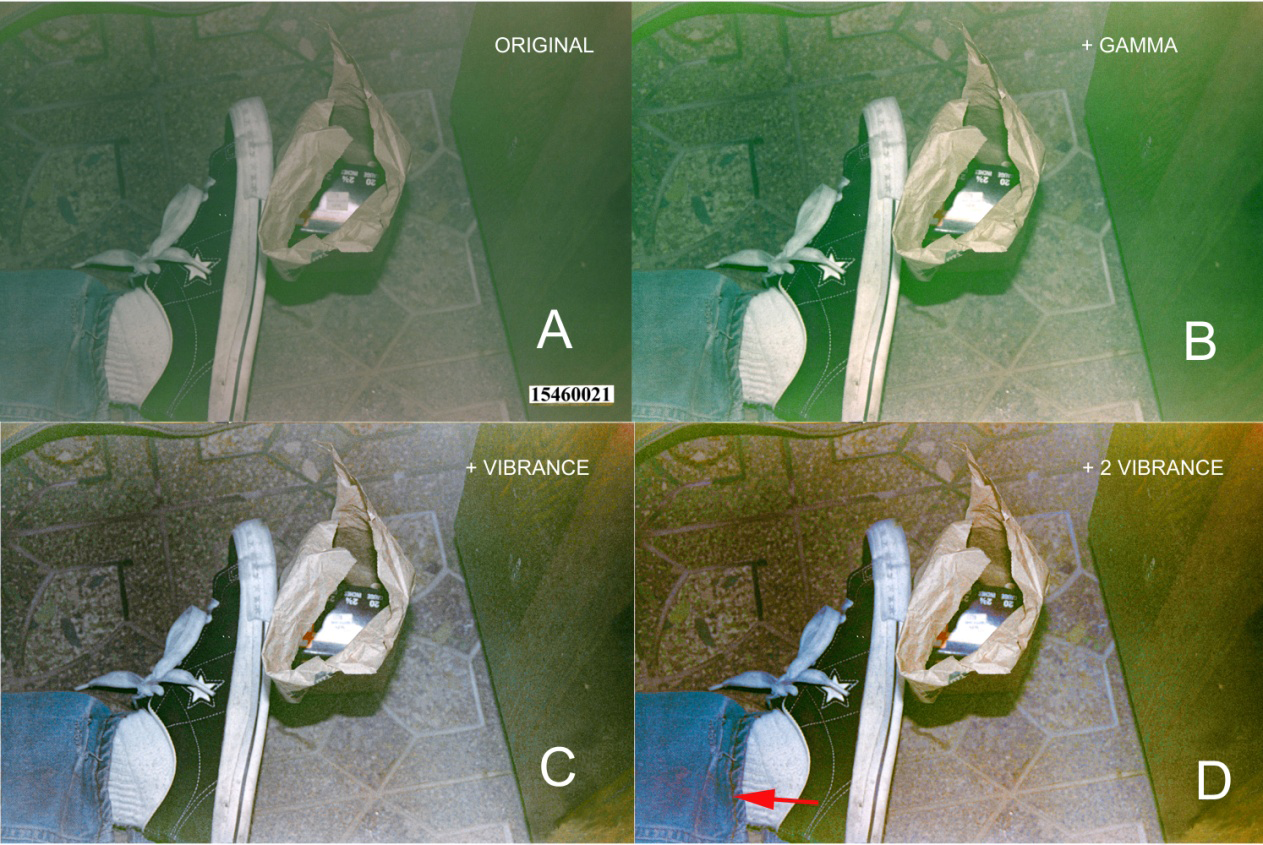
Figure 10. Crime scene image 15460021 from the SPD 2014 image release of the left lower leg and foot; Photoshop processed by author BB. A. The original image released by the SPD of Cobain’s left foot with a bag of 20-gauge shotgun shells; likely the original image was taken directly from the 35-mm negative by the Noritsu Koki scanner. The image resolution was 6096x4042 pixels. The image required enhancement for analysis. B. Gamma adjusted image in Photoshop. C. The gamma-adjusted image enhanced by the Photoshop routine, Vibrance. D. Two additional separate adjustments by the Photoshop Vibrance routine revealed a reddish discoloration on the pant at the arrow.
Bloodstain on Cobain’s Left Pant Leg - Bryan Burnett and Gabriele Rotter
The image 15460021 released by the SPD depicted the medial side of the lower part of Cobain’s pant leg, sock, and shoe (Figure 10A). Images were enhanced in Photoshop with pixel expansion and gamma adjustment (Figure 10B), one adjustment with the Vibrance routine (Figure 10C) followed by two additional Vibrance adjustments (Figure 10D). A red stain on the pant denim became visible with this image processing (Figure 10D arrow).
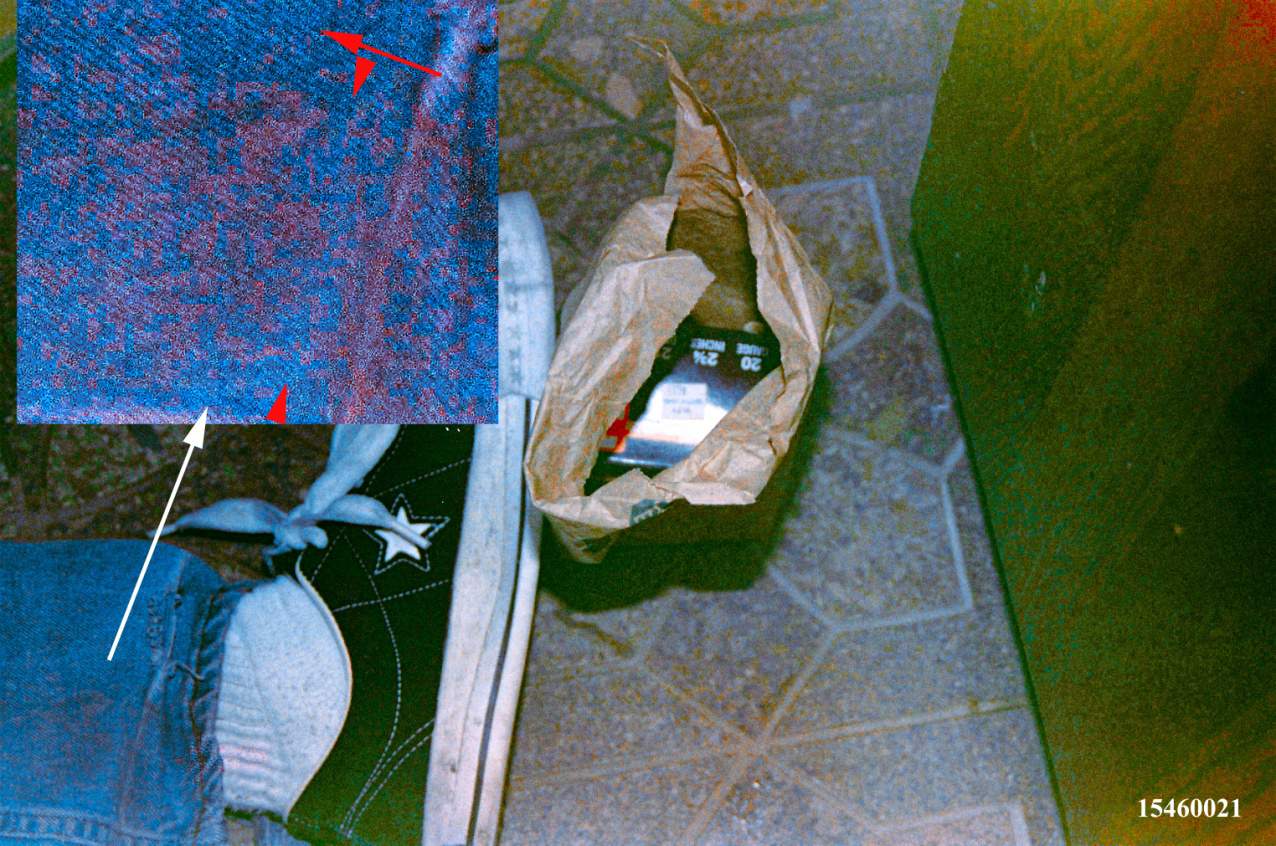
Figure 11. Left lower pant and foot of Cobain after processing (Figure 10); the image processing revealed bloodstains on the pant. Inset. Enlargement of the stained pant area showing detail; the bloodstains are in discreet islet areas. The red arrow indicates the movement direction of the fold when it overlapped the fabric, which created a partial stain void (between arrowheads).
The high resolution of the image allowed for the magnification of that area without pixelation (Figure 11, inset), revealing a bloodstain, given its color, character, and distribution. An image processing artifact can be ruled out, due to the clarity of this image. It is evident that the stain’s filling is irregular and its attenuated distribution is a typical characteristic of transfer bloodstains on fabrics that have a non-smooth texture [30]. Near the center of the stain (Figure 11 inset, between arrowheads), is a partially stained void, likely caused by an overlapping fold in the fabric (to the partial void’s right, arrow in Figure 11 inset) that temporarily prevented blood transfer to this area. There are no police or criminalist reports that this stain was detected in 1994 or later.
The absence of stains on the victim’s left sock and shoe suggests that the transfer bloodstain on the lower left pant leg was due either to a contact with a bloodied hand or contact with a bloodied surface without involving the shoe or sock. The latter is unlikely, unless that occurred and the sock and shoe were replaced during the staging of the body. Regardless of the manner in which the pant leg received this stain, it occurred when the body was moved after the shotgun discharge.
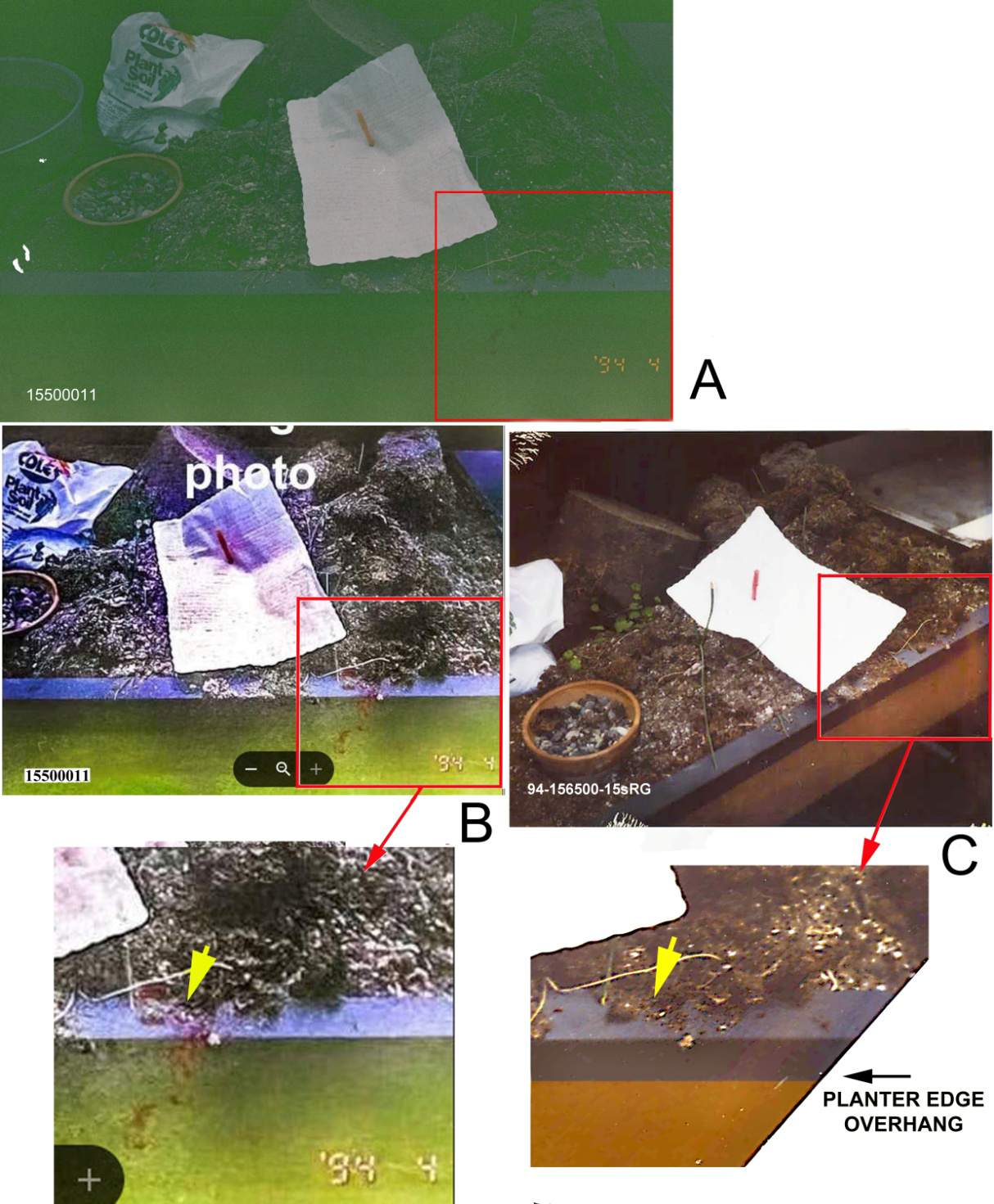
Figure 12. Image of the elevated planter surface and the handwritten alleged suicide letter, which includes an alleged bloodstain on the front of the elevated exterior planter frame; image file numbers are in the lower left. A. The original Apple QuickTake 100/dye-sub print (also Figure 2); the image was expanded to a higher resolution by scanning its dye-sub print (see above). The alleged bloodstain is within the square. Image from the SPD 2014 release. B. Top. Image A was processed by another party using a gamma adjustment and adding features through an image processing program such as Photoshop. Additional features included bright spots throughout the dirt surface and accentuation of the image defect to become a bloodstain. Bottom. Enlargement of the alleged bloodstain area. The arrow points to an area that has been modified by digitally adding dirt fragments and dark red to simulate blood. C. Top. Image from a Polaroid print of the same area as B. Image part of the 2014 SPD release. Bottom. Image of the area of interest rotated, gamma adjusted, sharpened and transformed in Photoshop to show the planter in approximately the same aspect as B bottom; the “bloodstain” in B is an image artifact, not observed in this image. The yellow arrow points to the same area as in B bottom and shows that this area was modified to appear to be a bloodstain.
Pseudo-Bloodstain on the Planter - Bryan Burnett
An alleged bloodstain on the planter close to the suicide note was found by another party by processing digital image
15500011 (Figures 2&12A). As we have noted, bloodstains are often key to determining the manner of death, so we are obligated to examine this image and incorporate the stain, if real, into our hypothesis on the manner of Cobain’s death. However, this image was digitally modified from the original to the image shown in Figure 12B top by an image processing program such as Photoshop. Features were added that were not present in the original image (Figure 12B bottom at yellow arrow). A Polaroid photograph (image 94-156500- 15sRG [7]) shows the same area (Figure 12C) that is devoid of many of these features (i.e., bloodstains and reflective dirt particles) found in Figure 12B. There was no blood on the planter behind Cobain’s body. In addition, the heavily modified bottom image of Figure 12B has also modified the planter frame by removing its overhang, making that surface appear flat (Figure 12B bottom compared with Figure 12C bottom).
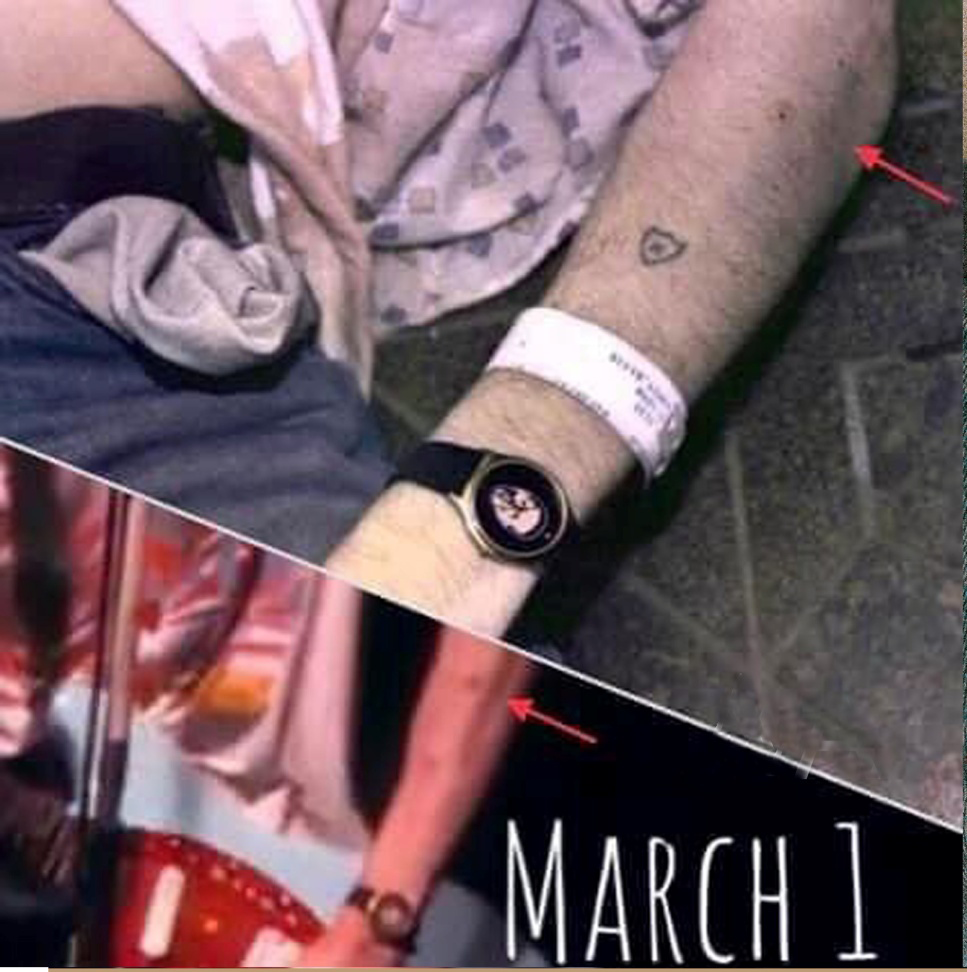
Figure 13. Top. Cropped image from image 15380001 (Figure 1C), showing Cobain’s left dorsal forearm; the arrow points to a punctate wound on his forearm. Bottom. Image extracted from a video tape of Cobain in his last concert on March 1, 1994, in Munich, Germany, more than a month before his death. The red mark on his proximal forearm is likely a bruise that has nothing to do with the punctate wound at that same location on his left arm at the death scene. Image found on the internet by author MW. Image’s original source is unknown.
Syringe Needle Injection Wound on Cobain’s Left Dorsal Forearm - Bryan Burnett
The punctate wound on the left proximal forearm (Figure 13 top, at arrow) of Cobain has received public attention. A video recording of Cobain’s last concert on March 1, 1994 in Munich, Germany, showed that he had a red spot at the same location on his left forearm. A frame grab of this recording showed this was likely a bruise (Figure 13 bottom, at arrow) that would have healed by the time of Cobain’s death on April 5, more than a month later. This image’s low resolution prevented a detailed examination of this defect.
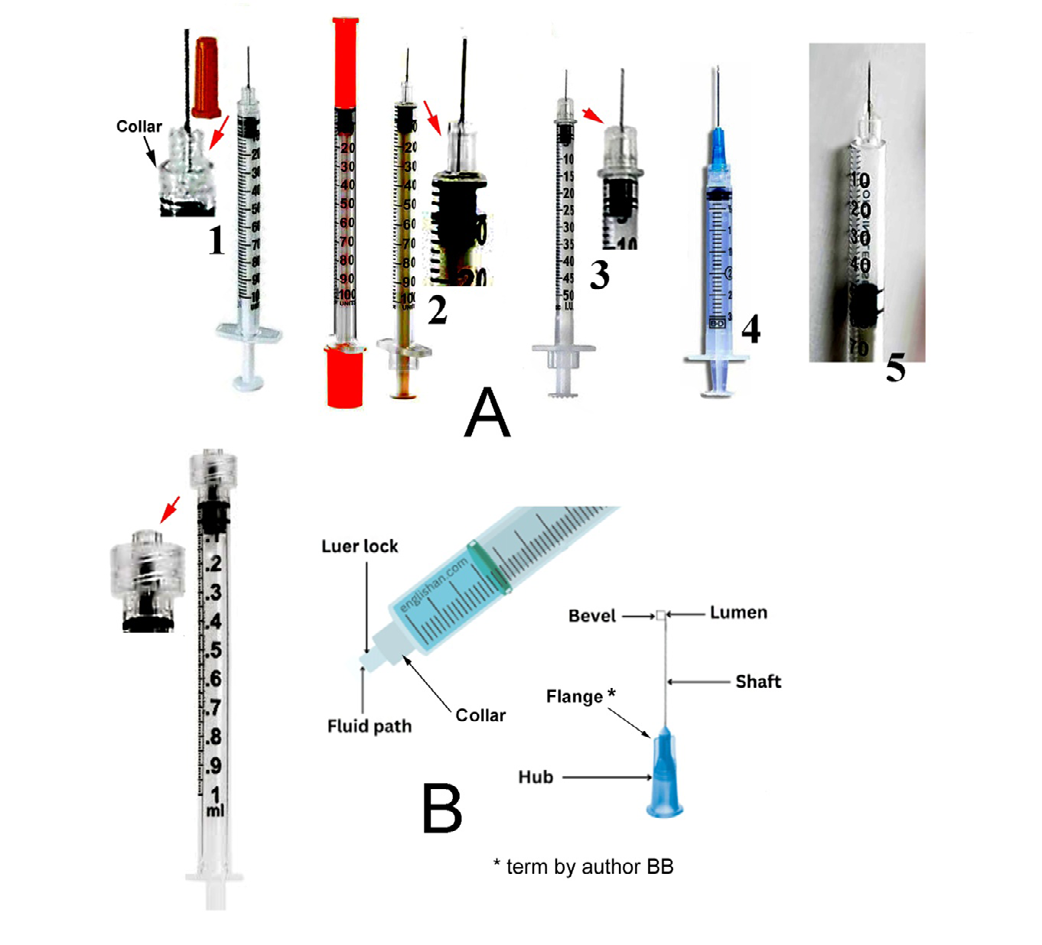
Figure 14. Images of syringes found in a Google search. A. Syringes with needles that are inseparable from the syringe body and designed for single-use injection; syringe 1 differs from the others by having a small collar. B. Syringes with a collar usually have the syringe body separate from the needle so that different size needles can be used. These syringes usually have a higher capacity than most single-use syringes. The syringe parts terminology is provided; the collar covers the hub, except for the flanges, which protrude beyond the collar. The outer collar diameter is 1 cm, measured on syringes from three different manufacturers.
There are two types of syringes: single use or insulin syringes with fixed needles (Figure 14A) and those with a detachable needle (Figure 14B). The single-use syringes have different forms, depending on the manufacturer. The hub is inseparable from the body of these syringes (Figure
14A 1 through 5). The other type, has the “Luer-lock,” with the hub and needle that is detachable, allowing for different needles to be used and perhaps for the syringe body to be reused (Figure 14B).
![Figure 15: A. Likely hypodermic needle wound on Cobain’s left dorsal proximal forearm; inset: an enlargement of the punctate wound showing it is surrounded by a circle of dermal discoloration. Image 15380001 (Figure 1C) from the SPD 2014 release. B. Graphic interpretation of the wound and its surrounding circle of skin discoloration; the presence of flange defects associated with the wound is uncertain. Graphic by author BB. C. Intramuscular injection using a collared syringe showing the collar almost touching the skin; image from Wikipedia [35].](/fulltextimages/14041/fig_15.png)
Figure 15. A. Likely hypodermic needle wound on Cobain’s left dorsal proximal forearm; inset: an enlargement of the punctate wound showing it is surrounded by a circle of dermal discoloration. Image 15380001 (Figure 1C) from the SPD 2014 release. B. Graphic interpretation of the wound and its surrounding circle of skin discoloration; the presence of flange defects associated with the wound is uncertain. Graphic by author BB. C. Intramuscular injection using a collared syringe showing the collar almost touching the skin; image from Wikipedia [35].
Cobain’s left arm punctate wound is surrounded by a circle of slightly discolored skin (Figure 15A inset). The central wound also appears to have bilateral defects, perhaps due to the flanges on the hub (Figure 14B), which is shown in Figure 15B. However, the resolution of this image casts uncertainty on this observation. Intramuscular injections can be almost to the syringe collar (Figure 15C). The features of this wound indicate that Cobain had received an injection by a collared syringe on his left dorsal proximal forearm.
| Watch Face | Defect on Arm | |
|---|---|---|
| COBAIN | 31.1 mm D | 9.1 mm D |
| TEST | 31.2 mm D | 9.4 mm D |
Table 1: Diameter measurements of the watch face on Cobain’s left wrist and the circular defect on his left proximal forearm (Fig
Table 1. Diameter measurements of the watch face on Cobain’s left wrist and the circular defect on his left proximal forearm (Figue 15A). The image was enlarged to approximate the life size for this measurement (60 mm approximate dorsal wrist width). The test measurements were the diameter of author BB’s watch and an inked anterior collar pressed on his arm at approximately the same location as Cobain’s wound and measured. The outer diameter of the test syringe collar was 1 cm.
![Figure 16: Cobain’s heroin prep cigar box found at the scene; the two syringes were the insulin type with the hub as part of the syringe. Of these two insulin syringes, one was speculated by the police investigators to have been used to inject the lethal heroin dose before the shotgun discharge [2]. These syringes appear to be from the same manufacturer as the one in Figure 14A2. There is a black tar heroin rock on the spoon and others in the box.](/fulltextimages/14041/fig_16.png)
Figure 16. Cobain’s heroin prep cigar box found at the scene; the two syringes were the insulin type with the hub as part of the syringe. Of these two insulin syringes, one was speculated by the police investigators to have been used to inject the lethal heroin dose before the shotgun discharge [2]. These syringes appear to be from the same manufacturer as the one in Figure 14A2. There is a black tar heroin rock on the spoon and others in the box.
Measurements of Cobain’s watch face and the circular defect on his left proximal arm (Figure 15A) compared with the measurements of author BB’s round face analog watch and inked collar defect on his arm (Table 1) indicate that Cobain likely had an injection on his left arm by a collared syringe. The syringe impacted his skin forcefully, causing a discoloration by the syringe collar on Cobain’s skin. It also appears that the needle hub (Figure 15A) had a flange and is part of the needle wound, but this is uncertain because the image resolution is insufficient to clearly resolve. The cigar box that was near Cobain’s body did not contain a collared syringe (Figure 16).
The Lethal Heroin Dose - Pietro Zuccarello
Cobain’s toxicology report [1] and the scene photograph indicating a possible intramuscular injection site, conceivably of heroin (Figure 15A), seem inconsistent with the described suicide scenario.
The summarized toxicology panel described a blood morphine concentration of 1.52mg/L and was positive for
6-monoacetylmorphine [1], indicating heroin administration occurred shortly before death. In the suicide scenario described by the SPD [14], Cobain injected this dose himself intravenously and he remained functional for long enough to pack away his heroin kit, move across the room, and shoot himself intraorally with a long firearm.
In the homicide scenario, this dose was injected, likely intramuscularly, by an assailant to incapacitate Cobain in order to facilitate a staged suicide by gunshot.
The available toxicology panel appears to be based on a screening analysis, which may not distinguish between free morphine and glucuronide-bound metabolites such as morphine-3-glucuronide (M3G) and morphine-6- glucuronide (M6G) [36]. Typically, 20-30% of a post-mortem heroin (morphine) dose is free morphine. In Cobain’s case, this would be around 0.5mg/L [37] although without confirmatory testing, the precise level remains uncertain. Free morphine levels above 0.2mg/L are typically fatal [37].
It is not publicly known if a confirmatory analysis was performed in order to establish a more accurate blood concentration of free morphine and report its metabolites. The importance of such investigations was already well known at that time and the required methods were widely understood [38].
To a certain extent, that information is superfluous as M6G has a pharmacological effect similar to that of free morphine. The analgesic properties of M6G were recognized in the early 1970s and studies suggest that it contributes significantly to opioid analgesia and sedation after morphine administration [39]. Regardless, these metabolites would have contributed to the rapid onset of the effects of the last dose of heroin taken, including sedation.
Even without specific information about the metabolites, comparisons can be made with other cases in which the total blood morphine level is reported. Comparison with data from numerous large studies reveals a blood morphine level of 1.52mg/L is significantly higher than is typically seen in fatal overdoses in even the most tolerant users [40, 41, 42], even in cases in which the user has chosen to commit suicide using heroin [43]. This aligns with SPD Detective Ciesynski’s description of Cobain’s dose as ‘an extreme amount of heroin’ and ‘a fatal dose’ [14]. Although heroin is used as a method of non-violent suicide, its presence is much less commonly associated with violent suicide than it is with homicide (OR 2.37 (CI 1.63–3.47)) [44], especially at higher doses [45].
Having been a heroin user for several years, it is possible that Cobain could have tolerated this dose and remained functional. Although the extent of Cobain’s drug use in 1994 is uncertain, various sources indicate that, at this stage in his life, Cobain was a binge user rather than a regular user of heroin [46, 47]. If this was the case, an intravenous dose of this magnitude, as would be the case in the suicide scenario, would likely lead to rapid unconsciousness, followed by profound hypotension (shock), respiratory depression, and hypoxia [48, 49], resulting in a clinical status incompatible with that required in the suicide scenario [50, 51].
Heroin, when administered intravenously, reaches peak plasma concentration in approximately thirty seconds. The drug results in a profound rush of euphoria and contentment lasting around one minute followed by drowsiness (‘the nod’), a heavy leaden feeling of the limbs, and deep sedation lasting several hours [51].
The suicide scenario demands that Cobain, blissfully euphoric and with rapidly progressing impairment of motor function, quickly rolls down his sleeve, recaps his syringe and tidies his heroin kit, moves several feet across the room, and positions a large firearm to discharge intraorally before the sedating effects of the drug take hold. Given intravenously injected heroin’s rapid rate of action, this scenario seems antithetical to the well-established psychological and physiological effects of the drug [49].
The physiological effects of this dose were likely potentiated by the co-presence of diazepam and its active metabolite nordiazepam, which are also CNS depressants that cause sedation and increase the risk of death [52].
In the homicide scenario, Cobain is given a forced intramuscular injection of heroin by an assailant. Intramuscular administration results in a longer duration of action than intravenous administration. The onset of effects is slower than intravenous administration but can still be considered swift in absolute terms [53]. Shortly after administration, Cobain would have likely demonstrated the typical effects of heroin, including sedation, rendering him defenseless [54, 55]. The existence of an intramuscular injection site is suggested by the photographed lesion of a central puncture mark surrounded by a uniform circular ring (Figure 15A), which we interpret as evidence of a forced injection from a collared syringe.
Cobain was left-handed. The identified intramuscular injection site at the left dorsal forearm (Figure 15A) is remarkable as it appears to be the only drug injection site identified on Cobain’s left arm - his dominant side. The only other puncture wound on that side appears to be from phlebotomy at the antecubital fossa by a clinician. According to the autopsy report, all other injection sites and track marks were found on his right arm—consistent with the pattern expected in a left-handed heroin user. In the suicide scenario, this would imply that Cobain injected his dominant arm using his non-dominant hand, a method for which the autopsy indicates no prior evidence [1].
Intramuscular injection is very infrequently seen in heroin users, except for those who are older and have no reliable venous access. The aforementioned phlebotomy at Cobain’s left antecubital fossa would imply venous access remained patent. A relatively young user such as Cobain would be unlikely to self-administer intramuscularly. This route is typically painful, more likely to result in tissue damage and infection, and reduces the intensity of the “high” [56]. A medical professional would not inject or perform phlebotomy at this site so that possibility can be excluded [57].
In summary, intravenous administration of a heroin dose sufficient to result in a blood morphine level of 1.52mg/L would likely lead to intoxication and sedation too quickly to allow for the series of events in the suicide scenario. An intramuscular administration of sufficient force to leave a collar impression seems unlikely to have been administered by Cobain, and could therefore be consistent with the action by an assailant.
Additionally, the black tar heroin ball found on the spoon in Cobain’s heroin kit (Figure 16) appears unused and similar in size to the other presumably unused pieces in the kit. Notably, these pieces are stored loosely and unwrapped. This method of storage is atypical for a heroin user, as black tar heroin is prone to degradation when exposed to air, can smear easily, and may be absorbed by dry materials— any of which could render it unusable [58]. These storage conditions are unusual given common user practice and raise the possibility that the heroin in the kit, including the piece on the spoon, may have been planted as part of a staged scene.
It should also be noted that the large quantity of heroin immediately available to Cobain, as evidenced by the other pieces of heroin in his kit, presented an obvious opportunity for a painless suicidal overdose. With so much heroin available, death would have been certain had suicide been his intent. In the suicide scenario, the violent and devastating gunshot seems unnecessary.
![Figure 17: Images of the alleged suicide letter found at the Cobain death scene. Images from the SPD unknown release date. A. Image of the letter on an elevated planter in the greenhouse; it was written in red ink on a restaurant placemat with a red pen impaling the letter; this was one of the images taken at the death scene on April 8, 1994 and released in 2014. The letter is cupped inward. B. An image of the letter that appeared to have been taken later and the image was subsequently processed which converted the red writing to black and digitally repaired the hole made by the pen. Curiously, the letter appears to be cupped outward, opposite to the letter shown in A. C. A photocopy of the letter; it was flattened and the bottom part of the four lines was removed in this copy. D. The bottom four lines of the letter are a change from the rest of the letter in tone, font size, and style [58]. E. Kurt Cobain’s full signature on the letter.](/fulltextimages/14041/fig_17.png)
Figure 17. Images of the alleged suicide letter found at the Cobain death scene. Images from the SPD unknown release date. A. Image of the letter on an elevated planter in the greenhouse; it was written in red ink on a restaurant placemat with a red pen impaling the letter; this was one of the images taken at the death scene on April 8, 1994 and released in 2014. The letter is cupped inward. B. An image of the letter that appeared to have been taken later and the image was subsequently processed which converted the red writing to black and digitally repaired the hole made by the pen. Curiously, the letter appears to be cupped outward, opposite to the letter shown in A. C. A photocopy of the letter; it was flattened and the bottom part of the four lines was removed in this copy. D. The bottom four lines of the letter are a change from the rest of the letter in tone, font size, and style [58]. E. Kurt Cobain’s full signature on the letter.
The Questioned Suicide Letter - Michelle Wilkins
The questioned suicide letter was found impaled by a red pen into the soil of an elevated planter (Figure 17A) which was behind Cobain’s head. It was written in red ink on a restaurant placemat and has long been cited as a key psychological indicator of suicidal intent, including in the original SPD investigative summaries [2] and in the ME’s declaration of suicide as the manner of death [1]. However, the letter’s physical presentation and internal stylistic contradictions require critical reexamination.
The first image of the alleged suicide letter at the death scene (Figure 17A), shows the placemat cupped inward and pinned to the planter. A second image taken at an unknown date, presents the same letter cupped outward, the scalloped edges cropped, its red writing digitally altered to black, and the hole from the pen digitally repaired (Figure 17B). The image inconsistencies between these two versions of the letter indicate that this second letter image was inappropriately digitally manipulated for any use in a legal setting. A third image (Figure 17C) is a photocopy of the letter with the final four lines removed. These four lines (Figure 17D) are the part of the letter that clearly reference suicidal intent. Their tone is dramatically different from the body of the text above, which reads like a farewell to the music industry rather than a personal goodbye to loved ones. However, linguistic profiling analyses concluded a suicidal intent by Cobain was also expressed in this part of the letter [59, 60].
The chain of custody for the photocopy (Figure 17C) that underwent handwriting analysis is uncertain. A different copy of the letter was part of the SPD 2014 released [2 p 82].
In 1997, the television program Unsolved Mysteries featured court-qualified forensic handwriting experts Marcel Matley and Reginald Alton, who reviewed the letter and publicly expressed concern that it may have been authored by more than one person [61]. The segment brought national attention to the question of authorship and highlighted the tonal shift in the final four lines as suspicious.
To evaluate these concerns further, a forensic handwriting report was recently prepared by James Green, a certified document examiner. The report compared the main body of the letter with its final four lines using letterform structure, slant, and baseline alignment. While Green did not make a conclusive determination that the final four lines were composed by a second author, he noted several “significant and notable” differences between the two sections [62].
Handwriting analyst Mozelle Martin reached a similar, although more decisive conclusion [63, 64]. She asserted that the last lines were written by a second individual, with clear shifts in, formation, and rhythm [63, 64]. However, Martin’s credentials have not been evaluated within a peer-reviewed context, and her findings are presented here as supplemental commentary.
The signature, “Kurt Cobain,” (Figure 17E) was at the bottom of the letter (Figure 17C). The use of his full legal name in this alleged farewell to his wife and daughter, rather than a personal sign-off like “Kurt” or “Love you,” is inconsistent with emotionally intimate communication. This detail, along with the theatrical presentation of the letter on a placemat stabbed into soil, suggests a potentially staged or performative intent. This was also noted in the Unsolved Mysteries presentation [61].
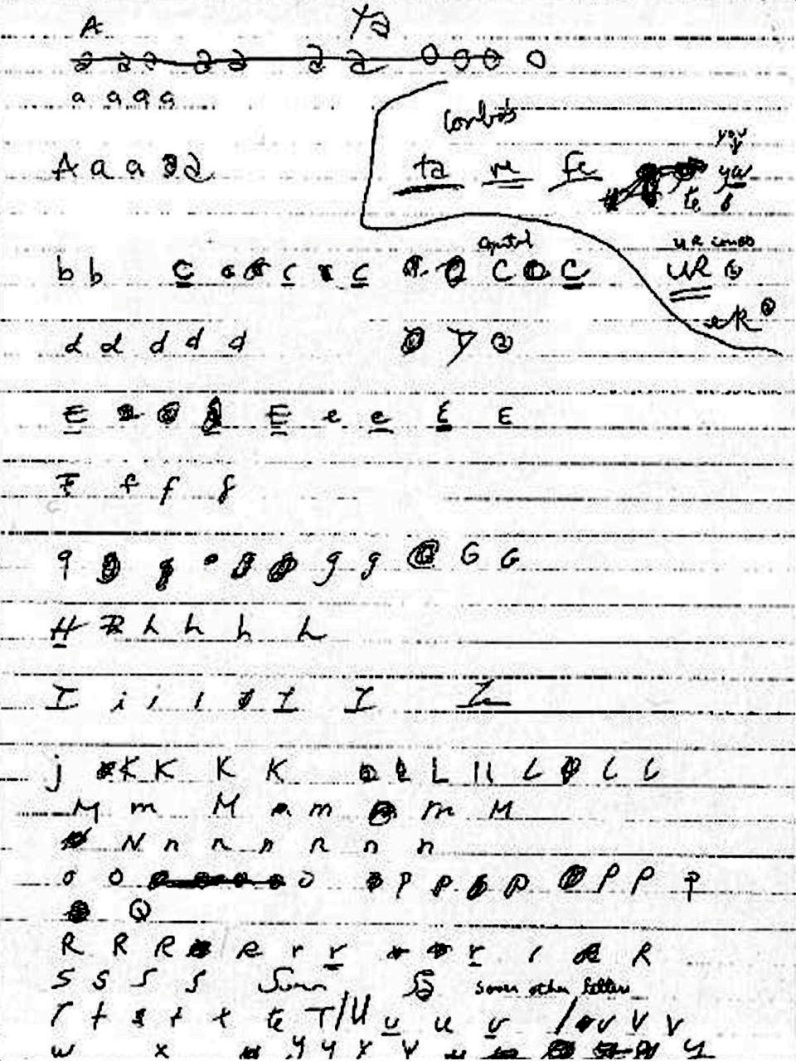
A second document, often referred to as the “practice sheet” (Figure 18), became relevant to the Cobain death investigation. It was discovered by Rosemary Carroll, Cobain and Courtney Love’s entertainment attorney, a short time after Cobain’s death [65]. According to Nick Broomfield’s 1998 documentary, “Kurt & Courtney” [65], Carroll admitted during a phone conversation with a private investigator that she found the practice sheet [65]. She never publicly disputed its alleged source and apparently released the photocopy of the practice sheet (Figure 18). Additionally, Carroll has been cited by multiple sources expressing skepticism about the authenticity of the suicide letter (e.g., [66]). The practice sheet contains many letterforms closely matching those in the final four lines of the questioned suicide letter [62, 63]. Attorney Carroll may still have custody of the practice sheet, although it is possible the SPD has obtained it from her due to its potential evidentiary value.
Discussion
Aspects of Premortem Cobain - Pietro Zuccarello
Cobain’s autopsy report describes findings [1] that may be interpreted as indicative of a period of shock prior to death. If accurately reported and correctly understood, this may suggest greater complexity than a sudden death due to suicide by intraoral gunshot wound alone [67].
This analysis is based on the application of general medical principles to the findings described in Cobain’s incomplete publicly available autopsy report by a non- specialist. Definitive conclusions can only be drawn by a thorough review of the full data, including the histological slides, by a forensic specialist. At present, this information is not available.
Assuming the findings and terminology are recorded accurately, the autopsy report describes several features that would be typically associated with cases involving hypoxia and circulatory collapse (shock) prior to or as a cause of death [68, 69]. These features are: cerebral necrosis [70, 71], hepatic congestion and necrosis [72, 73, 74, 75], pulmonary edema (“Deep red, markedly congested” “frothy, sanguineous fluid in airways”)[76, 77], and conjunctival petechiae [78].
These findings, if they are accurately described, typically require more time to develop than would be expected in a case involving a sudden death due to catastrophic brain injury. Instead, the report may be interpreted as suggesting that Cobain was already moribund from a hypoxic-ischemic event, when the shotgun was fired. A large heroin overdose, as suggested by Cobain’s toxicology report, offers a plausible explanation for these findings, indicating that they may have developed because of prolonged hypoxia and circulatory collapse due to opioid toxicity, rather than occurring solely from the immediate effects of a gunshot wound [68, 69].
Pulmonary edema and conjunctiva petechiae are non- specific findings and may be seen in death from a variety of causes, including trauma. They are however both more typically reported in deaths involving respiratory and circulatory compromise than in those due to traumatic brain injury [76, 78].
It is of course possible that Dr. Hartshorne used the term ‘necrosis’ as a loose term to describe postmortem changes such as autolysis and putrefaction. It should however be noted that microscopic analysis of tissue from Cobain’s heart, which would also be expected to demonstrate signs of decomposition more than three days after death, was reported as having ‘no pathological abnormality’ [1], suggesting this is not the case. Dr. Nikolas Hartshorne died in 2002 and so it is not possible to resolve this with certainty.
For the purposes of this analysis, it is assumed the term ‘necrosis’ was accurately used to describe antemortem events.
Necrosis, being a time-dependent antemortem finding that does not continue postmortem, implies a prolonged period of hypoxic-ischemic injury prior to death [69]. The presence of multi-organ necrosis therefore implies a systemic process of cellular injury and a consequent physiological response that occurred while Cobain was alive. That this process affected the liver, an organ distant to the intraoral gunshot, implies that there may have been a systemically injurious process unrelated to the gunshot.
In life, a person experiencing systemic compromise of this nature would likely be in shock and therefore unconscious [49, 50].
This may suggest that in his final moments, Cobain was in a physiological state incompatible with the cognitive and physical capacity required to commit suicide by a large firearm. Furthermore, there was no documentation of hemo- aspiration on his autopsy, which may simply mean it was not observed. However in the context of a seemingly intact brainstem its absence may suggest that at the time the trigger was pulled, Cobain was not breathing and could not exhibit agonal respiration following the gunshot [79].
These findings may suggest a profound hypoxic-ischemic insult before the gunshot and therefore could raise doubt about the autopsy conclusion of suicide, which requires that Cobain—profoundly intoxicated with heroin and possibly in a critically compromised physiological state—was nevertheless able to pack away his drug paraphernalia and then operate a long-barrelled firearm to fatally shoot himself [1].
In summary, the findings described in Cobain’s autopsy report raise questions that cannot be fully resolved without access to the complete histological and investigative record. While these findings may suggest the possibility of a period of physiological compromise prior to death, their precise interpretation falls within the expertise of a forensic pathologist. A full specialist review is warranted to determine their significance.
Intraoral Shotgun Discharge: Cobain Simulation - Michael Gregory, Bryan Burnett and Felice Nunziata
DiMaio notes, “A contact wound of the head is more likely to produce backspatter than a distant wound… the resultant backspatter stains may be found on the weapon, the shooter and objects in the vicinity” [29 p 105]. The Remington M11 shotgun was found lying on Cobain’s body with his left hand gripping the barrel behind the Cutts compensator and with the weapon unsupported (e.g., Figure 19) as it was in the suicide scenario. The physics of the recoil process should have resulted in the weapon violently recoiling away from Cobain’s mouth upon discharge. In either the suicide or homicide scenarios, a penetrating shotgun wound should have produced backspatter. His left hand on the barrel should have precluded the depositing of blood spatter on the barrel near the fore stock (Figure 7A at STAIN). Cobain’s hand was not in this position at the moment of discharge. In the suicide scenario, Cobain’s left dorsal hand should have been spattered with blood due to its close proximity to the mouth - it was not (Figure 1C). The intraoral angle of the shotgun (Figure 5E) appears to be rare [22] and just on its own should have garnered suspicion by investigators in 1994 that the Cobain death scene was staged.
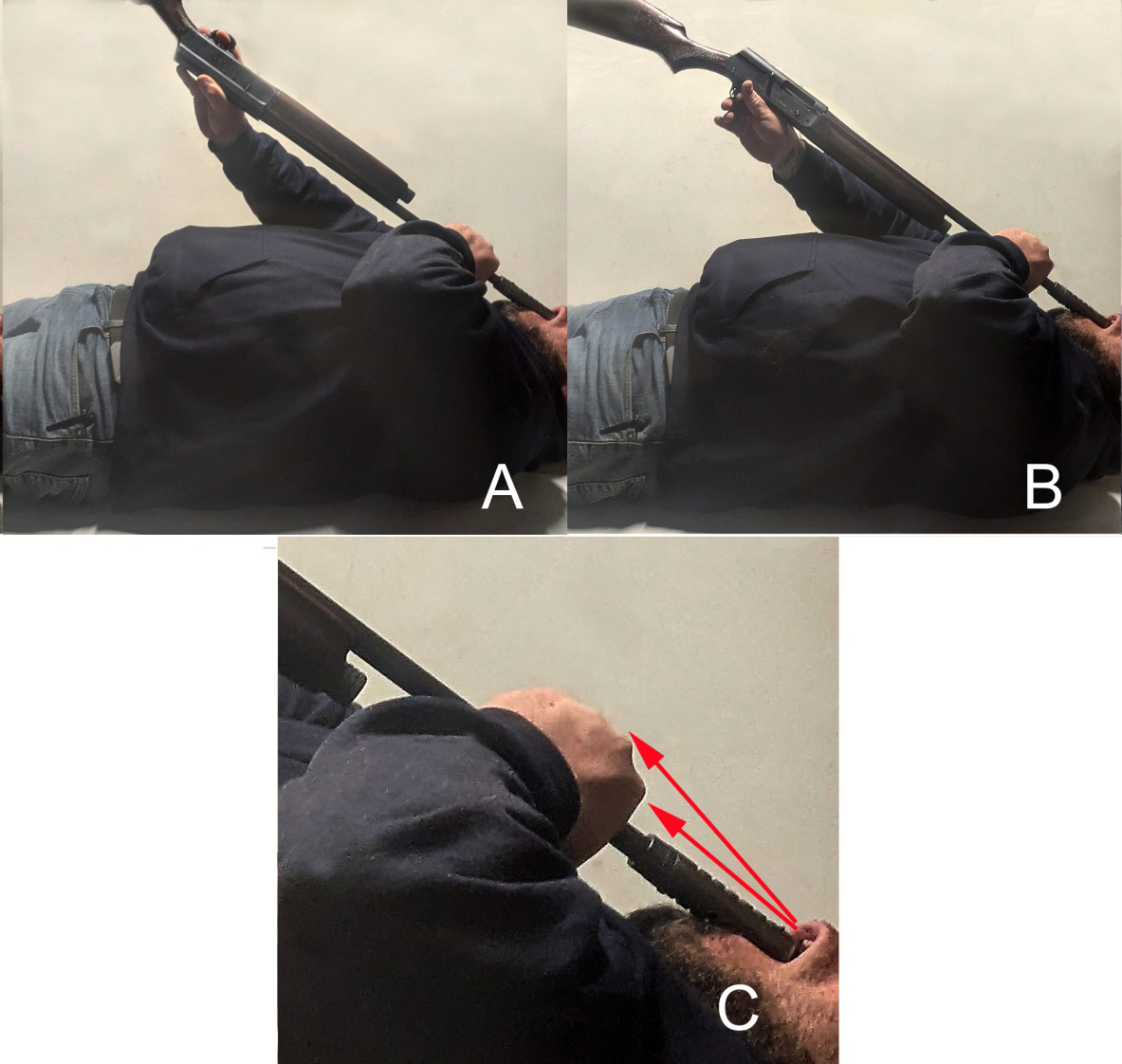
Figure 19. Cobain suicide scenario simulations of the shotgun positions; the simulation shotgun had the same dimensions as the Cobain shotgun (Figure 4C). The compensator muzzle in these simulations was not in contact with the hard palate due to the volunteer’s difficulty in attaining that position. The trigger could be reached in both suicide scenarios with the shotgun trigger either up or down even when the compensator muzzle was not in contact with the hard palate. The left hand, which was gripping the shotgun barrel when Cobain was found, should have had blood spatter if that was the position it was in when the shotgun discharged. It did not (Figure 8A). Images from author MG. A. The shotgun ventral side up (trigger up) simulates the suicide shotgun position prior to discharge at the death scene. B. The dorsal side up (trigger down) position of the shotgun in the suicide scenario; this was not the shotgun position when the body was found but was the position where the backspatter occurred. C. Close-up of the simulation suicide victim; arrows indicate the backspatter projection onto the lateral and part of the dorsal hand in the suicide scenario. The shotgun barrel on the other side of the hand near the receiver (Figure 7A, black arrow) should not have received backspatter in the suicide scenario, yet it had been bloodstained.
Cobain could have reached with his right hand the Remington M11 shotgun trigger with either the ventral side up (trigger up Figure 19A) or dorsal side up (trigger down, Figure 19B) position. Our Remington M11 shotgun has the same dimensions as the Cobain shotgun (Figure 4C). The volunteer noted in the simulation of the suicide scenario that when he tried to put the compensator muzzle in contact with his superior hard palate, that it “…was just extremely uncomfortable to make full contact [with the hard palate]. General discomfort in the simulation; definitely awkward to hold [the shotgun] and engage [the] trigger. I wouldn’t say pain as much as it was difficult to make contact with the palate due to the angle.” The volunteer could reach the trigger even when the compensator muzzle was not in contact with his hard palate (Figures 19A&19B).
The shotgun found with Cobain was ventral side up (trigger up). However, bloodstaining on the dorsal compensator and barrel indicates the discharge occurred when the shotgun was dorsal side up (trigger down; e.g., Figure 19B). If the shotgun was held with the trigger down (Figure 19B), the backspatter that filled the compensator vents would have also impacted the dorsal lateral left hand (Figure 19C). Spatter was not on Cobain’s left hand (Figure 1C).
It is uncertain if Cobain’s neck and shirt near the mouth were spattered without scene body images of this area. However, Cobain’s undershirt and shirt were bloodstained (Figure1C arrows). The available discovery did not mention clothing staining.
![Figure 20: Facial tearing due to intraoral firearm discharges. A. Suicide intraoral shotgun discharge showing massive facial damage; the shotgun stock was supported, which interfered with the recoil out of the victim’s mouth. The shotgun gauge was not divulged from the source. The exit wound, at the arrow, suggests the shotgun muzzle was on the superior hard palate at the barrel angle shown in Figures 5E&19 when it discharged, similar to Cobain’s entrance wound. Image from hermantheshocker. com/intraoral-suicide-with-a-shotgun/. B. Suicide victim by intraoral 12 gauge shotgun discharge causing massive facial tearing. Image from author FN. C. Homicide victim Colonel James Sabow; he showed minimal facial tearing after an intraoral 16-gauge shotgun discharge. The assailants attempted to stage a suicide after first striking him from behind with a club causing severe blunt force trauma to his occipital bone (posterior skull) followed by the intraoral 16-gauge shotgun discharge while he was lying on his side on the ground. The shotgun discharge angle was at approximately 65 degrees and was unsupported. Image from [25].](/fulltextimages/14041/fig_20.png)
Figure 20. Facial tearing due to intraoral firearm discharges. A. Suicide intraoral shotgun discharge showing massive facial damage; the shotgun stock was supported, which interfered with the recoil out of the victim’s mouth. The shotgun gauge was not divulged from the source. The exit wound, at the arrow, suggests the shotgun muzzle was on the superior hard palate at the barrel angle shown in Figures 5E&19 when it discharged, similar to Cobain’s entrance wound. Image from hermantheshocker. com/intraoral-suicide-with-a-shotgun/. B. Suicide victim by intraoral 12 gauge shotgun discharge causing massive facial tearing. Image from author FN. C. Homicide victim Colonel James Sabow; he showed minimal facial tearing after an intraoral 16-gauge shotgun discharge. The assailants attempted to stage a suicide after first striking him from behind with a club causing severe blunt force trauma to his occipital bone (posterior skull) followed by the intraoral 16-gauge shotgun discharge while he was lying on his side on the ground. The shotgun discharge angle was at approximately 65 degrees and was unsupported. Image from [25].
The Dynamics of Intraoral Shotgun Discharges - Felice Nunziata and Bryan Burnett
Intraoral gunshot wounds caused by firearm discharges are quite different from gunshot wounds to other parts of the body [80, 81, 82, 83]. In Cobain, the lack of photographs of his face leaves an evaluation of that gunshot wound and the shotgun recoil behavior at discharge more hypothetical than it would be otherwise.
Walker RV, et al. [81] calculated that the mean oral cavity volume is approximately 111 cm3 if completely open while closed a male [84] mouth can hold on average 76 cm3 if filled to the maximum with water [85].
A 20-gauge cartridge with 27 g of pellets requires an average amount of smokeless powder (average WM = 538) equal to 1.4 g, so the number of moles = 2.7×10⁻³. Using, with the appropriate approximations, the Noble-Abel equation of state [86] considering the gases escaping from the shotgun muzzle with pressure decreases equal to about 1 atm and with a typical temperature of the flash muzzle (≈2000 K) [87], the discharge gas volume is about 490 cm3 [88]. Disregarding the compensator’s diversion of discharge gas, the amount of gas inserted into the mouth/cranium would result in facial injury, especially to the mouth and cheeks.
Part of it could go down to the bronchi and stomach, while part would inflate the cheeks, causing facial tearing. The pellets travel as an independent body outside the bore (see below) and as soon as they exit the muzzle, they pierce the palate and enter the cranium without assistance by the discharge gas.
Cobain’s face should have been severely lacerated (e.g., Figures 20A&20B) not by the pellets, but by the high pressure discharge gas which would have partly invaded the oral cavity, potentially tearing it. However, from the autopsy report [1] and police reports [2], there are no descriptions of significant tearing of Cobain’s face. There are also no estimates as to the amount of gas diverted through the compensator (Figure 7A) that would affect the amount of gas inserted into the mouth and cranium. In Figure 19, the simulated suicide shotgun compensator muzzle was not touching the superior palate in either dorsal or ventral positions of the shotgun, but even with the compensator muzzle touching the superior hard palate, most of the gas would still be expelled from the shotgun compensator vents and muzzle outside of the mouth at discharge.
Newton’s Third Law pertains to the physics of the shotgun recoil when discharged: “Firearm recoil is a direct result of Newton’s Third Law of Motion, which states that for every action, there is an equal and opposite reaction. When a gun fires, the bullet experiences a force that pushes it forward. This force also causes the gun to experience an equal and opposite force, pushing it backward. This backward thrust is what we experience as recoil.” Google AI In the case of a rifle or shotgun discharge, the stock transmits the backward force to the shooter’s shoulder or for suicide, the stock is usually positioned on the floor, which absorbs that backward force. When the rifle or shotgun does not have support (shoulder or floor) and is hand-held at discharge, recoil motion will be observed upon the pellets or bullet exiting the muzzle [21]. For an intraoral discharge, the amount of discharge gas injected into the oral cavity or cranium may depend on whether the firearm is supported.
Intraoral discharge gas pressure can result in extensive facial tearing in either support position, shoulder or floor (e.g., Figures 20A&20B). In Colonel Sabow’s intraoral 16-gauge shotgun discharge, there was minimal tearing at the corners of his mouth (Figure 20C) [25] and that 16-gauge shotgun did not have a compensator. We propose that the 16-gauge shotgun in the Sabow homicide was held only in the hands at discharge, and that the muzzle exited the mouth so rapidly that a large portion of the propellant gas was not injected into the mouth and cranium, resulting in minimal facial tearing.
For Cobain, in either the suicide or homicide scenarios, the shotgun was held only by hands at discharge without support of a shoulder or floor. The retrograde force propelled the compensator muzzle out of the mouth with a portion of the propellant gas exiting the muzzle outside of the mouth, as occurred in Sabow. Gas also exited from the compensator. Cobain likely did not show significant facial tearing resulting from the intraoral shotgun discharge, but still enough discharge gas entered the entrance wound in the hard palate to deposit soot on the wound margin (Figure 5A). However, if he did, it would likely have been similar to that sustained by Colonel Sabow (Figure 20C). Contrast this with extensive facial tearing with an apparently supported shotgun (unknown gauge) (Figure 20A) held at an angle similar to the Cobain shotgun (Figure 5E). Additional Comments on the Dynamics of the Intraoral Shotgun Discharge - Felice Nunziata At the moment of firing, the shooter holding the weapon receives the impact of the weapon on the shoulder (long weapon – rifle. shotgun) or on the arms/hands (short weapon – pistol, revolver), an impact that is more or less strong depending on the caliber or gauge (powder and shot load). The impact is a direct consequence of the physical law of the conservation of impulse (Newton’s Third Law of Motion). Before firing, when the gun and projectile are at rest, the impulse (impulse = mass x velocity) of the system is equal to zero. With the shot, the projectile and the column of gas that follows it acquire an impulse in the direction of the shot, an impulse that is compensated by an equal impulse in the opposite direction and, therefore, towards the shooter, who receives its effects. The column of gas has a speed that is equal to zero on the base of the cartridge case and equal to about the speed at the projectile’s base. At the center of the barrel, it will have an intermediate speed, equal to half the speed of the projectile. The absorption of energy implies that the dissipation of this energy takes the form of physical work. It is not possible to establish, a priori, the way the weapon will be braked by the shooter’s body.
The longer the braking, the less the sensation of recoil, in an inversely proportional relationship. If the weapon is firmly gripped or supported on the shoulder, it becomes one with the hand or shoulder and the value of mass will not only be given by the weight of the weapon but also by that of the part of the body involved, and the sensation of impact will be less. To complicate matters, there is the additional phenomenon of the muzzle rise of the weapon.
For construction reasons, in almost all weapons the barrel is located above the center of gravity of the weapon; therefore, at the moment of firing and with the beginning of the movement of the projectile, the weapon acquires a rotary movement around the center of gravity, which tends to move the muzzle of the barrel upwards and continues even after the projectile has left the barrel.
So, the recoil energy is broken down into two parts, referable to the retrograde movement and the rotary movement, and the prevalence of one or the other depends, in part, also on the shooter’s behavior. The better the shooter controls the muzzle climb, the stronger he will feel the impact of the weapon; the more he lets the muzzle climb freely, the smaller this impact.
This explains how the mechanical structure of the weapon can influence the recoil: a correct distribution of the masses, a correct angle between the barrel and the grip, determine the different distribution of energy. The presence of springs and moving masses in the weapon that contribute to dissipating the recoil energy also serve as a “brake”, shortening the overall braking. The shooter’s physical structure also plays its part: a corpulent person who holds the weapon firmly will add greater muscle mass to the system and greater thicknesses of soft tissue will function as an additional shock-absorbing cushion. The same gases can be used as a brake by using muzzle brakes or compensators: if directed backwards through appropriate notches in the barrel, to compensate for their retrograde impulse, if directed upwards to compensate for the muzzle rise movement.
Having said that, a simplified calculation, which does not take into account the exhaust gases calculated velocity in terms of the de Laval nozzle rule [89], for a free recoil path relative to a Remington Model M11 Sportsman 20-gauge shotgun weighing about 3.5 kg, considering 27 g of lead pellets, 1.4 g of gunpowder, average muzzle velocity of 400 m/s, we would have an impulse of about 12 Ns, the recoil velocity will be about 3 m/s, the recoil energy of about 18 J.
The way Cobain held the shotgun in the suicide scenario, the mechanical constraints that the shotgun stock could have with fixed or movable objects present in the room (floor, chair, feet, etc.) must lead us to the conjecture that the management of the recoil for the person who holds the weapon and positions the muzzle in his own mouth, assumes an important role in the exercise of deductive logic. For example, if not bound by contact with generic objects but held by his hands only, the shotgun should have recoiled violently away from Cobain and not been found in his left hand so clearly, suggesting a staging. It can be deductible that of the numerous hypotheses, at least the following conjectures can be validated, that is, they are suppositions based on apparent and incomplete but likelihood based data:
1. If the stock of the shotgun had not been positioned solidly on a support across its entire rear surface (i.e., movement not blocked on a wall or floor), the shotgun muzzle would have a rapid retrograde from his mouth with discharge gas emanating from the muzzle outside of the mouth.
2. If the stock of the shotgun had been positioned where there is an angled tip of the stock on the floor, it would have raised considerably due to rotation induced by a torque, which expresses, in mechanical modeling, the rotational force imposed on a rigid body around its axis when this force is not applied to its center of mass. The redirected discharge gas by the compensator would counter this rotational force.
3. If the stock had not been placed on a shoulder or floor support and the shotgun was held exclusively in the shooter’s hands with variable gripping force at discharge, would have resulted in an unpredictable retrograde distance and velocity traveled by the shotgun in recoil. In the suicide scenario, the recoil could have removed the shotgun from Cobain’s hands and his left hand found gripping the shotgun barrel suggests a staging should have been considered when determining the manner of death.
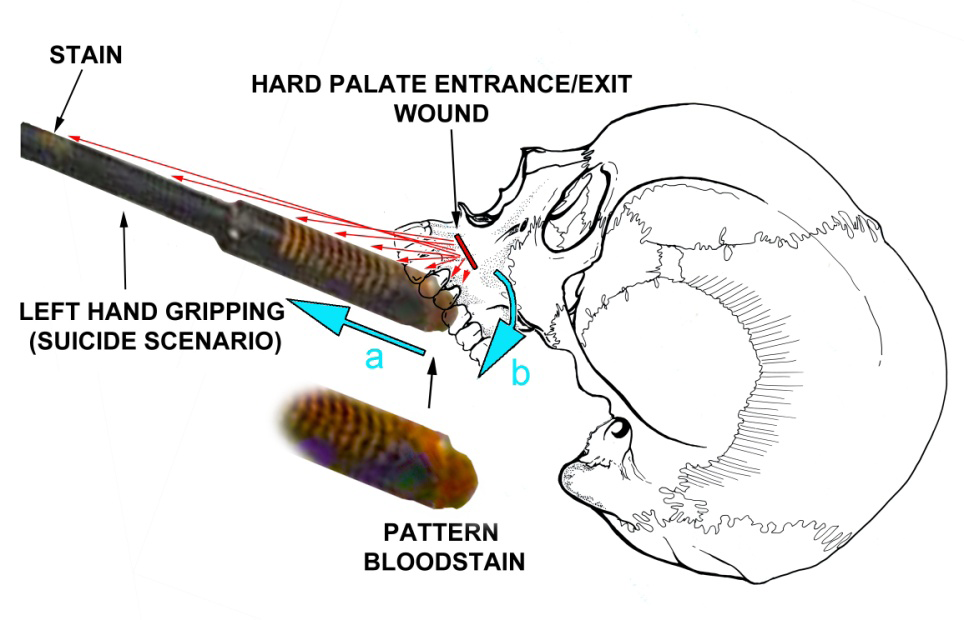
Figure 21. Graphic recreation of the shotgun recoil motion (blue arrows) in either suicide or homicide scenarios, where the retrograde motion of the recoil action (blue arrow a) there was a simultaneous rotation downward (blue arrow b) propelled by the compensator’s 90 degree gas redirect, which created the pattern bloodstain on the compensator muzzle during its retrograde and downward rotation. Backspatter was documented on the dorsal (trigger-down) shotgun compensator and barrel. The surface of the compensator on the vents and the shotgun barrel directly posterior to the compensator did not have discernible staining, indicating that it had been partly or fully rubbed off. The stain on the barrel (at “STAIN”) should not be present in the suicide scenario due to the left hand blocking spatter deposition on that part of the shotgun barrel (e.g., Figure 19C). Graphic by author BB.
Shotgun Recoil and Backspatter
The shotgun compensator muzzle was in contact or near contact on the superior hard palate within Cobain’s mouth (Figure 5E) prior to the shotgun discharge. Upon discharging, recoil would not only pull the compensator muzzle directly back out of his mouth (Figure 21 blue arrow a) but also rotate down (Fig. 21 blue arrow b) due to the compensator gas redirect pushing the barrel down. The pattern bloodstain on the compensator muzzle documents this rotational component of the compensator muzzle recoil. The stain on the barrel documents an unimpeded (left hand not on the barrel) backspatter to the barrel some distance from the compensator (Figure 21 at “STAIN”).
The autopsy report also should have described mechanical damage to the upper airways and due to the compensator muzzle’s downward motion upon the shotgun discharge recoil (Figure 20), the lower teeth were possibly fractured, perhaps the upper teeth as well, as the compensator muzzle recoiled out of Cobain’s mouth. Injuries to the cheeks and teeth, if occurred, could have been described in the missing two pages of the autopsy report [1]. Facial tearing for Cobain are lacking in any reports of that feature [1, 2, 3, 5, 13]. He was easily recognizable. The massive facial damage such as that shown in Figures 20A&20B did not occur.
Conclusions
The Failure of the SPD and King County ME
Why a reexamination of the Kurt Cobain manner of death after more than 30 years? What changed over these years since 1994? It was the autopsy report, found in December 2023 by author MW, which provided the evidence to initiate a new, independent analysis by a multidisciplinary, international group of forensic scientists. This group was brought together by authors MW and BB.
The release of the firearms report (January 2025) with the help of Seattle attorney Mark Larson provided important information about Cobain’s Remington M11 shotgun. Only with the recent discovery of these two reports did we have enough evidence coupled with the SPD images and Tom Reese’s photograph of Cobain’s body (Figure 9A) to determine, by a multidisciplinary approach, that Cobain did not commit suicide.
How is it that the SPD, a large police department and the King County ME missed the evidence of homicide and that the body was a staged suicide? We can only surmise that the investigators, both from the SPD and ME’s office did not have the training or experience in blood pattern analysis (BPA), shotgun behavior, heroin toxicology, the physical condition of the body and clothing, and the features of a staged suicide. Indeed, staged suicides can be challenging to detect even by experienced homicide investigators [12].
The Heroin Overdose
Kurt Cobain likely had a violently injected lethal dose of heroin by a multi-milliliter-capacity collared syringe. The injection site was on his left lateral proximal forearm. The lethal heroin dose quickly induced unconsciousness, possibly in less than a minute. The resultant hypoxia and hypotension resulted in multi-organ toxicity, identified at autopsy by cerebral and hepatic necrosis. Even if Cobain had prepared such a massive heroin dose and self injected, the effects would have been so rapid that he would not have been able to manipulate the shotgun. Cobain was unconscious when the intraoral shotgun discharge occurred.
The Intraoral Shotgun Discharge
The scene investigators reported that the shotgun was on Cobain’s body when he was found and his left hand was around the barrel near the compensator (e.g., Figure 19C). They incorrectly concluded that Cobain died by suicide in the greenhouse:
• Cobain allegedly discharged the shotgun with his right hand and held the barrel near the compensator with his left hand (Figure 18A). The Remington M11will not automatically cycle with his left hand gripping the barrel, which would leave the casing still lodged in the shotgun receiver after discharge [21]. The casing had been ejected and then planted near Cobain’s body in the greenhouse. The recoil dynamics of the shotgun dictate that it should not have been found so neatly across his torso. Cobain was not gripping the barrel with his left hand when the shotgun was discharged. The amount of backspatter could have been reduced from a normal shotgun discharge even without the attached compensator to its muzzle because a portion of the propellant gas exited from the unsupported, hand- held shotgun when it recoiled out of Cobain’s mouth. His mouth being open exceptionally wide and the muzzle contact with the hard palate at an angle (Figure 5E) could also have reduced the amount of gas injected into his cranium. The amount of discharge gas deflected out of the compensator ports (Figure 2B) and not into the cranium is unknown. Regardless, a sufficient amount of gas was injected into Cobain’s cranium for blowback to occur, as evidenced by the backspatter on the Cutts compensator and shotgun barrel (Figure 7A).
• Blood was deposited on the entire dorsal (trigger-down) compensator (Figure 7A) but not on its ventral side (trigger-up, Figure 7C) of the shotgun. The blood filled the vents over the full extent of the dorsal compensator outside of the mouth (Figure 7A), which documents backspatter occurred from Cobain’s intraoral superior hard palate wound. The shotgun could not have rotated from its firing position with the trigger down (Figure 19B) to trigger up (Figure 19A); the latter as found with the body.
• Cobain’s left hand was gripping the shotgun barrel near the compensator [1, 2] when he was found. The entire dorsal compensator was blood spattered, yet his dorsal left hand was not (Figure 1D&8A). Cobain’s left hand was not gripping the shotgun barrel when it discharged.
• A transfer bloodstain on the left thumb (Figure 8B) indicates that the hand was placed on the bloody barrel surface following the shotgun discharge. Blood was not reported on his palm, indicating that Cobain’s left hand may have been cleaned after an initial application to the bloody barrel, inadvertently leaving the stain on Cobain’s thumb or a little blood was on the barrel after an attempted cleaning and Cobain’s hand was placed on the barrel where wet blood remained.
• Cobain’s right arm was in an abducted position from his right side (Figure 9A). In the suicide scenario, in the sitting or supine position, his right hand would be on or near the midline of his torso and should have fallen onto his abdomen, possibly a finger or thumb remaining in the trigger guard, not to his side.
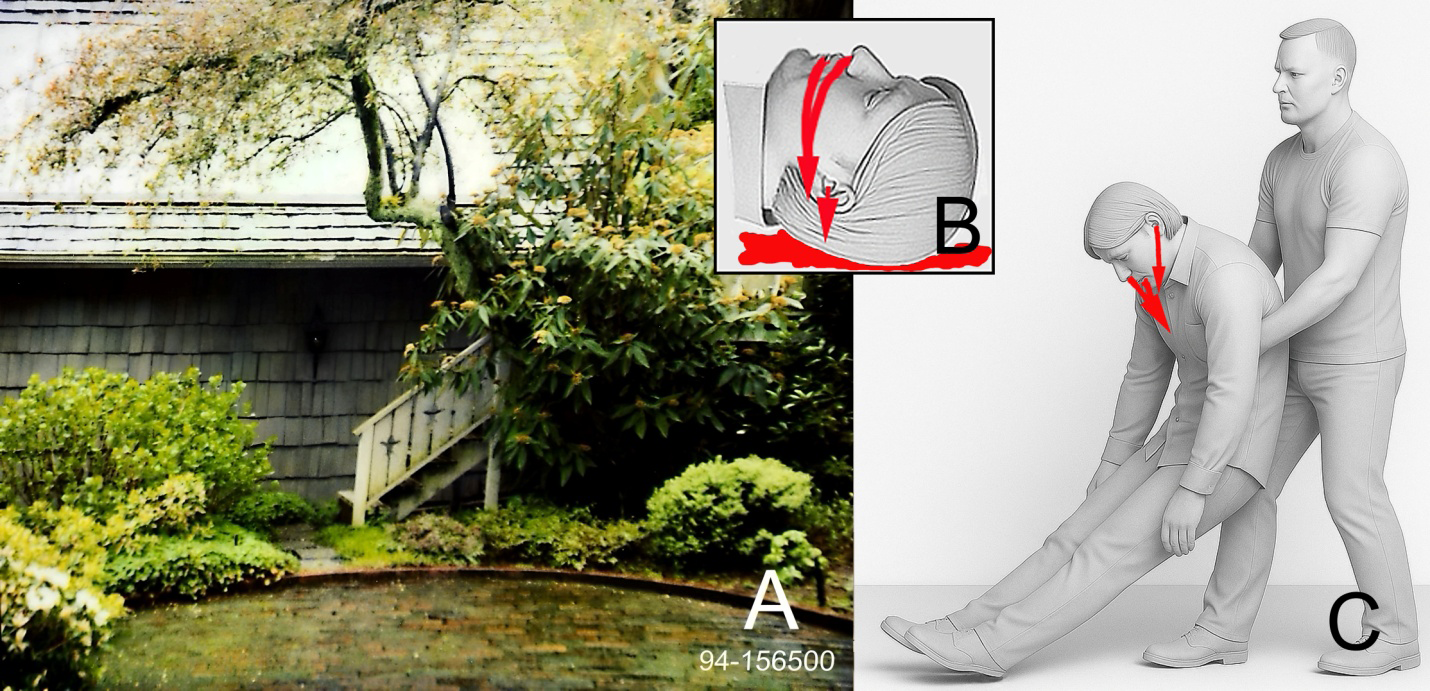
Figure 22. A. Image of the garage/greenhouse showing the stairs to the upper floor greenhouse; Cobain’s body may have been carried up these stairs to the greenhouse, if the homicide occurred at a location other than in the greenhouse. B. Simulation of the blood flow from Cobain’s mouth, nose, and ear canal if he had remained supine on the floor after the shotgun discharge; the blood would have flowed only onto the floor and would pool on the floor under his head and around it, not onto his shirts. Image from authors FN and BB. C. Simulation demonstrating the position of Cobain’s head and bleeding flow direction when his body was picked up from the floor. Any bleeding, with the shifting of his head, would be onto the front of his undershirt and shirt (indicated by arrows) which had been blood soaked (Figure 1C arrows). Following the action shown here, another assailant would have picked up Cobain’s feet, which evidence shows occurred (Figures 9&11) and his head would have remained in this position during the carrying of his body. Image from authors FN and BB.
The Body was Moved: The Shooting did not Occur where Cobain was Found
After the intraoral shotgun discharge, Cobain’s body was moved, either from a different location in the greenhouse prior to the staging of his body or, more likely, he was carried up the exterior stairs at the side of the garage to the greenhouse (Figure 22A).
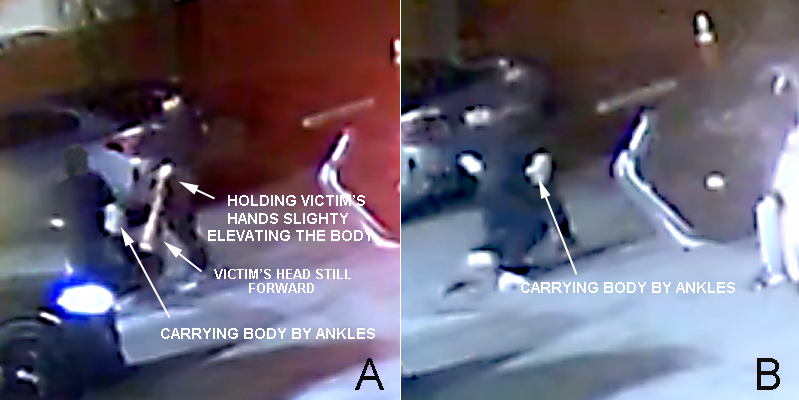
Figure 23. Security camera recording of friends of a homicide victim after a shootout with a rival gang carrying the unconscious, fatally wounded victim to a car to take him to a hospital. Images from author BB. A. The person at the victims feet was holding his ankles; the other person picked up the body by gripping his hands or wrists to elevate his body slightly off the ground. The victim’s head is tilted towards his chest. B. The body was carried to a waiting car.
- If Cobain’s body had not been moved, the blood from his mouth, nose, and left ear canal would have flowed onto his cheeks and neck to the floor (Figure 22B), not onto his shirt. The evidence shows he was likely initially moved by picking up his upper body (Figure 22C). Cobain’s head tilted forward causing blood to flow onto his shirts (Figure 22C) which was documented by bloodstaining on his shirts (Figure 1C arrows). The forward tilt of Cobain’s head, his chin on his chest, would have remained when his feet were picked up. While he was carried, his blood would continue to flow onto his shirts as illustrated in Figure 22C. If there were no barriers to negotiate (e.g. stairs) the body would likely have been carried as shown in Figure 23. The victim’s head is also tilted forward with his chin almost on his chest (Figure 23A) in the carrying of the body by the hands so that bleeding would also go onto his shirt.
- Cobain had three layers of clothing under his jeans, “… an underlying pair of camouflage pants, an underlying pair of gray sweat pants and an underlying pair of white thermal underwear...” [1]. The three layers were pushed off his right lower leg to his thigh (Figure 9). A person carrying his legs up the stairs to the greenhouse would be subjected to a downward force of the body, which would result in his hands on Cobain’s lower legs pushing the jeans and underlying clothing layers from the lower legs toward his thighs. The jeans were pulled back over the lower legs during the staging of the body leaving layers beneath bunched up on his thighs.
- The blood on Cobain’s left lower pant was transferred from a bloodied hand. The fold impression (Figure 11, the partial void between arrowheads) indicates that a bloodied hand gripped the leg, pressing down on the fold for only part of the time while gripping the leg.
The Questioned Suicide Letter
The divergence in tone between the body of the suicide letter (Figure 17C) and its last four lines (Figure 17D), the emergence of a practice sheet (Figure 18) and the letterform consistencies between the last four lines and the practice sheet challenges the authenticity of the suicide letter.
The Homicide Scenario
The assailant, probably with the assistance of at least one other, injected a lethal dose of heroin intramuscularly into Cobain’s left arm with a syringe with a higher volume capacity than an insulin syringe. Unlike the single-use insulin syringe (Figure 14A), the syringe used had a collar (e.g., Figure 14B) which left its impression and a needle mark on Cobain’s left proximal dorsal forearm (Figure 15A). The injection was likely through the long-sleeve shirt he was wearing (Figure 9A) and with force to leave the syringe collar impression on his skin (Figure 15A inset). A struggle may have taken place at the onset of the attack, which is suggested by a right hand abrasion that was described as being “over the dorsal surface of the right middle finger … distal to the knuckle…” [1].
Shortly following the lethal intramuscular injection, Cobain collapsed [53]. An indeterminate time later, during which Cobain was physiologically compromised, the shotgun was discharged intraorally.
The shotgun’s compensator muzzle was at contact or near contact with his superior hard palate (Figures 5A&5B) while he was supine (e.g., Figure 19). The angle of the shotgun compensator muzzle at discharge on the superior hard palate indicates that Cobain’s head was pushed back by the shotgun compensator muzzle in order to achieve the low angle (approximately 35 degrees to his long body axis) of the path of the lead shot (Figure 5E). The shotgun was unsupported at discharge and the muzzle recoiled from Cobain’s mouth. Because the shotgun compensator muzzle was at contact or near contact, the gas injected into Cobain’s cranium resulted in blowback of a bloody backspatter (e.g., Figure 6A). A backspatter was documented by the bloodied dorsal compensator on the shotgun (Figure 7A). Cobain’s left hand was gripping the shotgun barrel near his mouth when he was found and it should have been spattered in the suicide scenario. It was not (Figure 8A). He was not gripping the shotgun barrel with his left hand when it was discharged. In addition, the shotgun had been turned ventral side up (trigger up), opposite the orientation of the shotgun when it was discharged (dorsal side up, trigger down) in Cobain’s mouth, as shown by the blood (backspatter) on the dorsal compensator (Figure 7A) and the patterned bloodstain on the compensator muzzle. The ventral surface of the shotgun was not spattered (Figure 7B). Had Cobain’s left hand been on the barrel when the Remington M11 shotgun discharged, it would have prevented the subsequent ejection of the casing. A casing was not found in the shotgun’s receiver. Cobain’s left hand was not on the barrel when the shotgun discharged.
There was a blood transfer on Cobain’s left thumb (Figure 8B), but blood was apparently not found elsewhere on his hand [1]. His left hand after death was applied to the bloody shotgun barrel, transferring blood at least to his thumb. Part of the dorsal surface of the shotgun barrel as well as the compensator surface appeared to have been wiped (Figure 7A). Blood remained on the barrel (Figure 7A, black arrow) and within the compensator vents and its muzzle (Figure 7A).
There was postmortem manipulation of the body. The ME investigator wrote, “The face in addition, is streaked with blood” [1]. Bleeding was reported only from his mouth and left external auditory canal [1].
Bleeding was also from the nose [14]. The act of changing the body position caused blood to flow onto surfaces in different streams than before (Figure 22), and in this case, that change caused blood to flow onto Cobain’s shirts (Figure 1C, arrows). Blood soaking of Cobain’s shirts indicates that his head was in a position (e.g., Figure 22C) where blood flowed from his nose, mouth and ear canal onto his shirts).
Cobain’s right leg had three layers of clothing under his jean pants, the right pant was pushed up to his thigh (Figure 9) and his left lower pant had a transfer bloodstain by a hand (Figure 11). Cobain’s legs were carried by a second person after the intraoral shotgun discharge. The homicide occurred either in the greenhouse or more likely at a different location and post mortem he was carried up the stairs to the greenhouse (Figure 22A).
There was sufficient time from when the death occurred on April 5 to finding the body on April 8 for the cleanup of bloodstains at the actual shooting site and blood trail from the location of the homicide to the greenhouse floor where the body was found.
The Suicide Scenario
The evidence shows that Kurt Cobain was not a suicide victim.
Expert Opinion and Undisclosed Discovery
Joseph Orantes, crime scene reconstructionist and former head of the San Diego Police Crime Laboratory frequently reminded author BB when working together (1992-1996) on homicide reconstructions, “Remember that a reconstruction is the putting together the physical evidence into a meaningful scenario that best explains a crime scene. There is always uncertainty, where new or missed evidence might significantly alter that scenario.” The opinions expressed in this report are based on the currently available evidence and subject to modification when the restricted images and other, perhaps previously unknown, evidence becomes available. The authors of this report are experts, most with many years of experience in their respective fields.
The Authors
Bryan Burnett, MS is an independent forensic scientist. He has two Master of Science degrees in physiology and has more than 100 publications in marine science, scanning electron microscopy/energy dispersive X-ray spectroscopy (SEM/ EDS), documentation of pneumoconiosis causation, digital imaging, gunshot residue, and crime scene reconstruction. He is a court-accepted expert in SEM/EDS applications which include inorganic agents (e.g., asbestos and silica) in documenting pneumoconiosis and gunshot residue. He has also published crime scene reconstructions in peer-reviewed forensic journals, brburnett73@gmail.com Gabriele Rotter, JD is a criminalist with 15 years of experience in crime scene analysis and reconstruction. He holds specialized expertise in forensic chemistry and Bloodstain Pattern Analysis (BPA). He is the author of several peer-reviewed scientific publications featured in leading international forensic science journals. In addition to his research contributions, he serves as a manuscript reviewer and editorial board member for several internationally recognized forensic journals. In Italy, he has been appointed as a forensic expert in criminal proceedings both for the prosecution and as a court-appointed expert witness. gabriele.rotter@gmail.com Michael Gregory is a former US Marine Corps Non- Commissioned Officer who was involved as a Primary Marksmanship Instructor before his discharge. He has over thirty years of firearms experience. He holds several certifications for explosive material handling, and for over 10-years had been involved in electronics warfare, and the repair and maintenance of multiple surface- to- air and man-fired rocket systems. He is currently an ATF Federal Firearms licensee and has a gunsmithing business in central Pennsylvania. mikegregory156@yahoo.com Felice Nunziata, PhD is a physicist and forensic scientist. He is working at the National Research Council and is often appointed as a consultant for the Italian judicial authorities and sometimes for lawyers: His scientific interests are mainly focused on understanding non-equilibrium thermodynamics during the formation of inorganic gunshot residues, firearms discharge phenomena and gunshot wound from a physical point of view. felice.nunziata@stems.cnr.it Pietro Zuccarello, PhD is a Legal Medicine Researcher, specialist in Forensic Toxicology. He has more than fifty international publications. He is co-inventor of the analytical procedure entitled “Method for the extraction and determination of microplastics in organic and inorganic matrix samples”, patent method nationally and internationally protected (PCT/IB2019/051838 of March 7, 2019 - Italian patent number 102018000003337 of March 07, 2018). He won two awards for the best research at National congress’s, first in public health and second in forensic toxicology. pietro. zuccarello@unipegaso.it Cataldo Raffino, MD is a specialist in legal medicine who has served for the past 23 years as a Medical-Legal Officer (RLP)
at the INAIL Medico-Legal Department in Enna, Sicily. For over 25 years, he has also worked as an independent forensic pathologist and expert consultant for numerous courts throughout Sicily and Calabria (Italy), having performed approximately 1,500 autopsies. Over the years, he has developed particular expertise in forensic traumatology, with a special focus on firearm-related injuries, including wound and terminal ballistics. cataldo.raffino@gmail.com - cr.medicinalegale@aol.com Michelle Wilkins is an independent researcher and a former music journalist turned investigative researcher, currently leading a comprehensive inquiry into the death of iconic musician Kurt Cobain, a project she embarked on in 2023. With a deep-rooted passion for music and a keen eye for detail, Michelle utilizes her background in journalism to unravel the complexities surrounding Cobain’s legacy and the circumstances of his untimely passing. miwi@ forensicjournal.org
Acknowledgements
We wish to thank:
- Mark Larson for making possible the release of the full firearm report [11].
- Johnnie Ireland for the higher resolution image of Cobain’s right body (Figure 9A).
- Damien Gregory for his valuable assistance in this study.
- Jon Wilkins for assisting in the rendering of Figure 22C.
- Ashleigh Willis for proofreading of the manuscript.
- Dr. Anthony McNamara for assisting in writing of the toxicology section.
- Matt Beall for his support throughout this study
References
-
Hartshorne N (1994) Medical Examiner Determination: Cobain, Kurt Donald. Report obtained from Cobain family member, January 2024. https://meixatech.com/ COBAIN-AUTOPSY_REPORT.pdf Accessed 13 Sept 2025
-
Seattle Police Department (1994) Police investigation documents: cobain_notebook1.pdf, Released from SPD 2014, pp: 1-195. https://meixatech.com/COBAIN- NOTEBOOK1.pdf Accessed 13 Sept 2025
-
Seattle Police Department (1994) Police investigation documents: cobain_notebook2.pdf, Released from SPD 2014, pp: 112-225. https://meixatech.com/COBAIN- NOTEBOOK2.pdf Accessed 13 Sept 2025
-
Anon (2014) New Kurt Cobain suicide scene photos released; reexamination tells us nothing new. Associated Press.
-
Ciesynski M (2014) Case Investigation Report: Cobain, Kurt Donald. Seattle Police Department. https:// nirvana-legacy.com/wp-content/uploads/2014/04/ spd_policefile_27df.pdf . Accessed 13 Sept 2025
-
MacKay R (2016) Seattle police release 5 photos of shotgun that rock legend Kurt Cobain used to commit suicide. Fox13 Seattle.
-
Seattle Police Department (1994–2016) Cobain death scene images taken in 1994 and 2016 images of SPD detective Ciesynski holding Cobain’s Remington M11 shotgun. https://meixatech.com/Cobain_Images.html . Accessed 13 Sept 2025
-
Edwards B (2011) Looking back at 35 years of the digital camera. MacWorld.
-
Kruse B (2015) Lawsuit to release Kurt Cobain death photos dismissed. Fox13 Seattle.
-
Domonoske C (2018) Court dismisses latest attempt to acquire Kurt Cobain’s death scene photos. NPR.
-
Herbert LD (1994) Shotgun examination, Kurt Cobain. "http://www.meixatech.com/COBAIN-SHOTGUN_ REPORT.pdf"www.meixatech.com/COBAIN-SHOTGUN_ REPORT.pdf(released January 2025)
-
Pettler LG (2016) Crime scene staging dynamics in homicide cases. CRC Press, Boca Raton.
-
Darke S, Sunjic S, Zador D, Prolov T (1997) A comparison of blood toxicology of heroin-related deaths and current heroin users in Sydney, Australia. Drug Alcohol Depend 47(1): 45-53. https://pubmed.ncbi.nlm.nih. gov/9279497/ . Accessed 13 Sept 2025
-
Ciesynski M (2014) Interview of Detective Ciesynski on the death of Kurt Cobain. RAW VIDEO: Detective Mike Ciesynski Seattle Police Re-investigates Kurt Cobain’s Death. "https://www.youtube.com/ watch?v=VRpTXUytG2I"RAW VIDEO: Detective Mike Ciesynski Seattle Police Re-investigates Kurt Cobain's Death . Accessed 13 Sept 2025
-
https://en.wikipedia.org/wiki/Apple_QuickTake. Accessed 13 Sept 2025.
-
Google AI (2025) Explanation of dye-sublimation white spot defects. Statement confirmed by author BRB.
-
Fancher MR (1994) Photo of death showed grim reality of choice Cobain made on life. The Seattle Times.
-
Burnett BR (2007) Examination of a 30+ year-old homicide with a Ruger .44 magnum carbine that has no remaining physical evidence. Meixatech, USA. https:// meixatech.com/AccidentalShooting.pdf . Accessed 13 Sept 2025
-
Wagner SA (2009) Death scene investigation: A field guide. CRC Press, Boca Raton, FL.
-
Google AI (2025) Description of shotgun compensator function.
-
"http://www.meixatech.com/REMINGTON_M11_TEST. mp4%202025"www.meixatech.com/REMINGTON_ M11_TEST.mp4 2025. Accessed 13 Sept 2025
-
Zietlow C, Hawley DA (1993) Unexpectedly homicide. Am J Forensic Med Pathol 14(3): 230-233.
-
Wecht CH, Graham MA, Hanzlick RL (2016) Forensic pathology in civil and criminal cases. 4th ed. Juris Publishing, Huntington, NY.
-
Grant T, Richer R (2014) The mysterious death of Kurt Cobain: Suicide or murder-You decide. Kindle Edition.
-
Burnett BR (2017) The homicide of United States Marine Colonel, James E. Sabow: A forensic analysis submitted to the United States Congress. J Forensic Res 8: 362. https://doi.org/10.4172/2157.1000362
-
Burnett BR, Raffino C, Sabow JD (2024) The Billey Joe Johnson homicide. Int J Forensic Sci 9(1): 1-16. https:// doi.org/10.23880/ijfsc.16000367
-
Burnett BR, Nunziata F, Raffino C, Sabow D (2022) Errors, omissions and mistaken testimony in a shooting case. Forensic Sci Int Rep. https://doi.org/10.1016/j. fsir.2022.100288
-
MacDonell HL, Brooks BA (1977) Detection and significance of blood in firearms. Leg Med Annu (1977): 183-199.
-
DiMaio VJM (2016) Gunshot wounds. 3rd ed. CRC Press, Boca Raton.
-
Wolson TL (2025) Handbook of Bloodstain Pattern Analysis. 1st ed. Taylor & Francis Group, Oxford.
-
Bevel T, Gardner RM (2008) Bloodstain pattern analysis: with an introduction to crime scene reconstruction. 3rd ed. CRC Press/Taylor & Francis, Boca Raton.
-
James SH, Kish PE, Sutton TP (2005) Principles of bloodstain analysis. CRC Press, Boca Raton.
-
Eckert WG, James SH (1989) Interpretation of bloodstain evidence at crime scenes. Elsevier, New York, NY.
-
Remington (2025) M11 20-gauge shotgun compensator: came in steel or aluminum depending on caliber with a black finish. https://www.lymanproducts.com/media/ user/file/c/u/cutts_compensator.pdf . Accessed 13 Sept 2025.
-
https://em.wikipedia.org/wiki/Intramuscular_ injection . Accessed 13 Sept 2025.
-
Aherne GW, Aitkenhead AR, Piall E, Burton NK (1984) Morphine in plasma: comparison of results obtained by HPLC and RIA. In: Reid E, Wilson ID (Eds.) Drug Determination in Therapeutic and Forensic Contexts. Methodological Investigations in Biochemistry and Analysis, vol 14. Springer, Boston, MA, pp: 2397-2412. https://doi.org/10.1007/978-1-4613-2397-6_42
-
Meissner C, Recker S, Reiter A, Friedrich HJ, Oehmichen M (2002) Fatal versus non-fatal heroin “overdose”: blood morphine concentrations with fatal outcome in comparison to those of intoxicated drivers. Forensic Sci Int 130(1): 49-54. https://doi.org/10.1016/S0379- 0738(02)00343-2
-
Cimbura G, Koves E (1981) Radioimmunological screening and gas chromatographic determination of morphine and related narcotic analgesics in post mortem blood. J Anal Toxicol 5(6): 296-299. https://doi. org/10.1093/jat/5.6.296
-
Andersen G, Jensen NH, Christrup L, Hansen SH, Sjøgren P (2002) Pain, sedation and morphine metabolism in cancer patients during long-term treatment with sustained-release morphine. Palliat Med 16(2): 107- 114. https://doi: 10.1191/0269216302pm512oa
-
Darke S, Ross J (2000) Heroin-related deaths in regional New South Wales, 1992-96. Drug Alcohol Rev 19: 35-40. https://doi.org/10.1080/09595230096129
-
Jones AW, Holmgren A, Ahlner J (2012) Concentrations of free-morphine in peripheral blood after recent use of heroin in overdose deaths and in apprehended drivers. Forensic Sci Int 215(1-3): 18-24. https:// doi: 10.1016/j. forsciint.2011.01.043
-
Alghamdi A, Alsaeed A, Alzahrani S, Alzahrani M, Alzahrani A, Alzahrani A, et al. (2023) Heroin-related fatalities in Jeddah, Saudi Arabia, between 2008 and 2018. Toxics 11(3): 248. https://www.mdpi.com/2305- 6304/11/3/248
-
Darke S, Duflou J, Torok M (2010) Comparative toxicology of intentional and accidental heroin overdose. J Forensic Sci 55(4): 1015-1018. https://pubmed.ncbi.nlm.nih. gov/20384920/
-
Darke S, Duflou J, Torok M (2009) Drugs and violent death: comparative toxicology of homicide and non-substance toxicity suicide victims. Addiction 104(6): 1000-1005. https://doi.org/10.1111/j.1360-0443.2009.02565.x.
-
Darke S, Duflou J, Kaye S (2007) Comparative toxicology of fatal heroin overdose cases and morphine positive homicide victims. Addiction 102(11): 1793-1797. https://doi.org/10.1111/j.1360-0443.2007.01980.x.
-
Wallace M, Halperin I (2004) Love and Death: The Murder of Kurt Cobain. Atria Books, New York.
-
Vox-Nihil (2025) Kurt Cobain’s final journal entry, written in rehab and dated just one week before his suicide. Reddit. https://www.reddit.com/r/grunge/ comments/19c8fiu/kurt_cobains_final_journal_entry_ written_in_rehab/
-
Krantz MJ, Palmer RB, Haigney MCP (2020) Cardiovascular complications of opioid use: JACC state- of-the-art review. J Am Coll Cardiol 77(2): 205–223. https://doi.org/ 10.1016/j.jacc.2020.11.002
-
Feng G, Luo Q, Guo E, Yao Y, Yang F, et al. (2015) Multiple organ dysfunction syndrome, an unusual complication of heroin intoxication: a case report and review of literature. Int J Clin Exp Pathol 8(9): 11826-11830. https://pmc.ncbi.nlm.nih.gov/articles/PMC4637751/#
-
Hovstadius J, Wiklund L, Karlsson T, Martensson L (1999) Profound circulatory shock following heroin overdose. Resuscitation 40(1): 49-52. https://www.sciencedirect. com/science/article/pii/S0300957298000653
-
Milella MS, D’Ottavio G, De Pirro S, Barra M, Caprioli D, et al. (2023) Heroin and its metabolites: relevance to heroin use disorder. Transl Psychiatry 13(1): 120. https://doi. org/ 10.1038/s41398-023-02406-5
-
Bannon MJ, Lapansie AR, Jaster AM, Saad MH, Lenders J, et al. (2021) Opioid deaths involving concurrent benzodiazepine use: assessing risk factors through the analysis of prescription drug monitoring data and postmortem toxicology. Drug Alcohol Depend 225: 108854. https:// doi: 10.1016/j. drugalcdep.2021.108854
-
Skopp G, Ganssmann B, Cone EJ, Aderjan R (1997) Plasma concentrations of heroin and morphine- related metabolites after intranasal and intramuscular administration. J Anal Toxicol 21(2): 105-111. https:// doi.org/10.1093/jat/21.2.105
-
National Institute on Drug Abuse (2021) What are the immediate (short-term) effects of heroin use? NIDA Research Report. https://nida.nih.gov/publications/ research-reports/heroin/what-are-immediate-short- term-effects-heroin-use
-
Perekopskiy D, Kiyatkin EA (2019) 6-Monoacetylmorphine (6-MAM), not morphine, is responsible for the rapid neural effects induced by intravenous heroin. ACS Chem Neurosci 10(8): 3409-3414. https://doi.org/10.1021/ acschemneuro.9b00305
-
Meyer M, Eichenberger R, Strasser J, Dürsteler KM, Vogel M (2021) “One prick and then it’s done”: a mixed- methods exploratory study on intramuscular injection in heroin-assisted treatment. Harm Reduct J 18(1): 134. https://doi.org/10.1186/s12954-021-00584-3.
-
Northumberland, Tyne and Wear NHS Foundation Trust (2015) Appendix 2 – Intramuscular Injection (IMI) Sites. https://www.cntw.nhs.uk/wp-content/ uploads/2015/06/AMPH-PGN-10-IMI-App2-Injection- Sites-V01-iss-Sep7.pdf
-
Tampa Opioid Treatment Center (2025) Black tar heroin: sticky and sinister. https://www.tpoftampa.com/black- tar-heroin-sticky-and-sinister/
-
Sudjana ETS, Fitri N (2013) Kurt Cobain’s suicide note case: forensic linguistic profiling analysis. Int J Criminol Sociol Theory 6(3): 217-227.
-
Fata IA, Yusuf YQ, Kamal R, Namaziandost E (2021) The characteristics of linguistic features enfolded in suicide notes. J Lang Linguist Stud 17(2): 720-735. https://doi. org/10.53462/jlls.50
-
Unsolved Mysteries (1997) Segment featuring forensic handwriting of Cobain suicide letter by handwriting analysts Marcel Matley and Reginald Alton. NBC.
-
Green J (2025) Forensic Handwriting Report on the Cobain Note. https://www.meixatech.com/ CobainGreenReport.pdf
-
Martin M (2025) Handwriting analysis of Kurt Cobain’s suicide note. Did Kurt Cobain Write the Whole Note? A Forensic Handwriting Expert’s Findings. Medium.
-
Martin M (2025) Forensic graphology: the salient witness in cold case investigations. Forensic Magazine. https://www.forensicmag.com/3425-Featured-Article- List/619234-Forensic-Graphology-The-Silent-Witness- in-Cold-Case-Investigations/ . Accessed 13 Sept 2025
-
Broomfield N (1998) Kurt & Courtney. Documentary film examining the life and death of Kurt Cobain.
-
Facebook (2025) April 13th: Meeting with Courtney’s entertainment attorney Rosemary Carroll. https://www. facebook.com/WeCareAboutKURT/posts/april-13thi- met-with-courtneys-entertainment-attorney-rosemary- carroll-at-her-ho/3120697534852665/ . Accessed 13 Sept 2025
-
Karger B, Billeb E, Koops E, Brinkmann B (2002) Autopsy features relevant for discrimination between suicidal and homicidal gunshot injuries. Int J Legal Med 116: 273-278. https://doi.org/ 10.1007/s004-002-0325-8.
-
Morley S, Deboys L, Bunning C (2024) Autopsy when drugs or poisoning may be involved. In: Youd E, Swift B (Eds.) Guidelines on autopsy practice. 2nd ed. The Royal College of Pathologists, London. https://www.rcpath.org/static/ f855f467-c352-40a0-aba5c51fdcd4f876/844e58cc- c0da-4b1d-b1fb10a34ef9f225/G169-Guidelines-on- autopsy-practice-when-drugs-or-poisoning-may-be- involved.pdf
-
Goldspring R, Scott I (2023) Guidelines on autopsy practice: traumatic brain injury. The Royal College of Pathologists, London. https://www.rcpath.org/ static/263764cd-19a6-4ba2-84ac1371bddf13a1/ guidelines-autopsy-practice-traumatic-brain-injury.pdf
-
Lacerte M, Hays Shapshak A, Mesfin FB (2023) Hypoxic brain injury. In: StatPearls [Internet]. StatPearls Publishing, Treasure Island (FL). https://www.ncbi.nlm. nih.gov/books/NBK537310/
-
Love S, Perry A, Ironside JW, Budka H, eds. (2015) Greenfield’s Neuropathology. 9th ed. CRC Press, Boca Raton, p. 155. https://api.pageplace.de/ preview/DT0400.9781498729055_A35202900/ preview-9781498729055_A35202900.pdf
-
Regina AC, Goyal A, Mechanic OJ (2025) Opioid toxicity. In: StatPearls [Internet]. StatPearls Publishing, Treasure Island (FL). https://www.ncbi.nlm.nih.gov/books/ NBK470415/
-
Ciobanu AO, Gherasim L (2018) Ischemic hepatitis – intercorrelated pathology. Maedica (Bucur) 13(1): 5-11. https://pmc.ncbi.nlm.nih.gov/articles/PMC5972787/
-
Waseem N, Chen PH (2016) Hypoxic hepatitis: a review and clinical update. J Clin Transl Hepatol 4(3): 263-268. https://pubmed.ncbi.nlm.nih.gov/27777895/
-
De la Monte SM, Arcidi JM, Moore GW, Hutchins GM (1984) Midzonal necrosis as a pattern of hepatocellular injury after shock. Gastroenterology 86(4): 627-631. https://pubmed.ncbi.nlm.nih.gov/6698364/
-
Sporer KA, Dorn E, Herraiz F, Blanding J, Barnes RL (2002) Acute heroin overdose presentations resulting in pulmonary edema: patterns and outcomes. Am J Emerg Med 20(7): 527-532. https://doi.org/10.1053/ ajem.2002.35450
-
Brecher EM, Wang RI, Wong SS, Koff JM (1971) A clinical study of an epidemic of heroin intoxication and heroin- induced pulmonary edema. Am J Med Sci 261(4): 297- 311. https://doi.org/10.1097/00000441-197104000- 00006
-
Rao VJ, Wetli CV (1988) The forensic significance of conjunctival petechiae. Am J Forensic Med Pathol 9(1): 32-34. https://doi.org/10.1097/00000433- 198803000-00008.
-
Scaparra E, Peschel O, Kirchhoff C, Reiser M, Kirchhoff SM (2016) Detection of blood aspiration in deadly head gunshots comparing postmortem computed tomography (PMCT) and autopsy. Eur J Med Res 21(1): 43. https:// doi.org/10.1186/s40001-016-0237-6
-
Dorado-Fernández E, Andreu-Tena E, Magaña-Loarte C, Fernández ERT, Cáceres-Monllor D, et al. (2017) Deaths by firearm and intraoral gunshot: medicolegal etiology. Spanish J Legal Med 43(2): 70-78.
-
Walker RV, Frame JW (1984) Civilian maxillo-facial gunshot injuries. Int J Oral Surg 13(4): 263-277.
-
Bálico GG, de Carvalho Cotrim F, dos Santos LMP, da Silva RHA, Sassoli Fazan VP, et al. (2022) Areas of the head and neck most affected by firearm projectiles. J Morphol Sci 39.
-
Berens S, Ketterer T, Kneubuehl BP, Thali MJ, Ross S, et al. (2011) A case of homicidal intraoral gunshot and review of the literature. Forensic Sci Med Pathol 7: 209-212.
-
Nascimento WV, Cassiani RA, Dantas RO (2012) Gender effect on oral volume capacity. Dysphagia 27: 384-389.
-
Rana SS, Kharbanda OP, Agarwal B (2020) Influence of tongue volume, oral cavity volume and their ratio on upper airway: a cone beam computed tomography study. J Oral Biol Craniofac Res 10(2): 110-117.
-
Johnston IA (2005) The Noble-Abel equation of state: thermodynamic derivations for ballistics modelling weapons systems. Defence Science and Technology Organization, Australia. https://apps.dtic.mil/sti/pdfs/ ADA454209.pdf Accessed 13 Sept 2025
-
Klingenberg G (1989) Gun muzzle blast and flash. Propellants Explos Pyrotech 14(2): 57-68.
-
https://en.wikipedia.org/wiki/De_Laval_nozzle. Accessed 13 Sept 2025.
- Forensic Implications of Adverse Drug Reactions in Schizophrenia A Case Series
- Narcotics and Digital Forensics: Bridging Crimes in the Digital Age
- Ethics in Forensic Psychiatry: Principles, Dilemmas, and Human Rights
- Impact of Acute Stress on Attentional Orienting to Social Cues
- Head Injury and Intracranial Hemorrhage in Western Region of Libya
- A Forensic Study on Handedness: Examination of Handwriting Features in Right and Left Handed Writers